책임저자:권오정, 서울시 성동구 행당동 17번지 한양대학교 의과대학 외과학교실, 133-791 Tel: 02-2290-8485, Fax: 02-2281-0224 E-mail: [email protected]
접수일 : 2011년 10월 14일, 심사일 : 2012년 1월 25일 게재승인일 : 2012년 2월 13일
생체 신장 공여자의 삶의 질에 관한 연구
한양대학교병원 장기이식센터
1, 한양대학교 의과대학 외과학교실
2, 내과학교실
3김명희1ㆍ권오정2ㆍ강종명3
The Quality of Life for Living Donors after Kidney Transplantation
Myoung Hee Kim, R.N.
1, Oh Jung Kwon, M.D.
2and Chong Myung Kang, M.D.
3Transplant Center
1, Departments of Surgery
2, Internal Medicine
3, Hanyang University Hospital,
Hanyang University School of Medicine, Seoul, Korea
Background: The impact on quality of life (QOL) and safety has increasingly been an important consideration for living donors after kidney transplantation. The purposes of this study were to evaluate the QOL of living kidney donors and to indentify factors for impediment of their QOL.
Methods: The subjects of this study were 69 living kidney donors with whom transplantations were performed in our center from 1990 to 2010. The data was collected from May to July 2010 using donor characteristics and SF-36.
Results: The donors were predominantly female (60.9%) and the average age was 45.4±12.0 years. The total numbers of donors, categorized by their relationship to the recipients, included 20 siblings (29.0%), 17 parents (24.6%) and 13 spouses (18.8%). The measured characteristics as related to donation included the full return to normal pre-donation activities (72.5%), no visit to a hospital or pharmacy after donation (69.6%) and donation decision as propria persona (97.1%). Most donors were satisfied with their donation (92.8%) and had no regrets for making the donation (87.0%). The average score for QOL of all subjects was 71.89. The overall QOL of living kidney donors revealed lower scores (48.56±5.45) as compared to average scores (50) of the healthy population in the USA. In particular, the scores for PCS (52.87) on the SF-36 were higher than the scores for MCS (44.25).
Conclusions: Most living kidney donors were satisfied with their donation and showed good physical recoveries despite a lower QOL. Consequently, carefully pre-transplantation psychological assessment and programs are necessary to support donors. Systematic and continuous management after transplantation, as well as preoperatively appropriate information and counsel, is needed for kidney donors.
Key Words: QOL, Kidney transplantation, Living donor 중심 단어: 삶의 질, 신장이식, 생체 신장 제공자
서 론
신장이식은 만성신부전 질환의 가장 효과적인 치료 방 법이다. 이는 이식 후 생존율이 높아지면서 만성신부전으 로 고생하는 환자들에게 의미있는 삶을 연장해줄 수 있 고, 투석으로부터 벗어나 삶의 질을 증진시킬 수 있기 때 문이다. 신장이식은 생체 신장이식과 뇌사자 신장이식으
로 구분되며, 우리나라는 아직도 생체 신장이식에 크게 의존하고 있는 실정이다. 국립장기이식관리센터(KONOS) 의 통계(1)에 따르면 2010년 현재까지 우리 나라의 뇌사 자 신장이식 대기자수는 9,622명이지만, 2008년 1년 동안 시행된 뇌사자 신장이식은 481명, 2009년 495명, 2010년 495명으로 제공 장기의 수가 절대적으로 부족하다.
생체 신장이식의 활성화는 장기 부족을 해결할 수 있 는 대안 중 하나이다. 그러나 생체 신장공여자의 안정성 에 대한 국내 연구가 부족한 상황이며, 이식의료기관마다 생체 공여자의 기준 및 안정성 평가 기준이 다양하고, 수 술 후 신장 공여자에 대한 지속적인 관리가 이루어지지 않고 있는 실정이다.
현재까지의 연구 결과에 따르면 내과적 질환이 없는
Table 1. General characteristics of donor (n=69)
Item Characteristics (n=69) (100%)
Sex Age (yrs)
Marriage
Education
Religion
Income source
Gross income Men Women
<29 30∼49 50>
Unmarried Married Divorce
Separation by death Elementary school graduate Middle school graduate High school graduate Junior college graduate College
Graduate school No answer Catholic Christian Buddhism No religion Oneself Spouse Parent Offspring Et cetera
<1 million won
1 million won∼2 million won 2 million won∼3 million won 3 million won∼4 million won
>4 million won
27 42 5 38 26 15 50 3 1 11 7 29 5 14 2 1 4 25 16 24 33 30 4 1 1 4 16 21 14 14
39.1 60.9 7.2 55.1 37.7 21.7 72.5 4.3 1.4 15.9 10.1 42.0 7.2 20.3 2.9 1.4 5.8 36.2 23.2 34.8 47.8 43.5 5.8 1.4 1.4 5.8 23.2 30.4 20.3 20.3
Table 2. Donation characteristics of donor (n=69)
Item Characteristics (n=69) (100%) Surgical experience
before donation Job after donation
Return of pre-donation activities
Hospital or pharmacy visit
Decision to donation
Rewarding for donation
Regrets from donation
After the donation recommendation for donations
Subjective health state of donor
Change of a relationship with recipient
Yes No
Company employee Government employee Self-employed Student Housewife Professions Et cetera Yes No Yes No Voluntary Recommendation of family No answer Yes No No answer Yes No No answer Yes No No answer Good As previously Bad
No answer Good As previously Bad
No answer
11 58 17 4 16 3 13 1 15 50 15 21 48 67 1 1 64 4 1 7 60 2 45 23 1 33 26 8 2 14 52 1 2
15.9 84.1 24.6 5.8 23.2 4.3 18.8 1.4 21.7 72.5 21.7 30.4 69.6 97.1 1.4 1.4 92.8 5.8 1.4 10.1 87.0 2.9 65.2 33.3 1.4 47.8 37.7 11.6 2.9 20.3 75.4 1.4 2.9
18세 이상 65세 미만의 성인은 신장이식 공여자로 적합하며 제공 후에도 삶의 질, 신장기능 장애, 생존율에도 크게 영향을 받지 않는다고 알려져 있다(2-5).
생체 신장이식에 있어 가장 중요하게 고려해야 할 요 소는 신장 공여자의 건강과 안정성이다. 따라서 적절한 공여자의 선정과 수술 전후 공여자의 관리가 중요하고 추후 장기적인 삶의 질 관리도 필요하다.
본 연구는 생체 신장 이식 공여자에게 설문 조사를 통 해 삶의 질을 측정하여, 이를 토대로 이식 전 후의 공여 자들의 삶의 질 증진 뿐만 아니라 체계적이고 지속적인 관리의 필요성을 제시하고자 하였다.
대상 및 방법 1) 연구 대상
1990년부터 2010년 사이에 한양대학교병원에서 생체 신장이식을 시행한 공여자 657명 중 추적이 가능한 110
명(16.7%)을 선별하여 전화로 개별면담 후 우편으로 설 문지를 배포한 결과 2010년 5월부터 7월까지 69명의 설 문지를 회수하였다(회수율: 62.7%). 신장 기증 후 면담 및 설문 조사 시점은 신장 제공 후 평균 경과한 기간은 96.69±68.07개월로 나타났다.
2) 연구 도구
공여자 설문지는 1) 삶의 질 측정과 2) 제공관련 특성 으로 구성하였다. 삶의 질 측정 도구로는 MOS 36-Item Short Form Health Survey (SF-36 version 2.0)(6)를 Kim 등(7)이 번안한 도구를 사용하였다. 이 건강수준은 신체 적 기능(10문항), 사회적 기능(2문항), 신체적 역할제한(4 문항), 감정적 역할제한(3문항), 정신건강(5문항), 활력(4 문항), 통증(2문항), 일반건강(5문항) 등, 8개 항목의 35
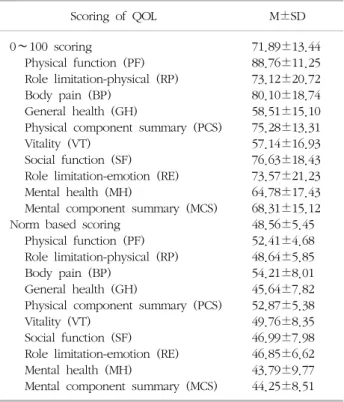
Table 3. The quality of life of living kidney donors (n=69)
Scoring of QOL M±SD
0∼100 scoring
Physical function (PF) Role limitation-physical (RP) Body pain (BP)
General health (GH)
Physical component summary (PCS) Vitality (VT)
Social function (SF) Role limitation-emotion (RE) Mental health (MH)
Mental component summary (MCS) Norm based scoring
Physical function (PF) Role limitation-physical (RP) Body pain (BP)
General health (GH)
Physical component summary (PCS) Vitality (VT)
Social function (SF) Role limitation-emotion (RE) Mental health (MH)
Mental component summary (MCS)
71.89±13.44 88.76±11.25 73.12±20.72 80.10±18.74 58.51±15.10 75.28±13.31 57.14±16.93 76.63±18.43 73.57±21.23 64.78±17.43 68.31±15.12 48.56±5.45 52.41±4.68 48.64±5.85 54.21±8.01 45.64±7.82 52.87±5.38 49.76±8.35 46.99±7.98 46.85±6.62 43.79±9.77 44.25±8.51
문항에 건강상태의 변화(health change)에 대한 문항이추가되어 총 36문항으로 구성되어 있다. 이 8개 항목은 다시 2개의 상위 개념인 신체적 건강 요약하지(physical component summary)와 정신적 건강 요약하지(mental component summary)로 나누어 분석하였다.
SF-36을 점수화하는 방법은 크게 2가지로 각 문항을 0
∼100점으로 점수화하여 같은 항목별로 합산한 후 0에서 100점으로 평균 점수화하는 방법(0∼100 scoring)과 norm based scoring 방법이 있다. Norm based scoring 방법은 모든 8개 항목에서 평균 50, 표준편차 10이 되도록 변형 한 점수로 50보다 작으면 미국의 일반인보다 삶의 질 수 준이 낮음을 의미하고 50보다 크면 삶의 질 수준이 높음 을 의미한다. 0∼100 scoring 방법의 경우 점수가 높을수 록 삶의 질이 높은 것을 의미한다. 본 연구에서 Cron- bach’s α값은 .93이었다.
3) 통계
결과 분석을 위해 SPSS 17.0 통계 프로그램을 통해 분 석하였다. 공여자의 일반적 특성과 제공 관련 특성은 빈 도와 백분율, 삶의 질은 평균과 표준편차, 일반적 특성과 제공 관련 특성에 따른 삶의 질의 차이는 T-test, ANOVA 를 이용하였다. 사후검정은 Scheffe’s test를 시행하였다.
결 과
1) 일반적인 특성
생체 신장이식 공여자는 여자가 42명(60.9%), 평균연 령은 45.4±12.0세이고, 가장 많은 연령층은 30∼49세 (55.1%)이다. 수혜자와의 관계는 형제자매 20명(29%), 부모 17명(24.6%), 배우자 13명(18.8%) 순이었으며, 혈 연간 45명(65.2%), 비혈연간 24명(34.8%)으로 구분된다.
수술 방법은 모두 open nephrectomy이며, 결혼 여부는 기혼자가 50명(72.5%), 미혼자가 15명(21.7%), 그 외 이 혼, 사별 등이 4명(5.7%)이었다. 최종 학력은 고등학교 졸업이 29명(42.0%), 대학교 졸업 이상 21명(30.4%), 중 학교 졸업 이하가 18명(26%)이었다. 종교는 기독교가 25 명(36.2%)으로 가장 많았고, 종교가 없는 경우 24명 (34.8%), 불교 16명(23.2%), 천주교 4명(5.8%)순이었다.
수입원으로는 본인이 33명(47.8), 배우자가 30명(43.5%) 순으로 나타났으며, 총수입은 200만원 이상∼300만원 이 하인 경우가 21명(30.4%)으로 가장 많았다(Table 1).
2) 신장 기증 후 신체적 상태
신장 기증 수술 시점을 기준으로, 수술 경험이 없는 경
우가 58명(84.1%)으로 대부분이었고, 수술 경험이 있는 경우는 평균 209.73개월 전에 수술 받은 것으로 나타났 다. 수술의 이유는 충수돌기염 3예, 위암 2예, 제왕절개, 자궁 외 임신, 난소제거술, 외상이 1예씩이었다.
기증 후 병원, 약국을 방문할 정도의 어떤 신체적 문제 점이 있었는가에 21명(30.4%)이 증상이 있었다고 응답했 다. 그 이유로는 소화 장애 및 복통이 4예로 가장 많았 고, 피로가 3예, 감기증상이 2예, 신장염증, 단백뇨, 요로 결석, 침샘 혹 제거, 산부인과 치료, 고지혈증 및 지방간, 당뇨, 두통이 1예씩 있었다(Table 2).
3) 신장 기증 후 정신-사회적 상태
주관적인 건강상태, 보람, 후회, 만족도 등의 정신적인 상태와 일상생활로의 복귀, 수혜자와의 관계 등에 대한 사회적인 상태로 구분하였다.
공여자의 67명(97.1%)은 신장 기증을 본인 스스로 결정 하였으며, 가족의 권유가 1명(1.4%)으로 나타났다. 설문시 점에서 공여자 64명(92.8%)은 신장 기증에 대하여 보람을 느꼈다고 답했으며, 보람을 느끼지 못한 경우가 4명(5.8%) 으로 나타났다. 보람을 느끼지 못했다고 대답한 4명은 수 술 후 자신이 느끼는 건강상태가 나쁘다고 답했고(1명), 또한 수혜자의 이기적인 태도(1명), 당연히 기증해야 한다 고 생각하는 수혜자의 태도(1명)로 서술하였다. 신장 제공
Table 4. Difference of QOL according to general characteristics of donor (n=69)
Item Characteristics
PF RP BP GH
M±SD torF M±SD torF M±SD torF
(scheffe) M±SD torF Sex
Age (yrs)
Marriage
Education
Religion
Income source
Gross income
Man Woman
<29 30∼49 50>
Unmarried Married Divorce
Separation by death Elementary school
aMiddle school
bHigh school
cJunior college
dCollege
eGraduate school
fCatholic Christian Buddhism No religion Oneself Spouse Parent Offspring Etc.
<1 million won 1 million∼
2 million won 2 million∼
3 million won 3 million∼
4 million won
>4 million won
89.25±11.15 88.29±11.54 94.00±6.51 89.32±8.83 86.73±14.62
89.00±8.90 88.46±11.73
98.33±2.88 65 84.54±16.34
95.00±6.45 90.00±7.69 89.00±9.61 88.92±10.95 87.5±10.60 90.00±8.16 90.83±10.80
85.62±8.53 88.33±13.72 91.25±11.07 87.33±10.80 86.25±12.5
65 80 83.75±22.86 87.66±11.31 89.76±8.163 88.57±12.77 89.64±11.17
.084 .998
2.327
.927
.694
1.904
.281
77.31±25.66 69.79±20.60 83.75±22.36 72.36±16.86 71.15±25.06 76.25±14.79 71.50±21.36 89.58±18.04
31.25 63.06±27.16 70.53±20.32 77.80±17.88 68.75±13.97 78.57±17.28 53.12±4.41 62.50±14.43 78.75±20.42 70.31±19.43 69.79±21.78 78.59±19.64 66.87±19.29 79.68±23.59
31.25 68.75 73.43±33.99 67.57±23.18 73.80±13.34 71.87±21.61 77.67±23.08
.056 .791
2.356
1.635
1.291
2.641*
.458
82.03±17.32 78.86±19.92 67.00±30.58 79.93±17.99 82.88±17.27 76.50±19.86 81.15±18.83 89.16±10.10
55 72.50±16.46 78.21±20.08 84.56±17.51 76.50±17.73 86.78±14.55 38.75±22.98 88.75±22.50 84.40±15.44 76.71±20.01 76.45±20.56 80.98±17.30 79.50±21,043
83.75±14.21 55 80 81.25±22.50 72.96±22.27 86.66±13.83 78.03±15.93 80.17±22.13
.014 1.510
1.055
3.626**
(f<c,e)
1.191
.490
1.271
58.51±18.01 61.66±15.64 54.00±9.61 60.52±14.69 61.53±20.03 56.33±14.07 61.10±16.82 76.66±16.07
40 55.45±23.71
64.28±7.86 61.72±14.09
61.00±6.51 61.07±19.72 65.00±21.21 70.00±10.80 64.40±16.54 53.43±17.48 59.37±15.55 60.60±17.35 61.16±14.83 65.00±21.98
40 35 55.00±29.72 56.87±16.82 58.57±16.36 63.57±11.33 65.71±17.08
1.154 .429
1.872
.331
1.992
1.067
.833
Abbrebiations: QOL, quality of life; M, mean; PF, physical function; RP, role limitation-physical; BP, body pain; GH, general health;
VT, vitality; SF, social function; RE, role limitation-emotion; MH, mental health.
*
P<.05; **
P<.01.
에 대해 후회하는가에 대한 질문에 후회하지 않는 경우가 60명(87%), 7명(10.1%)이 후회했다고 답했다. 타인에게 신장 기증을 권유할 수 있는지에 대한 질문에는 45명 (65.2%)이 예라고 응답하였고, 타인에게 신장 기증을 권유 하지 않겠다고 답변한 이유로, 23명(33.3%) 중에서 수술 후 회복 과정에서의 통증 및 신체적 활동의 제한을 11명 (15.9%)이, 수혜자의 사망 또는 건강악화를 2명(2.9%)이 서술하였다. 기타 서술한 이유로 자신에게 결정하라고 한 다 1명, 불안 증상 1명, 부담감 1명으로 나타났다.
설문에 응답한 공여자 중 기증 전에 다니던 직장이나 학교생활에 복귀한 경우는 50명(72.5%), 복귀하지 않은
경우는 15명(21.7%), 무응답 4명(5.8%)으로 나타났다.
활동을 복귀하지 않은 이유로 서술한 경우 고령(1명), 몸 이 힘들어서 잠시 쉰 경우(1명), 복직의 어려움(1명)으로 나타났다. 신장 기증 후 수혜자와의 관계는 이전과 같다 52명(75.4%), 좋아졌다 14명(20.3%), 나빠졌다 1명(1.4%), 무응답 2명(2.9%)으로 나타났다(Table 2).
4) 신장 제공 후 삶의 질 측정
전체 삶의 질 점수는 100점을 기준으로 하였을 때 평 균 71.89±13.44점이었으며, 신체적 기능(PF)이 88.76점 으로 가장 높았으며, 신체통증(BP) 80.10점, 사회적 기능
Table 4. Continued
Item Characteristics
VT SF RE MH
M±SD torF M±SD torF M±SD torF M±SD torF
Sex Age (yrs)
Marriage
Education
Religion
Income source
Gross income
Man Woman
<29 30∼49 50>
Unmarried Married Divorce
Separation by death Elementary school
aMiddle school
bHigh school
cJunior college
dCollege
eGraduate school
fCatholic Christian Buddhism No religion Oneself Spouse Parent Offspring Etc.
<1 million won 1 million∼
2 million won 2 million∼
3 million won 3 million∼
4 million won
>4 million won
58.10±18.32 56.39±16.36 57.50±14.25 56.57±14.45 57.69±21.16 58.33±11.73 55.37±17.85 81.25±10.82
50 54.54±25.78 59.82±17.62 59.05±15.72 48.75±8.14 58.48±15.23 53.12±4.41 46.87±14.87 62.75±16.28 54.68±15.05 54.42±18.47 60.79±18.17 52.91±14.92 64.06±19.34
50 37.5 59.37±29.53 49.21±18.80 53.57±16.72 64.73±10.28 62.94±13.30
.249 .034
2.402
.421
1.755
1.414
2.392
77.77±18.45 75.30±18.43 75.00±23.38 75.00±16.66 78.36±20.17 76.66±15.57 76.27±18.79 87.50±12.50
37.5 70.45±24.54 75.00±16.13 80.80±16.48 72.50±18.54 76.78±16.88 50.00±0.0 65.62±15.72 82.00±16.16 76.66±19.40 71.87±19.24 82.95±15.87 69.82±18.15 75.00±17.67
37.5 87.5 90.62±6.25 72.65±21.51 73.80±17.18 82.14±16.04 74.28±18.34
.125 .264
1.945
1.471
1.784
3.727**
1.291
73.14±25.66 73.21±17.98 70.00±29.81 72.58±19.84 74.67±22.04 68.88±20.28 74.33±21.61 83.33±16.66
50 68.18±21.34 76.19±23.77 79.31±18.71 56.66±21.57 72.61±22.98 58.33±11.78 58.33±20.41 81.66±19.39 67.18±21.61 70.83±20.55 79.79±22.34 68.88±17.08 58.33±28.86
50 66.66 83.33±23.57 71.35±24.52 67.46±20.90 75.00±18.49 79.16±17.26
5.488*
.133
.882
1.504
2.719
2.054
.948
64.88±18.21 64.16±16.88 62.00±18.90 64.34±17.13 65.00±17.88 61.33±12.60 64.10±17.91 90.00±5.00
50 59.09±23.00 64.28±12.05 66.89±18.53 58.00±11.51 67.50±14.90 60.00±7.07 51.25±26.25 70.00±13.91 65.31±16.77 60.20±18.02 69.84±15.58 59.16±17.37 58.75±21.74
50 80 58.75±16.52 62.50±19.23 59.28±16.97 72.85±14.50 67.50±16.61
.416 .062
2.790*
.557
2.248
2.121
1.622
Abbrebiations: QOL, quality of life; M, mean; PF, physical function; RP, role limitation-physical; BP, body pain; GH, general health;
VT, vitality; SF, social function; RE, role limitation-emotion; MH, mental health.
*
P<.05; **
P<.01.
(SF) 76.63점, 감정적 역할제한(RE) 73.57점, 신체적 역 할제한(RP) 73.12점, 정신건강(MH) 64.78점, 일반적 건 강(GH) 58.51점, 활력(VT) 57.14점의 순으로 나타났다.
한편, 삶의 질 점수를 미국 일반 시민의 삶의 질 수준 을 50으로 하였을 때 상대적인 점수를 나타내는 norm based score로 전환하였을 때 평균 48.56±5.45점이었으 며, 신체적 측면은 52.87점, 정신적 측면은 44.25점으로 나타나 신장 공여자는 일반인에 비해 정신적 건강 측면 에 대한 삶의 질이 더 낮은 것으로 나타났다(Table 3).
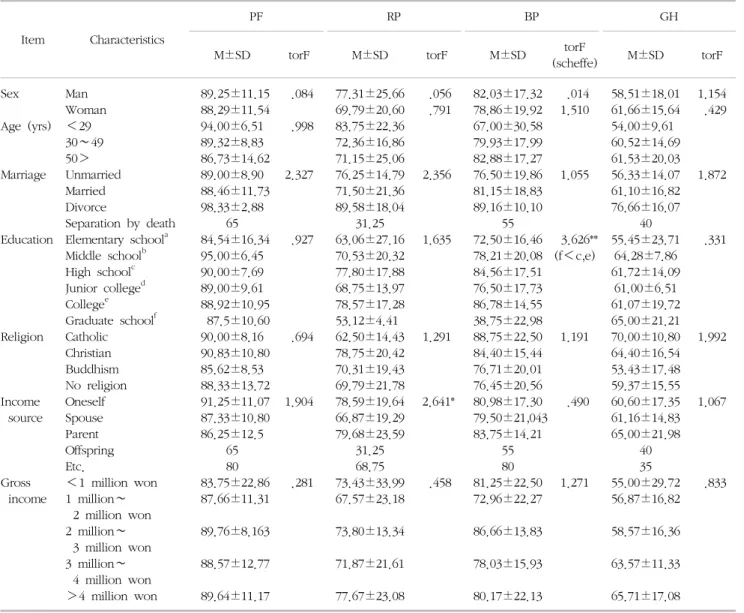
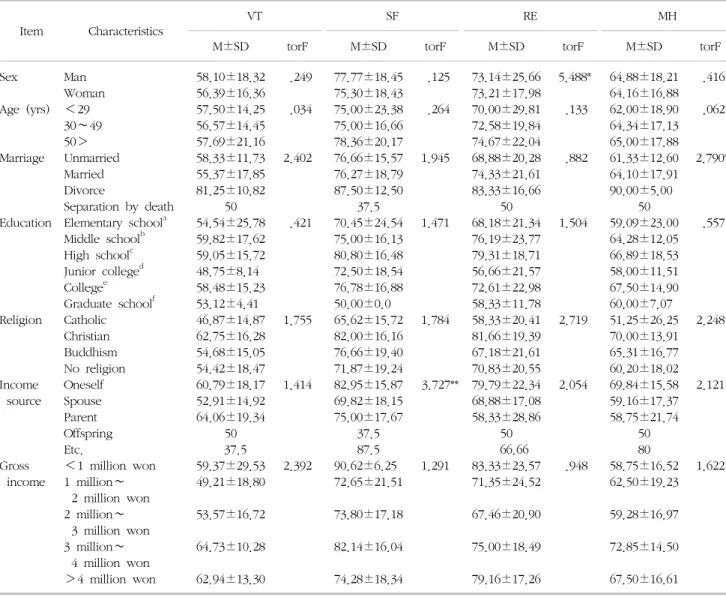
일반적 특성에 따른 삶의 질 차이는 다음과 같다 (Table 4). 성별에 따라 감정적 역할제한에 유의한 차이 (F=5.488, P=.022)가 있었으며, 결혼상태에 있어서는 이
혼한 경우에서 감정적 역할제한 점수가 유의하게 높은 것(F=2.790, P=.047)으로 나타났다. 학력은 대학원졸이 고졸이나 대졸보다 신체 통증이 유의하게 낮았으며 (F=3.626, P=.006), 수입원에 따라 신체적 역할제한(RP) 영역(F=2.641, P=.042), 사회적 기능(SF) 영역(F=3.727, P=.009)에 유의한 차이가 있는 것으로 나타났다.
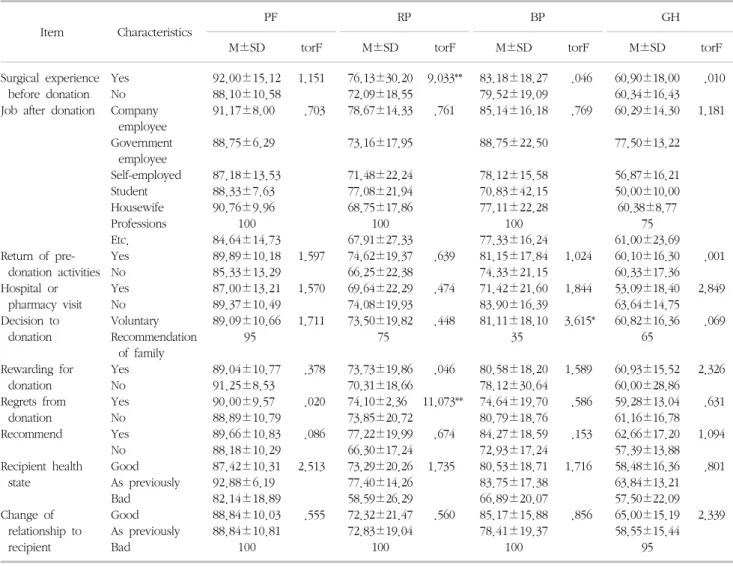
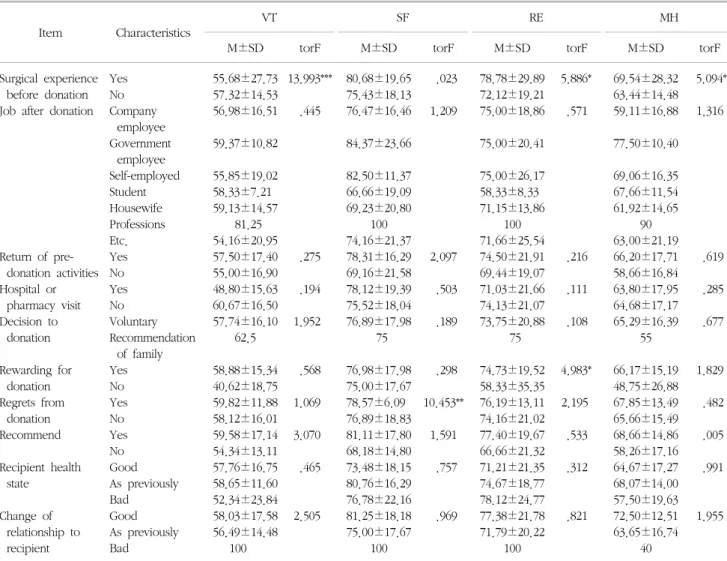
제공 관련 특성에 따른 삶의 질 차이는 다음과 같다 (Table 5). 수술 경험에 따른 신체적 역할제한(t=9.033, P=.004), 활력(t=13.993, P=.000), 감정적 역할제한(t=
5.886, P=.018), 정신적 건강(t=5.094, P=.027) 점수에 유 의한 차이가 있는 것으로 나타났다. 제공 결정에 따른 신 체 통증에도 유의한 차이(t=3.615, P=.032)가 있었으며,
Table 5. Difference of QOL according to donation characteristics of donor (n=69)
Item Characteristics
PF RP BP GH
M±SD torF M±SD torF M±SD torF M±SD torF
Surgical experience before donation Job after donation
Return of pre- donation activities Hospital or
pharmacy visit Decision to
donation Rewarding for
donation Regrets from
donation Recommend Recipient health
state Change of
relationship to recipient
Yes No Company
employee Government
employee Self-employed Student Housewife Professions Etc.
Yes No Yes No Voluntary Recommendation
of family Yes No Yes No Yes No Good As previously Bad Good As previously Bad
92.00±15.12 88.10±10.58 91.17±8.00 88.75±6.29 87.18±13.53 88.33±7.63 90.76±9.96
100 84.64±14.73 89.89±10.18 85.33±13.29 87.00±13.21 89.37±10.49 89.09±10.66
95 89.04±10.77 91.25±8.53 90.00±9.57 88.89±10.79 89.66±10.83 88.18±10.29 87.42±10.31 92.88±6.19 82.14±18.89 88.84±10.03 88.84±10.81
100
1.151 .703
1.597 1.570 1.711
.378 .020 .086 2.513
.555
76.13±30.20 72.09±18.55 78.67±14.33 73.16±17.95 71.48±22.24 77.08±21.94 68.75±17.86
100 67.91±27.33 74.62±19.37 66.25±22.38 69.64±22.29 74.08±19.93 73.50±19.82
75 73.73±19.86 70.31±18.66 74.10±2.36 73.85±20.72 77.22±19.99 66.30±17.24 73.29±20.26 77.40±14.26 58.59±26.29 72.32±21.47 72.83±19.04
100
9.033**
.761
.639 .474 .448
.046 11.073**
.674 1.735
.560
83.18±18.27 79.52±19.09 85.14±16.18 88.75±22.50 78.12±15.58 70.83±42.15 77.11±22.28
100 77.33±16.24 81.15±17.84 74.33±21.15 71.42±21.60 83.90±16.39 81.11±18.10
35 80.58±18.20 78.12±30.64 74.64±19.70 80.79±18.76 84.27±18.59 72.93±17.24 80.53±18.71 83.75±17.38 66.89±20.07 85.17±15.88 78.41±19.37
100
.046 .769
1.024 1.844 3.615*
1.589 .586 .153 1.716
.856
60.90±18.00 60.34±16.43 60.29±14.30 77.50±13.22 56.87±16.21 50.00±10.00 60.38±8.77
75 61.00±23.69 60.10±16.30 60.33±17.36 53.09±18.40 63.64±14.75 60.82±16.36
65 60.93±15.52 60.00±28.86 59.28±13.04 61.16±16.78 62.66±17.20 57.39±13.88 58.48±16.36 63.84±13.21 57.50±22.09 65.00±15.19 58.55±15.44
95
.010 1.181
.001 2.849 .069
2.326 .631 1.094 .801
2.339
Abbrebiations: QOL, quality of life; M, mean; PF, physical function; RP, role limitation-physical; BP, body pain; GH, general health;
VT, vitality; SF, social function; RE, role limitation-emotion; MH, mental health.
*
P<.05, **
P<.01, ***
P<.001.
기증 보람에 따른 감정적 역할제한(t=4.983, P=.029), 기 증 후회 여부에 따라서는 신체적 역할제한(t=11.073, P=.001), 사회적 기능(t=10.453, P=.002)에 유의한 차이 가 있는 것으로 나타났다.
고 찰
신장이식은 만성신부전 환자의 생존율과 삶의 질을 증 진시키는 결과를 기대할 수 있는 최선의 방법이지만, 공 여자는 장기 제공으로 인한 신체적, 정신적 부담감을 안 고 살아가야 한다. 그러나 기존 연구의 대부분이 신장이 식 또는 수혜자를 대상으로 하고 있어 공여자의 삶의 질 을 파악하는 연구는 부족한 실정이다. 이에 본 연구는 공 여자의 삶의 질 수준과 삶의 질에 영향을 미치는 변수를
파악함으로써 제공 전 후 관리 프로그램 개발의 기초자 료로 활용하며, 궁극적으로는 공여자의 삶의 질 증진에 기여하고자 하였다.
본 연구에서 공여자의 삶의 질 점수는 100점을 기준으 로 하였을 때 평균 71.89±13.44점이었으며, 미국 일반 시민의 삶의 질 수준을 50으로 하였을 때 상대적인 점수 를 나타내는 norm based score로 전환하였을 때 평균 48.56±5.45점이었으며, 신체적 측면은 52.87점으로 평 균 이상의 점수를 나타내고 있는 바, 생체 신장이식 후 공여자 대부분은 원활한 신체적 활동 복귀를 보이고 있 는 것으로 생각된다. 하지만, MJøen 등(8)의 보고에 의하 면 표본수가 적고 단일기관 연구에서는 삶의 질 점수가 다소 높게 측정되는 경우가 있다고 하였음을 감안할 때 표본수를 확대한 반복연구가 필요하겠으며, 국내에서는
Table 5. Continued
Item Characteristics
VT SF RE MH
M±SD torF M±SD torF M±SD torF M±SD torF
Surgical experience before donation Job after donation
Return of pre- donation activities Hospital or
pharmacy visit Decision to
donation Rewarding for
donation Regrets from
donation Recommend Recipient health
state Change of
relationship to recipient
Yes No Company
employee Government
employee Self-employed Student Housewife Professions Etc.
Yes No Yes No Voluntary Recommendation
of family Yes No Yes No Yes No Good As previously Bad Good As previously Bad
55.68±27.73 57.32±14.53 56.98±16.51 59.37±10.82 55.85±19.02 58.33±7.21 59.13±14.57
81.25 54.16±20.95 57.50±17.40 55.00±16.90 48.80±15.63 60.67±16.50 57.74±16.10
62.5 58.88±15.34 40.62±18.75 59.82±11.88 58.12±16.01 59.58±17.14 54.34±13.11 57.76±16.75 58.65±11.60 52.34±23.84 58.03±17.58 56.49±14.48
100
13.993***
.445
.275 .194 1.952
.568 1.069 3.070 .465
2.505
80.68±19.65 75.43±18.13 76.47±16.46 84.37±23.66 82.50±11.37 66.66±19.09 69.23±20.80
100 74.16±21.37 78.31±16.29 69.16±21.58 78.12±19.39 75.52±18.04 76.89±17.98
75 76.98±17.98 75.00±17.67 78.57±6.09 76.89±18.83 81.11±17.80 68.18±14.80 73.48±18.15 80.76±16.29 76.78±22.16 81.25±18.18 75.00±17.67
100
.023 1.209
2.097 .503 .189
.298 10.453**
1.591 .757
.969
78.78±29.89 72.12±19.21 75.00±18.86 75.00±20.41 75.00±26.17 58.33±8.33 71.15±13.86
100 71.66±25.54 74.50±21.91 69.44±19.07 71.03±21.66 74.13±21.07 73.75±20.88
75 74.73±19.52 58.33±35.35 76.19±13.11 74.16±21.02 77.40±19.67 66.66±21.32 71.21±21.35 74.67±18.77 78.12±24.77 77.38±21.78 71.79±20.22
100
5.886*
.571
.216 .111 .108
4.983*
2.195 .533 .312
.821
69.54±28.32 63.44±14.48 59.11±16.88 77.50±10.40 69.06±16.35 67.66±11.54 61.92±14.65
90 63.00±21.19 66.20±17.71 58.66±16.84 63.80±17.95 64.68±17.17 65.29±16.39
55 66.17±15.19 48.75±26.88 67.85±13.49 65.66±15.49 68.66±14.86 58.26±17.16 64.67±17.27 68.07±14.00 57.50±19.63 72.50±12.51 63.65±16.74
40
5.094*
1.316
.619 .285 .677
1.829 .482 .005 .991
1.955
Abbrebiations: QOL, quality of life; M, mean; PF, physical function; RP, role limitation-physical; BP, body pain; GH, general health;
VT, vitality; SF, social function; RE, role limitation-emotion; MH, mental health.
*
P<.05; **
P<.01; ***
P<.001.
일반인의 건강관련 삶의 질 수준의 평가가 제대로 되어 있지 않아 객관적으로 평가하기에는 무리가 있어 추후 이에 대한 연구가 요구된다(7).
연구결과에서 공여자의 대부분이 신장 기증에 대해 보 람을 느끼고, 자발적으로 결정하였음에도 타인에게 신장 기증을 권유하지 않겠다고 답변한 이유로 수술 후 회복 과정에서의 통증 및 신체적 활동 제한을 선택한 것으로 보아, 수술 전 후 적절한 정보제공을 통해 공여자의 불안 감 및 통증을 감소시키는 자가관리 교육 프로그램이 필 요하다는 것을 알 수 있다. 이는 다른 제공 예정자에게 기증 결정을 하는데도 도움을 줄 뿐만 아니라 외국의 사 례처럼 생체 장기기증자 모임과 같은 지지 그룹을 통해 공여자 스스로 정보를 공유하고 다양한 지지 체계를 경 험하도록 하는 프로그램 활성화에도 기여할 것이다.
이 외에도 Lima 등(9)이 공여자의 수술 후 합병증으로 제공신장 적출술로 인한 창상감염, 요로감염, 혈전정맥염 등을 제시하고 있으므로 자가관리 교육 프로그램에는 이 러한 내용들을 모두 내포하고 있어야 하겠다.
본 연구에서 공여자의 삶의 질 점수 중 정신적 측면은 44.25점으로 나타나 신장 공여자는 일반인에 비해 정신 적 건강 측면에 대한 삶의 질이 더 낮음을 알 수 있다.
사회심리적 측면에서 공여자는 한 개의 신장으로 인생 을 살아가야 하는 부담감, 우울, 실망감 등이 흔히 나타 나는 증상으로 보고되고 있으며(10-14), 장기기증 실패 또는 수혜자 사망시 기증한 것을 후회하는 반응이 증가 한다(6)는 연구보고들은 본 연구결과를 지지해준다.
한편, 공여자는 수혜자가 건강을 회복할 수 있도록 기 여했다는 점에서 매우 긍정적인 심리적 경험을 갖게 된
다(15-20)는 보고가 있으며, 공여자에게 이러한 점을 부 각시킨 정서지지가 이루어진다면 장기기증에 대한 값진 의미를 되새김으로서 정신적 삶의 질을 증진시킬 수 있 을 것이다.
본 연구는 신장이식 공여자의 수술 후 삶의 질 수준을 조사한 것으로 수술 전 후의 삶의 질의 변화에 대한 정 보를 알 수 없었다. 이에 적절한 도구 개발을 통해 수술 전 공여자의 심리 상태와 삶의 질을 측정하여, 신장 기증 이 그들의 삶의 질에 어떤 영향을 미치는 지를 파악하고, 장기적인 신장 공여자의 삶의 질 관리가 이루어져야 할 것이다.
결 론
생체 신장이식 후 대부분의 공여자는 신장 기증에 대 해 보람을 느끼고 원활한 신체적 활동 복귀를 보였으며, 그들의 삶에 대해 만족하였다. 그러나 신장 공여자는 일 반인에 비해 정신적 건강 측면에 대한 삶의 질 수준은 낮은 것으로 나타났다. 이에 수술 전 공여자의 심리 상태 를 정밀하게 검토하고 삶의 질을 측정하여, 신장 제공이 그들의 삶의 질에 어떤 영향을 미치는 지를 파악하여야 한다고 생각한다. 또한 생체 신장이식 공여자에게 수술 전 교육과 상담 뿐만 아니라 수술 후 체계적이고 지속적 인 검진과 삶의 질 관리가 필요할 것으로 생각한다. 따라 서 향후 다기관 연구를 통해 보다 많은 공여자를 대상으 로 생체 신장 공여자의 안정성을 입증하고, 수술 전 후 공여자를 체계적으로 관리하는 표준화된 프로그램의 마 련이 필요하다고 생각한다.
REFERENCES