• 검색 결과가 없습니다.

The Effects of Repeated Passive Movement of Different Velocities on Knee Joint Position Sense in Patients With Post-Stroke Hemiplegia

N/A
N/A
Protected

Academic year: 2021

Share "The Effects of Repeated Passive Movement of Different Velocities on Knee Joint Position Sense in Patients With Post-Stroke Hemiplegia"

Copied!
7
0
0

로드 중.... (전체 텍스트 보기)

전체 글

(1)

The Effects of Repeated Passive Movement of Different Velocities on Knee Joint Position Sense in Patients With Post-Stroke Hemiplegia

Su-jin Jo

1

, BHSc, PT, Jong-duk Choi

2

, PhD, PT

1Dept. of Physical Therapy, The Graduate School, Daejeon University,

2Dept. of Physical Therapy, College of Natural Science, Daejeon University

Abstract 1)

The aim of this study was to examine the effects of repeated passive movement (RPM) of different velocities on the improvement of knee joint position sense (JPS) in post-stroke patients with hemiplegia, thereby investigate the possibility of clinical application in the initial stage of rehabilitation for patients with post-stroke hemiplegia. Thirteen hemiplegic patients participated in this study. For the subjects’ knee JPS tests, a passive angle reproduction test and an active angle reproduction test were performed prior to and after the intervention, which involved 30 repetitions of passive full-range-of-motion flexion and extension exercise of the knee joints at randomized degrees of 0°/s, 45°/s, and 90°/s. Paired t-test analysis was done in order to compare changes in the pre- and post-intervention knee JPS. One-way repeated analysis of variance was used in order to compare changes in JPS after intervention at three different movement velocities. The level of significance was set at .05. The result was that the subjects’

post-intervention knee JPS significantly improved after the RPM exercise at a 45°/s and a 90°/s relative to the RPM exercise 0°/s (p<.05). JPS changes with RPM intervention at the rapid velocity of 90°/s were most increased, suggesting the most effective enhancement in knee JPS is with intervention at the velocity (p<.05). Therefore, RPM intervention at a half or higher velocity improved stroke patients’ knee JPS. During the initial stage of rehabilitation for patients with post-stroke hemiplegia, the efficient application of the RPM exercise at a half or higher velocity will be possible.

[Su-jin Jo, Jong-duk Choi. The Effects of Repeated Passive Movement of Different Velocities on Knee Joint Position Sense in Patients With Post-Stroke Hemiplegia. Phys Ther Kor. 2012;19(3):98-104.]

Key Words: Joint position sense; Passive movement; Stroke.

Introduction

Post-stroke hemiplegic patients have various types of sensory impairment, and have tactile, protective reaction, and proprioception problem. Proprioceptive impairment causes joint instability and decreases joint mobility. The resulting reduction in postural control increases postural sway by external stimuli and decreases balance (Docherty et al, 2004; Lephart and Fu, 2000).

Proprioception refers to the superficial receptors’

and the mechanoreceptors’ provision of information

about the position and movement of bones and joints in space (Lephart and Fu, 2000). It is an essential element for activities in daily living, such as walking and running (Beynnon et al, 1999). Proprioception in- cludes joint position sense (JPS) and kinesthesia. JPS is the capability of recognizing and reproducing in- formation about the position of a joint, and it in- cludes parameters such as velocity, size, and direc- tion (Lord et al, 1991; Riemann and Lephart, 2002). It also helps joint stability, and therefore may protect the body from impairment (Jerosch and Prymka, 1996).

Corresponding author: Jong-duk Choi [email protected]

(2)

Variable Mean±SD / Number Range

Age (yr) 60.1±10.7 42∼77

Disease duration (month) 7.4±5.5 1∼20

Gender (Male / Female) 8/5

Cause (Hemorrhage / Infarction) 3/10

Plegic side (Rt / Lt) 4/9

Table 1. Characteristics of the subjects (N=13)

Diverse factors, such as age, temperature, exercise, impairment, and disease, affect JPS (Marks and Quinney, 1993; Uchio et al, 2003). Exercise increases in elasticity of muscle tissue and facilitates the supply of oxygen. It also heightens body temperature and improves the sensitivity of mechanoreceptors, thereby positively influencing JPS (Bouet and Gahery, 2000). However, excessive exercise generates metabolites through the direct action of muscle spin- dles, disables afferent feedback, and causes fatigue of the body. This may adversely affect proprioception (Marks and Quinney, 1993).

Passive movement is unrestricted movement by external force, without voluntary muscle contraction.

The most vital purpose of passive movement is to reduce problems resulting from immobility. It also maintains the mechanical elasticity of the muscles and helps blood circulation. Another important func- tion of passive movement is to aid patients in main- taining their position sense and their ability to rec- ognize movement, which are proprioceptive senses. In a recent study, Friemert et al (2006) observed that repeated passive movement (RPM) intervention after anterior cruciate ligament (ACL) reconstruction im- proved knee JPS. Baek et al (2009) reported that RPM enhportd shoulder position sense in hemiplegic patients. Ju et al (2010) noted that RPM more pos- itively influenced knee JPS than repeated active movement and fatigue exercise in normal subjects. In a JPS test after RPM at rapid velocities of 90°/s and 150°/s, error scores significantly decreased. However, previous studies mostly involved normal subjects.

Research on the effects of RPM intervention on hemiplegic patients with proprioceptive problems is lacking, and research on the effects of RPM inter-

vention, at different movement velocities, on the knee JPS level of the affected side of hemiplegic patients has been rare.

Accordingly, the aims of the present study are as follows: first, to investigate the effects of RPM on the knee JPS of post-stroke hemiplegic patients; sec- ond, to examine the most effective movement veloc- ity for RPM. As a results, to examine the possibility of the clinical application of RPM intervention in the initial stage of the rehabilitation protocol for patients with post-stroke hemiplegia.

Methods

Subjects

The subjects were 13 hemiplegic patients diag-

nosed and hospitalized with post-stroke hemiplegia

and under treatment at Y hospital, located in

Daejeon. Only patients who understood the purposes

and content of the present study and consented to

voluntarily participate were included. The criteria for

inclusion in this study were: a mini-mental status

examination score of 25 points or higher, with no

cognitive problems; have not excessive muscle tone,

with one grade or less in the modified Ashworth

scale; a manual muscle test result of grade 3 or

higher for the knee joint extensor muscles; the abil-

ity to maintain a standing position for at least ten

seconds; and being capable of walking ten meters in

50 to 60 seconds (Baek et al, 2009). Those who had

knee impairment or disease, or a history of surgical

operation within six months (apart from stroke-re-

lated problems), were excluded. Table 1 shows the

general characteristics of the subjects.

(3)

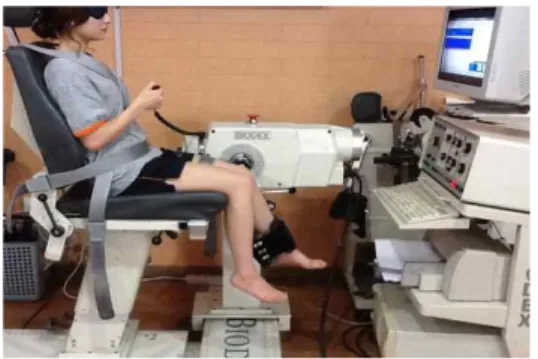
Figure 1. Knee joint position sense testing with isometric dynamometer.

Instruments and Measurement

2)

In order to estimate JPS, joint angles were meas- ured with an isokinetic dynamometer

1)

in a proprio- ception test program. The subjects were seated in a comfortable position; the back was fully supported by a backrest, with the lower limbs hanging freely over the side of the metal frame. They were blind- folded to prevent them from receiving feedback from visual sensory channels faster than proprioception.

The subjects were given the control box and in- structed to press the on/off switch when they per- ceived movement of the lower extremity being test- ed (Figure 1).

Knee JPS was measured via passive angle re- production (PAR) and active angle reproduction (AAR) testing error scores. The order of performing the two tests was determined by each subject. PAR test was initiated with the knee flexed at 90°. The subjects’ movement was passively provided at 2°/s, as measured by an isokinetic dynamometer (BIODEX), and stopped at a random target angle (an extension angle between 0° and 70°). They re- membered their target angle and maintained the po- sition for five seconds. After resting for ten seconds in the starting position, they reproduced the move- ment angle that had been passively provided. After a 20-second rest, a different target angle was pro- vided, and the same procedure was repeated.

Measurements were made at three random target angles and absolute error scores were calculated.

AAR was evaluated via the subject's ability to re- produce a specific knee angle that had been ran- domly selected among the extension angles between 10° and 70°. Subjects moved the knee toward the target extension angle and maintained the position for five seconds. After a resting time of ten sec- onds, they returned to the starting position and re- produced the knee extension at the same target angle. Three different target angles were provided, with a resting time of 20 seconds between them, and the evaluations were completed, as before. Each

given angle was tested only once in order to avoid a learning effect during the measuring process.

Intervention

Three different velocity on knee flexion and ex- tension RPM were applied to the subjects. The movement velocities were 0°/s, 45°/s, and 90°/s. This velocity was used in prior studies by selecting from a slow speed (0°/s) and fast speed (90°/s)(Ju et al, 2011). In addition, our study used speed of 45°/s be- tween 0°/s and 90°/s. RPM intervention was full range of flexion & extension passive movement of the knee for 30 times by an isokinetic dynamometer (BIODEX). Slightly different intervention times de- pendent on movement velocity, the average inter- vention time was 100 second. In the case of RPM at 0°/s, a rest of five minutes was provided after pre-intervention test. 0°/s at RPM was no inter- vention, investigated the effect of RPM.

Procedures

In a random sequence, one of the three inter- ventions was provided each day. The order was de- termined by selecting a paper from among three-col- ored papers in a pocket. A red paper, a blue paper, and a yellow paper represented 0°/s, 45°/s, and 90°/s, respectively. Pre-intervention knee JPS was evaluated by the PAR and AAR. The two evaluations were made after the intervention, and absolute error scores were calculated before and after the intervention.

1) BIODEX, medical systems INC., New York, U.S.A.

(4)

Group Pre-RPM

a

Post-RPM p

No Intervention 6.87±3.69

b

7.74±5.05 .297

45°/s 9.33±8.82 5.48±4.99 .008

90°/s 8.83±4.65 5.03±3.94 .000

a

repeated passive movement,

b

Mean±SD, *p<.05.

Table 2. A comparison of JPS in PAR test between pre & post RPM intervention according to velocity (Unit: °)

Group Pre-RPM

a

Post-RPM p

No Intervention 4.72±3.44

b

4.05±2.27 .399

45°/s 3.97±1.05 2.61±1.4 .002

90°/s 5.29±2.77 3.01±1.07 .003

a

repeated passive movement,

b

Mean±SD, *p<.05.

Table 3. A comparison of JPS in AAR test between pre & post RPM intervention according to velocity (Unit: °)

JPS

a

test No intervention 45°/s 90°/s F

PAR

b

-3.39±38.96

d

44.44±20.10 44.93±19.39 10.661*

AAR

c

-13.63±37.99 29.36±41.79 37.12±22.01 6.444*

a

joint position sense,

b

passive angle reproduction.

c

active angle reproduction,

d

Mean±SD, *p<.05.

Table 4. A comparison of JPS changes as RPM velocity (Unit: %)

Statistical Analysis

All data were analyzed using SPSS ver. 18.0 stat- istical software. A paired t-test was used to compare the pre-and post-intervention error scores. A one-way repeated ANOVA was done to compare the results (JPS changes) of different movement velocities.

Post-hoc Bonferroni tests were performed when stat- istical significances existed. The level of significance was set as α=.05.

Results

1. Effects of repeated passive movement at different movement velocities on pre­ and post­

intervention JPS

There were no significant changes between pre-intervention JPS and post-intervention JPS at 0°/s (p=.297), but there were significant changes at 45°/s and 90° (p=.008, p<.001) in the PAR test (Table 2). There were no significant changes be-

tween pre-intervention JPS and post-intervention JPS at 0°/s (p=.399), but there were significant changes at 45°/s and 90°/s (p=.002, p=.003) in the AAR test (Table 3).

2. Effects of repeated passive movement at different movement velocities on pre­ and post­

intervention JPS changes

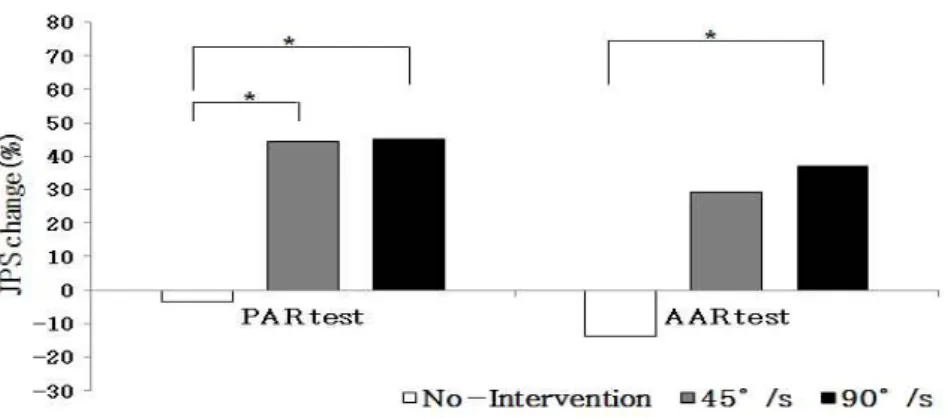
JPS changes were calculated by the equation: JPS changes (%)=(pre-intervention error scores – post-intervention error scores / pre-intervention error scores × 100). In the PAR test, JPS changes prior to RPM and after RPM were significantly different be- tween 0°/s and 45°/s and between 0°/s and 90°/s (p=.018, p=.009), but they were not significantly dif- ferent between 45°/s and 90°/s (p=1.000) (Table 4).

In the AAR test, JPS changes after RPM were sig-

nificant for movement velocity between 0°/s and

90°/s (p=.005), but they were not significant for

movement velocity between 0°/s and 45°/s or be-

tween 45°/s and 90°/s (p=.109, p=1.000) (Figure 2).

(5)

Figure 2. A comparison of JPS changes as RPM intervention (JPS:

joint position sense, PAR:passive angle reproduction, AAR: active angle reproduction)(*p<.05).

Discussion

Hemiplegic patients undergo JPS impairment; in other words, impairment of the function to deliver information about joint movement, position, direction, and velocity to the central nervous system. As a re- sult, they have a risk of decreased mobility, balance problems, and falls (Lephart and Fu, 2000).

This study applied RPM of knee flexion and ex- tension, at three different velocities, to post-stroke hemiplegic patients with JPS problems. We inves- tigate effect of velocity of RPM was selected for the three kind of velocity. The study of Ju et al (2011) used the slow velocity each of 0°/s, 2°/s and the rapid velocity each of 90°/s, 150°/s, so we select the velocity of 0°/s and 90°/s. And we used a half ve- locity of 45°/s that between 0°/s and 90°/s. 0°/s at RPM was no intervention, investigated the effect of RPM.

Compared to RPM at 0°/s, RPM at 45°/s and 90°/s significantly improved knee JPS. RPM at 90°/s, the most rapid of the three different velocities, was the most effective.

Periodical passive movement reduces muscle stiff- ness (McNair et al, 2002; Nordez et al, 2009) and provides warm-up effects, heightening body temper- ature and thereby increasing the sensitivity of cuta- neous receptors. It has been proposed that, as a con- sequence, passive moment improves the sensitivity of the movement sense and the position sense (Bouet

and Gahery, 2000; Kauranen and Vanharanta, 1997).

For this reason, the subjects of the present study saw their knee JPS improve after RPM intervention.

The present study results support the results of the following two studies. Friemert et al (2006) ob- served that knee JPS in patients with ACL re- construction improved, although the that were not statistically significant, after RPM. Baek et al (2009) reported that RPM intervention was effective in im- proving shoulder position sense in hemiplegic adults.

The present study applied RPM intervention, at three different velocities, to its subjects, and the knee JPS changes after intervention were highest at 90°/s. This result is consistent with the study by Ju et al (2011), where the knee JPS of healthy adults had statistically significant improvement at rapid ve- locities of 90°/s and 150°/s when compared to slow velocities of 0°/s and 2°/s. RPM at a rapid velocity would result in the stretch reflex at the knee-flexion and extension end range. Such a stretch reflex acti- vates the 1a afferent fibers of muscle spindles. The rubrospinal pathway and the rubro-bulbospinal pathway control the stimuli and help the output of the γ-motor system of muscle spindles, thereby en- hancing fusimotor activities. There is some evidence that improvement in proprioception results from in- creased fusimotor activities (Fitzpatrick and McCloskey, 1994).

However, knee JPS significantly changed after

RPM at 45°/s, as applied in the our study. Further,

(6)

in the PAR test, knee JPS changes were significant at 45°/s, relative to 0°/s. From this result, it can be inferred that RPM at 45°/s improved knee JPS. The velocity of 45°/s is not at a high enough level to trigger the stretch reflex. Nonetheless, the warm-up effects resulting from passive movement and full-range exercise would bring about activity in the joint receptors by stimulating them with compression at a knee-extension end range. It is thought that joint receptors would have been stimulated during repeated movement.

To measure JPS, the PAR and AAR tests, which had been employed in previous studies, were con- ducted (Callaghan et al, 2002). AAR test, one of two measurement methods, needs more integration proce- dure in neuromuscular system compared with PAR test. PAR test was reproduce the same angle that passively positioned by device without muscle contraction. Also, voluntary muscle contraction in AAR test stimulated to joint receptors, muscle spin- dle and Golgi tendon organ. Therefore participants may be more difficult in AAR test for accurate joint angle reproduction (Miura et al, 2004). Different score between PAR test and AAR test would be explained.

The our study is a crossover design study; it ap- plied a different intervention each day for three days and compared the results. A crossover design study performs experiments with the same subjects under different conditions, comparing the results. Using a crossover design study, the effects of variation dif- ferences on the results can be more effectively ex- cluded than when the subjects are divided into dif- ferent groups.

In order to exclude motor learning effects in the measurement process, three different angles were randomly selected for the two JPS tests. The order of the two test methods was randomly decided for each subject. The three interventions were applied to each subject according to the order of three colored papers selected from a pocket.

The limitations of the present study are as fol- lows: First, the number of repetitions was the same

for the three different velocities, and as a result the total time of intervention differed. This study failed to compare effects where the total time of inter- vention was equal. Second, the present study pre- sented the immediate effects of intervention;however, it is difficult to explain the long-term effects of re- peated passive movement on proprioception. Third, the subjects were hemiplegic patients, but their char- acteristics, degree of paralysis, and level of function were not the same, which may have influenced the result. And subjects affected other sensory input to the ankle cuff. Future research on the long term ef- fects of RPM intervention and on functional ability (gait, activities of daily living) at rapid velocity in post-stroke hemiplegic patients is considered necessary.

Conclusion

According to this study results, repeated passive movement at 45°/s and 90°/s was effective in im- proving post-stroke hemiplegic patients’ knee JPS, as compared to 0°/s (no intervention). Knee JPS changes with RPM were significant at the 45°/s and 90°/s. Therefore, RPM at a half velocity (45°/s) or higher can be was efficiently applied to enhance the JPS of patients with brain injuries during their initial stage of rehabilitation.

References

Baek JH, Kim JW, Kim SY, et al. Acute effect of repeated passive motion exercise on shoulder position sense in patients with hemiplegia: A pi- lot study. NeuroRehabilitation. 2009;25(2):101-106.

Beynnon BD, Ryder SH, Konradsen L, et al. The ef- fect of anterior cruciate ligament trauma and bracing on knee proprioception. Am J Sports Med. 1999;27(2):150-155.

Bouët V, Gahéry Y. Muscular exercise improves

(7)

This article was received May 3, 2012, was re- viewed May 3, 2012, and was accepted June 27, 2012.

knee position sense in humans. Neurosci Lett.

2000;289(2):143-146.

Callaghan MJ, Selfe J, Bagley PJ, et al. The effects of patellar taping on knee joint proprioception. J Athl Train. 2002;37(1):19-24.

Docherty CL, Arnold BL, Zinder SM, et al.

Relationship between two proprioceptive meas- ures and stiffness at the ankle. J Electromyogr Kinesiol. 2004;14(3):317-324.

Fitzpatrick R, McCloskey DI. Proprioceptive, visual and vestibular thresholds for the perception of sway during standing in humans. J Physiol.

1994;478(Pt 1):173-186.

Friemert B, Bach C, Schwarz W, et al. Benefits of active motion for joint position sense. Knee Surg Sports Traumatol Arthrosc. 2006;14(6):564-570.

Jerosch J, Prymka M. Knee joint proprioception in normal volunteers and patients with anterior cruciate ligament tears, taking special account of the effect of a knee bandage. Arch Orthop Trauma Surg. 1996;115(3-4):162-166.

Ju YY, Wang CW, Cheng HY. Effects of active fati- guing movement versus passive repetitive movement on knee proprioception. Clin Biomech.

2010;25(7):708-712.

Ju YY, Liu YC, Cheng HY, et al. Rapid repetitive passive movement improves knee proprioception.

Clin Biomech. 2011;26(2):188-193.

Kauranen K, Vanharanta H. Effects of hot and cold packs on motor performance of normal hands.

Physiotherapy. 1997;83(7):340-344.

Kisner C, Colby LA. Therapeutic Exercise: Fondation and Techniques. 4th ed. PA, F.A. Davis CO., 2002;34-35.

Lephart SM, Fu FH. Proprioception and neuro- muscular control in joint stability. Human Kinetics. 2000;23-415.

Lord SR, Clark RD, Webster IW. Postural stability and associated physiological factors in a pop- ulation of aged persons. J Gerontol. 1991;46(3):

M69-M76.

Marks R, Quinney HA. Effect of fatiguing maximal isokinetic quadriceps contractions on ability to estimate knee-position. Percept Mot Skills.

1993;77(3 Pt 2):1195-1202.

McNair PJ, Hewson DJ, Dombroski E, et al. Stiffness and passive peak force changes at the ankle joint: The effect of different joint angular velocities. Clin Biomech. 2002;17(7):536-540.

Miura K, Ishibashi Y, Tsuda E, et al. The effect of local and general fatigue on knee proprioception.

Arthroscopy. 2004;20(4):414-418.

Nordez A, McNair PJ, Casari P, et al. The effect of angular velocity and cycle on the dissipative properties of the knee during passive cyclic stretching: A matter of viscosity or solid friction. Clin Biomech. 2009;24(1):77-81.

Riemann BL, Lephart SM. The sensorimotor system, part I: The physiologic basis of functional joint stability. J Athl Train. 2002;37(1):71-79.

Uchio Y, Ochi M, Fujihara A, et al. Cryotherapy in- fluences joint laxity and position sense of the healthy knee joint. Arch Phys Med Rehabil.

2003;84(1):131-135.

수치

Table  1.  Characteristics of the subjects (N=13)
Figure  1. Knee joint position sense testing with isometric dynamometer.
Table  2. A comparison of JPS in PAR test between pre &amp; post RPM intervention according to velocity (Unit: °)
Figure  2. A comparison of JPS changes as RPM intervention (JPS:

참조

관련 문서

Abstract: This study was aimed to investigate the adhesion control standards of pain relieving patch (PRP) drugs and to survey it′s adverse effects on the skin of patients

Injury is a burden on athletes, but the rehabilitation exercise of this study suggests that the improvement of knee muscle function and knee function

High complication rate in locking plate fixation of lower periprosthetic distal femur fractures in patients with total knee arthroplasties.. Management and

Studies on the stabilization mechanism of metal(loid)s in contaminated soil with different calcareous wastes Waste..

8.50… thin-walled, closed x-s of arbitrary shape subjected to an applied torque, assumed to be in a state of uniform torsion, axial strain and stress components vanish  n(s)

The main effect according to the results of the repeated measures ANOVA on physical fitness based on test time showed a significant difference in grip

 If we picked the n th element, then it replaces one of the s elements in the sample S, picked uniformly at random.  Claim: This algorithm maintains a sample S with

In-stack shuffling means to get new position on the top tier in same bay with a minimum movement from original position for picking up and putting on the chassis