Journal of Sensor Science and Technology Vol. 30, No. 5 (2021) pp. 295-299 http://dx.doi.org/10.46670/JSST.2021.30.5.295 pISSN 1225-5475/eISSN 2093-7563
CMOS binary image sensor with high-sensitivity metal-oxide semiconductor field-effect transistor-type photodetector for high-speed imaging
Juneyoung Jang
1, Wonbin Heo
1, Jaesung Kong
2, Young-Mo Kim
1, and Jang-Kyoo Shin
1,+Abstract
In this study, we present a complementary metal-oxide-semiconductor (CMOS) binary image sensor. It can shoot an object rotating at a high-speed by using a gate/body-tied (GBT) p-channel metal-oxide-semiconductor field-effect transistor (PMOSFET)-type pho- todetector. The GBT PMOSFET-type photodetector amplifies the photocurrent generated by light. Therefore, it is more sensitive than a standard N+/P-substrate photodetector. A binary operation is installed in a GBT PMOSFET-type photodetector with high-sensitivity characteristics, and the high-speed operation is verified by the output image. The binary operations circuit comprise a comparator and memory of 1- bit. Thus, the binary CMOS image sensor does not require an additional analog-to-digital converter. The binary CMOS image sensor is manufactured using a standard CMOS process, and its high- speed operation is verified experimentally.
Keywords : CMOS image sensor, Binary operation, Gate/body-tied, Photodetector, PMOSFET, High-speed operation.
1. INTRODUCTION
Imaging systems, such as digital still-cameras and digital video cameras that use image sensors to acquire video information effectively, are used widely. The manufacturing- process and application method can be classified largely into charge coupled device (CCD) image sensors and complementary metal-oxide- semiconductor (CMOS) image sensors. Since the latter half of the 1970s, CMOS image sensors have attracted attention owing to their capability to overcome technical issues such as noise, which are generally weak spots, and advantages such as low price, low power consumption, and superior integration. As a result, research involving modern CMOS image sensors is currently being conducted [1–3]. Sensitivity, high-speed, and dynamic range are the key study subjects for CMOS image sensors. The number of frames per second (fps) is one of the features of CMOS image sensors. An image consists of several still screens. A frame is a
paused image in this context. The fps value is adjusted based on the number of frames in a second of video. The higher the fps value, the smoother the video is when it is played. A typical image has approximately 30 fps, and a very large fps value is used during high-speed shooting. The operating speed of the read-out circuit, which is composed of an amplifier and an analog-to-digital converter (ADC), is limited by the conversion speed of the ADC.
Research on the development of binary image sensors is being pursued actively to overcome the drawbacks of conventional CMOS image sensors [4–8].
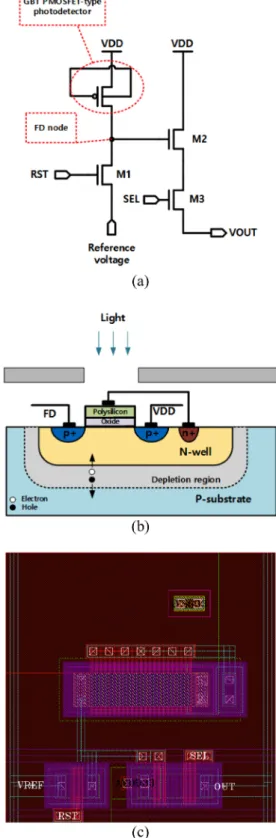
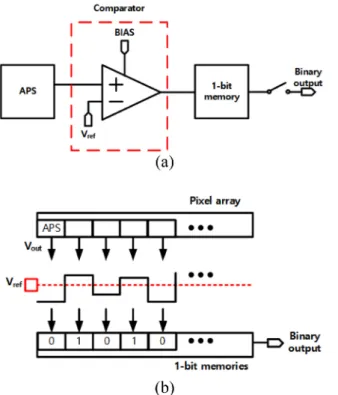
A CMOS binary image sensor that uses a built-in GBT PMOSFET-type photodetector with high-sensitivity characteristics operates at high speed by binarizing the output of a pixel similarly as in a read-out operation in a normal memory. It does not require an additional ADC. It consists of a high-speed logic operation- based comparator and a simple circuit using memory. Therefore, it operate with low power consumption [9]. The CMOS binary image sensor with a built-in GBT PMOSFET-type photodetector is designed herein, manufactured using the 0.35-µm standard CMOS process, and evaluated by measuring its characteristics.
2. PRINCIPLE OF OPERATION
2.1 Active pixel sensor with N+/P-substrate photodetector
Fig. 1(a) shows the schematic of an active pixel sensor (APS)
1School of Electronic and Electrical Engineering, Kyungpook National Unversity
80, Daehak-ro, Buk-gu, Daegu, 41566, Korea
2Korea Polytechnic Robot Campus
1, Robotcampus-ro, Yeongcheon-si, Gyeongsangbuk-do, 38839, Korea
+Corresponding author: [email protected]
(Received: Sep. 15, 2021, Revised: Sep. 25, 2021 Accepted: Sep. 29, 2021)
This is an Open Access article distributed under the terms of the Creative Commons Attribution Non-Commercial License(https://creativecommons.org/
licenses/by-nc/3.0/) which permits unrestricted non-commercial use, distribution, and reproduction in any medium, provided the original work is properly cited.