DOI:10.4047/jap.2010.2.2.61
61 CASE REPORT J Adv Prosthodont 2010;2:61-3
INTRODUCTION
Nowadays, there are many patients who want to restore their teeth more esthetically not only for the origin such as den- tal caries or tooth fracture but also for diastema. As the inter- ests of patients in esthetics increased, a number of reports over the porcelain laminate veneer increased.1,2
Interdental spacing in the anterior region of the mouth pre- sents a challenge for correction that has been traditionally dif- ficult to resolve with conventional full-veneer crown treatment alternatives due to imbalanced tooth proportion. In such instances, an interdisciplinary approach, which is composed of orthodontics, periodontology and prosthodontics, is necessary to evaluate, diagnose, and resolve esthetic.3When a compre- hensive approach is necessary, communication among the disciplines is critical in achieving improved esthetic out- comes in the anterior maxilla. Uneven space between maxil- lary anterior teeth can be treated orthodontically. After the rearrangement of the teeth, the anterior maxillary esthetics can be restored with porcelain laminate veneers for minimal teeth preparations, which can preserve sound tooth structure and prevent pulp-irritation, with the least possible irritation of marginal gingiva around the restored teeth.4,5
This clinical report describes a patient with uneven interdental space between anterior maxillary teeth, improper clinical crown lengths, tooth size discrepancies, and malocclusion. The
patient’s esthetic demands were met through an interdisciplinary treatment approach consisting of orthodontic movement and porcelain laminate veneers.
CASE REPORT
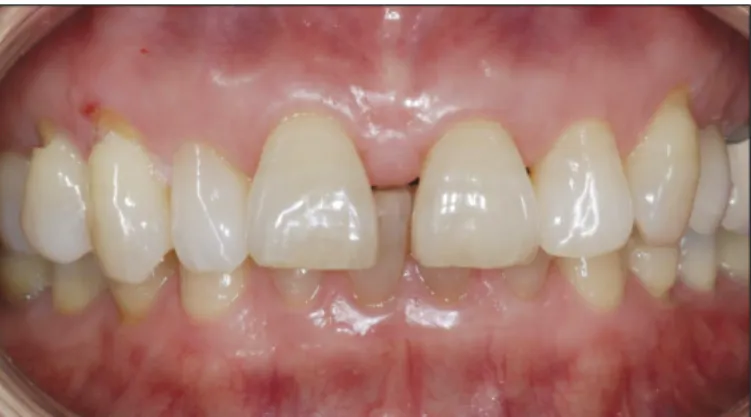
A 50-year-old woman visited Seoul National University Dental Hospital, with a chief complaint of “desire to improve esthetics”because of the existing space between anterior maxillary teeth. The patient had uneven space between ante- rior maxillary teeth and showed deep bite Angle class II malocclusion. The problem list of patient’s anterior maxillary part was as followed: asymmetrical zenith lines, abnormal incisal profile with disharmonious tooth axes and imbalances in tooth positions (Fig. 1). The midline was deviated and the max- illa was canted to the right. The proportion of tooth size was asymmetrical and there was wide diastema between central incisors, approximately 2 mm. On the first visit, irreversible hydrocolloid impressions of both maxillary and mandibular arch- es were taken, and diagnostic wax up was performed. To produce the most esthetic result, recurring esthetic dental (RED) proportion was used to establish the widths of the anterior six teeth as viewed from the frontal.6 The author has defined the RED proportion as the proportion of succes- sive widths of the teeth viewed from the frontal, remaining con- stant as one moves distally. As it is well known, the golden pro-
Esthetic restorations of maxillary anterior teeth with orthodontic treatment and porcelain laminate veneers
: a case report
Ji-Eun Moon, DDS, Sung-Hun Kim, DDS, PhD, Jung-Suk Han, DDS, MSD, PhD, Jae-Ho Yang, DDS, MSD, PhD, Jai-Bong Lee*, DDS, MSD, PhD
Department of Prosthodontics and Dental Research Institute, School of Dentistry, Seoul National University, Seoul, Korea
If orthodontists and restorative dentists establish the interdisciplinary approach to esthetic dentistry, the esthetic and functional outcome of their combined efforts will be greatly enhanced. This article describes satisfying esthetic results obtained by the distribution of space for restoration by orthodontic treatment and porcelain laminate veneers in uneven space between maxillary anterior teeth. It is proposed that the use of ortho- dontic treatment for re-distribution of the space and the use of porcelain laminate veneers to alter crown anatomy provide maximum esthet- ic and functional correction for patients with irregular interdental spacing. [J Adv Prosthodont 2010;2:61-3]
Corresponding author: Jai-Bong Lee
Department of Prosthodontics and Dental Research Institute, School of Dentistry, Seoul National University
275-1, Yeongeon-Dong, Jongno-Gu, Seoul, 110-768, Republic of Korea Tel, +82 2 2072 3393: e-mail, [email protected]
Received May 30, 2010 / Last Revison June 7, 2010 / Accepted June 10, 2010
KEY WORDS. Interdental spacing, Orthodontic treatment, Porcelain laminate veneers, Interdisciplinary approach
ⓒ 2010 The Korean Academy of Prosthodontics
This is an Open Access article distributed under the terms of the Creative Commons Attribution Non-Commercial License (http://creativecommons.org/licenses/by- nc/3.0) which permits unrestricted non-commercial use, distribution, and reproduction in any medium, provided the original work is properly cited.
62 J Adv Prosthodont 2010;2:61-3
portion is limited to 62%, however, the RED proportion gives greater flexibility, as the dentist can define desired RED proportion, and an approximate 70% is preferred. Based on the RED proportion of 70%, diagnostic wax-up was per- formed, and the favorable results were predicted by space re- distribution. If the right central incisor would be moved toward mesial and incisal directions 1 mm respectively, the left lateral incisor would be moved toward incisal direction 1 mm (Fig. 2).
Deciding as for the treatment option, the MBT brackets (3M Unitek, Monrovia, CA, USA) were bonded to the ante- rior maxillary teeth according to their related positions, and the brackets of the right central incisor and the left lateral incisor were bonded in slightly cervical positions for extrusion. Then open coil spring (3M Unitek, Monrovia, CA, USA) was inserted between the right central incisor and the right later- al incisor in order to move the right central incisor in mesial direction. On the other hand, closed coil springs (3M Unitek, Monrovia, CA, USA) were inserted between the right central incisor and the left central incisor and between the right lateral incisor and the right canine, with keeping in mind not to
overclose of the diastema and not to take the wrong distal direc- tion for the right lateral incisor. After the spring and wire were inserted, all of the brackets and 016 stainless-steel round wire (Jin-Sung Industrial Co., Seoul, Korea) were ligated tightly and activation of teeth movements had begun (Fig. 3).
The recall checks were carried out with two weeks inter- vals. The careful observation of teeth movements was fulfilled and open coil spring had been changed, if necessary. The occlusal adjustment of extruded right central incisor and the palatal sur- face of the left lateral incisor was carried out to remove occlusal interferences. The minute examination was per- formed for evaluating favorable teeth movements 6 weeks after brackets bonding procedure. Because the teeth were in prop- er positions in the maxillary dentition, all brackets and wire were removed, and the teeth surfaces were cleaned and polished. The fixed retainer was bonded to avoid the relapse of the moved teeth.
On the next visit, porcelain laminate preparation was performed with the silicone index (Exafine Putty Type; GC Corporation, Tokyo, Japan) attained from the diagnostic wax-up cast.
Immediate dentin sealing (Adper Scotchbond Multi-purpose
Esthetic restorations of maxillary anterior teeth with orthodontic treatment and porcelain laminate veneers Moon JE et al.
Fig. 1. Pretreatment intra-oral photograph. Look at the wide diastema between #11 and #21.
Fig. 2. Diagnostic wax-up was performed on the supposition that #11 and
#22 moved as mentioned.
Fig. 3. The brackets were bonded as considered the teeth movements. Fig. 4. Porcelain laminate veneer preparation was done and immediate dentin sealing was performed.
63 J Adv Prosthodont 2010;2:61-3
Adhesive; 3M ESPE, St. Paul, MN, USA) was carried out for achieving improved bond strength, fewer gap formations, decreasing bacterial leakage, and reducing dentin sensitivity (Fig. 4).7-9The final impression was taken with polyvinyl siloxane impression material (Express; 3M ESPE, St. Paul, MN, USA) using 1-step technique. Shade was carefully decided con- sidering the prepared teeth and opposite mandibular incisors with shade guide (VITA System 3D-Master; VITA Zahnfabrik, Sa¨ckingen, Germany). The provisional restorations (Luxatemp;
DMG, Hamburg, Germany) were fabricated directly with premade silicone index (Exafine Putty Type; GC Corporation, Tokyo, Japan) attained from the diagnostic wax-up cast.
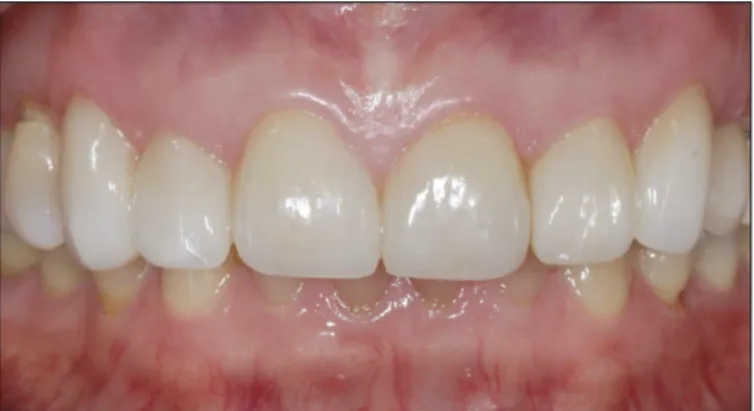
After 2 weeks, the final restorations was completed and tried in the mouth, all margins, contacts were verified (Fig. 5). The final restorations were bonded using resin cement (Variolink II; Ivoclar vivadent, Schaan, Liechtenstein). After delivery, as shown in Fig. 5, the gingiva was healthy and showed harmonious shapes and contours. The proper esthetics was obtained that the shade of surrounding tissues was stable and shown balanced properties, the proportion of tooth size was favorable and sat-
isfied. The retainer was bonded for maximum retention of new teeth positions. The following check-ups of the patient were performed for 3 months after placement of the definitive prosthesis, and oral hygiene was maintained in excellent state and tooth alignment was stable. The patient was very sat- isfied with the appearance and the function.
CONCLUSION
This clinical report describes an interdisciplinary approach where communication and coordination were the key for an improved esthetic result in the anterior maxilla. Coordinated treatment with careful consideration of patient expectations and requests were critical for successful outcome and patient’s sat- isfaction.
REFERENCES
1. Banker CA, Berlocher WC, Mueller BH. Alternative meth- ods for the management of persistent maxillary central di- astema. Gen Dent 1982;30:136-9.
2. Rakow B, Light EI, Condello P. Enamel bonded mechanically retained laminate veneer. Gen Dent 1978;26:47-8.
3. Kokich VG, Spear FM. Guidelines for managing the orthodontic- restorative patient. Semin Orthod 1997;3:3-20.
4. Claman L, Alfaro MA, Mercado A. An interdisciplinary approach for improved esthetic results in the anterior maxilla. J Prosthet Dent 2003;89:1-5.
5. Heymann HO, Hershey HG. Use of composite resin for restora- tive and orthodontic correction of anterior interdental spac- ing. J Prosthet Dent 1985;53:766-71.
6. Ward DH. Proportional smile design using the recurring esthetic dental (red) proportion. Dent Clin North Am 2001;45:143-54.
7. Magne P. Immediate dentin sealing: a fundamental procedure for indirect bonded restorations. J Esthet Restor Dent 2005;17:144- 54.
8. Magne P, Kim TH, Cascione D, Donovan TE. Immediate dentin sealing improves bond strength of indirect restorations.
J Prosthet Dent 2005;94:511-9.
9. Magne P, So WS, Cascione D. Immediate dentin sealing supports delayed restoration placement. J Prosthet Dent 2007;98:166-74.
Esthetic restorations of maxillary anterior teeth with orthodontic treatment and porcelain laminate veneers Moon JE et al.
Fig. 5. Frontal view of definitive porcelain laminate veneers.