Effect of silane activation on shear bond
strength of fiber-reinforced composite post to resin cement
Hyun-Dong Kim1, DDS, Joo-Hee Lee1, DDS, MSD, PhD, Kang-Min Ahn2, DDS, MSD, PhD, Hee-Sun Kim3, DDS, MSD, PhD, Hyun-Suk Cha1*, DDS, MSD, PhD
1 Divison of Prosthodontics, Department of Dentistry, College of Medicine, University of Ulsan, Asan Medical Center, Seoul, Republic of Korea
2 Division of Oral and maxillofacial Surgery, Department of Dentistry, College of Medicine, University of Ulsan, Asan Medical Center, Seoul, Republic of Korea
3Department of Dentistry, Seoul National University Boramae Hospital, Seoul, Republic of Korea
PURPOSE. Among the surface treatment methods suggested to enhance the adhesion of resin cement to fiber- reinforced composite posts, conflicting results have been obtained with silanization. In this study, the effects of silanization, heat activation after silanization, on the bond strength between fiber-reinforced composite post and resin cement were determined. MATERIALS AND METHODS. Six groups (n=7) were established to evaluate two types of fiber post (FRC Postec Plus, D.T. Light Post) and three surface treatments (no treatment; air drying; drying at 38℃). Every specimen were bonded with dual-curing resin cement (Variolink N) and stored in distilled water for 24 hours at 37℃. Shear-bond strength (MPa) between the fiber post and the resin cement were measured using universal testing device. The data were analyzed with 1-way ANOVA and by multiple comparisons according to Tukey’s HSD (α=0.05). The effect of surface treatment, fiber post type, and the interactions between these two factors were analyzed using 2-way ANOVA and independent sample T-tests. RESULTS. Silanization of the FRC Postec Plus significantly increased bond strength compared with the respective non-treated control, whereas no effect was determined for the D.T. Light Post. Heat drying the silane coupling agent on to the fiber- reinforced post did not significantly improve bond strength compared to air-syringe drying. CONCLUSION. The bond strength between the fiber-reinforced post and the resin cement was significantly increased with
silanization in regards to the FRC Postec Plus post. Bond strength was not significantly improved by heat activation of the silane coupling agent. [J Adv Prosthodont 2013;5:104-9]
KEY WORDS: Post and core technique; Silane; Resin cements; Shear strength; Heat treatment
Corresponding author:
Hyun-Suk Cha
Division of Prosthodontics, Department of Dentistry College of Medicine, University of Ulsan, Asan Medical Center
#388-1, Pungnap 2-Dong, Songpa-Gu, Seoul, 138-736, Republic of Korea
Tel. 82230103850: e-mail, [email protected]
Received October 19, 2012 / Last Revision April 25, 2013 / Accepted April 27, 2013
© 2013 The Korean Academy of Prosthodontics
This is an Open Access article distributed under the terms of the Creative Commons Attribution Non-Commercial License (http://creativecommons.
org/licenses/by-nc/3.0) which permits unrestricted non-commercial use, distribution, and reproduction in any medium, provided the original work is properly cited.
INTRODUCTION
Fiber-reinforced composite posts are widely used to restore endodontically treated teeth with all-ceramic crowns. The major advantage of these posts is the similarity of the elas- tic modulus to dentin, which reduces stress concentration as well as root fracture.1,2 However, fiber post-restored teeth occasionally fail, most commonly as the result of debonding of the post at the post-cementation junction.3
To enhance the adhesion of the resin cement to the fiber-reinforced composite post, several surface treatment methods have been suggested.4-8 In a strategy aimed at achieving micro-mechanical interlocking between the resin cement and the fiber-reinforced post, increasing the rough- ness of the post surface has been examined.9 Airborne-
particle abrasion (sandblasting) was shown to significantly increase the bond strength between the post and the resin cement.6,7 Alternatively, roughening can be enhanced by etching the post surface using hydrogen peroxide. This is a clinically simple method to improve the bonding strength without the need for acid etching of the post.10
Chemical bonding between the resin cement and the fiber-reinforced composite post also has been tested. For example, silane coupling agents have an organic functional group such that covalent bonds are formed between the resin cement and the quartz fibers of the post. Silane has been shown to increase bond strength between ceramics and resin composite materials,11,12 thus strengthening the case for using silane coupling agents in dentistry, in order to improve the surfaces of fiber-reinforced composite posts for resin bonding.1,13
Nonetheless, among the post surface treatment methods, studies examining the efficiency of silanization in enhancing bond strength have reported conflicting results. There were no significant difference in bond strength between silane- treated posts and untreated posts.7,14,15 However, silanization improves the microtensile bond strength between resin cement and fiber-reinforced composite posts in other reports.1,13,16
In the glass industry, silane treated glass is routinely heat-treated to maximize bond strength.11 In dentistry applications, Shen et al. reported that silane drying under a stream of warm air was effective in enhancing the tensile bond strength of the composite to ceramic.12 A similar approach to fiber-reinforced composite posts has been pro- posed to activate silanization, based on the premise that silane dried under warm air (38℃) has a higher bond strength than when dried at room temperature (21℃).17
The objective of this study was to determine the effect of silanization, heat activation after silanization, and fiber- reinforced composite posts differing in composition on the bond strength between the post and the resin cement. The null hypothesis was that none of these parameters would improve bond strength.
MATERIALS AND METHODS
Two post types were tested in this study: FRC Postec Plus (Ivoclar Vivadent AG, Schaan, Liechtenstein), with a maxi- mum diameter of 2.0 mm; and D.T. Light Post, Size 3 (BISCO Inc., Schaumburg, IL, USA), with maximum diam- eter of 2.2 mm. The FRC Postec Plus is composed of glass fiber (70%), ytterbium fluoride (9%), and dimethacrylate (21%), i.e., UDMA and TEGDMA. The D.T. Light Post is composed of quartz fibers (60%) and an epoxy resin matrix (40%).18
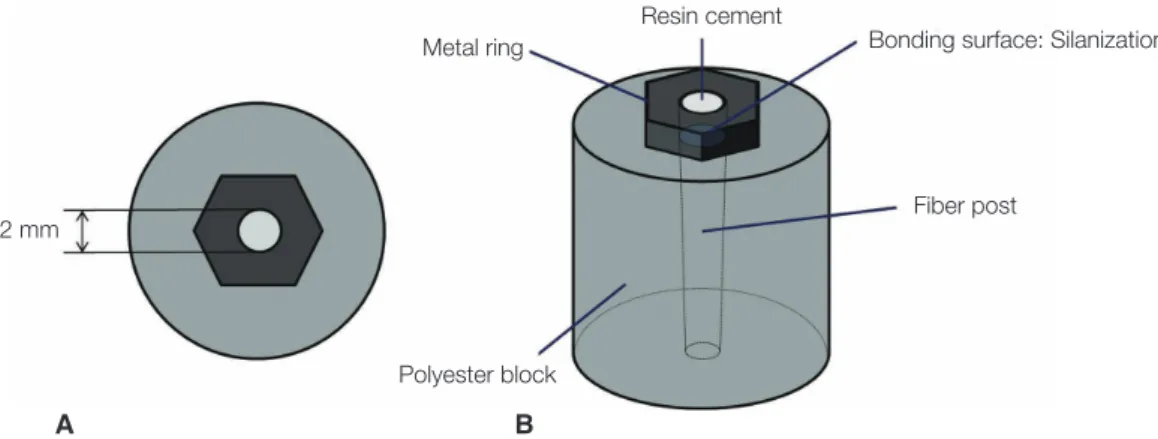
The posts were embedded perpendicularly with unsatu- rated polyester resin (Formica Polycoat; Aekyung Chemical Co., Seoul, Korea) in the mold of a metal ring with a diam- eter of 15 mm and a length of 23 mm. By incremental pouring of the unsaturated polyester resin, the top surface of fiber posts were positioned at an even level with the top surface of the resin blocks (Fig. 1). The exposed surface of the post was cleaned using phosphoric acid (Total Etch;
Ivoclar Vivadent AG, Schaan, Liechtenstein), rinsed with distilled water, and dried as recommended by the respective manufacturers.7
Six experimental groups (n=7 per group) were estab- lished to evaluate the two different types of fiber post and the three surface treatments. Group 1 served as the untreat- ed control for the FRC Postec Plus. A metal hexagon nut with a 2 mm inner diameter was placed on the exposed top of the post embedded in a polyester resin block. An Accudose syringe and needle tip (Centrix, Shelton, CT, USA) were used to add dual-polymerizing resin cement (Variolink II; Vivadent AG, Schaan, Liechtenstein) so as to completely fill the metal hexagon nut, thereby establishing a uniform bonding surface area. The specimen was light- polymerized with a polymerizing light-emitting diode (Mini L.E.D.; Satelec, Paris, France) at a distance of 2 mm for 40 seconds. In Group 2, prior to resin cement adhesion, the post surface was silanized using a two component silane coupling agent (Porcelain Liner M; Sun Medical, Moriyama City, Japan) applied with a brush to the upper surface of
Fig. 1. Schematic drawing of specimen preparation for shear bond strength test. A: cross-sectional view for shear bond test, B: total view of mounted specimen.
A B
Fiber post 2 mm
Resin cement
Polyester block
Bonding surface: Silanization Metal ring
the fiber post. The silanized post was then dried at room temperature (21℃) for 60 seconds from a distance of 30 cm using an air-syringe. In Group 3, the silane coupling agent was applied with a brush after which the post was dried under warm air mode (38℃) using a blow dryer (EDDY UN-1552, Unix electronics, Seoul, Korea) for 60 seconds at a distance of 30 cm. In Group 4-6, the proce- dures were the same but the post was a D.T. Light Post, likewise embedded in a resin block .
Before their analysis in a shear bond strength test, the 42 specimens prepared for the study were stored in distilled water for 24 hours at 37℃, since water storage has been shown to influence post retention similar to the oral envi- ronment.5
Each specimen was mounted in a universal testing device (Instron 3366, Instron Corp., Norwood, MA, USA) and loaded at a crosshead speed of 1.0 mm/min (Fig. 2A).
When the metal hexagon nut separated from the resin block, the load at failure was measured (Fig. 2B).
Dividing the load (N) at failure by the bonding surface area (mm2), defined the shear bond strength, expressed in mega-Pascals (MPa).
The data were statistically analyzed, beginning with a 1-way ANOVA to examine the effects of the different sur- face treatments: no treatment, silanization plus air drying at 21℃ (S21), and silanization plus air drying at 38℃ (S38).
Tukey’s HSD multiple comparison was then applied in a post-hoc analysis, followed by a 2-way ANOVA and inde- pendent sample t-tests to examine the effects of surface treatments, the fiber post composition, and the interactions between the two. The alpha value was set at 0.05. SPSS 18.0 software (SPSS, Inc, Chicago, USA) was used for the ANOVA, post-hoc analysis, and t-tests.
RESULTS
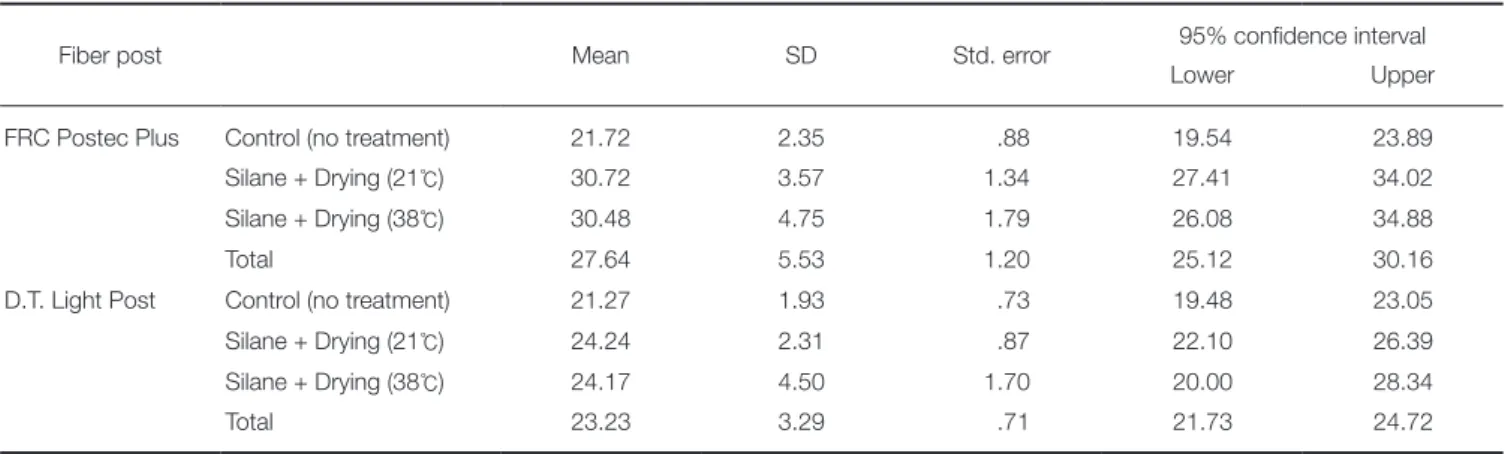
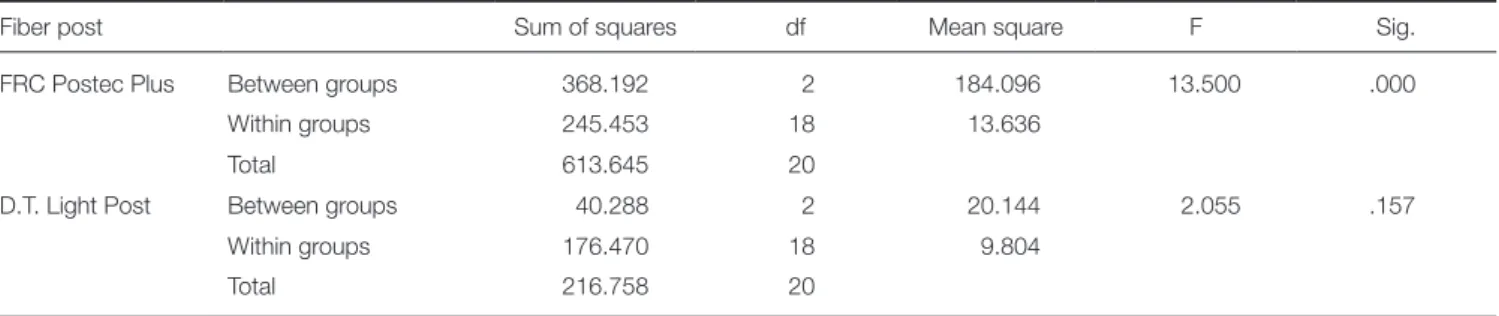
For the FRC Postec Plus post, the mean shear bond strength was 21.72 ± 2.35 (MPa) for the control group (no surface treatment), 30.72 ± 3.57 (MPa) for the S21 group, and 30.48 ± 4.75 (MPa) for the S38 group (Table 1). The differences between these groups were significant according to the 1-way ANOVA (Table 2, Fig. 3). Further analysis with Tukey’s HSD test showed significant differences in the shear bond strengths of the control group and either the
Fig. 2. Schematic presentation of shear bond test. A: the mounting specimen and loading, B: failure.
A B
Table 1. Mean value and standard deviation (MPa) of shear bonding strength
Fiber post Mean SD Std. error 95% confidence interval
Lower Upper
FRC Postec Plus Control (no treatment) 21.72 2.35 .88 19.54 23.89
Silane + Drying (21℃) 30.72 3.57 1.34 27.41 34.02
Silane + Drying (38℃) 30.48 4.75 1.79 26.08 34.88
Total 27.64 5.53 1.20 25.12 30.16
D.T. Light Post Control (no treatment) 21.27 1.93 .73 19.48 23.05
Silane + Drying (21℃) 24.24 2.31 .87 22.10 26.39
Silane + Drying (38℃) 24.17 4.50 1.70 20.00 28.34
Total 23.23 3.29 .71 21.73 24.72
S21 group or the S38 group. However, the differences between the latter two groups were not significant.
For the D.T. Light Post, the mean shear bond strength was 21.27 ± 1.93 (MPa) for the control group, 24.24 ± 2.31 (MPa) for the S21 group, and 24.17 ± 4.50 (MPa) for the S38 group (Table 1). However, unlike the FRC Postec Plus post, none of the differences between the groups were sig- nificant (Table 2, Fig. 3).
As seen in Table 3, the 2-way ANOVA showed signifi- cant effects of the type of the fiber-reinforced composite post and the surface treatment on shear bond strength.
There was also significant interaction between the type of the fiber-reinforced composite post and the surface treat- ment.
In the independent sample t-test, the shear bond strength values obtained for the FRC Postec Plus and D.T.
Light Post were compared with respect to the surface treat- ment. In Levene’s test for the equality of variances, the assumed equal variances of the three surface treatment methods were confirmed. For the two control groups, there were no significant differences between the FRC Postec Plus and D.T. Light Post. However, for the S21 and S38 silanization groups, the shear bond strength of the FRC Postec Plus was significantly higher than that of the D.T.
Light Post (Table 4).
Fig. 3. Shear bond strength of the FRC Postec Plus and the D.T. Light Post as a function of the surface treatment.
*: Mean values were significantly different by 1-way ANOVA (P<.05).
40.00 35.00 30.00 25.00 20.00 15.00 10.00 5.00 0.00
Control (no treatment) Silane (21℃) Silane (38℃) (MPa)
FRC Postec Plus D.T. Light Post
Shear bond strength
24.17 21.72 21.27
30.72
24.25
30.48
Table 2. One-way ANOVA results for the FRC Postec Plus and the D.T. Light Post
Fiber post Sum of squares df Mean square F Sig.
FRC Postec Plus Between groups 368.192 2 184.096 13.500 .000
Within groups 245.453 18 13.636
Total 613.645 20
D.T. Light Post Between groups 40.288 2 20.144 2.055 .157
Within groups 176.470 18 9.804
Total 216.758 20
Table 3. Results of a 2-way ANOVA with fiber post and surface treatment as the independent variables and shear-bond strength as the dependent variable
Source Sum of squares df Mean square F Sig.
Corrected model 612.859(a) 5 122.572 10.458 .000
Intercept 27174.652 1 27174.652 2318.642 .000
Fiber post 204.378 1 204.378 17.438 .000
Surface treatment 326.034 2 163.017 13.909 .000
Fiber post * Surface treatment 82.447 2 41.223 3.517 .040
Error 421.923 36 11.720
Total 28209.433 42
Corrected total 1034.781 41
a R Squared = .548 (Adjusted R Squared = .486)
DISCUSSION
The results of this study partially support the null hypothe- sis, according to which neither silanization, heat activation nor fiber post composition would improved the strength of the bond between the fiber-reinforced composite post and the resin cement. Higher shear bond strengths between the fiber-reinforced composite post and the resin cement were achieved with silanization of either post. Between the two post types, silanization of the FRC Postec Plus resulted in higher shear bond strengths. However, heat activation did not significantly improve shear bond strength as there were no significant differences, in this respect, between heat- dried and room-temperature-dried posts.
Clinical failure of a tooth restored with fiber-reinforced post is usually the result of cementation failure. In this study, bonding at the junction between the resin cement and the fiber-reinforced post was evaluated in posts sub- jected to three types of surface treatment using testing method that was designed based on the results of a previ- ous study by Choi et al.7. To ensure a bonding surface of constant area, a metal hexagon nut, as a mold, and posts with same diameter were used. In a pilot study, we noted that air bubbles became trapped during deposition of the resin cement, leading to irregularities in the bonding surface area. This problem was remedied by using an Accudose needle tip and syringe (Centrix, Shelton, CT, USA), which allowed the resin cement to be contained within the metal hexagon nut without the trapping of air bubbles.
Consequently, we were able to reduce the standard variation of the experimental data reported herein compared to those of the pilot study.
In the present work, the bond strength with the resin cement was higher for fiber-reinforced posts of the silani- zation group than for control, untreated posts. Conflicting results regarding the effect of silanization on the bond strength between fiber-reinforced posts and resin cement have been reported. Our results are in accordance with those of previous studies showing a significant increase in bond strength after silanization of the fiber-reinforced post,1,16 although in other studies the improvement obtained with silanization was not significant.7,13,14
The higher shear bond strength of the FRC Postec Plus may have been due to the composition of its matrix. While both the glass fibers of the FRC Postec Plus and the quartz fibers of the D.T. Light Post contain hydroxyl groups that can react with a silane coupling agent, the matrix of the D.T. Light Post is an epoxy resin, which lacks these func- tional groups. By contrast, the matrix of the FRC Postec Plus, which contains UDMA, TEGDMA, ytterbium trifluo- ride, and highly dispersed silicon dioxide, is similar to the composition of resin cement (Variolink II) such that better coupling is achieved between the two.
Blow dryer was chosen because it is easy to get and can be applied easily in clinical setting. It was examined for capability of maintaining heat temperature and proved maintaining the temperature at 38-40℃ with 30 cm distance in warm mode. But, in this study heat treatment after silani- zation of the post was not effective in enhancing bond strength. Silane coupling is a technique-sensitive step, given that incomplete evaporation of the solvent may compro- mise chemical reactions between silane and the glass or quartz fibers of the post.19 Heat treatment after application of the silane coupling agent is thought to promote com- plete evaporation of the solvent. Although the optimal temperature has not been determined, in the glass industry, the silane coupling agent is heat-treated at a temperature close to 100℃.20 Monticelli et al. reported that, in dental applications, heat treatment of the silane coupling agent at a temperature of 38℃ but not at 21℃ effectively enhances bond strength.17 Based on that study, we examined the effects of heat treatment at 38℃ but failed to detect a sig- nificant difference compared to drying at room tempera- ture.
Pre-activated silane coupling agents, allows forming siloxane bonds, but they have short shelf life. In this study two-component system (Porcelain liner M) was used in which hydrolysis of the functional group occurs only after the silane coupler (γ-MPTS) is mixed with the acidic mono- mer (4-META). Thus, in two-component system, complete solvent evaporation is more likely than a pre-activated sys- tem. In the previous study, silanization using a two-compo- nent silane coupling agent resulted in greater bonding strength when the posts were dried at a higher temperature Table 4. Independent sample t-test to compare the shear bond strength of the FRC Postec Plus and the D.T. Light Post as a function of the surface treatment
Surface treatment Levene's test for equality of variances t-test for equality of means
F Sig. t df Sig. (2-tailed)
Control (no treatment) Equal variances .445 .518 .391 12 .702
Not equal variances .391 11.566 .703
Silane + Drying (21℃) Equal variances 4.187 .063 4.024 12 .002
Not equal variances 4.024 10.297 .002
Silane + Drying (38℃) Equal variances .092 .767 2.548 12 .026
Not equal variances 2.548 11.965 .026
(38℃) than at room temperature (21℃).17 Accordingly, in this study, we used a two-component silane coupling agent, expecting that it would clearly demonstrate the benefits of heat treatment after silanization. However, this was not the case as the two temperatures did not yield significant differ- ences in bonding strength. Similar results were obtained in a previous study, in which the two-component silane pro- duced higher bond strength when air drying was carried out at room temperature (23℃) rather than at a higher tempera- ture (60℃).21 In that report, it was speculated that while heating may improve solvent evaporation, the extent of the improvement is probably related to the volatile nature of the specific solvent, such that bonding strength might even decline after heating.21
The specimen design of this study offered a simple method to control the bonding surface area. In addition, the depth of the light transmission was relatively short, enabling a high rate of light-induced polymerization. A lim- itation of this study design was the above-described diffi- culty with the blow dryer not capable of discriminating the effect of evaporation of the solvent from heat activation of silane. The use of a higher controlled range of heat radiat- ing device with small aperture may allow more precise eval- uation of the effect of surface treatment, including combi- nations of silanization, heat treatment, in addition to the micro-mechanical surface processes, such as airborne-parti- cle abrasion.
CONCLUSION
In this in vitro study of the bond strength between a fiber- reinforced post and resin cement, the results support the following conclusions:
Silanization of the FRC Postec Plus but not of the D.T.
Light Post significantly increased the bond strength between the fiber-reinforced post and the resin cement.
Heat treatment after silanization of the fiber-reinforced post did not significantly improve the bond strength between the fiber-reinforced post and the resin cement compared to the strength achieved with silanization fol- lowed by drying at room temperature.
REFERENCES
1. Aksornmuang J, Foxton RM, Nakajima M, Tagami J.
Microtensile bond strength of a dual-cure resin core material to glass and quartz fibre posts. J Dent 2004;32:443-50.
2. Aksornmuang J, Nakajima M, Foxton RM, Panyayong W, Tagami J. Regional bond strengths and failure analysis of fi- ber posts bonded to root canal dentin. Oper Dent 2008;33:
636-43.
3. Ferrari M, Cagidiaco MC, Goracci C, Vichi A, Mason PN, Radovic I, Tay F. Long-term retrospective study of the clini- cal performance of fiber posts. Am J Dent 2007;20:287-91.
4. Monticelli F, Osorio R, Sadek FT, Radovic I, Toledano M, Ferrari M. Surface treatments for improving bond strength to prefabricated fiber posts: a literature review. Oper Dent
2008;33:346-55.
5. Albashaireh ZS, Ghazal M, Kern M. Effects of endodontic post surface treatment, dentin conditioning, and artificial ag- ing on the retention of glass fiber-reinforced composite resin posts. J Prosthet Dent 2010;103:31-9.
6. Balbosh A, Kern M. Effect of surface treatment on retention of glass-fiber endodontic posts. J Prosthet Dent 2006;95:
218-23.
7. Choi Y, Pae A, Park EJ, Wright RF. The effect of surface treatment of fiber-reinforced posts on adhesion of a resin- based luting agent. J Prosthet Dent 2010;103:362-8.
8. Yenisey M, Kulunk S. Effects of chemical surface treatments of quartz and glass fiber posts on the retention of a compos- ite resin. J Prosthet Dent 2008;99:38-45.
9. Mazzitelli C, Ferrari M, Toledano M, Osorio E, Monticelli F, Osorio R. Surface roughness analysis of fiber post condition- ing processes. J Dent Res 2008;87:186-90.
10. de Sousa Menezes M, Queiroz EC, Soares PV, Faria-e-Silva AL, Soares CJ, Martins LR. Fiber post etching with hydrogen peroxide: effect of concentration and application time. J Endod 2011;37:398-402.
11. Barghi N, Berry T, Chung K. Effects of timing and heat treatment of silanated porcelain on the bond strength. J Oral Rehabil 2000;27:407-12.
12. Shen C, Oh WS, Williams JR. Effect of post-silanization dry- ing on the bond strength of composite to ceramic. J Prosthet Dent 2004;91:453-8.
13. Perdigao J, Gomes G, Lee IK. The effect of silane on the bond strengths of fiber posts. Dent Mater 2006;22:752-8.
14. Bitter K, Noetzel J, Neumann K, Kielbassa AM. Effect of si- lanization on bond strengths of fiber posts to various resin cements. Quintessence Int 2007;38:121-8.
15. Mosharraf R, Baghaei Yazdi N. Comparative evaluation of effects of different surface treatment methods on bond strength between fiber post and composite core. J Adv Prosthodont. 2012;4:103-8.
16. Goracci C, Raffaelli O, Monticelli F, Balleri B, Bertilli E, Ferrari M. The adhesion between prefabricated FRC posts and composite resin cores: microtensile bond strength with and without post-silanization. Dent Mater 2005;21:437-44.
17. Monticelli F, Toledano M, Osorio R, Ferrari M. Effect of temperature on the silane coupling agents when bonding core resin to quartz fiber posts. Dent Mater 2006;22:1024-8.
18. Goracci C, Ferrari M. Current perspectives on post systems: a literature review. Aust Dent J 2011;56 Suppl 1:77-83.
19. de la Fuente JL, Madruga EL. Solvent effects on the free-rad- ical copolymerization of butyl acrylate with methyl methacry- late. Macromol Chem Phys 1999;200:1639-43.
20. Barghi N. To silanate or not to silanate: making a clinical de- cision. Compend Contin Educ Dent 2000;21:659-62.
21. Novais VR, Simamotos Junior PC, Rontani RM, Correr- Sobrinho L, Soares CJ. Bond strength between fiber posts and composite resin core: influence of temperature on silane coupling agents. Braz Dent J 2012;23:8-14.