• 검색 결과가 없습니다.

Intrapericardial Implantation of an Implantable Cardioverter-Defibrillator in a Child

N/A
N/A
Protected

Academic year: 2021

Share "Intrapericardial Implantation of an Implantable Cardioverter-Defibrillator in a Child"

Copied!
3
0
0

로드 중.... (전체 텍스트 보기)

전체 글

(1)

Korean J Thorac Cardiovasc Surg 2011;44:61-63 □ Case Report □ DOI:10.5090/kjtcs.2011.44.1.61 ISSN: 2233-601X (Print) ISSN: 2093-6516 (Online)

− 61 −

*Department of Thoracic and Cardiovascular Surgery, Seoul National University Hospital, Seoul National University College of Medicine

**Department of Thoracic and Cardiovascular Surgery, Seoul National University Bundang Hospital, Seoul National University College of Medicine

Received: July 24, 2010, Revised: September 20, 2010, Accepted: September 26, 2010

Corresponding author: Woong-Han Kim, Department of Thoracic and Cardiovascular Surgery, Seoul National University Hospital, Seoul National University College of Medicine, 28, Yeongeon-dong, Jongno-gu, Seoul 110-460, Korea

(Tel) 82-2-2072-3637 (Fax) 82-2-3672-3637 (E-mail) [email protected]

C

The Korean Society for Thoracic and Cardiovascular Surgery. 2011. All right reserved.

CC
This is an open access article distributed under the terms of the Creative Commons Attribution Non-Commercial License (http://creative- commons.org/licenses/by-nc/3.0) which permits unrestricted non-commercial use, distribution, and reproduction in any medium, provided the original work is properly cited.

Intrapericardial Implantation of an Implantable Cardioverter-Defibrillator in a Child

Yong Won Seong, M.D.*, Woong-Han Kim, M.D.*, Jae Suk Yoo, M.D.**, Hye-seon Kim, M.D.*, Byoung-Ju Min, M.D.*, Young-Ok Lee, M.D.*

Implantable cardioverter defibrillator (ICD) can be a crucial therapeutic modality for pediatric patients with congenital heart disease, Brugada syndrome, long QT syndrome and cardiomyopathy. Because transvenous implantation of ICD is mostly unfeasible for pediatric patients due to anatomical and technical limitations, epicardial patch type or subcutaneous type ICD have been used. Implantation of these alternative ICDs, however, was reported to be fre- quently associated with significant complications. We report a case of successful intrapericardial implantation of a single coil-type ICD through the transverse sinus in a 27 month-old child weighing lesser than 10 kg, and it was inferred from this experience that this alternative technique may decrease complications and morbidities after ICD implantation in children.

Key words: 1. Congenital heart disease 2. Arrhythmia

3. Defibrillation 4. Pacemaker

CASE REPORT

A 27-month-old boy (body weight: 9.9 kg, Height: 84.9 cm), who had been on medication for dilated cardiomyopathy (DCMP) and long QT syndrome, underwent intrapericardial implantation of implantable cardioverter-defibrillator (ICD).

He had first episode of ventricular fibrillation when he was 3 months old, which was successfully resuscitated in our emer- gency room (ER). He was transferred from other institute af- ter recovering from recurrent attack of ventricular fibrillation 3 days prior to his visit to our ER. On arrival, his vital signs were within normal limits, but he showed intermittent brady-

cardia, down to 33 beat/minute, on Holter monitoring,. His

elder brother had died of DCMP-associated sudden death

syndrome. Electrophysiologic study revealed that ventricular

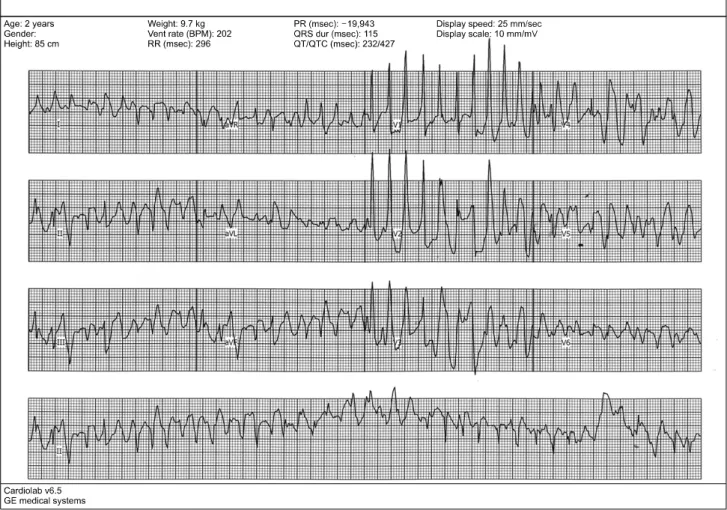
pacing induced polymorphic ventricular tachycardia (Fig. 1),

and genetic study showed SCN5A gene mutation, which is

believed to be linked to long QT syndrome or Brugada

syndrome. Because the risk of recurrent ventricular tachy-

cardia/fibrillation was deemed high, we elected to implant a

DDD-type ICD for this patient. In the operating room, ex-

ternal defibrillator pad (zoll) was applied on the patient’s

back and general anesthesia was induced. Through median

sternotomy pericardium was widely opened, and single-type

(2)

Yong Won Seong, et al

− 62 −

Fig. 1. Preoperative electrophysiologic study showing polymorphic ventricular tachycardia induced by single ventricular pacing.

Fig. 2. Chest X-rays showing ad-

equately positioned coil, electrodes

and the ICD generator.

(3)

Intrapericardial ICD Implantation

− 63 − coil (Transvene

TM

, model number: 6937, Medtronic Inc, Minneapolis, MN, USA) was introduced into the transverse sinus. After positioning the distal part of the coil in the junc- tion between the superior vena cava and the left atrial roof, the coil was stabilized by three 4-0 black silk sutures. Then steroid-releasing bipolar extra-cardiac electodes were fixed in the lateral wall of the right atrium and in the apices of both ventricles. From the lower end of the median sternotomy in- cision, a pouch was made in the right upper quadrant of the abdominal wall by bluntly dissecting the potential space be- tween the rectus abdominis fascia and the peritoneum, and Dual-chamber ICD generator (Entrust D154VR; Medtronic Inc.) was inserted into this pouch after being connected with the coil and electrodes. Proper operation of the ICD was con- firmed by successful defibrillation of induced ventricular fi- brillation, and pacemaker was set at the mimimal heart rate of 60 beats/min. Postoperative course was uneventful, and postoperative simple chest X-ray showed adequate positioning of the coil and the electrodes (Fig. 2). During the one year follow-up period, pacing threshold and ICD impedances were within an appropriate range (atrial pacing: 650 ohms, ven- tricular pacing: 800 ohms, ICD impedence: 54∼55 ohms).

There were two proper shocks for episodes of polymorphic ventricular tachycardia during the same time frame.

DISCUSSION

Implantable cardioverter defibrillator (ICD) can be a crucial treatment modality for pediatric patients with congenital heart disease, Brugada syndrome, long QT syndrome and various types of cardiomyopathy. Differing from adults, pediatric pa- tients have limitations in receiving transvenous implantation of ICD because small body of this subset may not have room

for relatively large generator or coil. Furthermore, rapid so- matic growth after ICD implantation frequently leads to elec- trode dislodgement with ICD malfunction [1]. For these rea- sons, epicardial patch type or subcutaneous type ICD have been used for children. Epicardial patch type ICD, however, has been reported to cause chest pain due to folding or wrin- kling of the patch as time passes [2]. Subcutaneous type ICD also has drawbacks such as elevation of sensing threshold and dislodgement/fracture of the electrodes as the child grows up [3]. To alleviate these problems, intrapericardial coil im- plantation technique was proposed by Hsia et al [4]. They as- serted that this technique could be performed with minimal skin incision without median sternotomy. In our case, we per- formed the procedure through median sternotomy because precise positioning of the coil and electrodes was thought to be more important than minimal incision, given that this pa- tient required appropriate pacing for intermittent bradycardia as well as cardioversion-defibrillation for ventricular arrhy- thmia.

REFERENCES

1. Link MS, Hill SL, Cliff DL, et al. Comparison of frequency of complications of implantable cardioverter-defibrillators in children versus adults. Am J Cardiol 1999;83:263-6.

2. Molina JE, Benditt DG, Adler S. Crinkling of epicardial de- fibrillator patches. A common and serious problem. J Thorac Cardiovasc Surg 1995;110:258-64.

3. Kriebel T, Ruschewski W, Gonzalez MG, et al. ICD im- plantation in infants and small children: the extracardiac technique. Pacing Clin Electrophysiol 2006;29:1319-25.

4. Hsia TY, Bradley SM, LaPage MJ, et al. Novel minimally

invasive, intrapericardial implantable cardioverter defibril-

lator coil system: a useful approach to arrhythmia therapy

in children. Ann Thorac Surg 2009;87:1234-8.

수치

Fig. 1. Preoperative electrophysiologic study showing polymorphic ventricular tachycardia induced by single ventricular pacing.

참조

관련 문서

ICD(Implantable cardioverter-defibrillator) 삽입 급사의 고위험군이나 급사에서 회생한 사람에서 고려 해야 된다. 장기간 추 적결과 대부분에서 증상과 운동능의

Background: Pinch-off syndrome (POS) is a rare complication after totally implantable venous access device (TIVAD) implantation.. In cancer patients, it is

Implantable Cardi- overter-Defibrillator (ICD) therapy in a patient with the Long QT syndrome. Clinical investigation of implan-table antitachycardia devices: Report of the

Implantable cardioverter- defibrillator ( ICD ) therapy in a patient with thelong QT synd- rome. Right bundle branch block, persistent ST segment elevation and sudden cardiac

Accordingly, the right subclavian vein was punctured and the ICD lead was diverted from the right side area to the active Can in the left pectoral area by tunneling over the