344 Copyright © 2015 The Korean Society of Cardiology Korean Circulation Journal
Introduction
Implantable cardioverter-defibrillator (ICD) therapy is acknowledged as a valid treatment method for the effective prevention of sudden cardiac death.
1)Sudden cardiac death is a major cause of mortality (19–26%) in adult congenital heart disease (ACHD) patients.
2)Since the survival rate of patients with congenital heart disease has risen due to improved surgical methods and peri-operative management, the number of ACHD patients has also increased recently. Consequently, the importance of the proper management of long term complications in these patients has garnered attention. Therefore, the need of ICD therapy in ACHD patients is gaining momentum.
3)We report a case in which an ICD was transvascularly implanted in a patient who had undergone a one-and-a-half ventricle repair.
Case
A 31-year-old male patient presented to the emergency department with symptoms including severe palpitation and a presyncopal episode. His blood pressure was 80/60 mm Hg and the electrocardiogram showed monomorphic ventricular tachycardia (VT), at a rate of 225 bpm (Fig. 1). In the emergency department, cardioversion was performed and the tachycardia was converted into a sinus rhythm.
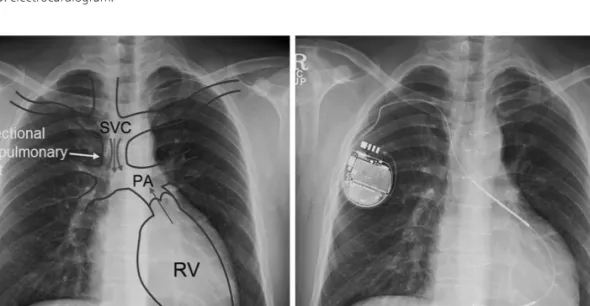
The patient was diagnosed with right heart failure at the age of 10, when he visited our clinic due to dyspnea on exertion and generalized edema. The patient was followed up in the outpatient clinic regularly with heart failure medications. However, right ventricular (RV) dysfunction occurred and RV enlargement progressed. Because the severe RV dysfunction was unresponsive to medical treatment, the patient underwent a one-and-a-half ventricle repair along with tricuspid annuloplasty and valvuloplasty. One-and- a-half ventricle repair is an operation to create an end-to-side anastomosis of the superior vena cava (SVC) and the right pulmonary artery (a bidirectional cavopulmonary shunt) in conjunction with standard heart repair. A partial diversion of systemic venous return directly to the pulmonary artery reduces the volume load on the right ventricle. The schematic picture for describing the one-and-a-half ventricle repair was drawn on the patient’s chest X-ray (Fig. 2A). After the one-and-a-half ventricle repair, the patient’s symptoms improved dramatically and, against
Case Report
http://dx.doi.org/10.4070/kcj.2015.45.4.344 Print ISSN 1738-5520 • On-line ISSN 1738-5555
Transvascular Implantation of an Implantable Cardioverter-Defibrillator in a Patient Who has Undergone One-and-a-Half Ventricle Repair
Pil-Sung Yang, MD 1 , Je Wook Park, MD 1 , Yong-Joon Lee, MD 1 , Dong-Jun Kim, MD 1 , Seng Chan You, MD 1 , Dong Hyuk Park, MD 1 , Jae-Sun Uhm, MD 1 , and Nam Kyun Kim, MD 2
1