70 http://www.aard.or.kr
급성 진행성 사구체신염을 동반한 eosinophilic granulomatosis with polyangiitis 1예
김소정,1 이상민,1 심영섭,2 안정열,3 이상호,4 하승연,4 이상표1 가천대학교 길병원 1내과, 2영상의학과, 3진단검사의학과, 4병리과
Eosinophilic granulomatosis with polyangiitis accompanied by rapidly progressive glomerulonephritis
Sojeong Kim,1 Sang Min Lee,1 Young Sup Shim,2 Jeong Yeal Ahn,3 Sangho Lee,4 Seung Heon Ha,4 Sang Pyo Lee1 Departments of 1Internal Medicine, 2Radiology, 3Laboratory Medicine, and 4Pathology, Gachon University Gil Medical Center, Incheon, Korea
Eosinophilic granulomatosis with polyangitis (EGPA) should be considered in asthmatic patients who present with severe systemic symptoms and eosinophilia. Progressive renal insufficiency can occur during the acute phase of EGPA accompanied by renovascu- lar involvement. A 58-year-old man visited local clinic with complaints of malaise, weight loss, fever, and dyspnea. Eosinophilia was revealed in peripheral blood. Pulmonary function tests were carried out, which yielded decreased lung function with positive bron- chodilator response. Kidney and skin biopsies were performed, and histological examination showed acute necrotizing crescentic glomerulonephritis and leukoclastic vasculitis in the skin, which led to a diagnosis of EGPA (Churg-Strauss syndrome) associated with rapidly progressive glomerulonephritis. The patient received pulse steroid therapy with parenteral methylprednisolone, fol- lowed by oral prednisolone. Clinical and laboratory findings improved dramatically, and remission was attained rapidly. The patient continued to be in remission for 5 months. Prompt and aggressive treatment with systemic corticosteroids is mandatory to control disease activity and to achieve remission. (Allergy Asthma Respir Dis 2016;4:70-73)
Keywords: Churg-Strauss syndrome, Eosinophilic granulomatosis with polyangiitis, Rapidly progressive glomerulonephritis, Kidney injury
서 론
Eosinophilic granulomatosis with polyangiitis (EGPA)는 천식, 호산구증다증, 육아종을 특징으로 하는 전신성 괴사성 혈관염으 로 1951년 처음 보고된 이후,1 매년 인구 100만 명당 1–3명이 발병하 고, 기관지천식 환자 100만 명당 6명이 발병하는 것으로 추정되는 드문 질환이다. 국내에서는 17명 환자들의 장기 추적 임상 결과가 보고된 바 있으나 국내 발병 환자들의 정확한 역학적 양상에 대해 서는 알려지지 않고 있다.2
EGPA는 폐 침윤이 가장 흔하고 피부, 신경, 심장, 소화기계를 침 범할 수 있다. 10% 정도에서 신장을 침범하는 것으로 알려져 있지
만 급속 진행성 사구체신염(rapidly progressive glomerulonephri- tis)은 매우 드물고 예후가 불량한 것으로 알려져 있다.3 최근 국내 에서도 급성 신부전을 동반한 EGPA 1예가 보고된 바 있지만 출혈 의 위험으로 신장조직검사를 시행하지 않아서 급속 진행성 사구체 신염 등 급성 신부전의 명확한 원인이 규명되지는 않았다.4
저자들은 고열을 포함한 심한 전신 증상과 호산구증다증으로 3 주간 항생제 치료를 받던 중 급격한 신기능저하가 발생되어 전원된 환자를 신장 및 피부에 대한 조직검사를 통해 급속 진행성 사구체 신염이 합병된 EGPA로 진단하고 고용량의 부신피질 호르몬 투여 후 호전된 바 있어, 이를 문헌고찰과 함께 보고하고자 한다.
Allergy Asthma Respir Dis 4(1):70-73, January 2016 http://dx.doi.org/10.4168/aard.2016.4.1.70
pISSN: 2288-0402 eISSN: 2288-0410
CASE REPORT
Correspondence to: Sang Pyo Lee http://orcid.org/0000-0002-6181-0766
Division of Pulmonology and Allergy, Department of Internal Medicine, Gachon University Gil Medical Center, 21 Namdong-daero 774beon-gil, Namdong-gu, Incheon 21565, Korea
Tel: +82-32-460-3200, Fax: +82-32-469-4320, E-mail: [email protected] Received: August 12, 2015 Revised: October 19, 2015 Accepted: October 19, 2015
© 2016 The Korean Academy of Pediatric Allergy and Respiratory Disease The Korean Academy of Asthma, Allergy and Clinical Immunology This is an Open Access article distributed under the terms of the Creative Commons Attribution Non-Commercial License (http://creativecommons.org/licenses/by-nc/4.0/).
김소정 외 • 척-스트라우스증후군 1예 Allergy Asthma Respir Dis
http://dx.doi.org/10.4168/aard.2016.4.1.70 71
증 례
환자: 58세, 남자 주소: 3주간 지속된 고열
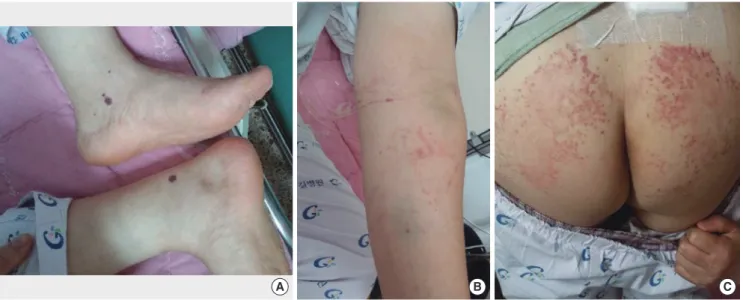
현병력: 약 10년간 만성 비염이 있었으나 치료를 받지 않았고 1년 전 기관지천식을 진단받았으나 스테로이드/지속성 기관지확장제 복합흡입제를 불규칙적으로 사용하였으며 속효성 기관지확장제 를 호흡곤란 증상 발생 시에 흡입하였다. 내원 3주 전부터 38°C 이 상의 열, 피로감, 근육통, 체중 감소, 기침과 가래가 점차 심해져 인 근 의원에서 경구 세팔로스포린 항생제를 투여 받았으나 증상의 호전이 없었다. 2주 전부터 전신 증상이 악화되고 양손과 발의 저리 고 따끔거리는 감각 이상과 함께 상복부 통증이 동반되었는데, 해 당 의원에서는 급성 신우신염 의증으로 레보플록사신(levofloxa- cin) 항생제를 투여하였다. 내원 5일 전 고열이 지속되고 호흡곤란 이 동반되어 2차 의료기관을 방문하여 입원하였다. 당시 백혈구증 다증(호산구 분율 40%)에 대하여 항생제 주사 치료를 받던 중 내 원 하루 전 양측 발목과 좌측 전완 및 엉덩이에 자반성 구진이 발생 하면서, 소변량 감소를 동반한 신기능 악화가 관찰되어 대학병원으 로 전원되었다.
가족력: 특이 가족력 없었다.
사회력: 30갑년의 흡연자로 10년 전 금연하였고, 주 1회 소주 반 병 정도 음주를 했다.
신체검사 소견: 활력징후에서 혈압 138/76 mmHg, 맥박수 분당 86회, 호흡수 분당 20회, 체온 37.9°C였다. 환자 의식은 명료하였으 나 급성 병색을 보였다. 두부 및 경부검진에서 특이 소견 없었다. 흉 부검진에서 양폐야에 거친 호흡음과 천명음 청진되었다. 복부검진 에서 우상부의 압통 및 머피씨 징후(Murphy's sign)가 있었다. 상하
지 검진에서 양측 발목과 좌측 전완 및 엉덩이에 자반성 구진이 관 찰되었다(Fig. 1). 신경학적 검진에서 양측 손가락과 발에 감각 이상 (paresthesia) 및 감각 감퇴(hypesthesia)가 있었으나 사지 근력은 grade V로 정상이었고 심부 건반사도 정상이었다.
검사실 소견: 일반혈액검사에서 혈색소 12.3 g/dL, 백혈구 23,540/mm3 (호중구 49.1%, 호산구 39%), 혈소판 247,000/mm3이 었으며 C-반응성 단백은 13.12 mg/dL였다. 혈청 총 IgE는 9,450/
mm3, 호산구 양이온단백은 105.0 μg/L, 핵둘레 항호중성 백혈구 세포질 항체(perinuclear anti-neutrophil cytoplasmic antibody, p- ANCA)는 1:320으로 증가되어 있었고, 혈청 blood urea nitrogen (BUN) 25.5 mg/dL, creatinine 2,5 mg/dL로 증가되어 있었다. 24시 간 소변 단백은 145.6 mg/day로 증가되어 있었고, 소변단백 전기염 동에서 mixed type proteinuria 확인되었다.
폐기능검사: 폐기능검사에서 forced expiratory volume in 1 sec- ond (FEV1) 1.60 L (예측치의 47%), forced vital capacity (FVC) 2.34 L (예측치의 51%), FEV1/FVC 68%였고, 기관지확장제 투여 후 FEV1
의 증가량은 9%로 확인되었다.
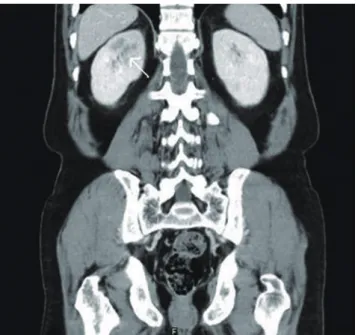
방사선 소견: 단순 흉부 및 복부 방사선 사진에서 특이 소견은 없었다. 부비동 방사선 사진에서 양측 상악동의 염증 소견이 관찰 되었고, 복부 전산화 단층촬영에서 우측 신장 상극의 실질 음영이 감소하였다(Fig. 2).
말초혈액도말검사 및 골수검사: 말초혈액도말검사에서 호산구 가 28%로 증가되어 있었고, 정적혈구 정색소성 빈혈, 독성 과립백 혈구 증가가 동반되었다. 골수검사에서는 미성숙한 보라색 과립을 보이는 호산구 전구체와 호산구가 42.2%로 증가되어 있었고 거핵 구증다증도 관찰되었지만 악성 질환의 증거는 없었다.
병리 검사: 신장 조직검사에서 반월상 사구체신염이 관찰되었으
A B C
Fig. 1. Multiple purpuric papules are observed on both ankles (A), left forearm (B), and buttock (C).
Kim S, et al. • Eosinophilic granulomatosis with polyangiitis Allergy Asthma Respir Dis
72 http://dx.doi.org/10.4168/aard.2016.4.1.70
며 피부조직검사에서는 표피에서 호중구, 호산구, 적혈구로 채워진 소수포와 함께 해면화 및 세포외출이 관찰되었고, 진피에서는 적혈 구의 혈관외유출과 혈관 주위 중성구, 림프구 및 호산구의 침윤, 그 리고 섬유소의 침착이 관찰되었는데, 호중구의 침윤은 표재진피에 이르러 백혈구 파쇄성 혈관염에 합당하였다(Fig. 3A).
신경 근전도 검사: 특이 이상 소견은 관찰되지 않았다.
심전도 및 심초음파: 특이 이상 소견은 관찰되지 않았다.
치료 및 경과: 급성 콩팥부전을 동반한 EGPA 의심하에 입원 2 일째부터 methylprednisolone을 정맥으로 60 mg/day 투여하였으 며 입원 3일째 신장조직검사 시행하여 급속 진행성 사구체신염을 진단하였고 추가적인 면역억제제 투여 없이 상기 치료를 유지하였 다. 입원 후 시행한 추적 혈액검사에서 호산구는 입원 1일째 2,348/
mm3에서 입원 5일째 0/mm3로 급격히 감소하였고, 혈중 BUN과
creatinine도 입원 1일째 각각 25.5 mg/dL, 2.5 mg/dL에서 입원 4일 째 각각 73.6 mg/dL, 4.5 mg/dL로 증가하다가 이후 감소하기 시작 하여 입원 18일째에는 각각 49.7 mg/dL, 1.2 mg/dL까지 호전되었 다. 방사선학적 검사에서는 상악동염이 호전되었고, 피부병변도 소 실되었으나 상하지의 저림 및 하지의 근력 약화는 지속되었다. 폐기 능검사에서는 FEV1 3.56 L (예측치의 105%), FVC 4.29 L (예측치의 94%), FEV1/FVC 83%로 폐기능이 호전되었다. 환자는 입원 18일째 경구 methylprednisolone 60 mg/day를 유지하면서 퇴원하였다.
고 찰
1951년에 Churg와 Strauss가 13명의 부검을 통해 호산구의 조직 침윤, 혈관 외 조직 육아종 형성 및 괴사성 혈관염의 조직학적 소견 을 EGPA의 진단 기준으로 제시하였다.1 또한 1990년 미국류마티스 학회(American College of Rheumatology)에서는 기관지천식, 부 비동염, 말초혈액 내 호산구 증다증(10% 이상), 이동성 폐 침윤, 단 발성 또는 다발성 신경병증, 조직검사상의 혈관 외 호산구 침윤의 6 가지 기준 중에 4가지 이상을 만족할 때 EGPA로 진단하도록 권고 하였다.5 본 증례의 환자에서는 기관지천식, 부비동염과 함께 중증 의 말초 혈액 내 호산구 증다증이 관찰되었고, 신장조직검사와 피 부조직검사에서 각각 호산구의 침윤 및 괴사성 혈관염이 관찰되어 EGPA를 진단할 수 있었다.
EGPA에서 나타나는 임상 양상을 높은 빈도 순으로 나열해 보 면, 천식(100%), 호산구 증다증(100%), 말초신경병증(80%), 부비동 염을 포함한 상기도 이상(60%–80%), 피부 병변(50%–55%), 심장침 범(33%), 소화기계이상(33%–48%), 신장침범(26%–55%), 근골격계 이상(21%–40%)이 있다.6,7
본 증례에서는 천식, 부비동염, 호산구 증다증이 관찰되었고 환 자가 사지의 감각 이상 및 저하를 호소하여 말초신경병증이 의심되 었으나 신경근전도검사에서는 특이 이상 소견이 관찰되지 않았다.
또한, 혈관 괴사와 출혈로 인한 자반성 구진이 관찰되었고, 피부조 Fig. 2. Abdominal computed tomography reveals decreased parenchymal en-
hancement (arrow) in upper pole of the right kidney.
A B C
Fig. 3. The glomerulus of kidney biopsy reveals crescentic glomerulonephritis (A), and skin biopsy is consistent with leukocytoclastic vasculitis (B, C). (A) Cellular cres- cent in glomerulusof kidney (PAS, × 400), (B) neutrophilic infiltration in the superficial dermis with extravasation of red blood cells (RBCs) and intravesicular filling with neutrophils, eosinophils and RBCs (H&E, × 200), and (C) dermal perivascular infiltration of neutrophils, lymphocytes and eosinophils with fibrin material (H&E, × 400).
김소정 외 • 척-스트라우스증후군 1예 Allergy Asthma Respir Dis
http://dx.doi.org/10.4168/aard.2016.4.1.70 73 직검사에서 괴사성 혈관염이 관찰되었는데, 혈관 주위로 중성구,
림프구 및 호산구의 침윤이 관찰되었다.
EGPA에서 심장 침범, 소화기계이상 및 근골격계 이상은 그 발생 빈도가 50% 이하로 상대적으로 드물다.6,7 본 증례에서도 이를 의심 할 만한 증상은 없었고, 심전도와 심초음파 모두 정상 소견을 보였다.
EGPA에서 신장 침범은 그 빈도가 20%–88%로 다양하게 보고되 고 있으며, 임상 경과와 중증도도 보고마다 다소 차이를 보인다.8-11 국내 연구에서도 신장 침범을 동반한 EGPA가 보고되고 있으나 그 빈도는 낮으며 Jeong 등의 증례에서 신기능 악화 및 급성 진행성 신 부전의 경과를 보인 EGPA가 보고된 바 있다.2,4 이 증례에서는 신기 능의 급성 악화로 단백뇨, 핍뇨 및 폐부종이 확인되었으며 급성 진 행성 신부전의 경과를 보였다. 본 증례에서도 신기능의 감소 및 단 백뇨가 확인되었으며 급속 진행성 신부전의 경과를 보였다. EGPA 의 신조직검사에서는 괴사성 반월상 사구체신염이 흔히 관찰되며, 이외에도 국소성분절성 사구체신염, 국소성 메산지움 증식성 사구 체신염, 호산구성 간질성 사구체신염 등이 관찰되기도 하고, 비교 적 드물게 급성 진행성 사구체신염의 양상을 띠기도 한다.8,9,12-17 본 증례에서는 괴사성 반월상 사구체신염과 함께 급성 진행성 사구체 신염에 합당한 소견을 보였다.
Sinico 등10의 보고에 의하면 116명의 EGPA 환자에서 31명 (26.7%)이 신장 침범이 있었는데, 16명의 환자에서 신장조직검사를 시행하였고, 그 결과 11명의 환자에서 괴사성 반월상 사구체신염이 관찰되었다. 본 증례에서도 ANCA가 양성이었으며, 신장조직검사 에서 괴사성 반월상 사구체신염이 관찰되었다.
EGPA의 신장 침범에서는 고용량의 전신 코르티코스테로이드를 투여하며 치료 반응이 대부분 좋다.6,9 그러나 치료 반응이 좋지 않 은 경우에는 cyclophosphamide 혹은 azathioprine을 병합하여 치 료하면 효과를 기대할 수 있으며, 혈장교환술도 고려해 볼 수 있으 나 아직까지 치료 효과가 정립되지 않았다.6,9
본 증례의 경우에는 전신 코르티코스테로이드를 단독 투여하였 으며, 입원 18일 째 혈청 creatinine이 거의 정상화될 정도로 호전되 어 환자를 퇴원시킬 수 있었다.
결론적으로 저자들은 국내에서는 처음으로 급속 진행성 사구체 신염이 합병된 EGPA를 조직학적으로 진단하고 고용량의 부신피 질호르몬 투여 후 호전된 바 있어, 이를 문헌고찰과 함께 보고하는 바이다.
REFERENCES
1. Churg J, Strauss L. Allergic granulomatosis, allergic angiitis, and periar- teritis nodosa. Am J Pathol 1951;27:277-301.
2. Oh MJ, Lee JY, Kwon NH, Choi DC. Churg-Strauss syndrome: the clini- cal features and long-term follow-up of 17 patients. J Korean Med Sci 2006;21:265-71.
3. Baldini C, Della Rossa A, Grossi S, Catarsi E, Talarico R, d'Ascanio A, et al. Churg-Strauss syndrome: outcome and long-term follow-up of 38 pa- tients from a single Italian centre. Reumatismo 2009;61:118-24.
4. Jeong IH, Nam YH, Kim DC, Lee HW, Yoon NB, Um SJ, et al. A case of Churg-Strauss syndrome with acute renal failure. Korean J Asthma Al- lergy Clin Immunol 2012;32:193-7.
5. Masi AT, Hunder GG, Lie JT, Michel BA, Bloch DA, Arend WP, et al. The American College of Rheumatology 1990 criteria for the classification of Churg-Strauss syndrome (allergic granulomatosis and angiitis). Arthritis Rheum 1990;33:1094-100.
6. Guillevin L, Cohen P, Gayraud M, Lhote F, Jarrousse B, Casassus P. Churg- Strauss syndrome: clinical study and long-term follow-up of 96 patients.
Medicine (Baltimore) 1999;78:26-37.
7. Solans R, Bosch JA, Perez-Bocanegra C, Selva A, Huguet P, Alijotas J, et al. Churg-Strauss syndrome: outcome and long-term follow-up of 32 pa- tients. Rheumatology (Oxford) 2001;40:763-71.
8. Lanham JG, Elkon KB, Pusey CD, Hughes GR. Systemic vasculitis with asthma and eosinophilia: a clinical approach to the Churg-Strauss syn- drome. Medicine (Baltimore) 1984;63:65-81.
9. Clutterbuck EJ, Evans DJ, Pusey CD. Renal involvement in Churg-Strauss syndrome. Nephrol Dial Transplant 1990;5:161-7.
10. Sinico RA, Di Toma L, Maggiore U, Tosoni C, Bottero P, Sabadini E, et al.
Renal involvement in Churg-Strauss syndrome. Am J Kidney Dis 2006;
47:770-9.
11. Chumbley LC, Harrison EG Jr, DeRemee RA. Allergic granulomatosis and angiitis (Churg-Strauss syndrome). Report and analysis of 30 cases.
Mayo Clin Proc 1977;52:477-84.
12. Rychlík I, Tesar V, Stejskalova A, Stejskal J, Honsova E, Bartůnková J.
ANCA-positive Churg-Strauss syndrome with renal failure. Nephrol Dial Transplant 1997;12:837-8.
13. Gaskin G, Clutterbuck EJ, Pusey CD. Renal disease in the Churg-Strauss syndrome: diagnosis, management and outcome. Contrib Nephrol 1991;
94:58-65.
14. Prochnicka A, Zelichowski G, Wojtecka A, Lubas A, Bant A, Perkowska- Ptasinska A, et al. Atypical clinical presentation of Churg-Strauss syn- drome with rapidly progressive glomerulonephritis: case report. Pol Arch Med Wewn 2009;119:830-3.
15. Sugino K, Kikuchi N, Muramatsu Y, Sano G, Kusano E, Isobe K, et al.
Churg-Strauss syndrome presenting with diffuse alveolar hemorrhage and rapidly progressive glomerulonephritis. Intern Med 2009;48:1807-11.
16. Yamashita Y, Yorioka N, Taniguchi Y, Yamakido M, Watanabe C, Kita- mura T, et al. Nonasthmatic case of Churg-Strauss syndrome with rapidly progressive glomerulonephritis. Intern Med 1998;37:561-3.
17. Tesar V, Rychlik I, Bartunkova J, Stejskalova A, Honsova E, Lachmanova J.
The Churg-Strauss syndrome with rapidly progressive glomerulonephri- tis positive for antineutrophil cytoplasmic antibodies. Cas Lek Cesk 1993;
132:691-4.