ISSN 2234-3806 • eISSN 2234-3814
390 www.annlabmed.org http://dx.doi.org/10.3343/alm.2013.33.5.390 Ann Lab Med 2013;33:390-392
http://dx.doi.org/10.3343/alm.2013.33.5.390
Letter to the Editor
Laboratory Informatics
Development and Evaluation of a Laboratory
Information System-Based Auto-Dilution and Manual Dilution Algorithm for Alpha-Fetoprotein Assay
Tae-Dong Jeong, M.D., So Young Kim, M.D., Woochang Lee, M.D., Sail Chun, M.D., and Won-Ki Min, M.D.
Department of Laboratory Medicine, University of Ulsan College of Medicine and Asan Medical Center, Seoul, Korea
Korea is known as a hepatitis B virus-endemic area with a high incidence of hepatocellular carcinoma (HCC) [1]. Alpha-fetopro- tein (AFP) is the most widely used tumor marker for monitoring HCC in clinical practices. The serum AFP level is <10 ng/mL in healthy adults, but patients with HCC show a very wide distribu- tion of AFP levels. AFP level is known to increase in 60-70% of patients with HCC [2]. In addition, 8.2-30.1% of these patients have high levels of AFP (e.g., levels of >400 ng/mL) [3, 4]. Ty- son et al. [5] reported that 29% of patients with hepatitis C-re- lated HCC had elevated AFP levels of >1,000 ng/mL.
AFP levels are currently determined by immunoassay in most clinical laboratories. As the analytical measurement range (AMR) of AFP assay reagents cannot cover all the clinically im- portant range of AFP levels, it is necessary to dilute and retest the specimens with high AFP levels.
At our institution, we measure AFP levels by using the chemi- luminescent microparticle immunoassay (ARCHITECH i2000SR system; Abbott Laboratories, Abbott Park, IL, USA) with the AR- CHITECT AFP Reagent kit (Abbott Laboratories). The AMR of the assay reagent is 0.4-350 ng/mL. However, the manufacturer has made the following recommendation: if the AFP level of the original samples is >200 ng/mL, the original samples are auto- matically retested by the instrument with a fixed-dilution ratio of
1:16.7 to rule out “hook effect.” In addition, if the AFP levels of auto-diluted samples are >5,845 ng/mL (350×16.7), the original samples are manually diluted. These dilution processes not only waste assay reagents but increase turnaround time (TAT) as well. Therefore, we developed an auto-dilution and manual dilu- tion algorithm by using the laboratory information system (LIS) to minimize the number of AFP dilution analyses and reduce TAT.
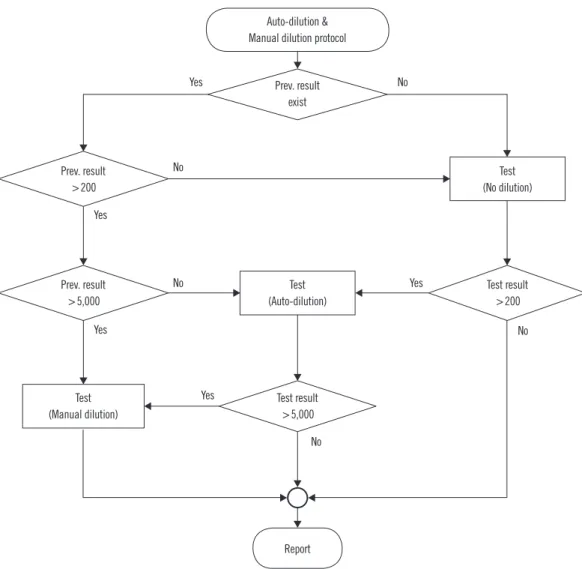
We developed an auto-dilution and manual dilution algorithm, taking into consideration both the measurement range of the AFP reagent and the fixed-dilution rate of the instrument (Fig. 1).
When previous AFP results were not available or the previous AFP results were <200 ng/mL, samples were, then, briefly tested without diluting them. Previous AFP results were defined as re- sults that were obtained within 8 weeks prior to the current AFP assay. The instrument automatically diluted the original samples if the previous AFP results were within the 200-5,000 ng/mL range. In addition, if the previous AFP results were >5,000 ng/
mL, corresponding sample racks were immediately ejected from the instrument with a particular flag sign, and the tests were subsequently performed following the manual dilution proce- dure conducted by laboratory personnel.
In total, 11,297 samples were ordered for AFP assay from June to September 2012. Among them, the developed algorithm
Received: February 7, 2013 Revision received: March 8, 2013 Accepted: June 18, 2013 Corresponding author: Won-Ki Min
Department of Laboratory Medicine, University of Ulsan College of Medicine and Asan Medical Center, 88 Olympic-ro 43-gil, Songpa-gu, Seoul 138-736, Korea
Tel: +82-2-3010-4503, Fax: +82-2-478-0884, E-mail: [email protected]
© The Korean Society for Laboratory Medicine.
This is an Open Access article distributed under the terms of the Creative Commons Attribution Non-Commercial License (http://creativecommons.org/licenses/by-nc/3.0) which permits unrestricted non-commercial use, distribution, and reproduction in any medium, provided the original work is properly cited.
Jeong T-D, et al.
Auto-dilution algorithm for AFP assay
391
http://dx.doi.org/10.3343/alm.2013.33.5.390 www.annlabmed.org
was evaluated using 10,947 samples, excluding 350 samples for prenatal screening. Previous AFP assay results were available for 8,745 of the total 10,947 samples (79.9%). Of these 8,745 samples, 479 (479/8,745; 5.5%), and 169 (169/8,745; 1.9%) had previous AFP assay results that were 200-5,000 ng/mL and
>5,000 ng/mL, respectively.
By applying the developed auto-dilution algorithm, one assay step could be omitted by automatically diluting the original sam- ples with previous AFP results of 200-5,000 ng/mL (i.e., 479 samples). Starting from the time of aspiration of the sample in the instrument, it takes approximately 29 min to obtain the re- sult of an AFP assay. As the original samples were not analyzed, the TAT could be shortened by more than 29 min in these sam- ples. In no cases were the AFP values obtained by dilution anal- ysis lower than the lowest limit of detection. Similarly, 2 assay
steps, including the measurement of the original sample and the auto-dilution assay, could be omitted by manual dilution in samples with previous AFP results of >5,000 ng/mL (i.e., 169 samples). The TAT was shortened by more than 58 min in these cases. Consequently, 8.4% of the reagents could be conserved, and the TAT was shortened by 29 to 58 min by applying the auto-dilution algorithm in patients with previous AFP results.
In conclusion, the LIS-based auto-dilution and manual dilu- tion algorithm for the AFP assay shortened the TAT and con- served reagents. Application of this auto-dilution and manual di- lution algorithm based on the patient’s previous results to the automated immunoassay system could allow for more cost-ef- fective laboratory practices in clinical laboratories.
Auto-dilution &
Manual dilution protocol
Test (No dilution)
Test result
>200 Prev. result
>5,000
Test result
>5,000 Prev. result
>200
Prev. result exist
Report Yes
Yes Yes
Yes
No
No No
No
No Yes
Test (Auto-dilution)
Test (Manual dilution)
Fig. 1. Flow chart of the auto-dilution and manual dilution algorithm for the alpha-fetoprotein (AFP) assay. The upper linearity limit of AFP assay without dilution is 200 ng/mL for the ARCHITECT AFP reagent kit. The 5,000 ng/mL is an arbitrary value that is approximately 85%
of the upper detection limit of the ARCHITECH i2000SR system for AFP assay.
Jeong T-D, et al.
Auto-dilution algorithm for AFP assay
392 www.annlabmed.org http://dx.doi.org/10.3343/alm.2013.33.5.390
Authors’ Disclosures of Potential Conflicts of Interest
No potential conflicts of interest relevant to this article were re- ported.
REFERENCES
1. El-Serag HB. Hepatocellular carcinoma. N Engl J Med 2011;365:1118- 27.
2. Arrieta O, Cacho B, Morales-Espinosa D, Ruelas-Villavicencio A, Flores- Estrada D, Hernández-Pedro N. The progressive elevation of alpha feto-
protein for the diagnosis of hepatocellular carcinoma in patients with liv- er cirrhosis. BMC Cancer 2007;7:28.
3. Kim YJ, Jang BK, Kim ES, Chung WJ, Park KS, Cho KB, et al. Hepato- cellular carcinoma in the elderly: clinical characteristics, treatment, sur- vival analysis in Korean patients older than 70 years. J Korean Med Sci 2012;27:1147-54.
4. Merani S, Majno P, Kneteman NM, Berney T, Morel P, Mentha G, et al.
The impact of waiting list alpha-fetoprotein changes on the outcome of liver transplant for hepatocellular carcinoma. J Hepatol 2011;55:814-9. 5. Tyson GL, Duan Z, Kramer JR, Davila JA, Richardson PA, El-Serag HB.
Level of -fetoprotein predicts mortality among patients with hepatitis C- related hepatocellular carcinoma. Clin Gastroenterol Hepatol 2011;9: 989- 94.