A comparative study on the accuracies of resin denture bases and metal denture bases
Hwee-Woong Park, DDS, Chang-Whe Kim, DDS, MSD, PhD, Yung-Soo Kim, DDS, MSD, PhD, MSc (OSU)
Department of Prosthodontics, College of Dentistry, Seoul National University.
Since the late 1930s, acrylic resins have been the materials of choice for the fabrication of complete denture bases. It has excellent esthetic properties, adequate strength, low water sorption, and low solubility. But acrylic resin has disadvantage of processing shrinkage that reduces denture reten- tion and accuracy of denture occlusion.
Metals also have been used in denture base material. Metals used in denture bases display excel- lent strength and dimensional stability. The major disadvantages associated with metal denture bases include increased cost, difficulty in fabrication, compromised esthetic qualities, and inability to re- base.
The purpose of this study is to compare the artificial tooth movements of complete dentures with resin bases and metal bases after curing, deflasking, polishing, immersion in water for 1 week and 4 weeks.
Twenty-four maxillary complete resin denture bases with artificial teeth were fabricated. Twelve of them were resin based and other twelve of them were metal based. Fine crosses were marked on the incisal edges of right central incisors and distobuccal cusps of both second molars. Measurements were done for the changes of distances of reference points at the time of wax denture, after deflasking, after decasting, after polishing, after immersion in water for 1 week and 4 weeks Meaurements were done to the accuracy of 0.001mm with a measuring microscope.
The results were as follows :
1. Metal base showed significantly less tooth movement than resin base after curing and decasting (p<0.01).
2. Metal base showed significantly less tooth movement than resin base after polishing (p<0.01).
3. After immersion in water for 1week and 4 weeks, metal base showed less movement than resin base.
Difference was significant for anterior-posterior distances (p<0.01), but not significant for molar- to-molar distance (p>0.01).
4. 1 week and 4 weeks of immersion failed to compensate the initial processing shrinkage of metal and resin bases (p>0.01).
Key Words:
Complete denture, metal base, resin base, accuracy, artificial tooth movement
J Korean Acad Prosthodont : Volume 39, Number 3, 2001
S
ince the late 1930s, acrylic resins have been the materials of choice for the fabrication of complete den- ture bases. It has excellent esthetic properties, ade- quate strength, low water sorption, and low solubility.1 But from the time that the denture wax-up is com- pleted until the denture is delivered to the patient and properly seated, many changes occur in the posi- tions of the artificial teeth. These changes, usually known as processing errors, have to be corrected before patients can successfully use their dentures.2 Upon polymerizing, these poly(methyl methacrylate) resins exhibit a 0.2% to 0.5% linear polymerization shrinkage. Numerous articles reported concerning the physical and mechanical properties of PMMA.Woelfel3found that linear change from waxed to fin- ished dentures, when measured molar to molar across the posterior section of the specimens, showed a shrinkage of 0.4mm(0.9%). A recovery of 0.1mm(0.2%) occurred after 3months of use. Several other investigators4-7used linear measurements to eval- uate the dimensional stability of the denture base materials by placing pins at strategic points in den- tures. Yun,8Chae9 reported the dimensional sta- bility of denture base resins and Kim10reported on occlusal and vertical changes after denture pro- cessing.
Anthony and Peyton11studied the dimensional sta- bility of heat-activated resin bases, autopolymerized resin bases, and cast cobalt-chromium bases using a modified contour comparator. The results showed that the autopolymerizing resin denture showed the most accurate fit. This study was in agreement with that of Skinner and Cooper,12in which the temperature range of cooling required after the plastic reached a rigid state in the molds(transi- tion temperature)was the principal factor in the observed shrinkage.
In the past few years, acrylic resin monomers and polymers have also been modified to improve not only physical and mechanical properties, but al- so the working properties that facilitate laboratory
techniques of denture fabrication. These new lab- oratory techniques include microwave-and visible light-activated polymerization, and vacuum-plus- pressure adaptation during low-temperature poly- merization of resin system.13In spite of all of these advances, no combination of resin material and processing technique has been able to reduce linear distortion to less than 0.2%.14
The movement of teeth during processing of complete dentures disturbs the harmonious oc- clusal scheme achieved at the final try-in stages. This movement can be in any direction and may occur as a result of processing procedures and dimensional changes of the acrylic resin denture base during cur- ing, deflasking, finishing, and polishing.15,16
Several variables contribute to denture base dis- tortion. For example, Woelfel and Paffenbarger2 discovered that a thinner denture base will distort twice as much as a thicker denture base. Barco et al.17 observed that dentures processed in heat-poly- merized resin without teeth fit better than those with teeth.
Metal alloys also have been used in denture base material. Metal alloys used in denture bases display excellent strength-to-volume ratios18and may be cast in thin sheets maintaining rigidity and fracture resistance. Thinner metallic denture bases decrease interference with phonation.19Metal bases also dis- play desirable dimensional characteristics and may be cast accurately.20They also exhibit the sorption- related dimensional changes characteristic of com- monly used polymers.21
High thermal conductivity also has been thought to be a significant advantage and some practition- ers feel that this characteristic is responsible for enhanced health of tissues in contact with metal bases.
However, little objective information is available.
The major disadvantages associated with metal den- ture bases include increased cost, difficulty in fab- rication, compromised esthetic qualities, and in- ability to rebase.
There were many studies on dimensional accuracy
of resin denture base. But little research has been con- ducted on comparison of tooth movements in den- ture with resin base and metal base.
The purpose of this study was to compare the tooth movements of complete dentures with resin bases and metal bases after curing, deflasking, polish- ing, immersion in water for 1 week and 4 weeks.
MATERIAL AND METHODS
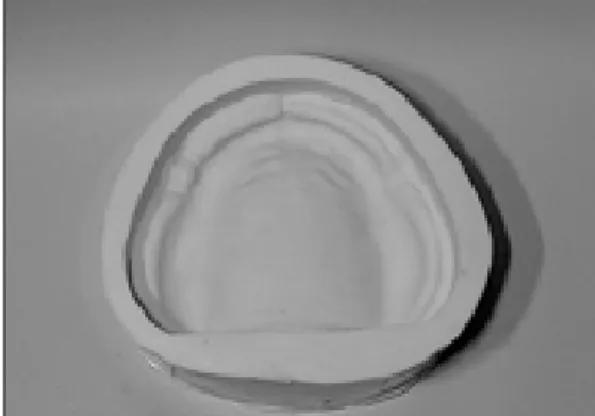
A rubber mold (Fig. 1) was made of a nonundercut edentulous maxillary cast (Fig. 2) using molding sil- icone (Shinetshu, Japan). This mold was used to pre- pare 24 identical stone casts. Type V dental stone (Die- Keen, Heraeus Kulzer Inc, USA) was measured and mixed with the recommended amount of wa-
ter(W/P ratio=21ml/100g) using automatic mix- er(MixQueen, Oscotec, Korea). A master complete maxillary denture (Fig. 3) with palatal thickness of 2mm was waxed up with acrylic resin denture teeth (Truebyte Bioform 264 and 32M, Dentsply). On 12 stone casts, metal denture base was fabricated (Ticonium Premium 100, Ticonium Co., Albany.
NY). Metal bases covered all palate and were ex- tended to residual alveolar ridge (Fig. 4). Retentive beads were formed for denture base resin to be at- tached to metal base. To ensure uniformity and permit comparisons, a mold from silicone rubber (Exaflex putty, GC America Inc., USA) was made from the master denture (Fig. 5). With the same mold of teeth the denture wax-up were duplicated by melting and pouring wax into the mold that
Fig. 1.Silicone mold for duplication of stone cast. Fig. 2. The master stone cast.
Fig. 3.Complete maxillary denture wax-up for resin base. Fig. 4. Complete maxillary denture wax-up for metal base.
held the acrylic resin teeth and stone casts in correct relationship to each other.
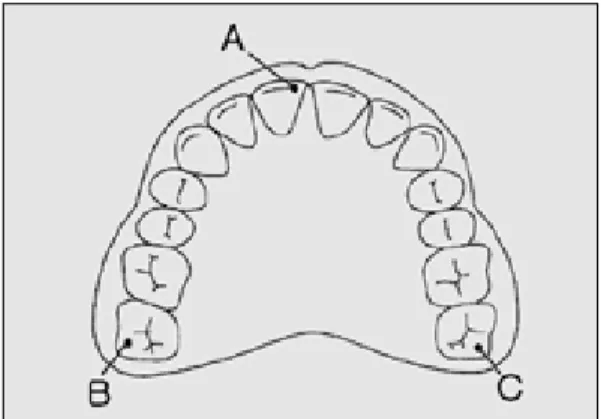
Twenty-four denture wax-ups(twelve for metal den- ture base and twelve for resin denture base) in- cluding the reference points were made. The wax- ups were identical in thickness, height, and contour because they were prepared from the same mold. Fine crosses were marked with a surgical scalpel(Surgical Blade, Feather Safety Razor Co., LTD, Japan) on the incisal edges of right central incisors(point A) and distobuccal cusps of both second molars(point B and C) to be used as reference points for measuring
distances(Fig. 6). The crosses were marked with indelible pencil to make them more visible(Fig. 7).
Distances(ABR, BCR, and CARfor resin denture, ABM, BCMand CAMfor metal denture) on artificial teeth were measured at the wax-up stage before investing.
These were used as the starting point, and all values were calculated with these measurements as the start- ing point. Subsequent measurements were made (1) after processing and before decasting, (2) after de- casting, (3) after the dentures had been polished, (4) after the dentures had been stored in water at room temperature for 1week, and (5) for 4 weeks.
Heat curing acrylic resin (Vertex RS, Dentimex Zeist, Holland) was used for denture base material, and curing was performed in boiling water for 20 Fig. 7. Reference point seen with the microscope(×50).
Fig. 5. Silicone mold for duplication of wax denture. Fig. 6.Positions of reference points on maxillary den- ture.
Fig. 8. Traveling microscope for measuring distances between reference points.
minutes with denture curing unit(Curing Unit, Teledyne Hanau, Buffalo, N.Y.).
All measurements were made with digital mea- suring microscope(Mitsutoyo, Japan) and recorded to the nearest 0.001mm(Fig. 8). Measurements were made by the same operator, and every measurement was made 3 times to establish a mean value.
The data were analyzed with Statistical Analysis System(SAS) Version 6.04 software(SAS Institute Inc., Cary, N.C.) using Wilcoxon rank sum test.
RESULTS
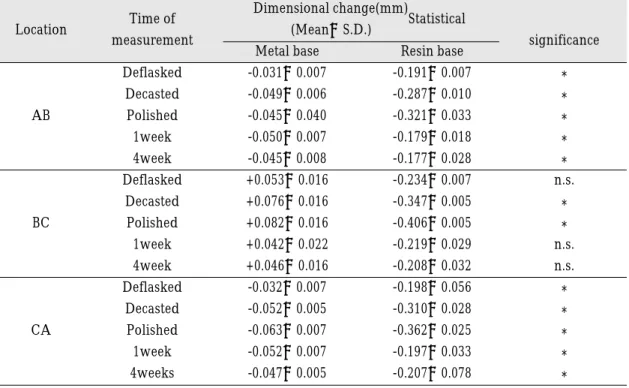
Table Ⅰ shows horizontal dimensional changes in AB, BC, and CA distances measured at the time of wax denture vs. measurements at various times and statistical results.
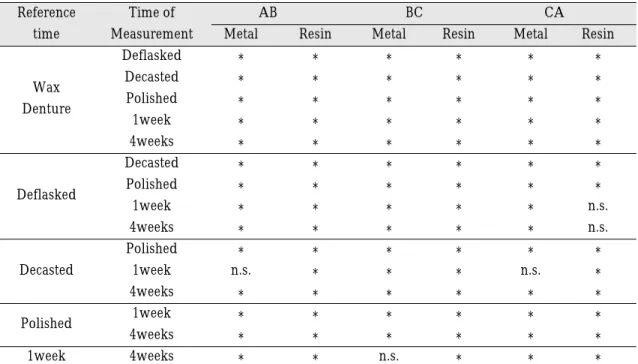
Table Ⅱ shows results of Wilcoxon rank sum
test on the continuous dimensional changes in each group and each reference time. This shows whether each group had significant change compared to previous stage.
Figs. 9,10 and 11 show dimensional changes con- tinuously and graphically. The shrinkage or ex- pansion of measured distances are presented as negative or positive values in all tables and graphs.
Significant differences were found between the resin group and the metal group throughout the proce- dures. Metal group showed significantly smaller di- mensional changes in processing, polishing, and storage of 1 week and 4 weeks for all the anterior- posterior measurements. But the molar-to-molar distances between metal base and resin base showed no significant difference after deflasking, immersion of 1 week and 4 weeks. So difference of tooth move- ment between metal base and resin base was small-
Table Ⅰ. Horizontal dimensional changes in AB, BC, and CA distances measured at the time of wax denture vs measurements at various times and results of Wilcoxon rank sum test
Time of Dimensional change(mm)
Statistical Location
measurement (Mean±S.D.)
significance
Metal base Resin base
Deflasked -0.031±0.007 -0.191±0.007 *
Decasted -0.049±0.006 -0.287±0.010 *
AB Polished -0.045±0.040 -0.321±0.033 *
1week -0.050±0.007 -0.179±0.018 *
4week -0.045±0.008 -0.177±0.028 *
Deflasked +0.053±0.016 -0.234±0.007 n.s.
Decasted +0.076±0.016 -0.347±0.005 *
BC Polished +0.082±0.016 -0.406±0.005 *
1week +0.042±0.022 -0.219±0.029 n.s.
4week +0.046±0.016 -0.208±0.032 n.s.
Deflasked -0.032±0.007 -0.198±0.056 *
Decasted -0.052±0.005 -0.310±0.028 *
CA Polished -0.063±0.007 -0.362±0.025 *
1week -0.052±0.007 -0.197±0.033 *
4weeks -0.047±0.005 -0.207±0.078 *
* denotes significant difference at 0.01 level
er for molar-to-molar distance. Finally after storage of 4 weeks, the differences of changes in AB and CA distances showed significant differences between met- al and resin base. But no significant differences were found for BC distances. All distances of resin base denture showed a shrinkage after processing.
This finding confirms previous results.22-29Linear change increased continuously during deflasking, decasting, and polishing. After decasting, the decrease of distance of resin base was 0.287mm to 0.347mm.
After polishing, it increased to 0.321mm to 0.406mm.
After immersion in distilled water for 1 week and 4 Table Ⅱ. Wilcoxon rank sum tests on the continuous dimensional changes in each group and each reference time
Reference Time of AB BC CA
time Measurement Metal Resin Metal Resin Metal Resin
Deflasked * * * * * *
Wax Decasted * * * * * *
Denture Polished * * * * * *
1week * * * * * *
4weeks * * * * * *
Decasted * * * * * *
Deflasked Polished * * * * * *
1week * * * * * n.s.
4weeks * * * * * n.s.
Polished * * * * * *
Decasted 1week n.s. * * * n.s. *
4weeks * * * * * *
Polished 1week * * * * * *
4weeks * * * * * *
1week 4weeks * * n.s. * * *
* denotes distance significantly different to that of reference time at 0.01 level.
Fig. 9. Dimensional changes in AB distances of metal based denture and resin based denture.
Fig. 10.Dimensional changes in BC distances of metal based denture and resin based denture.
weeks, some recovery of shrinkage was observed.
Finally after storage in distilled water for 4 weeks, the decrease of distance was 0.177mm to 0.209mm.
As seen in the graphs, the amount of tooth move- ment in resin base increased continuously through the procedure of curing, decasting, polishing. The amount of tooth movement was greatest after pol- ishing, and recovery occurred after immersion in wa- ter.
The changes of metal base were different from that of resin base. AB and CA distance of dentures of met- al base decreased, but the BC distance of them showed a small increase. The distance of metal base denture showed a decrease of 0.049mm for AB and 0.052mm for CA after decasting. On the contrary, the BC distance increased to the amount of 0.076mm after decasting. After polishing they were 0.045mm for AB, 0.063mm for CA. And finally after storage of 4 weeks, they were 0.045mm and 0.047mm for each.
Also, analysis were done for continuous dimen- sional changes in each group and each reference time(Table Ⅱ). Almost all measurements underwent significant changes after each step of denture fab- rication.
DISCUSSION
The first unavoidable dimensional change in
every acrylic resin prosthesis is shrinkage that occurs during processing and finishing. The second change, expansion, occurs when the dentures are either stored in a water bath or inserted in the mouth and then absorb oral fluids.30-32
In this experiment, dentures with metal bases showed greater dimensional stability after decast- ing. Traditionally, PMMA dentures are processed in brass denture flasks by compression molding of the acrylic resin with stone while it is in the doughy stage. The flasks are placed in a temperature-con- trolled water bath for a specified time to permit resin polymerization. There has always been a problem with shrinkage of the acrylic resin during the polymerization process. The resin’s coefficient of linear expansion is 81×10-6. The gypsum products which form the mold have a coefficient of linear ex- pansion one-eighth that of acrylic resin. This difference contributes to the dimensional change and induced strain.33
But it can be assumed that in a metal base denture, all the internal stress could not be released due to the reinforcing effect of the metal base. The metal frame had retentive beads and was extended beyond the residual alveolar ridge. Also a denture with metal base has smaller volume of PMMA resin than a denture without metal base. In this experiment, dentures with metal bases also showed signifi- cantly less tooth movement after decasting. The amount of movements were -0.052 to +0.076mm. They also showed significantly less tooth movement af- ter polishing. They have less volume and less sur- face area of PMMA resin, and much less time and amount of resin to be reduced. So dimensional changes due to polishing and finishing is mini- mized. Woelfel27stated that during the finishing and polishing, minimize the reduction of bulk, avoid heating up the denture base as frequently oc- curs with the use of large arbor bands. He also stated that either gross bulk reduction or over- heating may cause unnecessary denture base warpage. Other investigators2,4,34,35stated similar Fig. 11. Dimensional changes in CA distances of met-
al based denture and resin based denture.
opinions.
The resin group showed decrease of distances for all direction, but in the metal group, molar-to-mo- lar distance showed increase. This result can be thought to be due to the U-shaped portion of resin base. Resin contracts in a direction to the center, but in U-shaped base, contraction occurred to the out- side direction. So expansion was observed in these measurements.
The changes of molar-to-molar distances for met- al bases were smaller than that of resin bases, but no significant differences were found between metal bases and resin bases after 1 week and 4 weeks of im- mersion. The amount of processing shrinkage after decasting were -0.347 to -0.287mm in resin group. This amount is larger than those reported by other au- thors.3,14,36In this experiment, fast heat-cured resin(boil- able resin) was used. Some articles reported about the dimensional stability of boilable acrylic resin. Some authors29,33reported that boilable acrylic resin pro- duced significantly less distortion in a denture base than the conventional acrylic resin. Others37,38reported opposite opinion. These differences are thought be due to the different test specimen and conditions.
In experimental studies on dimensional stability of complete denture, it is difficult to standardize test condition, e.g. palatal shape, arch shape, height of residual ridge, denture thickness. These factors would have led to different results.
Results of this study are comparable to the de- scription of Woelfel and Paffenbarger.39They reported the dimensional changes in complete dentures up- on drying, wetting, and heating in water. The average change of the molar-to-molar and the border-to-bor- der distances for individual dentures during the 12 to 35 months of immersion in water raged from - 0.017% to +0.70%; on drying for 3weeks in a desic- cator the range was -0.03% to -0.92%. Also this results confirms the report of Antonopoulos40which de- scribed the dimensional and occlusal changes in processing denture.
All distances of resin base denture significantly ex-
panded and showed recovery after 1-week compared to the measured distances after polishing. 4 week im- mersion in water failed to compensate processing shrinkage. Theoretically, water sorption can help com- pensate for processing shrinkage by expanding the denture.41Campbell42concluded that water sorption reflects increased retention of dentures. Skinner and Cooper12and other authors43,44stated that water sorption by the acrylic resin denture base general- ly compensates for the shrinkage that occurs during processing.
Woelfel and Paffenbarger2on the other hand, showed that linear shrinkage is actually greater than linear expansion. Polyzois et al.29reported that the expansion of dentures after storage in wa- ter at room temperature for 1 week failed to com- pensate for the initial processing shrinkage. Anthony and Peyton11stated that after storage in water for 8 months, the dentures remained dimensionally sta- ble. Mowery et al.45concluded that the greatest di- mensional recovery occurs during the first month of storage in water and that no significant expansion occurs afterward. Pickett and Appleby46concluded that maximum improvement in denture base adap- tation occurs after 3 days storage in water when a tin- foil substitute is used as a separator during flasking and a 160℉, 15-hour curing cycle is used. These dif- ferences are thought to be the result of different test condition, test method, and material used.
All distances of metal base denture showed no sig- nificant recovery after immersion in water for 1 week and 1 month. Significant changes occurred af- ter 4 weeks, but these changes failed to compensate initial processing shrinkage. It is difficult to evalu- ate this result because there are few articles re- porting tooth movement of metal base denture.
But in this experiment after immersion in water for 4 weeks, metal base denture showed significantly less distortion than resin base denture.
Clinically, tooth movement during processing, pol- ishing, and immersion in water affect the occlu- sion of the complete denture. Sykora et al.47em-
phasized that with the use of anatomical posterior teeth any induced change in the cusp angle rela- tionship of the teeth to each other due to the wax and/or acrylic resin base dimensional change will be greatly magnified. This will substantially affect the incisal pin opening and the loss of centric occlusal contacts.
All of the errors and inaccuracies should be cor- rected before the patient is permitted to wear the pros- theses.48The greater the errors, the more time con- sumed in the correction procedure. Accurate and di- mensionally stable denture base is essential.
Metal denture bases have many advantages. It has better thermal conductivity and reduced bulk, increase tissue tolerance49and as seen in this study, has bet- ter dimensional stability during processing and storage. If these properties are understood, clinicians could have another treatment choice for complete den- ture patients.
CONCLUSION
This study measured the movement of artificial teeth in maxillary denture to evaluate the dimensional stability of two denture bases: heat-cured resin base and metal base.
The results were as follows:
1. Metal base showed significantly less tooth move- ment than resin base after curing and decast- ing (p<0.01).
2. Metal base showed significantly less tooth move- ment than resin base after polishing (p<0.01).
3. After immersion in water for 1 and 4 weeks, metal base showed less movement than resin base. Difference was significant for anterior- posterior distances (p<0.01), but not significant for molar-to-molar distance (p>0.01).
4. 1 week and 4 weeks of immersion failed to com- pensate the initial processing shrinkage of met- al and resin bases (p>0.01).
REFERENCES
1. Winkler S. Denture base resins. Dent Clin North Am 1984;28:287-297.
2. Woelfel JW, Paffenbarger GC. Method of evaluating the clinical effect of warping a denture. 1959 J Am Dent Assoc 1959;59:250-264.
3. Woelfel JB, Paffenbarger GC, Sweeney WT.
Dimensional changes occurring in dentures dur- ing processing. J Am Dent Assoc 1960;61:413-430.
4. Sweeney WT, Paffenbarger GC, Beall JR. Acrylic resins for dentures. J Am Dent Assoc 1942;29:7-33.
5. Skinner EW. Acrylic resins:An appraisal of their use in dentistry. J Am Dent Assoc 1949;39:261-268.
6. Stafford GD, Bates JF, Huggett R, Handley RW. A review of the properties of some denture base polymers. J Dent 1980;8:292-306.
7. Yeung KC, Chow TW, Clark RKF. Temperature and dimensional changes in the two-stage process- ing technique for complete dentures. J Dent 1995;23:245-253.
8. Yun SD, Kim CW. An experimental study on di- mensional stability of complete dentures processed in various denture base resins. Journal of College of Dentistry, Seoul National University Vol.1 1988.
9. Chae SY, Vang MS. Dimensional stability and surface morphology of various denture resins.
JKAP 1992:30.
10. Kim KS, Kim CW. An experimental study on oc- clusal and vertical changes after denture pro- cessing. JKAP 1990;28.
11. Anthony DH, Peyton FA. Dimensional accuracy of various denture-base materials. J Prosthet Dent 1962;12:67-81.
12. Skinner WE, Cooper EN. Physical properties of den- tal resins. Part 1. Curing shrinkage and water sorption. J Am Dent Assoc 1943; 30:1845-1852.
13. Takamata T, Setocos JC. Resin denture bases:
Review of accuracy and methods of polymeriza- tion. Int J Prosthodont 1989;2:555-562.
14. Baemmert RJ, Lang BR, Barco MT, Billy EJ. The ef- fects of denture teeth on the dimensional accura- cy of acrylic resin denture bases. Int J Prosthodont 1990;3:528-537.
15. Philips RW. Skinners science of dental materials.
8th ed. Philadenphia: WB Saunders Co, 1982:196.
16. Wesley RC, Henderson D, Frazier QZ. Processing changes in complete dentures: posterior tooth contacts and pin opening. J Prosthet Dent 1973;29:46- 54.
17. Barco M, Moore B, Swartz M. The effect of relining on the accuracy and stability of maxillary complete dentures-An in vitro and in vivo study. J Prosthet Dent 1979;42:17-22.
18. Faber BL. Lower cast metal base denture. J Prosthet Dent 1957;7:51-54.
19. Allen LR. Improved phonetics in denture con- struction. J Prosthet Dent 1958;8:753-763.
20. Roth GJ. An analysis of articulate sounds and its
use and application in the art and science of den- tistry. Am J Orthod 1940;26:1-23.
21. Philips RW. Skinners science of dental materials.
9th ed. Philadelphia: WB Saunders, 1991:177-213.
22. Grunewald AH, Paffenbarger GC, Dickson G.
The effect of molding processes on some proper- ties of denture resins. J Am Dent Assoc 1952;44:269- 284.
23. McCartney JW. Flange adaptation discrepancy, palatal base distortion, and induced malocclu- sion caused by processing acrylic resin maxillary complete dentures. J Prosthet Dent 1984;52:545-553.
24. Becker CM, Smith DE, Nicholls JI. The comparison of denture-base processing technique. Part II.
Dimensional changes due to processing. J Prosthet Dent 1977;37:450-459.
25. Vieira DF. Changes in the relative position of teeth in the construction of denture bases. J Dent Res 1962;41:1450-1460.
26. Zani D, Vieira DF. A comparative study of silicone as a separating medium for denture processing. J Prosthet Dent 1979;42:386-391.
27. Woelfel JB. Processing complete dentures. Dent Clin Nort Am 1977;21:329-38.
28. Garfunkel E. Evaluation of dimensional changes in complete dentures processed by injection-press- ing and the pack-and-press technique. J Prosthet Dent 1983;50:757-761.
29. Polyzois GL, Karkazis HC, Zissis AJ, Demetriou PP.
Dimensional stability of dentures processed in boilable acrylic resins: A comparative study. J Prosthet Dent 1987;57:639-647.
30. Sykora O, Sutow EJ. Improved fit of maxillary complete dentures processed on high expansion stone casts. J Prosthet Dent 1997;77:205-208.
31. Johnson DL Duncanson JM Jr. The plastic postpalatal denture seal. Quentessence Int 1987;18:457-462.
32. Jow J. Mechanical undercuts as a means of de- creasing shrinkage in the postpalatal seal region of the maxillary denture. J Prosthet Dent 1989;62:110- 115.
33. Firtell DN, Green AJ, Elahi JM. Posterior periph- eral seal distortion related to processing temper- ature. J Prosthet Dent 1981;45:598-601.
34. Skinner EW, Jones PM. Dimensional stability of self- curing denture base acrylic resin. J Am Dent Assoc 1955;51:426-431.
35. Lorton L, Philips RW. Heat-released stress in acrylic dentures. J Prosthet Dent 1979;42:23-26.
36. Craig RG. Restorative Dental Materials, 8th ed. CV Mosby, St Louis. 1989;529.
37. de Gee AJ, ten Harkel EC, Davidson CL. Measuring procedure for the determination of the three-di- mensional shape of dentures. J Prosthet Dent 1979;42:149-153.
38. Stafford GD, Hugget R, Handley RW. A review of the properties of some denture base polymers. J Dent 1980;8:292-306.
39. Woelfel JB, Paffenbarger GC, Sweeney WT.
Dimensional change in complete dentures on dry- ing, wetting and heating in water. J Am Dent Assoc 1962;65:495-505.
40. Antonopoulos AN. Dimensional and occlusal changes in fluid resin dentures. J Prosthet Dent 1978;39:605-615.
41. Peyton FA, Anthony DH. Evaluation of dentures processed by different techniques. J Prosthet Dent 1963;13:269-282.
42. Campbell RL. Effects of water sorption on reten- tion of acrylic resin denture bases. J Am Dent Assoc 1956;52:448-455.
43. Sykora O, Sutow EJ. Posterior palatal seal adaptation:
influence of processing technique, palatal shape and immersion. J Oral Rehabil 1993;20:19-31.
44. Anderson GC, Schulte JK, Arnold TG. Dimensional stability of injection and conventional process- ing of denture base acrylic resin. J Prosthet Dent 1988;60:394-398.
45. Mowery WE, Burns CL, Dickson G, and Sweeney WT. Dimensional stability of denture base resins.
J Am Dent Assoc 1958;57:345-353.
46. Pickett HG, Appleby RC. A comparison of six acrylic resin processing techniques. J Am Dent Assoc 1970;80:1309-1314.
47. Sykora O, Sutow EJ. Comparison of the dimensional stability of two waxes and two acrylic resin pro- cessing techniques in the production of complete dentures. J Oral Rehabil 1990;17:219-227.
48. Firtell DN, Finzen CF, Holmes JB. The effect of clin- ical remount procedures on the comfort and suc- cess of complete dentures. J Prosthet Dent 1987;57:53- 57.
49. Hickey JC. Zarb GA, Bolender CL. Boucher’s prosthodontic treatment for edentulous patients.
9th ed. St Louis:CV Mosby: 1985. p. 464.
Reprint request to:
DR.CHANG-WHE KIM
DEPT. OF PROSTHODONTICS, COLLEGE OF DENTISTRY, SEOUL NATIONAL UNIV.
28-1, YEONGUN-DONG, CHONGNO-GO, SEOUL, 110-749,KOREA Tel:+82-2-760-2661, Fax:+82-2-760-3860