
Joumulofthe Korean ChemicalSociety 2000, Vol.44, No. 3
Prhted in the Republicof Kore~
Synthesis and
ABSTRACT.
z+=%”
“$sH!I
~Ajq q-~ +qqq-q q qa++
(2000. 4. 15 %+=)
Electronic Properties of Dicarbonyltetrakis(triphenylphosphine) Complexes of Molybdenum(0) and llmgsten(0)
Chil-Nam Choi* and Sun-Kyu Kim
Department of Chemistry, Chosun Universi~, Kwang Ju 501-759, Korean (Received April 15, 2000)
The chemical behavior for Mo(O) and W(0) complexes, [M(co),(pph)d (M=Mo and W), has been investigated by UV-vis spectroscopic, magnetic, and electrochemical methods. Three absorption bands are observed in the UV-spectra. The crystal-field-splitting energy, spin-pairing energy, and bond strengths were deduced from the spectra. The metal d electrons in both complexes seemed to be delocalized in low-spin state.
Metal ligaod correlation appeared to strongly depend on bond strengths and diamagnetic properties. In elec- trochemical processes, both complexes exhibit an irreversible reduction wave.
INTRODUCTION
There are many biologically interesting ligands that form various complexes with molybdenum and tung- sten.’2 ,4 few important complexes may deserve men- tioning. For example, the purple-brown, air-sensitive solid Mo(acac)3 was obtained by heating Mo(CO)C or K3MoC16with acetylaeetonate(CHjCOCHCOCHs, acae).
Pyrazolyborate complexes or’the type (HbpzJMCl~ were obtained from molybdenum compounds, and their oxi- dation to a variety of mixed oxochloro species was car- ried out.34 Dinitrogen complexes have been studied extensively with a view to understanding natural nitro- gen-fixing systems.s The bis(dinitrogen) complexes are generally prepared by the reactions of higher-valent halo- gen complexes already containing the phosphine ligauds with strong reducing agents (e.g., NakIg) in the presence of Nz gas.6 Of the Iigands that form various complexes with both Mo and W, the dithiocarbamato ligand is the most important.7
Molybdenum and tungsten complexes frequently ex- hibit similarities in various aspects of their chemistry, although there are some differences that are not easy to explain. Thus, some compounds of the same type differ noticeably in their reactivity toward various reagents; for example, Mo(CO)G and W(CO)6 do not react wi+~ acetic acid to give the same type of the compounds, quadruply bonded dimetal tetraacetate. For the heavier elements, the higher oxidation states are more common and more stable against reduction than the lighter ones. Molybdenum is one of the biologically active transition elements.g It is inti- mately involved in the functioning of enzymes called nitrogenases, which cause atmospheric N2 to be reduced to NH,. In this paper, we report the electronic properties, magnetic properties, and electrochemical behavior of complexes of the type M(CO) 2(PPhJ, (M=Mo and W).
EXPERIMENTAL SECTION
Materials and instrumentation. All reagents and sol-
vents were purified according to the conventional proce- dotes. Dimethylsolfoxide(DMSO) used in electrochemic- al measurements was distilled twice over P,O, and then once over CaHZ under nitrogen. Tns(acetylacetonato) molybdenum(III) and -tungsten(HI) compounds, [M(acac)J (M=Mo, W, acac=CHjCOCHCOCHJ were prepared by the literature method.’
UV-visible spectra were obtained with a Beckmann IX-T-68.Elemental analyses were performed with Perkin- Elmer Model 240C Elemental Analyzer, and conduc- tance was measured with an ORION 142. The magnetic susceptibilities were measured with a PARC Model 155 Vibrating Sample Magnetometer(V. S.M). Cyclic Volta- mmetry(CV) was carried out with a PARC Model-303A static mercury dropping electrode(SMDE) and PARC 264A polarographic analyzer equipped with a PARC Model KE-0089 XY recorder. A three-electrode cell consisting of a working electrode, a platinum-wire coun- ter electrode, and a Ag/AgCl reference electrode, was used. Lithium perchlorate(LiC104) was used as a Sup- porting electrolyte.
Preparation. Unless otherwise stated, all the reactions have been performed with standard Schlenk line and cannula techniques under argon or nitrogen. The title compounds, &M(CO) Z(PPhJq (M=Mo and W) were synthesized by the same method reported for related Mo(O) and W(0) compounds. ‘“
To a stirred solution of 0.723 g(l.84 mmol) of [Mo (acac)s] and 4.840 g(11.1 mmol) of PPh, in 35 ml of tol- uene was added 2.2 g( 11.1 mmol) of tri(isobutyl)alumi- num at –40 “C. The temperature was gradual] y raised to room temperature, and the CO gas was bubbled into the reaction mixture for 30 min. Addition of 30 ml of n-hex- ane to the solution gave cis-Mo(CO)z(PPhJd (1) as bmwn- yellow ctystals. III the same way, cis-W(CO)Z (?phJ, (2) was obtained m dark brown crystals, respectively. Com- pounds 1 and 2 were recrystallized from n-hexane. Anal.
calcd forc74&Io2p&b C, 74.W, H, 5.M, Q 2.66.FOUUd C, 73.5Q H, 5.05; 0,2.57. C,J-Ln02P,lV C, 68.93; H 4.69;
O, 2.48. Found C, 68.88; H, 4.65; O, 2.50.
RESULTS AND DISCUSSION
UV-vis spectroscopy. The W-visible spectra of [Mo (CO)2(PPhJJ (1) and [W(CO)JPPhJd (2) are shown in
2000,Vol.44, No. 3
200 300 400
Wavelength (rim)
Fig. 1. UV visible absorption spectra of [Mo(CO)ApphJ.d (a) and [W(CO),(pphJ,](b) complexes in dimethylsulfoxide solutions.
Fig. 1, which shows distinctive three absorption bands for each compound. Compound 1 exhibits one band at 18870.17 cm-’ that can be assigned as a d-d transition, in addition to two intense bands (E=104-10s) at 20708.03 and 23881.47 cm-’ that can be assigned as charge-trans- fer or intraligand transitions. ” In a similar manner, com- pound 2 exhibits one band at 18904.43 cm-’(a d-d transition) and two bands at 20874.87 and 23881.47 cm”’.
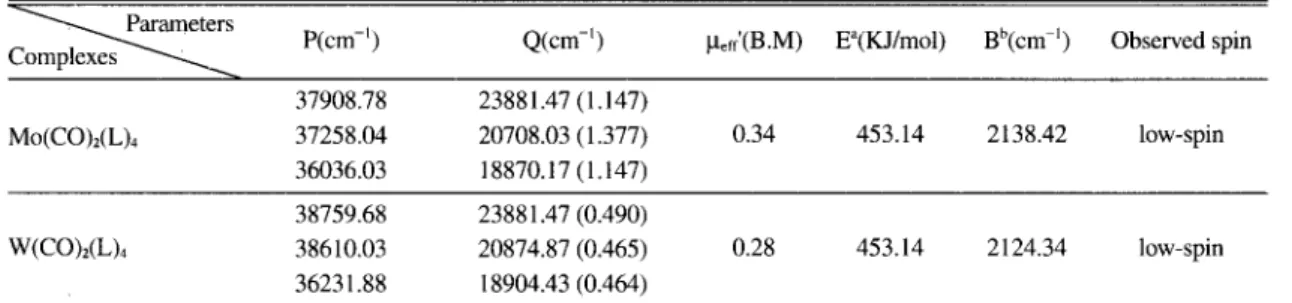
Table 1 lists absorption data for compounds 1 and 2.
Because the coordination sphere of the Mo(O) and W(0) metals in both compounds is octahedral, the absorption bands expected for these compounds should be spin- allowed, but Laporte-forbidden, d-d transitions, although weak in intensity.
The spin state of the central metal (high- or low-spin) depends on the relative magnitudes of crysta-filed-split- ting energy (AJ and spin-pairing energy (P). The mag- nitude of Ao can be determined by investigating the energy difference between the two bands at vz and v~ in the free metal ion and those in its complex.’2 On the basis of the values in Table 1, the A“ value for compound 1 can be calculated as 3173.43 cm-’, and its P value as 650.74 cm-’. In the same manner, the ,, value for com- pound 2 can be calculated as 3006.60 cm-’, and its P value as 149.65 cm-’. These values indicate that the mean A,, value is greater than the mean P value, and therefore both compounds are expected to be in the low-
Table1. Parameters for crystal field splitting of Mo(VI) and W(VI) complexes
= P(cm-’) Q(cm-’) p.N’(B.M) E’(KJ/mol) Bb(cm-’) Observed spin
37908.78 23881.47 (1.147)
MA,, 37258.04 20708.03 (1.377) 0.34 453.14 2138.42 low-spin
36036.03 18870.17 (1.147) 38759.68 23881.47 (0.490)
w(CO),(L)4 38610.03 20874.87 (0.465) 0.28 453.14 2124.34 low-spin
36231.88 18904.43 (0.464)
L. Tetrakis-Triphenylphosphine, P: Free ion Frequency (cm-l), Q: Complex Frequency (cm-]), I.&: Magnetic susceptibility, a Strength of Bonding, b: Electronic Repulsion Parameter, (E): (log&M-’)(Absorption Ratio)
spin state. It is well known that, with increasing crystal- filed strength, the electrons will preferentially occupy the more stable tjgorbitals.’3
Threed-d transitions are observed in these systems: at 18870.17, 20708.03, and 23881.47 cm-’ for compound 1; 18904.43, 20874.87, and 23881.47 cm-’ for com- pound 2. These transitions can be assigned to the tran- sitions ‘A,&#T,s.(F), ‘A,@)-+’T@), and ‘A@)-+’T@).
From the equations proposed by DOU’4and from the energies of the bands at VZand v~,the band expected for the third, high energy, spin-allowed d-d transition (’Al,(F)+ ’T,,(P)) should occur at v,. This band can be overlapped by the stronger charge-transfer or ligand-cen- tered bands appearing near at v~,The calculated Racah parameter is 211.56 cm-’ for 1 and that is 200440 cm-’
for 2.
The electronic structure of these complexes might be predicted on the basis of electron configuration of met- als. According to the calculations (&), the lowest energy- band might be assigned as a d,. d,,, d,. (nonbinding)-+
e~”(antibonding n“) transition, that is, a metal-centered d- d transition. The t,, and e,” orbitals can accommodate all the necessary metal d-electrons. In addition, both octa- hedral complexes are expected to be in d2sp3 hybridiza- tion with low-spin states.
Magnetic Measurements. Magnetic susceptibilities were measured with a vibrating sample magnetometer.
The susceptibilities were calculated from the eq 1.
1.L.fi’=2.84(XNIcOrXT) (1)
From eq 1, the dipole moments (v,H’)for compounds 1 and 2 can easily be calculated from the measured sus- ceptibilities (~~). The calculated values of ~~, as shown
in Table 1, suggest a very similar diamagnetic behavior for both compounds. On the basis of the experimental values, we speculate that empty metal d orbitals can receive electron density arising from the metal-centered d-d transition.
Crystal-field strength. From the absorption maxi- mums inFig. 1 and eq 2, the spin-paring energy can be calculated, and Table 1 shows the results.
.E=l .20x lo5/k (2)
The E term in eq 2 has the unit of kJ/mol, and the k term has the unit of nm. As mentioned earlier, the value ofE for compound 1 is 453.14 kJ/mol, and that for 2 is 453.14 kJ/mol. The crystal-field splitting (At) values in our study are comparable to the vahres obtained by Basolo and co-workers.’5
The large Ao values suggest compounds 1 and 2 to be ionic in the strong field.’5 Thus both molecular orbital theory and crystal field theory account for magnetic and spectral properties in terms of & which is greater than the spin-pairing energy (F’)for compound 1 and 2. The calculated spin-pairing energies are greater than 400 kJ/
mol, suggesting that both compounds are ionic with low- spin state.’6
The value of B (the interelectronic repulsion parame- ter) for ‘A,,(F) -+ ’T,,(P) transition can be calculated by using following eq 3.
] 5B=v~+vz–3v[ (3)
The states of a free metal ion in a crystal field are usu- ally denoted by the symbols introduced by Midliken based on group theory, and the states are shown inFig. 3 and 4 (Tanabe Sugano diagrams). The Jahn Teller effect
197
18
14-
12
10-
$ ,_
6-
4-
2-
0
0 4 8 16 20 24
;/B
Fig. 2. Energy diagram for spin allowed transitions [Mo (CO) JpphJ4] complex.
16-
’14-
12-
10-
s &
6-
4-
2-
0
0 4 8 12 16 20 24
Dq/E
Fig. 3. Energy diagram for spin allowed transitions [Mo (CO), (pphW1.
on aan octahedral complex of a db ion is expected to cause E~ and TZ~states to split further in such a manner, as shown in Fig. 3 and 4. As expected, the ground state of the free metal ion is split field into a TZ~ground state and an EF excited state.
Fig. 2 and 3 are plotted as a function of 10 Dq/B against E/B. The intersection points of the vertical line at Dq/B=15.04 and the lines for the ‘T,,(F) and ‘T#’)
-110o~
EVS.Ag/AgCl
Fig. 4. Cyclic vokamogram on the [Mo(CO),(pphJd reduc- tion in dimethylsulfoxide solution with 0.1 M-LiCIO, sup- pwting electrolyte (scan rate Q 50 mV/s, @ 10UmV/s, @ 200 mV/s, @ 500 mV/s).
terms in Fig. 2 correspond to the vafues of E/B to be 11.20, 9.68, and 8.83. In addition, we obtained the value of Dq/B to be 15.00 and the values of E/B to be 11.24, 9.83, and 8.90 in Fig. 3. From the above results, com- pound 2 turns out to have B=2138.42 cm-[ and 10 Dq=
3173.43 cm-’, and compound 3 B=2124.34 cm-’ and 10 Dq=3006.60 cm-’.
There are very weak bands arising from the F and P terms in fig. 1. The stronger band is due to spin-allowed (but Laporte-forbidden) transition originating from the
‘T,,(’A,) ground term. The other band, also very wek, seems to arise from the spin-forbidden (and Laporte-for- bidden) transition. These assignments reasonably agree with observed bands, and the calculated vafues (E/B and 10 Dq/B) suggest the spin-orbital coupling effects. These values for two complexes are listed in Table 2.
The interelectron-pair repulsive terms, F and E (in Fig. 2 and 3) are greater than 10,000 cm”’.‘bThe decrease in the interelectronic repulsions between the d-electrons of the metal ion on complex formation (Tables 1 and 2)
Table 2, Parameter for Mo(VI) and W(VI) metal complexes
Complexes Racaff Constant P’ Dq/BC Localization Type A.
MA,, 211.56 0.36 15.04 delocalize 48.00
W(CO)2(L), 200.44 0.38 15.00 delocalize 43.00
a Energy gaps between excited terms of spin orbital F and P, b: Nephelauxetic ratio of BIComplex]/B’(free ion); c: Crystal field strength (Dq: frequency difference (P-F); B: Racah parameter); AM:Molar Conductance
24)00,Vol.44, No. 3
198 w%
25
20 1
10251LA
o~
.110 -120 -130 -1,40 -1,50 -160EVS Ag/AgCl
Fig. 5. Cyclic voltamogram on the [W(CO),(pph~),] reduc- tion in dimethylsulfoxide solution with 0.1M-LiC104 sup- porting electrolyte (scan rate: 050 mV/s, @l (XlmV/s, @ 200 mV/s, @ 500 mV/s),
5 10 15 20 25
v’”
Fig. 6, Plot of the peak current vs the sqwu-eroot of the scan rate; cyclic voltamogram for the reduction processes of 1mM IvTo(VI)and W(VI) complex in DMF(O. 1 M TEAP sup- porting electrolyte) at 20+0.1 “C).
4HRE
might be explained on the basis of the delocalization of the metal d-electrons over the ligands. The extent of this delocalization can be expressed in terms of the ~ value, where ~=B[complex].B[free ion] --- (4), B being the interelectronic repulsion parameter. The decrease in ~ value is known to correspond to a greater delocalization of the metal d-electrons.’8 The calculated
~ values in our experiment are 0.36 (for 1) and 0.38 (for 2). Therefore, the degree of delocalization (or covalence) between the metal and Iigands for com- pounds 1and 2 seems to be large, as indicated by these relatively values.’7
Electrochemical properties. The electrochemical proper- ties of the complexes were investigated by cyclic volta- mmogram (CV) in 0.1 M LiC104-DMSO solutions at the scan rate of 50-500 mVs-’. All electrochemical measure- ments were carried out under nitrogen, and the results are shown inFig. 4and 5 and inTable 3. Compounds 1 and 2 exhibit a reduction wave, but the corresponding oxidation wave is not observed.
CONCLUSION
The crystal-field strength (&) for [M(CO)@Ph,),l (M=Mo (1) and W (2)) are greater than the spin-pairing energy (P), from which both metals are expected to have d2sp3 hybridization. Both complexes have the mag- netic dipole moments of 0.34 and 0.28 B.M, which suggests diamagnetism. These results suggest that both complexes are ionic in a strong field. Interelectron-pair repulsions of F and P terms appear to arise from spin- orbital coupling. Compounds 1 and 2 exhibit an irre-
IWe 3.Electrochemical data for [Mo(CO)2L,] and ~(CO)2LJ complexes in dimethylformarnide
EPc
Complex Em 1,. IPJJI
Sweep rate (mV/s)
-E(V) (LA) jAl(mV/sec)”2
MO(CO)2(L)4
50 1.43 0.71 0.90 0.08
100 200
1,44 1.45
0.72 0.73
1.08 1.33
0,09 0.11
500 1.48 0.74 1.83 0.13
50 1.38 0.69 1.10 0.12
100
W(CO)2(L)4
1.41 0.71 1.40 0.13
200 1.44 0.72 1.88 0.14
500 1.49 0.75 2.77 0.16
L: Tetralds-Tnphenylphosphine:(pphJ,
versible reduction wave.
REFERENCES
1. Stiefel, E. I. Prog. Inorg. Chem., 1977, 22, 1; Proceed- ings of the Fifth International conference on chemistry and uses of Molybdenum, F’olyhehedron 1986, 5, 3- 606.
2. Doriz. Prog. lrrorg. Chem. 1981, 28, 239.
3. Milkrr, M, et al., J. Am. Chem. Sot. 1982, 104, 288.
4. Lincoln, S.; Koch, S. A, Inorg. Chem., 1986,25, 1594.
5. Henderson, R A. et al., Adv. Inorg. Chem. Radiochem.
1983, 27, 197.
6. Caromona, E, et al., Inorg. Chem. 1985, 24, 4033.
7. Templeton, J. L. et al., J. Am. Chem. Sot, 1985, 107, 6956.
8. CoughIan, M. Ed., Molybdenum and Molybdenum Con- taining Enzymes; Pergamen Press: New York, 1980.
9. Larson, M. L.; Moor, F. W. Inorg. Synth. 1967,8, 153.
10. Masanobu, H.; Kenichi, T.; Yasuzo, U. J Am. Chem.
.$oc. 1972, 94, 110.
11. Bradley, D. C,; Basi, J. S.; Chisholm, M. H, J. Chem.
Sot. (A) 1971, 1433.
12. Hall, A. J.; Satchel], D. F? N. J. Chem. Sot., Dalton.
Trans. 1977, 1403.
13. Cotton , A.; Wilkinson, G.; Gaus, P. L. Basic Inorganic Chemistry, 2nd.; Wiley Sons: New York, U.S.A. 1987, p440.
14. Dou, Y. J. Chem. Edu. 1990, 67, 134.
15. Basolo, F.; Pearson, R. G. Mechanism of Inorganic Reaction; John Wiley Sons: New York, U.S.A., 1968, Pp 71-83.
16. Choi, C. N.; Son, H. Y. J. Korean Chem. Sot. 199438, 592.
17. Banerjea, D. Coordination Chemistry; McGraw-Hill:
New York, U.S.A., 1993, p 244.
2000, vol. 44, No. 3
 complexes in dimethylsulfoxide solutions.](https://thumb-ap.123doks.com/thumbv2/123dokinfo/5301045.155581/2.747.399.665.103.368/fig-visible-absorption-spectra-apphj-complexes-dimethylsulfoxide-solutions.webp)
![Fig. 2. Energy diagram for spin allowed transitions [Mo (CO) JpphJ4] complex. 16- ’14- 12- 10-s & 6- 4- 2-0 0 4 8 12 16 20 24 Dq/E](https://thumb-ap.123doks.com/thumbv2/123dokinfo/5301045.155581/4.748.391.673.105.335/fig-energy-diagram-spin-allowed-transitions-jpphj-complex.webp)
![Fig. 5. Cyclic voltamogram on the [W(CO),(pph~),] reduc- reduc-tion in dimethylsulfoxide solureduc-tion with 0.1M-LiC104 sup-porting electrolyte (scan rate: 050 mV/s, @l (XlmV/s, @ 200 mV/s, @ 500 mV/s),](https://thumb-ap.123doks.com/thumbv2/123dokinfo/5301045.155581/5.747.60.347.90.332/cyclic-voltamogram-reduc-reduc-dimethylsulfoxide-solureduc-porting-electrolyte.webp)
