서 론
다태아는 모성 및 주산기 이환율과 사망률 증가에 유의 한 연관성이 있고, 그리고 국가보건의료 서비스 비용 증가 에도 영향을 미친다(Murray & Norman, 2014). 단태아 보다 다태아에서 태아, 신생아, 영아사망의 위험도가 높고 (Ko et al., 2018), 다태아의 경우 신생아기, 영아기에 의료 자원의 요구도가 크다(Chambers et al., 2014).
DOI: https://doi.org/10.21896/jksmch.2019.23.3.202 pISSN 1226-4652ㆍeISSN 2384-440X
우리나라 다태아 출생률 추이에 관한 연구: 1981–2017
박 상 화
1·임 달 오
21서울대학교 의학연구원 인구의학연구소, 2공주대학교 보건행정과
Secular Trends of Multiple Birth Rate in Korea: 1981–2017
Sang Hwa Park
1·Dar Oh Lim
21Institute of Reproductive Medicine and Population, Medical Research Center, Seoul National University, Seoul, Korea
2Department of Health Administration, Kongju National University, Gongju, Korea
<ABSTRACT>
Purpose: To determine the secular trend of the multiple birth rate in Korea from 1981 to 2017.
Methods: This study used birth certificate data covering the years 1981–2017 (20,948,901 births), pro- vided by Statistics Korea. The impact of assisted reproductive technologies (ART) on multiple birth was analyzed by examining data prior to and after the introduction of ART and the national support program for infertile couples in South Korea. The odds ratio (OR) and 95% confidence intervals were calculated to describe the secular trend in the multiple birth rate per 100 births.
Results: During this period, the multiple birth rate per 100 births increased by 277 percent from 1.031 to 3.891, the twin birth rate increased from 1.013 to 3.807 (275%), and the triplet birth rate increased from 0.018 to 0.084 (363%). The secular trend of the multiple birth rate remained in the 1.000 level during 1981–1991, but has been rising steadily since 1992. The average increment of the multiple birth rate was 3.9% annually from 1981 through 2017 (peaking at more than 10 percent during 2006–2007). Prior to the introduction of ART in Korea (1981–1984), the multiple birth rate was 1.007, but after its introduc tion, the multiple birth rate was 1.005 in 1985–1989 (OR, 0.998; 95% confidence interval, 0.982–1.014), 1.084 in 1990–1994 (1.007; 1.060–1.094), 1.891 in 2000–2004 (1.894; 1.866–1.922), 3.127 in 2010–2014 (3.173;
3.129–3.217), and 3.811 in 2015–2017 (3.893; 3.835–3.952).
Conclusion: Over the past three decades, multiple births have risen dramatically in Korea, primarily due to the increasingly widespread use of fertility therapies, and the delayed age of childbearing. There is a need for more research to understand the factors contributing to multiple births, and the national birth registration systems ought to be reformed to monitor whether multiple births originated spontaneously or from assisted-conception.
Key Words: Multiple birth rate, Twin and triplet birth rate, Secular trend
Corresponding Author: Dar Oh Lim
Department of Health Administration, Kongju National University, 56, Gongjudaehak-ro, Gongju 32588, Korea Tel: +82-41-850-0327, Fax: +82-41-850-0320 E-mail: [email protected]
ORCID: https://orcid.org/0000-0001-7016-1983 Received: June 20, 2019, Revised: July 9, 2019 Accepted: July 10, 2019
Copyrightⓒ2019 by The Korean Society of Maternal and Child Health
전 세계적으로 다태아 출생률은 1970년대 최저 수준에 도달 후 1980–1990년대에 출생률이 증가하였고(Collins, 2007), 미국의 다태아 출생률(1,000명당)은 1980년 19.3명, 1990년 23.3명, 2000년 31.1명, 2009년 34.8명 (Martin et al., 2011), 2010년 34.8명, 2014년 35.1명으 로 보고되었다(Hamilton et al., 2015). 우리나라의 쌍태아 출생률(1,000명당)은 1982–1984년 9.86명, 1995–1998 년 13.50명, 삼태아 출생률은 각각 0.13명, 0.35명이었으 며(Park et al., 2001), 1997–2013년간 15–49세 부인의 다태아 출생률(100명당)은 1.50명에서 3.27명으로 보고 된 바 있다(Park & Lim, 2015).
다태아 출생에 있어서 출산 연령 고령화 및 보조생식술 (assisted reproductive technologies)이 주요 기여 인 자이며(Murray & Norman, 2014), 과거 20여 년간 다태 아 출생률 증가는 고령 임신 증가와 출산치료요법(fertility theraphies)의 확산에 기인된 것으로 알려져 있다(Rey- nolds et al., 2003; Wright et al., 2007). Martin 등(2012) 은 1980년 이후 30여 년간 쌍태아 출생률 증가치의 약 2/3 정도는 보조생식술의 확산에 기인된 것으로 보고하였다. 우 리나라는 체외수정시술(in vitro fertilization)이 1984년에 처음 도입된 이후 쌍태아 출생률의 증가율은 1985–1989년 에는 1%, 1990–1994년 8%, 1995–1998년 38%, 삼태아는 각각 12%, 52%, 176%로 보고되었다(Park et al., 2001).
쌍태아 출생률 증가에 있어서 보조생식술이나 출산 연 령을 독립적으로 구분해서는 설명할 수 없으며(Tandberg et al., 2007), 출산 연령이 증가하면 다태아 출생률도 상승 하며(Park & Lim, 2015), 미국에서 1980년 이후 30여 년 간 쌍태아 증가율은 30–34세 76%, 35–39세 100%, 40세 이상은 200%로 보고되었다(Martin et al., 2012). 우리나라 의 경우 1980년대에 출산 연령이 쌍태아 출생률에 미치는 영향이 미미하였으나, 1990년에는 고령에서 출생률이 뚜렷 하게 증가하였다(Hur & Kwon, 2005). 또한 35세 이상 고 령 출산 분포에서 1997–1998년 5.7%에서 2014–2015년 22.7%로 급격하게 증가하였다(Park et al., 2017). 이러 한 출산 연령의 고령화는 다태아 출생률의 규모 및 증가 속 도에 영향을 준 것으로 볼 수 있다.
우리나라에서 체외수정시술이 1984년에 처음 시술된 이후 현재에 이르고 있고, 또한 난임부부를 위한 체외수정 시술비 정부 지원 사업이 2006년부터 시행되어 의료비 지 급대상자, 지급 회수, 지급 금액 등이 많이 확대된 바 있다
(Ministry of Health and Welfare, 2016). 이 연구에서는 우리나라에서 체외수정시술이 도입되기 이전의 다태아 출 생률과 그 이후 출생률의 시계열적 변동 추이를 분석하고, 난임부부를 위한 정부 지원 사업 이후 다태아 출생률의 증 감 추이를 비교하였다. 이러한 다태아 출생률에 대한 시계 열적 정보는 우리나라 모자보건 증진을 위한 기초자료를 제공하는데 이 연구의 의의가 있다.
대상 및 방법 1. 연구 대상
이 연구 대상은 출생신고에 의해 집계된 통계청의 1981–
2017년 인구동태 통계자료를 이용하였다. 1981년부터 1996년까지는 출생신고 원자료에서 획득된 선행 연구(Park et al., 2001)의 연도별 단태아, 쌍태아, 삼태아 통계 정보 를 활용하였다. 1997년부터 2017년의 자료는 통계청 인구 동향조사 마이크로데이터 서비스(Microdata Integrated Service, 2019)에서 각 연도별 원자료를 다운로드 받아 재 가공하여 전체 단태아, 쌍태아 및 삼태아 이상의 정보를 획득하였다. 1981년부터 2017년까지 전체 출생아 수는 20,984,901건이었다.
2. 연구 방법
다태아 출생률의 추이를 분석하기 위해서 1981년부터 2017년까지 출생아 100명당 다태아(쌍태아+삼태아 이 상) 출생률(multiple birth rate)을 산출하였다. 이 연구의 출생통계자료는 출생아 중심으로 집계되었기 때문에 산모 중심의 다태아 분만율(multiple delivery rate)의 정보는 추정이 불가능하였다.
1981년부터 2017년까지 다태아 출생률의 연간 평균 증 가율은 각 연도별 증가율의 평균을 이용하였다. 우리나라 에서 체외수정시술에 의해 첫 출생아 발생 시점이 1985년 10월이며, 난임부부 지원 사업의 일환으로 2006년에 체외 수정시술비 지원이 처음 시행되었으며, 근래에 체외수정시 술비 지원 회수가 2회에서 6회로 확대된 바 있다(Ministry of Health and Welfare, 2016). 다태아 출생률의 추이를 분석하기 위해서 체외수정시술 도입 이전의 1981–1984 년 다태아 출생률을 기준군(reference group)으로 하고,
1985–1989년, 1990–1994년, 1995–1999년, 2000–2004 년, 2005–2009년, 2010–2014년, 2015–2017년 각 구간 별 다태아 출생 오즈비(odds ratio) 및 95% 신뢰 구간(95
% confidence interval)을 추정하였다. 그리고 난임부부 체외수정시술비 정부 지원 사업이 개시된 시점, 시술 지원 확대 시점 등을 기준으로 다태아 출생률의 추이를 분석하 였다. 이 연구에서 원시자료 분석을 위해 IBM SPSS ver.
18.0 (IBM Co., Armonk, NY, USA)을 이용하였다.
결 과
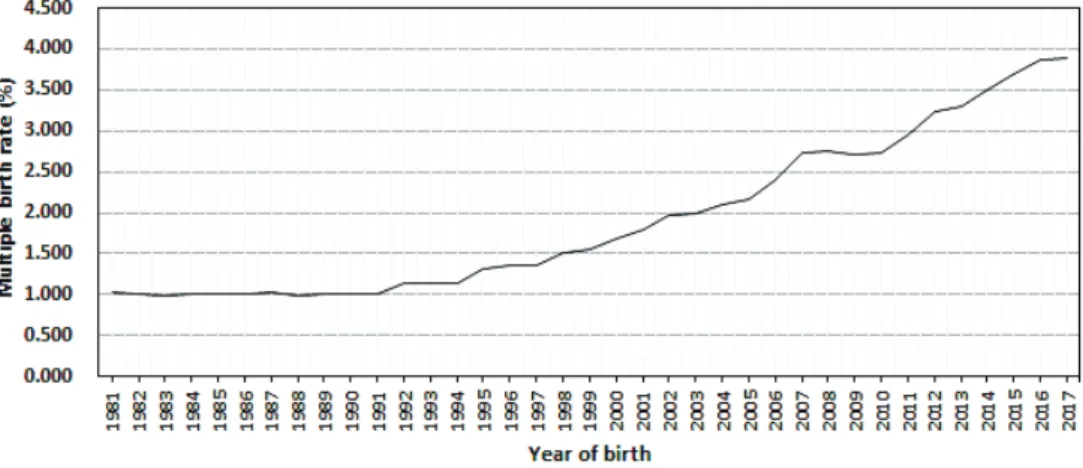
우리나라 다태아 출생률(100명당)은 1981년 1.031명 에서 2017년 3.891명으로 277% 증가하였고, 쌍태아는 1.013명에서 3.807명으로 275%, 삼태아는 363% 증가하 였다. 다태아 출생률은 1981년부터 1991년까지는 1.000 명으로 정체 수준이었고, 1992년을 기점으로 다태아 출생 률은 서서히 증가하여 1995년 1.318명, 2000년 1.685명, 2005년 2.174명, 2010년 2.731명, 2017년 3.891명이었 다(Table 1). 이 기간(1981–2017) 동안 다태아 출생률은 연간 평균 3.9% 증가하였고, 1981–1991년까지 정체 수준 을 보였으며, 그 이후 증가 추세를 나타냈으며, 2004년 이 후부터 다태아 출생률은 2.000명 수준을 상회하였고, 2012 년에는 출생률이 3.000수준을 넘어 2017년에 4.000에 근 접하는 것으로 나타났다(Fig. 1).
5년 단위 구간별 다태아 출생률에서 1981–1984년 1.007명, 1990–1994년 1.084명, 2000–2004년 1.891 명, 2010–2014년 3.127명, 2015–2017년 3.811명이었 다(Table 2). 체외수정시술에 영향을 받지 않은 1981–
1984년 다태아 출생률(기준군)에 비해 1985–1989년 다 태아 출생 오즈비는 0.998 (95% 신뢰구간, 0.982–1.014) 로 유의하지 않았고, 1990–1994년은 1.077, 1995–1999 년 1.412, 2000–2004년 1.894, 2005–2009년 2.581, 2010–2014년 3.173, 2015–2017년 3.893으로 유의하였 다(p<0.01).
고 찰
2010년 유럽의 다태아 출생률은 덴마크, 스페인, 체코의 경우 4%를 상회하고, 핀란드, 영국은 3.1%, 프랑스 3.0%, 스웨덴은 2.8%, 루마니아는 1.8% (Delnord et al., 2015),
미국의 다태아 출생률(100명당)은 1980년 1.93명, 2014 년 3.51명으로 보고되었다(Hamilton et al., 2015). 이 연 구에서 다태아 출생률(100명당)은 1981년 1.031명에서 2017년 3.687명으로 277% 증가하였다. 다태아는 30세 이상 고령 출산의 증가와 체외수정, 배란 유도제 투여 및 인 공수정을 포함하는 보조생식술의 확산에 연관이 있는 것으 로 보고된 바 있다(Blondel & Kaminski, 2002; Eriksson
Table 1. Number of births, twin birth rate, and triplet birth rate per 100 births in Korea 1981–2017
Year No. of births Multiple birth rate (%)
Birth rate (%) Twin Triplet
1981 730,041 1.031 1.013 0.018
1982 736,628 1.002 0.986 0.016
1983 685,225 0.995 0.983 0.012
1984 618,938 1.000 0.990 0.011
1985 637,527 1.010 0.994 0.016
1986 593,429 1.011 0.998 0.013
1987 587,772 1.023 1.007 0.016
1988 602,513 0.980 0.965 0.015
1989 579,506 1.002 0.991 0.011
1990 626,861 1.011 0.996 0.015
1991 688,329 0.997 0.977 0.020
1992 712,287 1.131 1.110 0.021
1993 702,546 1.134 1.112 0.022
1994 710,064 1.135 1.117 0.018
1995 704,590 1.318 1.272 0.046
1996 683,043 1.358 1.307 0.051
1997 668,344 1.355 1.328 0.027
1998 634,790 1.512 1.498 0.014
2000 634,501 1.685 1.668 0.017
2001 554,895 1.796 1.778 0.018
2002 492,111 1.963 1.947 0.016
2003 490,543 1.999 1.985 0.015
2004 472,761 2.090 2.077 0.013
2005 435,031 2.174 2.159 0.015
2006 448,153 2.403 2.384 0.019
2007 493,189 2.728 2.693 0.036
2008 465,892 2.745 2.716 0.029
2009 444,849 2.711 2.676 0.035
2010 470,171 2.731 2.687 0.044
2011 471,265 2.939 2.882 0.057
2012 484,550 3.224 3.162 0.062
2013 436,455 3.293 3.234 0.059
2014 435,435 3.486 3.421 0.065
2015 438,420 3.687 3.598 0.089
2016 406,243 3.873 3.762 0.111
2017 357,771 3.891 3.807 0.084
& FeIlman, 2007; Reynolds et al., 2003: Wright et al., 2007). 보조생식술에 의한 다태아 임신율은 24% (Murray
& Norman, 2014), 2011년 우리나라 불임클리닉(74개) 에서 보조생식술에 의한 출생아(5,408명)의 쌍태아 출생 률은 25.6%, 삼태아는 0.38% (Committee for Assisted Reproductive Technology et al., 2016), 체외수정시술비 정부 지원 사업에 의한 쌍태아 출생률은 2006년 33.7%, 삼태아는 0.5%, 2011년 각각 26.6%, 0.5%로 보고되었다 (Hwang et al., 2013).
체외수정시술에 영향을 받지 않은 1981–1984년의 다 태아 출생률(1.007명)에 비해 연도별 다태아 출생 오즈비 는 1985–1989년 0.998 (95% 신뢰구간, 0.982–1.014), 1990–1994년 1.077, 1995–1999년 1.412, 2000–2004 년 1.894, 2005–2009년 2.581, 2010–2014년 3.173,
2015–2017년 3.893으로 증가하였다. 우리나라 다태아 출생률은 1981년부터 2017년까지 연간 평균 3.9% 증가 하였다. 미국(1980–2009)의 쌍태아 출생률은 1980년부 터 2004년까지 매년 2% 이상, 1995–1998년은 4% 이상, 2005–2009년은 연간 1% 이하 증가한 것으로 보고된 바 있다(Martin et al., 2012).
우리나라 난임부부 정부 지원 사업이 시행된 시기인 2006년 다태아 출생률의 증가율을 Table 1의 자료를 근거 로 산출 해보면 전년도 대비 10.5%, 2007년은 13.6%로 증가하였고, 시술비 지원 금액 및 회수가 확대된 2011년은 전년도 대비 7.6%, 2012년은 9.7%로 비교적 높았다. 우리 나라 난임부부 지원 사업은 2006년에 체외수정시술비 지원 (2회)이 처음 시행되었고, 2010년 시술비 지원대상자 확대 및 인공수정시술비 신규 지원, 2011년 체외수정시술비 지원 회수 확대(4회), 2014년 체외수정시술비 지원 회수 확대 (6회)와 같은 사업이 진행된 바 있다(Ministry of Health and Welfare, 2016). 난임부부 시술비 지원 사업에 의한 출생아 수는 2008년 4,535명, 2010년 6,536명, 2011년 11,317명, 2012년 14,087명, 2013년 14,346명, 2016 년 19,736명으로 보고된 바 있다(Hwang et al., 2015;
Hwang et al., 2017). 우리나라에서 2015년 10월부터 시 술여성 및 태아의 건강보호와 생명윤리 차원에서 이식할 수 있는 배아를 제한하는 지침을 시행하였으며, 최대 이식 배아 수는 배양일수에 따라 35세 미만은 1–2개, 35세 이상 은 2–3개로 제한하였다(Ministry of Health and Welfare, 2016). 이 연구에서 Table 1의 자료에서 전년도 대비 증 Table 2. Odds ratio (OR) of multiple birth rate prior to the introduc
tion of ART in Korea
Year No. of
births
Multiple
birth rate (%) OR† (95% CI) 1981–1984 2,770,832 1.007 1.000
1985–1989 3,000,747 1.005 0.998 (0.982–1.014) 1990–1994 3,440,087 1.084 1.077 (1.060–1.094)**
1995–1999 3,305,000 1.417 1.412 (1.391–1.433)**
2000–2004 2,644,811 1.891 1.894 (1.866–1.922)**
2005–2009 2,287,114 2.559 2.581 (2.544–2.619)**
2010–2014 2,297,876 3.127 3.173 (3.129-3.217)**
2015–2017 1,202,434 3.811 3.893 (3.835-3.952)**
ART, assisted reproductive technology; CI, confidence interval.
†Reference group: multiple birth rate of 1981–1984 (prior to the introduction of ART in Korea), **p<0.01.
Fig. 1. Secular trend of multiple birth rate per 100 births in Korea, 1981–2017 (introduction of assisted re productive technology in Korea in 1984, and introduction of national supporting program for infertile couples in 2006).
가율으로 보면 2014–2016년 다태아 출생률의 연간 증가 율은 5% 수준이었으나, 2017년은 0.5%에 불과하여 배아 이식 제한 효과에 의한 것으로 추정되나 좀 더 장기적인 관 찰이 필요할 것으로 보여진다. 다태아 발생을 감소시키는 전략으로 단일배아 이식 시술의 권장이 있으며(Murray &
Norman, 2014), 호주(2001–2010년)는 단일배아 이식 권장 결과 이식율은 21%에서 70%로 증가하였고, 보조생 식술에 의한 다태아 출생률은 21.4%에서 7.9%로 감소하 였다(Chambers et al., 2013). 2006년 기준으로 단일배 아 이식율은 미국 10.7%, 덴마크 36.4%, 벨기에 49.2%, 호주 53.3% 수준이며(Scholten et al., 2015), 우리나라 난임부부 지원 사업에 의한 단일배아 이식율은 2010년 12.4%, 2011년 13.2%, 2012년 14.5%, 2013년 14.2%, 2014년 17.4%, 2016년 27.7%였으며(Hwang et al., 2015; Hwang et al., 2017), 평균 배아 이식 수는 2015년 2.18개에서 2016년 1.90개로 감소된 것으로 보고되었다 (Hwang et al., 2017).
다태아 출생은 고령 임신에서 높게 나타나며(Luke &
Martin, 2004), 시계열적인 쌍태아 출생률의 증가폭도 고 령에서 높다(Martin & Park, 1999; Martin et al., 2012 Park & Lim, 2015). 우리나라(2011–2013년) 다태아 출생률은 출산 연령 20–24세 1.46%, 25–29세 2.24%, 30–34세 3.56%, 35–39세 4.63%, 40세 이상은 3.55%
로 보고되었고(Park & Lim, 2015), 미국(2000–2009 년)의 출산 연령 구조를 1980년과 동일하게 표준화 했을 때 쌍태아 출생률은 약 14% 감소하였는데(Martin et al., 2012), 이는 출산 연령 구조가 쌍태아 출생률에 영향을 미 친다는 근거로 볼 수 있다. 보조생식술은 1980–1990년대 에는 전 연령층에 시술되었으나 근래는 30세 이상에서 점 유율이 높아 고령에서 다태아 출생률의 상승 효과가 더 크 다(Chandra & Stephen, 2010). 우리나라의 2012년 난임 부부 지원 사업에서 30–34세 점유율은 56.7%, 35–39세 31.1%로 특정 연령에 집중되었다(Hwang et al., 2013).
이 연구에서 2016년 난임부부 지원 사업에 의한 출생아 수 19,736명(Hwang et al., 2017)과 보조생식술에 의한 쌍태아 출생률(25.6%), 삼태아 출생률(0.38%)의 연구보 고(Committee for Assisted Reproductive Technology et al., 2016)를 참고하여 정부 지원 사업에 의한 쌍태아 추 정 출생아 수는 5,052명, 삼태아는 75명으로 산출되었다.
2016년 통계청에서 집계된 다태아(쌍태아: 15,284명, 삼
태아: 450명) 중 정부 지원에 의한 쌍태아와 삼태아 출생 점유율은 각각 33.1%, 16.7%로 추정되었다.
시계열적인 다태아 출생률 추이를 분석하기 위해서는 출산 연령 고령화에 따른 증가 요인, 그리고 보조생식술의 확산(난임부부의 정부 지원 사업과 자비 부담 규모)에 따 른 증가 요인으로 구분하여 접근하는 것이 타당하다. 그러 나 통계청 인구동향자료에서의 임신 성립 방법(자연 및 인 공임신에 대한 정보)에 대한 정보 부재, 정부 난임부부 지 원 사업의 평가 결과 보고서에서 관련 정보의 불완전성 등 으로 인해 자연임신과 인공임신(정부 지원 또는 자비 부 담)에 의한 연령별, 연도별 다태아 출생률의 세분화된 분석 이 불가능 한 것이 이 연구의 제한 점으로 볼 수 있다.
다태아 출생률의 추이를 분석하는데 있어서 자연임신에 의한 연령별 다태아 출생률은 매우 유용한 지표가 되기 때 문에 지역사회 인구집단을 반영할 수 있는 체계화된 연구 접근이 필요하고, 특히 우리나라 출생신고서 작성 시 임신 성립방법(자연임신, 체외수정시술, 인공수정시술)에 대한 항목을 포함하는 제도적 부분도 고려되어야 할 것으로 보 여 진다. 우리나라는 출산 연령의 고령화, 보조생식술의 확 산 등으로 앞으로 다태아 출생률은 계속 증가될 것으로 예 견되기 때문에 다태아 발생 위험도를 줄일 수 있는 적절한 중재 프로그램이 마련되어야 할 것으로 보여 진다.
결 론
이 연구 대상은 출생신고에 의해 집계된 통계청 인구동 태통계 자료를 이용하였으며, 1981년부터 2017년까지 총 출생아 수는 20,948,901건이었다. 다태아 출생률의 추이 를 분석하기 위해서 출생아 100명당 다태아 출생률을 산 출하였다. 각 년도 구간별 다태아 발생 오즈비(odds ratio) 및 95% 신뢰 구간을 분석하였다.
다태아 출생률(100명당)은 1981년 1.031명에서 2017 년 3.891명으로 277% 증가하였고, 쌍태아는 275% 증가, 삼태아는 363% 증가하였다. 다태아 출생률은 1981년부터 1991년까지는 1.000명으로 정체 수준이었고, 1992년을 기점으로 다태아 출생률은 서서히 증가하여 1995년 1.318 명, 2000년 1.685명, 2005년 2.174명, 2010년 2.731 명, 2017년 3.891명이었다. 다태아 출생률은 1981년부터 2017년 사이에 연간 평균 3.9% 증가한 것으로 나타났다.
체외수정시술에 영향을 받지 않은 1981–1984년에 비해
년도 구간별 다태아 출생 오즈비는 1985–1989년 0.998 (95% 신뢰구간, 0.982–1.014), 1990–1994년 1.077 (1.060-1.094), 1995–1999년 1.412 (1.391–1.433), 2000–2004년 1.894 (1.866–1.922), 2005–2009년 2.581 (2.544–2.619), 2010–2014년 3.173 (3.129–
3.217), 2015–2017년 3.893 (3.835–3.952)로 나타났다.
우리나라 다태아 출생률은 체외수정시술과 같은 보조생 식술이 도입된 이후 높은 증가율을 보였으며, 또한 난임부 부 체외수정시술비 정부 지원 사업이 개시된 2006년 이후 다태아 출생률의 증가 현상을 관찰할 수 있었다. 다태아 출 생률의 증가에 기여하는 다른 요인인 출산 연령의 고령화 에 따른 기여도에 대한 부분도 좀 더 체계적인 연구가 이루 어져야 할 것으로 보여 진다. 이를 위해서는 임신 방법(자 연임신, 인공임신)에 대한 정보가 필수적이며, 이러한 통계 정보 획득을 위해서는 국가적인 출생신고 모니터링 시스템 의 구축이 필요할 것으로 사료된다.
감사의 글 및 알림(ACKNOWLEDGMENTS)
이 논문은 2015년 공주대학교 학술연구지원사업의 연 구지원에 의하여 연구되었음.
REFERENCES
Blondel B, Kaminski M. Trends in the occurrence, deter- minants, and consequences of multiple births. Semin Peri- natol 2002;26:239-49.
Chambers GM, Hoang VP, Lee E, Hansen M, Sullivan EA, Bower C, et al. Hospital costs of multiple-birth and singleton-birth children during the first 5 years of life and the role of assisted eproductive technology. JAMA Pediatr 2014;168:1045-53.
Chambers GM, Wang YA, Chapman MG, Hoang VP, Sullivan EA, Abdalla HI, et al. What can we learn from a decade of promoting safe embryo transfer practices? A compara- tive analysis of policies and outcomes in the UK and Au- stralia, 2001-2010. Hum Reprod 2013;28:1679-86.
Chandra A, Stephen EH. Infertility service use among U.S.
women: 1995 and 2002. Fertil Steril 2010;93:725-36.
Collins J. Global epidemiology of multiple birth. Reprod Biomed Online 2007;15 Suppl 3:45-52.
Committee for Assisted Reproductive Technology, Statistics, Korean Society for Assisted Reproduction, Lee GH, Song HJ, Lee KS, et al. Current status of assisted reproductive
technology in Korea, 2011. Clin Exp Reprod Med 2016;
43:38-43.
Delnord M, Blondel B, Zeitlin J. What contributes to dispari- ties in the preterm birth rate in European countries? Curr Opin Obstet Gynecol 2015;27:133-42.
Eriksson AW, Fellman J. Temporal trends in the rates of multiple maternities in England and Wales. Twin Res Hum Genet 2007;10:626-32.
Hamilton BE, Martin JA, Osterman MJ, Curtin SC, Matthews TJ. Births: final data for 2014. Natl Vital Stat Rep 2015;
64:1-64.
Hur YM, Kwon JS. Changes in twinning rates in South Korea:
1981-2002. Twin Res Hum Genet 2005;8:76-9.
Hwang NM, Chae SM. Chang IS. Analysis and evaluation of the results of national supporting program for infertile couples in 2014. Sejong (Korea): Korea Institute for Health and Social Affairs; 2015:19-39.
Hwang NM, Chang IS, Park SM, Chae SM. Analysis and evaluation of the results of national supporting program for infertile couples in 2012. Sejong (Korea): Korea In- stitute for Health and Social Affairs; 2013.
Hwang NM, Lee SH, Chang IS. Analysis and evaluation of the results of national supporting program for infertile couples in 2016. Sejong (Korea): Korea Institute for Health and Social Affairs. 2017:4-26.
Ko HS, Wie JH, Choi SK, Park IY, Park YG, Shin JC. Multiple birth rates of Korea and fetal/neonatal/infant mortality in multiple gestation. PLoS One 2018;13:e0202318.
Luke B, Martin JA. The rise in multiple births in the United States: who, what, when, where, and why. Clin Obstet Gynecol 2004;47:118-33.
Martin JA, Hamilton BE, Osterman MJ. Three decades of twin births in the United States, 1980-2009. NCHS Data Brief 2012;80:1-8.
Martin JA, Hamilton BE, Ventura SJ, Osterman MJ, Kirmeyer S, Mathews TJ, et al. Births: final data for 2009. Natl Vital Stat Rep 2011;60:1-70.
Martin JA, Park MM. Trends in twin and triplet births: 1980- 97. Natl Vital Stat Rep 1999;47:1-16.
Microdata Integrated Service [Internet]. Daejeon (Korea):
Statistics Korea; [cited 2019 Feb 28]. Available from:
https://mdis.kostat.go.kr/index.do.
Ministry of Health and Welfare. National supporting program for infertile couples. Guideline for 2016 Maternal and Childe Health Services. Sejong (Korea): Korea Ministry of Health and Welfare; 2016;135-61.
Murray SR, Norman JE. Multiple pregnancies following assi- sted reproductive technologies--a happy consequence or double trouble? Semin Fetal Neonatal Med 2014;19:
222-7.
Park SH, Kim JS, Lim DO. Adverse child's birth outcomes
and maternal age at birth; 1997-98, 2014-15 birth cer- tificate data of Korea. J Health Info Stat 2017;42:294- 300.
Park SH, Kim TJ, Moon SY, Kim SH. Study on Trends of Multiple Birth in Korea: 1982-1998. Korean J Perinatol 2001;12:449-52.
Park SH, Lim DO. Contribution of maternal age distribution to incidence of multiple birth rate; 1997-99 and 2011- 13. J Reprod Med Popul 2015;28:96-102.
Reynolds MA, Schieve LA, Martin JA, Jeng G, Macaluso M.
Trends in multiple births conceived using assisted re- productive technology, United States, 1997-2000. Pe- diatrics 2003;111(5 Pt 2):1159-62.
Scholten I, Chambers GM, van Loendersloot L, van der Veen F, Repping S, Gianotten J, et al. Impact of assisted reproductive technology on the incidence of multiple- gestation infants: a population perspective. Fertil Steril 2015;103:179-83.
Tandberg A, Bjørge T, Børdahl PE, Skjaerven R. Increasing twinning rates in Norway, 1967-2004: the influence of maternal age and assisted reproductive technology (ART). Acta Obstet Gynecol Scand 2007;86:833-9.
Wright VC, Chang J, Jeng G, Chen M, Macaluso M; Centers for Disease Control and Prevention. Assisted reproductive technology surveillance - United States, 2004. MMWR Surveill Summ 2007;56:1-22.