ABSTRACT
Purpose: Physicians' awareness of their cancer patients' unmet needs is an essential element for providing effective treatment. This study investigated the accuracy of physicians' awareness of breast cancer survivors' unmet needs in Korea.
Methods: A cross-sectional interview survey was performed among 106 physicians and 320 Korean breast cancer survivors. The Comprehensive Needs Assessment Tool was administered to physicians and cancer survivors after obtaining their written informed consent to participate. Data were analyzed using t-test, analysis of variance, and multiple regression analysis.
Results: The level of unmet needs was highest in the hospital service domain (mean ± standard deviation: 2.19 ± 0.82), and the top-ranked unmet need item was “wished my doctor to be easy, specific, and honest in his/her explanation” (2.44 ± 0.93). Higher unmet needs were correlated with the presence of a genetic counseling clinic. They were not associated with age, sex, marital status, religion, department, working period, type of institution, number of staff, and number of operations. In multiple regression analysis, the presence of a genetic counseling clinic was associated with a higher level of recognition for psychological problems, social support, hospital service, and information and education needs. Physicians overestimated breast cancer survivors' unmet needs in all domains, compared to their self- reported unmet needs. The discordance in the perceived unmet needs was highest in the
‘family/personal relationship problems’ domain.
Conclusions: Physicians who treat Korean breast cancer survivors rated the level of unmet needs of breast cancer survivors as highest in the hospital service domain. The presence of a genetic counseling clinic in physicians' institutions was associated with a higher perception
Original Article
Received: Oct 14, 2020 Revised: Nov 3, 2020 Accepted: Nov 10, 2020 Correspondence to Hyun Jo Youn
Department of Surgery, Research Institute of Clinical Medicine, Jeonbuk National University Hospital, Jeonbuk National University and Biomedical Research Institute, 20 Geonji-ro, Deokjin-gu, Jeonju 54907, Korea.
E-mail: [email protected]
© 2021 Korean Breast Cancer Society This is an Open Access article distributed under the terms of the Creative Commons Attribution Non-Commercial License (https://
creativecommons.org/licenses/by-nc/4.0/) which permits unrestricted non-commercial use, distribution, and reproduction in any medium, provided the original work is properly cited.
ORCID iDs Ilkyun Lee
https://orcid.org/0000-0002-1546-5543 Jihyoun Lee
https://orcid.org/0000-0003-0041-8717 Se Kyung Lee
https://orcid.org/0000-0003-1630-1783 Hyuk-Jae Shin
https://orcid.org/0000-0003-2728-3146 So-Youn Jung
https://orcid.org/0000-0002-4508-4522 Jong Won Lee
https://orcid.org/0000-0001-7875-1603 Zisun Kim
https://orcid.org/0000-0002-1413-2800 Min Hyuk Lee
https://orcid.org/0000-0001-9003-8819 Juhyung Lee
Ilkyun Lee 1 , Jihyoun Lee 2 , Se Kyung Lee 3 , Hyuk-Jae Shin 4 , So-Youn Jung 5 , Jong Won Lee 6 , Zisun Kim 7 , Min Hyuk Lee 2 , Juhyung Lee 8 , Hyun Jo Youn 9
1
Department of Surgery, Catholic Kwandong University International St. Mary's Hospital, Catholic Kwandong University College of Medicine, Incheon, Korea
2
Department of Surgery, Soonchunhyang University Seoul Hospital, Soonchunhyang University College of Medicine, Seoul, Korea
3
Department of Surgery, Samsung Medical Center, Sungkyunkwan University School of Medicine, Seoul, Korea
4
Department of Surgery, Myongji Hospital, Goyang, Korea
5
Breast Cancer Center, National Cancer Center, Goyang, Korea
6
Department of Surgery, Asan Medical Center, University of Ulsan College of Medicine, Seoul, Korea
7
Department of Surgery, Soonchunhyang University Bucheon Hospital, Soonchunhyang University College of Medicine, Bucheon, Korea
8
Department of Preventive Medicine, Jeonbuk National University Medical School, Jeonju, Korea
9
Department of Surgery, Research Institute of Clinical Medicine, Jeonbuk National University Hospital, Jeonbuk National University and Biomedical Research Institute, Jeonju, Korea
Physicians' Awareness of the Breast
Cancer Survivors' Unmet Needs in
Korea
Hyun Jo Youn
https://orcid.org/0000-0002-2407-8537 Conflict of Interest
The authors declare that they have no competing interests.
Author Contributions
Conceptualization: Lee I, Youn HJ; Data curation: Lee J,
1Lee SK, Shin HJ, Jung SY, Lee JW, Kim Z, Lee MH, Youn HJ; Formal analysis:
Lee J
2; Methodology: Lee I, Lee J,
2Youn HJ;
Writing - original draft: Youn HJ; Writing - review & editing: Youn HJ.
Lee J,
1Jihyoun Lee; Lee J,
2Juhyung Lee.
breast cancer survivors. Efforts to reduce these discordances are needed to implement optimal survivorship care.
Keywords: Breast neoplasms; Physicians; Survivors; Unmet need
INTRODUCTION
With increasing survival rates, the number of cancer survivors is rising owing to early diagnosis and advanced treatment modalities. Breast cancer is the most common cancer among women worldwide. In Korea, 26,534 patients were newly diagnosed with breast cancer in 2017, making it the most common cancer among women, as in other countries [1]. Breast cancer has good prognosis; the 5-year relative survival rate of Korean breast cancer patients is 93.2%. There are about 217,000 breast cancer survivors, ranked 4th (11.6%) among Korean cancer survivors [2].
Most cancer survivors, including breast cancer survivors, experience various physical and psychological problems after cancer diagnosis and treatment. Since these difficulties directly affect the quality of life (QoL) of cancer survivors and are also related to treatment outcomes, efforts to identify and address the unmet needs of cancer survivors are essential for effective treatment [3].
The concordance in the perception of unmet needs between physicians and patients has a positive effect on the patients' health [4]. Additionally, higher concordance rates are correlated with higher patient satisfaction, increased treatment adherence, and better treatment outcomes [5,6]. In general, physicians assume that they are aware of the unmet needs of cancer survivors because they are cognizant of the medical conditions of their patients. However, many physicians are mainly interested in the primary treatment, such as operation and chemotherapy, and tend to neglect supportive care needs. Consequently, there is actually a considerable discrepancy in the perceptions of unmet needs between physicians and their cancer survivor patients, which is a major obstacle to providing comprehensive survivorship care [7,8].
It is essential to accurately identify the unmet needs of cancer survivors and investigate discordances regarding unmet needs between physicians and cancer survivors to provide improved survivorship care. However, several previous studies either emphasize a single factor or include small samples. Some previous studies had limitations such as the use of different needs assessment tools for the 2 groups [9,10]. Additionally, there is a dearth of comprehensive studies on specific populations of cancer survivors, including breast cancer survivors.
This study evaluated the key elements of unmet needs and factors affecting the unmet
needs of cancer survivors among physicians who treat breast cancer survivors in Korea. We
investigated the discordance in perceived unmet needs between physicians and breast cancer
survivors to present basic data for providing adequate cancer survivorship care.
METHODS
Study population
A cross-sectional interview survey of 106 physicians was performed between July 2016 and August 2017. The members of the Korean Breast Cancer Society who provided informed consent to participate were recruited as participants in the study. After excluding 4 respondents due to missing data, the final analysis included 102 physicians. Additionally, a cross-sectional interview survey was conducted among 320 breast cancer survivors during the same period after obtaining their informed consent to participate. They were recruited from among the patients who had been diagnosed with breast cancer and were receiving treatment in 6 medical centers in Korea: Jeonbuk National University Hospital, National Cancer Center, Samsung Medical Center, Myongji Hospital, Soonchunhyang University Seoul and Bucheon Hospital. The Institutional Review Board (IRB) of Jeonbuk National University Hospital, Jeonju, Korea (approval number 2016-01-018-004) approved this study. Moreover, breast cancer survivors were surveyed after obtaining approval from the IRB of each of the 6 medical centers mentioned above.
Measurements
The needs of cancer survivors as perceived by physicians and breast cancer survivors were assessed using the Comprehensive Needs Assessment Tool (CNAT), which was developed at Korea's National Cancer Center [11]. The CNAT is the most appropriate tool to measure the needs of Korean cancer survivors. The CNAT comprises 59 items grouped into 8 domains:
information and education (10 items), psychological problems (10 items), healthcare staff (8 items), physical symptoms (12 items), hospital service (6 items), family/personal relationship problems (3 items), religious/spiritual support (2 items), and social support (8 items) (Supplementary Table 1). Breast cancer survivors were instructed to rate each item on a 4-point Likert scale (0 = no need, 1 = low need, 2 =moderate need, 3 = high need) based on their experiences in the past month. Physicians were also surveyed regarding their perceived roles.
We investigated the unmet needs of Korean breast cancer survivors as perceived by physicians, analyzed the factors affecting the perceived unmet needs, and examined the discordances in the perception of unmet needs between physicians and breast cancer survivors.
Statistical analyses
Principal component analysis was used for factor extraction, the eigenvalue threshold was defined as 1, and factor analysis was conducted using the varimax method among orthogonal rotation methods. The t-test and analysis of variance were performed to compare need scores for each factor and need scores according to the physicians' characteristics. The need score for each factor was used as the dependent variable, and variables that were statistically significant in univariate analysis were used as independent variables. Then, multiple regression analysis was conducted to investigate the effects of major variables on needs.
Furthermore, the differences in the perception of unmet needs between physicians and
breast cancer survivors were investigated. All statistical analyses were performed using SPSS
version 23.0 (SPSS Inc., Chicago, USA), and statistical significance was set at p < 0.05.
RESULTS
Characteristics of the study population
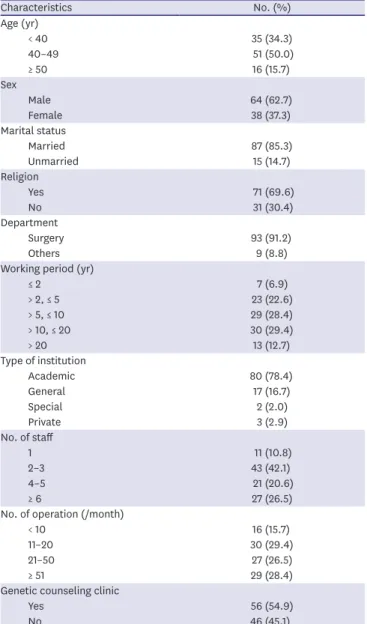
Among the physicians, the highest proportion (51 people, 50.0%) belonged to the 40–49 age group, and 64.7% were males. Eighty-seven physicians (85.3%) were married and 69.6%
(71/102) had a religion. Majority of the physicians (93, 91.2%) were surgeons, and 42.1%
(43/102) were breast specialists who had worked as surgeons for 10 or more years. Regarding the type of institution, 78.4%, 42.1%, and 54.9% physicians worked at an academic hospital, an institution with 2–3 breast cancer staff, and an institution with a genetic counseling clinic, respectively. Regarding the total number of breast cancer operations performed per month, the proportion of surgeons performing 11–20 cases per month was the highest (30/102 people, 29.4%) (Table 1).
Table 1. Characteristics of physicians
Characteristics No. (%)
Age (yr)
< 40 35 (34.3)
40–49 51 (50.0)
≥ 50 16 (15.7)
Sex
Male 64 (62.7)
Female 38 (37.3)
Marital status
Married 87 (85.3)
Unmarried 15 (14.7)
Religion
Yes 71 (69.6)
No 31 (30.4)
Department
Surgery 93 (91.2)
Others 9 (8.8)
Working period (yr)
≤ 2 7 (6.9)
> 2, ≤ 5 23 (22.6)
> 5, ≤ 10 29 (28.4)
> 10, ≤ 20 30 (29.4)
> 20 13 (12.7)
Type of institution
Academic 80 (78.4)
General 17 (16.7)
Special 2 (2.0)
Private 3 (2.9)
No. of staff
1 11 (10.8)
2–3 43 (42.1)
4–5 21 (20.6)
≥ 6 27 (26.5)
No. of operation (/month)
< 10 16 (15.7)
11–20 30 (29.4)
21–50 27 (26.5)
≥ 51 29 (28.4)
Genetic counseling clinic
Yes 56 (54.9)
No 46 (45.1)
Factor analysis of needs
Seven factors were extracted from the factor analysis of the needs of breast cancer survivors perceived by physicians. They were labeled according to the characteristics of the items included in each factor as follows: “information and education,” “psychological problems,” “social support,” “healthcare staff,” “hospital service,” “physical symptoms,”
and “information and education (II).” As a result of factor analysis, of the 59 items, one item (Q9) was not classified under any particular factor; therefore, it was excluded from the needs variable of breast cancer survivors (Supplementary Table 2). Among the top 10 unmet need items, 5 items belonged to the information and education domain, and the unmet need score was highest in the hospital service domain (mean ± standard deviation: 2.19 ± 0.82) (Table 2).
The item with the highest unmet need score was “wished my doctor to be easy, specific, and honest in his/her explanation” in the healthcare staff domain (2.44 ± 0.93).
Needs by characteristics of the study population
There was no significant difference in the level of unmet needs according to age, sex, marital status, and religion among physicians (Table 3). The perceived unmet needs were higher among non-surgeon physicians than among surgeons; however, there was no statistically significant difference (1.98 needs according to age, p = 0.178). There was no difference in unmet needs according to the type of institution, working period, and the number of staff.
As the number of cases of breast cancer operations performed per month increased, the level of unmet needs also increased; however, there was no statistically significant difference. The presence of a genetic counseling clinic was statistically significantly correlated with higher unmet needs concerning psychological problems, social support, hospital service, and information and education (II). Multiple regression analysis was conducted to investigate the influence of each independent variable on the total score of each unmet need as the dependent variable. The results revealed that physicians working at institutions with a genetic counseling clinic (Table 4) perceived a higher number of unmet needs of cancer survivors.
Comparison of the perceived unmet needs between physicians and breast cancer survivors
The comparison of the perceived unmet needs between physicians and breast cancer
survivors revealed that physicians rated the level of unmet needs of cancer survivors as higher in all domains as compared to the breast cancer survivors (Figure 1). Among the top 10 discordant unmet needs, 5 items belonged to the “physical symptoms” domain, the highest discordance was observed in the “family/personal relationship problems” domain (1.94 ± Table 2. Top 10 unmet needs of physicians
Rank Items Score (mean ± standard
deviation) Domain
1 Wished my doctor to be easy, specific, and honest in his/her explanation 2.44 ± 0.93 Healthcare staff 2 Needed information about current status of my illness and its future courses 2.40 ± 1.01 Information and education 3 Wished to be able to seek doctor in a quick and easy way when in need 2.38 ± 0.80 Healthcare staff
4 Needed help in coping with fear of recurrence 2.38 ± 0.74 Psychological problem
5 Wished for a short waiting period between the reservation and the doctor appointment 2.37 ± 0.80 Hospital service 6 Needed information about correct diet (food to eat, food to avoid) 2.36 ± 0.84 Information and education
7 Needed information about tests and treatments 2.34 ± 1.00 Information and education
8 Needed an easy and accurate explanation about its benefits, side effects and application
of current medication 2.32 ± 0.99 Information and education
9 Needed help with depression 2.32 ± 0.75 Psychological problem
10 Needed information about symptoms require a hospital visit 2.31 ± 0.91 Information and education
Table 3. Needs by characteristics of physicians
Variables Total Information and
education Psychological
problem Social support Health care staffHospital service Physical
symptom Information and education (II) Age (yr)
< 40 1.94 ± 0.53 2.14 ± 0.77 2.10 ± 0.61 1.49 ± 0.65 1.90 ± 0.75 2.12 ± 0.72 1.90 ± 0.56 1.89 ± 0.69 40–49 2.05 ± 0.54 2.19 ± 0.67 2.17 ± 0.61 1.61 ± 0.79 1.95 ± 0.84 2.24 ± 0.62 2.05 ± 0.61 2.15 ± 0.61
≥ 50 2.01 ± 0.56 2.21 ± 0.55 2.04 ± 0.64 1.65 ± 0.75 2.07 ± 0.73 2.45 ± 0.53 1.89 ± 0.67 1.75 ± 0.82
p-value 0.626 0.923 0.753 0.693 0.771 0.238 0.446 0.061
Sex
Male 2.01 ± 0.53 2.22 ± 0.60 2.09 ± 0.60 1.56 ± 0.71 2.00 ± 0.75 2.26 ± 0.59 1.94 ± 0.61 1.97 ± 0.69 Female 2.00 ± 0.56 2.11 ± 0.81 2.18 ± 0.63 1.60 ± 0.79 1.87 ± 0.85 2.19 ± 0.75 2.03 ± 0.60 2.04 ± 0.69
p-value 0.996 0.473 0.464 0.774 0.448 0.616 0.488 0.595
Marital status
Married 2.01 ± 0.53 2.19 ± 0.65 2.13 ± 0.61 1.58 ± 0.72 1.97 ± 0.80 2.24 ± 0.62 1.96 ± 0.61 1.98 ± 0.69 Unmarried 1.99 ± 0.60 2.13 ± 0.87 2.13 ± 0.61 1.56 ± 0.85 1.81 ± 0.73 2.20 ± 0.84 2.03 ± 0.59 2.07 ± 0.70
p-value 0.911 0.747 0.964 0.944 0.466 0.833 0.687 0.671
Religion
Yes 1.99 ± 0.53 2.16 ± 0.68 2.11 ± 0.61 1.54 ± 0.71 2.02 ± 0.72 2.18 ± 0.66 1.95 ± 0.60 1.97 ± 0.66
No 2.04 ± 0.56 2.22 ± 0.71 2.17 ± 0.62 1.65 ± 0.81 1.79 ± 0.93 2.36 ± 0.60 2.03 ± 0.63 2.06 ± 0.74
p-value 0.668 0.728 0.669 0.496 0.232 0.182 0.568 0.512
Department
Surgery 1.98 ± 0.53 2.16 ± 0.69 2.10 ± 0.62 1.53 ± 0.72 1.92 ± 0.80 2.23 ± 0.63 1.96 ± 0.61 1.97 ± 0.67 Others 2.24 ± 0.59 2.38 ± 0.67 2.43 ± 0.44 1.98 ± 0.77 2.27 ± 0.62 2.28 ± 0.85 2.09 ± 0.51 2.22 ± 0.83
p-value 0.178 0.361 0.119 0.080 0.210 0.829 0.543 0.304
Working period (yr)
≤ 2 1.83 ± 0.73 1.92 ± 0.95 1.92 ± 0.81 1.39 ± 0.79 2.00 ± 0.87 1.86 ± 0.89 1.79 ± 0.59 1.95 ± 0.80
> 2, ≤ 5 2.01 ± 0.53 2.23 ± 0.69 2.18 ± 0.60 1.62 ± 0.71 1.89 ± 0.67 2.21 ± 0.69 1.99 ± 0.59 1.99 ± 0.69
> 5, ≤ 10 1.96 ± 0.58 2.11 ± 0.81 2.05 ± 0.68 1.49 ± 0.83 1.83 ± 0.95 2.25 ± 0.68 2.04 ± 0.65 1.94 ± 0.56
> 10, ≤ 20 2.05 ± 0.41 2.18 ± 0.57 2.22 ± 0.40 1.60 ± 0.64 2.05 ± 0.67 2.21 ± 0.57 1.96 ± 0.52 2.12 ± 0.75
> 20 2.01 ± 0.61 2.34 ± 0.45 2.01 ± 0.75 1.62 ± 0.74 1.98 ± 0.85 2.46 ± 0.49 1.86 ± 0.74 1.78 ± 0.73
p-value 0.893 0.737 0.624 0.911 0.861 0.424 0.841 0.661
Type of institution
Academic 1.99 ± 0.54 2.18 ± 0.69 2.09 ± 0.61 1.53 ± 0.71 1.94 ± 0.81 2.26 ± 0.64 1.95 ± 0.60 1.95 ± 0.69 General 2.04 ± 0.56 2.18 ± 0.75 2.22 ± 0.65 1.63 ± 0.83 1.85 ± 0.73 2.16 ± 0.72 2.04 ± 0.63 2.22 ± 0.58 Special 2.36 ± 0.42 2.26 ± 0.00 2.43 ± 0.10 2.21 ± 0.91 2.70 ± 0.14 2.25 ± 1.06 2.00 ± 0.71 2.67 ± 0.00 Private 2.09 ± 0.62 2.14 ± 0.71 2.29 ± 0.68 2.14 ± 0.65 2.27 ± 0.64 1.83 ± 0.52 2.28 ± 0.63 1.67 ± 1.00
p-value 8.467 0.998 0.729 0.290 0.464 0.685 0.783 0.189
No. of staff 1.96 ± 0.52 2.00 ± 0.87 2.12 ± 0.62 1.52 ± 0.77 1.87 ± 0.84 2.18 ± 0.76 2.03 ± 0.52 1.97 ± 0.74
1 1.93 ± 0.62 2.14 ± 0.77 2.00 ± 0.71 1.45 ± 0.79 1.86 ± 0.90 2.21 ± 0.70 1.85 ± 0.67 1.98 ± 0.73
2–3 2.16 ± 0.45 2.34 ± 0.46 2.30 ± 0.44 1.78 ± 0.69 2.23 ± 0.57 2.44 ± 0.42 2.07 ± 0.48 1.97 ± 0.71 4–5 2.03 ± 0.45 2.19 ± 0.62 2.20 ± 0.52 1.63 ± 0.65 1.92 ± 0.71 2.13 ± 0.65 2.08 ± 0.60 2.05 ± 0.59
p-value 8.467 0.556 0.261 0.382 0.339 0.402 0.354 0.974
No. of operation (/month)
< 10 1.89 ± 0.64 1.92 ± 0.86 2.06 ± 0.66 1.51 ± 0.84 1.91 ± 0.79 1.94 ± 0.77 1.89 ± 0.72 2.02 ± 0.79 11–20 1.95 ± 0.52 2.21 ± 0.69 2.05 ± 0.62 1.41 ± 0.74 1.85 ± 0.80 2.32 ± 0.64 1.90 ± 0.62 1.89 ± 0.63 21–50 2.00 ± 0.59 2.19 ± 0.69 2.05 ± 0.64 1.68 ± 0.72 2.06 ± 0.85 2.22 ± 0.66 1.91 ± 0.56 1.90 ± 0.77
≥ 51 2.11 ± 0.44 2.28 ± 0.56 2.28 ± 0.52 1.65 ± 0.69 1.97 ± 0.76 2.30 ± 0.56 2.16 ± 0.56 2.15 ± 0.58
p-value 0.530 0.408 0.395 0.499 0.785 0.248 0.288 0.436
Genetic counseling clinic
Yes 2.13 ± 0.51 2.26 ± 0.70 2.25 ± 0.56 1.79 ± 0.68 2.01 ± 0.82 2.36 ± 0.55 2.05 ± 0.64 2.17 ± 0.60
No 1.86 ± 0.53 2.08 ± 0.66 1.97 ± 0.63 1.31 ± 0.72 1.87 ± 0.75 2.08 ± 0.72 1.89 ± 0.55 1.78 ± 0.73
p-value 0.010 0.202 0.019 0.001 0.373 0.026 0.181 0.004
Table 4. The result of multiple regression analysis by needs Variables: Genetic
counseling clinic (ref: No)
Information and
education Psychological
problem Social support Health care staff Hospital service Physical symptom Information and education (II)
β T β T β T β T β T β T β T
Yes 0.715 1.285 0.282 2.384 * 0.480 3.457
†0.140 0.895 0.286 2.259 * 0.161 1.348 0.390 2.968
†Adjusted 0.006 0.044 0.098 −0.002 0.039 0.008 0.072
F-value 1.652 5.685 11.950 0.800 5.103 1.818 8.810
p-value 0.202 0.019 0.001 0.373 0.026 0.181 0.004
* p < 0.05;
†p < 0.01.
0.85 vs. 0.98 ± 1.07), and the item with the highest discordance was “needed someone to help me with housekeeping and/or child care” (2.13 ± 0.93 vs. 0.89 ± 1.08) (Table 5).
A
0 0.5 1.0 1.5 2.0 2.5
Q1
Q2
Q3
Q4
Q5 Q6
Q7 Q8 Q9
Q10
B
0 0.5 1.0 1.5 2.0 2.5
Q11
Q12
Q13
Q14
Q15 Q16
Q17 Q18 Q19
Q20
C
0 0.5 1.0 1.5 2.0 2.5
Q21
Q22
Q23
Q24
Q25 Q26
Q27 Q28
Information and education Psychological problem Health care staff
D
0 0.5 1.0 1.5 2.0 2.5
Q29
Q30
Q31
Q32
Q33
Q34 Q35
Q36 Q37 Q38
Q39 Q40
E
0 0.5 1.0 1.5 2.0 2.5
Q41
Q42
Q43
Q44 Q45
Q46
F
0 0.5 1.0 1.5 2.0 2.5
Q47 Q48 Q49
Physical symptom Hospital service Family/personal
relationship problems
H
0 0.5 1.0 1.5 2.0 2.5
Q52
Q53
Q54
Q55
Q56 Q57
Q58 Q59