INTRODUCTION
Nodal involvement and tumor size are the most impor- tant prognostic factors for breast cancer patients at different risk of disease recurrence and/or death (1). Many clinicopa- thologic variables other than TNM stage have been identi- fied to predict the clinical course of the disease. However, identifying all high-risk patients is still difficult. Beyond the conventional clinicopathologic variables, therefore, novel prognostic factors are needed to be explored to predict the outcome more accurately (2). Molecular markers such as p53 and bcl-2 have been extensively evaluated for their prognos- tic value since the 1990s (2-5). Although the prognostic value of p53 and bcl-2 expression in breast cancer has been evalu- ated in a number of studies, the results were controversial.
Heterogeneous patient and tumor characteristics might be partly responsible for the discrepancy. Treatments were also various with mastectomy (6, 7) breast conservative therapy
(8-11) or the combination of the two (12-14).
Given these observations, we evaluated the prognostic val- ue of p53 and bcl-2 expression on the treatment outcome, in relatively homogeneous population consisted of early stage breast cancer patients who underwent breast conservative treatment. In addition, the correlation between these mark- ers and triple-negative phenotype was also investigated.
MATERIALS AND METHODS
Between March 2000 and February 2002, 125 patients underwent radiotherapy after breast conserving surgery for breast cancer. Of these, 100 patients whose immunohisto- chemical staining for p53 and bcl-2 was performed at the time of diagnosis were the cohorts for this retrospective study.
The median age was 44 yr (range; 24-68). Performance status of the patients was good with ECOG grade of 0 for
235
Kyubo Kim1, Eui Kyu Chie1, Wonshik Han2, Dong-Young Noh2, In Ae Park3, Do-Youn Oh4, Seock-Ah Im4, Tae-You Kim4, Yung-Jue Bang4, and Sung W. Ha1,5
Departments of Radiation Oncology1, Surgery2, Pathology3, and Internal Medicine4, Seoul National University College of Medicine; Institute of Radiation Medicine5, Medical Research Center, Seoul National University, Seoul, Korea
K Kim and EK Chie contributed equally to this study.
Address for Correspondence Sung W. Ha, M.D.
Department of Radiation Oncology, Seoul National University College of Medicine, 103 Daehak-ro, Jongno-gu, Seoul 110-744, Korea
Tel : +82.2-2072-2524, Fax : +82.2-765-3317 E-mail : [email protected]
Presented at the 49th Annual Meeting of the American Society for Therapeutic Radiology and Oncology, Los Angeles, CA USA Oct 27-Nov 1, 2007.
Prognostic Value of p53 and bcl-2 Expression in Patients Treated with Breast Conservative Therapy
Prognostic value of p53 and bcl-2 expression on treatment outcome in breast can- cer patients has been extensively evaluated, but the results were inconclusive. We evaluated the prognostic significance of these molecular markers in patients treat- ed with breast conserving surgery and radiotherapy. One hundred patients whose immunostaining of p53 and bcl-2 expression was available among 125 patients who underwent radiotherapy after breast conserving surgery and axillary lymph node dissection were enrolled into this study. Eighty-seven patients also received adju- vant chemotherapy and/or hormonal therapy. Conventional clinicopathologic vari- ables and treatment-related factors were also considered. The 5-yr loco-regional relapse-free and distant metastasis-free survival rates were 91.7% and 90.9%, res- pectively. On univariate analysis, age, T stage and the absence of bcl-2 & estro- gen receptor (ER) expression were associated with loco-regional relapse-free sur- vival. When incorporating these variables into Cox proportional hazard model, only bcl-2(-)/ER(-) phenotype was an adverse prognostic factor (P=0.018). As for the distant metastasis-free survival, age, T stage, and p53 expression were significant on univariate analysis. However, p53 expression was the only prognosticator on multivariate analysis (P=0.009). A bcl-2(-)/ER(-) phenotype and p53 expression are useful molecular markers predicting loco-regional relapse-free and distant metas- tasis-free survival, respectively, in patients treated with breast conserving surgery and radiotherapy.
Key Words : Breast Neoplasms; bcl-2; p53
Received : 4 February 2009 Accepted : 27 April 2009
ⓒ 2010 The Korean Academy of Medical Sciences.
This is an Open Access article distributed under the terms of the Creative Commons Attribution Non-Commercial License (http://creativecommons.org/licenses/by-nc/3.0) which permits unrestricted non-commercial use, distribution, and reproduction in any medium, provided the original work is properly cited.
27 patients and grade of 1 for 73 patients. Histologic sub- type was invasive ductal carcinoma in 90 patients (90.0%).
All patients had breast conserving surgery with axillary lymph node dissection. Sixty patients received chemothera- py: cyclophosphamide, methotrexate and 5-fluorouracil in 30 patients; doxorubicin-containing regimen in 27 patients;
others in 3 patients. Sixty-two patients received hormonal therapy and 35 of them also received chemotherapy. As re- gards to radiotherapy, whole breast irradiation was given, up to 50.4 Gy at 1.8 Gy/fraction by using two opposing tan- gential photon beams. Tumor bed boost was supplemented up to 10 Gy at 2 Gy/fraction.
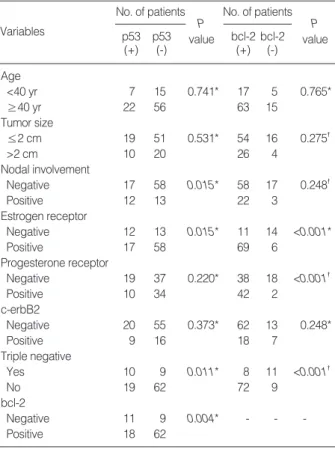
The clinicopathologic findings according to the expression of p53 and bcl-2 are summarized in Table 1. Median dura- tion of follow-up was 69 months (range; 21-88).
The specimens were immunostained to determine the ex- pression of p53, bcl-2 and c-erbB2 as well as the status of es- trogen receptor (ER) and progesterone receptor (PR). Immu- nostaining was performed in the usual manner, using anti- bodies to p53 (Dako, Glostrup, Denmark; 1:1,200), bcl-2 (Dako, 1:50), c-erbB2 (Novacastra Laboratories Ltd., New Castle upon Tyne, UK, 1:200), ER (Dako, 1:50) and PR (Dako, 1:50).
The percentage of tumor cells with nuclear staining for p53 was graded semi-quantitatively: 0%, 1-25%, 26-50%,
51-75% or >75%. For statistical analysis, p53 expression was considered as negative if ≤25% of tumor cells were stained and as positive if >25% of tumor cells were stained.
ER/PR and bcl-2 expression were judged as positive when
≥10% of tumor cells were stained in nucleus and membr- ane, respectively. C-erbB2 expression was considered as pos- itive if the score was 3, and negative if the score was 0, 1 or 2.
Statistical analysis was done by using SPSS software (release 12.0.1. SPSS Inc., Chicago, IL, USA). Differences in categor- ical variables between the parameters were compared by us- ing standard chi-square test or Fisher’s exact test. The actu- arial survival rates were calculated by using the Kaplan-Meier method and statistical significance of differences between the actuarial survival rates was evaluated by the log-rank test.
Cox proportional hazard model was used for multivariate analysis. For all statistical tests, P values <0.05 were consid- ered significant.
RESULTS
Patients with p53 expression were more likely to have node-positive and ER-negative tumors. In contrast, bcl-2 expression was associated with both ER- and PR-positivity.
Expression of p53 was correlated with triple-negative phe- notype (P=0.011), while bcl-2 negativity was correlated with triple-negative phenotype (P<0.001). Inverse relation- ship was demonstrated between p53 and bcl-2 expression (P=0.004, Table 1).
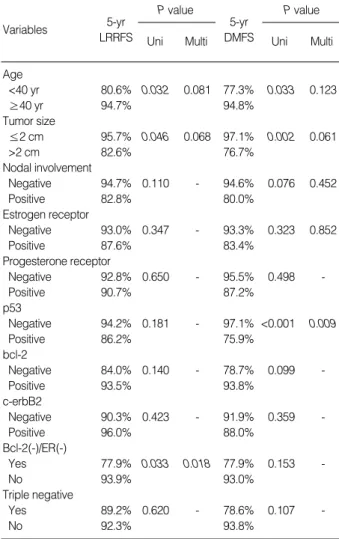
The 5-yr loco-regional relapse-free and distant metastasis- free survival rates were 91.7% and 90.9%, respectively. On univariate analysis, age less than 40 yr and T2 stage were sig- nificant prognosticators predicting poor loco-regional relapse- free survival (Table 2). When incorporating these variables into Cox proportional hazard model, however, both lost the statistical significance. Given the association between bcl-2 expression and ER status, we tested interaction of the two variables. Compared with bcl-2(-)/ER(-) phenotype (n=14), other phenotypes (bcl-2[-]/ER[+], bcl-2[+]/ER[-], and bcl- 2[+]/ER[+]) achieved higher loco-regional relapse-free survival rate (77.9% vs. 93.9%, P=0.033, Fig. 1). On multivariate analysis incorporating age, T stage and the presence of bcl- 2(-)/ER(-) phenotype, the bcl-2(-)/ER(-) phenotype was the only adverse prognostic factor for loco-regional relapse-free survival (P=0.018). When the use of chemotherapy and hor- monal therapy were added in the model, the prognostic sig- nificance of the bcl-2(-)/ER(-) phenotype became marginal (P=0.064).
For the distant metastasis-free survival, age less than 40 yr, T2 stage and p53 positivity (Fig. 2) were adverse prognostic factors (Table 2). Patients with bcl-2(-)/ER(-) phenotype had an inferior distant metastasis-free survival rate than those with other phenotypes, but the difference was not statistically sig- nificant (77.9% vs. 93.0%, P=0.153). On multivariate anal-
No. of patients No. of patients
Variables P
value
P value p53
(-) p53
(+)
bcl-2 (+)
bcl-2 (-) Age
<40 yr 7 15 0.741* 17 5 0.765*
≥40 yr 22 56 63 15
Tumor size
≤2 cm 19 51 0.531* 54 16 0.275�
>2 cm 10 20 26 4
Nodal involvement
Negative 17 58 0.015* 58 17 0.248�
Positive 12 13 22 3
Estrogen receptor
Negative 12 13 0.015* 11 14 <0.001*
Positive 17 58 69 6
Progesterone receptor
Negative 19 37 0.220* 38 18 <0.001�
Positive 10 34 42 2
c-erbB2
Negative 20 55 0.373* 62 13 0.248*
Positive 9 16 18 7
Triple negative
Yes 10 9 0.011* 8 11 <0.001�
No 19 62 72 9
bcl-2
Negative 11 9 0.004* - - -
Positive 18 62
Table 1. Clinicopathologic variables according to the expression of p53 and bcl-2
*chi-square test; �Fisher’s exact test.
ysis incorporating aforementioned variables as well as nodal and ER status, which were correlated with p53 expression, only p53 expression was significant (P=0.009). The statisti- cal significance of p53 expression remained even after the use of chemotherapy and hormonal therapy were added in the model (P=0.011).
In subgroup analysis with triple-negative phenotype (n=
19), bcl-2(-)/ER(-) phenotype was not associated with loco- regional relapse (P=0.204), and p53 expression was not asso- ciated with distant metastasis (P=0.331).
DISCUSSION
There have been several reports that investigated the prog- nostic value of p53 or bcl-2 expression on loco-regional fail- ure after breast conservative therapy. Elkhuizen et al. com- pared 66 patients who experienced local recurrence with 139 matched controls in terms of the expression of several onco-
genes along with histological factors. They found that bcl-2 negativity carried a 17 times higher risk of local recurrence in patients >50 yr (10). Noguchi et al. (9) and Turner et al.
(15) conducted similar case-control studies and noted the association between local recurrence and p53 positivity. How- ever, a case-control approach has the limitation of inevitable biases in selecting control cases although the process is ran- dom. In contrast, other studies which analyzed consecutive patients failed to show any prognostic significance of these markers on local control (8, 11, 16). This might be partly due to the small number of events, that is, local recurrences in early stage breast cancer patients receiving breast conser- vative therapy.
We also failed to show that any of the two molecular mar- kers was associated with loco-regional relapse-free survival.
Instead, the combined variable of bcl-2(-)/ER(-) phenotype was proven to be a significant prognostic factor in univariate and multivariate analyses. Given the association between bcl- 2 expression and ER status in a number of studies including ours (11, 17-19), a combined analysis of bcl-2 and ER has already been tried. Callagy et al. showed that the risk of death in bcl-2(-)/ER(-) phenotype is higher than those in other three phenotypes (20). Gasparini et al. demonstrated that the bcl-
P value P value
Variables 5-yr
LRRFS
5-yr Multi DMFS
Uni Uni Multi
Age
<40 yr 80.6% 0.032 0.081 77.3% 0.033 0.123
≥40 yr 94.7% 94.8%
Tumor size
≤2 cm 95.7% 0.046 0.068 97.1% 0.002 0.061
>2 cm 82.6% 76.7%
Nodal involvement
Negative 94.7% 0.110 - 94.6% 0.076 0.452
Positive 82.8% 80.0%
Estrogen receptor
Negative 93.0% 0.347 - 93.3% 0.323 0.852
Positive 87.6% 83.4%
Progesterone receptor
Negative 92.8% 0.650 - 95.5% 0.498 -
Positive 90.7% 87.2%
p53
Negative 94.2% 0.181 - 97.1% <0.001 0.009
Positive 86.2% 75.9%
bcl-2
Negative 84.0% 0.140 - 78.7% 0.099 -
Positive 93.5% 93.8%
c-erbB2
Negative 90.3% 0.423 - 91.9% 0.359 -
Positive 96.0% 88.0%
Bcl-2(-)/ER(-)
Yes 77.9% 0.033 0.018 77.9% 0.153 -
No 93.9% 93.0%
Triple negative
Yes 89.2% 0.620 - 78.6% 0.107 -
No 92.3% 93.8%
Table 2. Univariate and multivariate analysis for 5-yr loco-regional relapse-free and distant metastasis-free survival rate
LRRFS, loco-regional relapse-free survival; DMFS, distant metastasis- free survival; ER, estrogen receptor.
Probability (%)
100 80 60 40 20
00 12 24 36 48 60 72
Months from surgery
5-yr rate 93.9%
77.9%
(P=0.018) Other phenotype
bcl-2(-)/ER(-) phenotype
Fig. 1. Loco-regional relapse-free survival curves according to the expression of bcl-2(-)/ER(-) phenotype.
Probability (%)
100 80 60 40 20
00 12 24 36 48 60 72
Months from surgery
5-yr rate 97.1%
75.9%
(P=0.009) p53 (-)
p53 (+)
Fig. 2. Distant metastasis-free survival curves according to the ex- pression of p53.
2(-)/ER(-) phenotype had a 5.7 times higher risk of overall recurrence compared with bcl-2(+)/ER(-) phenotype on mul- tivariate analysis (12). Likewise, an analysis of several molec- ular markers in combination provides more accurate prog- nostic information than that of the single variable, even in the low-risk group like our population.
For the distant metastasis, there are some limited data on the prognostic value of these markers in the breast conserva- tive treatment setting. Aforementioned case-control studies noted a higher risk of distant metastases in patients with p53 expression (9, 15). Again, however, consecutive population- based studies failed to verify the relationship, despite the lar- ger number of patients and events (11, 17). In the current study, p53 positivity was an independent prognostic factor predicting distant metastasis-free survival after adjusting con- ventional clinicopathologic variables including nodal and ER status and treatment-related factors such as the use of chemo- therapy and/or hormonal therapy.
Recently, a number of investigators are seeking for new therapeutic strategy for triple-negative breast cancer, which is associated with inferior distant metastasis-free survival (21- 23). Unlike other reports, however, triple negativity was not a significant risk factor for distant metastasis in the present study. However, the correlation between p53 expression and triple-negative phenotype was demonstrated. This finding was also observed by other studies (24, 25). Although the prognostic impact of p53 expression in triple-negative tumors was not established in our study as well as others (25), p53 expression can give therapeutic implication for those patients with triple-negative tumors. Regarding this issue, Bidard et al. showed that the rate of pathologic complete remission was higher in patients with p53-positive tumors than those with p53-negative tumors after neoadjuvant chemotherapy for triple-negative breast cancer (26).
Despite the small number of patients and events, our study demonstrated the prognostic significance of bcl-2 and p53 expression on loco-regional control and distant metastasis, respectively. This is partly because our population is relative- ly homogeneous, consisted of early stage breast cancer pati- ents treated with breast conserving surgery and radiotherapy.
Moreover, accrual period of the patient was relatively short, and therefore our patients were treated in a relatively uni- form fashion regarding loco-regional therapy. But, the deliv- ery of systemic therapy was somewhat various as decision to undergo systemic therapy was based on the risk of the indi- vidual patient and the subsequent gain with systemic thera- py. Further studies with larger population are needed to con- firm the results from this study.
Unlike hormonal receptor expression or c-erbB2 expres- sion, there is currently no specific treatment available to tar- get tumors with either p53 expression or bcl-2 negativity.
But, breast cancer patients may be stratified into more detail- ed subtypes by these markers as well as other more relevant molecular markers, which are in the process of development.
Although more diversified patient and tumor specific treat- ment strategies need to be elucidated from future trials, this approach will eventually benefit patients undergoing treat- ment for breast cancer.
In conclusion, results from this study show that a bcl-2(-)/
ER(-) phenotype and p53 positivity are useful molecular mar- kers predicting loco-regional relapse-free and distant metas- tasis-free survival, respectively, in patients treated with breast conserving surgery and radiotherapy.
REFERENCES
1. Cianfrocca M, Goldstein LJ. Prognostic and predictive factors in early-stage breast cancer. Oncologist 2004; 9: 606-16.
2. Alizadeh AA, Ross DT, Perou CM, van de Rijn M. Towards a novel classification of human malignancies based on gene expression pat- terns. J Pathol 2001; 195: 41-52.
3. Thor AD, Moore DH II, Edgerton SM, Kawasaki ES, Reihsaus E, Lynch HT, Marcus JN, Schwartz L, Chen LC, Mayall BH, Smith HS. Accumulation of p53 tumor suppressor gene protein: an inde- pendent marker of prognosis in breast cancers. J Natl Cancer Inst 1992; 84: 845-55.
4. Bergh J, Norberg T, Sjogren S, Lindgren A, Holmberg L. Complete sequencing of the p53 gene provides prognostic information in breast cancer patients, particularly in relation to adjuvant systemic thera- py and radiotherapy. Nat Med 1995; 1: 1029-34.
5. Silvestrini R, Veneroni S, Daidone MG, Benini E, Boracchi P, Mez- zetti M, Di Fronzo G, Rilke F, Veronesi U. The Bcl-2 protein: a prog- nostic indicator strongly related to p53 protein in lymph node-nega- tive breast cancer patients. J Natl Cancer Inst 1994; 86: 499-504.
6. Zhang GJ, Tsuda H, Adachi I, Fukutomi T, Yamamoto H, Hirohashi S. Prognostic indicators for breast cancer patients with one to three regional lymph node metastases, with special reference to alterations in expression levels of bcl-2, p53 and c-erbB-2 proteins. Jpn J Clin Oncol 1997; 27: 371-7.
7. Chen HH, Su WC, Guo HR, Chang TW, Lee WY. p53 and c-erbB- 2 but not bcl-2 are predictive of metastasis-free survival in breast cancer patients receiving post-mastectomy adjuvant radiotherapy in Taiwan. Jpn J Clin Oncol 2002; 32: 332-9.
8. Silvestrini R, Veneroni S, Benini E, Daidone MG, Luisi A, Leutner M, Maucione A, Kenda R, Zucali R, Veronesi U. Expression of p53, glutathione S-transferase-pi and Bcl-2 proteins and benefit from adju- vant radiotherapy in breast cancer. J Natl Cancer Inst 1997; 89: 639- 45.
9. Noguchi S, Koyama H, Kasugai T, Tsukuma H, Tsuji N, Tsuda H, Akiyama F, Motomura K, Inaji H. A case-control study on risk fac- tors for local recurrences of distant metastases in breast cancer pati- ents treated with breast-conserving surgery. Oncology 1997; 54: 468- 74.
10. Elkhuizen PH, Voogd AC, van den Broek LC, Tan IT, van Houwelin- gen HC, Leer JW, van de Vijver MJ. Risk factors for local recurrence after breast-conserving therapy for invasive carcinomas: a case-con- trol study of histological factors and alterations in oncogene expres-
sion. Int J Radiat Oncol Biol Phys 1999; 45: 73-83.
11. Choi DH, Kim S, Rimm DL, Carter D, Haffty BG. Immunohisto- chemical biomarkers in patients with early-onset breast carcinoma by tissue microarray. Cancer J 2005; 11: 404-11.
12. Gasparini G, Barbareschi M, Doglioni C, Palma PD, Mauri FA, Bo- racchi P, Bevilacqua P, Caffo O, Morelli L, Verderio P, Pezzella F, Harris AL. Expression of bcl-2 protein predicts efficacy of adjuvant treatments in operable node-positive breast cancer. Clin Cancer Res 1995; 1: 189-98.
13. Le^ MG, Mathieu MC, Douc-Rasy S, Le Bihan ML, Adb El All H, Spielmann M, Riou G. c-myc, p53 and bcl-2, apoptosis-related genes in infiltrating breast carcinomas: evidence of a link between bcl-2 protein over-expression and a lower risk of metastasis and death in operable patients. Int J Cancer 1999; 84: 562-7.
14. Neri A, Marrelli D, Roviello F, DeMarco G, Mariani F, DeStefano A, Megha T, Caruso S, Corso G, Cioppa T, Pinto E. Bcl-2 expres- sion correlates with lymphovascular invasion and long-term prog- nosis in breast cancer. Breast Cancer Res Treat 2006; 99: 77-83.
15. Turner BC, Gumbs AA, Carbone CJ, Carter D, Glazer PM, Haffty BG. Mutant p53 protein overexpression in women with ipsilateral breast tumor recurrence following lumpectomy and radiation thera- py. Cancer 2000; 88: 1091-8.
16. Kim KJ, Huh SJ, Yang JH, Park W, Nam SJ, Kim JH, Lee JH, Kang SS, Lee JE, Kang MK, Park YJ, Nam HR. Treatment results and pro- gnostic factors of early breast cancer treated with a breast conserv- ing operation and radiotherapy. Jpn J Clin Oncol 2005; 35: 126-33.
17. Rolland P, Spendlove I, Madjid Z, Rakha EA, Patel P, Ellis IO, Dur- rant L. The p53 positive Bcl-2 negative phenotype is an independent marker of prognosis in breast cancer. Int J Cancer 2007; 120: 1311-7.
18. Hellemans P, van Dam PA, Weyler J, van Oosterom AT, Buytaert P, van Marck E. Prognostic value of bcl-2 expression in invasive bre- ast cancer. Br J Cancer 1995; 72: 354-60.
19. Berardo MD, Elledge RM, de Moor C, Clark GM, Osborne CK, All- red DC. Bcl-2 and apoptosis in lymph node positive breast carcino- ma. Cancer 1998; 82: 1296-302.
20. Callagy GM, Pharoah PD, Pinder SE, Hsu FD, Nielsen TO, Ragaz J, Ellis IO, Huntsman D, Caldas C. Bcl-2 is a prognostic marker in breast cancer independently of the Nottingham Prognostic Index.
Clin Cancer Res 2006; 12: 2468-75.
21. Haffty BG, Yang Q, Reiss M, Kearney T, Higgins SA, Weidhaas J, Harris L, Hait W, Toppmeyer D. Locoregional relapse and distant metastasis in conservatively managed triple negative early-stage bre- ast cancer. J Clin Oncol 2006; 24: 5652-7.
22. Nguyen PL, Taghian AG, Katz MS, Niemierko A, Abi Raad RF, Boon WL, Bellon JR, Wong JS, Smith BL, Harris JR. Breast cancer subtype approximated by estrogen receptor, progesterone receptor, and HER-2 is associated with local and distant recurrence after bre- ast-conserving therapy. J Clin Oncol 2008; 26: 2373-8.
23. Freedman GM, Anderson PR, Li T, Nicolaou N. Locoregional recur- rence of triple-negative breast cancer after breast-conserving surgery and radiation. Cancer 2009; 115: 946-51.
24. Tan DS, Marchio C, Jones RL, Savage K, Smith IE, Dowsett M, Reis- Filho JS. Triple negative breast cancer: molecular profiling and pro- gnostic impact in adjuvant anthracycline-treated patients. Breast Can- cer Res Treat 2008; 111: 27-44.
25. Rakha EA, El-Sayed ME, Green AR, Lee AH, Robertson JF, Ellis IO. Prognostic markers in triple-negative breast cancer. Cancer 2007;
109: 25-32.
26. Bidard FC, Matthieu MC, Chollet P, Raoefils I, Abrial C, Domont J, Spielmann M, Delaloge S, Andre F, Penault-Llorca F. p53 status and efficacy of primary anthracyclines/alkylating agent-based regi- men according to breast cancer molecular classes. Ann Oncol 2008;
19: 1261-5.