Recent Trends in the Incidence of Multiple Births and Its Consequences on Perinatal Problems in Korea
The aim of this study was to survey multiple birth data and to analyze the recent trends of multiple births and its consequences on perinatal problems in Korea from 1991 to 2008.
Data were obtained from the Korean Statistical Information Service. The total number of multiple births showed increasing trends. The multiple birth rate was maintained within less than 10.0 for the decade from 1981 to 1990. However, it increased gradually to reach 27.5 in 2008. The maternal age for multiple births was higher than for total live births. The mean birth weight of the total live births was 3.23 kg; for the multiple births it was 2.40 kg in 2008. The incidence of low birth weight infants (LBWI) among total live births was 3.8% in 2000 and 4.9% in 2008. For multiple births it was 49.2% and 53.0% during the same years.
The incidence of preterm births among total live births was 3.8% in 2000 and 5.5% in 2008; for the multiple births it was 38.3% and 51.5% during the same years. The incidence of multiple births and its consequences on perinatal problems (preterm, LBWI, and advanced-maternal age) have been increased steadily over the last two decades in Korea.
Key Words: Multiple Birth Offspring; Twin study; Incidence; Birth Rate; Premature Birth;
Infant, Newborn; Infant, Low Birth Weight; Maternal age Sun Hee Choi, Young Sil Park,
Kye Shik Shim, Yong Sung Choi, Ji Young Chang, Won Ho Hahn, and Chong-Woo Bae
Department of Pediatrics, Kyung Hee University School of Medicine, Seoul, Korea
Received: 9 March 2010 Accepted: 20 May 2010 Address for Correspondence:
Chong-Woo Bae, M.D.
Department of Pediatrics, Kyung Hee University East-West Neo Medical Center, 148 Bangadari-gil, Gangdong-gu, Seoul 134-727, Korea
Tel: +82.2-440-6130, Fax: +82.2-440-7175 E-mail: [email protected]
DOI: 10.3346/jkms.2010.25.8.1191 • J Korean Med Sci 2010; 25: 1191-1196 Pediatrics
INTRODUCTION
Multiple births (i.e. twins, triplets and quadruplets) have been associated with increased maternal and fetal morbidity and mortality during pregnancy and delivery including the higher risk for spontaneous abortion, preeclampsia, hydramnios, pre- term labor, and maternal hemorrhage (1). Multiple births are associated with a higher frequency of preterm infant (less than 37 weeks of gestation period, GP) and low birth weight infant (LBWI, less than 2,500 gm of birth weight, BW). In addition, the rates of malformations, abnormal growth, and trauma at deliv- ery, are higher than in signleton pregnancies. Therefore, multi- ple births are considered high risk and require close monitoring and in many cases neonatal intensive care (1-4).
The incidence of spontaneous twinning differs according to country and ethnicity. In general, the frequency is: 1/70 among African Americans, 1/88 among Caucasian Americans , 1/86 among Italians, 1/150 among Greeks, 1/150 among the Japa- nese, and 1/300 among the Chinese (5). Triplets are estimated to occur in 1 out of [86]2 pregnancies and quadruplets in 1 out of [86]3 pregnancies in the United States (5). Globally, the inci- dence of multiple births is increasing; since the early 1990s there have been an increased number of pregnancies later in life, and increased use of assisted reproductive technology (ART) such as induction of ovulation and in vitro fertilization (1, 6-9).
The changes in the multiple (twin) pregnancy rate per 1,000
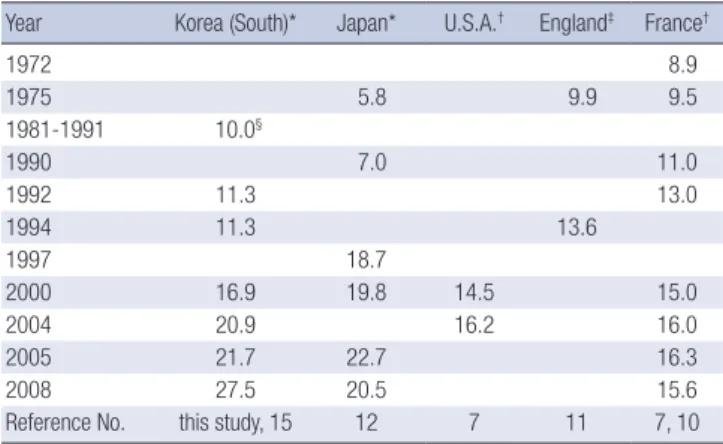
pregnancies have been reviewed in Europe. Investigators from France reported an increase in the twin pregnancy rate to 15.6 in 2008, an 80% increase from 8.9 in 1972 (7, 10). Similar results have been reported from England, where the multiple pregnancy rate was 9.9 in 1975, and increased to 13.6 in 1994, with a marked increase since 1992 (11).
The multiple birth rate (MBR) is defined as the ratio of multi- ple births per 1,000 live births. A Japanese study reported chang- es in the MBR from 5.8 in 1975 to 7.0 in 1990, 22.7 in 2005, and 20.5 in 2008 (12). Some Korean studies on the MBR and perina- tal morbidity and mortality have been previously reported (13, 14). Hur and Kwon (15) reported a nationwide survey for the first time, using data from the National Satistics of Korea, which includes data on the trends in MBR only from 1981 to 2002 in Korea. In their study, the MBR was maintained within slightly less than 10.0 over a decade from 1981 to 1990. However, it started to increase gradually from the early 1990s, and finally it reached 19.6 in 2002.
On the line of continuity of Hur and Kwon’s (15) study, the aim of this study was to focus on the survey of recent trends of multiple births and its consequences on perinatal problems in Korea during the last two decades from 1991 to 2008, to analyze the incidence and the changes in multiple births, the distribu- tion of maternal age, as well as the BW and GP of the infants. The goal was to describe the trends of increasing multiple births, the relationship between maternal age and multiple births, and the
incidence of preterm infants and LBWI among the multiple births.
MATERIALS AND METHODS
Data was obtained from the Korean Statistical Information Ser- vice (16). The data evaluated included: a) the annual number of multiple biths and MBR, b) maternal age at the time of the birth and the percentage of mothers of advanced-aged, more than 35, c) the distribution of BW and the incidence of LBWI and very low birth weight infants (less than 1,500 g, VLBWI), and d) the distribution of GP and the incidence of preterm infants (subdi- vided to GP<31, GP: 32-36, and total preterm groups) from 1991 to 2008. All of the results were compared with the same param- eters among the total live births during the same time period.
Comparison with other countries is also discussed.
RESULTS
The number of multiple births and MBR in the last two decades
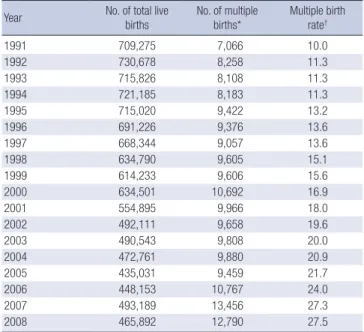
The number of multiple births and the changes in the MBR are shown in Table 1. The total live births decreased. However, the total number of multiple births shows increasing trends. The MBR was 10.0 in 1991, 13.2 in 1995, 16.9 in 2000, 21.7 in 2005, and 27.5 in 2008. There was a 275% increase in the MBR over the last 18 yr. MBR doubling from 10.0 to 20.0 took 12 yr from 1991 to 2003; however, it took only 5 yr to reach 27.5, suggesting a rapid increase in multiple births.
The number of twins and triplets and its rates
The annual number of twins and triplets is shown in Table 2 for the years 2000, 2005, and 2007. The number of triplet births was 123, 69 and 176 in 2000, 2005, and 2007, respectively. The twin birth rate (/1,000 live births) was 16.7 in 2000, 21.6 in 2005 and 26.9 in 2007 and for triplets it was 0.19 in 2000, 0.15 in 2005, and 0.36 in 2007. Both rates show increasing trends.
The distribution of maternal age and the percentage of advanced-maternal age
Comparison of the distribution of maternal age between the to- tal live births and multiple births is shown in Table 3. The ma- ternal age for total live births increased from 2000 to 2008. How- ever, the manternal age for multiple births was much higher than for total live births. The percentage of advanced-maternal age for total live births, i.e. more than 35 yr of age, was 6.7% in 2000, 10.6% in 2005, and 14.3% in 2008. For the multiple births, it Table 1. Annual changes in number of total live births, multiple births, and multiple
birth rate in Korea (1991-2008)
Year No. of total live
births
No. of multiple births*
Multiple birth rate†
1991 709,275 7,066 10.0
1992 730,678 8,258 11.3
1993 715,826 8,108 11.3
1994 721,185 8,183 11.3
1995 715,020 9,422 13.2
1996 691,226 9,376 13.6
1997 668,344 9,057 13.6
1998 634,790 9,605 15.1
1999 614,233 9,606 15.6
2000 634,501 10,692 16.9
2001 554,895 9,966 18.0
2002 492,111 9,658 19.6
2003 490,543 9,808 20.0
2004 472,761 9,880 20.9
2005 435,031 9,459 21.7
2006 448,153 10,767 24.0
2007 493,189 13,456 27.3
2008 465,892 12,790 27.5
*No. of multiple birth: Individual No. of multiples born (not means twin pairs or triplet sets); †Multiple birth rate: multiple births/1,000 live births.
Table 2. Annual Incidence of twin and triplets in Korea (2000-2007)
2000 2005 2007
No. of twin individuals* 10,569 9,393 13,280
No. of triplets individuals* 123 66 176 Twin births rate/1,000 live birth 16.7 21.6 26.9 Triplets births rate/1,000 live birth 0.19 0.15 0.36
*No. of Individuals of twin or triplets born (not means twin pairs or triplet sets).
Table 3. Maternal age distribution for total live births and multiple births in Korea (2000-2008)
Maternal age No. of total live births No. of multiple births
2000 % 2008 % 2000 % 2008 %
<15 7 0.0 46 0.0 0 0.0 0 0.0
15-19 4,599 0.7 2,728 0.6 42 0.4 10 0.1
20-24 74,328 11.7 28,173 6.0 882 8.2 388 3.0
25-29 328,207 51.7 168,893 36.3 4,899 45.8 3,559 27.8
30-34 183,044 28.8 198,748 42.7 3,733 34.9 6,278 49.1
35-39 36,904 5.8 59,596 12.8 983 9.2 2,319 18.1
40-44 5,038 0.8 6,537 1.4 126 1.2 202 1.6
45-49 290 0.0 334 0.1 11 0.1 14 0.1
≥50 46 0.0 32 0.0 2 0.0 2 0.0
Unknown 2,038 0.3 805 0.2 14 0.1 18 0.1
Total 634,501 100.0 465,892 100.0 10,692 100.0 12,790 100.0
was 10.5% in 2000, 14.3% in 2005, and 19.8% in 2008, much higher than for total live births (Fig. 1).
The distribution of BW and the incidence of LBWI and VLBWI
The BW distribution between for total live births and multiple
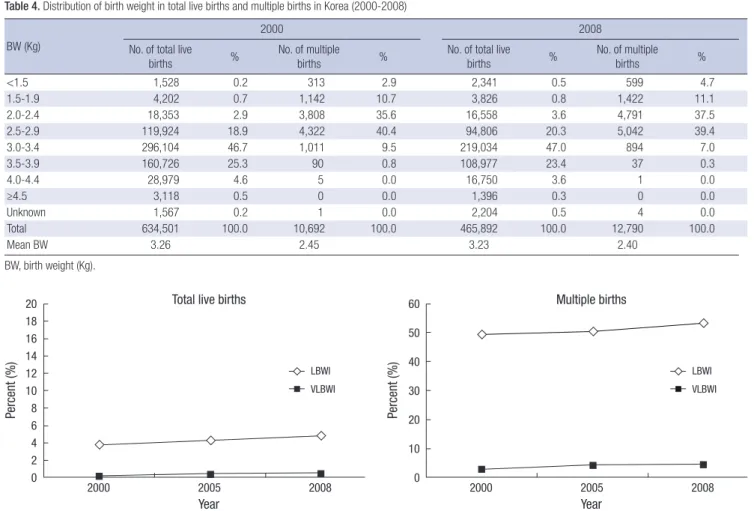
births is shown in Table 4. The BW among multiple births was much lower. The mean BW of total live births was 3.23 kg, and for multiple births it was 2.40 kg in 2008.
The incidence of LBWI among total live births was 3.8%, 4.3%, and 4.9% in 2000, 2005, and 2008, respectively (Fig. 2). For the multiple births, it was 49.2%, 50.3%, 53.0% during the same years.
The incidence of VLBWI for multiple births was 2.9%, 4.2%, and 4.7% in 2000, 2005, and 2008, respectively. It was much higher than among total live births. Both showed increasing trends.
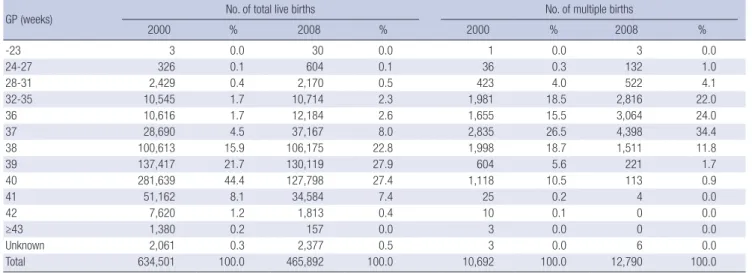
The distribution of GP and the incidence of preterm infants The distribution of the GP for total live births and multiple births was analyzed (Table 5). The GP was much shorter for the multi- ple births than the total live births. The incidence of preterm in- fants among the total live births was 3.8% in 2000, 4.7% in 2005, and 5.5% in 2008, and for the multiple births it was 38.3%, 44.7%, and 51.5% during the same years. These factors showed increas- ing treands.
The GP was divided into three groups, less than 31 weeks, between 32 and 36 weeks, and total (Fig. 3). The incidence of preterm infants was greater with multiple births than in total
Percent (%)
Year
Total live births Multiple births
2000 2005 2008
25
20
15 10
5
0
Fig. 1. Advanced-maternal age distribution, more than 35 yr of age, during 2000, 2005, and 2008: The percentage of advanced-maternal age was much higher for multiple births than for the total live births, with increasing trends.
Table 4. Distribution of birth weight in total live births and multiple births in Korea (2000-2008)
BW (Kg)
2000 2008
No. of total live
births % No. of multiple
births % No. of total live
births % No. of multiple
births %
<1.5 1,528 0.2 313 2.9 2,341 0.5 599 4.7
1.5-1.9 4,202 0.7 1,142 10.7 3,826 0.8 1,422 11.1
2.0-2.4 18,353 2.9 3,808 35.6 16,558 3.6 4,791 37.5
2.5-2.9 119,924 18.9 4,322 40.4 94,806 20.3 5,042 39.4
3.0-3.4 296,104 46.7 1,011 9.5 219,034 47.0 894 7.0
3.5-3.9 160,726 25.3 90 0.8 108,977 23.4 37 0.3
4.0-4.4 28,979 4.6 5 0.0 16,750 3.6 1 0.0
≥4.5 3,118 0.5 0 0.0 1,396 0.3 0 0.0
Unknown 1,567 0.2 1 0.0 2,204 0.5 4 0.0
Total 634,501 100.0 10,692 100.0 465,892 100.0 12,790 100.0
Mean BW 3.26 2.45 3.23 2.40
BW, birth weight (Kg).
Percent (%) Percent (%)
Year Year
Total live births Multiple births
2000 2005 2008 2000 2005 2008
20 18 16 14 12 10 8 6 4 2 0
60 50 40 30 20 10 0 VLBWI
LBWI
VLBWI LBWI
Fig. 2. The incidence of low birth weight infants (LBWI) and very low birth weight infants (VLBWI) among total and multiple live births during 2000, 2008: The incidence was higher among multiple births compared to total live births group, with increasing trends.
live births. These factors also showed increasing trends.
DISCUSSION
The results of this study (1991-2008) along with those from Hur
and Kwon (1981-2002) (15), are shown in Fig. 4. The MBR was maintained within slightly less than 10.0 for a decade from 1981 to 1990. However, it started to increase in 1992 from 11.3 and reached 13.2 in 1995, 16.9 in 2000, 20.0 in 2003, 21.7 in 2005, and 27.5 in 2008. There was a 275% increase in the MBR from 10.0 to Table 5. Distribution of gestational period in total live births and multiple births in Korea (2000-2008)
GP (weeks) No. of total live births No. of multiple births
2000 % 2008 % 2000 % 2008 %
-23 3 0.0 30 0.0 1 0.0 3 0.0
24-27 326 0.1 604 0.1 36 0.3 132 1.0
28-31 2,429 0.4 2,170 0.5 423 4.0 522 4.1
32-35 10,545 1.7 10,714 2.3 1,981 18.5 2,816 22.0
36 10,616 1.7 12,184 2.6 1,655 15.5 3,064 24.0
37 28,690 4.5 37,167 8.0 2,835 26.5 4,398 34.4
38 100,613 15.9 106,175 22.8 1,998 18.7 1,511 11.8
39 137,417 21.7 130,119 27.9 604 5.6 221 1.7
40 281,639 44.4 127,798 27.4 1,118 10.5 113 0.9
41 51,162 8.1 34,584 7.4 25 0.2 4 0.0
42 7,620 1.2 1,813 0.4 10 0.1 0 0.0
≥43 1,380 0.2 157 0.0 3 0.0 0 0.0
Unknown 2,061 0.3 2,377 0.5 3 0.0 6 0.0
Total 634,501 100.0 465,892 100.0 10,692 100.0 12,790 100.0
GP, gestational period (weeks).
Percent (%) Percent (%)
Year Year
Total live births Multiple births
2000 2005 2008 2000 2005 2008
20 18 16 14 12 10 8 6 4 2 0
60 50 40 30 20 10 0 32-36 w
32-36 w Total (<37 w)
Total (<37 w)
<31 w
<31 w
Fig. 3. The incidence of preterm infants among total live births and multiple live births during 2000, 2005, and 2008: The preterm group was subdivided according to gestational period (GP) less than 31 weeks and between 32 and 36 weeks of GP. The preterm incidence was much higher for multiple births than total live births with increasing trends.
Multiple birth rate
Year
1981 1983 1985 1987 1989 1991 1993 1995 1997 1999 2001 2003 2005 2007
50
40
30
20
10
0
Fig. 4. Change in the multiple birth rate per 1,000 live biths in Korea from 1981 to 2008: The MBR was maintained at approximately 10.0 from 1981 to 1990, started to increase during the early 1990s, followed by a marked recent increase.
27.5 in the two decades studied. The increase in the MBR in the last 5 yr, was from 20.0 to 27.5, compared to the doubling time of the MBR, in the past, from 10.0 to 20.0, which took almost 12 yr from 1991 to 2003 in Korea.
Numerous factors have been associated with the increase of multiple births, such as social factors, familiar tendency, genet- ic factors, nutritional factors, fertility, advanced maternal age, and the introduction of ART (1).
Multiple births categorized as twins and triplets, showed that the number of triplets was 123 in 2000, 69 in 2005, and 176 in 2007. The twin birth rate (/1,000 live birth) was 16.7 in 2000, 21.6 in 2005, and 26.9 in 2007, and the triplet birth rate (/1,000 live birth) was 0.19, 0.15, and 0.36 in the same years in Korea. It shows increasing trends. A comparison of the MBR and mutiple (twin) pregnancy rate between Korea and other countries is shown in Table 6. The changes in Korea are consistent with those in Japan, USA, England and France.
Chang et al. (17) reported the first successful ART procedure in Korea in 1986, and it has become widely used gradually from the early 1990s. The Korean Society of Obstetrics and Gynecol- ogy reports the annual results through the ART Committee, from their first report titled ‘Current status of ART in Korea for 1994’
(18) to the latest survey in 2006 (19). The parallel in the incidence of multiple births with the use of ART suggest the importance of the association of ART with multiple births in Korea. In addition, maternal age is another important factor associated with multi- ple births. The maternal age was found to be higher among mul- tiple births than singleton births, and the percentage of woman considered to be advanced-maternal age was higher among the multiple births. In the results of this study, advanced-maternal age had a frequency of 14.3% among all live births; however, it was 19.8% among the multiple births in Korea in 2008. That is, one out of five mothers among the multiple births were ad- vanced-aged pregnancies. This suggests that advanced-mater-
nal age was one of the factors associated with multiple births.
However, Kim et al. (20) reported that the mean age of most women undergoing ART was high; therefore, it is difficult to seperate the two variables (age and ART). We could not deter- mine the number of ART pregnancies accounting for multiple births in the data available for this study. We speculate that stud- ies about the trends of mutiple births by ART in Korea will be required in the next subject.
The incidence of preterm and LBWI is also increasing in Korea.
The associated factors include: preterm labor, twinning, ART, social factors, and advanced-maternal age. In the present study, the mean BW was lower and the GP was shorter among multi- ple births compared to the total live births. These findings sug- gest that the incidence of preterm and LBWI was much higher among the multiple births. In 2008, LBWI accounted for 53.3%
and preterm infants for 51.1% of all multiple births in Korea; that is, half of all multiple births were preterm or LBWI. These find- ings suggest the need for close monitoring of such pregnancies and deliveries.
In conclusion, the incidence of multiple births and its conse- quences on perinatal problems (preterm infant, LBWI, and ad- vanced-maternal age at the time of the birth) have been increased steadily over the last two decades in Korea. Such pregnancies, deliveries, and multiple birth infants require close monitoring and care due to the associated risks.
REFERENCES
1. Wenstrom KD, Gall SA. Incidence, morbidity and mortality, and diag- nosis of twin gestations. Clin Perinatol 1988; 15: 1-11.
2. Loos RJ, Derom C, Derom R, Vlietinck R. Determinants of birthweight and intrauterine growth in liveborn twins. Paediatr Perinat Epidemiol 2005; 19 Suppl 1: 15-22.
3. Kim NO, Choi SJ, Han KH, Hyung HS, Shin SR. Birth weight distribution of twins according to gestational age. Korean J Obstet Gynecol 2004; 47:
1860-4.
4. Lee KH, Hwang SJ, Kim SH, Lee SH, Yu DK, Hwang JH, Choi CW, Shim JW, Chang YS, Park WS. Comparison of mortality and morbidity in mul- tiple versus singleton very low birth weight infants in a neonatal inten- sive care unit. J Korean Med Sci 2003; 18: 779-82.
5. Kliegman RM, Behrman RE, Jenson HB, Stanton BF. Nelson textbook of pediatrics. 18th ed. Philadelphia: Saunder Elsevier, 2007; 699-700.
6. Allen VM, Wilson RD, Cheung A; Genetics Committee of the Society of Obstetricians and Gynaecologists of Canada (SOGC); Reproductive Endocrinology Infertility Committee of the Society of Obstetricians and Gynaecologists of Canada (SOGC). Pregnancy outcomes after assisted reproductive technology. J Obstet Gynaecol Can 2006; 28: 220-50.
7. Blondel B. Increase in twin maternities and consequences on health. J Gynecol Obstet Biol Reprod 2009; 38: S7-17.
8. Blondel B, Kogan MD, Alexander GR, Dattani N, Kramer MS, Macfarlane A, Wen SW. The impact of the increasing number of multiple births on the rates of preterm birth and low birthweight: an international study.
Am J Public Health 2002; 92: 1323-30.
Table 6. Comparison of multiple birth rate in Korea to multiple (twin) pregnancy rate in other countries
Year Korea (South)* Japan* U.S.A.† England‡ France†
1972 8.9
1975 5.8 9.9 9.5
1981-1991 10.0§
1990 7.0 11.0
1992 11.3 13.0
1994 11.3 13.6
1997 18.7
2000 16.9 19.8 14.5 15.0
2004 20.9 16.2 16.0
2005 21.7 22.7 16.3
2008 27.5 20.5 15.6
Reference No. this study, 15 12 7 11 7, 10
*Multiple birth rate (MBR): multiple births/1,000 live births; †Twin pregnancy rate:
twin pregnancies/1,000 pregnancies; ‡Multiple pregnancy rate: multiple pregnancies/
1,000 pregnancies; §The MBR was maintained within slightly less than 10.0 for a decade from 1981 to 1990 in Korea.
9. Han M, Park ES. The clinical outcome of twin pregnancies after IVF. Ko- rean J Reprod Med 2007; 34: 173-8.
10. Blondel B, Kaminski M. The increase in multiple births and its conse- quences on perinatal health. J Gynecol Obstet Biol Reprod (Paris) 2002;
31: 725-40.
11. Dunn A, Macfarlane A. Recent trends in the incidence of multiple births and associated mortality in England and Wales. Arch Dis Child Fetal Neonatal Ed. 1996; 75: F10-9.
12. Japan Ministry of Health, Labour and Welfare. Available from: URL: http:
//www.mhlw.go.jp/toukei/index.html [accessed on 15 January 2010]
13. Lee SH, Kim OY, Seo SS. Clinical study on twins. J Korean Pediatr Soc 1993; 36: 1663-71.
14. Lee GR, Park KH, Park JS, Lee WM, Cha JY, Kim HH, Park MI, Cho SH, Chung SR. Statistical analysis of twin pregnancy for 10 Years (1993~2002).
Korean J Obstet Gynecol 2003; 46: 1957-64.
15. Hur YM, Kwon JS. Changes in twinning rates in South Korea: 1981-2002.
Twin Res Hum Genet 2005; 8: 76-9.
16. Korean Statistical Information Service. Available from: URL: http://
www.kosis.kr [accessed on 15 January 2010]
17. Chang YS, Lee JY, Moon SY, Kim JG. Pregnancy and its outcome by in vitro fertilization of human oocytes and embryo transfer. Korean J Ob- stet Gynecol 1986; 29: 354-61.
18. Moon SY, Kim BR, Kim SH, Son YS, Lee KS, Lee BI, Lee SH, Lee YI, Jeon SS, Choi YM, Hwang TY. Current status of assisted reproductive technol- ogy in Korea for 1994. Korean J Obstet Gynecol 1998; 41: 236-53.
19. ART committee, Korean Society of Obstetrics and Gynecology. Current status of assisted reproductive technology in Korea, 2006. Korean J Ob- stet Gynecol. 2009; 52: 1212-38.
20. Kim HM, Lee JW, Shin SH, Kim SK, Sung TJ. Comparison of neonatal outcomes between the spontaneous and in vitro fertilization twin preg- nancies Korean J Pediatr 2007; 50: 740-5.