325
and Safety
Available online at http://www.foodhygiene.or.kr
https://doi.org/10.13103/JFHS.2018.33.5.325
Combination of Hydrophobic Filtration and Enrichment Methods for Detecting Bacillus cereus in Fresh-Cut Cabbage
Sujung Lee1,2, Yukyung Choi1,2, Heeyoung Lee2,Sejeong Kim1,2, Jeeyeon Lee1,2, Jimyeong Ha1,2, Hyemin Oh1,2, Yewon Lee1,2, Yujin Kim1,2, Yohan Yoon1,2, and Soomin Lee2*
1Department of Food and Nutrition, Sookmyung Women’s University, Seoul, Korea
2Risk Analysis Research Center, Sookmyung Women’s University, Seoul, Korea (Received April 5, 2018/Revised July 16, 2018/Accepted October 1, 2018)
ABSTRACT - This study developed a rapid detection method for Bacillus cereus in fresh-cut cabbages. Fresh-cut cabbage samples were inoculated at 1-, 2- and 3-Log CFU/g, and pathogens were enriched in tryptic soy broth con- taining 0.15% polymyxin B at 30oC, 37oC, and 42oC to determine the detection limit and appropriate enrichment tem- perature for multiplex PCR detection. Enriched bacterial cells in enrichment broth were collected in a hydrophobic filter prior to DNA extraction for multiplex PCR. Filters were resuspended in distilled water, and DNA was extracted from the suspension. DNA samples were further analyzed by multiplex PCR. Detection limit of multiplex PCR was 5-Log CFU/mL. B. cereus cell counts were higher (P < 0.05) at 42oC than other temperatures. Detection rate of 1-, 2-, and 3-Log CFU/g inoculated samples were 60%, 80%, and 100% after enrichment respectively. However, when enriched samples were filtered with hydrophobic membrane filter, detection rates became 100%, regardless of inocu- lation level. Results indicate a combination of enrichment with hydrophobic filtration improves rapid detection effi- ciency of B. cereus in fresh-cut cabbage by multiplex PCR.
Key words : Bacillus cereus, Fresh-cut cabbage, Multiplex PCR, Enrichment, Hydrophobic filtration
Fresh-cut vegetables that are consumed raw, are being concerned for foodborne pathogens, because they could be contaminated throughout cultivation, irrigation, post har- vesting, and packaging1,2). As the vegetable consumption has been increased, Bacillus cereus has been recognized as one of the most frequently detected foodborne pathogens in fresh- cut vegetables with low concentration about 3-Log CFU/g1,3). Thus, the detection method of B. cereus should be able to detect low concentration of B. cereus and distinguish B.
cereus from other B. cereus group3-7). However, conven- tional methods of B. cereus detection require 24~48 h for enumeration in selective culture media and additional 18~48 h for identification5,8,9).
To complement selective culture methods, polymerase chain reaction (PCR) based detection methods (e.g. real-time PCR and droplet digital PCR) have been developed for rapid detection10,11). However, PCR methods were sensitive to inhibitors and used for identification only with isolated colony12-14). Ganji et al.15) reported that Clostridium perfringens was identified by PCR when the cell concentration was
presented upto 4-Log CFU/g in food samples, and B. cereus need to be concentrated upto 3-Log CFU/mL to be detected by multiplex PCR in cold dish samples. Thus, if cell concentrations can increase rapidly, bacteria in samples can be detected directly by PCR, and enrichment method has been accompanied as one of the pretreatment method to apply PCR method16). PCR inhibitors that contained in the food and environmental samples can interfere PCR re- actions13). Wei et al.17) identified that polysaccharides, poly- phenols, and pectin may interfere PCR reactions. To improve the PCR reactions, silica membrane filtration and column chromatography using Chelex and cetrimonium bromide have been used18,19). Also, two-step filtration was applied to remove PCR inhibitory substances from beef samples20). Nabil et al.21) conducted hydrophobic membrane filter procedure for concentration of viruses. However, there have been few previous studies on the application of hydrophobic filtration in prior to PCR for the bacteria detection. Therefore, this study developed the efficient detection method for B. cereus in fresh-cut cabbages
Materials and Methods
Inocula preparation
A single colony of each B. cereus strain [B. cereus KCTC-
*Correspondence to: Soomin Lee, Risk Analysis Research Center, Sookmyung Women's University, Seoul 04210, Korea Tel: 82-2-2077-7585, Fax: 82-2-710-9479
E-mail: [email protected]
for 24 h. A five-strain mixture (50 mL) of B. cereus was centrifuged at 1,912× g at 4oC for 15 min, and the cell pellet was washed twice with phosphate-buffered saline (PBS, pH 7.4; 0.2 g of KH2PO4, 1.5 g of Na2HPO4·7H2O, 8.0 g of NaCl, and 0.2 g of KCl in 1 L of distilled water). The suspension was then diluted with PBS serially to make 1-, 2-, 3-, 4-, 5-, 6-, and 7-Log CFU/mL of inocula.
Detection limit of B. cereus multiplex PCR kit To determine detection limit with multiplex B. cereus PCR kit (Jinsung-UniTech Co., Korea), one-milliliter aliquots of each inoculum level were used to prepare DNA template.
The one-milliliter aliquots of the inocula were centrifuged at 14,000 rpm at 4oC for 5 min, and the pellets were resuspended in 30μL of distilled water. The bacterial sus- pensions were heated at 100oC for 10 min and centrifuged at 14,000 rpm at 4oC for 3 min. The supernatant was used as DNA template in PCR analysis according to the manu- facturer’s protocol. Three primers for cry1 (138 bp), groEL (250 bp), and ces (405 bp) were included in the multiplex PCR kit (Jinsung-UniTech Co., Korea). B. cereus producing emetic toxin was detected by the presence of groEL and ces gene. B. cereus, non-producing emetic toxin, was detected by groEL gene. B. thuringiensis was indicated by cry1 and groEL gene.
Determination of enrichment temperature
The enrichment broth (TSB with 0.15% polymyxin B) was prepared according to the Bacteriological Analytical Manual6). One-mililiter of polymyxin B (Oxoid, England) was added into 150 mL of TSB after filtering with 0.45μm pore size filter (Hyundai Micro Co., Korea). The inoculum was inoculated into 50 mL TSB with 0.15% polymyxin B (Oxoid, England) to obtain 1-Log CFU/mL, and the media were incubated at 30oC for 0, 3, 6, 9, and 12 h. This process was conducted at other temperatures (37oC and 42oC) in same manners. One-mililiter aliquots of the enriched samples were spread plated on mannitol-egg yolk-polymyxin (MYP ; Becton, Dickinson and Company) agar and incubated at 30oC for 24 h. B. cereus colonies on the plates were manually counted.
B. cereus inoculation and detection
The fresh-cut cabbage samples were purchased from a market in Seoul, South Korea. Twenty-gram portions of the cabbage were placed into the filter bag (3M, St. Paul, MN,
polymyxin B were placed into the cabbage samples. The samples were enriched at 42oC. The temperature was deter- mined by the previous assay. One-milliliter aliquots of the enriched samples were centrifuged at 14,000 rpm at 4oC for 5 min, and the pellet was washed by adding 30μL distilled water. For non-filtered samples, the suspension was then boiled at 100oC for 10 min. The heated suspension was left at room temperature for 2 min and centrifuged at 14,000 rpm at 4oC for 3 min. For hydrophobic-filtered samples 1-mL aliquots of the enriched samples were filtered through hydrophobic filter membranes with 0.45μm pore size (Hyundai micro Co., LTD., South Korea). Before filtering, the hydrophobic filter membranes were dipped in 2-propanol (Sigma-Aldrich Co., St. Louis, USA), and they were then assembled with ADVANTEC® filter holder (Toko Roshi Kaisha., LTD., Japan). Two-milliliters of distilled water were filtered for the hydrophobic filter to wash the residues.
After the filter membranes were vortexed in 2 mL of distilled water for 1 min, and the filtrates were centrifuged at 14,000 rpm and 4oC for 5 min. Thirty-microliter of distilled water were added into the pellets, and the suspension were boiled at 100oC for 10 min. The heated suspensions were left at room temperature for 2 min and centrifuged at 14,000 rpm and 4oC for 3 min. The supernatants were used as DNA template. To detect B. cereus in both non-filtered and hydrophobic filtered samples multiplex PCR was conducted as described above.
Statistical analysis
Data (n = 4) were analyzed with the general linear model procedure of SAS® (SAS ver. 9.2 Institute Inc., USA). The significance of fixed effects was determined by a pairwise t-test at α = 0.05.
Results and Discussion
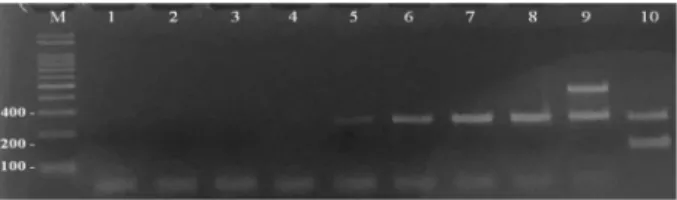
The minimal detection concentration for detection of B.
cereus by multiplex PCR was about 5-Log CFU/mL (Fig.
1). The result indicates that the B. cereus in fresh-cut cabbage samples should be enriched at least up to 5-Log CFU/g to be detected by the multiplex PCR in case B. cereus level is lower than that in a fresh-cut cabbage sample. Thus, enrichment temperatures for B. cereus enrichment were compared, and B. cereus cell counts were generally higher (p < 0.05) at 42oC than those at 30oC and 37oC (Table 1).
Hence, we decided to use 42oC for enrichment temperature.
When inoculated fresh-cut cabbage samples at 1-Log CFU/
g were enriched for 7 h, B. cereus was detected with multiplex PCR in three of the five samples (60%), even though B. cereus levels were above the detection limit (Table 2 and Fig. 2). B. cereus in 2-Log CFU/g inoculated samples were enriched from 1.7 to 7.5 Log CFU/g that was above the detection limit within 6 h, and the pathogen was detected with multiplex PCR in four samples (80%) (Table 2 and Fig. 2). B. cereus in 3-Log CFU/g inoculated samples
were enriched from 2.9 to 8.2 Log CFU/g within 6 h, and the pathogen were detected in all samples (100%) (Table 2 and Fig. 2). These results indicate that enrichment is not sufficient to have accurate detection result with multiplex PCR. Elhariry et al.22) reported that B. cereus spores and vegetative cells could adhere rapidly to cabbage, and that would make the minimal concentration for detection of the multiplex PCR increase. Also, PCR inhibitors such as chlorophyll and pectin could influence detection efficiency of the multiplex PCR13,23). In previous report, hydrophobic liquid was used for the NA purification by acting the liquid as an immiscible phase filter (IPF)24). Similarly, Wu et al.23) reported that the hydrophobic filter can effectively eliminate chlorophyll from lettuce samples to detect E. coli O157:H7.
Thus, to improve the detection efficiency of PCR method, enriched samples were filtered with a hydrophobic filter. For filtered samples with a hydrophobic filter after enrichment, B. cereus were detected in all 1-Log CFU/g inoculated Fig. 2. Detection of Bacillus cereus in non-filtered fresh-cut cab- bage samples by multiplex PCR. (A) Lane M: 100-bp ladder;
lanes 1-2: 3-Log CFU/g inoculated and 4-h enriched samples;
lanes 3-4: 1-Log CFU/g inoculated and 5-h enriched samples;
lanes 5-6: 2-Log CFU/g inoculated and 5-h enriched samples;
lanes 7-8: 3-Log CFU/g inoculated and 5-h enriched samples;
lanes 9-10: 1-Log CFU/g inoculated and 6-h enriched samples;
lanes 11-12: 2-Log CFU/g inoculated and 6-h enriched samples;
lanes 13-14: 3-Log CFU/g inoculated and 6-h enriched samples;
lane 15: B. cereus positive control; lane 16: B. thuringiensis posi- tive control; lanes 17-18: 1-Log CFU/g inoculated and 7-h enriched samples; (B) lane M: 100-bp ladder; lanes 1-3: 1-Log CFU/g inoculated and 4-h enriched samples; lane 4: B. cereus positive control; lane 5: B. thuringiensis positive control; lanes 6- 8: 1-Log CFU/g inoculated and 5-h enriched samples; lanes 9-11:
2-Log CFU/g inoculated and 5-h enriched samples; lanes 12-14:
3-Log CFU/g inoculated and 5-h enriched samples; (C) lane M:
100-bp ladder; lanes 1-3: 1-Log CFU/g inoculated and 6-h enriched samples; lanes 4-6: 2-Log CFU/g inoculated and 6-h enriched samples; lanes 7-9: 3-Log CFU/g inoculated and 6-h enriched samples; lanes 10-12: 1-Log CFU/g inoculated and 7-h enriched samples; lane 13: B. cereus positive control; lane 14: B.
thuringiensis positive control.
Fig. 1. Detection limit of Bacillus cereus multiplex PCR. Lane M:
100-bp ladder; lane 1: < 1 Log CFU/g inoculation; lane 2: 1-Log CFU/g inoculation; lane 3: 2-Log CFU/g inoculation; lane 4: 3- Log CFU/g inoculation; lane 5: 4-Log CFU/g inoculation; lane 6:
5-Log CFU/g inoculation; lane 7: 6-Log CFU/g inoculation; lane 8: 7-Log CFU/g inoculation; lane 9: B. cereus positive control;
lane 10: B. thuringiensis positive control.
Table 1. Bacillus cereus cell counts (Log CFU/g; mean ± standard deviation) in enrichment broth samples inoculated at 1- Log CFU/mL (n = 4)
Enrichment time (h)
Incubated temperatures (oC)
30 37 42
0 0.9±0.4Ac 0.9±0.4 Ad 0.9±0.4 Ad 3 2.5±0.4 Ac 2.9±0.6 Acd 3.2±0.3 Ac 6 4.6±0.6 Bb 4.8±0.4 ABbc 5.4±0.3 Ab 9 5.7±1.1 Aab 5.9±1.2 Aab 6.2±0.9 Aab 12 7.3±0.5 Aa 7.7±0.1 Aa 7.2±0.4 Aa
A-BMeans with the same row with different superscript uppercase letters are significantly different (p < 0.05)
a-dMeans with the same column with different superscript lower- case letters are significantly different (p < 0.05)
Table 2. Bacillus cereus cell counts (Log CFU/g; mean ± standard deviation) in fresh-cut cabbage samples (n = 5) during enrichment at 42oC
Enrichment time (h)
Inoculation levels (Log CFU/g)
1 2 3
0 0.8±0.3 1.7±0.8 2.9±0.2
4 -* - 5.8±0.2
5 5.4±0.3 6.4±0.3 7.5±0.3
6 6.4±0.6 7.5±0.4 8.2±0.2
7 6.9±0.3 - -
*: Not tested
samples (100%) within 6 h. The bacteria in 2-Log CFU/g inoculated samples were detected in all samples (100%) within 5 h. These results indicate that filtering enriched samples with a hydrophobic filter can improve detection efficiency of B. cereus in fresh-cut cabbage with multiplex PCR. Hydrophobic filter removes PCR inhibitors such as chlorophyll from fresh-cut cabbage23).
In conclusion, a combination of enrichment and hydrophobic filtering fresh-cut cabbage samples improves detection efficiency for B. cereus with multiplex PCR.
Acknowledgements
This work was supported by the "Cooperative Research Program for Agriculture Science & Technology Development (Project No. PJ01193002)" Rural Development Adminis- tration, Republic of Korea.
증균온도는 B. cereus 균주 5 개를 혼합하여 1 Log CFU/
mL이 되도록 증균배지에 접종하고 30oC, 37oC, 42oC에서 증균한 뒤 3시간 간격으로 MYP agar에 도말한 후 계수 하여 선정하였다. 소수성필터 미적용 그룹은 B. cereus 균 주 5 개를 혼합하여 신선편이 양배추에 접종한 뒤 최적 증균온도에서 증균하였으며, 증균배양액을 가열하여 DNA 를 추출한 뒤 multiplex PCR을 진행하였다. 소수성필터 적 용 그룹은 증균배양액을 소수성 필터에 적용하고 필터에 있는 균을 멸균증류수로 현탁한 뒤 가열하여 추출된 DNA 로 multiplex PCR을 진행하였다. 증균온도 확인 결과, 6시 간 증균 시 42oC에서 증균된 샘플(5.4 ± 0.3 Log CFU/mL) 과 30oC에서 증균된 샘플(4.6 ± 0.6 Log CFU/mL) 간 유의 차가 확인되었다(p < 0.05). 소수성필터 적용 유무에 따른 multiplex PCR 결과, 1 Log CFU/g 접종된 샘플의 검출률 이 소수성 필터 적용 전 60%(3/5)에서 100%(5/5)로 향상 되었다. 2 Log CFU/g 접종 샘플은 소수성필터 적용 전 80%(4/5)에서 소수성 필터 적용 후 100%(5/5)로 검출률이 증가하였으나, 3 Log CFU/g 접종 샘플은 소수성 필터 적 용 전후 모두 100%(5/5)로 확인되었다. 이상의 결과를 통 해 신선편이 양배추 내 B. cereus 검출 시 증균배양액에 소수성필터를 적용하고 multiplex PCR을 적용했을 때 신 속하고 효율적인 검출이 가능할 것으로 판단된다.
References
1. Berger C. N., Sodha S. V., Shaw R. K., Griffin P. M., Pink D., Hand P., Franke G.: Fresh fruit and vegetables as vehicles for the transmission of human pathogens. Environ. Micro- biol., 12, 2385-2397 (2010).
2. Valero M., Hernández-herrero L.A., Fernández P.S., Salm- erón M.C.: Characterization of Bacillus cereus isolates from fresh vegetables and refrigerated minimally processed foods by biochemical and physiological tests. Food Microbiol., 19, 491-499 (2002).
3. Jensen G.B., Hansen B.M., Eilenberg J., Mahillon J.: The hid- den lifestyles of Bacillus cereus and relatives. Environ Micro- biol., 5, 631-640 (2003).
4. FDA (Food and Drug Administration). Bacteriological Ana- lytical Manual (BAM). Bacillus cereus Media M158: Tryp- ticase Soy-Polymyxin Broth. Available online: https://www.
fda.gov/Food/FoodScienceResearch/LaboratoryMethods/ucm- 063848.htm (accessed on 5 March 2018).
5. FDA (Food and Drug Administration). Bacteriological Ana- lytical Manual (BAM). Bacillus cereus. Available online:
http://www.fda.gov/Food/FoodScienceResearch/Laboratory- Fig. 3. Detection of Bacillus cereus in hydrophobic-filtrated
fresh-cut cabbage homogenates by multiplex PCR. (A) Lane M:
100-bp ladder; lanes 1-2: 3-Log CFU/g inoculated and 4-h enriched samples; lanes 3-4: 1-Log CFU/g inoculated and 5-h enriched samples; lanes 5-6: 2-Log CFU/g inoculated and 5-h enriched samples; lanes 7-8: 3-Log CFU/g inoculated and 5-h enriched samples; lanes 9-10: 1-Log CFU/ inoculated and 6-h enriched samples; lanes 11-12: 2-Log CFU/g inoculated and 6-h enriched samples; lanes 13-14: 3-Log CFU/g inoculated and 6-h enriched samples; lane 15: B. cereus positive control; lane 16: B. thuring- iensis positive control; lanes 17-18: 1-Log CFU/g inoculated and 7-h enriched samples; (B) lane M: 100-bp ladder; lanes 1-3: 1- Log CFU/g inoculated and 4-h enriched samples; lane 4: B.
cereus positive control; lane 5: B. thuringiensis positive control;
lanes 6-8: 1-Log CFU/g inoculated and 5-h enriched samples;
lanes 9-11: 2-Log CFU/g inoculated and 5-h enriched samples;
lanes 12-14: 3-Log CFU/g inoculated and 5-h enriched samples;
(C) lane M: 100-bp ladder; lanes 1-3: 1-Log CFU/g inoculated and 6-h enriched samples; lanes 4-6: 2-Log CFU/g inoculated and 6-h enriched samples; lanes 7-9: 3-Log CFU/g inoculated and 6-h enriched samples; lane 10: B. cereus positive control; lane 11: B.
thuringiensis positive control; lanes 12-14: 1-Log CFU/g inocu- lated and 7-h enriched samples;
Methods/ucm070875.htm (accessed on 5 March 2018).
6. Kramer, J.M. and Gilbert, R.J.: Bacillus cereus and other Bacillus species. Ch 2 In: Doyle MP (ED) Foodborne bacte- rial pathogens. Marcel Dekker, New York, pp. 22-26 (1989) 7. Valero M., Fernández P.S., Salmerón M.C.: Influence of pH and temperature on growth of Bacillus cereus in vegetable substrates. Int. J. Food Microbiol., 82, 71-79 (2003).
8. FDA (Food and Drug Administration). Bad bug book: Food- borne pathogenic microorganisms and natural toxins hand- book. Available from: https://www.fda.gov/downloads/food/
foodsafety/foodborneillness/foodborneillnessfoodbornepatho- gensnaturaltoxins/badbugbook/ucm297627.pdf. Accessed Feb.
20, 2018.
9. Tallent S.M., Kotewicz M.K., Strain E.A., Bennett R.E.: Effi- cient isolation and identification of Bacillus cereus group. J.
AOAC Int., 95, 446-451 (2012).
10. Cattani F., Barth V.C., Nasário J.S.R., Ferreira C.A.S., Oliveira S.D.: Detection and quantification of viable Bacillus cereus group species in milk by propidium monoazide quan- titative real-time PCR. J. Dairy Sci., 99, 2617-2624 (2016).
11. Porcellato D., Narvhus J., Skeie S.B.: Detection and quanti- fication of Bacillus cereus group in milk by droplet digital PCR. J. Microbiol. Method., 127, 1-6 (2016).
12. Demeke T., Adams R.P.: The effects of plant polysaccharides and buffer additives on PCR. Biotechniques., 12, 332-334 (1992).
13. Hu Q., Liu Y., Yi S., Huang D.: A comparison of four meth- ods for PCR inhibitor removal. Forensic Sci Int., 16, 94-97 (2015).
14. Schrader C., Schielke A., Ellerbroek L., Johne R.: PCR inhib- itors - occurrence, properties and removal. J. Appl. Microbiol., 113, 1014-1026 (2012).
15. Ganji L., Azimirad M., Farzi N., Alebouyeh M., Shirazi M.H., Eshraghi S.S., Mirshafiey A., Daryani N.E., Zali M.R.:
Comparison of the detection limits of the culture and PCR methods for the detection of Clostridium difficile, Clostrid- ium perfringens, Campylobacter jejuni, and Yersinia entero- colitica in human stool, Arch. Pediatr. Infect Dis., 5, 1-7 (2017).
16. Garrido-Maestu A., Azinheiro S., Carvalho J., Prado M.:
Rapid and sensitive detection of viable Listeria monocytoge- nes in food products by a filtration-based protocol and qPCR.
Food Microbiol., 73, 254-263 (2018).
17. Wei T., Lu G., Clover G.: Novel approaches to mitigate primer interaction and eliminate inhibitors in multiplex PCR, demonstrated using an assay for detection of three strawberry viruses. J. Virol. Methods., 151, 132-139 (2008).
18. Böddinghaus B., Wichelhaus T. A., Brade V., Bittner T.:
Removal of PCR inhibitors by silica membranes: evaluating the amplicor mycobacterium tuberculosis Kit. J. Clin. Micro- biol., 39, 3750-3752 (2001).
19. Gisendorf B. A. J., Quint W. G. V., Henkens M. H. C., Stege- man H., Huf F. A., Niesters H. G. M.: Rapid and sensitive detection of Campylobacter spp. in chicken products by using the polymerase chain reaction. Appl. Environ. Microbiol., 58, 3804-3808 (1992).
20. Venkateswaras K., Kamijoh Y., Ohashi E., Nakanishia H.:
Simple filtration technique to detect enterohemorrhagic Escherichia coli O157:H7 and its toxins in beef by multiplex PCR. Appl. Environ. Microbiol., 63, 4127-4131 (1997).
21. Nabil E. B., Duron J., Gingras D., Lippé R.: Quantitative evaluation of protein heterogeneity within herpes simplex virus 1 particles. J. Virol., 91, (2017).
22. Elhariry H. M.: Attachment strength and biofilm forming ability of Bacillus cereus on green-leafy vegetables: cabbage and lettuce. Food Microbiol., 28, 1266-1274 (2011).
23. Wu X., Han C., Chen J., Huang Y. W., Zhao Y.: Rapid detec- tion of pathogenic bacteria from fresh produce by filtration and surface-enhanced raman spectroscopy. JOM., 68, 1156- 1162 (2016).
24. Sur K., Mcfall S. M., Yeh E. T., Jangam S. R., Hayden M.
A., Stroupe S. D., Kelso D. M.: Immiscible phase nucleic acid purification eliminates PCR inhibitors with a single pass of paramagnetic particles through a hydrophobic liquid. J.
Mol. Diagn., 12, 620-628 (2012).