Korean J Biol Psychiatry 2016;23(4):157-165
Introduction
How a society perceives suicide influences the suicidal be- havior of individuals in that society. Previous studies show that the more permissive toward sucide a society is, the more fre- quent suicide is in both individual and country levels.1-6) If this correlation between permissiveness, in terms of admissibility or acceptability, and suicide rate does in fact exist, then South Korea, which has one of the highest suicide rates in the world,
must have a highly permissive attitude toward suicide.
Our study aims to explore and compare the national atti- tudes towards suicide with a representative sample of the gener- al population. For this purpose, we carried out a survey in three countries: South Korea, Japan, and the United States. South Ko- rea and Japan share many cultural similarities : strong tradition of Confucianism ; highly homogeneous ethnic demographics ; long history of nationalism ; importance of collectivism, etc. The United States, on the other hand, is a cultural mirror image of
A Comparative Study of Permissive Attitudes Toward Suicide : An Analysis of Cross-National Survey in South Korea, Japan, and the United States
C. Hyung Keun Park, MD,1,2 Bora Kim, MD,3 Sang Sin Lee, PhD,4 Kyooseob Ha, MD,1,2 Chang-Jae Baek, PhD,5 Min-Sup Shin, PhD,1,2 Yong-Min Ahn, MD1,2,6
1Department of Neuropsychiatry, Seoul National University Hospital, Seoul, Korea
2Department of Psychiatry and Behavioral Science, Seoul National University College of Medicine, Seoul, Korea
3Department of Psychiatry, University of California at San Francisco, San Francisco, CA, USA
4Korean Institute for National Unification, Seoul, Korea
5Department of Political Science and International Relations, College of Social Sciences, Seoul National University, Seoul, Korea
6Institute of Human Behavioral Medicine, Seoul National University College of Medicine, Seoul, Korea
ObjectivesZZThere were previous studies which indicated that attitude toward suicide is able to influence the suicide outcome in both individual and group levels. In regard to the highest suicide rate in Korea, our study aims to explore the influence that attitude toward suicide has on suicide by comparing the national attitude towards suicide with a representative sample of the general population.
MethodsZZThe target population was 20- to 59-year-old adults from South Korea, Japan, and the United States. The panel data were divided according to gender, age, and residential area of individuals, and an email with a hyperlink to our web survey was sent to the randomly selected participants in each stratum. To measure the perceptual differences about suicide in different cultures, this study adopted the Attitudes Toward Suicide questionnaire.
ResultsZZA total of 2247 subjects in three countries participated in this study. According to results from factor analysis, there were different structure of factors and included items within factors in the three countries : five factors with nineteen items in South Korea, five factors with nineteen items in the United States, and five factors with twenty-five items in Japan. With regard to permissive atti- tude toward suicide, the mean value of permissiveness was not significantly different among countries, but permissiveness according to education level, gender, and marital status was different in each country.
ConclusionsZZThis study is the first nationwide comparative study about attitude toward suicide with a representative sample. Our findings suggest that permissive attitude toward suicide influence the suicide phenomenon in each country ; however, its impact is not a mean score of permissiveness, but the detailed difference by various demographics.
Key WordsZZSuicide ㆍPermissiveness ㆍFactor analysis ㆍComparative study.
Received: August 2, 2016 / Revised: August 8, 2016 / Accepted: August 12, 2016 Address for correspondence: Yong-Min Ahn, MD
Department of Neuropsychiatry, Seoul National University Hospital, 101 Daehak-ro, Jongro-gu, Seoul 03080, Korea Tel: +82-2-2072-2457, Fax: +82-2-744-7241, E-mail: [email protected]
South Korea and Japan with its individualist tradition and pragmatism deeply rooted in the basis of American society.
Suicide is such a complex phenomenon that it needs to be approached from multiple dimensions. Various disciplines cast suicide in their own lights : for psychology suicide is main- ly an individual behavior ; for sociology or anthropology it is a socio-cultural problem ; for psychiatrics it is a mental disorder that requires proper treatment. Of course, we need to have multi- disciplinary approaches to truly understand the depth and com- plexity of suicidal behavior. Psychiatric problems that are con- sidered suicide related are depression, substance abuse, and excessive stress, as well as physical illness and interpersonal rela- tionship, occupational, and economic concerns.7)8) In regard to socio-cultural factors, suicide has been considered as a product of social conditions ever since Emile Durkheim proposed a so- ciological theory of suicide in Le Suicide in 1897. An excess of two main sociological forces, “social integration” and “social regulation,” may result in increased suicide rates. Since then, many sociological studies emerged to explain the difference between countries.9)10)
Among the various aspects of explanation for suicide between countries, we focus on the effect of the general perception of suicide in a society. For example, South Korea has been under the strong influence of Confucianism since the 14th century, which emphasizes the importance of family value. Such a gen- eral culture may influence permissiveness for suicide and af- fect suicide behaviors. Attitude toward suicide was used as one of methods in order to approach the general thought for sui- cide.
Previous studies showed that attitude toward suicide is af- fected by a number of factors such as sex, age, religion, prior contact with suicidal individuals, and one’s own history of suicidality. But the outcomes of those studies are not consis- tent.2)11-17) In terms of the association between permissive atti- tude toward suicide and suicidality, some studies have shown a significant correlation.1-3)5)18) Despite these results, some other studies have argued that countries with more permissive atti- tudes toward suicide are more likely to have lower suicide rates.
The common limitation of these previous research efforts is that they do not have samples that can represent the general popula- tion of a society. Usually these studies only have specific and limited samples such as health care workers, medical school stu- dents, nurses, or university students. As a result, samples from almost all previous research were not representative and were limited in large scale comparisons, such as difference between countries. The discrepancy among previous literatures may be caused by this problem of partial samples.
Methods
Procedures
The data for this study was gathered by a multi-stage stratified sampling method. The target population was 20- to 59-year-old adults from South Korea, Japan, and the United States. The pan- el data was divided according to gender, age, and residential area of individuals, and an email with a hyperlink to our web survey was sent to the randomly selected participants in each stratums. The surveys were conducted by three survey compa- nies – Macromill Embrain in South Korea, Global Mappping International in the United States, and Micromill in Japan. The web survey questionnaire contained a self-administered ques- tionnaire and information about the purpose of the research.
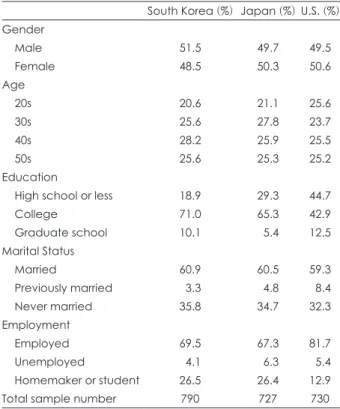
The total number of the respondents was 2247 (790 from South Korea, 730 from the United States, and 727 from Japan). The web-questionnaire was designed to not allow a respondent to skip an item, so that there were no missing values in the datas- et. The only exception was an item that measured the level of suicidal ideation of a respondent. But only a small number of respondents chose not to answer this question (10 missing val- ues from South Korea, 15 from Japan, and 9 from the United States).
This survey was monitored and approved by the Institution- al Review Board of Seoul National University. Any questions that could reveal the identity of individuals were dropped from the questionnaire. Through a filter question that appeared be- fore the main body of the questionnaire, individuals who had sought professional help for their mental problems or attempt- ed suicide were excluded from the survey.
Measurement
To measure the perceptual differences on suicide in different cultures, this study adopted the Attitudes Toward Suicide ques- tionnaire (ATTS). The ATTS was originally developed by Swed- ish researchers.19) Compared to other questionnaires that are being widely used such as Suicide Opinion Questionnaire (SOQ) or Suicide Attitude Questionnaire (SUIATT), the ATTS has the advantage in its relative simplicity and conciseness, so it is bet- ter equipped for large-scale public survey.20)21) Out of the forty items from the 2008 version of ATTS, thirty-seven items were employed in this study. The ATTS items were measured with a five-point Likert Scale, which ranged from Strongly Agree to Strongly Disagree. The ATTS had been translated into Japa- nese by Japanese researchers,20) and this study utilized this ver- sion of the Japanese translation. The Korean version of ATTS was translated by Park and Kim.22)
Data analysis
Exploratory factor analysis is performed with the data from the three countries. Parallel analysis method is employed to de- termine the number of factors in each analysis, which is consid- ered to be the most accurate way of estimating factors.23-25) Par- allel analysis reveals that the ATTS items converge into five factors in all three countries. After deciding the number of fac- tors, exploratory factor analysis with maximum likelihood ex- traction method and promax rotation is performed. The items for which the factor loading value are smaller than 0.35 were discarded. Also the items with high factor loading value (>
0.35) for multiple factors are excluded from the analysis. Cron- bach’s α is calculated for each factor.
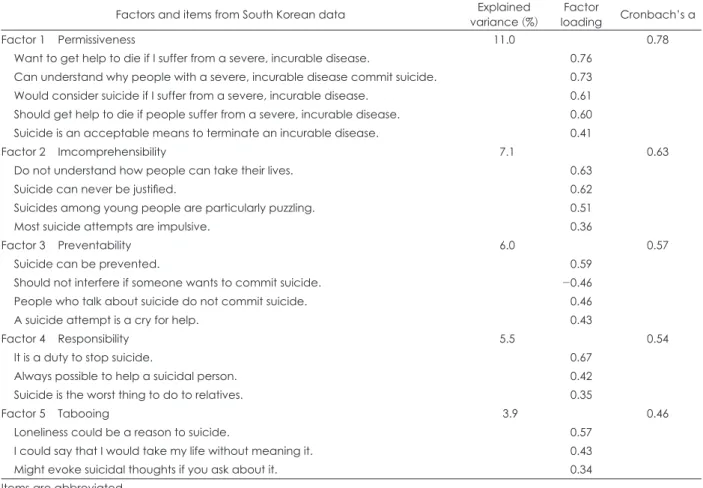
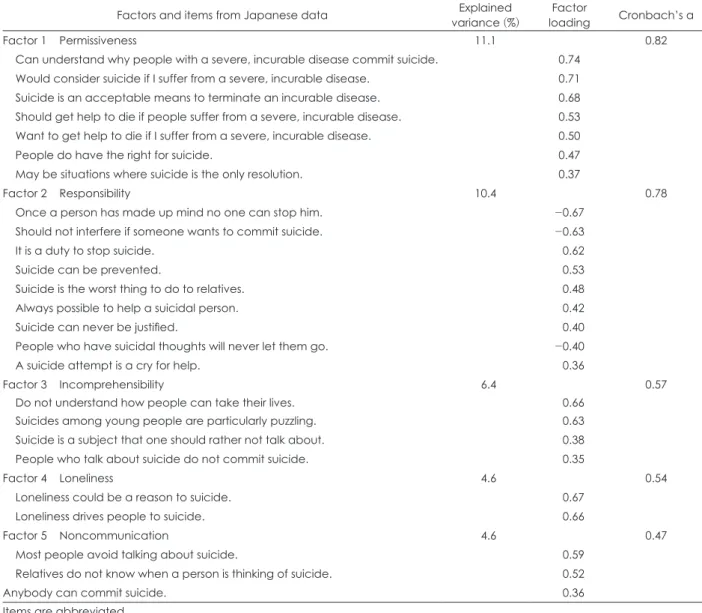
The exploratory factor analysis of ATTS in each country shows that the permissiveness factor in all three countries is comprised of very similar items (Table 1-3). Also, among all the factors the permissiveness explains the most variance (11.0% in South Korea, 11.1% in Japan, 16.8% in the United States). To compare permissiveness in the three countries, a summation scale is constructed by adding up five items that commonly are part of the permissiveness factor (e.g., suicide is an acceptable means to terminate an incurable disease ; would consider sui-
cide if I suffer from a severe, incurable disease).
One-way ANOVA is conducted is to test the group difference for permissiveness (Table 5). The demographic variables that are employed in ANOVA are gender, age, level of education, employment status, and marital status. In addition, the national characteristics of the items in the permissiveness factor that were not shared by all three countries were examined using one-way ANOVA and Tukey’s post hoc test.
For significant test results, 5% level of p values is used for two-tailed tests. All the statistical analysis of this research are conducted using STATA version 13.1 (StataCorp., College Sta- tion, TX, USA) and SPSS for Windows version 21.0 for PC (SPSS Inc., Chicago, IL, USA).
Results
Table 4 summarizes the characteristics of sample demo- graphics for the three countries. Table 1-3 present the result of factor analysis of ATTS in each country. In the case of South Korea, five factors are found which consisted of nineteen items.
Likewise, the American ATTS model has five factors with nineteen items, but each factor is constructed with different Table 1. Factors obtained from exploratory factor analysis of South Korean survey data
Factors and items from South Korean data Explained
variance (%) Factor
loading Cronbach’s α
Factor 1 Permissiveness 11.0 0.78
Want to get help to die if I suffer from a severe, incurable disease. 0.76 Can understand why people with a severe, incurable disease commit suicide. 0.73 Would consider suicide if I suffer from a severe, incurable disease. 0.61 Should get help to die if people suffer from a severe, incurable disease. 0.60 Suicide is an acceptable means to terminate an incurable disease. 0.41
Factor 2 Imcomprehensibility 07.1 0.63
Do not understand how people can take their lives. 0.63
Suicide can never be justified. 0.62
Suicides among young people are particularly puzzling. 0.51
Most suicide attempts are impulsive. 0.36
Factor 3 Preventability 06.0 0.57
Suicide can be prevented. 0.59
Should not interfere if someone wants to commit suicide. -0.46-
People who talk about suicide do not commit suicide. 0.46
A suicide attempt is a cry for help. 0.43
Factor 4 Responsibility 05.5 0.54
It is a duty to stop suicide. 0.67
Always possible to help a suicidal person. 0.42
Suicide is the worst thing to do to relatives. 0.35
Factor 5 Tabooing 003.9 0.46
Loneliness could be a reason to suicide. 0.57
I could say that I would take my life without meaning it. 0.43
Might evoke suicidal thoughts if you ask about it. 0.34
items in two countries. The Japanese factor model also has five factors, but those factors contain twenty-five items.
The permissiveness factor, which is the major concern of this article, is found in all three countries. The Korean permissive- ness factor has five items, and these items are also commonly found in the Japanese and American models. Based on these factor analyses, a summation scale for permissiveness of sui- cide is constructed with the five common items that all three country models shared. Cronbach’s alpha for this permissive- ness scale is 0.75 in South Korea, 0.79 in Japan 0.79, and 0.84 in the United States.
Table 5 presents the results of the one-way ANOVA of per- missiveness. The national mean value of permissiveness was not significantly different between countries, but permissive- ness according to various demographic variables was different
in each country. In South Korea, none of the demographic variables has significant association with permissiveness. Basi- cally, for all the Korean groups in each demographic, variables have more or less the same level of permissiveness of suicide.
But in the case of Japan, statistically significant group differ- ences are found in gender, education, and marital status : Japa- nese male respondents are more permissive than female re- spondents; the level of education has a non-linear relationship with permissiveness—while college graduates have more per- missive attitudes than those with lower education levels, the people with graduate level education have the most intolerant attitudes toward suicide. If we devide into two groups, less than high school education and more than college graduation, peo- ple with higher education levels were more significantly per- missive than people with relatively lower education levels in Table 2. Factors obtained from exploratory factor analysis of Japanese survey data
Factors and items from Japanese data Explained
variance (%) Factor
loading Cronbach’s α
Factor 1 Permissiveness 11.1 0.82
Can understand why people with a severe, incurable disease commit suicide. 0.74 Would consider suicide if I suffer from a severe, incurable disease. 0.71 Suicide is an acceptable means to terminate an incurable disease. 0.68 Should get help to die if people suffer from a severe, incurable disease. 0.53 Want to get help to die if I suffer from a severe, incurable disease. 0.50
People do have the right for suicide. 0.47
May be situations where suicide is the only resolution. 0.37
Factor 2 Responsibility 10.4 0.78
Once a person has made up mind no one can stop him. -0.67
Should not interfere if someone wants to commit suicide. -0.63
It is a duty to stop suicide. -0.62
Suicide can be prevented. -0.53
Suicide is the worst thing to do to relatives. -0.48
Always possible to help a suicidal person. -0.42
Suicide can never be justified. -0.40
People who have suicidal thoughts will never let them go. -0.40
A suicide attempt is a cry for help. -0.36
Factor 3 Incomprehensibility 06.4 0.57
Do not understand how people can take their lives. -0.66
Suicides among young people are particularly puzzling. -0.63
Suicide is a subject that one should rather not talk about. -0.38
People who talk about suicide do not commit suicide. -0.35
Factor 4 Loneliness 04.6 0.54
Loneliness could be a reason to suicide. -0.67
Loneliness drives people to suicide. -0.66
Factor 5 Noncommunication 04.6 0.47
Most people avoid talking about suicide. -0.59
Relatives do not know when a person is thinking of suicide. -0.52
Anybody can commit suicide. -0.36
Items are abbreviated
Korea and the United States [mean 13.94 (SD 0.32) in less than high school education and 14.69 (SD 0.15) in college graduate or higher education in Korea ; mean 14.00 (SD 0.29) in less than high school education and 15.06 (SD 0.25) in college graduate or higher education in the United States]. Finally, the experience of marriage significantly reduces the tendency of permissive attitude toward suicide. But employment status and age do not have significant impact on permissiveness. The ANOVA of American data reveals that gender and education are statistically significant : American males are more permis- sive than females ; and American respondents with college level education have the most permissive attitude than other educa- tion level groups, which is the same as the Japanese model.
The last row of Table 5 reports the national mean of permis- siveness for each country. The United States has the most per- missive attitude toward suicide (14.59), while South Korea and Japan have relatively smaller values of permissiveness (14.55 and 14.52, respectively). T-test showed that the differences of permis- siveness among the three countries are not significant. Overall, we can conclude that the three countries of this research, even with their cultural differences, have more or less the same level of permissive attitude toward suicide.
Table 3. Factors obtained from exploratory factor analysis of the U.S. survey data
Factors and items from the U.S. data Explained
variance (%) Factor
loading Cronbach’s α
Factor 1 Permissiveness 16.8 0.88
Would consider suicide if I suffer from a severe, incurable disease. 0.81 Want to get help to die if I suffer from a severe, incurable disease. 0.78 Can understand why people with a severe, incurable disease commit suicide. 0.76 Should get help to die if people suffer from a severe, incurable disease. 0.69 Suicide is an acceptable means to terminate an incurable disease. 0.68
People do have the right for suicide. 0.50
Factor 2 Inevitability 07.9 0.72
Should not interfere if someone wants to commit suicide. 0.80
Once a person has made up mind no one can stop him. 0.40
Suicide is a subject that one should rather not talk about. 0.39
People who have suicidal thoughts will never let them go. 0.37
Factor 3 Incomprehensibility 10.6 0.76
Do not understand how people can take their lives. 0.73
Suicide is the worst thing to do to relatives. 0.62
Suicides among young people are particularly puzzling. 0.59
It is a duty to stop suicide. 0.52
Suicide can never be justified. 0.51
Factor 4 Loneliness 06.2 0.59
Loneliness could be a reason to suicide. 0.81
Loneliness drives people to suicide. 0.48
Factor 5 Preventability 05.2 0.59
Always possible to help a suicidal person. 0.77
Want to get help to die if I suffer from a severe, incurable disease. 0.47 Items are abbreviated
Table 4. Demographic variables between the three countries, South Korea, Japan, and the Unites States
South Korea (%) Japan (%) U.S. (%) Gender
Male 51.5 49.7 49.5
Female 48.5 50.3 50.6
Age
20s 20.6 21.1 25.6
30s 25.6 27.8 23.7
40s 28.2 25.9 25.5
50s 25.6 25.3 25.2
Education
High school or less 18.9 29.3 44.7
College 71.0 65.3 42.9
Graduate school 10.1 05.4 12.5
Marital Status
Married 60.9 60.5 59.3
Previously married 03.3 04.8 08.4
Never married 35.8 34.7 32.3
Employment
Employed 69.5 67.3 81.7
Unemployed 04.1 06.3 05.4
Homemaker or student 26.5 26.4 12.9
Total sample number 790 727 730
In the permissiveness factor, one item, “May be situations where suicide is the only resolution,” was found only in Japan, and the other item, “People do have the right for suicide,” ap- peared only in Japan and the United States. For the former, sig- nificantly higher agreement was observed in Japan than in both South Korea and the United States (p < 0.001, one-way ANOVA, Tukey’s post hoc test), between which there was no significant difference, and, for the latter, significantly higher agreement was shown in the United States than in Japan (p < 0.001, one-way ANOVA, Tukey’s post hoc test) and in Japan than in South Ko- rea (p < 0.001, one-way ANOVA, Tukey’s post hoc test).
Discussion
We aimed two goals : the exploration of the difference of structure of attitude in three different countries and the rela- tionship between permissive attitude toward suicide and na- tional suicide rate. First, the results of our study show that there exist differences in the composition of factors for the attitudes toward suicide in the three countries. This is the first report to compare the attitude toward suicide between countries with a large number of representative sample and a full 37 items of the ATTS Scale. Next, with regard to permissive attitude toward suicide, the mean value of permissiveness was not significantly different between countries, but permissiveness according to Table 5. Difference of permissiveness by demographic variables in the three countries using ANOVA
South Korea Japan United States Combined
Mean
(SD) n F Mean
(SD) n F Mean
(SD) n F Mean
(SD) n F
Gender
Male 14.48
(3.82) 407 0.29 14.97
(3.64) 361 †8.02† 15.22
(5.05) 361 †11.17‡ 14.85
(4.21) 1129 †11.48‡
Female 14.62
(3.7)7 383 14.15
(3.47) 366 13.97
(5.04) 369 14.25
(4.13) 1118 Age
20s 14.58
(3.77) 163 0.39 14.94
(3.83) 153 2.04 14.56
(5.11) 187 70.19 14.68
(4.33) 0503 71.42
30s 14.77
(3.81) 202 14.76
(3.55) 202 14.77
(5.27) 173 14.77
(4.21) 0577
40s 14.45
(3.73) 223 14.33
(3.51) 188 14.66
(4.88) 186 14.48
(4.06) 0597
50s 14.41
(3.74) 202 14.1
(3.41) 184 14.38
(5.11) 184 14.30
(4.14) 0570 Education
High school or less 13.95
(3.9)7 149 72.4 14.16
(3.9)7 213 *3.10* 14.00
(5.17) 326 7†4.22† 14.04
(4.54) 0688 †77.86‡
College 14.68
(3.7)7 561 14.75
(3.39) 475 15.16
(4.88) 313 14.81
(3.91) 1349 Graduate school 14.79
(3.86) 780 13.69
(3.66) 739 14.74
(5.29) 091 14.56
(4.51) 0210 Employment
Employed 14.60
(3.73) 549 1.16 14.53
(3.64) 489 2.38 14.50
(5.04) 595 71.01 14.54
(4.23) 1633 70.97
Unemployed 13.56
(3.73) 732 15.54
(3.80) 746 15.69
(5.49) 039 15.05
(4.48) 0117 Homemaker or student 14.56
(3.83) 209 14.27
(3.32) 192 14.62
(5.16) 094 14.45
(3.94) 0495 Marrital status
Married 14.49
(3.68) 481 0.55 14.21
(3.29) 440 †6.31† 14.56
(5.14) 433 72.39 14.42
(4.10) 1354 *74.50*
Previously married 15.27
(4.21) 726 13.86
(4.77) 735 13.36
(4.74) 061 13.91
(4.66) 0122 Never married 14.58
(3.85) 283 15.15
(3.78) 252 14.95
(5.03) 236 14.88
(4.23) 0771
National mean 14.55
(3.76) 790 14.52
(3.57) 727 14.59
(5.08) 730 14.55
(4.18) 2247
* : p < 0.05, †: p < 0.01, ‡: p < 0.001
education level, gender, and marital status was different in each country. This result seems to be a little different than we ex- pected, in part, regarding higher permissiveness toward suicide in countries with high suicide rates. However, it is affecting the culture of each country by the difference between the configu- ration of each demographic factors of attitude rather than sim- ply the overall attitude. This result makes it possible to under- stand a little more in-depth about the concept of suicide.
First, we focus on the structures of items, especially the num- ber of factors and consistent concept of suicide. Items of ATTS were divided with five factors in all three countries ; however, the composition of each item was different in Korea, Japan, and the United States. It is difficult to compare the results of previ- ous factor analysis studies directly because they used different versions of ATTS. For instance, there was a factor analysis study with a 20 item Korean version of ATTS26) and another analysis performed in Sweden, Norway, and Russia with a 40 item of ATTS.20) In a 37 item version study performed in Japan, it was analyzed with six factors and there was little difference of com- position in the included items. This is due to the fact that the subjects enrolled in the survey were different : The subjects of the previous Japanese study were specialists that participated in one seminar; on the other hand, our sample is representative of the general population. Therefore, our results may be represen- tative of the structure of ATTS in each country.
Second, with regard to permissive attitude, it is understand- able on the basis of contradictory results from previous research- es. There were several researches about association with more permissive attitudes toward suicide and suicide as an outcome in individual aspects1)2) and international comparison between countries.3-6) Overall, the more permissive attitude towards suicide was interconnected with higher prevalence of suicide ; however, some results have shown more permissive attitudes in countries with lower suicide rates. Our results were also not correlated with suicide rate and permissive attitude toward suicide, uniformly. According to the Organization for Econom- ic Cooperation and Development (OECD) Health Statistics re- port of 2016,27) the South Korean suicide rate was 28.7 per 100000 population in 2013, and in Japan in 2013 it was 18.7. But the American suicide rate in 2013 was 13.1, which is distinctively low- er than the other two countries and more or less the same with the OECD average suicide rate (12.1 in 2014 or nearest year). This result suggests that the suicide rate in a country could not be understood simply by comparing one aspect and should be considered comprehensively with a number of related factors.
Additionaly, we analyzed the permissiveness toward suicide with several demographic variables. Males were more permis- sive about suicide in Japan and the United States ; however, there
was no significant difference in Korea. In previous researches, women were reported to be more likely to disapprove of one’s right to suicide14) and tended to believe that rational suicide should be allowed under certain conditions.15) The results about gender difference of Japan and the United States in our study are consistent with previous studies, but only the result from Korea was inconsistent. Likewise, our study further showed that this gender difference of permissive attitude also differ in countries.
In regard to age in our study, age did not affect the attitudes about suicide in all three countries. About permissive attitude by aging, there were different previous results. It was reported that older subjects tended to be more empathetic toward suicid- al patients11) ; on the contrary, older subjects were reported to be more condemnatory toward the right to suicide12) or to be more comprehensible than younger subjects in another researches.13) Our results were not inconsistent with previous researches.
Additionally, permissive attitude was related with education level and marital status. In Korea and the United States, people with higher education levels had more permissive attitudes, but there was no significant difference in Japan. Influence of mari- tal status on permissive attitude was different for each country : Those who never married in the United States were more per- missive about suicide than married people, and people who were previously married had lower permissive attitudes. On the contrary, married people in Japan were less permissive than people without marriage experience. This complex demograph- ic difference of attitude toward suicide in each country may come from the cultural differences between countries, so it needs to combine other various cultural factors in order to ex- plain attitude toward suicide. On examples of other cultural fac- tors, it has revealed the association between attitude toward sui- cide and religion, such as Christianity and Judaism.16) There were reports about another factors relating individual experi- ence or psychiatric problems ; subjects with a history of suicide crisis were more accepting of the idea of suicide than subjects without such history.2) Likewise, it is possible to explain about attitude after considering a number of factors, social, cultural, and individual.
The results from the study can also be understood by the no- tion of the suicidal process, which begins with suicidal ideation, proceeds with suicidal plan, and ends with completed suicide.28) Permissive attitude can be considered to belong to the stage of suicidal ideation whereas the suicide rate marks the terminal point of the process ; therefore, permissive attitude and suicide rate do not necessarily have to correlate. The result that the na- tional mean of permissiveness reveals no significant difference may imply that, in South Korea, suicidal ideation including permissive attitude toward suicide can evolve through suicidal
plan or attempt without less difficulty. Moreover other factors such as predictors and protectors of suicide might intervene in and affect the suicidal process resulting in the difference in the suicide rate. To clarify such element, we further investigated two items found in the permissiveness factor of only one to two coun- tries-one item, “May be situations where suicide is the only reso- lution,” found only in Japan, was more strongly agreed in Japan than in both South Korea and the United States. This item asks about “the resolution.” It may show that the Japanese are accus- tomed to pondering about an adverse situation and devising a means to overcome it with, and thus they are likely to find an alternative resolution rather than suicide. The other item, “Peo- ple do have the right for suicide,” found in Japan and the United States, was more stongly agreed in the United States than in Ja- pan and in Japan than in South Korea. This item inquires about
“the right.” It may imply that, whereas, in Japan and the United States, people do have the right to make a decision, in South Ko- rea, they have relative difficulty in standing on one’s right pos- sibly due to its interdependent culture29) and thus are likely to use suicide as a remedy in despair.
In addition, individual factors, such as psychiatric problem and experience contacting suicidal people, should also be con- sidered. Our follow up study plan is to build an integrated mod- el combined with those elements based on this study. Our study has several important implications and strengths. First, we se- lected subjects that is representative of the general population.
To overcome the limitations of subjects in previously performed researches, we selected a large number and distributed evenly by age and sex of the general population. Second, our study is an international comparative study between three countries.
Suicide problem in Korea can be understood through this com- parison study with Japan and the United States, and at the same time, the influence of attitude toward suicide on suicide rate in each country can be also understood.
Our study also has several limitations. First, because of our web-survey method, the adult population over 60 was excluded from the sampling, due to their lack of internet access and skills. This is an unavoidable shortcoming of web-surveys.
However, we distributed sex and age evenly in the three coun- tries and used a large number of subjects in order to minimize these limitations. Moreover, the level of education of subjects was higher than the general population since people accessing the web-based survey may have relatively higher education lev- els. Lastly, there might have been some limitations in explaining the related attitude toward suicide and suicide rate in different countries because it should be explained through an integrated model including factors influencing general thought or attitude, such as sex, age, income, religion, and relative’s or familial expe-
rience of suicide. In this study, we performed a cross-sectional analysis and plan further research for an integrated model.
In conclusion, this study explored the comparison of the na- tional attitudes toward suicide with a representative sample of the general population in three countries, Korea, Japan and the United States. The structure of factors and composed items in ATTS were different in each country. Overall mean score of per- missiveness was not correlated with the suicide rate of each of the three countries. However, permissive attitude by gender, ed- ucation level, and marital status was different in each country.
Our findings suggest that attitude toward suicide is able to in- fluence the suicide phenomenon in each country ; however, it correlates many different aspects, cultural and social factors, and need to explore a combined integrated model in order to under- stand the suicide phenomenon. Our results which can represent the three countries may be the basis for that.
Acknowledgments
This work was supported by the Brain Fusion Research Grant from Seoul National University.
Conflicts of interest
The authors have no financial conflicts of interest.
REFERENCES
1) Zemaitiene N, Zaborskis A. Suicidal tendencies and attitude to- wards freedom to choose suicide among Lithuanian schoolchildren:
results from three cross-sectional studies in 1994, 1998, and 2002.
BMC Public Health 2005;5:83.
2) McAuliffe C, Corcoran P, Keeley HS, Perry IJ. Risk of suicide ide- ation associated with problem-solving ability and attitudes toward suicidal behavior in university students. Crisis 2003;24:160-167.
3) Dervic K, Gould MS, Lenz G, Kleinman M, Akkaya-Kalayci T, Velting D, et al. Youth suicide risk factors and attitudes in New York and Vienna: a cross-cultural comparison. Suicide Life Threat Behav 2006;36:539-552.
4) Domino G, Leenaars AA. Attitudes toward suicide: a comparison of Canadian and U.S. college students. Suicide Life Threat Behav 1989;19:160-172.
5) Domino G, Takahashi Y. Attitudes toward suicide in Japanese and American medical students. Suicide Life Threat Behav 1991;21:
345-359.
6) Skruibis P, Gailiene D, Hjelmeland H, Fartacek R, Fekete S, Knizek BL, et al. Attitudes towards suicide among regional politicians in Lithuania, Austria, Hungary, Norway and Sweden. Suicidol Online 2010;1:79-87.
7) Arsenault-Lapierre G, Kim C, Turecki G. Psychiatric diagnoses in 3275 suicides: a meta-analysis. BMC Psychiatry 2004;4:37.
8) Mann JJ, Apter A, Bertolote J, Beautrais A, Currier D, Haas A, et al. Suicide prevention strategies: a systematic review. JAMA 2005;
294:2064-2074.
9) Shneidman ES. Suicidology and the university: a founder’s reflec- tions at 80. Suicide Life Threat Behav 2001;31:1-8.
10) Chen J, Choi YJ, Mori K, Sawada Y, Sugano S. Socio-economic stud- ies on suicide: a survey. J Econ Surv 2012;26:271-306.
11) Samuelsson M, Sunbring Y, Winell I, Asberg M. Nurses’ attitudes to attempted suicide patients. Scand J Caring Sci 1997;11:232-237.
12) Botega NJ, Reginato DG, da Silva SV, Cais CF, Rapeli CB, Mauro
ML, et al. Nursing personnel attitudes towards suicide: the devel- opment of a measure scale. Rev Bras Psiquiatr 2005;27:315-318.
13) Oncü B, Soyka C, Ihan IO, Sayil I. Attitudes of medical students, general practitioners, teachers, and police officers toward suicide in a Turkish sample. Crisis 2008;29:173-179.
14) Hjelmeland H, Akotia CS, Owens V, Knizek BL, Nordvik H, Schro- eder R, et al. Self-reported suicidal behavior and attitudes toward suicide and suicide prevention among psychology students in Gha- na, Uganda, and Norway. Crisis 2008;29:20-31.
15) Seidlitz L, Duberstein PR, Cox C, Conwell Y. Attitudes of older people toward suicide and assisted suicide: an analysis of Gallup Poll findings. J Am Geriatr Soc 1995;43:993-998.
16) Domino G, Cohen A, Gonzalez R. Jewish and Christian attitudes on suicide. J Relig Health 1981;20:201-207.
17) Domino G. Attitudes toward physician assisted suicide: Poland and the United States. Omega (Westport) 2002-2003;46:105-115.
18) Renberg ES, Jacobsson L. Development of a questionnaire on atti- tudes towards suicide (ATTS) and its application in a Swedish pop- ulation. Suicide Life Threat Behav 2003;33:52-64.
19) Renberg ES, Hjelmeland H, Koposov R. Building models for the relationship between attitudes toward suicide and suicidal behavior:
based on data from general population surveys in Sweden, Norway, and Russia. Suicide Life Threat Behav 2008;38:661-675.
20) Kodaka M, Inagaki M, Yamada M. Factors associated with atti- tudes toward suicide: among Japanese pharmacists participating in the Board Certified Psychiatric Pharmacy Specialist Seminar. Cri-
sis 2013;34:420-427.
21) Kodaka M, Postuvan V, Inagaki M, Yamada M. A systematic review of scales that measure attitudes toward suicide. Int J Soc Psychiatry 2011;57:338-361.
22) Park JI, Kim YJ. Factor structure of Korean version of attitudes to- ward suicide (ATTS-20). Ment Health Soc Work 2014;42:92-114.
23) Dinno A. Implementing Horn's parallel analysis for principal com- ponent analysis and factor analysis. Stata J 2009:9:291-298.
24) Horn JL. A rationale and test for the number of factors in factor analysis. Psychometrika 1965;30:179-185.
25) Glorfeld LW. An improvement on Horn’s parallel analysis method- ology for selecting the correct number of factors to retain. Educ Psy- chol Meas 1995;55:377-393.
26) Kim K, Park JI. Attitudes toward suicide among college students in South Korea and the United States. Int J Ment Health Syst 2014;8:17.
27) OECD [homepage on the Internet]. OECD Health Statistics 2016.
Paris: Organisation for Economic Co-operation and Development [updated 2016 June 30; cited 2016 July 28]. Available from: http://
www.oecd.org/els/health-systems/health-data.htm/.
28) Portzky G, Audenaert K, van Heeringen K. Adjustment disorder and the course of the suicidal process in adolescents. J Affect Dis- ord 2005;87:265-270.
29) Kwon SY. Well-being and spirituality from a Korean perspective:
Based on the study of culture and subjective well-being. Pastoral Psychology 2008;56:573-584.