73 ISSN:1226-7244 (Print)
ISSN:2288-243X (Online) j.inst.Korean.electr.electron.eng.Vol.21,No.1,73∼76,March 2017 논문번호17-01-10 http://dx.doi.org/10.7471/ikeee.2017.21.1.73
(73)
낮은 순방향 전압 강하를 갖는
4H-SiC Trench-type Accumulation Super Barrier Rectifier(TASBR)
4H-SiC Trench-type Accumulation Super Barrier Rectifier(TASBR) for Low Forward Voltage drop
배 동 우*, 김 광 수*★ Dong-woo Bae*, Kwang-soo kim*★
Abstract
SiC devices have drawn much attentions for its wide band gap material properties. Especially 4H-SiC Schottky barrier diode is widely used for its rapid switching speed and low forward voltage drop. However, the low reliability of Schottky barrier diode has many problems that Super Barrier Rectifier(SBR) was researched for alternative. makes 4H-SiC trench-type accumulation super barrier rectifier(TASBR) is analyzed and proposed in this paper. We could verified that forward voltage drop was improved 21.06% without severe degradation of reverse breakdown voltage and leakage current based on the results from 2-D numerical simulations. With this novel rectifier structure, we can expect application with less power loss.
요 약
실리콘카바이드 소자는 넓은 밴드갭을 갖는 물질로서 많은 주목을 받아왔다. 특히 4H-SiC 쇼트키 배리어 다이오 드는 빠른 스위칭 속도와 낮은 순방향 전압강하의 특성으로 인해 널리 사용되고 있다. 그러나 쇼트키 배리어 다이 오드의 낮은 신뢰성으로 인한 문제로 대안인 Super Barrier Rectifier(SBR)가 연구되었다. 본 논문은 4H-SiC trench-type accumulation super barrier rectifier(TASBR)를 분석하고 제안한다. 2D 시뮬레이션을 통해 본 구조는 심각한 역방향 저지전압의 감소와 누설전류의 증가가 없는 동시에 순방향 전압 강하는 21.06% 향상됨을 확인 할 수 있었다. 이러한 새로운 정류기 구조를 이용하면 전력손실이 적은 애플리케이션을 기대할 수 있다.
Key words : 4H-SiC, Super Barrier Rectifier(SBR), forward voltage drop, breakdown voltage, channel implant
* Dept. of Electronic Engineering, Sogang University
★Corresponding author
e-mail: [email protected], tel: 070-8816-0032※ Acknowledgment
This research was supported by the KIAT(Korea Institute for the Advancement of Technology), supervised by MOTIE(Ministry of Trade, Industry and Energy)(N0001594), and then the IDEC(IC Design Education Center).
Manuscript received Dec.29, 2016; revised Mar.28, 2017 ; accepted,Mar.29, 2017
This is an Open-Access article distributed under the terms of the Creative Commons Attribution Non-Commercial License (http://creativecommons.org/licenses/by-nc/3.0) which permits unrestricted non-commercial use, distribution, and reproduction in any medium, provided the original work is properly cited.
74 j.inst.Korean.electr.electron.eng.Vol.21,No.1,73∼76,March 2017
(74)
Ⅰ. 서론
최근 Silicon Carbide(SiC) 소자는 고전력, 고전 압 분야에서의 빠른 발전으로 많은 주목을 받고 있다.[1] 4H-SiC의 넓은 밴드갭 에너지 (3.26eV)[2], 큰 임계 전계(3MV/cm)와 높은 열 전도도(3-3.8 W/cmK)는 DMOSFET, 쇼트키 배 리어 다이오드, IGBT, PiN 다이오드 등의 소자 개발을 가능케 하였다.[3] 그 중 4H-SiC 쇼트키 배리어 다이오드는 고전압 소자이며 스위칭이 빠 르고 낮은 순방향 전압 강하를 갖기 때문에 널리 사용된다.[4]
그러나 image charge에 의한 전위 장벽 저하 효과는 역방향 바이어스에서의 많은 누설 전류를 야기하며, 쇼트키 다이오드의 고온에서의 낮은 신 뢰성으로 인해 전력 손실이 있다. 이러한 쇼트키 다이오드의 단점을 보완한 소자 중엔 Super Barrier Rectifier(SBR)[5]가 있다. SBR은 MOS구 조를 차용한 구조로 게이트 산화물 아래에 채널 이 형성되어 정 바이어스에서의 동작을 보장한다.
하지만 온 상태가 되기 위해 채널 층의 반전이 필요하다는 점은 순방향 전압 강하를 높이는 요 인으로 작용한다. 본 논문은 채널층 주입을 통하 여 채널층을 미리 형성해 순방향 전압 강하를 낮 추고 항복전압의 저하를 최소로 하는 새로운 4H-SiC Trench-type Accumulation Super Barrier Rectifier(TASBR) 구조를 제안하며 구조 의 분석을 2D-시뮬레이션을 통하여 진행하였다.
Ⅱ. 본론
1. SBR(Super Barrier Rectfier)
SBR은 기존 다이오드와는 다르게 MOS 구조의 채널형성 방법을 차용한 소자이다. 쇼트키나 PN 접합 기술로 구현하던 다이오드보다 높은 성능과 신뢰성을 갖는 소자를 만들 수 있는 장점이 있으 며 구조의 특성상 image charge에 의한 장벽 감 소 현상이 없어 오프 상태에서의 누설전류가 적 다.
2. 구현
가. 구조 및 동작개요
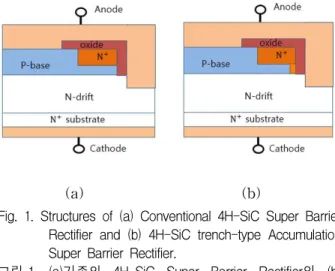
그림 1은 (a)기존의 4H-SiC Super Barrier Rectifier와 (b)새로운 4H-SiC Accumulation Super Barrier Rectifier를 나타낸다. 두 구조의 가 장 큰 차이점은 이온주입을 통해 형성된 채널층 의 유무이다. 기존의 SBR 구조와 달리 미리 채널 층을 형성해둠으로써 낮은 정 전압에서 소자를 턴 온 할 수 있기 때문에 순방향 전압 강하를 낮 출 수 있어 스위칭 시의 손실을 줄일 수 있다. 역 바이어스시에는 채널층이 반전되어 채널을 통해 전류가 흐르는 것을 막는다. 채널층이 완전히 반 전되지 않으면 누설전류가 심해지고, 펀치스루 효 과로 인해 저지전압이 낮아지는 부작용이 생길 수 있기 때문에 여러 번의 시뮬레이션을 통해 소 자의 파라미터를 최적화하는 작업이 필요하였다.
(a) (b)
Fig. 1. Structures of (a) Conventional 4H-SiC Super Barrier Rectifier and (b) 4H-SiC trench-type Accumulation Super Barrier Rectifier.
그림 1. (a)기존의 4H-SiC Super Barrier Rectifier와 (b) 4H-SiC Accumulation Super Barrier Rectifier 구조
나. 시뮬레이션 결과 및 분석
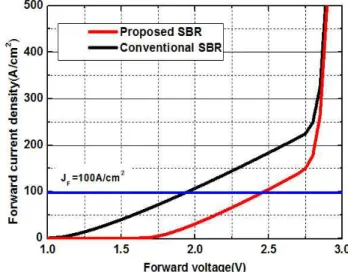
시뮬레이션은 Synopsys 사의 Sentaurus TCAD tool을 이용하여 진행하였다. 그림 2는 아노드에 2V 의 전압을 가했을 시 일반적인 SBR과 TASBR의 차이를 보여준다. 일반적인 SBR의 경우 2V의 정전 압에서 채널이 형성되지 않아 전류가 거의 흐르지 않지만, TASBR의 경우 미리 형성된 채널층으로 인해 전류가 흐르는 즉 순방향 적압이 낮아진 것을 확인 할 수 있다. 그림 3는 I-VF 특성을 나타내는 그래프로 기존의 SBR구조와 trench-type Accumulation SBR구조에서의 순방향 전압 강하는
75 4H-SiC Trench-type Accumulation Super Barrier Rectifier(TASBR) for Low Forward Voltage drop
(75) 100A에서 각각 2.47V, 1.95V이다.
즉 기존의 SBR에 비해 Accumulation SBR은 약 21.06% 낮은 순방향 전압 강하를는다고 볼 수 있 고 이를 통해 스위칭 전력 손실을 줄일 수 있다.
그림 4은 기존의 SBR구조와 Accumulation SBR
구조에서의 각각의 전계분포를 나타낸다.
Accumlation SBR의 경우 역 바이어스 시 펀치스 루 효과를 막으면서 동시에 정 바이어스시엔 채 널주입 효과를 원활하게 갖기 위해 채널층의 두 께와 농도의 최적화가 필요하였다.
소자 시뮬레이션 구체적인 결과는 Table 1에 정 리하였다.
Fig. 2. Comparison of electron current density between SBR and TASBR for anode voltage 2V.
그림 2. SBR과 TASBR의 아노드에 2V를 가했을 때의 electron current density 비교
Fig. 3. Comparison of electron current density between SBR and TASBR for anode voltage 2V.
그림 3. SBR과 TASBR의 아노드에 2V를 가했을 때의 electron current density 비교
Table 1. Parameter of SBR and TASBR.
표 1. SBR과 TASBR의 파라미터
Parameters SBR TASBR
Breakdown voltage(V) 905 910 Leakage current() 1.25E-9 1.25E-9
Forward voltage drop
(at 100) 2.47V 1.95V
Ⅲ 결론
시뮬레이션 결과 trench-type Accumulation SBR 은 기존의 SBR에 비해 약 21.06% 낮은 순방향 전압 강하를 갖기 때문에 스위칭 시의 전력 손실 을 줄일 수 있다. 또한 Accumulation SBR 구조 는 4H-SiC 계면의 trap charge에 관하여 기존 SBR의 구조에 비해 순방향 전압 강하 안정성이 향상될 것으로 예상된다. 그러나 본 논문에서 진 행한 시뮬레이션은 이를 고려하지 않았기에 다음 연구를 통해 이를 보이고 분석할 계획이다.
76 j.inst.Korean.electr.electron.eng.Vol.21,No.1,73∼76,March 2017
(76)
References
[1] G. H. Song and K. K. Kim, "SiC/SiO2 Interface Characteristics in N-based 4H-SiC MOS Capacitor Fabricated with PECVD and NO Annealing Processes,"
j.inst.Korean.electr.electron.eng, vol. 18, no.4, pp. 447-455, Dec. 2014.
DOI:10.7471/ikeee.2014.18.4.447
[2] B. J. Baliga, "Fundamentals of Power Semiconductor Devices," NY, USA: Springer, 2010, pp. 91-166.
[3] Chin-Fang Huang, Hua-Chih Hsu, Kuan-Wei Chu, Li-Heng Lee, Ming-Jinn Tsai, Kung-Yen and Feng Zhao "Counter-Doped JTE, an Edge Termination for HV SiC Devices With Increased Tolerance to the Surface Charge" IEEE Electron Device Lett., vol. 62, no. 2, pp. 354-358, Feb. 2015.
DOI: 10.1109/TED.2014.2361535
[4] B. S. Kim and K. K. Kim, "A 4H-SiC Trench MOS Barrier Schottky (TMBS) Rectifier using the trapezoid mesa and the upper half of sidewall," j.inst.Korean.electr.electron.eng, vol.
17, no.4, pp. 428-433, Dec. 2013.
DOI : 10.7471/ikeee.2013.17.4.428
[5] V. Rodov, A. L. Ankoudinov, Taufic, "Super Barrier Rectifier - A New Generation of Power Diode," Applied Power Electronics Conference, APEC 2007 - Twenty Second Annual IEEE, vol., no., pp.1053-1056, Feb. 25 2007 March 1 2007.DOI: 10.1109/TIA.2007.912752