• 검색 결과가 없습니다.

AKARI OBSERVATIONS OF MASSIVE STAR-FORMING REGIONS INDICATIVE OF LARGE-SCALE CLOUD-CLOUD COLLISIONS

N/A
N/A
Protected

Academic year: 2021

Share "AKARI OBSERVATIONS OF MASSIVE STAR-FORMING REGIONS INDICATIVE OF LARGE-SCALE CLOUD-CLOUD COLLISIONS"

Copied!
3
0
0

로드 중.... (전체 텍스트 보기)

전체 글

(1)

Publications of the Korean Astronomical Society pISSN 1225-1534

32: 123 ∼ 125, 2017 March eISSN 2287-6936

2017. The Korean Astronomical Society. All rights reserved. c https://doi.org/10.5303/PKAS.2017.32.1.123

AKARI OBSERVATIONS OF MASSIVE STAR-FORMING REGIONS INDICATIVE OF LARGE-SCALE CLOUD-CLOUD COLLISIONS

Yasuki Hattori, Hidehiro Kaneda, Daisuke Ishihara, Mitsuyoshi Yamagishi, Toru Kondo, and Hidetoshi Sano

1

1

Graduate School of Science, Nagoya University, Furo-cho, Chikusa-ku, Nagoya 464-8602, Japan E-mail: [email protected]

(Received December 14, 2015; Revised October 15, 2016; Accepted October 15, 2016)

ABSTRACT

We present our AKARI study of massive star forming regions where a large-scale cloud-cloud collision possibly contributes to massive star formation. Our targets are Spitzer bubbles, which consist of two types of bubbles, closed and broken ones; the latter is a candidate of the objects created by cloud-cloud collisions. We performed mid- and far-infrared surface photometry toward Spitzer bubbles to obtain the relationship between the total infrared luminosity, L

IR

, and the bubble radius, R. As a result, we find that L

IR

is roughly proportional to R

β

where β = 2.1±0.4. Broken bubbles tend to have larger radii than closed bubbles for the same L

IR

.

Key words: infrared: massive stars

1. INTRODUCTION

The formation process of massive stars, which strongly affects the interstellar environment, is still poorly under- stood. One of compelling scenarios is a large-scale cloud- cloud collision, which leads to an efficient gas compres- sion to trigger massive star-formation activities. Many pieces of observational evidence for cloud-cloud colli- sions have been found for massive star-forming regions by CO observations with the NANTEN/NANTEN2 ra- dio telescopes (e.g., Torii et al., 2011; Fukui et al., 2014).

Infrared (IR) observations of such star forming regions would provide estimates on the total energy of embed- ded sources such as young massive stars in the regions.

Spitzer bubbles are important objects to investigate the cloud-cloud collisions. They have been identified in Spitzer 8 µm images (Churchwell et al., 2006) and are generally categorized into two types, closed bubbles and broken bubbles. According to the simulation of a cloud-cloud collision (Habe & Ohta 1992), cloud struc- tures similar to the broken bubbles are expected as a resultant form. We verify a possibility that some of

http://pkas.kas.org

the broken bubbles have been formed by a cloud-cloud collision, searching for a systematic difference between closed bubbles and broken bubbles. As a first step, we study the relationship between the total infrared lumi- nosity, L

TIR

, and the radius, R, of each bubble by using AKARI mid- and far-IR all-sky survey data.

2. OBSERVATION AND ANALYSIS

2.1. Sample Selection

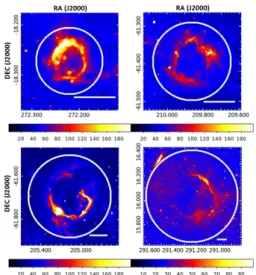
Our sample includes 111 Spitzer bubbles, for which in- formation on the distance is available in several liter- atures (e.g., Beaumont & Williams, 2009; Churchwell et al., 2006; Deharveng et al., 2010; Pavel & Clemens, 2012; Watson et al., 2010), and the sample consists of 69 closed bubbles and 42 broken bubbles. We also checked that these bubbles did not suffer apparent contamina- tion from nearby objects. These bubbles were observed in the AKARI all-sky survey at wavelengths of 9, 18, 65, 90, 140, and 160 µm. We show examples of the sample bubbles in Figure 1.

123

(2)

124 YASUKI HATTORI ET AL.

Figure 1. Examples of Spitzer bubbles in the AKARI 9 µm images. Upper two are closed bubbles and lower two are broken bubbles. The solid circle and the solid line represent the aperture size and 5

0

size, respectively. The color levels are given in units of MJy sr

−1

.

Figure 2. An example of SEDs, where solid, dotted, dashed and dashed-dotted curves indicate the result of SED fitting, PAH feature, warm dust component and cold dust compo- nent, respectively.

2.2. Analysis Method

We carried out aperture photometry of the bubbles in the six bands with an aperture radius which was twice as large as the bubble radius defined in Churchwell et al. (2006). Then, we created spectral energy distribu- tions (SEDs) and decomposed the SEDs into polycyclic aromatic hydrocarbons, warm dust and cold dust com- ponents. Figure 2 is an example of the SED fitting. We derived L

TIR

of each bubble by integrating the fitting result with respect to the wavelength from 5 to 200 µm.

Since L

TIR

reflects the luminosity of embedded massive stars contributing to dust heating, we compare L

IR

with R which were calculated by using the bubble angular ra- dius and the distance to the bubble.

Figure 3. The relationship between L

TIR

and the bubble ra- dius on logarithmic scales. Triangles and squares represent closed bubbles and broken bubbles, respectively. The line indicates the fitting result for the closed bubbles.

3. RESULTS AND DISCUSSION

Figure 3 shows the derived relationship between the L

TIR

and R for all the bubbles. The closed and bro- ken bubbles seem to have the power law relation be- tween the L

TIR

and the bubble radii. We fit the data of the closed bubbles with L

TIR

∝R

β

. In the fitting, the closed bubbles which have larger radii than logR = 0.6 were excluded because they are likely to be influenced by strong stellar wind of central massive stars. As a result, we obtain β = 2.1±0.4.

A bubble-like structure can be formed by ionizing ra- diation of central massive stars (Deharveng et al., 2010;

Figure 1). The radius of the ionized region is expressed as a Str¨ omgren radius R

s

, which is related to the to- tal number of ionizing photons, Q, emitted by a central star:

Q = 4

3 πR

s3

n

e

n

p

α, (1)

where n

e

, n

p

and α are the electron density, proton den-

sity and recombination coefficient. Vacca et al. (1996)

calculated the relation between the bolometric luminos-

ity of a central star, L

bol

, and R

s

to find L

bol

∼R

2.6s

.

Assuming L

TIR

∼L

bol

, our result (L

TIR

∝R

2.1

) is close

to the relation L

bol

∼R

2.6s

, which implies that most of

the closed bubbles are likely to be created by ionizing

radiation. On the other hand, the broken bubbles seem

to have larger radii than the closed bubbles for the same

L

IR

, although the difference is not obvious. We need to

verify this tendency with larger sample. If the difference

is significant, this would suggest that broken bubbles are

of cloud-cloud collision origins because their radii are ex-

pected to be determined by the sizes of collided clouds

rather than R

s

.

(3)

AKARI OBSERVATIONS OF MASSIVE STAR-FORMING REGIONS 125

4. SUMMARY

We have studied Spitzer bubbles using AKARI all-sky survey data to investigate the importance of cloud-cloud collision for massive star formation. We carried out aperture photometry for 111 bubbles and obtained L

TIR

versus the bubble radius for each bubble to find sys- tematic difference between closed bubbles and broken bubbles. As a result, we find that L

IR

is roughly pro- portional to R

β

where β = 2.1±0.4. Broken bubbles tend to have larger radii than closed bubbles for the same L

IR

.

REFERENCES

Beaumont, C. N. & Williams, J. P., 2009, Molecular Rings around Interstellar Bubbles and the Thickness of Star- Forming Clouds, ApJ, 709, 791

Churchwell, E., et al., 2006, The Bubbling Galactic Disk, ApJ, 649, 759

Deharveng, L., et al., 2010, A gallery of bubbles, A&A, 523, 6

Fukui, Y., et al., 2014, Molecular Clouds Toward the Super Star Cluster NGC3603; Possible Evidence for a Cloud- Cloud Collision in Triggering the Cluster Formation, ApJ, 780, 36

Habe, A. & Ohta, K., 1992, Gravitational instability induced by a cloud-cloud collision - The case of head-on collisions between clouds with different sizes and densities, PASJ, 44, 203

Pavel, M. D. & Clemens, D. P., 2012, HII Region Driven Galactic Bubbles and Their Relationship to the Galactic Magnetic Field, ApJ, 760, 150

Torii, K., et al., 2011, Molecular clouds in the Trifid neb- ula M20; Possible evidence for a cloud-cloud collision in triggering the formation of the first generation stars, ApJ, 738, 46

Vacca, W. D., Garmany, C. D., & Shull, J. M., 1996, The Lyman-Continuum Fluxes and Stellar Parameters of O and Early B-Type Stars, ApJ, 460, 914

Watson, C., Hanspal, U., & Mengistu, A., 2010, Triggered

Star Formation and Dust around Mid-Infrared-Identified

Bubbles, ApJ, 716, 1478

수치

Figure 2. An example of SEDs, where solid, dotted, dashed and dashed-dotted curves indicate the result of SED fitting, PAH feature, warm dust component and cold dust  compo-nent, respectively.

참조

관련 문서

In cloud computing the artificial intelligence based resource allocation techniques act and work like humans for resource allocation. Keeping the impact of artificial intelligence

6 illustrates the interaction of the proposed dynamic service assignment where cloud services are collected from cloud service providers after the mean

The use of portable technologies and personal cloud services facilitates the work of digital nomads across different places.. Given the knowledge-heavy varieties

Azure Data Factory (ADF) is a cloud-based data integration service that allows you to orchestrate and automate data movement and data transformation. Ingesting data can

parallel processing (e.g. ETL) of large data sets in Google Cloud Supports both Streaming and Batch processing (no need for separate pipeline code development). Autoscales

Where possible, replace Amazon EC2 workloads with AWS managed services that either don’t require you to make any capacity decisions (such as ELB, Amazon CloudFront, Amazon

VMware Cloud SDDC and Hybrid

Improving infrastructure efficiency on-premises and in the cloud with Cisco Workload Optimizer. “CWOM has provided tangible benefits in terms of