• 검색 결과가 없습니다.

A study on the impact of homestay sharing platform on guests' online comment willingness

N/A
N/A
Protected

Academic year: 2021

Share "A study on the impact of homestay sharing platform on guests' online comment willingness"

Copied!
11
0
0

로드 중.... (전체 텍스트 보기)

전체 글

(1)

JKSCI

A study on the impact of homestay sharing platform on guests' online comment willingness

1)

Ji-Kai Zou*, Teng-Yue Liang*, Cui Dong*

*Student, Dept. of Global Business, Kyonggi University, Suwon, Korea

*Student, Dept. of Global Business, Kyonggi University, Suwon, Korea

*Student, Dept. of Global Business, Kyonggi University, Suwon, Korea

[Abstract]

The purpose of this study is to explore the impact of home stay platform on guests' willingness to comment online under the Shared home stay business model. Shared platform of home stay facility in addition to providing a variety of support services, help the landlord to the tenant do offline accommodation services, implementation, trading, will need to take some measures to actively promote the tenant groups to the landlord, the evaluation is objective, effective and sufficient number in order to better promote the sharing credit ecological establishment of home stay facility. In this study, consumers who have used the Shared home stay platform are taken as the research objects. The survey method adopts network questionnaire survey and Likert seven subscales. The statistical software SPSS24.0 program is used to process the data. Firstly, descriptive statistical analysis was conducted, followed by validity analysis and reliability analysis. After the reliability and validity of the questionnaire were determined, correlation analysis and regression analysis were used to verify the proposed hypothesis.

The research results of this study are summarized as follows :(1) the usability of platform comment function, guest satisfaction and platform reward have a positive impact on the guest online comment willingness; (2) The credit mechanism of the platform has a positive regulating effect on the process of tenant satisfaction influencing tenant comment intention.

▸Key words: Platform comment function usability, Platform comment reward, Platform credit mechanism, Tenant satisfaction, Tenant comment willingness

∙First Author: Ji-Kai Zou, Corresponding Author: Teng-Yue Liang

*Ji-Kai Zou ([email protected]), Dept. of Global Business, Kyonggi University

*Teng-Yue Liang ([email protected]), Dept. of Global Business, Kyonggi University *Cui Dong ([email protected]), Dept. of Global Business, Kyonggi University

∙Received: 2020. 11. 02, Revised: 2020. 12. 01, Accepted: 2020. 12. 02.

Copyright ⓒ 2020 The Korea Society of Computer and Information http://www.ksci.re.kr pISSN:1598-849X | eISSN:2383-9945
(2)

[요 약]

본 논문의 연구 목적은 공유숙박 비즈니스 바탕으로 숙박 플랫폼이 세입자의 온라인 리뷰 의향 에 미치는 영향을 연구하는 것이다 . 기존 숙박예약 모델보다 공유숙박 중 숙박 플랫품, 집주인, 세입자 간을 공유하는 독립성이 더 명확하다. 공유숙박 플랫폼은 집주인과 세입자간의 오프라인 숙박서비스를 완료하고 거래를 실현할 수 있도록 다양한 지원 서비스를 제공하는 것은 물론 , 공 유숙박 플랫폼은 세입자가 집주인에게 객관적이고 적극적으로 평가하도록 장려하는 특정 조치를 파악해야 한다. 공유숙박에 대한 신용 생태를 더 잘 확립할 수 있도록 필요하다. 본 논문에서는 공유숙박 플랫폼을 사용해본적 있는 소비자들을 대상으로 , 2주간의 설문 조사를 하고 SPSS24.0 프 로그램을 사용하여 데이터가 분석되었다 . 이 논문의 연구결과는: (1) 플랫폼 리뷰 기능의 사용 용 이성, 세입자의 만족도 및 플랫폼 리뷰 인센티브가 세입자의 온라인 리뷰 의향에 긍정적인 영향 을 미친다 . (2) 플랫폼의 신용 메커니즘은 세입자의 만족도가 온라인 리뷰 의향에 영향을 미치는 과정에서 긍정적인 영향을 미친다 .

▸주제어: 플랫폼 리뷰 기능 용이성, 플랫폼 리뷰 인센티브, 플랫폼 신용 메커니즘, 세입자 만족도, 세입자 온라인 리뷰 의향

I. Introduction

Since the 2010s, with the emergence of world-renowned sharing commercial enterprises such as Uber, Didi and Airbnb in the field of Shared travel, this P-to-P e-commerce model, which takes mobile Internet APP platform as a bridge and individual merchants serving individual consumers, has been widely accepted by consumers all over the world. Sharing business model has the general e-commerce inherent risk of information asymmetry, and the sharing business to both the seller and the buyer is a person, because this online transaction uncertainty and risk of compared with the traditional electronic commerce is more so.

In order to solve the problem of information asymmetry, different types of e-commerce platforms have developed commodity comment systems, and constantly improve the function of the comment system and user experience, in order to enhance the level of user's comment participation. Users currently online Reviews have become an important part of the e-business processes, consumer reports of “Bright Local”

showed that 88% of people will trust online

Reviews and according to the comments to make a choice and decision, and a research of “Power of Reviews”, also showed that nearly 9 out of 10 consumers will decide whether to make a purchase based on the comments of others.

Under the mode of traditional e-commerce platform of service attributes is stronger, in the process of the buyer online reviews, platform more have the effect of the assistance and support, even through various means to influence the buyer to the seller's comment on the behavior of the results did not take strict controls.

In the Shared business model, taking Shared home stay as an example, the tripartite relationship between the landlord, the platform and the tenant is more clear,considering the personal attributes of the landlord and the neutral position of the platform by charging the service fees of the buyer and the seller. Home-stay sharing platforms need to take more measures to maintain the number and objectivity of online comments so as to promote the healthy development of trilateral relations.

By referring to the existing literature, we find

(3)

that most of the relevant studies on buyers' online comment intention start from the motivation of online comment and comprehensively study all the factors affecting buyers' online comment. Although this can provide Suggestions for the operation of e-commerce platform to some extent, it does not distinguish the role of seller, platform and buyer respectively in online comments. This study will separately study the factors that influence the online evaluation willingness of the tenants, so as to put forward Suggestions for the operation of the home-stay sharing platform more clearly.

In particular, this study takes Airbnb, Tujia and Xiaozhu, which have a high market share in China, as the research objects, this research focuses on three actual work as "providing comment function", "providing comment reward"

and "optimizing platform credit mechanism" of platform in order to promote the tenant review,

analyzing their effect of tenant online reviews.

This has a very direct practical significance to the operators of Shared homestay.

II. Theoretical background

1. Tenant satisfaction

The concept of customer satisfaction by Cardozo was first proposed in 1964, the definition of customer satisfaction at home and abroad and it has many versions. Szymznski and Hise (2000) defined online shopping consumers' satisfaction as

"consumers' evaluation of post-consumption experience on shopping websites by using the Internet", and proposed the influencing factors of online shopping consumers' satisfaction, including website architecture, security, product quality, merchant service level, shopping convenience, etc.

Cao Gaohui (2017) divided the satisfaction after e-commerce consumption into satisfaction and dissatisfaction.

After analyzing the above literature, we find that the content related to e-commerce websites and

the content related to merchants can be classified into two categories: content related to e-commerce websites and content related to merchants. In combination with the independent and interrelated characteristics of the home-stay sharing platform, landlord and tenant, this study believes that in the process of using home-stay sharing, tenant satisfaction can be divided into satisfaction with the landlord service and satisfaction with the platform.

2. Ease of use of platform comment function Ease of use is the level of effort a user puts into using a particular system. Li Caicai (2019) believed that the usability of the website includes the ability to quickly and easily master the use method and the website structure is simple and easy to operate, etc. Fu Yuqing (2013) believes that ease of use refers to the ease with which users can use a system, which usually has a significant impact on user adoption in the early stage of using a new technology. Tang Rongli (2016) believes that consumers are reluctant to spend a lot of time on research, and the convenience and usefulness of browsing and using the APP will also affect users' decisions

The link studied in this study is the online guest review link, and the research object is the Shared home stay platform. Therefore, the ease of use referred to in this study only includes the ease of use of the online review function of the Shared B&B APP platform. As for the research dimension of the usability of the platform's online comment function, referring to the above literatures, we set it as the difficulty of technical operation and the difficulty of understanding the comment rules.

3. Platform comment award

In the actual use, whether on Airbnb, Tujia or

Xiaozhu, guests will be rewarded to varying degrees

if they actively post online reviews after their

offline stay. These include, for example, gaining

identity rating points within the Shared

(4)

accommodation platform, and obtaining vouchers directly or indirectly. Wang Xingqiong (2020) believes that the rewards of consumer reviews on websites include cash back of reviews, bonus points, coupons and in-site rankings, which can be divided into material rewards and spiritual rewards.

Song Zhijie (2020) believes that in the process of online shopping, merchants introduce a series of incentive measures to enhance consumers' evaluation, especially positive evaluation.

Due to the reality, Tujia, Xiaozhu market area, a slightly different target customers, their operations are also different, so this article is not detailed three platform specific incentives for comment, but a combination of literature, comments reward on properties can be divided into economic level and spiritual level, and according to the degree of reward and how many set research scale.

4. Platform credit mechanism

There are abundant academic researches on the credit mechanism of e-commerce platforms. Yan Huili (2020) believes that credit mechanism can regulate and constrain the behavior of merchants and help to transmit more signals to users to reduce information asymmetry, so it has a positive effect on users' participation behavior. Han Yuehui (2017) believes that the credit mechanism in shopping websites can affect all behaviors of buyers and sellers in the whole transaction process.

Relevant literature generally believes that the credit mechanism of e-commerce platforms is the basic constraint and guarantee for various behaviors of buyers and sellers within e-commerce platforms, but most of them focus on the transaction behaviors of buyers and sellers, and in e-commerce platforms, especially in Shared commercial platforms, comments are also part of the behaviors of buyers and sellers. Therefore, this study argues that the credit mechanism within the Shared home stay platform also has some influence on the guest's willingness to comment.

The credit mechanism of sharing homestay generally includes the following three contents: 1.

Provide enough necessary information to obtain the identity of "a platform landlord". 2. Require the landlord to complete certain quality and quantity of services that meet the official standards in order to obtain the official credit rating. 3. Set reasonable rules, establish a fair and objective evaluation system, and let tenants and landlords evaluate each other.

Zucker(1986) proposed three confidence-building mechanisms: one is to decide whether to grant trust based on the recognition degree of social identity background; Second, based on reputation, past behavior and reputation are more likely to be trusted. Third, trust is given on the basis of laws or institutions, that is, on the basis of rules and regulations of a non-personal nature, resulting in a sense of security. Therefore, this study holds that the three dimensions of the platform credit mechanism are the background identity confirmation of the landlord, the credit evaluation of the landlord and the evaluation mechanism.

5. Guest's intention to comment

The so-called consumer online comment is a specific form of Internet word of mouth, which is the most important channel for other consumers to obtain the information of products and merchants within the same e-commerce platform.

Schindier & Bickart (2005) defined online commenting as consumers Posting personal product comments on commercial sales websites, product websites or independent review websites.

Wang Song (2018) believes that if consumers are satisfied with online shopping, they will participate in online reviews to support sellers. If not, it will punish the seller for their willingness to participate in online reviews.

The guest comment intention mentioned in this

study refers to the willingness of the guest to log

on the Shared home stay platform again to

comment for some reason after completing the

(5)

online booking and offline accommodation experience successively. Online comment willingness is a kind of willingness of guests to participate in the activities of the home stay Sharing platform, and it is also one of the important contents that the operator of the home stay Sharing platform hopes to promote.

III. Assumption and models

1. Assumption

1.1. Impact of the ease of use of the review function on guest reviews

According to TAM, ease of use determines consumers' willingness to adopt new technologies.

The research of Lee et al. (2011) shows that the ease of operation of information system will greatly affect users' experience. The simpler the operation process is, the better the user experience will be, and the higher the users' willingness to comment online will be. Guo Kaiqiang (2014) verified that ease of use had a significant positive impact on both positive and negative evaluation intentions through empirical research. Li Yaqin et al. (2017) confirmed in their research that ease of use has a positive effect on online comment willingness. The more complex the use process is, the weaker the user's willingness to use it will be. In the actual review participation process, consumers need to log back into the shopping website for payment confirmation and writing shopping reviews, which increases the time execution cost and usage burden of consumers. Once users feel the tedious use process, they are likely to give up participating in the review.

Based on literature research, the following assumptions are made in this study:

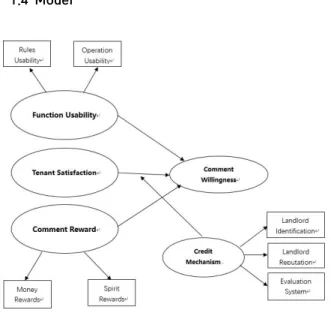
H1:The usability of the platform's comment function has a significant + effect on the guest's willingness to comment online

H1a: The ease of use of comment rules has a

significant + effect on comment intention

H1b:The ease of use of comment operation has a significant + effect on comment intention

1.2 Influence of platform comment reward on guest comment willingness

According to social exchange theory, the greater the exchange value obtained, the greater the will of the actor. The research of Vallerand et al. (1997) shows that the greater the economic return consumers get from comments, the greater their motivation to participate in comments. The higher the tangible or intangible rewards the greater the incentive for consumers to participate in online reviews. Writz & Chew(2002), Yu Chunling et al. (2011) all pointed out that consumers may make positive comments in order to get additional rewards, and reward stimulation can promote word-of-mouth recommendation among satisfied consumers. Kuester(2014) further pointed out that the size of the reward size affects people's enthusiasm for commenting, small rewards can increase the enthusiasm for commenting, but large rewards have no significant impact. Yin Jinggang (2012) believed that economic returns had a positive and significant impact on the willingness to comment. Based on the previous research, the assumptions of this study are as follows:

H2: The platform's comment reward has a significant + effect on the guest's willingness to comment online

H2a: Financial incentives had a significant + effect on the guest's willingness to comment

H2b: Spiritual motivation had a significant + effect on the guest's willingness to comment

1.3 Influence of the credit mechanism of the platform on the guest's willingness to comment

About satisfaction for online reviews will affect a lot of research, scholars generally think that the former is the main cause of the latter form.

Ranaweera & Prabhu(2003) 's large survey of fixed

network users in the UK and Babin(2005)' s

(6)

consumption assessment of the Korean catering industry both show that there is a positive linear relationship between consumer satisfaction and consumers' willingness to spread positive word of mouth.

Although the literature mostly proves the positive influence of satisfaction on comment intention, there is little research on the influence of platform credit mechanism on consumers' online comment intention. This study puts forward an innovative hypothesis and hopes to draw a regular conclusion through empirical research. In general, whether or not a comment is made is related to whether or not the reviewer believes his or her comments are influential, in addition to the supervisor's wishes. It is easy to understand the impact and significance of people's opinions in a society with a very good credit system, rather than a society where there is no trust at all.

Corresponding to the Shared home stay platform, if the tenant is satisfied with the service and has enough trust between the parties within the platform, the tenant will believe that the comments are more meaningful and will be more willing to praise the landlord. If the tenant is not satisfied with a service and there is no trust between the parties in the platform, the tenant may suspect that even if he makes a negative comment, no one will believe him, and may lose the willingness to comment, let alone continue to use the platform. Based on the above analysis, this study proposes the following hypotheses:

H3:The platform credit mechanism has a positive moderating effect on the effect of guest satisfaction on guest comment intention

H3a:The platform has a positive moderating effect on the degree of landlord's identity in the process that tenant satisfaction affects tenant's willingness to comment

H3b:The credit rating mechanism of the platform on the landlord has a positive moderating effect on the effect of tenant satisfaction on the review intention of the tenant

H3c:The rationality of the evaluation system within the platform has a positive moderating effect on the impact of tenant satisfaction on their willingness to comment

1.4 Model

IV. Analysis and Results

1. Descriptive Statistics

Table 1. Demographic Characteristics

(7)

After frequency analysis of the data, the conclusions are shown in < Table 1>.

First of all, in terms of gender, among the 316 respondents, 179 were males, accounting for 56.6%, and 137 were females, accounting for 34.4%, with a slightly higher proportion of males than females. From the point of view, age below 20 years old (including) and more than 50 years old (including) the participation of five and six, respectively, only accounted for 1.6% and 1.9%, and the 20s and 30s people, there are 154 and 88 respectively, the total accounted for 76.5%, thus, participate in most of the body of the questionnaire by the relatively independent financial and accept new things faster 20~40 years old people. From the point of view of occupation distribution, relatively more uniform. From the point of view of the distribution structure of educational background, college degree or above accounts for 94%, a very high proportion. From the perspective of the structure of the years of use of the Shared home stay accommodation platform, the majority of the users are 1-3 years old, while those with more than 3 years only account for about 1/4, indicating that consumers generally came to understand, accept and use the Shared home stay accommodation platform relatively late. From the perspective of marital status, unmarried people accounted for 61.1%, higher than married people.

2. Validity and Reliability

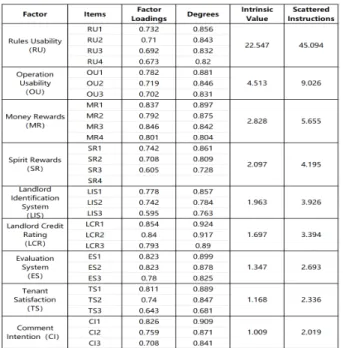
In this study, SPSS 24.0 software is used to conduct exploratory factor analysis (EFA) on the data samples, so as to judge whether the sample data is suitable for factor analysis. The KMO value in the data analysis results (KMO=0.911) and Bartlett sphere test results (P =0.000) both indicate that the data variables are suitable for principal component analysis. The analysis results are shown in < Table 2>.

KMO:.911,Bartletts:21238.608(p=.000),Cumulative dispersion indication(%):78.339

Table 2. Factor Analysis

Cronbach's Alpha is the most commonly used analysis method to verify data reliability. Generally speaking, if Cronbach's Alpha is higher than 0.7, the data reliability can be considered relatively high. In this study, the Alpha value of each factor is greater than 0.7, CR is greater than 0.8, indicating that the scale has good reliability, and AVE is greater than 0.6, indicating that the scale has good convergence validity. The analysis results are shown in < Table 3>.

Table 3. Reliability Analysis

3. Correlation Analysis

Correlation analysis refers to the analysis of two

or more correlated variables and measures their

(8)

correlation degree. In this study, SPSS 24.0 software was used to analyze the data, and the results were shown in < Table 4>. As can be seen from the table, there is no correlation between rule usability and financial reward or spiritual incentive. There was no correlation between operational ease of use and financial reward and spiritual incentive. The correlation between monetary reward and guest room satisfaction and comment intention was strongest. Secondly, the correlation between spiritual motivation and comment intention; Room satisfaction, rule ease of use and willingness to comment also show a high correlation.

RU=Rules Usability, OU=Operation Usability, MR=Money Rewards, SR=Spirit Rewards, TS=Tenant Satisfaction, CI=Comment Intention.

Table 4. Correlation Analysis

4. Regression Analysis

The quantitative relationship of interdependence between two or more variables can be determined by regression analysis. In this study, the direct impact and the regulatory effect are respectively analyzed by regression analysis, and the analysis results are as follows.

(1) Regression Analysis of Direct Impact

This study aims to explore the correlation between the ease of use of platform comment function and platform reward on the intention of guest room online comment. Therefore, regression analysis is conducted for these variables, and the analysis results are shown in < table 5>. It can be seen from the table that the significance (P values) are all less than 0.05, indicating that the usability of the platform comment function and platform reward have a significant impact on the willingness to review online rooms, and monetary reward has the greatest impact on the willingness to evaluate. That is, hypothesis H1, H1a, H1b, H2, H2a and H2b are all supported.

Table 5. Regression Analysis

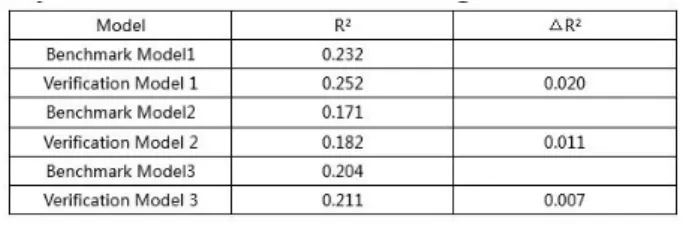
(2) Regression Analysis of Regulatory Impact For the verification of the moderating effect of the platform credit mechanism on the impact of guest room satisfaction and comment intention, the analysis results are shown in < Table 6> and <

Table 7>. < Table 6> △R indicates that each factor of platform credit mechanism has a positive adjustment effect on room satisfaction and comment intention. < Table 7>analysis results also verify the regulatory role of the platform credit mechanism (p < 0.01), thus supporting hypothesis H3, H3a, H3b and H3c.

Benchmark model: Independent variables are A(decentralization) and B(decentralization).

Verification model: Independent variables are A × B, A(decentralization) and B (decentralization).

Table 6. Analysis on the Influence of Landlord Identification Degree/Credit Score/ Evaluation System on the Model Fitting of Comment Intention

LIDC= Landlord Identification

Degree(decentralization)TSC=Tenant Satisfaction(decentralization)

LRSC= Landlord Reputation Score (decentralization) RSC= Tenant Satisfaction (decentralization)

RESC= Reasonable Evaluation System (decentralization) TSC= Tenant Satisfaction (decentralization)

Table 7. Regression Analysis of the Landlord

Identification Degree/Credit Score/ Evaluation

System on the Model Fitting of Comment Intention

(9)

Ⅴ. Conclusion and discussion

1. Theoretical significance

The purpose of this study is to analyze the impact of the Shared home stay platform on the guests' willingness to comment online. Mentioned as, different from the traditional economic mode, share many characteristics, economic mode of the home stay facility platform mode is different from the traditional hotel industry, research on evaluation mechanism also can produce a lot of differences, to fill the research gap, this study puts forward the comments about Shared economic mode of the home stay facility platform usability, commentary reward mechanism for online home stay facility evaluation will affect the six hypotheses, credit mechanism and platform for the tenant comments will produce regulation of three assumptions. The results of the current study indicate that:

(1) The usability of the platform's comment function has a positive impact on the willingness of guests to comment online. The usability of the platform comment function in this study includes the usability of rules(0.615**) and the usability of operations(0.594**). Through data analysis, it can be seen that both of them have a significant positive impact on the comment intention of the guests, among which the impact of the usability of rules is more prominent.

(2) The review incentive mechanism of the platform has a positive impact on the willingness of the guests to comment online. To be specific, both the financial reward(0.762**) and the spiritual incentive(0.680**) of the platform have a positive effect on the comment willingness of the tenants, and the influence degree of the economic reward is higher than the influence degree of the spiritual incentive.

(3) The platform credit mechanism has a positive moderating effect on the impact of tenant satisfaction on their willingness to comment. In this study, the credit mechanism of the platform is

divided into three parts: the identity degree of the landlord, the credit rating mechanism of the landlord and the rationality of the evaluation system within the platform. According to the results of data analysis, it can be seen that all of them have a positive moderating effect on the process of the tenant satisfaction affecting the comment intention.

2. Theoretical significance

First of all, through empirical research, this study once again proves that on e-commerce platforms, consumer satisfaction has a positive role in promoting consumers to log on to the platform again for online comments after consumption.

Secondly, different from the previous literature focusing on the factors that influence consumers' online comment willingness, this study innovatively focuses on the platform-related factors.

Thirdly, this study innovatively studies the impact of platform credit mechanism on consumers' online comments, which is a very important supplement to the research of credit mechanism within e-commerce platform.

3. Practical significance

The study also offers some practical significance. How to guide consumers to continue to participate in the platform interaction after the end of consumption, and how to influence or inspire new consumption of other consumers through word of mouth effect has always been one of the important tasks that e-commerce platform operators including Shared home stay have to solve. Through empirical research, this study provides the following inspirations for home stay sharing operators.

The first. In addition to the impact of the

guests' feelings in the process of consumption, the

various initiatives of the platform also play a very

important role. In addition to focusing on how to

(10)

improve service quality and customer satisfaction, the platform customer operation should also take direct measures to stimulate customer comments.

Second, the most effective way for the platform to directly promote customers to participate in online comments is to establish effective rewards for comments, conduct technical evenings for comment functions and improve rules, and make comments "simple and convenient" and

"reasonable return".

Thirdly, the platform credit mechanism has become the core task throughout the Shared business platform. The platform credit mechanism, including merchant identification, credit rating within the platform, and evaluation rules, has directly affected consumers' first and second purchases. Has become the key to the sustainable and healthy operation of the platform.

It is necessary for Shared business platform operators to take the continuous improvement of platform credit mechanism as one of the core of platform operation business.

4. Limitations and deficiencies

This study is limited by the trade secret protection of each home-stay sharing platform for its own operating rules, so we cannot directly obtain the underlying data of the credit mechanism from the platform. At the same time, in terms of review rewards and functional ease of use, we also took more into account the actual feelings of consumers and tenants, so all the data was obtained through the questionnaire for tenants. In addition, the research objects selected in this study are mainly home-stay sharing platforms aimed at consumers in China, among which Airbnb only investigated users in China. As a KIND of P2P business, Shared business is influenced by the culture and cognition of consumers in different countries and regions. So the results are not representative of the global market.

5. Future research outlook

On the one hand, in order to obtain more accurate research data and more objective research results, we will try to obtain relevant data within enterprises of different platforms in the future. On the other hand, with the continuous development of Shared business, any enterprise or platform will take the global market as its future target. Therefore, it is necessary to carry out different studies based on the actual situation of different countries, so as to give more targeted Suggestions for the operation of Shared home stay platform in different regional markets.

REFERENCES

[1] Babin B J.Lee Y K, Kim E J, et al,“ Modeling consumer satisfaction and word of mouth: restaurant patronage in Korea”

[J].Journal of Services Marketing,Vol. 19, No.3, pp.133- 139, 2005.

[2] Cao Gaohui, "empirical study on consumers' willingness to Participate in online comments", Management Review, Vol. 29, No. 11, pp.148-158, November 2017.

[3] Fu Yuqing, "Research on Consumers' Search efforts and Influencing Factors by Using Travel APP Information" [J].

Tourism Management Research, pp.89-92, July 2013.

[4] Guo Kaiqiang, "Antepensis of consumer comments through online Reputation System", Management Review Vol.26 No. 09, P180-190, 2014.

[5] Han Yuehui, "Research on credit mechanism in e-commerce Environment", E-commerce, pp.37-38, March 2017.

[6] Kuester M.,Benkenstein M.,Turning Dissatisfied into Satisfied Customers: How Referral Reward Programs Affect the Referrer’s Attitude and Loyalty toward the Recommended Service Provider

[J].Journal of Retailing and Consumer Services,Vol.21, No.

6, pp.897-904, 2014.

[7] Lee Y.H., Hsieh Y.C。,Hsu C.N., “Adding Innovation Diffusion Theory to the Technology Acceptance Model:

Supporting Employees, Intentions to Use E-Learning Systems”,

[J].Educational Technology & Society, Vol.14, No. 4, pp.

124-137,2011.

[8] Li Caicai, "Empirical Research on the Influence of Service Quality of E-commerce Platform on Corporate Reputation", Business Economics Research, No.9, pp.80-83, 2019.

[9] Li Yaqin, "Research on the Motivation of Online Comments of

(11)

Consumers on E-commerce Platforms", [J]. Business Economics and Management, No. 5, pp.29-40, 2017.

[10] Ranaweera C,Prabhu J.,“On the relative importance of customer satisfaction and trust as determinants of customer retention and positive word of mouth”,[J]. Journal of Targeting, Measurement and Analysis for marketing, Vol.12, No.1, pp. 82-90, 2003.

[11] Schind1er,R. M. ,& Bickart,B. ,“Pub1ished word of mouth : Referable, consumer—generated information on the lnternet”, C. P. Haugtvedt, K. A. Machleit, & R.F. Ya1ch [M]

.On1ine Consumer Psychology: Understanding and influencing consumer behavior in the virtual world, pp.35-61,2005.

[12] Song, Zhijie, "An evolutionary game Analysis of the impact of evaluative rewards on consumer online comments", Mathematics practice and understanding, Vol. 50, No. 3, pp.95-104, February 2020.

[13] Szymanski DM, Hise R T., “E-satisfaction: an initial examination”, [J]. Journal of retailing, Vol.76, No.3, 2000.

[14] Tang Rongli, "Factors Influencing Mobile Payment Behavior", HAINAN FINANCE, Issue No. 327, pp.42-46, No. 2, 2016.

[15] Vallerand, R. J., “Toward a hierarchical model of intrinsic and extrinsic motivation”,[J]. Advances in Experimental Social Psychology, No.29, pp.271-360, 1997.

[16] Wang Song, "A Study on the Motivation and Perceived Value of Consumer Online Shopping Reviews", Value Theory and Practice, No.6, pp.122-125, 2018.

[17] Wang Xingqiong, "Research on the Influence of Consumers' online rating Usage Habits on online rating Effect", Journal of Chongqing Technology and Business University, Vol. 37, No.

5, pp.23-33, Oct 2020.

[18] Wirtz J., Chew P.. “The Effects of Incentives,Deal Proneness,

Satisfaction and Tie Strength on Word-of-mouth B behavior,

[J].International Journal of Service Industry Management,

Vol. 13, No.2, pp.141-150, 2002.

[19] Yan Huili, "the gradient effect and mechanism of e-commerce platform credit mechanism and user participation", Business research, No.4, pp.1-12, 2020.

[20] Yin Jinggang, "Research on factors influencing the Willingness to comment in the Mobile Internet environment", Books and Information Work, Vol. 56, No. 2, P135-141, January 2012.

[21] Yu Chunling, "The Influence of Word-of-mouth on Recipients of Reward recommendation Plan" [J]. Nankai Management Review, Vol.14, No. 4, pp. 59-68, 2011.

[22] Zucker, L.G. “Production of Trust: Institutional Sources of Economic Structure”, Research in Organizational Behavior, 8, 53-111. pp.1840-1920,1986.

Authors

Ji-Kai Zou Graduated from Hankuk University of Foreign Studies. Now studying for a doctor degree at Kyonggi University.

Ji-Kai Zou Admitted the Kyonggi University. Korea in 2018. During the

school period, the main research interest is Korean sociology ,Global Business and marketing .

Teng-Yue Liang Graduated from Kyonggi University. Now studying for a doctor degree at Kyonggi University. Teng-Yue Liang Admitted the Kyonggi University,

Korea in 2018. During the school period,

the main research interest is Global Business, E-Business, Big Data and marketing.

Cui Dong Received Bachelor of Arts degree from Foreign Trade &Business College of Chongqing Normal University, China, in 2003; Master of Business degree from Kyonggi University, Korea, in 2011.

Cui Dong entered the Doctoral course in Global Business

Kyonggi University in 2018. During the study period, the

main research interests the Global business, E-commerce,

and marketing etc.

수치

Table  1.  Demographic  Characteristics
Table  2.  Factor  Analysis
Table  6.  Analysis  on  the  Influence  of  Landlord  Identification  Degree/Credit  Score/  Evaluation  System  on  the  Model  Fitting  of  Comment  Intention

참조

관련 문서

The results of this study are as follows: first, the motive of participating in senior education programs toward employment is influenced by aging;

Injury is a burden on athletes, but the rehabilitation exercise of this study suggests that the improvement of knee muscle function and knee function

Another platform for academic projects is proposed by [14], based on Raspberry Pi and Arduino boards as hardware platforms and ThingSpeak as a software and communication

It considers the energy use of the different components that are involved in the distribution and viewing of video content: data centres and content delivery networks

Unique members represent the cumulative number of members that have borrowed on the SoFi platform or opened a financial services account through SoFi Money, SoFi Invest, SoFi

1 John Owen, Justification by Faith Alone, in The Works of John Owen, ed. John Bolt, trans. Scott Clark, &#34;Do This and Live: Christ's Active Obedience as the

First, ICT convergence innovation ecosystem creation; Second, expansion of climate smart agriculture and precision agriculture; third, strengthening the on-off linking platform

The purpose of this study is to investigate the effect of online shopping mall characteristics on direct purchasing satisfaction of foreign consumers and purchase