Received: 3 March, 2012 Revised: 5 June, 2012 Accepted: 2 July, 2012 Corresponding author: Won-Jae Choi
Department of Physical Therapy, Uijeongbu Healings Hospital, 19 Cheongsa-ro 48beon-gil, Uijeongbu 480-865, Republic of Korea Tel: 82-31-853-9222 Fax: 82-31-853-9221 E-mail: [email protected]
This is an Open-Access article distributed under the terms of the Creative Commons Attribution Non-Commercial License (http://creativecommons.org/licens es/by-nc/3.0) which permits unrestricted non-commercial use, distribution, and reproduction in any medium, provided the original work is properly cited.
Copyright © 2012 Korean Academy of Physical Therapy Rehabilitation Science
pISSN 2287-7576 Phys Ther Rehabil Sci
eISSN 2287-7584 2012, 1 (1), 13-16
www.jptrs.org
The effect of focus of attention by electroencephalogram- feedback on balance in young adults
Dong-Yeop Leea, Won-Jae Choib, Seung-Won Leec
aDepartment of Physical Therapy, Sunmoon University, Asan, Republic of Korea
bDepartment of Physical Therapy, Uijeongbu Healings Hospital, Uijeongbu, Republic of Korea
cDepartment of Physical Therapy, College of Health and Welfare, Sahmyook University, Seoul, Republic of Korea
Objective: Electroencephalogram (EGG)-feedback is a training procedure aimed at altering brain activity, and is used as a treat- ment for disorders like attention. The purpose of this study was to determine the effects of external focus of attention by EGG-feed- back on balance in young adults.
Design: Cross-sectional study.
Methods: Subject were students in Sahmyook University. Fifty young adults in their twenties and thirties. Subjects were per- formed both with and without external focus of attention by EEG-feedback on the posture of standing and tandem standing.
Participants were educated effort to maintain static posture when they were under internal focus of attention. Good Balance System was used for measurement of postural consistency upon the following force platforms.
Results: Body sway decreased significantly both normal standing and tandem standing with external focus of attention by EEG-feedback (p<0.05).
Conclusions: The results demonstrate that the benefits of an external attentional focus are generalizable to young adults. The ex- ternal focus of attention outperformed the internal focus of attention on the postural balance (p<0.05). It is showed that external focus of attention significant effects on balance by revoked automatic postural control of movement. Furthermore balance might be improved by training with an external focus. Further study is required to develop for training as a method of preventing fall in elderly peoples.
Key Words: Attention, Balance, Electroencephalogram, Feedback
Introduction
Postural imbalance often causes falls [1], or fear of stand- ing [2], significantly affecting quality of life [3]. Aside from previous studies, current studies have reported multiple causes of falls, such as, but not limited to, inappropriate bal- ance adjustment, sensual error, or weakened muscle [4-7].
Focus is considered the name of the game, in order to maintain the given posture, and is believed to allow for in- dividual variations in age, balancing capability, and tasks in- volved [8]. Referable research has demonstrated the aural reactivity of young adults, who are deemed most reactive
when sitting and becoming less reactive with standing up and walking, indicating the importance of focus for posture maintenance and the proportionate relationship between the focus of attention and task complexity [9]. As current re- search studies have reported that the cognitive fault, such as inattention, affects the postural imbalance [10,11], humans may ‘fall’ not only upon imbalance but the disability in focus distribution for multitasking [12,13]. As for the elderly, pos- tural balance can be trained, in a way that falling can be pre- vented [14]. For such training, the improvement in external focus, by use of training equipment adapting human move- ment to the set environment, is deemed more effective to the Original Article
14 Phys Ther Rehabil Sci 1(1)
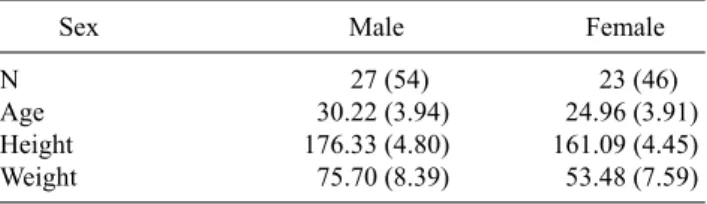
Table 1. General characteristics of the subjects
Sex Male Female
N 27 (54) 23 (46)
Age 30.22 (3.94) 24.96 (3.91)
Height 176.33 (4.80) 161.09 (4.45)
Weight 75.70 (8.39) 53.48 (7.59)
Values are presented as n (%) or mean (SD).
Table 2. Comparison of x-speed, y-speed, and velocity mo- ment in normal standing
Normal standing
Normal standing with attention p x-speed (mm/s) 3.46 (1.06) 3.16 (0.87) 0.017 y-speed (mm/s) 6.23 (2.56) 5.87 (2.50) 0.048 velocity moment (mm2/s) 8.28 (3.49) 6.91 (3.35) 0.004 Values are presented as mean (SD).
Table 3. Comparison of x-speed, y-speed, and velocity mo- ment in tandem standing
Tandem standing
Tandem standing with attention p x-speed (mm/s) 14.57 (3.07) 13.90 (3.10) 0.016 y-speed (mm/s) 14.77 (6.17) 13.23 (5.45) 0.000 velocity moment (mm2/s) 48.65 (22.60) 42.09 (21.49) 0.002 Values are presented as mean (SD).
internal focus [15,16]. Focusing on the intended body move- ment is known to promote involvement of the subconscious or auto-processing [16,17]. However, the conscious adjust- ment may confuse the said auto-processing [16] as being rel- evant to the internal focus. Note that external focus eases the human consciousness and is thereby reactive to activation of the auto-feedback loop [16].
Such external focus may be trained by way of electro- encephalogram (EEG)-feedback [18]. Aside from the pre- vious research on EEG-feedback focusing on children with attention deficit hyperactivity disorder (ADHD) [19], a re- search study reported by Egner and Gruzelier [20] has dem- onstrated an inversely proportionate relationship between continual focus and impulsiveness when applied with
‘sensory motor rhythm (SMR)’ (12-15 Hz) uptraining to en- hance ‘perceptual sensitivity’ and decrease ‘commission er- rors’. Also referable is the review by Monasta et al. [19], an- alyzing the effectiveness of ADHD cure by way of SMR en- hancement and theta (4-8 Hz) suppression, SMR enhance- ment and high beta (22-30 Hz) suppression, and beta-1 (16-20 Hz) enhancement and theta suppression [19]. Refer to the following in order to further study the focus of atten- tion by EEG-feedback on the sense of balance.
Methods
Participants who volunteered and agreed to participate in the study, included 50 adults in their twenties and thirties who had not participated in any similar experiments (Table 1).
The Good Balance System (Good Balance System, Metitur Ltd., Jyväskylä, Finland, 2008) was used for meas- urement of postural consistency upon the following force platforms:
1) normal standing for 30 s with eyes open, hands hanging down loosely, feet comfortably apart, and gaze fixed on a mark (a cross on the opposite wall at 2 m), 2) tandem stand- ing for 20 s with eyes open, hands hanging down loosely,
and gaze fixed on a mark, as before, 3) normal standing, as above, for 30 s, but attention on a screen (a cross on the op- posite wall at 2 m), 4) tandem standing, as above, for 20 s, but attention on a screen, as before.
Each posture was measured three times in order to obtain an average, with a 30-sec period in between, devoid of learn- ing effect.
Participants were trained to be stationed when standing and tandem standing with wore a headset (Mindwave, Neurosky, San Jose, CA, USA), when on a platform, for proper measurement of SMR and beta wave. Participants were further trained to stare with a focus on the virtual fire- works (Blinkzone, Mental Exercise Software).
IBM SPSS Statistical Package, ver. 19.0 (IBM Co., Armonk, NY, USA) was used for statistical analysis, by way of t-test with the significance level at 0.05.
Results
Fifty young adult were measured during the study in 4 conditions. the analysis revealed statistically significant de- crease at both standing and standing in tandem upon EEG-feedback with x-speed, y-speed and velocity moment (p<0.05). x-speed and y-speed reduced by 0.30 mm/s and 0.36 mm/s (Table 2) in normal standing or 0.67 mm/s and 1.54 mm/s (Table 3) in tandem standing respectively, also velocity moment reduced by 1.37 mm/s2 in normal standing and 6.56 mm/s2 in tandem standing.
Lee, et al: The effect of focus of attention by EEG-feedback on balance 15
Discussion
As the fundamental for functional activity of humans, bal- ance demands a certain level of focus. However, there are still remain challenge that identifying the exact reasons for the learning advantages of an external focus of attention al- though external focus of effect has been proven. Movement of controlled by self-consciousness explains the constrained action hypothesis incorporating interferences during the process of automatic motor control [21]. However, focus on the movement itself brings about the natural self-organ- ization procedure for such motor control, devoid of any in- terference [16].
Note that the external focus of attention, deemed much more effective to such motor control [16], promotes involve- ment of the unconscious, reflexive adjustment [14] toward better execution of the given task, and, ultimately, auto-pro- cessing. Scores of research studies have demonstrated the effectiveness of such external focus, in terms of the sim- plicity in movement and bodily effort, as minimizing co-contraction between an agonist and an antagonist [22].
The study herein demonstrates greater imbalance in the posture of Standing in Tandem, thereby resulting in a much greater improvement by the effect of the concentration. Note that, given the same condition applied, the greater the person is imbalanced the better the improvement would be. With EEG-feedback, concentration is even more effective for re- taining the given posture than being stationed, the external focus is deemed as bearing a telling effect.
Note further that the slow cortical potentials (SCPs) are retained for a few seconds, 0.3-sec at minimum, in the form of a brainwave originating from the upper cortical layer.
Such a brainwave is not naturally generated but produced upon the external and internal event [23,24]. The brainwave is controllable by ordinary men. Intensive enhancement in the adjustability of the frontocentral negative SCPs affects the cholinergic and dopaminergic activities, likely curing ADHD in children through training in the adjustability of such activities in an effort to learn how to behave and con- centrate [24].
Quality of movement can be improve by self-adjustment via EEG-feedback in this study. Having proven the effec- tiveness of EEG-feedback for young adults in the current study, further research for the elderly or imbalanced, in com- parison with the results reported herein, as well study to de- termine how well EEG-feedback works, is needed.
References
1. Matinolli M, Korpelainen JT, Korpelainen R, Sotaniemi KA, Virranniemi M, Myllylä VV. Postural sway and falls in Parkinson's disease: a regression approach. Mov Disord 2007;
22:1927-35.
2. Ryan RM, Deci EL. Self-determination theory and the facili- tation of intrinsic motivation, social development, and well- being. Am Psychol 2000;55:68-78.
3. Playfer JR. Falls and Parkinson's disease. Age Ageing 2001;30:
3-4.
4. Maki BE, McIlroy WE. Postural control in the older adult. Clin Geriatr Med 1996;12:635-58.
5. Manchester D, Woollacott M, Zederbauer-Hylton N, Marin O.
Visual, vestibular and somatosensory contributions to balance control in the older adult. J Gerontol 1989;44:M118-27.
6. Daubney ME, Culham EG. Lower-extremity muscle force and balance performance in adults aged 65 years and older. Phys Ther 1999;79:1177-85.
7. Salminen M, Vahlberg T, Sihvonen S, Sjösten N, Piirtola M, Isoaho R, et al. Effects of risk-based multifactorial fall pre- vention on postural balance in the community-dwelling aged: a randomized controlled trial. Arch Gerontol Geriatr 2009;48:
22-7.
8. Woollacott M, Shumway-Cook A. Attention and the control of posture and gait: a review of an emerging area of research. Gait Posture 2002;16:1-14.
9. Lajoie Y, Teasdale N, Bard C, Fleury M. Attentional demands for static and dynamic equilibrium. Exp Brain Res 1993;97:139-44.
10. Maki BE, Zecevic A, Bateni H, Kirshenbaum N, McIlroy WE.
Cognitive demands of executing postural reactions: does aging impede attention switching? Neuroreport 2001;12:3583-7.
11. Bensoussan L, Viton JM, Schieppati M, Collado H, Milhe de Bovis V, Mesure S, et al. Changes in postural control in hemi- plegic patients after stroke performing a dual task. Arch Phys Med Rehabil 2007;88:1009-15.
12. Shumway-Cook A, Woollacott M. Attentional demands and pos- tural control: the effect of sensory context. J Gerontol A Biol Sci Med Sci 2000;55:M10-6.
13. Brauer SG, Woollacott M, Shumway-Cook A. The influence of a concurrent cognitive task on the compensatory stepping re- sponse to a perturbation in balance-impaired and healthy elders.
Gait Posture 2002;15:83-93.
14. Chiviacowsky S, Wulf G, Wally R. An external focus of attention enhances balance learning in older adults. Gait Posture 2010;32:
572-5.
15. Wulf G, Landers M, Lewthwaite R, Töllner T. External focus in- structions reduce postural instability in individuals with Parkin- son disease. Phys Ther 2009;89:162-8.
16. Wulf G, McNevin N, Shea CH. The automaticity of complex mo- tor skill learning as a function of attentional focus. Q J Exp Psychol A 2001;54:1143-54.
17. Wulf G, Weigelt M, Poulter D, McNevin N. Attentional focus on suprapostural tasks affects balance learning. Q J Exp Psychol A 2003;56:1191-211.
16 Phys Ther Rehabil Sci 1(1)
18. Logemann HN, Lansbergen MM, Van Os TW, Böcker KB, Kenemans JL. The effectiveness of EEG-feedback on attention, impulsivity and EEG: a sham feedback controlled study.
Neurosci Lett 2010;479:49-53.
19. Monastra VJ, Monastra DM, George S. The effects of stimulant therapy, EEG biofeedback, and parenting style on the primary symptoms of attention-deficit/hyperactivity disorder. Appl Psy- chophysiol Biofeedback 2002;27:231-49.
20. Egner T, Gruzelier JH. Learned self-regulation of EEG fre- quency components affects attention and event-related brain po- tentials in humans. Neuroreport 2001;12:4155-9.
21. McNevin NH, Shea CH, Wulf G. Increasing the distance of an external focus of attention enhances learning. Psychol Res 2003;
67:22-9.
22. Marchant DC, Greig M, Scott C. Attentional focusing in- structions influence force production and muscular activity dur- ing isokinetic elbow flexions. J Strength Cond Res 2009;23:
2358-66.
23. Birbaumer N, Elbert T, Canavan AG, Rockstroh B. Slow poten- tials of the cerebral cortex and behavior. Physiol Rev 1990;70:
1-41.
24. Strehl U, Leins U, Goth G, Klinger C, Hinterberger T, Birbaumer N. Self-regulation of slow cortical potentials: a new treatment for children with attention-deficit/hyperactivity disorder. Pediatrics 2006;118:e1530-40.