Status of Health and Safety Management in Occupational Hygiene Laboratories in Korea
Status of Health and Safety Management in Occupational Hygiene Laboratories in Korean
목적: 1990년대 초반부터 시작된 우리나라의 산업 보건에 대한 사회적 관심의 증대와 시장의 요구에 따라 산업위생기관의 양적인 팽창이 이루어지긴 하였으나 실험실 관련 안전보건규정이 미비한 상태에서 추진되 어 산업위생 실험실에서 다양한 유해·위험성 인자를 취급함에도 불구하고 사용되는 량이 소규모로 인해 안 전보건과 관련된 사항은 대부분 간과하고 있으며, 산업 위생 실험실의 안전보건관리 실태는 선진외국에 비해 상당히 낙후되어 있는 실정이다.
따라서 본 연구는 우리나라 산업위생 실험실과 관련 한 안전보건관리 실태를 평가함으로써 향후 실험실의 안전보건관리 수준을 향상 시키는데 효과적인 자료로 활용하는데 기여하고자 한다.
방법: 산업위생실험실의 안전보건 실태를 파악하기 위해 설문조사를 수행하였으며, 설문은 실험실의 전반 적인 안전보건, 화학물질 저장 및 용기, 가연성 및 인화 성 화학물질, 가스 실린더, 의사전달, 응급처치 및 비상 사태 장비, 정리정돈, 소방안전, 전기안전, 개인보호구, 흄후드 및 환기, 및 이황화탄소 취급 사례로서 12개 영 역으로 구성되었다.
연구대상은 2001년 한국산업안전공단 정도관리프 로그램에 참여한 기관으로서 총 대상은 119개 기관이
었다. 연구기간은 2002년 7월 01일부터 8월 30일까지 약 60일 이었다. 설문은 반송봉투에 넣어 설문완성 후 연구자에게 보낼 수 있도록 배려하였으며, 1차 설문을 보낸 후 2주 후에 설문 참여를 독려하기 위해 엽서를 발 송하였고, 다시 2주 후에 각 산업위생기관에 개별 전화 연락을 취하였다. 그 결과 63% (75개 기관)의 완성된 설문을 얻을 수 있었다.
설문의 총 조사항목은 79문항으로 구성되어 있으며, 산업위생실험실의 안전보건 수준을 정량적으로 평가하 기 위해 안전보건 매뉴얼, 교육훈련프로그램 및 한국산 업안전공단 실험실 지침서를 보유한 기관과 그렇지 않 은 기관간의 차이는 선별된 67문항에 대해 각 문항에 합당하거나 적절할 경우 1점을 부여하는 방식으로 점 수화하였다. 이들의 관련성을 파악하기 위하여 Microsoft-Excel 2000 프로그램을 이용하여 two- tailed t-test 분석을 실시하였다.
결과
1. 산업위생실험실 운영과 관련한 67개 항목(항목별 로 각 1점 부여)에 대한 안전보건 성과지수화 (100점 으로 점수 환산) 결과 안전보건 매뉴얼을 보유한 기관 은 42.98±13.36(p<0.001)점, 교육훈련프로그램을 보 유한 기관은 50.75±14.12(p<0.01)점, 한국산업안전 Hyukseung Yang1‡·Jaewook Choi
2·Seokjoon Yoon
2· Terry FARR
3
1
Center for Life and Environmental Science, Neodin Medical Institute, Seoul, Korea
2
Department of Environmental and Occupational Health, Graduate Studies of Public Health, Korea University
3
Occupational Health and Safety, School of Public Health, Queensland University of Technology ,Australia Hyukseung Yang1‡·Jaewook Choi
2·Seokjoon Yoon
2·Terry FARR
3
1
Center for Life and Environmental Science, Neodin Medical Institute
2
Department of Environmental and Occupational Health, Graduate Studies of Public Health, Korea University
3
Occupational Health and Safety, School of Public Health, Queensland University of Technology, Australia
공단 실험실 지침서를 보유한 기관은 43.58±11.92 (p<0.01)점으로 그렇지 않은 기관에 비해 통계적으로 유의하게 높은 점수분포를 보였다.
2. 화학물질 보관 캐비닛이 있는 기관 중 64.8%의 기관은 화학물질을 알파벳 순으로, 27.8%는 분류 기준 에 따라, 그리고 7.4%는 무작위로 보관하고 있었다.
3. 단지 8.0% (6개)의 기관만이 실험실내에 눈세정 분수(2 개), 샤워기(3개) 및 눈세정물병(3개, 2개 중복 응답 기관)과 같은 응급처치 장치 및 물품을 갖추고 있 었다.
4. 89.0%의 기관이 흄후드내에 화학물질을 보관하 고 있었다.
5. 물질안전보건자료, 흄후드 기록지, 비상사태 절차 서 및 한국산업안전공단 실험실 지침서와 같은 문서관 리는 부적절하게 관리 및 기록되고 있었다.
6. 대부분의 산업위생 실험실은 응급처치 장비, 화학 물질 또는 가스용기 보관실과 같은 실험실 안전설비가 부족할 뿐만 아니라 정리정돈, 화학물질 저장 캐비닛, 안전보호구 및 흄후드와 같은 관리가 미비하였다.
결론: 이상의 결과에 근거하여 기관장은 실험실의 안전보건관리를 위하여 문서관리체계를 제공하고, 모 든 실험실 종사자가 적절한 개인보호구를 착용할 수 있 도록 하며, 비상 장비를 설치하고, 실험실과 관련한 적 절한 규정을 제정하며, 교육훈련 프로그램을 제공하여 야 한다. 또한 실험실 종사자는 실험 중 적절한 개인보 호구의 착용하고, 비상장비 이용에 대한 교육훈련에 참 여하며, 적절한 실험실 운영관리에 대한 책임감을 가져 야 한다. 위의 권고사항 이행을 위해서 KOSHA는 KQCP 프로그램에 실험실 안전보건관리 항목을 삽입 하여 주기적인 평가를 수행할 필요가 있다. 우리나라 실험실의 특성을 고려할 때 본 연구결과는 일반 실험실 에도 적용될 수 있을 것으로 생각된다.
Health and safety management, Occupational hygiene laboratory, Questionnaire survey, Korea
Key Words :
접수일 : 2006년 12월 5일, 채택일 : 2007년 3월 15일
‡ 교신저자 : Hyukseung Yang ( Tel: 02-2244-6500(ext.520), Fax: 02-2243-0384)
Ⅰ. Introduction
A chemical laboratory is a facility where scientific experimentation or research is performed. It is a workplace where a wide variety of hazardous chemicals and gases are usually stored and used in small quantities on a non-production basis (Lieckfield &
Farrar, 1991; OSHA, 1996; Wawzyniecki & Thompson, 1997).
Occupational hygiene is an area of activities that involve anticipation, assessment, and surveillance of health hazards in the working environment with the objective of protecting worker health and well-being, as well as safeguarding the community at large (IOHA, 2007). As part of this activity, an occupational hygiene laboratory generally analyzes samples collected from the field to assess exposures or potential exposures of workers to dusts, fibers, fumes, mist, gases, and vapors in their workplaces.
According to the results of researchers’observations on the conditions of occupational health and safety for laboratory workers, it was found that most Korean occupational hygiene organizations have limited spaces for laboratories due to the small size of institutions, and that laboratory space is often shared with chemical and gas cylinder storage rooms, analytical laboratories, and work
offices (Yoo et al., 2000). Most hazardous chemicals are stored in fume hoods and drawers without appropriate ventilation systems.
Gas cylinders are stored beside instruments or at corners of the laboratory. Therefore, even though only small quantities of chemicals and gases are stored and used in the occupational hygiene laboratory, the laboratory workers could be exposed to unknown or highly toxic substances and highly corrosive or reactive liquids, resulting in serious consequences such as uncontrolled release of heat or fire and explosion hazards in some cases.
The Korean Quality Control Program (KQCP) is designed to ensure accuracy and precision of analytical data in the occupational hygiene survey institutions, on a biannual basis. This is undertaken by the Korea Occupational Safety and Health Agency (KOSHA) and the Korean Society of Occupational and Environmental Hygiene (KSOEH) in accordance with the Industrial Safety and Health Act (No. 42), Enforcement Regulation (No. 97-2), and Notification of Ministry of Labor (No. 99-38) (KOSHA, 2001 a, b).
The KQCP has been improving the quality of laboratory analysis, as well as providing accurate analytical data for the occupational hygiene survey.
The quality assurance provision focuses on the quality of
analytical data and includes data on the status of employment of analysts and instruments of participating institutions. Moreover, the KOSHA laboratory guideline does not give much detail about the health and safety of occupational hygiene laboratories. Therefore, occupational hygiene laboratories are not only faced with poor working conditions, but are also being inappropriately managed under the current system of occupational health and safety provision.
This research is aimed to identify and assess the conditions of health and safety related to the operation of Korean occupational hygiene laboratories. The research has also been conducted to identify inadequacies in management of risks in occupational hygiene laboratories, so that suitable provisions can be developed to better manage those risks.
Ⅱ. Methods & Analysis
A questionnaire on health and safety performance was designed to identify occupational hygiene laboratory status. The occupational hygiene laboratory in this study signified the institutions to participate in the KQCP (which was undertaken by the KOSHA and KSOEH in 2001) and generally analyzed samples collected from the field to assess exposures or potential exposures of workers.
119 institutions have been invited to participate in the KQCP. This study included all participating institutions for KQCP.
The survey questionnaire consisted of 12 sections: general health and safety, chemical storage and containers, flammable/combustible liquids, gas cylinders, hazard communications, first aid and emergency equipment, housekeeping, fire safety, electrical safety, personal protective equipment (PPE), fume hoods and general ventilation, and a case study on carbon disulfide.
A questionnaire on health and safety performance was designed to identify occupational hygiene laboratory status and was mailed to each institution of the participating KQCP in August 2002. 63.0%
(75 institutions) of questionnaires were returned completed, 3.0% of questionnaires were returned uncompleted, 3.0% of questionnaires were returned to the sender unopened, and 30.0% of questionnaires were not returned at all.
Health and safety performance was evaluated for each institution by scoring 67 items in the questionnaire (Table 1). To quantitatively assess whether the institutions that possessed the health and safety manual, training program, and KOSHA laboratory guideline had managed better than those that did not, one point was assigned to each item marking if the applicable institution was suitable or
appropriate for the purpose of the questionnaire item. The score of health and safety performance has been converted to a 100.0% scale.
In order to identify any associations between the score of health and safety performance and the use of a health and safety manual, the existence of a training program, and the use of the KOSHA laboratory guideline, respectively, a two-tailed t-test was undertaken using the Microsoft-Excel 2000 program for Windows.
Ⅲ. Results
Among the 75 responding institutions, a total of 138 chemical analysts were employed, and each institution had an average of 1.8 (range 1-8) analysts. Universities, university institutions, and companies’in-house laboratories had more than 2 analysts, while the other institution groups employed less than 2 analysts in their laboratories (Table 2).
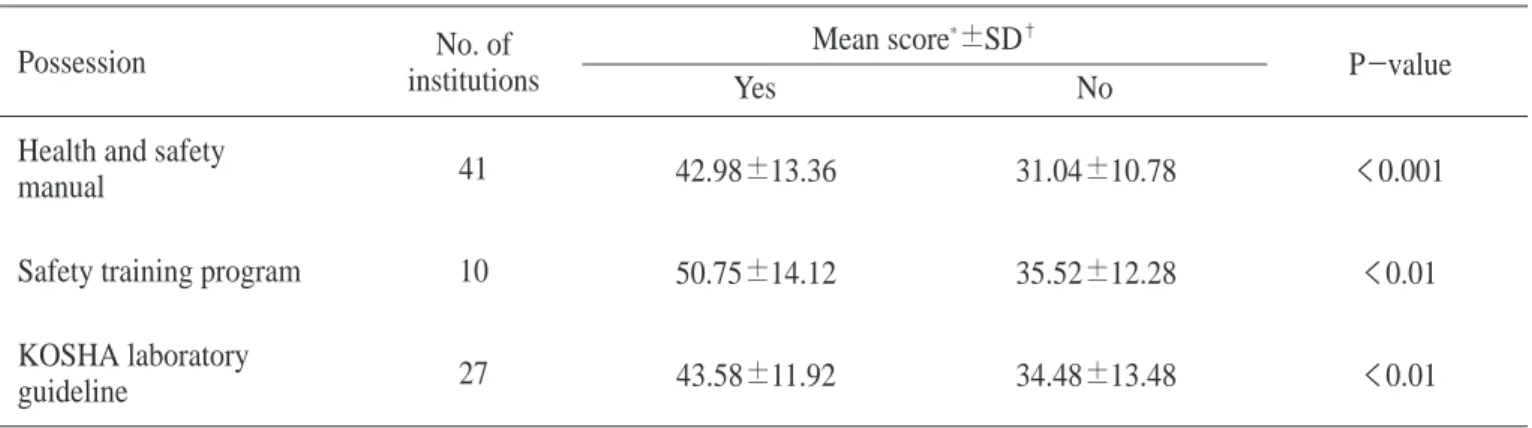
According to the findings, in total, 54.7% of the institutions provided a health and safety manual in their laboratories and kept a laboratory health and safety manual (Table 3). The mean score of the institutions for health and safety that provided a health and safety manual was 42.98±13.36 (range 21-76). In comparison, the institutions that did not provide a health and safety manual scored 31.04±10.78 (13-64). The mean score of the institutions that provided the manual was statistically significantly higher than that of those that did not (p<0.001).
Only 13.3% of the institutions had a training program for safety in the laboratories (Table 3), meaning most institutions did not provide a safety training program for their laboratory workers. The same analytical methods were applied to training programs for safety in the laboratories. The mean score of the institutions that had a training program in their laboratories was 50.75±14.12 (range 28-75). On the other hand, the institutions that did not have training programs scored 35.52±12.28 (13-71). A statistically significant difference was identified in the mean score of health and safety performance between the institutions that provided the training program and that of those that did not (p<0.01).
The KOSHA laboratory safety guideline has been recently published to provide information about laboratory health and safety and also to recommend maintaining its guideline at all laboratories.
However, only 36.0% of the institutions had the KOSHA guidelines
in their laboratories (Table 3). The mean score (43.58 ±11.92, range
28-76) of the organizations that had the KOSHA laboratory
guideline was higher than that of those that did not (34.48±13.48,
Details of questionnaire items Regular general health examinations
Health and safety manual Training program for safe work KOSHA laboratory guide Chemical storeroom
Adequate air-conditioning and/or dehumidifier systems in the chemical storeroom
Exposed to direct sunlight or localized heat Accessible only to authorized personnel Flammable liquid storage cabinet
“No Smiking” signs
Flammable liquid cintainers kept away from fire hazards Gas cylinder storage room
All gas cylinders stored in
Empty gas cylinders stored separately Valve-cap securely in place of gas cylinders Emergency procedures
Emergency evacuation plans Evacuation practices Material safety data sheets Laboratory chemical inventory First aid supplies
Emergency telephone numbers
Emergency personal protective equipment Self-contained breathing apparatus Emergency equipment
Walkways and exits marked Walkways and exits free Eat or drink in laboratory Separate eating area
Specific labelled containers (Chemical waste, Sharps, General waste, Recyclable solvents)
Chemical waste management guideline Adequate fire extinguishers
Periodically inspected and maintained Fire alarm system
Fire exits marked
“No Smiking” signs posted Automatic fire extinguishing
Electrical equipment properly grounded Extension cords
Electrical boxes and panels Electrical cords suspended
Wearing of appropriate PPE compulsory Wear open-toed footwear
Fume hood(s)
Electical services within the fume hood Checked and recorded periodically Storage of chemicals
Canopy type hoods provided over equipment Health serveillance
Monitored for urinary-TTCA Standard operating procedure
Written procedures for cleaning up spills Spills of carbon disulfide
Formal educational program
Reporting system related incidents (spills, Skin/eye splash, lnhalation, lrritation, Symptoms of exposure)
Air sampling for carbon disulfide Ventilation system performance Material safety data sheet Smoking prohibited Fire extinguishers PPE required No. of questions
4
4
3
3
5
5
9
6
4
2 5
17
67 Categories of health and safety
General Health and Safety
Chemical Storage and Containers
Flammable/combustible liquids
Gas cylinders
Hazard communications
First aid & emergency equipment
Housekeeping
Fire safety
Electrical safety
Personal protective equipment Fume hoods
Carbon disulfide as a case study
Total
Table 1. Contents and details of health and safety performance questionnaire
13-71). The analytical data indicated a statistically significant difference between institutions that maintained the KOSHA guideline and those that did not (p<0.01).
As a result, it is concluded that the institutions that provided a health and safety manual, a training program, and the KOSHA laboratory guideline managed their laboratories’health and safety facilities better than the institutions that did not provide these services.
A total of 60.0% of the institutions had a chemical storage room.
Among them, 64.8% of the institutions alphabetically stored chemicals in store areas and 7.4% of the institutions stored chemicals by random placement. Only 27.8% of the responding institutions stored chemicals by class; for example, oxidizers with oxidizers and flammables with non-flammables (Table 4).
Gases such as acetylene were used as an ignition source to operate analytical instruments. Other compressed gases used in occupational hygiene laboratories were compressed air, nitrogen, hydrogen,
helium, and argon. 62.7% of the institutions confirmed the use of gas cylinders in the laboratories. An average of 55.1% of gas cylinders were secured by brackets or chains to prevent them from falling or being knocked over (Figure 1).
A total of 54.7% of the institutions had Material Safety Data Sheets (MSDSs) readily available in their laboratories. However, 42.7% of the remaining institutions did not store MSDSs and the last 2.7% of them replied that they did not know whether they had MSDSs or not.
Multiple responses were made that only 8.0% of the institutions (6 institutions; 2-multiple responses) supplied eyewash fountains (2), safety showers (3), and eyewash bottles (3) and all of them were accessible less than 10 meters from the hazardous area. However, 92.0% of the remaining institutions did not have all of the eyewash fountains, safety showers, and eyewash bottles.
In total, 70.7% of the institutions provided fire extinguishers suited to the fire hazards in their laboratories. Of these, 54.7% of the
No. of lab.
analysts
University laboratories
KIHA
*laboratories
University hospital laboratories
Private &
public hospital laboratories
Company in-house laboratories
Total
0 2 3 1 0 0 17
7 4 0 0 0 1 23
8 10
1 0 0 0 31
13 11 0 0 0 0 35
3 8 1 0 2 0 32
31 70 15 4 10
8 138 1
2 3 4 5 8 Total
Table 2. Number of laboratory analysts employed by each institutional laboratory grup
Possession No. of
institutions
Mean score
*±SD
†Yes No P-value
Health and safety manual
Safety training program KOSHA laboratory guideline
41
10
27
42.98±13.36
50.75±14.12
43.58±11.92
31.04±10.78
35.52±12.28
34.48±13.48
< 0.001
< 0.01
< 0.01 Table 3. Distribution of health and safety performance score with respect to possession of the health and
safety manual, training program, and KOSHA laboratory guideline
*Korea lndustrial Health Association
*Mean score was calculated as a percentage score that 67 questions assigned one point by each item, if yes
†SD : Standard deviation
Categories No. of institutions
Details of
questionnaire items No %
Chemical storage room
*Gas cylinders in laboratories MSDSs availability
Emergency facilities
*Fire extinguishers
Periodical inspection of fire Extinguishers
Personal protective equipment
*45
†47
‡75
75 75
53
¶75
Stored chemicals by alphabetically Stored chemicals by class
Stored chemicals by random secured by brackets, etc.
Yes No
Do not know Yes
Yes No
Do not know Yes
No
Do not know Laboratory coat Gloves
Respiratory protection Eye protection Face shield Footwear Apron
35 15 4 - 41 32 2 6 53 15 7 29 10 14 65 47 38 32 16 7 7
64.8 27.8 7.4 55.1
§54.7 42.7 2.7 8.0 70.7 20.0 9.3 54.7 18.9 26.4 86.7 62.7 50.7 42.7 21.3 9.3 9.3 Table 4. Laboratory healty and safety features
* Multiple responses, §Average percentage of secured by brackets, etc.
†A total of 45 institutions possessed chemical storage room(s) in their lab among 75 institutions
‡A total of 47 institutions used gas cylinder(s) in their lab among 75 institutions
¶A total of 53 institutions had fire extinguisher(s) to the fire hazards in their lab among 75 institutions
institutions periodically inspected and maintained their fire extinguishers.
Among the 75 respondents, considering compound responses, lab coats (86.7%), gloves (62.7%), and respiratory protection equipment (50.7%) were usually provided to the laboratory workers. However, only 42.7% of the institutions supplied eye protectors, 21.3%
supplied face protectors, and 9.3% supplied footwear and aprons.
Only 14.7% of the institutions had strict rules about wearing PPE at all times in the laboratories. A total of 66.7% of the institutions permitted the wearing of open-toed footwear during experimentation in the laboratory.
Of the 75 respondents, only 12.3% of the institutions made periodical checks and maintained records of fume hood performance. The average minimum acceptable face velocity of the fume hoods was 0.55m/s (range: 0.21-0.70) as a performance standard of their fume hood(s), which was checked and recorded by laboratory workers.
The storage of chemicals in fume hoods is usually acceptable in most institutions in Korea. A total of 89.0% of the institutions stored their chemicals in the fume hoods (Table 5; Figure 2).
Considering multiple responses, 66.7% of the institutions provided mechanical general ventilation systems, 61.3% of the institutions supplied air conditioning, and 20.0% of the institutions maintained natural general ventilation systems. In relation to the maintenance of air quality in the laboratory, 48.0% of the institutions considered temperature as a more relevant factor in creating comfortable conditions in the laboratory environment, rather than being concerned with general air quality, humidity, specific contaminants, and air velocity.
Ⅳ. Discussion
In general, a wide variety of hazardous chemicals and gases were
used in occupational hygiene laboratories even though very small amounts of substances were employed to analyze individual samples. Because of this, among other factors, hazard controls in laboratories are difficult to administrate, and it is not easy to manage these hazardous substances in the laboratory.
A health and safety manual was part of the program for providing safety information to laboratory workers. The manual contained adequate occupational health and safety information as necessary, and also ensured that users of the hazardous chemical substances
would receive effective education and/or training before handling or using hazardous materials (Dux & Stalzer, 1988). Approximately half of the institutions had a health and safety manual and these institutions had significantly higher health and safety scores as a result.
A training and education program is one of most important preventive measures that can be taken to ensure health and safety in laboratories (Lieckfield & Farrar, 1991), because an adequate training program can prevent or minimize accidents/incidents on an
Categories No. of
institutions Details of questionnaire items No %
Fume hood(s)
Fume hood(s) checks and records preiodically
Storage of chemicals prohibited General ventilation systems
Concerns of air quality
†75 73
*73
*75
75
Yes No Yes No
Do not know Yes
No
Air conditoning system Natural dilution ventilation Fan forced dilution ventilation Temperature
Humidity Air velocity
Specific contaminants General air quality
73 2 9 59
5 8 65 46 15 50 36 15 3 16 18
97.3 2.7 12.3 80.8 6.9 11.0 89.0 61.3 20.0 66.7 48.0 20.0 4.0 21.3 24.0 Table 5. Characteristics of fume hood and general ventilation in laboratories
*A total of 73 institutions had fume hood(s) in their lab among 75 institutions
†Multiple responses