• 검색 결과가 없습니다.

Research on Air Pollution Status and Its Control Technology in China

N/A
N/A
Protected

Academic year: 2021

Share "Research on Air Pollution Status and Its Control Technology in China"

Copied!
6
0
0

로드 중.... (전체 텍스트 보기)

전체 글

(1)

1. Introduction

The atmosphere is an indispensable environment for human survival, and in the past hundred years, with the acceleration of global industrialization, the problem of air pollution has become increasingly prominent and has gradually become a common problem facing the whole world. As the largest developing country, China is a big energy consuming country, and the problem of air pollution is quite serious. Atmospheric pollution presents a new type of atmospheric compound pollution, in which soot and motor vehicle pollution coexist.

Particulate matter is the main pollutant. Haze and photochemistry smog are frequent, and acid deposition is transformed into sulfuric acid and nitric acid pollution

[1]

. Over the past decade, the country has suffered severe and sustained air pollution, such as haze, light fog, sand, dust and other air pollution intensification, which has seriously affected people's survival and development, and restricted the development of China's economy

[2]

. Due to the air pollution has the characteristics of long duration, wide diffusion range and relatively difficult difficulty in monitoring, it is difficult to completely purified in a short time. China has put forward the slogan of winning the battle of defending the blue sky. Through strengthening the control of the root causes of pollution, strengthening

the improvement of laws and regulations on atmospheric quality, adjusting the energy structure and changing the mode of production, a series of measures have been taken to control the problem of atmospheric pollution.

2. Status of Atmospheric Pollution in China

2.1 Total Emissions of Atmospheric Pollutants Decreased

Over the past five years, with the increasing efforts of the state to control atmospheric pollution, the emission of SO2, CO and NOx in various parts of China has been reduced, and Concentrations of PM2.5 and PM10 also decreased. Especially in large and medium-sized cities, this proportion has declined significantly.

Due to the influence of China's national conditions, in the next period of time,70% of China's major source of electricity is coal-fired electric power generation, and coal will still occupy the main position in China's energy structure. At the same time, with the continuous improvement of China's economic level, the number of private cars owned by residents has continued to grow rapidly in recent years. By the end of 2018, there were 240 million vehicles in the country, an increase of 22 million 850 thousand compared with 2017,

* School of Biology, Food and Environment, Hefei University, Hefei 230601, China.

** School of Biology, Food and Environment, Hefei University, Hefei 230601, China. Correspondent Author

Research on Air Pollution Status and Its Control Technology in China

SaiXia

*

·Zhen Yu Yang * ·JieJin **

Abstract: China's rapid economic growth has also caused serious air pollution, endangering the health of the people and the good operation of the surrounding ecological environment.In this paper, the current situation of air pollution in China is briefly described, and the sources and changing trends of major air pollutants (including PM10, PM2.5, SO2, NO2, CO and O

3

)are analyzed. Meanwhile, the treatment technologies and measures for atmospheric pollutants under the current situation.

Key Words: air pollution; ecological environment; pollutants; treatment technology;

(2)

an increase of 10.51%, making the proportion of oil in energy consumption increasing. As a result, although the total amount of atmospheric pollutants discharged in China has decreased, it is impossible to cut off the generation of pollutants from the root source.

2.2 Atmospheric Pollution Presents Regional Characteristics

China has a large land and a large population. Due to geographical environment, historical factors and economic policies, the distribution of energy and population presents certain regional characteristics. In the northwestern region and the Beijing-Tianjin -Hebei region, due to the relatively abundant coal resources, the region is mainly dominated by coal-type pollution. At the same time, it is affected by geomorphic climates such as poor soil, sparse vegetation, low rainfall, and high wind speed. The concentration of SO2 , CO and PM is high. The Yangtze River Delta and the Pearl River Delta and other parts of East China and South China, due to the proximity of the coast, industrial intensive, developed transportation, relatively high level of urbanization, so the region is mainly based on petroleum-type air pollution, atmospheric pollutants, NOx, O3 concentration high. The concentration comparison of atmospheric pollutants in Jinjingyu, Northwest China, Yangtze River Delta and Pearl River Delta is shown in Figure 1:

Fig. 1 Comparison of regional air pollution concentration in China

2.3 Air Pollution Presents Seasonal Differences

Due to the large spatial heterogeneity in China, atmospheric pollutants show different seasonal variations due to the monsoon climate.

The concentrations of PM2.5 , PM10 , SO2 , CO and NO2 are present in winter > spring >

autumn > summer. Taking the seasonal variation trend of atmospheric pollutant concentration in Beijing and Tianjin for the past five years as an example (see Figure 2) , the concentration of PM2.5 and SO2 in autumn and winter is significantly higher than that in spring and summer, which is mainly attributed to coal-fired heating for households. influences. A large amount of flue gas and SO2 gas generated during the coal combustion process , and a high concentration of SO2 gas easily undergoes a secondary reaction in the air to form a hydrochloric acid aerosol, resulting in an increase in PM2.5 and CO and a continuous haze phenomenon. At the same time, in the winter, the meteorological features such as shallow mixed layer, weak solar radiation and slow wind speed appear more frequently in winter, which makes the air mobility of the near-surface layer weaker, unfavorable diffusion, and the pollutants gradually accumulate, leading to SO2 and NO2 High load.

Fig. 2 Jingjinji nearly five seasonal variation of air pollutant concentrations

On the contrary, high precipitation, strong

temperature turbulent vortex can alleviate air

pollution in summer, and sufficient precipitation

has obvious scavenging effect on gaseous

pollutants

[3]

. In addition, in large cities with

dense population and developed transportation,

(3)

affected by high-rise buildings and urban ecological environment, dust is dense and easy to accumulate over the city for a long time, resulting in an increase in PM10 and NOx concentrations. Compared with other pollutants, the concentration of O3 was significantly higher in spring and summer than in autumn and winter, and the lowest in winter. The main reason is that the summer stratospheric and tropospheric exchange process can promote the accumulation of O3 . At the same time, the solar radiation is strong in summer, and the temperature is high, which is favorable for a large number of OH radicals to form, and the radiation is coupled with high temperature, which leads to the production of O3, and simultaneously generates VOCs and OH radicals, thereby accelerating the photochemical reaction of pollutants in the atmosphere and produce more O3

[4]

.

2.4 O

3

Concentration Shows an Upward Trend

Due to the accelerating industrialization process and the rapid increase of motor vehicles in China, the emission of VOCs in China has increased in recent years, and VOCs can react with nitrogen oxides in the air to generate ozone, which leads to atmospheric photochemical smog. Events that endanger human health and plant growth

[5]

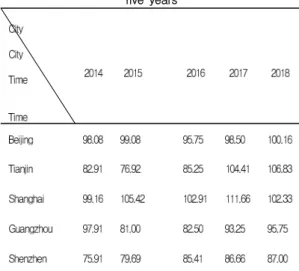
. Especially in the more developed are as of China, such as the mega-city belts such as Beishangguang (seeTable1), due to the development of industrial transportation, the concentration of VOCs is relatively high, and the urban heat island effect in summer is relatively prominent, thus accelerating the generation of ozone. At the same time, with the continuous reduction of atmospheric pollutant emissions in recent years, the reduction of NOx emissions may inhibit the titration reaction of NO and O3

[6]

, so that the ozone in the air can not be further transformed, and the accumulation continues to increase the concentration.

Table 1 Average concentration of O3 over the last five years

2.5 Atmospheric Pollutants Exhibit Weekly Cycle Differences

The concentration of atmospheric pollutants in large and medium cities shows a significant weekend effect. The concentrations of PM2.5 , PM10 , SO

2

,NO

2

and CO during the working day aregenerally greater than on Saturday and Sunday, and the lowest concentration is often on Sunday. According to the results of one-way analysis of variance (ANOVA), all contaminants except for O

3

all contaminants except for O

3

were significantly higher than the weekend.

Although many vehicle restrictions have been implemented in some metropolitan areas (such as Beijing and Shanghai), traffic intensity is still considered to be an important factor affecting the accumulation of pollutants. However, the daily concentration of O3 did not show a significant weekly cycle. The average O

3

value appearedslightly higher than the weekdays on weekends, but the study concluded that the advection process and vertical mixing are the main factors affecting the O

3

concentration.

3. Air pollution Control and Prevention Technology

At this stage, China's energy structure still uses coal and oil as the main energy sources.

Thermal power plants and motor vehicles are

the main sources of atmospheric pollutants. The

(4)

efficient removal and coordinated control of pollutants is a strategic frontier in China's energy and environmental fields. One of the studies

[7]

.

3.1 Desulfurization Treatment Technology Industrial waste gas emitted by thermal power plants is mainly composed of sulfur dioxide and nitrates. Therefore, to control the pollution problems of thermal power plants, it is necessary to start from the flue gas control of thermal power plants

[8]

. Traditional flue gas treatment methods are usually based on physical treatment. By installing dust removal facilities, including electrostatic precipitators, bag filters, mechanical dust collectors and wet dust collectors, the solid state in coal-fired flue gas is removed or captured. Or liquid particles.

This treatment has a good removal effect on large particle suspensions in the flue gas, but cannot remove SO2, NOx and fine particles.

Therefore, based on this treatment, chemical treatment technology is added to effectively remove various exhaust gases in the flue gas.

There are four main desulfurization technologies for flue gas: dry desulfurization technology, semi-dry powder desulfurization technology, wet desulfurization technology and flue gas circulating fluidized bed method

[9]

. At present, limestone-gypsum wet desulfurization technology is widely used at home and abroad, using tray tower process, double tower series process and single tower double cycle process to achieve high efficiency desulfurization. The desulfurization effect of some power plant units can reach more than 99.4%, but flue gas desulfurization Investment and operating costs are relatively high.

3.2 Denitrification Treatment Technology Power plants, cement plants, steel plants and industrial boilers are the main sources of fixed source NOx. In view of the NOx generated, at present, the nitrogen-containing oxide in the flue gas is usually separated by a reduction method and an oxidation method, and then converted into a solid or liquid substance, thereby achieving the purpose of reducing the concentration of nitrogen oxides in the flue gas.

The currently used denitration techniques are

liquid phase reaction (wet method) and gas phase reaction (dry method), and dry method is further divided into selective catalytic reduction (SCR) and selective non-catalytic reduction (SNCR)

[10-11]

. Among them, NH3 as a reducing agent selective catalytic reduction technology is a mature fixed source denitrationtechnology

[12]

. The difference between the two is that the former uses a catalyst to reduce the activation energy of the denitration reaction, thereby reducing nitrogen oxides at a lower temperature of 200 to 400°C. The latter is the reduction of nitrogen oxides in a furnace or flue at a high temperature of 800 to 1100°C. The denitrification efficiency of the two is greatly affected by temperature. In order to ensure the denitration effect, the SNCR+SCR coupling method is generally used for denitration.

3.3 Biological Filtration Technology

With the rapid development of bioengineering and materials science, biofiltration technology plays an extremely important role in air pollution control and has achieved satisfactory results

[13]

. The working principle of the technology is as follows: a large amount of microorganisms are attached to the filler of the reactor. When the exhaust gas passes through the reactor, the relevant pollutants react with the microorganisms, and the exhaust gas is purified under the action of microorganisms to achieve the purpose of controlling air pollution

[14]

. Compared with other technologies for treating exhaust gas, it has the advantages of relatively simple structure, low investment, low operating cost, high degradation efficiency and difficulty in causing secondary pollution. At present, it is mainly applied in dust control, exhaust gas desulfurization, automobile exhaust gas treatment, etc

[15]

.

3.4 Nano-photocatalysis Technology

Nano-photocatalytic technology is an

emerging air pollution control technology with

technical advantages of high efficiency, safety

and wide application range. The technology

utilizessemiconductor materials to effectively

decompose various contaminants under

illumination conditions, thereby purifying the

air

[16]

. The core of the catalyst is the choice of

(5)

catalyst materials . At present, TiO2 is usually used as a typical semiconductor photocatalyst, which can catalyze various pollutants in the exhaust gas at normal temperature and pressure, and is easy to recycle without secondary pollution. Environmental safety features. At present, the focus of nano- photocatalytic technology is to develop effective nano-photocatalytic materials. Due to the difficulty in the preparation of semiconductor photocatalysts, it is necessary to manufacture high-efficiency catalysts in order to further improve the catalyst after changing performance to improve the catalytic activity of the catalyst itself

[17]

. With the further improvement of the theory and technology of photocatalytic reaction, this technology will have broad application prospects in the prevention and control of air pollution.

4. Summary

In recent years, with the continuous increase of air pollution control in China, remarkable achievements have been made, and the pollution degree of most indicators has declined.

At present, the current situation of air pollution in China is as follows: the total amount of atmospheric pollutants is decreasing year by year, but the ozone concentration is increasing, and the pollutants show regional, seasonal and cyclical trends. Therefore, China's air pollution control still has a long way to go, and it has multi-faceted characteristics for the cause of current air pollution. In the process of air pollution control and prevention, in addition to strengthening the control of pollution sources, increasing the improvement of air quality laws and regulations, and adjusting energy In addition to a series of measures such as structure and changing production methods, various atmospheric treatment technologies are also needed, including traditional desulfurization and denitrification treatment technologies and biotechnology and nanophotocatalysis technologies with good application prospects

Acknowledgments

This research were supported by Innovation Team for Manucipal Solid Waste Treatment of Anhui, Financial Support Project for Top-notch Talents in the Universities of Anhui (gxgnfx2018030), Opening Project of Anhui Key Laboratory (MJ-ZK201701), Talent Research Foundation of Hefei University(16-17RC04), Major Scientific and Technological Projects of Anhui Province (16030801119)

References

[1] JiMing Hao, Zhen Cheng, ShuXiao Wang, (2012), “Research on the Status Quo of Atmospheric Environmental Pollution and Prevention Measures in China”, Environmental Protection, No. 09, P. 17-20.

[2] Li Zhang,(2018), “Analysis of the status quo and prevention measures of atmospheric pollution in China”, Shandong Industrial Technology, No. 13, P. 208.

[3] YingYing Zeng, YuanFei Cao, Xue Qiao, Barnabas C. Seyler, TangYa,(2019), “Air pollution reduction in China: Recent success but great challenge for the future”, Science of the Total Environment, P. 663.

[4] ChunSheng Liang, FengKui Duan, KeBin He, YongLiang Ma,(2016), “Review on recent progress in observations, source identifications and countermeasures of PM 2.5”, Environment International, P. 86.

[5] YanPing Wen, YuLong Yan, LiJuan Li,(2016),

“Analysis of characteristics and sources of volatile organic compounds in summer in Taiyuan City”, Journal of Taiyuan University of Technology, Vol. 47, No. 3, P. 331-335.

[6] Rui Li, ZhenZhen Wang, LuLu Cui, HongBo Fu, LiWu Zhang, LingDong Kong, WeiDong Chen, JianMin Chen,(2018), “Air pollution characteristics in China during 2015– 2016:

Spatiotemporal variations and key meteorological factors ”, Science of the Total Environment.

[7] ShuFang Qi, PengLai Zuo, ChenLong Wang,

JiaJia Gao, XiaoTong Zhang, Li Yan,

YongHua Ding, Tao Yue,(2016), “Analysis

of current situation of air pollution control

(6)

in thermal power plants in China”, China Environmental Protection Industry, No. 07, P. 46-50.

[8] JianGuo Zhai, FaHua Zhu, XueLi Sun,(2018),

“Current Situation and Challenges of China's Thermal Power Air Pollution Prevention and Control”, China Electric Power, Vol. 51, No. 06, P. 2-10.

[9] Yi Zhang,(2019), “Application of flue gas desulfurization and denitrification technology in air pollution of thermal power plants”, Chemical Industry Management, No. 07, P.

49.

[10] GuoNian He,(2016), “Analysis on the development trend of flue gas desulfurization and denitrification integrated technology in coal-fired power plants”, Engineering Technology: Abstracts, No. 7, P. 248.

[11] XueTao Wang, PeiDi Wang, Yu Liu,(2014),

“Development trend of flue gas desulfurization and denitrification integrated technology in coal-fired power plants”, Energy and Energy Conservation, Vol. 8, P.

1-3.

[12] DaoJun Zhang, ZiRan Ma, Qi Sun, WenQiang Xu, YongLong Li, Tao Zhu, BaoDong Wang,(2019), “Research progress in the mechanism of selective catalytic reduction (SCR) reaction”, Chemical Progress, Vol. 38, No. 04, P. 1611-1623.

[13] Xia Tang, XianNian Xiao, Bo Pang, Gang Luo,(2014),“Overview of application status and development prospects of deodorization technology in urban sewage treatment plants”, Environmental Science and Technology, Vol. 27, No. 02, P. 70-74.

[14] WangXuan Deng, JinWei Ma, Ling Li,(2018),“Application of biological filtration technology in air pollution control”, Environment and Development, Vol. 30, No.

07, P. 33-35.

[15] YueXi Guo, Wei Xing, YaMin Yan,(2018),

“Application of Biological Filtration Technology in Air Pollution Control”, Chemical Industry Management, No. 20, P.

143-144.

[16] Wei Lü, QingZhu Zhang, (2018),

“Nano-TiO

2

Photocatalysis Technology and Air Pollution Control”, China Environmental Science, Vol. 38, No. 03, P. 852-861.

[17] Dan Zhou,(2018),“Application of Nano Photocatalysis Technology in Air Pollution Control”, Environment and Development, Vol. 30, No. 04, P. 80-82.

논문투고일 2019년 11월 30일

논문심사일 2019년 12월 10일

논문게재일 2019년 12월 30일

수치

Fig.  2    Jingjinji  nearly  five  seasonal  variation  of  air  pollutant  concentrations
Table  1    Average  concentration  of  O3  over  the  last  five  years

참조

관련 문서

Therefore, the paper would propose amendment of Immigration Control Act, strengthening of foreigner management, disclosure of foreigners information, crime

The responsibility for marine pollution control in Korea is now scattered among the Ministry of Oceans and Fisheries, the National Maritime Police

In Korea, based on the early attained Air Superiority, the UN Airpower conducted Close Air Support, Air Interdiction and Combat Cargo operations to saved the

In addition to an integrated control system of state obligation, the government should expand the control boundary of state obligation, so that it, putting

Particles are especially dangerous because they’re not always visible to the human eye, allowing the pollution to go easily unnoticed.. Particle pollution

The desalted crude is then sent to another series of heat exchangers (6 10) for heating to 427 o F then sent to exchangers (6-10) for heating to 427 o F, then, sent

Just as we achieved good control with a joint-based controller that was based on a linearizing and decoupling model of the arm, we can do the same for the Cartesian case.

Season, sex, age, and education as modifiers of the effects of outdoor air pollution on daily mortality in Shanghai, China: The Public Health and Air Pollution in Asia