• 검색 결과가 없습니다.

Soil CO<sub>2</sub> Efflux and Leaf-Litter Decomposition of Quercus variabilis and Pinus densiflora Stands in the Southern Region of Korean Peninsular

N/A
N/A
Protected

Academic year: 2021

Share "Soil CO<sub>2</sub> Efflux and Leaf-Litter Decomposition of Quercus variabilis and Pinus densiflora Stands in the Southern Region of Korean Peninsular"

Copied!
6
0
0

로드 중.... (전체 텍스트 보기)

전체 글

(1)

183

F OREST S OCIETY

Soil CO 2 Efflux and Leaf-Litter Decomposition of Quercus variabilis

and Pinus densiflora Stands in the Southern Region of Korean Peninsular

Sung Bin Kim

1

, Nam Chul Jung

2

and Kye-Han Lee

1

*

1

Department of Forestry, Chonnam National University 77 Youngbong-ro, Buk-gu, Gwangju 500-757, Korea

2

Forest Resources Research Institute, JeollaNamDo San 23-7, Sanje-ri, Sanpo, Naju-city, JeollaNamDo 520-833, Korea

Abstract : It is necessary to determine the amount of carbon dioxide (CO

2

) absorbed by plants and released from forest floor into atmosphere, to gain a better understanding how forests participate in the global carbon cycle. Soil CO

2

efflux, litter production, and decomposition were investigated in Q. variabilis and P.

densiflora stands in the vicinity of Gwangju, Chonnam province. Soil CO

2

efflux was measured using Infrared Gas Analyzer (IRGA) at midday of the 10th day at every month over 12-month period, to quantify seasonal and annual budgets of soil CO

2

efflux. Soil temperature and soil moisture were measured at the same time. Seasonal soil CO

2

efflux in Q. variabilis and P. densiflora were the highest in summer season.

In August, maximum soil CO

2

efflux in Q. variabilis and P. densiflora was 7.49, 4.61 CO

2

µmol·m

−2

·s

−1

, respectively. Annual CO

2

efflux in each stand was 1.77, 1.67 CO

2

kg·m

-2

respectively. Soil CO

2

efflux increased exponentially with soil temperature and related strongly in Q. variabilis (r

2

=0.96), and in P.

densiflora (r

2

=0.91). Litter production continued throughout the year, but showed a peak on November and December. Annual litter production in the Q. variabilis and P. densiflora stands were 613.7 g dw·m

−2

·yr

−1

and 550.5 g dw·m

−2

·yr

−1

, respectively. After 1 year, % remaining mass of Q. variabilis and P. densiflora litter was 48.2, 57.1%, respectively. The soil CO

2

efflux rates in this study showed clear seasonal variations. In addition, the temporal variation in the CO

2

efflux rates was closely related to the soil temperature fluctuation rather than to variations in the soil moisture content. The range of fluctuation of soil CO

2

efflux and litter decomposition rate showed similar seasonal changes. The range of fluctuation of soil CO

2

efflux and litter decomposition rate was higher during summer and autumn than spring and winter.

Key words : Litter decomposition, Litterfall, P. densiflora, Q. variabilis, Soil CO

2

efflux

Introduction

Forests have been considered as potential C sinks that may play a role in storing some of the carbon dioxide emitted in the atmosphere (Watson et al. , 2000; Janssens et al ., 2002). However, the role and the importance of forests as C sources or sinks are likely to be quite vari- able with region, type of forest, age of trees and forest management activities (Lee and Jose 2003; Pypker and Fredeen 2003). In addition, Photosynthesis by plant and respiration processes changes in forest ecosystems is a key factor in understanding the C cycling, because both processes are an important process in the C flow in for- est ecosystems (Bowden et al. , 1993; Raich, 1998; Kim,

2004).

Soil CO

2

efflux represents a major component of the soil C cycle (Raich and Schlesinger 1992) and is an indi- cator of C storage, soil biological activity and overall soil quality (Ewel et al., 1987; Tufekcioglu et al. , 2001).

In general, soil CO

2

efflux depends on the respiration of plant roots and soil microorganisms. Environmental fac- tors such as soil temperature and soil moisture are major two factors influencing the seasonal dynamics of soil CO

2

efflux (Lloyd and Taylor 1994). Soil physical and chemical properties such as texture, organic matter con- tent, root density, and microbial biomass may also affect the magnitude of soil CO

2

efflux (Haynes and Gower 1995; Kelting et al. 1998; Raich and Tufekcioglu 2000).

The influence of climate and substrate quality on fresh litter decomposition has been well documented (Aber et al ., 1990; Aert 1997; Berg et al ., 1993; Couteaux et al .,

*Corresponding author

E-mail: [email protected]

(2)

ter limitation is particularly important as understanding the factors controlling later stages of decomposition are needed to determine the potential fate of the organic matter stores with climate change. In particular, the role of temperature on the decomposition rates of well- decayed organic matter has been the subject of some debate (Grace and Rayment 2000). In an analysis of lit- erature, Giardina and Ryan (2000) concluded that decom- position rates of well-decayed soil organic matter are not strongly controlled by temperature and that increased temperature alone would not stimulate decomposition of forest-derived C in mineral soil.

The objectives of this study were 1) to measure dif- ferences in soil CO

2

efflux under two different stands ( Q. variabilis and P. densiflora ) and to examine the rela- tionships among soil CO

2

efflux, soil temperature, soil moisture content, 2) to measure litterfall and decompo- sition rates in Q. variabilis and P . densiflora litter.

Materials and Methods 1. Study site

The study was conducted in Mountain Mudeung (35°

07' N, 126° 31' E) located in Gwangju, Korea. The annual precipitation in the area was 1,070.3 mm·yr

−1

and the annual average temperature was 14.7

o

C during the study year at Gwangju meterological administration. Experi- mental plots were located in two adjacent Q. variabilis and P. densiflora stands. The study included a com- pletely randomized design with three plots (10×10 m) for each species. Species found in Q. variabilis stand were Prunus sargentii , Viburnum dilatatum , Cornus contro- cersa , Weigela subsessilis Fraxinus sieboldiana , Rhododen- dron mucronulatum etc. Species found in P. densiflora stand were Rhus sylvestris , Styrax japonica , Quercus serrata , Stephanandra incisa , Lindera erythrocarpa etc.

The soil texture of Q. variabilis stand was SiL with pH 4.40. The mean stand density of the stand was 750 trees·ha

−1

. The mean tree diameter and height were approximately 18 cm and 21 m, respectively. The soil texture of P. densiflora stand was L with pH 4.74. The mean stand density of the stand was 900 trees ha

−1

. The mean tree diameter and height were approximately 22 cm and 23 m, respectively.

2. Soil CO

2

efflux

Soil CO

2

efflux was measured by using an infrared gas analyzer (IRGA) (Licor 6400 portable photosynthesis system, Li-Cor Inc., Lincoln, NE) equipped with a soil chamber. At the time of measurement, the forest floor

with the equipment used. Measurements were performed between 10:00 a.m. and 14:00 p.m. for 12 months (from September 2006 to August 2007) in the study sites. Dur- ing the measurement, soil temperature and moisture were measured with (T&D Thermo Recorder and Field- scout TDR 100) at 15 cm depth adjacent to each cham- ber at the same time.

3. Litterfall

Litterfall was collected in littertraps using 1.5 mm nylon net. The collecting area was 1 m

2

. Eighteen traps in three plots (10×10 m) in Q. variabilis and P. densi- flora stands were installed on the ground. Litter was col- lected at approximately monthly intervals from September 2006 to August 2007. Litter collected from each trap was transported to the laboratory and oven-dried at 65

o

C for 48 hours. All dried samples were separated into leaf, branch, reproductive organ, bark, other, and each portion was weighed.

4. Litter decomposition

Mass loss rates in decomposing litter were estimated using the litterbag technique. Fresh litter from each plot was collected on the forest floor. After collection, the lit- ter was air-dried at room temperature for 14 days. And approximately 10 g was placed in 18 cm×25 cm nylon net bags each with a 1.0mm size mesh. Sub-samples from the litter were also taken to determine oven-dried mass at 65

o

C for 48 hours. Litterbags within each plot were randomly placed on the forestry in September 2006. The litterbags were collected from each plot at 2 month intervals from Nov 2006 to Nov 2007. After col- lection, each litterbag sample was oven-dried at 65

o

C for 48 hours, weighed, and mass loss rates were determined.

5. Lignin and holocellulose

Air-dried litter of 40~60 mesh was extracted with ben- zene:alchol (2:1, v/v) for 8 hrs in a Sohxlet apparatus and again air-dried. Holocellulose was prepared by delig- nification of extractive-free litter with acidified sodium chlo- rite at 75

o

C for 4 hrs. Lignin content was determined as the insoluble residue after hydrolysis of the litter with 72% sulfuric acid by the Klason lignin method(Effland 1977).

Results 1. Soil CO

2

efflux

Soil CO

2

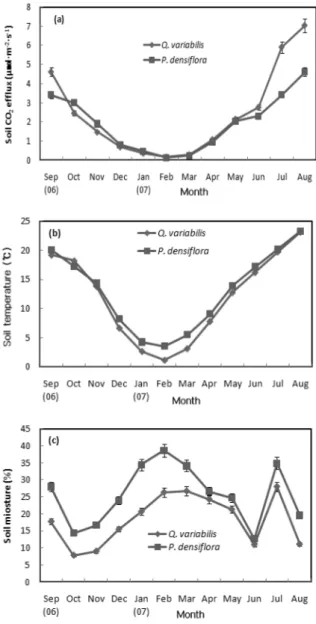
efflux rates showed a clear seasonal varia-

tions. The rates increased during spring and summer, and

(3)

reached maximum values in August (Figure 1). Soil CO

2

efflux rates began to decline during the fall, reaching values close to those in spring. A correlation coefficient between soil CO

2

efflux and soil temperature at 15cm depth (Figure 2) was highly significant. Soil temperature was related strongly to soil CO

2

efflux in Q. variabilis

(r

2

=0.96) P. densiflora (r

2

=0.91). However, the regression between the soil CO

2

efflux rates and soil moisture con- tent was not significant (Figure 3). Annual mean CO

2

efflux during the study period of one year in Q. vari-

abilis and P. densiflora were were 0.46 g CO

2

·m

−2

·h

−1

, 0.37 g CO

2

·m

-2

·h

-1

respectively.

2. Litterfall

The annual litterfall in Q. variabilis and P. densiflora

stands was 613.7, 550.5 g dw·m

−2

·yr

−1

, respectively. Leaf

litter was major component of total litterfall in the stands.

leaf litter in Q. variabilis stand accounted for 66.5% of total annual litterfall, followed by other (21.2%) > branch (6.9%) > reproductive organ (4.9%) > bark (0.5%). leaf litter in P. densiflora stand accounted for 51.3% of total annual litterfall, followed by other (21.1%) > reproductive organ (13.6%) > bark (7.3%) > branch (6.7%). In seasonal variation, the heavy litterfall month in the stands was November and December (Figure 3). Litterfall production in Q. variabilis and P. densiflora stands during this period involved 77.1%, 38.0% of the annual litterfall.

3. Litter decomposition

Mass loss rates for one year from decomposing litter were faster in Q. variabilis than in P. densiflora (P<0.05) Figure 1. Monthly variation of soil CO

2

efflux(a), soil

temperature(b) at 15cm depth, soil moisture content(c) at 15cm in the study stands.

Figure 2. The relationships between soil CO

2

efflux rate and soil temperature(a), soil moisture(b) in study stands.

Figure 3. Monthly change of leaf litter inputs in the study

stands.

(4)

(Figure 4). Decomposing litter declined steadily in weight during the experiment. The mass loss change was similar between the Q. variabilis and P. densiflora for one year. About 52% of the original mass in the Q. vari-

abilis litter disappeared, while about 43% in P. densi-

flora disappeared. The rates of litter decomposition was not significantly different between the Q. variabilis and

P. densiflora stands.

4. Lignin and holocellulose

The original concentrations of lignin in Q. variabilis

and P. densiflora were 38.8%, 28.2% respectively. The lignin change in decomposing litter was similar between the Q. variabilis and P. densiflora . The origin concen- trations of holocellulose in Q. variabilis and P. densi-

flora were 45.4%, 47.2% respectively.

Discussion

The range of fluctuation, reducing minimum value from maximum value of the soil CO

2

efflux and the litter decomposition rate of intra-season, was graphed to elu- cidate relationship between them (Figure 6). The range of fluctuation of soil CO

2

efflux and litter decomposition rate showed similar seasonal changes. The range of fluc- tuation of soil CO

2

efflux and litter decomposition rate was higher during summer and autumn than spring and winter.

Soil CO

2

efflux rates showed a clear seasonal varia- tions. In addition, temporal variation in the rates was closely related to soil temperature fluctuation rather than the variation of soil moisture content (Figure 1). Many studies reported that soil CO

2

efflux in temperate forests is typically higher in summer and lower in winter, corre- sponding to changes in ambient temperature because root and soil organism contribute to soil CO

2

efflux through respiration (Son and Kim 1996, Ohashi et al., 1999, Wise- man and Seiler 2004), the effect of these factors varied according to the geographical location and season (Ohashi

et al. , 1999). In addition, an exponential increase in soil CO

2

efflux with respect to soil temperature was observed in this study. Previous investigator report similar results that soil CO

2

efflux was correlated strongly with soil tem- perature (Son and Kim 1996, Ohashi et al ., 1999, Laporte

et al ., 2003, Lee and Jose 2003).

Annual mean soil CO

2

efflux during the study period of one year in Q. variabilis and P. densiflora were 0.46 g CO

2

·m

−2

·h

−1

, 0.37 g CO

2

·m

−2

·h

−1

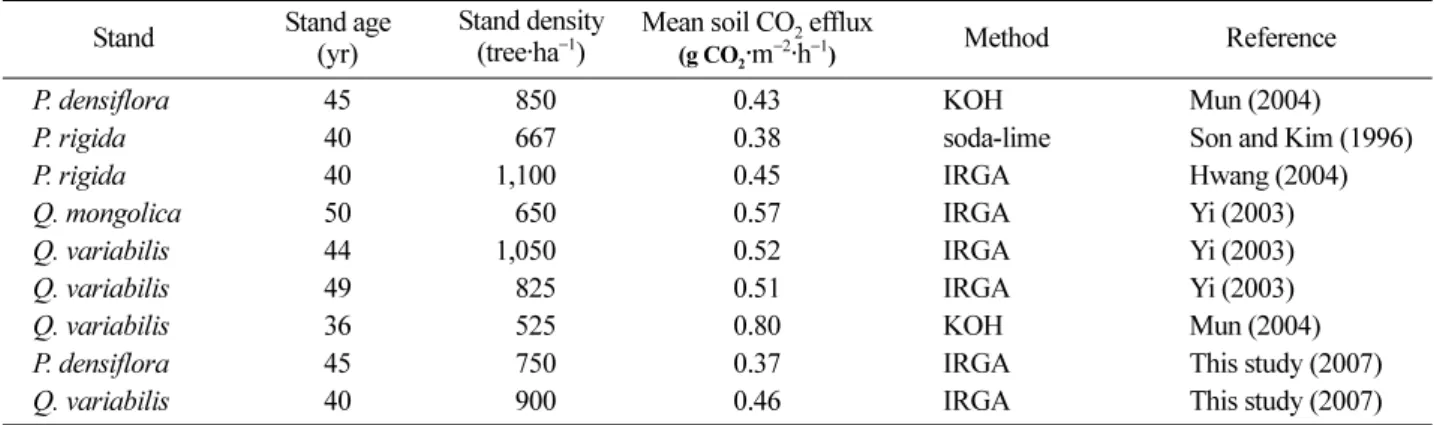
respectively. These values were similar to other stands in Korea (Table 1).

Total soil respiration rates in Q. variabilis and P. den-

siflora in this study were 4029 g CO

2

·m

−2

·yr

−1

, 3241 g CO

2

·m

−2

·yr

−1

respectively. Son and Kim (1996) observed that the annual soil respiration in a 40-year-old larch Figure 4. Remaining mass of leaf litter for one years in

study stands.

Figure 5. Lignin(a) and holocellulose(b) concentration changes of decomposing leaf litter.

Figure 6. Change phases on the range of fluctuation of

soil CO

2

efflux and litter decomposition rate of intra-

season. Spring (Mar.~May), Summer (Jun.~Aug.), Autumn

(Sep.~Nov.), Winter (Dec.~Feb.)

(5)

stand ranged from 2370 to 2680 g CO

2

·m

−2

·yr

−1

in Yang- pyoung in central Korea.

Annual litter production in the Q. variabilis and P.

densiflora stands were 613.7 g dw·m

−2

·yr

−1

and 550.5 g dw·m

−2

·yr

−1

, respectively (Figure 3). Yi et al. (2005) reported that litter production of Q. mongolica natural forests ranged from 314.3to 554.9 g dw·m

-2

·yr

-1

(average 428.5 g dw·m

−2

·yr

−1

). Litter production of oak forests in Korea ranged from 248.0 to 876.1 g dw·m

−2

·yr

−1

(Mun and Joo1994, Son et al., 2004). Litter production of oak forests in this fell within those ranges. Mun and Kim (1992) reported that litter production in P. densiflora for- ests was 453.5 g dw·m

−2

·yr

−1

, respectively, Kim (2006) also reported that litter production in P. densiflora forest was g dw·m

−2

·yr

−1

. Litter production of pine foerst in this study was much higher than that of above results. This difference might be related to tree density, age and can- opy cover among them. Leaf litter was the major com- ponent of total litterfall in the stands.

Litter decomposition rates during 12 months were more rapid in Q. variabilis than P. densiflora . About 52% of the original mass in the Q. variabilis litter dis- appeared, while about 43% in disappeared (Figure 4).

These differences in decomposition rates are probably due to in differences substrate quality. Weight loss in summer season was greater than that in winter season.

This may be due to the greater activities of decomposer in summer season and water soluble fractions in litter leached out more in wet summer season (Jensen 1974, Millar 1974, Swift 1979).

Acknowledgment

This study was financially supported by Chonnam National University.

Literature Cited

1. Aber, J.D., Melillo, J.M. and McClaugherty, C.A. 1990.

Predicting long-term patterns of mall loss, nitrogen dynamics, and soil organic matter formation from ini- tial fine litter chemistry in temperate forest ecosystems.

Can. J. Bot. 68: 2201-2208.

2. Aert, R. 1997. Climate, leaf litter chemistry and leaf-lit- ter decomposition in terrestrial ecosystems-a triangular relationship. Oikos, 79: 439-449.

3. Berg, B., Berg, M.P., Bottner, P., Box, E., Breymeyer, A., Calvo De Anta, R., Couteaux, M.-M., Escudero, A., Gallardo, A., Kratz, W., Madeira, M., Malkonen, E., McClaugherty, C., Meentemeyer, V., Munoz, F., Piussi, Remacle, J. and Virzo De Santo, A. 1993. Litter mass loss in pine forests of Europe and Eastern United State:

some relationships with climate and litter quality. Bio- geochemistry, 20: 127-153.

4. Bowden, R.D., Nadelhopffer, K.J., Boone R.D., Melillo, J.M. and Garrison, J.B. 1993. Contributions of aboveground litter, belowground litter, and root respi- ration to total soil respiration in a temperate mixed hardwood foest. Can J For Res 23: 1402-1407.

5. Couteaux, M.-M., Bottner, P. and Berg, B. 1995. Litter decomposition, climate and litter quality. Trends Ecol Evol. 10: 63-66.

6. Effland, M.J. 1977. Modified procedure to determine acid-insoluble lignin in wood and pulp. Tappi 6(10):

143-144.

7. Ewel, K.C., Cropper, W.P. and Gholz, H.L. 1987. Soil CO

2

evolution in florida slash pine plantations. I.

Changes through time. Can J For Res 17: 325-329.

8. Grace, J. and Rayment, M. 2000. Respiration in bal- ance. Nature (London), 404: 819-820.

9. Giardina, C.P. and Rayan, M.G. 2000. Evidence that decomposition rates of organic carbon in mineral soil do not vary with temperature. Nature (London), 404:

858-861.

10. Haynes B.E. and Gower S.T. 1995. Belowground car- bon allocation in unfertilized red pine plantations in northern Wisconsin. Tree physiol 15: 317-325.

11. Hwang, J. 2004. Belowground Carbon Dynamics after Thinning, Liming and Litter Layer Treatments in Pinus

Table 1. Mean soil CO

2

efflux of Quercus spp. and Pinus spp. forest stands in Korean peninsular.

Stand Stand age

(yr) Stand density

(tree·ha

−1

) Mean soil CO

2

efflux

(g CO

2

· m

−2

·h

−1

) Method Reference

P. densiflora 45 850 0.43 KOH Mun (2004)

P. rigida 40 667 0.38 soda-lime Son and Kim (1996)

P. rigida 40 1,100 0.45 IRGA Hwang (2004)

Q. mongolica 50 650 0.57 IRGA Yi (2003)

Q. variabilis 44 1,050 0.52 IRGA Yi (2003)

Q. variabilis 49 825 0.51 IRGA Yi (2003)

Q. variabilis 36 525 0.80 KOH Mun (2004)

P. densiflora 45 750 0.37 IRGA This study (2007)

Q. variabilis 40 900 0.46 IRGA This study (2007)

(6)

rara, A., Ceulemans, R. 2002. The carbon cost of fine root turnover in Scot pine forest. Forest Ecol Manage 168: 231-240.

13. Jesen, V. 1974. Decomposition of angiosperm tree leaf litter. In:Dickson CH, Pugh GJF (eds). Biology of Plant Litter Decomposition. Vol. 1. Academic Press, New York. pp 69-104.

14. Johnson, DW. 1992. Effect of forest management and carbon storage, Water Air Soil Poll 64: 83-120.

15. Kelting, D.L., Burger, J.A. and Edwards, G.S. 1998.

Estimating root respiration, microbial respiration in the rizosphere, and root free soil respiration in forest soils.

Soil biol Biochem 30: 961-968.

16. Kim, C. 2004. Effects of stand density on carbon dynamics in a larch ( Larix leptolepis ) plantation. J Kor For Soc 93: 355-362.

17. Kim, C. 2006. Soil carbon cycling and soil CO

2

efflux in a red pine ( pinus densiflora ) stand. J Ecol Field Biol 29: 23-27.

18. Lloyd, J. and Taylor, J.A. 1994. On the temperature dependence of soil respiration. Func Ecol 8: 315-323.

19. Laporte, M.F., Duchesne, L.C. and Morrison, I.K.

2003. Effect of clear cutting, selection cutting, shelter- wood cutting and microsites on soil surface CO

2

efflux in a tolerant hardwood ecosystem of northern Ontrario.

Forest Ecol Manage 185: 263-272.

20. Lee, K.H. and Jose, S. 2003. Soil respiration, fine root respiration, fine root production, and microbial biomass in cottonwood and loblolly plantation along a nitrogen fertilization gradient. Forest Ecol Mange 185: 263-273.

21. Meentemeyer, V. 1978. Macroclimate and lignin con- trol of litter decomposition rates. Ecology, 59: 465-472.

22. Melillo, J.M., Aber, J.D. and Muratore, J.F. 1982. Nitrogen and lignin control of hardwood leaf litter decomposi- tion dynamics. Ecology, 63: 6216-626.

23. Millar, C.S. 1974. Decomposition of coniferous leaf lit- ter. In: Dickson CH, Pugh GJF (eds). Biology of plant Litter Decomposition. Vol. 1. Academic Press, New York. pp 105-128.

24. Mun, H.T. and Kim, J.H. 1992. Litterfall, decomposi- ton, and nutrient dynamics of litter in red pine ( pinus densiflora ) and chines thuja ( Thuja orientalis ) stands in the limestone area Korean J Ecol 15: 147-155.

25. Mun, H.S. 2004. Soil respiration in P. densiflora , Q.

variabilis and Platycarya strobilacea stands in Jinju, Gyeongnam Province. Korean J. Ecol. 27(2): 87-92.

26. Nakane, K. 1995. Soil carbon cycling in a Japanese cedar (Cryptomeria japonica) plantation. Nature 363:

234-240.

27. Ohashi, M., Gyokusen, K. and Saito, A. 1999. Mea-

105-114.

28. Pypker, T.G. and Fredeen, A.L. 2003. Below ground CO

2

efflux from cut blocks of varying ages in sub- boreal British Columbia. Forest Ecol Mange 123: 105- 29. Raich, J.W. and Schlesinger, W.H. 1992. The global 114.

carbon dioxide flux in soil respiration and its relation- ship to vegetation and climate. Tellus 44B: 81-99.

30. Raich, J.W. 1998. Aboveground productivity and soil respiration in three Hawaiian rain forests. For Ecol Manage 107: 309-318.

31. Raich, J.W. and Tufekcioglu, A. 2000. Vegetation and soil respiration: Correlations and controls. Biogeochem 48: 71-90.

32. Reich, J.W. and Nadelhoffer, K.J. 1989. Belowground carbon allocation in forest ecosystems: global trends.

Ecology 70: 1346-1354.

33. Son, Y. and Kim, H.W. 1996. Soil respiration in Pinus rigida and Larix Leptolepis plantations. J Kor For Soc 85: 496-505.

34. Swift, M.J., Heal, O.W. and Anderson, J.M. 1979. Decom- position in Terrestrial Ecosystems. Studies in Ecology, Vol. 5. University of California Press, Berkeley, CA.

35. Taylor, B.R., Prescott, C.E., Parsons, W.J.F. and Par- kinson, D. 1991. Substrate control of litter decomposi- tion in four Rocky Mountain coniferous forests. Can J.

Bot. 69: 22242-2250.

36. Tufekcioglu, A., Raich, J.W., Isenhart, T.M. and Schultz, R.C. 2001. Soil respiration within riparian buffers and adjacent crop fields. Plant Soil 299: 117- 37. Waston, R.T., Novel, I.R., Bolin, B., Ravindranath, 124.

N.H., Verardo, D.J. and Dokken, D.J. 2000. Land use, Land-use change, and Forestry. Cambrige: Cambrige University Press.

38. Wiseman, P.E. and Seiler, J.R. 2004. Soil CO

2

efflux across four age classes of plantation loblolly pine ( Pinus taeda L.) on the Virginia Piedmont. For Ecol Manage 192: 297-311.

39. Yi, M.J. 2003. Soil CO

2

evolution in Q. variabilis and Q. mongolica forest in Chunchon, Kangwon Province.

J Kor For Soc 92: 263-269. (in Korean with English summary).

40. Yi, M.J., Son, Y., Jin, H.O., Park, I.H., Kim, D.Y., Kim, Y.S. and Shin, D.M. 2005. Belowground carbon allo- cation of natural Quercus mongolica forests estimated from litterfall and soil respiration measurement. Korean J Agri For Meteorology 7: 227-234.

(Received February 16, 2009; Accepted April 16, 2009)

수치

Figure 3. Monthly change of leaf litter inputs in the study stands.
Figure 6. Change phases on the range of fluctuation of soil CO 2  efflux and litter decomposition rate of  intra-season
Table 1. Mean soil CO 2  efflux of Quercus spp. and Pinus spp. forest stands in Korean peninsular.

참조

관련 문서

Days to emergence and heading, duration of growth, leaf traits and stem diameter of sweet sorghum as affected by soils. Soil type Days

A laboratory experiment was performed to investigate the removal of nitrogen and phosphorus from plating factory effluent using the soil column.. Soil,

The purpose of this study was to compare the microleakage of different adhesive systems (three 2-step adhesives and two 1-step adhesives) in class V

In this study, we investigated the effects of low-power CO 2 laser on proliferation on human gingival fibroblast cells so that determine laser

In this study, it is shows that the stream of CO 2 is more effective in the reduction of unreacted TEGDMA and the increase of surface microhardness than that of N 2

Rasmussen, The use of soil-gas CO 2 in the exploration for sulfide-bearing breccia pipes in northern Arizona, 1990, Journal of Geochemical Exploration, vol.38, pp..

In this context, this study compared and analyzed a variety of soil decontamination methods used to evaluate the wide-area soil contaminated with Cs:

To estimate the change of riverbed geography by the operation of movable weir, two-dimensional RMA-2 and SED-2D were used in this study. Hydraulic elements