Vol. 22, No. 2, 2019, 69-78
https://doi.org/10.5229/JKES.2019.22.2.69
− 69 −
pISSN 1229-1935 eISSN 2288-9000
미세 패턴화된 리튬금속 전극의
Vinylene Carbonate 첨가제 도입에 따른 전기화학 특성에 관한 연구
진다희1,2·박주남1·Cyril Bubu Dzakpasu1·윤별희2·유명현2,**·이용민1,*
1대구경북과학기술원 에너지공학전공, 2한밭대학교 화학생명공학과 (2019년 5월 15일 접수 : 2019년 5월 21일 수정 : 2019년 5월 21일 채택)
Effect of Vinylene Carbonate as an Electrolyte Additive on the Electrochemical Properties of
Micro-Patterned Lithium Metal Anode
Dahee Jin1,2, Joonam Park1, Cyril Bubu Dzakpasu1, Byeolhee Yoon2, Myung-Hyun Ryou2,**, and Yong Min Lee1,*
1Department of Energy Science and Engineering Daegu Gyeongbuk Institute of Science and Technology (DGIST)
2Department of Chemical and Biological Engineering, Hanbat National University (Received May 15, 2019 : Revised May 21, 2019 : Accepted May 21, 2019)
초 록
리튬 금속 음극은 낮은 환원 전위, 고에너지 밀도로 인해 흑연을 대체할 차세대 음극재로 재조 명 받고 있다. 하지만, 충방전시 리튬 금속 표면에서의 반복적인 산화/환원 반응에 의해 리튬 덴 드라이트가 형성되며 이로 인해 수명특성이 급격하게 저하되고 더 나아가 내부 단락(Internal Short-circuit)과 같은 안전성 문제로 인해 상용화되기에는 어려운 실정이다. 이를 해결하기 위해 본 연구 그룹에서는 리튬 금속에 미세 패턴을 형성하여 전류 밀도를 제어함으로써 덴드라이트 형성을 제어하였으나, 고전류밀도에서는 리튬 덴드라이트의 형성을 완벽하게 제어할 수는 없었다.
본 연구에서는 미세 패턴화된 리튬 금속 전극에 전해질 첨가제 Vinylene Carbonate(VC)를 도 입하여 고율 충방전 시 미세 패턴화된 리튬 금속 전극의 덴드라이트 형성 억제를 극대화하고자 하였다. 미세 패턴화된 리튬 금속 전극과 VC 첨가제의 시너지 효과로 인해 높은 전류 밀도에서 의 리튬 덴드라이트가 비교적 치밀하게 형성되는 것을 확인할 수 있었다. 이로 인해 300사이클 동안 88.3%의 용량유지율을 보였으며, 기존의 미세 패턴화된 리튬 금속 전극에 대비하여 수명 특성이 약 6배 이상 향상된 것을 확인할 수 있었다.
Abstract : Lithium metal anode with the highest theoretical capacity to replace graphite anodes are being reviewed. However, the dendrite growth during repeated oxidation/reduction reaction on lithium metal surface, which results in poor cycle performance and safety issue has hindered its successful implementation. In our previous work, we solved this problem by using surface modification technique whereby a surface pattern on lithium metal anode is introduced.
Although the micro-patterned Lithium metal electrode is beneficial to control Li metal depo- sition efficiently, it is difficult to control the mossy-like Li granulation at high current density
*E-mail: [email protected] (Y.M. Lee), [email protected] (M.-H. Ryou)
(>2.0 mA cm-2). In this study, we introduce vinylene carbonate (VC) electrolyte additive on micro patterned lithium metal anode to suppress the lithium dendrite growth. Owing to the syn- ergetic effect of micro-patterned lithium metal anode and VC electrolyte additive, lithium den- drite at a high current density is dense. As a result, we confirmed that the cycle performance was further improved about 6 times as compared with the reference electrode.
Key words : Vinylene Carbonate, Electrolyte Additive, Patterned Lithium Metal Anode, Lithium Dendrite, Lithium Secondary Battery
1. 서 론
리튬 이온 전지(Lithium-ion Batteries, LiB)는 고출 력 및 고에너지 밀도를 장점으로 소형 IT 디바이스뿐 만 아니라 전기자동차(Electric Vehicles, EVs) 및 에 너지 저장 시스템(Energy Storage Systems, ESSs)과 같은 중대형 전지 시스템의 주 전원 소자로써 적용 범위가 확대되고 있다.1-4) 특히 전기자동차에 대한 수 요가 지속적으로 증대됨에 따라 전기자동차의 주행거 리를 내연기관 수준으로 늘리는 것이 가장 큰 이슈로 대두되고 있다. 하지만 현재 Ni 함량이 높은 NCM 계열의 양극과 흑연 조합의 리튬 이온 전지로는 내연 기관 수준의 주행거리를 달성하는 것은 어려운 실정 이며 흑연을 리튬 금속 음극으로 대체함으로써 이를 해결고자 하는 시도가 다시 주목되고 있다.5)
리튬 금속 음극은 가장 낮은 환원전위(-3.04V vs SHE), 높은 에너지 밀도 (3860mAh g-1, 2060mAh cm-3)로 인해 가장 이상적인 음극으로 여겨지고 있다.6,7) 그럼에도 불구하고, 리튬 금속 음극의 몇 가지 문제점 으로 인해 상용화되기에는 한계가 존재한다. 리튬 금 속 음극은 표면에서의 반복적인 산화 환원 반응을 통 해 리튬 금속 표면과 액체 전해질 사이에 Solid Electrolyte Interphase(SEI)를 생성하게 된다.8,9) 충 방 전과정동안 불 균일한 리튬 금속 음극 표면에 수지상 의 리튬 금속 덴드라이트가 성장하게 되며 이로 인해 지속적으로 전해질 분해가 일어나게 되고 전지의 급 격한 용량감소로 이어지게 된다. 그 뿐만 아니라, 리 튬 금속 덴드라이트가 성장되거나 물리적으로 박리되 어 분리막을 뚫고 양극과 접촉하면 내부 단락(Short- circuit)이 발생될 수 있으며 이는 안전성의 문제를 일 으킬 수 있다.4,10,11) 따라서, 리튬 금속을 음극으로써 적용하기 위해서는 덴드라이트를 억제하는 기술 개발 이 필수적으로 선행된다.
이를 해결하기 위해 최근 1) 기능성 전해질의 사용2,12-15), 2) 3D Hosting 물질의 사용16-20), 3) 분리막 개질21-25) 4) 리튬 금속 표면 개질26-32) 등 다양한 방면에서 리튬 금속의 덴드라이트를 억제하고자 하는 연구가 진행되 고 있다. 특히 본 연구 그룹에서는 리튬 금속 표면에
미세 패턴을 형성하여 표면의 전류밀도를 제어하고, 리튬 금속 표면의 불규칙한 Native Layer를 균일화 및 제거함으로써 리튬 금속이 패턴 내부로 증착 되도 록 유도하였다26,29,31). 리튬 금속 덴드라이트를 효과적 으로 제어함으로 인해 전기화학적 특성이 크게 향상 되었지만, 높은 전류 밀도에서는 리튬 덴드라이트를 완전히 억제하지 못하고, 이끼상 (Mossy-like)의 덴드 라이트가 패턴 내부에 형성되는 것을 확인하였다. 이 와 같이 표면적이 큰 덴드라이트를 형성하는 것은 지 속적으로 전해질 소모를 유도하며 리튬 금속기반의 전 지 성능에 악영향을 미칠 수 있다.33,34)
리튬 금속 음극의 덴드라이트를 억제하기 위해서는 리튬 금속 표면에 매우 안정하고 견고한 SEI를 형성 하는 것이 필수적이다8,9). 이를 해결하기 위해 전해질 조 성을 최적화하거나 소량의 기능성 첨가제를 첨가하는 것은 가장 효율적이고 경제적인 방법으로 대두되고 있 다. 소량의 전해질 첨가제는 리튬 금속 표면에 손쉽게 균일하고 견고한 SEI를 형성할 수 있으며 이는 반복되 는 충방전 과정에서의 전해질 분해를 방지하고 덴드라 이트를 억제할 수 있다. 이를 위한 전해질 첨가제는 VC (Vinylene Carbonate)12,35-39), FEC (Fluoroethylene Carbonate)40-44), SA (Succinic Anhydride)45-47), TPSA(2-(triphenylphosphoranylidene) succinic anhydride)46,48) 등이 제시되고 있으며 그 중 VC는 상용 화된 전지에 가장 널리 사용되고 있다. VC는 전해질 내에 약 ~5%정도로 소량을 첨가함으로써 리튬 금속 음 극 표면에 poly(VC) 성분의 안정적이고 견고한 SEI가 형성되어 수명특성을 크게 향상시킬 수 있다.49-53)
따라서 본 연구에서는 높은 전류밀도에서 미세 패 턴화된 리튬 금속의 리튬 덴드라이트 형성을 비교적 안정화하기 위해 전해질 첨가제로써 VC를 5wt%가량 첨가하였다. 미세 패턴화된 리튬 금속과 VC 전해질 첨가제의 시너지 효과로 인해 고전류밀도에서 리튬 덴 드라이트가 비교적 치밀하게 증착 되었으며 이로 인 해 전기화학적 성능이 크게 향상됨을 확인하였다. 또 한, 이를 Galvanostatic Cycling, 전계 방출 주사 현 미경, X선 광전자 분광 표면 분석을 통해 보다 더 자 세히 확인하였다.
2. 실험방법 2.1 전극 제조
양극 활물질 90 wt% Li(Ni0 . 6Co0 . 2Mn0 . 2)O2 (NCM622, L&F Co., Ltd., Korea), 5 wt% 도전재 (Super-P Li ®, Imerys, Belgium), 고분자 바인더로 는 5 wt% polyvinylidene Fluoride (PVdF, KF- 1300, Kureha Battery Materials Co., Japan, Mw = 350,000)를 N-methyl-2-pyrrolidone (NMP, Sigma- Aldrich, USA) 용매를 사용하여 혼합한 후 슬러리를 제조하였다. 이 때 제조된 바인더는 NMP용매에 10 wt% PVdF를 녹여서 사용하였다. 이를 닥터블레이드 를 이용하여 알루미늄 집전체 (15 µm, Sam-A Aluminum, Korea) 위에 코팅하였다. 제조된 전극을 130oC에서 1 h 건조한 후, Roll Presser (CLP-2025, CIS, Korea)를 이용하여 전극의 두께와 밀도를 조절하 였다. 제조된 양극의 Loading Level은 10.35 mg cm-2, 밀도는 2.3 g cm-3으로 제어하여 평가하였다.
2.2 코인셀 조립
전기화학적 특성을 평가하기 위해 반쪽전지(Half- cell)를 2032-type coin cell을 제조하였다. 제조된 NCM622 양극은 지름 12 mm의 원 모양으로 펀칭 한 후, 80oC에서 12시간 동안 진공 건조하여 사용하 였다. 패턴화된 Li metal(100µm, Honjo Metal Co, J a pan )은 지름 16.2 mm의 원모양으로 분리막 (Polyethylene, PE, 20µm, ND420, Asahi Kasei E- materials, Japan)은 지름 18 mm의 원모양으로 펀칭하 여 사용하였다. Reference 전해액은 1.15 M LiPF6 in E C ( E t h y l e n e C a r b o n a t e ) / E M C ( E t h y l e n e Carbonate) (3/7, v/v, ENCHEM, Korea)을 사용하였 으며 대조군은 Reference 전해액에 VC를 5 wt%를 첨가하여 사용하였다. 각 단전지 내의 전해질의 양은 200µl로 제어되었다. 상기 전극 및 분리막은 Argon gas 분위기의 Glove Box내에서 조립되었다. (이슬점 - 80oC)
2.3 전기화학적 특성 평가
각 단위 전지는 조립 후 12 h의 Aging 후에, C/
10 (0.158mA cm-2)의 전류밀도로 정전류(Constant Current, CC) 조건에서 3.0~4.3V, 25oC에서 충·방전되 어 Formation 단계를 거쳤다. (PNE Solution, Korea) Formation 단계 이후, C/5 (0.317 mA cm-2)의 전류 밀도로 정전류/정전압(Constant Current/Constant Voltage, CC/CV)조건으로 안정화(Stabilization) 단계를 진행하였다. (전압 영역: 3.0 ~ 4.3 V, 온도: 25oC).
Formation과 Stabilization 단계를 총칭하여 초기사이클
(Precycling)이라 한다. 단위전지는 초기사이클 단계를 거친 이후 C/2 (CC/CV Mode, 0. 792 mA cm-2) 충 전, C/2, 1C, 2C, 3C, 5C, 7C, 10C, 15C, C/2 (C C Mo de, 0.7 92 m A cm- 2, 1.5 84 m A cm- 2, 3.167 mA cm-2, 4.751 mA cm-2. 7.918 mA cm-2, 11.085 mA cm-2, 15.836 mA cm-2, 23.76 mA cm-2, 0.792 mA cm-2) 방전 조건으로 3.0~4.3 V cut off에서 각각 5cycle을 반복함으로써 출력 특성을 평가하였다.
수명 특성은 1C (CC/CV mode, 1.584 mA cm-2) 충 전, 1C (CC mode, 1.584 mA cm-2)를 반복하여 전지 의 용량감소율을 확인하였다.
2.4 전기화학적 분석
리튬 금속 음극 표면의 리튬 덴드라이트의 몰폴로 지(Morphology)를 확인하기 위해 초기사이클 이후, 2 mA cm-2전류밀도로 5분동안 전류를 인가해준 이후 단위 전지를 분해하여 전계 방출 주사 현미경(FE- SEM, Hitachi S-4800, Japan) 분석을 실시하였다. 또 한 패턴화된 리튬 금속의 표면 SEI 성분을 분석하기 위해 초기사이클 단계 이후 제조된 단전지를 분해하 였다. 초기사이클 단계에 사용되었던 패턴화된 리튬 금속 음극을 DMC용매를 사용하여 세척하였으며 이 를 글러브박스 내의 챔버에 12시간동안 건조하였다.
건조된 패턴화된 리튬 금속 음극을 X선 광전자 분광 표면(XPS, ESCALAB 250Xi, Thermo Scientific) 분석을 실시하였다.
3. 결과 및 고찰
미세 패턴화된 리튬 금속 음극을 제작하기 위해 스테 인리스강 재질의 2 cm × 2 cm의 스탬프를 제작하였다.
제작된 스탬프의 패턴 몰폴로지를 확인하기 위해 Optic Microscope 및 3D Mapping한 이미지를 측정 하였으며 이를 Fig. 1에 나타내었다. Fig. 1 (a)를 보 면, 스탬프에 전체적으로 피라미드 상의 패턴이 균일 하게 형성되어 있었다. 또한, 3D Mapping한 이미지 (Fig. 1 (b), (c))를 통해 각 피라미드 팁의 길이는 약 50µm, 가로 및 세로는 50µm 그리고 각각의 피라미 드 팁은 서로 100µm가량의 간격을 갖는 것을 확인 하였다. 이를 통해 실험에 사용되는 스탬프의 몰폴로 지가 이전 연구에서 시뮬레이션을 통해 최적화된 몰 폴로지와 비슷한 수준임을 알 수 있었다.26)
이를 이용하여 100µm기반 리튬 금속 음극에 미세 패턴을 형성한 이후, Li/Li Symmetric Cell을 제조하 여 Galvanostatic Cycling Test를 진행함으로써 리튬 금속의 Plating, Stripping 거동을 확인하고자 하였다.
(Fig. 2) 충전, 방전 전류밀도는 0.5 mA cm-2로 30분동
안 전류를 인가하였으며 충전 방전 각각의 과정 사이 에는 10분의 휴지시간을 주었다. Galvanostatic Cycling Test 결과, Reference 전해액에 대비하여 5 wt%의 VC가 첨가된 전해액이 더 낮은 과전압을 형 성하는 것을 확인할 수 있었다. 5 wt% VC가 첨가된 전지의 경우, VC가 환원되는 전압 (Reduction Potential = 1.06 V vs. Li/Li+, Table 1 참고) 내에서 전지가 구동하였기 때문에 VC가 전해액보다 먼저 환원 되어 안정하고 견고한 SEI를 형성시킬 수 있었다.54,55)
따라서, 추가적인 전해액 분해를 막아주고 안정한 SEI 층에 의해 덴드라이트의 형성을 제어함으로써 Reference 전해액이 적용된 전지 대비하여 낮은 과전압을 형성 하였을 것이라고 생각된다.
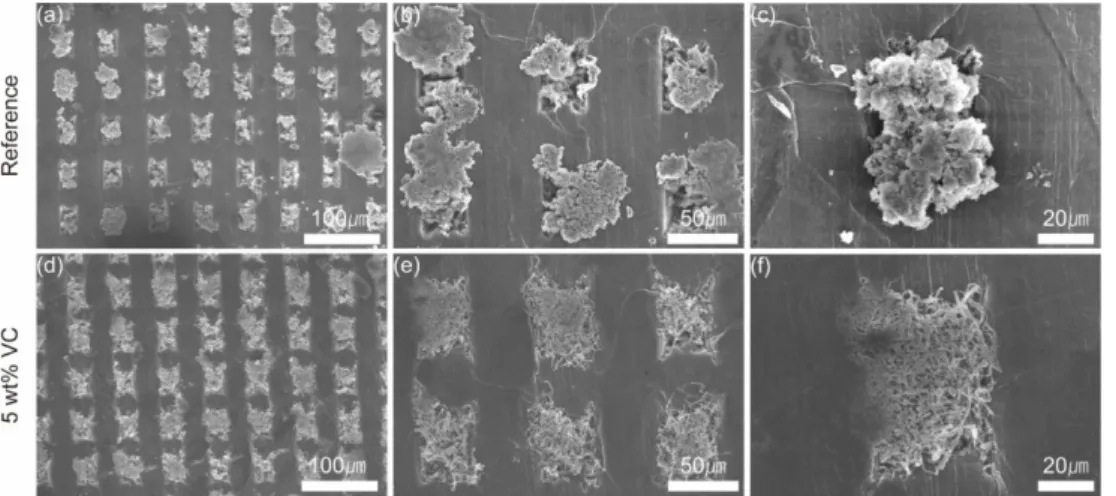
이에 대한 리튬 금속의 덴드라이트 형성 메커니즘 에 대하여 자세히 알아보기 위해 Li/Li Symmetric Cell을 제조한 후 높은 전류밀도(2 mA cm-2, 5min, SOC 10% 수준)로 전류를 인가해 준 이후 리튬 금속 덴드라이트의 몰폴로지를 확인하였다. (Fig. 3) SEM Image 측정 결과, 두 전지 모두 리튬 덴드라이트가 패턴 내부로 증착 되는 것을 확인할 수 있었으나 리 Fig. 1. (a) Optic images and (b, c) 3D mapping image of 2 cm × 2 cm stainless-steel stamp by using digital microscope.
Fig. 2. Potential profiles of Li/Li symmetrical cells during galvanostatic cycling [+0.5 mA cm-2 (30 min) → Rest (10min) → –0.5 mA cm-2 (30 min) → Rest (10min)].
Table 1. HOMO and LUMO energy levels of ethylene carbonate(EC), ethyl methyl carbonate(EMC) and, vinylene carbonate(VC), and their reduction potentials.
Material HOMO (eV)
LUMO (eV)
Reduction potential (V vs. Li/Li+) Ethylene
Carbonate (EC)
-13.3 1.40 0.93
Ethyl methyl Carbonate
(EMC)
-8.25 0.81
Vinylene Carbonate (VC)
-7.2 -0.26 1.06
튬 덴드라이트의 몰폴로지는 다른 것을 확인할 수 있 었다. Fig. 3(a), 3(b), 3(c)를 보면 Reference 전해액 이 적용된 전지의 경우 높은 전류 밀도에서 표면적이 큰 이끼상의 덴드라이트가 성장되었으며 이는 이전의 연구와 같은 경향을 보였다.26) 이러한 형태의 덴드라 이트는 액체전해질을 지속적으로 분해되도록 함으로 써 전지의 열화를 가속화할 수 있기 때문에 전지의 장기적인 수명에서는 악영향을 미칠 수 있다. 이에 반 해, 5 wt% VC가 첨가된 전지의 경우, 패턴내부로 비 교적 치밀한 형태의 리튬 금속 덴드라이트가 성장되 었다 (Fig. 3(d), 3(e), 3(f)).
VC 첨가제 도입에 따른 미세 패턴화된 리튬 금속 음극의 전기화학적 특성을 알아보기 위해 NCM622/
Li 반쪽전지 평가를 진행하였다. Fig. 4는 첨가제 도
입 유무에 따른 전지의 초기 전압 곡선을 나타내고 있다. 초기 충방전효율, 용량이나 전압 곡선의 개형은 첨가제 도입 유무에 의한 유의차 없이 진행되었다. 하 지만, Formation 과정의 충전 개형을 면밀히 살펴보면, 5 wt%의 VC가 도입된 전지의 경우 과전압이 낮게 형 성되었으며 낮은 율속으로 초기 충방전 과정을 진행 하였기 때문에 초기 충방전 효율 및 비용량은 동등 수준임을 확인하였다. (Reference Discharge Capacity
= 172.4 mAh g-1 (88.6%), 5 wt% VC Discharge Capacity = 174.8 mAh g-1 (89.3%)) 이는 첨가제 도입 으로 인해 리튬 금속 덴드라이트의 몰폴로지를 잘 제 어되었기 때문에 초기의 과전압이 낮게 형성되었다.
초기 충방전 단계에서 VC 첨가제 유무에 따른 전 기화학적 특성을 더욱 면밀히 분석하기 위해 초기 사 Fig. 3. SEM images of (a, b, c) Reference, (d, e, f) 5 wt% VC with Micro-Patterned Lithium anode after plating with a current density of 2 mA cm -2.
Fig. 4. Voltage profiles of Li (Ni0.6Co0.2Mn0.2) O2 electrodes (a) without VC and (b) with VC electrolyte additive during precycling.
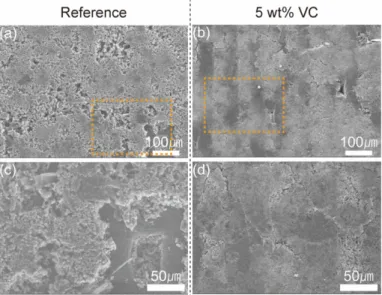
이클 단계 이후 전지를 분해하여 SEM Image(Fig.
5) 및 X-ray 광전자 분광법(XPS) (Fig. 6) 분석을 진 행하였다. Fig. 5(a), 5(c)를 보면, VC 첨가제가 적용 되지 않은 경우, 초기 충방전 단계 동안 패턴 내의 리튬 소모가 크게 진행되었기 때문에 패턴의 모양이 변형되었다. 또한 불안정한 SEI에 의해 패턴 외부로 리튬 금속 덴드라이트가 넘치게 형성되는 것을 확인 하였다. 반면에, 5 wt%의 VC 첨가제가 도입된 전지의 경우 비교적 패턴 내부로만 덴드라이트가 증착 되었 다. 이는 앞선 Fig. 3(d), 3(e), 3(f)와 같은 결과로, VC 첨가제가 도입된 경우 안정하고 저항특성이 낮은 SEI가 형성될 뿐만 아니라 치밀한 덴드라이트가 형성 되었기 때문으로 해석된다.
VC 첨가제 도입에 의한 SEI 개질 효과를 알아보기 위해 미세패턴화된 리튬 금속 표면에 형성된 SEI의 화학적 조성을 XPS를 이용하여 분석하였다. Fig. 6을 보면 VC 첨가제 유무에 따른 미세 패턴화된 리튬 금속 표면의 C1s의 고해상도 XPS 스펙트럼을 나타 냈다. 결합 에너지 기반으로 각 성분을 분석하면 Reference 전해액의 경우, 유기용매인 EC, EMC가 환원됨에 따라 생기는 C-C peak(약 284.6 eV), C-O Peak(약 286.8 eV), Li2CO3 Peak(약 290.0 eV)이 형 성되는 것을 확인하였다. 반면에, VC 첨가제가 도입 된 전지에서는 C-C peak(약 284.6eV)보다는 Poly(VC)의 구성 성분인 C-O Peak(약 286.8eV), C=O Peak(약 289.0 eV) 그리고 Li2CO3 Peak(약 Fig. 5. SEM images of (a, c) Reference and (b, d) 5 wt% VC with Micro-patterned lithium metal electrodes after precycling.
Fig. 6. C 1s XPS spectra of the micro-patterned lithium metal anodes (a) without and (b) with VC after precycling.
290.0eV)의 크기가 증가하였다. 이를 통해 전해액 내 의 리튬 염과 용매가 분해되기 전에 VC가 먼저 환 원되어 리튬 금속 표면에 안정한 SEI를 형성하였다 고 판단할 수 있다. 또한, 이러한 VC 환원 분해 산 물로 인해 전해액의 지속적인 소모와 덴드라이트 형 성을 비교적 잘 억제할 수 있었다.
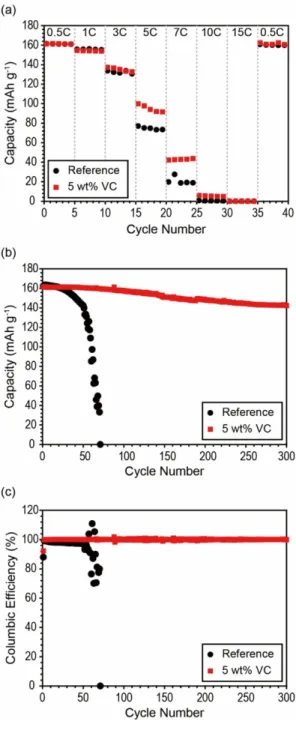
이와 같은 결과를 토대로, 실제 전지 내에서의 VC 첨가제의 효과를 확인하기 위해 NCM622 양극 기반의 반쪽 전지의 전기화학적 평가를 진행하였다. (Fig. 7) 출 력 특성 평가는 충전 율속을 0.5 C (0.797 mA cm-2)로 고정한 후 방전 율속을 증가하면서 진행되었으며 그 결 과, 첨가제가 적용된 전지의 출력특성이 크게 향상되 었다. (Fig. 7(b)) 수명 특성평가는 충 방전 속도를 1C (1.584 mA cm-2) 수준으로 하여 진행되었으며 그 에 대한 결과는 Fig. 7(b)에 나타내었다. 수명 특성 평가 결과, Reference 전지의 경우 약 55회의 충방전 이후 초기용량의 80% 밖에 유지하지 못하였으며, 리 튬 덴드라이트의 성장 및 지속적인 전해질 분해에 의한 전지의 열화 현상이 진행되어 이후 충방전 사 이클에서 급격하게 전지의 비용량이 줄어들었다. 이 러한 급격한 수명특성 저하의 원인은 1 C (1.584 mA cm-2)수준의 높은 전류밀도 조건 및 박막 의 리튬금속 (100µm) 기반에서 전지를 구동하였기 때문이다. 반면에, 5 wt%의 VC가 첨가된 전지는 비 교적 치밀한 덴드라이트의 형성으로 인해 전해질 분 해를 억제되었으며 이로 인해 높은 전류 밀도 하에 서도 300 Cycle 동안 초기용량의 88.3%를 유지하고 있었다. 또한, Reference 전지의 경우 충방전이 진행 될수록 충방전 효율이 감소하는 것에 비해 5 wt%의 VC를 첨가한 전지의 충방전 효율은 100%에 가깝게 유지되었다.
4. 결 론
본 연구에서는 미세 패턴화된 리튬 금속 음극과 VC 전해질 첨가제의 시너지 효과로 인한 리튬 덴드 라이트 성장 억제를 통한 전기화학적 성능향상을 보 고한다. VC 전해질 첨가제 도입으로 인해 형성된 SEI는 poly(VC) 성분이 많이 존재하여 더 낮은 저항 특성을 나타내었다. 그 결과 높은 전류 밀도에서도 리 튬 덴드라이트가 패턴 내로 더 치밀하게 형성되는 것 이 확인하였다. 따라서, 기존의 미세 패턴화된 리튬 금 속 음극보다 낮은 전지 저항과 수명 특성이 약 6배 정도 향상된 결과를 나타내었다. 본 연구는 비교적 쉽 고 간단한 방법을 통해 리튬 금속 음극의 덴드라이트 를 효과적으로 억제하고 전기화학적 성능을 향상시켰 다는 점에서 의미가 있다.
Fig. 7. Electrochemical performance of NCM622/Li cells employing Micro-patterned Lithium metal electrodes with and without VC electrolyte additive (a) Comparison of the discharge capacities of the cells at different discharge rates from 0.5C (0.792 mA cm-2) to 15C (23.76 mA cm-2) while keeping the charge rate constant at 0.5C (0.792 mA cm-2). (b) Cycling performance measured at a rate of 1C (1.584 mA cm-2) between 3.0 V and 4.3 V (vs. Li/Li+) (c) Columbic efficiencies of unit cells relevant to Fig. 7b.
감사의 글
This work was supported by Technology Development Program(S2414576) funded by the Ministry of SMEs and Startups(MSS, Korea) and by the Technology Innovation Program (10067183) of the Korea Institute of Energy Technology Evaluation and Planning (KETEP) funded by the Ministry of Trade, Industry & Energy (MI, Korea).
인용문헌
1. M. Armand and J.-M. Tarascon, Building better batteries, Nature 451, 652, (2008).
2. H. Xiang, P. Shi, P. Bhattacharya, X. Chen, D. Mei, M.
E. Bowden, J. Zheng, J.-G. Zhang and W. J. J. o. P. S.
Xu, Enhanced charging capability of lithium metal batteries based on lithium bis (trifluoromethanesulfonyl) imide-lithium bis (oxalato) borate dual-salt electrolytes, Jornal of Power Sources 318, 170-177, (2016).
3. L. Lu, X. Han, J. Li, J. Hua and M. Ouyang, A review on the key issues for lithium-ion battery management in electric vehicles, Journal of power sources 226, 272-288, (2013).
4. J.-M. Tarascon and M. Armand, in Materials for Sustainable Energy: A Collection of Peer-Reviewed Research and Review Articles from Nature Publishing Group, World Scientific 2011, p. 171-179.
5. Q. Hu, The renaissance of lithium metal: SolidEnergy’s role in the future of lithium batteries, Nature 526, 4-10, (2015).
6. W. Xu, J. Wang, F. Ding, X. Chen, E. Nasybulin, Y.
Zhang and J.-G. Zhang, Lithium metal anodes for rechargeable batteries, Energy Environmental Science 7, 513-537, (2014).
7. D. Lin, Y. Liu and Y. Cui, Reviving the lithium metal anode for high-energy batteries, Nature nanotechnology 12, 194, (2017).
8. X. B. Cheng, R. Zhang, C. Z. Zhao, F. Wei, J. G. Zhang and Q. Zhang, A review of solid electrolyte interphases on lithium metal anode, Advanced Sicence 3, 1500213, (2016).
9. P. Verma, P. Maire and P. Novák, A review of the features and analyses of the solid electrolyte interphase in Li-ion batteries, Electrochimica Acta 55, 6332-6341, (2010).
10. Z. Li, J. Huang, B. Y. Liaw, V. Metzler and J. Zhang, A review of lithium deposition in lithium-ion and lithium metal secondary batteries, Journal of power sources 254, 168-182, (2014).
11. K. N. Wood, E. Kazyak, A. F. Chadwick, K.-H. Chen, J.- G. Zhang, K. Thornton and N. P. Dasgupta, Dendrites and pits: Untangling the complex behavior of lithium
metal anodes through operando video microscopy, ACS central science 2, 790-801, (2016).
12. H. Ota, K. Shima, M. Ue and J.-i. Yamaki, Effect of vinylene carbonate as additive to electrolyte for lithium metal anode, Electrochimica Acta 49, 565-572, (2004).
13. J. Zheng, M. H. Engelhard, D. Mei, S. Jiao, B. J. Polzin, J.-G. Zhang and W. Xu, Electrolyte additive enabled fast charging and stable cycling lithium metal batteries, Nature Energy 2, 17012, (2017).
14. L. Suo, W. Xue, M. Gobet, S. G. Greenbaum, C. Wang, Y. Chen, W. Yang, Y. Li and J. Li, Fluorine-donating electrolytes enable highly reversible 5-V-class Li metal batteries, Proceedings of the National Academy of Sciences 115, 1156-1161, (2018).
15. S. Jiao, X. Ren, R. Cao, M. H. Engelhard, Y. Liu, D. Hu, D. Mei, J. Zheng, W. Zhao and Q. Li, Stable cycling of high-voltage lithium metal batteries in ether electrolytes, Nature Energy 3, 739, (2018).
16. X. B. Cheng, T. Z. Hou, R. Zhang, H. J. Peng, C. Z.
Zhao, J. Q. Huang and Q. Zhang, Dendrite-free lithium deposition induced by uniformly distributed lithium ions for efficient lithium metal batteries, Advanced Materials 28, 2888-2895, (2016).
17. H. Jo, D. Song, Y.-C. Jeong, Y. M. Lee and M.-H. Ryou, Study on dead-Li suppression mechanism of Li-hosting vapor-grown-carbon-nanofiber-based protective layer for Li metal anodes, Journal of power sources 409, 132-138, (2019).
18. H. Lee, J. Song, Y.-J. Kim, J.-K. Park and H.-T. Kim, Structural modulation of lithium metal-electrolyte interface with three-dimensional metallic interlayer for high-performance lithium metal batteries, Scientific reports 6, 30830, (2016).
19. Y. Liu, D. Lin, Z. Liang, J. Zhao, K. Yan and Y. Cui, Lithium-coated polymeric matrix as a minimum volume- change and dendrite-free lithium metal anode, Nature communications 7, 10992, (2016).
20. W. Liu, D. Lin, A. Pei and Y. Cui, Stabilizing lithium metal anodes by uniform Li-ion flux distribution in nanochannel confinement, Journal of the American Chemical Society 138, 15443-15450, (2016).
21. W.-K. Shin, A. G. Kannan and D.-W. Kim, Effective suppression of dendritic lithium growth using an ultrathin coating of nitrogen and sulfur codoped graphene nanosheets on polymer separator for lithium metal batteries, ACS applied materials & interfaces 7, 23700- 23707, (2015).
22. M. H. Ryou, D. J. Lee, J. N. Lee, Y. M. Lee, J. K. Park and J. W. Choi, Excellent cycle life of lithium-metal anodes in lithium-ion batteries with mussel-inspired polydopamine-coated separators, Advanced Energy Materials 2, 645-650, (2012).
23. H. Jeon, S. Y. Jin, W. H. Park, H. Lee, H.-T. Kim, M.-H.
Ryou and Y. M. Lee, Plasma-assisted water-based Al2O3 ceramic coating for polyethylene-based microporous separators for lithium metal secondary batteries,
Electrochimica Acta 212, 649-656, (2016).
24. H. Lee, X. Ren, C. Niu, L. Yu, M. H. Engelhard, I. Cho, M. H. Ryou, H. S. Jin, H. T. Kim and J. Liu, Suppressing lithium dendrite growth by metallic coating on a separator, Advanced Functional Materials 27, 1704391, (2017).
25. W. Luo, L. Zhou, K. Fu, Z. Yang, J. Wan, M. Manno, Y.
Yao, H. Zhu, B. Yang and L. Hu, A thermally conductive separator for stable Li metal anodes, Nano letters 15, 6149-6154, (2015).
26. J. Park, J. Jeong, Y. Lee, M. Oh, M. H. Ryou and Y. M.
Lee, Micro-patterned lithium metal anodes with suppressed dendrite formation for post lithium-ion batteries, Advanced Materials Interfaces 3, 1600140, (2016).
27. S. Kim, J. Park, A. Friesen, H. Lee, Y. M. Lee and M.- H. Ryou, Composite protection layers for dendrite- suppressing non-granular micro-patterned lithium metal anodes, Electrochimica Acta 282, 343-350, (2018).
28. J. Heine, S. Krüger, C. Hartnig, U. Wietelmann, M.
Winter and P. Bieker, Coated Lithium Powder (CLiP) Electrodes for Lithium-Metal Batteries, Advanced Energy Materials 4, 1300815, (2014).
29. M. H. Ryou, Y. M. Lee, Y. Lee, M. Winter and P. Bieker, Mechanical surface modification of lithium metal:
towards improved Li metal anode performance by directed Li plating, Advanced Energy Materials 25, 834- 841, (2015).
30. D. Jin, J. Oh, A. Friesen, K. Kim, T. Jo, Y. M. Lee and M.-H. Ryou, Self-Healing Wide and Thin Li Metal Anodes Prepared Using Calendared Li Metal Powder for Improving Cycle Life and Rate Capability, ACS applied materials & interfaces 10, 16521-16530, (2018).
31. J. Park, D. Kim, D. Jin, C. Phatak, K. Y. Cho, Y.-G. Lee, S. Hong, M.-H. Ryou and Y. M. Lee, Size effects of micro-pattern on lithium metal surface on the electrochemical performance of lithium metal secondary batteries, Journal of power sources 408, 136-142, (2018).
32. Y. J. Kim, H. S. Jin, D. H. Lee, J. Choi, W. Jo, H. Noh, J. Lee, H. Chu, H. Kwack and F. Ye, Guided Lithium Deposition by Surface Micro-Patterning of Lithium- Metal Electrodes, ChemElectroChem 5, 3169-3175, (2018).
33. K. N. Wood, M. Noked and N. P. Dasgupta, Lithium metal anodes: toward an improved understanding of coupled morphological, electrochemical, and mechanical behavior, ACS Energy Letters 2, 664-672, (2017).
34. W. Li, H. Zheng, G. Chu, F. Luo, J. Zheng, D. Xiao, X.
Li, L. Gu, H. Li and X. Wei, Effect of electrochemical dissolution and deposition order on lithium dendrite formation: a top view investigation, Faraday discussions 176, 109-124, (2015).
35. K. Abe, H. Yoshitake, T. Kitakura, T. Hattori, H. Wang and M. Yoshio, Additives-containing functional electrolytes for suppressing electrolyte decomposition in lithium-ion batteries, Electrochimica Acta 49, 4613-4622,
(2004).
36. J. Guo, Z. Wen, M. Wu, J. Jin and Y. J. E. C. Liu, Vinylene carbonate–LiNO3: A hybrid additive in carbonic ester electrolytes for SEI modification on Li metal anode, Electrochemistry Communications 51, 59- 63, (2015).
37. X.-G. Sun and S. Dai, Electrochemical investigations of ionic liquids with vinylene carbonate for applications in rechargeable lithium ion batteries, Electrochimica Acta 55, 4618-4626, (2010).
38. I. A. Profatilova, C. Stock, A. Schmitz, S. Passerini and M. Winter, Enhanced thermal stability of a lithiated nano-silicon electrode by fluoroethylene carbonate and vinylene carbonate, Journal of power sources 222, 140- 149, (2013).
39. D. Xiong, J. Burns, A. Smith, N. Sinha and J. Dahn, A high precision study of the effect of vinylene carbonate (VC) additive in Li/graphite cells, Journal of The Electrochemical Society 158, A1431-A1435, (2011).
40. X. Q. Zhang, X. B. Cheng, X. Chen, C. Yan and Q.
Zhang, Fluoroethylene carbonate additives to render uniform Li deposits in lithium metal batteries, Advanced Functional Materials 27, 1605989, (2017).
41. M.-H. Ryou, G.-B. Han, Y. M. Lee, J.-N. Lee, D. J. Lee, Y. O. Yoon and J.-K. Park, Effect of fluoroethylene carbonate on high temperature capacity retention of LiMn2O4/graphite Li-ion cells, Electrochimica Acta 55, 2073-2077, (2010).
42. J. Heine, P. Hilbig, X. Qi, P. Niehoff, M. Winter and P.
Bieker, Fluoroethylene carbonate as electrolyte additive in tetraethylene glycol dimethyl ether based electrolytes for application in lithium ion and lithium metal batteries, Journal of The Electrochemical Society 162, A1094- A1101, (2015).
43. J.-H. Song, J.-T. Yeon, J.-Y. Jang, J.-G. Han, S.-M. Lee and N.-S. Choi, Effect of fluoroethylene carbonate on electrochemical performances of lithium electrodes and lithium-sulfur batteries, Journal of The Electrochemical Society 160, A873-A881, (2013).
44. E. Markevich, G. Salitra, F. Chesneau, M. Schmidt and D. Aurbach, Very stable lithium metal stripping–plating at a high rate and high areal capacity in fluoroethylene carbonate-based organic electrolyte solution, ACS Energy Letters 2, 1321-1326, (2017).
45. G.-B. Han, J.-N. Lee, D. J. Lee, H. Lee, J. Song, H. Lee, M.-H. Ryou, J.-K. Park and Y. M. Lee, Enhanced cycling performance of lithium metal secondary batteries with succinic anhydride as an electrolyte additive, Electrochimica Acta 115, 525-530, (2014).
46. M.-H. Ryou, J.-N. Lee, D. J. Lee, W.-K. Kim, J. W.
Choi, J.-K. Park and Y. M. Lee, 2-(triphenylpho- sphoranylidene) succinic anhydride as a new electrolyte additive to improve high temperature cycle performance of LiMn2O4/graphite Li-ion batteries, Electrochimica Acta 102, 97-103, (2013).
47. Y. Li, G. Xu, Y. Yao, L. Xue, S. Zhang, Y. Lu, O.
Toprakci and X. Zhang, Improvement of cyclability of silicon-containing carbon nanofiber anodes for lithium- ion batteries by employing succinic anhydride as an electrolyte additive, Journal of Solid State Electrochemistry 17, 1393-1399, (2013).
48. J. Jeong, J.-N. Lee, J.-K. Park, M.-H. Ryou and Y. M.
Lee, Stabilizing effect of 2-(triphenylphosphoranylidene) succinic anhydride as electrolyte additive on the lithium metal of lithium metal secondary batteries, Electrochimica Acta 170, 353-359, (2015).
49. L. El Ouatani, R. Dedryvere, C. Siret, P. Biensan, S.
Reynaud, P. Iratçabal and D. Gonbeau, The effect of vinylene carbonate additive on surface film formation on both electrodes in Li-ion batteries, Journal of The Electrochemical Society 156, A103-A113, (2009).
50. Y. Wang, S. Nakamura, K. Tasaki and P. B. Balbuena, Theoretical studies to understand surface chemistry on carbon anodes for lithium-ion batteries: how does vinylene carbonate play its role as an electrolyte additive?, Journal of the American Chemical Society 124, 4408-4421, (2002).
51. C. C. Nguyen and B. L. Lucht, Comparative study of
fluoroethylene carbonate and vinylene carbonate for silicon anodes in lithium ion batteries, Chemistry of Materials 161, A1933-A1938, (2014).
52. F. A. Soto, Y. Ma, J. M. Martinez de la Hoz, J. M.
Seminario and P. B. Balbuena, Formation and growth mechanisms of solid-electrolyte interphase layers in rechargeable batteries, Chemistry of Materials 27, 7990- 8000, (2015).
53. A. L. Michan, B. S. Parimalam, M. Leskes, R. N.
Kerber, T. Yoon, C. P. Grey and B. L. Lucht, Fluoroethylene carbonate and vinylene carbonate reduction: understanding lithium-ion battery electrolyte additives and solid electrolyte interphase formation, Chemistry of Materials 28, 8149-8159, (2016).
54. X. Zhang, R. Kostecki, T. J. Richardson, J. K. Pugh and P. N. Ross, Electrochemical and infrared studies of the reduction of organic carbonates, Journal of The Electrochemical Society 148, A1341-A1345, (2001).
55. Y.-K. Han, Y. Moon, K. Lee and Y. S. Huh, Computational screening of lactam molecules as solid electrolyte interphase forming additives in lithium-ion batteries, Current Applied Physics 14, 897-900, (2014).
![Fig. 2. Potential profiles of Li/Li symmetrical cells during galvanostatic cycling [+0.5 mA cm -2 (30 min) → Rest (10min) → –0.5 mA cm -2 (30 min) → Rest (10min)].](https://thumb-ap.123doks.com/thumbv2/123dokinfo/4949444.541509/4.892.233.660.211.562/potential-profiles-symmetrical-cells-galvanostatic-cycling-rest-rest.webp)