Relationships among Knowledge, Self-efficacy, and Health Behavior of Osteoporosis and Fall Prevention in Old Aged Women
Ahn, Sukhee · Oh, Jiwon
College of Nursing, Chungnam National University, Daejeon, Korea
Purpose: This study was conducted among older women to (1) identify their levels of knowledge, self-efficacy, and health behavior in dealing with osteoporosis and falls and (2) explore the relationships between the study variables based on a health-beliefs model. Methods: With a cross-sectional survey design, we recruited 94 older women of ages from 65 to 74 at a community setting via convenience sampling. The study participants completed two sets of structured questionnaires (on osteoporosis and fall prevention). Results: The general characteristics of the study participants demonstrated that the women were at high risk for osteoporosis and falls. Overall, the levels of knowledge about osteoporosis and falls, their self-efficacy, and their preventive behaviors were average or slightly above. The relationships between the study variables showed that self-efficacy and healthy behavior, such as doing osteoporosis exercise, eating an osteoporosis diet, and avoiding falls, were related (r=38, p<.001; r=.33, p<.05; r=.26, p<.05).
In addition, there were statistically significant relationships between osteoporosis and fall prevention knowledge (r=.37~.46, p<.001), self-efficacy (r=.50~.53, p<.001), and preventive behaviors (r=.50, p<.001). Conclusion: The women’s scores on osteoporosis and fall knowledge, self-efficacy, and preventive behaviors suggest an urgent need for the implementation of educational programs for older women. A close relationship between self-efficacy and health behaviors implies a need for transformation of a traditional one-way lecture form.
Key Words: Osteoporosis, Falls, Aged, Women, Health behavior, Self-efficacy
Corresponding author: Oh, Jiwon
College of Nursing, Chungnam National University, 266 Munhwa-ro, Jung-gu, Daejeon 35015, Korea.
Tel: +82-42-580-8321, Fax: +82-42-580-8309, E-mail: [email protected]
- This work was supported by the National Research Foundation of Korea (NRF) grant funded by the Korean government (Ministry of Education)(NRF No. 2010-0023125).
Received: Apr 25, 2018 / Revised: May 25, 2018 / Accepted: May 28, 2018
This is an open access article distributed under the terms of the Creative Commons Attribution Non-Commercial License (http://creativecommons.org/licenses/
by-nc/3.0), which permits unrestricted non-commercial use, distribution, and reproduction in any medium, provided the original work is properly cited.
INTRODUCTION
Osteoporosis is a prevalent metabolic disease world- wide, primarily affecting the postmenopausal women as their estrogen level decreases [1]. Estrogen is a significant factor regulating bone mineral density, and the deficient amount leads to weakening of the bone [1]. Because bone loss occurs asymptomatically, women may not know they have osteoporosis until they experience sudden collapse in their bones [2]. According to the International Osteoporosis Foundation (IOF)[3], three in four women older than age 65 face osteoporotic fractures. Bone fractures can be dis- tressing to many as reduced range of motion and de- creased quality of life may occur [4]. For an elderly pop- ulation, limitation of body movements can cause death
which makes morbidity and mortality as the secondary substantial complication to osteoporosis [1]. In addition, osteoporotic fracture treatment usually requires longer hospital stays than any other common chronic illnesses and frequent re-hospitalizations occur [5]. The lengthy stay in hospitals makes osteoporosis a costly disorder. To reduce the cost and incidence rates, osteoporosis and os- teoporotic fracture prevention are essential.
A myriad of strategies to prevent low bone mass and its complications have been attempted [6-8]. One of the cost- effective ways to prevent osteoporosis is modifying one’s lifestyle [9]. Examples of lifestyle adjustments include per- forming regular weight-bearing exercises, taking adequate calcium supplements, and having routine osteoporosis screening tests [9]. Most programs created to promote os-
teoporosis prevention predominantly encourage partic- ipants to practice healthy lifestyle. Another common pro- gram to prevent osteoporotic fracture is designed to in- hibit falls [10]. One in every four adults older than 65 expe- rience falls each year, which place them at a high risk of bone fractures [11]. Fall prevention is important as bone fractures can be avoided. Some effective strategies to pre- vent falls include exercising, wearing non-slippery shoes, or modifying home hazards such as removing loose floor mats or brightening dimmed lights [12]. Fall prevention approaches, similar to osteoporosis prevention methods, involve one’s daily habitual changes.
To promote effective lifestyle modifications, prior stud- ies on osteoporosis and fall prevention programs utilized health belief model (HBM) as a framework. HBM was originally developed in an attempt to explain one’s per- formance of health preventive behaviors [13]. This theo- retical model demonstrates the modifying factors (age, sex, ethnicity, socioeconomic status, personality, or know- ledge level) influence one’s perception of seriousness, sus- ceptibility, benefits, barriers, and self-efficacy which even- tually, in combination with cues to actions, shape one’s health behaviors. For instance, Austin et al.[14] explained cues to actions (healthcare workers recommendations, bro- chures, or media), perceived barriers (fear, shame, or re- stricted English proficiency), and perceived susceptibility (low awareness of the needs of cancer screening) influ- enced the breast and cervical cancer screening behaviors of Hispanic women. In another study, Chen et al.[15] iden- tified the HBM factors such as age, occupation, location of areas, child medical histories, perceived susceptibility of the child to influenza, perceived benefits/barriers of vac- cination, and cues to action impacted the caregivers’ deci- sion making behaviors concerning their children’s flu vaccination. Osteoporosis and fall prevention behaviors were also examined using the health belief model. For ex- ample, the researchers applied HBM as a conceptual frame- work to examine the bone health behavior factors and to predict the osteoporosis prevention behaviors [16]. In ad- dition, another study reported the implementation and evaluation of osteoporosis prevention educational pro- grams which were developed based on a health belief model [17]. Other than osteoporosis prevention behaviors, Jang & Ahn [18] developed a valid predictive model of fall prevention behaviors using HBM constructs to manage osteoporotic fracture incidences among postmenopausal women. An HBM-based fall prevention educational pro- gram was also developed and implemented to hospital in- patients which effectively reduced the rates of falls [19].
Despite various studies have demonstrated the benefits
of both osteoporosis and fall prevention programs apply- ing HBM constructs, few studies have effectively resear- ched on the association between the two programs. Con- sidering substantial portion of osteoporosis and osteopor- otic fracture events can be reduced either by practicing os- teoporosis or fall preventive behaviors, examining the re- lationship of osteoporosis and falls is meaningful. As re- cent studies suggested the effectiveness of the use of HBM model in facilitating healthy behaviors, the association of knowledge, self-efficacy, and health behavior was identi- fied to provide a baseline information for designing the prevention program in the future. The purpose of this study was to 1) examine the levels of knowledge, self-effi- cacy, and preventive health behavior of osteoporosis and fall prevention and to 2) explore the relationships among the study variables in old aged women.
METHODS
1. Design and SubjectsThis was a secondary data analysis from the interven- tion study [20]. With a cross-sectional survey design, we recruited old aged women via convenience sampling who met the following inclusion criteria: (1) Women aging from 65 to 74 years old; (2) residing in the community settings;
and (3) being able to perform activities of daily living. Any women who had underlying comorbidities or disorders that may reduce bone density and increase bone fracture susceptibility were excluded. The minimum sample size was estimated to a total of 84 participants using an ⍺ of .05, a power value of .80, and an effect size of r=.30. A total of 94 participants were recruited.
2. Measurements
Women who agreed to participate completed 2 sets of self-report structured questionnaires. The questionnaire included a total of 76 items measuring the participants’
knowledge, self-efficacy, and health behavior level on os- teoporosis and fall prevention. All research tools used in this study were authorized by the tool developers, and any original survey tools written in non-Korean were replaced with Korean versions that were previously utilized in Ko- rean research studies. Reliability and validity of all study instruments were established.
1) Osteoporosis prevention: Knowledge, self-efficacy, health behavior
The instrument developed by Kim et al.[21] was used to
measure the level of osteoporosis prevention knowledge.
This tool consists a total of 24 questionnaires including 9 items on osteoporosis risk factors, 7 items on exercises, and 8 items on calcium supplements in diet. Responses on each item were scored as correct or incorrect. The level of osteoporosis prevention knowledge is measured into two subscales which are exercise and diet. The total possible score for osteoporosis exercise knowledge ranges from 0 to 16 combining the scores obtained from 9 items on osteo- porosis risk factors and 7 items on exercises. The diet know- ledge score ranges from 0 to 17 which is calculated by add- ing the 9 items on osteoporosis risk factors and the remain- ing 8 items on calcium supplements. The higher score in- dicates higher level of knowledge on osteoporosis preven- tion. The tool reliability was confirmed by a Cronbach’s ⍺ of .50 for exercise subscale and .51 for diet subscale.
The osteoporosis prevention self-efficacy was measured using the tool developed by Horan et al [22]. The self-effi- cacy is also classified into exercise and diet subgroups. This tool uses a 5-point Likert scale, with a higher score demon- strating a higher level of self-efficacy. The tool includes a total of 12 questionnaires with 6 items on exercises (score range: 6 to 30) and 6 items on calcium supplements in diet (score range: 6 to 30). The tool reliability was confirmed by a Cronbach’s ⍺ of .94 for exercise subscale and .93 for diet subscale.
The level of osteoporosis prevention health behaviors was evaluated by a tool utilized by Lee [23]. This instru- ment has a total of 18 questionnaires scored on a 4-point Likert scale, with 7 items on exercises, 8 items on calcium supplements in diet, and 3 items on routine follow-ups.
The score of osteoporosis prevention health behaviors ranges from 18 to 72 with higher score indicating higher level of performing preventive behaviors for bone health.
The tool reliability was confirmed by a Cronbach’s ⍺ of .87.
2) Fall prevention: Knowledge, self-efficacy, health behavior The level of fall prevention knowledge and self-efficacy was screened by the instrument developed by Jang & Ahn [18]. The tool for fall prevention knowledge includes a to- tal of 8 items with a score ranging from 0 to 8. Responses on the scale were scored as correct or incorrect. The tool re- liability was confirmed by a Cronbach’s ⍺ of .81. The tool for fall prevention self-efficacy consists of 6 questionnaires scored on a 5-point Likert scale. The score for self-efficacy ranges from 6 to 30. The tool reliability was confirmed by a Cronbach’s ⍺ of .88. The level of fall prevention health be- haviors was evaluated with a questionnaire used by Moon
& Lee [24]. The evaluation tool includes 8 items with a score ranging from 8 to 32. The tool uses a 4-point Likert
scale for scoring the points. The tool reliability was con- firmed by a Cronbach’s ⍺ of .81. The higher score indi- cates a higher level of measured study variables for all tools related to fall prevention.
3. Data collection
Prior to conducting the original study, ethical approval was obtained from the Institutional Review Board (IRB, 2013-48) of College of Nursing at C University, Korea. A research assistant asked women to participate into the study through one-to-one interview at an elderly com- munity center. The women who complied with the inclu- sion criteria received research information such as study purpose, risks, benefits, and confidentiality of their private information. For those who agreed to participate in the study signed the informed consent form and received small gifts.
4. Data Analysis
Statistical Package for the Social Sciences (SPSS) WIN 22.0 was utilized for the statistical data analysis. The level of major study variables and the participants’ demogra- phic characteristics were evaluated using descriptive sta- tistics. For a detailed analysis of the level of study varia- bles based on the participants’ history with BMD test, os- teoporosis, and degenerative arthritis, an independent t test was also used. The relationships between the study variables were measured using Pearson correlations.
RESULTS
1. Demographic Characteristics of the Study Parti- cipants
The mean age of the participants was 71.2±3.64. More than half of the women had no spouse (54.3%), had middle school graduate degree or less (60.2%), and most of them lived with their families (69.9%). For their general health information, 82.4% of them had at least one chronic dis- ease and the most prevalent disease was hypertension.
Most women (87.2%) took a bone mineral density test, 26.6
% of the women were diagnosed with osteoporosis and 12.8% had a history of falling (Table 1).
2. Levels of Knowledge, Self-efficacy, and Health Behavior of Osteoporosis and Falls
Overall, the levels of knowledge, self-efficacy, and pre-
Table 1. General Characteristics of Study Participants (N=94) Characteristics Categories n (%) or M±SD
Age (year) 71.2±3.64
Partners No
Yes
51 (54.3) 43 (45.7) Educational
level
Middle school or below Over middle school
53 (60.2) 35 (39.8) Living with Alone
Family
28 (30.1) 65 (69.9) History of
BMD test
No Yes
12 (12.8) 82 (87.2) History of
osteoporosis No Yes
69 (73.4) 25 (26.6) Comorbidities No
Yes
Types of comorbidities Rheumatoid arthritis Hypertension Cardiac diseases Diabetes mellitus Degenerative arthritis Thyroid diseases Others
16 (17.6) 75 (82.4) 3 (2.4) 49 (39.5)
8 (6.5) 22 (17.7) 24 (19.4) 4 (3.2) 14 (11.3) History of falls No
Yes
82 (87.2) 12 (12.8)
Table 2. Levels of Knowledge, Self-efficacy, and Preventive Health Behavior on Osteoporosis and Falls (N=94)
Variables Categories M±SD Min Max
Knowledge Osteoporosis Exercise (0~16)
Diet (0~17)
9.29±2.31 8.48±2.50
4 3
14 13
Fall (0~8) 6.81±1.87 0 8
Self-efficacy Osteoporosis Exercise (6~30)
Diet (6~30)
19.72±4.56 20.11±4.27
6 11
30 30
Fall (6~30) 23.18±2.90 12 30
Preventive health behavior Osteoporosis (18~72) 47.36±10.49 22 72
Fall (8~32) 24.08±5.21 8 32
Min=minimum score reported; Max=maximum score reported.
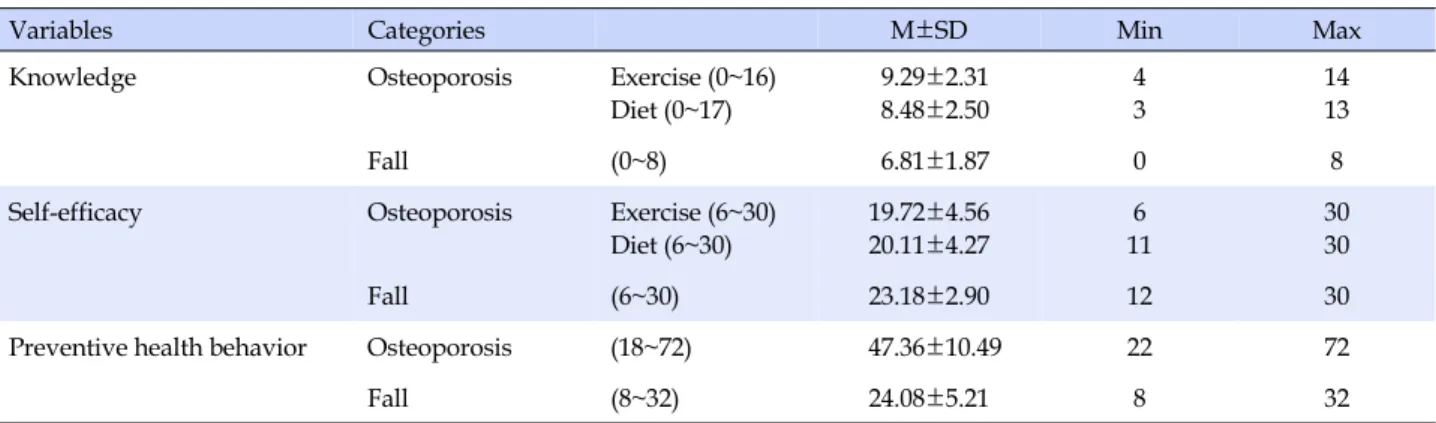
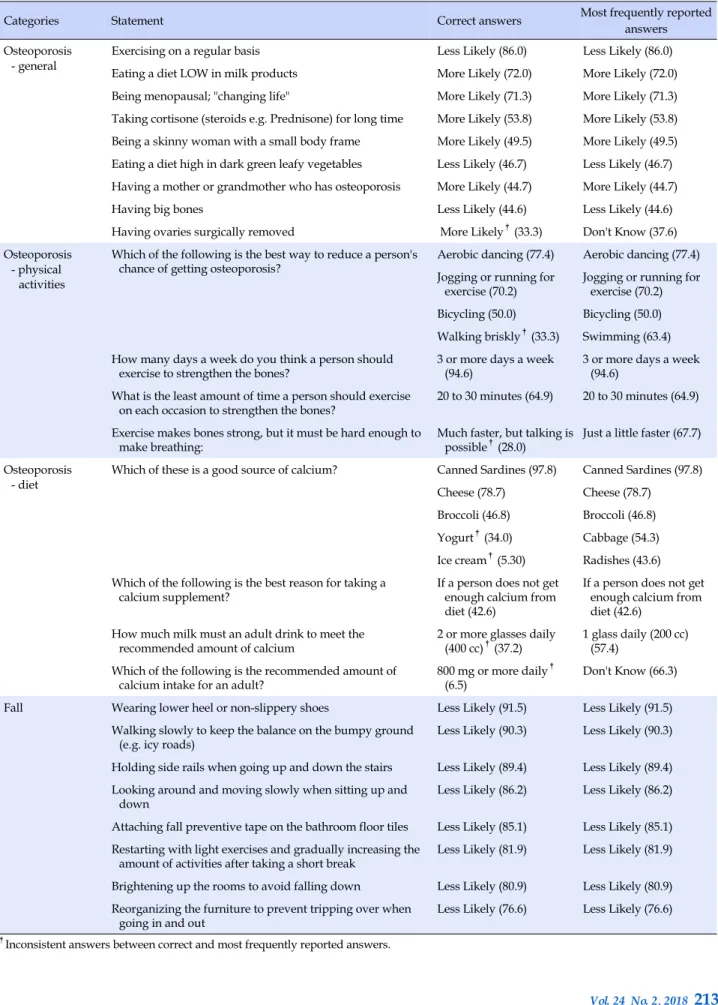
ventive behaviors for osteoporosis and falls were consid- ered inadequate. The mean of osteoporosis knowledge level on exercise was 9.29±2.31, and diet was 8.48±2.50 (Table 2). Although the women had general knowledge on osteoporosis and fall prevention, 37.6% of the women did not know whether having oophorectomy would cause os- teoporosis. Also, many women had incorrect knowledge of the types of exercises or foods they needed to consume to prevent osteoporosis. For example, 63.4% of the women
answered swimming was better in preventing osteopo- rosis than brisk walking (33.3%) and almost half of the women reported cabbage (54.3%) and radishes (43.6%) were rich in calcium whereas the correct answers were yo- gurt (34.0%) and ice cream (5.3%) instead. In addition, most participants had incorrect knowledge on the amount of ex- ercise or calcium intake they needed to consume per day (Table 3). The mean of osteoporosis self-efficacy level on ex- ercise was 19.72±4.56, and diet was 20.11±4.27. The mean of performance level of osteoporosis preventive behavior was 47.36±10.49. The levels of fall prevention knowledge, fall prevention self-efficacy, and fall prevention health behav- iors were 6.81±1.87, 23.18±2.90, and 24.08±5.21 (Table 2).
3. Differences of Knowledge, Self-efficacy, and Health Behavior Levels of Osteoporosis and Falls
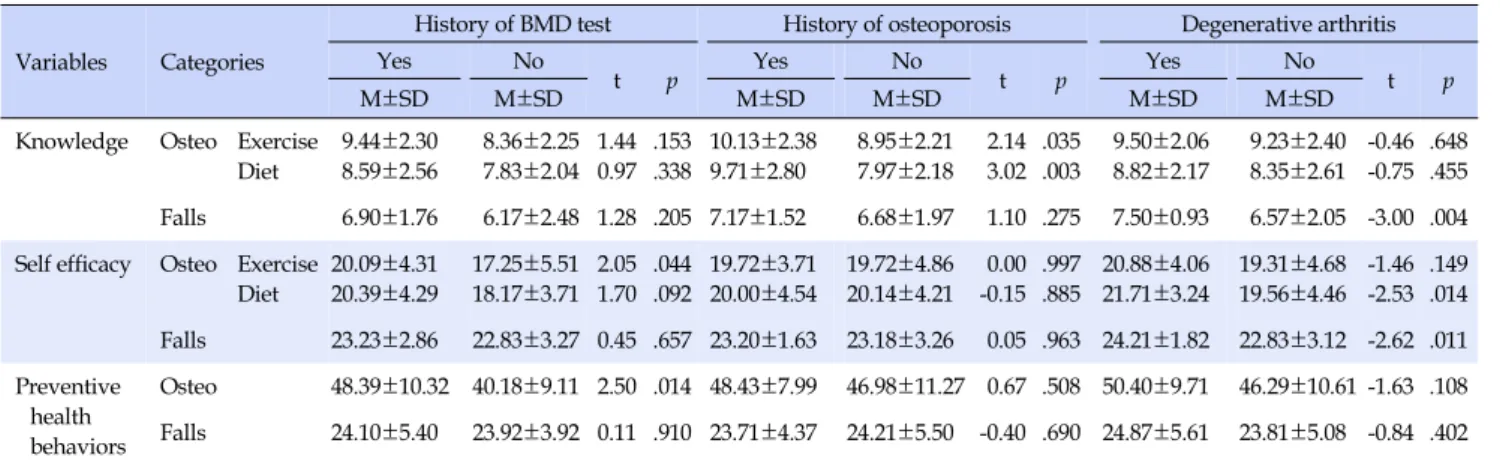
The statistically significant differences on the levels of study variables were identified based on the participants’
history of bone mineral density (BMD) test, osteoporosis, and degenerative arthritis. The results showed a higher level of self-efficacy on exercise among women who have previously taken the bone mineral density test had com- pared to those who have not (t=2.05, p=.044). The perform- ance of preventive behavior level was statistically higher among the participants who had an experience with bone mineral density test than those without the experience (t=2.50, p=.014). The level of exercise and diet knowledge of osteoporosis was also greater among the women who were diagnosed with osteoporosis (t=2.14, p=.035; t=3.02, p=.003). In addition, the women with underlying degener- ative arthritis had higher mean knowledge scores on falls (t=-3.00, p=.004) and elevated self-efficacy level on osteo- porosis diet and falls (t=-2.53, p=.014; t=-2.62, p=.011) (Table 4).
Table 3. Frequencies of Reported Answers on Osteoporosis and Fall Knowledge (N=94)
Categories Statement Correct answers Most frequently reported
answers Osteoporosis
- general
Exercising on a regular basis Less Likely (86.0) Less Likely (86.0)
Eating a diet LOW in milk products More Likely (72.0) More Likely (72.0) Being menopausal; "changing life" More Likely (71.3) More Likely (71.3) Taking cortisone (steroids e.g. Prednisone) for long time More Likely (53.8) More Likely (53.8) Being a skinny woman with a small body frame More Likely (49.5) More Likely (49.5) Eating a diet high in dark green leafy vegetables Less Likely (46.7) Less Likely (46.7) Having a mother or grandmother who has osteoporosis More Likely (44.7) More Likely (44.7)
Having big bones Less Likely (44.6) Less Likely (44.6)
Having ovaries surgically removed More Likely†(33.3) Don't Know (37.6) Osteoporosis
- physical activities
Which of the following is the best way to reduce a person's
chance of getting osteoporosis? Aerobic dancing (77.4) Aerobic dancing (77.4) Jogging or running for
exercise (70.2) Jogging or running for exercise (70.2) Bicycling (50.0) Bicycling (50.0) Walking briskly†(33.3) Swimming (63.4) How many days a week do you think a person should
exercise to strengthen the bones? 3 or more days a week
(94.6) 3 or more days a week
(94.6) What is the least amount of time a person should exercise
on each occasion to strengthen the bones? 20 to 30 minutes (64.9) 20 to 30 minutes (64.9) Exercise makes bones strong, but it must be hard enough to
make breathing: Much faster, but talking is
possible†(28.0) Just a little faster (67.7) Osteoporosis
- diet
Which of these is a good source of calcium? Canned Sardines (97.8) Canned Sardines (97.8) Cheese (78.7) Cheese (78.7)
Broccoli (46.8) Broccoli (46.8) Yogurt†(34.0) Cabbage (54.3) Ice cream†(5.30) Radishes (43.6) Which of the following is the best reason for taking a
calcium supplement? If a person does not get
enough calcium from diet (42.6)
If a person does not get enough calcium from diet (42.6)
How much milk must an adult drink to meet the
recommended amount of calcium 2 or more glasses daily
(400 cc)†(37.2) 1 glass daily (200 cc) (57.4)
Which of the following is the recommended amount of
calcium intake for an adult? 800 mg or more daily†
(6.5) Don't Know (66.3)
Fall
Wearing lower heel or non-slippery shoes Less Likely (91.5) Less Likely (91.5) Walking slowly to keep the balance on the bumpy ground
(e.g. icy roads) Less Likely (90.3) Less Likely (90.3)
Holding side rails when going up and down the stairs Less Likely (89.4) Less Likely (89.4) Looking around and moving slowly when sitting up and
down Less Likely (86.2) Less Likely (86.2)
Attaching fall preventive tape on the bathroom floor tiles Less Likely (85.1) Less Likely (85.1) Restarting with light exercises and gradually increasing the
amount of activities after taking a short break Less Likely (81.9) Less Likely (81.9) Brightening up the rooms to avoid falling down Less Likely (80.9) Less Likely (80.9) Reorganizing the furniture to prevent tripping over when
going in and out Less Likely (76.6) Less Likely (76.6)
†Inconsistent answers between correct and most frequently reported answers.
Table 4. Differences on the Levels of Study Variables (N=94) Variables Categories
History of BMD test History of osteoporosis Degenerative arthritis
Yes No
t p Yes No
t p Yes No
t p
M±SD M±SD M±SD M±SD M±SD M±SD
Knowledge Osteo Exercise Diet
9.44±2.30 8.59±2.56
8.36±2.25 7.83±2.04
1.44 0.97
.153 .338
10.13±2.38 9.71±2.80
8.95±2.21 7.97±2.18
2.14 3.02
.035 .003
9.50±2.06 8.82±2.17
9.23±2.40 8.35±2.61
-0.46 -0.75
.648 .455 Falls 6.90±1.76 6.17±2.48 1.28 .205 7.17±1.52 6.68±1.97 1.10 .275 7.50±0.93 6.57±2.05 -3.00 .004 Self efficacy Osteo Exercise
Diet
20.09±4.31 20.39±4.29
17.25±5.51 18.17±3.71
2.05 1.70
.044 .092
19.72±3.71 20.00±4.54
19.72±4.86 20.14±4.21
0.00 -0.15
.997 .885
20.88±4.06 21.71±3.24
19.31±4.68 19.56±4.46
-1.46 -2.53
.149 .014 Falls 23.23±2.86 22.83±3.27 0.45 .657 23.20±1.63 23.18±3.26 0.05 .963 24.21±1.82 22.83±3.12 -2.62 .011 Preventive
health behaviors
Osteo 48.39±10.32 40.18±9.11 2.50 .014 48.43±7.99 46.98±11.27 0.67 .508 50.40±9.71 46.29±10.61 -1.63 .108 Falls 24.10±5.40 23.92±3.92 0.11 .910 23.71±4.37 24.21±5.50 -0.40 .690 24.87±5.61 23.81±5.08 -0.84 .402 Osteo=osteoporosis; BMD=bone mineral density.
Table 5. Relationships between Major Study Variables
Variables
Knowledge (Osteo- exercise)
Knowledge (Osteo-
diet)
Knowledge (Falls)
Self-efficacy (Osteo- exercise)
Self-efficacy (Osteo-
diet)
Self-efficacy (Falls)
Preventive behaviors
(Osteo)
r (p) r (p) r (p) r (p) r (p) r (p) r (p)
Knowledge
(Osteo-diet) .79
(<.001)
Knowledge (Falls) .46
(<.001) .37
(.001) Self-efficacy
(Osteo-exercise) .24
(.032) -.02
(.865) .01
(.913) Self-efficacy
(Osteo-diet) .18
(.114) .05
(.638) .13
(.210) .65
(<.001)
Self-efficacy (Falls) .28
(.013) .04
(.714) .18
(.083) .53
(<.001) .50
(<.001) Preventive
Behaviors (Osteo) .17
(.147) .08
(.497) .07
(.486) .38
(<.001) .33
(.002) .28
(.010) Preventive
behaviors (Falls) .14
(.227) .10
(.361) .03
(.796) -.01
(.904) .14
(.190) .26
(.012) .50
(<.001) Osteo=osteoporosis.
4. Relationships among Knowledge, Self-efficacy, and Health Behavior of Osteoporosis and Falls The relationships among study variables were also ex- amined. Higher osteoporosis knowledge level for exercise was associated with higher osteoporosis self-efficacy level for exercise (r=.24, p<.05), and the osteoporosis self-effi- cacy level for exercise was related with higher perform- ance level for osteoporosis preventive behaviors (r=.38, p<.001). For fall prevention, greater fall self-efficacy level was related to performing better preventive behaviors for fall prevention (r=.26, p<.05). Furthermore, there were sig- nificant correlations between knowledge level of osteopo- rosis and fall prevention (r=.37~.46, p<.001), between self-
efficacy of osteoporosis and fall (r=.50~.53, p<.001), and between preventive behaviors for osteoporosis and falls (r=.50, p<.001)(Table 5).
DISCUSSION
This study was conducted to identify the levels and relationships of osteoporosis and fall prevention know- ledge, self-efficacy, and health behaviors among old aged women. The reason for choosing to focus on the three ele- ments (knowledge, self-efficacy, and health behaviors) over other study variables within the health belief model was based on the authors belief that healthcare providers could easily intervene one’s knowledge compared to other
modifying factors (e.g. age, sex, ethnicity, socioeconomic status, personality) and that self-efficacy was the most sig- nificant factor that induced one’s behavior. The average scores of study variables revealed a need for improve- ments of the women’s knowledge, self-efficacy, and health behaviors related to osteoporosis and fall prevention. Other key findings were similar level of preventive behavior per- formances between women with and without osteoporosis history although women with previous diagnosis had higher knowledge. The correlation analysis revealed stat- istically significant relationships between self-efficacy and preventive behaviors. However, there were no direct asso- ciations between knowledge and preventive behaviors.
Another noteworthy relationship finding was positive lin- ear correlations between osteoporosis and fall prevention of all study variables.
1. Levels of Knowledge, Self-efficacy, and Health Behaviors of Osteoporosis and Falls
The mean scores of study variables showed the partici- pants had insufficient level of bone health knowledge, self-efficacy, and preventive behaviors. This result was con- sistent with previous studies conducted worldwide which have also reported low levels of knowledge [25-28], self-ef- ficacy [25,26], and preventive behaviors [25,28]. Consider- ing the results from the previous studies and no complete scores both on bone health exercise and diet knowledge within this study participants suggest higher demands in facilitating the old women’s osteoporosis knowledge.
The reported frequencies of answers on general osteo- porosis knowledge implied most women were aware of prevention of bone loss through regular exercises and milk products. However, more than half of the participants did not know consuming dark green leafy vegetables impro- ved their bone health. This result was inconsistent with a study by Oh et al. [25] which majority of the middle aged women answered spinach, kale, and broccoli contained much calcium. Although applying a different tool may have caused the dissimilar outcome, it may also have been caused from targeting a different age group. This suggests the information needs to be tailored specifically to the old- er aged group when delivering the knowledge.
The reported answers on osteoporosis exercise knowl- edge suggested the study participants had inaccurate knowledge on specific types or intensity of physical activi- ties. For example, most women chose swimming as a bet- ter way of preventing osteoporosis while brisk walking was the correct answer. In addition, most participants re- ported ‘just a little faster’ breathing was an appropriate in-
tensity of exercising while ‘much faster, but talking is pos- sible’ was the right answer. This result was similar to the previous study conducted on women screened by BMD test [27]. This consistency implies an educator will need to focus on teaching accurate and specific knowledge related to osteoporosis exercise.
Similar to exercises, most participants had incorrect knowledge on specific types or amount of diet they need- ed to consume to prevent bone loss. Despite most women knew eating diet high in milk products would less likely to cause osteoporosis, they answered cabbage and radishes were a better source of calcium than yogurt or ice cream.
On the other hand, in a study surveyed a group of Polish women, most participants reported yogurt and ice cream were the best source of calcium [27]. This contrasting out- come may have caused from cultural differences, as many Korean seniors are not familiar with western foods.
However, in terms of the amount of calcium the women needed to take each day, the participants from both of this study and Janiszewska et al. [27] had inaccurate know- ledge. If a healthcare educator is developing a curriculum related to osteoporosis diet, he or she will need to consider the cultural background of the audience and deliver pre- cise information on types or amount of diet.
For further analysis of the study variables, the authors evaluated the score differences based on the women’s ex- periences with BMD test, osteoporosis, and degenerative arthritis. Among the group of women who have previou- sly taken the BMD test, a higher self-efficacy to exercise and a greater involvement to preventive behaviors were identified compared to the participants who did not take the BMD test. However, no differences on knowledge lev- el were found based on the experience of the BMD test.
This highlights women with BMD test experiences tend to be more confident and active even though they may have similar knowledge level to those with no BMD test experi- ences. This may suggest one’s self-efficacy has more im- pact on inducing lifestyle changes compared to one’s know- ledge level.
Other study variables analyzed based on the history of osteoporosis demonstrated women with a previous diag- nosis had greater knowledge than those without history of the disease. However, contrary to our expectations, there were no differences on the scores of self-efficacy and pre- ventive behaviors. The results imply that women with a history of osteoporosis may have received or searched for information when diagnosed with low bone mass but the knowledge did not impact either self-efficacy or beha- viors. This alerts the non-adherence issues to self-care be- haviors consistent with other studies reporting problems
with low compliance to treatment regimen or lifestyle changes [29, 30]. In the light of current and previous study results, widespread health educational strategies which mostly focus on strengthening one’s knowledge may have limitations in motivating old aged women to practice healthy behaviors.
Lastly, the level of study variables based on the diag- nosis of degenerative arthritis were evaluated. The statisti- cally significant score differences were identified on fall preventive knowledge and self-efficacy among the partici- pants. A higher level of knowledge and self-efficacy on fall prevention suggest women with degenerative arthritis were well aware with the risk of falls and they also had more confidence in conducting fall preventive behaviors.
2. Relationships among Knowledge, Self-efficacy, and Health Behavior of Osteoporosis and Falls The relationships among study variables suggested a way to encourage women to perform healthy behaviors.
The associations of study variables indicated women with more knowledge on osteoporosis exercise had greater self- efficacy leading to higher level of conducting preventive behaviors. This result was consistent with the concept of health belief model. However, regarding to osteoporosis di- et and fall prevention, the women with higher self-efficacy practiced more preventive behaviors whereas no associa- tions between knowledge and self-efficacy were found. In ad- dition, no direct relationships were found between knowl- edge and preventive behaviors on any study variables. This result was inconsistent with other studies which reported statistically significant relationships between bone health knowledge and preventive behaviors [25,26]. The different age group or the cultural variations may have caused the contrasting outcome from previous research studies. Al- though previous studies showed a significant association between knowledge and preventive behaviors, no direct re- lationships between the two variables in this study imply improving the self-efficacy as much as knowledge may be ef- fective in encouraging women change their lifestyle.
Other highlighting relationships observed were statisti- cally significant associations between all study variables of osteoporosis and fall prevention. The positive linear re- lationships between osteoporosis and falls suggested both components could be considered together when arranging contents for osteoporosis prevention programs.
3. Limitations
This study had limitations despite several meaningful
findings. First, the tool reliability for osteoporosis exercise and diet knowledge was low within this study. Consider- ing Kim et al. [21] reported a Cronbach’s ⍺ of .69 for ex- ercise knowledge and .72 for diet knowledge of the origi- nal instrument, future studies will need to examine the use of this tool more carefully. Another improvement that needed to be made was the measurement of other study variables within health belief model such as perception of seriousness, susceptibility, benefits, and barriers. By meas- uring these study variables, the way to promote one’s health behavior could be understood better which will help health- care providers in arranging their osteoporosis treatment plans for old aged women.
4. Implications for Nursing Education and Practice In summary, applying an HBM-based osteoporosis and fall prevention program would be effective in facilitating old aged women to perform preventive behaviors. If a healthcare provider is planning to design an educational program, one must remember promoting the participants’
self-efficacy may have more direct impact in making wo- men practice healthy lifestyles. Along with enhancing the self-efficacy, the educator should deliver precise and cul- turally tailored information on specific types or amount of exercises and diet related to bone health. Through accu- rate and practical knowledge, the participants with en- hanced self-efficacy will be able to conduct proper pre- ventive behaviors.
The overall study results suggest a traditional one-way lecture which focus on strengthening the knowledge may have limitations in having women change their lifestyle.
The previous systematic reviews suggest offering direct and indirect experiences, role modeling, providing pos- itive feedbacks, or recognition and problem-solving skills are useful strategies to improve one’s self-efficacy [31]. To integrate these techniques into a conventional lecture form, small group education or one-to-one counselling may be more appropriate. The healthcare providers should con- tinue to strive to seek for innovative strategies of teaching methods that are sensitive and tailored to the old aged women.
CONCLUSION
Conducting preventive behaviors for osteoporosis and falls are important for old aged women who are at high risk for low bone density. The insufficient scores of study variables demand the needs to enhance the knowledge, self-efficacy, and preventive behaviors of osteoporosis and
fall prevention among old aged women. In addition, a close relationship between self-efficacy and preventive behav- ior suggests reinforcing one’s self-efficacy would have more direct effect in having women change their habitual lifestyle. A higher knowledge but similar behavioral per- formances between women with and without previous os- teoporosis diagnosis feature a didactic form of education may have limitations in motivating women to modify their behaviors. Establishing an osteoporosis and fall pre- vention educational program using small group activities or one-on-one interventions using health belief model as a framework is desired to promote preventive health behav- iors among old aged women.
ORCID
Ahn, Sukhee https://orcid.org/0000-0002-1694-0027 Oh, Jiwon https://orcid.org/0000-0002-3137-4529
REFERENCES
1. International Osteoporosis Foundation (IOF). Pathophysiology:
biological causes of osteoporosis [Internet]. [Place unknown]:
IOF; 2017 [cited 2017 January 24]. Available from:
https://www.iofbonehealth.org/pathophysiology-bio- logical-causes-osteoporosis
2. National Institutes of Health Osteoporosis and Related Bone Diseases National Resource Center. What is osteoporosis? fast facts: an easy-to-read series of publications for the public [In- ternet]. Bethesda, MD: National Institutes of Health Osteopo- rosis and Related Bone Diseases National Resource Center;
2015 [cited 2017 January 24]. Available from:
https://www.niams.nih.gov/Health_Info/Bone/Osteoporos is/osteoporosis_ff.asp
3. International Osteoporosis Foundation(IOF). Facts and sta- tistics [Internet]. [Place unknown]: IOF; 2017 [cited 2018 May 15]. Available from:
https://www.iofbonehealth.org/facts-statistics
4. Svensson HK, Olofsson EH, Karlsson J, Hansson T, Olsson LE.
A painful, never ending story: older women's experiences of living with an osteoporotic vertebral compression fracture.
Osteoporosis International. 2016;27(5):1729-1736.
https://doi.org/10.1007/s00198-015-3445-y
5. Weycker D, Li X, Barron R, Bornheimer R, Chandler D. Hospi- talizations for osteoporosis-related fractures: economic costs and clinical outcomes. Bone Reports. 2016;5:186-191.
https://doi.org/10.1016/j.bonr.2016.07.005
6. Kemmler W, Bebenek M, Kohl M, von Stengel S. Exercise and fractures in postmenopausal women. Final results of the con- trolled Erlangen fitness and osteoporosis prevention study (EFOPS). Osteoporosis International. 2015;26(10):2491-2499.
https://doi.org/10.1007/s00198-015-3165-3
7. Vlaeyen E, Coussement J, Leysens G, Van der Elst E, Delbaere K, Cambier D, et al. Characteristics and effectiveness of fall pre- vention programs in nursing homes: a systematic review and meta-analysis of randomized controlled trials. Journal of the American Geriatrics Society. 2015;63(2):211-221.
https://doi.org/10.1111/jgs.13254
8. Kastner M, Perrier L, Munce SEP, Adhihetty A, Lau J, Hamid V, et al. Complex interventions can increase osteoporosis in- vestigations and treatment: a systematic review and meta- analysis. Osteoporosis International. 2018;29(1):5-17.
https://doi.org/10.1007/s00198-017-4248-0
9. North American Menopause Society (NAMS). Management of osteoporosis in postmenopausal women: 2010 position state- ment of The North American Menopause Society. Menopause.
2010;17(1):25-54.
https://doi.org/10.1097/gme.0b013e3181c617e6
10. Gianoudis J, Bailey CA, Ebeling PR, Nowson CA, Sanders KM, Hill K, et al. Effects of a targeted multimodal exercise program incorporating high-speed power training on falls and fracture risk factors in older adults: a community-based randomized controlled trial. Journal of Bone and Mineral Research. 2014;29 (1):182-191. https://doi.org/10.1002/jbmr.2014
11. Centers of Disease Control and Prevention (CDC). Important facts about falls [Internet]. Atlanta, GA: CDC; 2017 [cited 2017 January 24]. Available from:
https://www.cdc.gov/homeandrecreationalsafety/falls/adult falls.html
12. Karlsson MK, Magnusson H, von Schewelov T, Rosengren BE.
Prevention of falls in the elderly - a review. Osteoporosis Inter- national. 2013;24:747-762.
https://doi.org/10.1007/s00198-012-2256-7
13. Rosenstock IM, Strecher VJ, Becker MH. Social learning theory and the health belief model. Health Education Quarterly. 1988;
15(2):175-183.
14. Austin LT, Ahmad F, McNally MJ, Stewart DE. Breast and cer- vical cancer screening in Hispanic women: a literature review using the health belief model. Women's Health Issues. 2002;12 (3):122-128. https://doi.org/10.1016/S1049-3867(02)00132-9 15. Chen MF, Wang RH, Schneider JK, Tsai CT, Jiang DD, Hung
MN, Lin LJ. Using the health belief model to understand care- giver factors influencing childhood influenza vaccinations.
Journal of Community Health Nursing. 2011;28(1):29-40.
https://doi.org/10.1080/07370016.2011.539087
16. Jang HJ, Ahn SH. An equation model development and test based on health belief model regarding osteoporosis preven- tion behaviors among postmenopausal women. Korean Jour- nal of Adult Nursing. 2015;27(6):624-633.
https://doi.org/10.7475/kjan.2015.27.6.624
17. Jeihooni AK, Hidarnia A, Kaveh MH, Hajizadeh E, Askari A.
Effects of an osteoporosis prevention program based on health belief model among females. Nursing and Midwifery Studies.
2015;4(3):e26731.
https://doi.org/10.17795/nmsjournal26731
18. Jang HJ, Ahn SH. A predictive model of fall prevention behav- iors in postmenopausal women. Journal of Korean Academy of Nursing. 2014;44(5):525-533.
https://doi.org/10.4040/jkan.2014.44.5.525
19. Haines TP, Hill A, Hill K, McPhail S, Oliver D, Brauer SB. Pati- ent education to prevent falls among older hospital inpatients:
a randomized controlled trial. Archives of Internal Medicine.
2011;171(6):516-524.
https://doi.org/10.1001/archinternmed.2010.444
20. Oh J, Ahn S, Kim J, Park S, Song R. Effect of health belief mod- el-based osteoporosis and fall prevention program on early old- aged women. Poster session presented at: 28th International Nursing Research Congress of the Sigma Theta Tau Internatio- nal Honor Society of Nursing; 2017 Jul 27-31; Dublin, Ireland.
21. Kim KK, Horan ML, Gendler P. Osteoporosis knowledge test, osteoporosis health belief scale, and osteoporosis self-efficacy scale. Allendale, MI: Grand Valley State University; 1991.
22. Horan ML, Kim KK, Gendler P, Froman RD, Patel MD. Devel- opment and evaluation of the osteoporosis self-efficacy scale.
Research in Nursing & Health. 1998;21(5):395-403.
23. Lee S. Factors influencing osteoporosis prevention behavior of menopausal women using health belief model. The New Me- dical Journal. 2007;50(1):23-37.
24. Moon EK, Lee ES.(2010). The relationship between knowledge, health beliefs, and prevention behaviors of osteoporotic frac- ture in patients receiving osteoporosis treatment. Korean Jour- nal of Women Health Nursing. 2010;16(2):147-156.
https://doi.org/10.4069/kjwhn.2010.16.2.147
25. Oh EG, Yoo JY, Lee JE, Ko IS, Chu SH. Bone health knowledge, self-efficacy, and behaviors in middle-aged Korean women.
Korean Journal of Health Promotion. 2012;12(2):90-99.
26. Aree-Ue S, Petlamul M. Osteoporosis knowledge, health be- liefs, and preventive behavior: A comparison between young- er and older women living in a rural area. Health Care for Women International. 2013;34(12):1051-1066.
https://doi.org/10.1080/07399332.2012.736565
27. Janiszewska M, Firlej E, Żołnierczuk-Kieliszek D, Dziedzic M. Knowledge about osteoporosis prevention among women screened by bone densitometry. Menopause Review. 2016;15 (2):96-103. https://doi.org/10.5114/pm.2016.61192
28. Barzanji AT, Alamri FA, Mohamed AG. Osteoporosis: A study of knowledge, attitude and practice among adults in Riyadh, Saudi Arabia. Journal of Community Health. 2013;38(6):1098- 1105. https://doi.org/10.1007/s10900-013-9719-4
29. Saleh F, Mumu SJ, Ara F, Hafez MA, Ali L. Non-adherence to self-care practices & medication and health related quality of life among patients with type 2 diabetes: A cross-sectional study. BMC Public Health, 2014;14:431.
https://doi.org/10.1186/1471-2458-14-431
30. Jefferis BJ, Sartini C, Lee I, Choi M, Amuzu A, Gutierrez C, et al. Adherence to physical activity guidelines in older adults, using objectively measured physical activity in a population- based study. BMC Public Health, 2014;14:382.
https://doi.org/10.1186/1471-2458-14-382.
31. Rajati F, Sadeghi M, Feizi A, Sharifirad G, Hasandokht T, Mos- tafavi F. Self-efficacy strategies to improve exercise in patients with heart failure: a systematic review. ARYA Atherosclerosis, 2014;10(6):319-333.
Summary Statement
■ What is already known about this topic?
Both osteoporosis and fall prevention can be facilitated by improving one’s knowledge and self-efficacy. However, few studies have examined the association of knowledge, self-efficacy, and health behavior with osteoporosis and fall prevention.
■ What this paper adds?
Women with higher prevention knowledge, self-efficacy, and healthier behavior in dealing with osteoporosis demonstrated the same three strengths in dealing with falls as well.
■ Implications for practice, education and/or policy
Developing a program that combines osteoporosis and fall prevention contents, focusing on increa- sing women’s self-efficacy by delivering culturally tailored information, could effectively encourage women to deal better with both osteoporosis and fall prevention.