The complete genome sequence of a marine sponge-associated bacteria, Bacillus safensis KCTC 12796BP, which produces the anti-allergic compounds
Nguyen Phan Kieu Hanh
†, Soo Hee Kim
†, Geum Jin Kim, Hyukjae Choi*, and Doo Hyun Nam*
College of Pharmacy, Yeungnam University, Gyeongsan 38541, Republic of Korea
해양 해면체로부터 분리한 세균으로 항알러지성 물질을 생산하는 Bacillus safensis KCTC 12796BP의 유전체 해독
한 응엔 판 기우
†・ 김수희
†・ 김금진 ・ 최혁재* ・ 남두현*
영남대학교 약학대학
(Received September 17, 2018; Revised October 16, 2018; Accepted October 16, 2018)
†
These authors contributed equally to this work.
*For correspondence. (H. Choi) E-mail: [email protected];
Tel.: +82-53-810-2824; Fax: +82-53-810-4654/
(D.H. Nam) E-mail: [email protected];
Tel.: +82-53-810-2825; Fax: +82-53-810-4654
The full genome sequence of Bacillus safensis KCTC 12796BP which had been isolated from the marine sponge in the seawater of Jeju Island, was determined by Pac-Bio next- generation sequencing system. A circular chromosome in the length of 3,935,874 bp was obtained in addition to a circular form of plasmid having 36,690 bp. The G + C content of chromosome was 41.4%, and that of plasmid was 37.3%. The number of deduced CDSs in the chromosome was 3,980, whereas 36 CDS regions were determined in a plasmid. Among the deduced CDSs in chromosome, 81 tRNA genes and 24 rRNA genes in addition to one tmRNA were allocated. More than 30 CDSs for sporulation, 16 CDSs for spore coat, and 20 CDSs for germination were also assigned in the chromosome. Several genes for capsular polysaccharide biosynthesis and for flagella biosynthesis and chemotaxis in addition to genes for osmotic tolerance through glycine-choline betaine pathway were also identified. Above all, the biosynthetic gene cluster for anti- allergic compounds seongsanamides were found among two non-ribosomal peptide synthetase (NRPS) gene clusters for secondary metabolites.
Keywords: Bacillus safensis, genome sequence, marine bacteria, non-ribosomal peptide synthetase, seongsanamide
Due to the limitation and difficulty in finding novel natural products from terrestrial biological sources, natural product chemists are starting to search novel biological active compounds from marine biological sources. Ocean covering almost 70% of earth surface possesses tremendous biological and chemical diversity. Based on the diverse oceanic environment, the exploitation of marine natural products having biologically functional activities led the emergence of some important pharmaceutical candidates (Lindequist, 2016; Romano et al., 2017).
Particularly, the marine sponges living in benthic environment has been attracted an interests from scientists, because those are good hosts to many microorganisms constituting up to 40–60%
of its total biomass (Santos-Gandelman et al., 2014). The
interaction of marine sponges and diverse microorganisms
belonging to different phyla provides the rich source of novel
functional biological molecules (Paul et al., 2011; Choi and
Oh, 2015; Agrawal et al., 2016). In addition to marine sponges
itself, the symbiotic bacteria on marine sponges has been also
Table 1. Genome Feature of Bacillus safensis KCTC 12796BP
DNA Bases (bp) G + C content (%) CDS Pseudogene tRNA rRNA tmRNA
chromosome 3,935,874 41.4 3,905 75 81 24 1
plasmid 36,690 37.3 36 1 0 0 0
Total 3,972,564 41.3 3,941 76 81 24 1
explored as a source of marine active metabolites (Thomas et al., 2012; Choi and Oh, 2015; Bibi et al., 2017), and more than 5,000 natural compounds has been found from sponges and their associated microorganisms (Santos-Gandelman et al., 2014).
Bacillus safensis KCTC 12796BP was isolated from a marine sponge in the seawater in front of Seongsan-ri, Jeju Island, Korea, in the process of exploiting novel marine meta- bolites from ocean environment. Through the metabolite analysis of this strain by LC-Mass spectrometer, novel compounds belonging to a non-ribosomal lipopeptide group were identified, one of which showed the anti-allergic activity (Kim et al., 2018). In order to confirm the exact chemical structure of those compounds in this family, the full genome sequencing of the strain was attempted, as likely as the case of other marine sponge-associated Bacillus species including Bacillus atrophaeus producing algaecide bacillamide (Liu et al., 2016) and three Bacillus species producing antibacterial PE8-15 (van Zyl et al., 2012).
The genome sequence of B. safensis KCTC 12796BP was obtained by PacBio_10K yielding 242,134 reads; > 381.4-fold coverage with mean subread length of 8,443 bp. Total 3 linear contigs were firstly produced by de novo assembly using FALCON software (Pacific Biosciences). The large sequence of contig 1 was assumed to be a chromosome, and the contig 2 to be a plasmid. It was found that contig 3 was mistakenly assembled by connecting two reverse part sequences of contig 1. Because the Bacillus genomes are generally circular, the gene amplification was attempted using probes corresponding 5’-end region of contig 1 and 3’-end region of contig 3 reverse sequence. The gap (120 bp) between both ends of contig 1 and contig 3 were filled up to make finally a complete circular chromosome. Contig 2 was also confirmed by gene amplification using probes corresponding 5’-end and 3’-end regions, and one base missing was detected between both ends, finally to make a complete circular plasmid.
The genome sequences of this strain are 97.42% identical by average nucleotide identity (ANI) to the type genome of B.
safensis FO-36b (BioProject PRJNA270528), with 86.2%
coverage of the genome.
The complete sequence of chromosome of B. safensis is consisted of 3,935,874 bp with 41.4% G + C content, and the complete sequence of plasmid is composed of 36,690 bp with 37.3% G + C content (Table 1). Through open reading frames (ORFs) analysis using a prokka pipeline, 3,905 CDSs and 75 pseudogenes were found with 81 tRNA genes, 24 rRNA genes, and one tmRNA gene in a chromosome. In contrast 37 CDSs with one pseudogene were assigned in a plasmid.
The COG (cluster of orthrologous genes) analysis of the annotated CDSs in the chromosome by eggNOG pipeline (Jensen et al., 2008) showed that 16.7% of total was involved in information storage and processing, 21.8% participated in cellular processes, 29.6% encoded the proteins for cell metabolism, and 31.9% poorly characterized.
The most distinguishable feature of genera Bacillus is the formation of endospore. In the chromosome, more than 30 genes involved in the sporulation process (BSL056_11545~
BSL056_11570, BSL056_12030~BSL056_12065, BSL056_
13350~BSL056_13355, BSL056_14540~BSL056_14545, BSL 056_14620~BSL056_14625, and so on) and 16 genes encoding spore coat protein (BSL056_05790~BSL056_05835, BSL056_
18760~BSL056_18770, and so on) were identified. In addition more than 20 genes related to spore germination (BSL056_
16065~BSL056_16070, BSL056_16595~BSL056_16605, BSL 056_18005~BSL056_18015, and so on) were also confirmed (Eijlander et al., 2013).
Same as other Bacillus species, the genes for capsule bio- synthesis by poly- γ-glutamate synthase including capABC (BSL056_17990~BSL056_18000) in addition to capD (BSL056_
10680) were found with its positive regulator acpB (BSL056_
04010) in the chromosome (Candela et al., 2005).
The osmotolerance of this strain in the saline environment
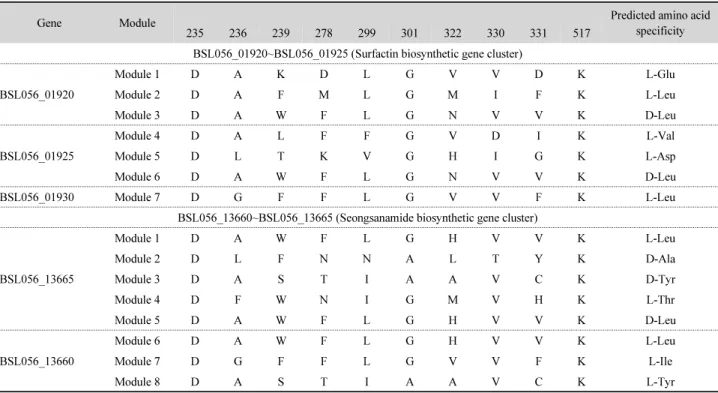
Table 2. Amino acid residues lining the binding pocket of each adenylation domain in NRPS gene clusters found in the chromosome of Bacillus safensis KCTC 12796BP
Gene Module Predicted amino acid
specificity
235 236 239 278 299 301 322 330 331 517
BSL056_01920~BSL056_01925 (Surfactin biosynthetic gene cluster)
BSL056_01920
Module 1 D A K D L G V V D K L-Glu
Module 2 D A F M L G M I F K L-Leu
Module 3 D A W F L G N V V K D-Leu
BSL056_01925
Module 4 D A L F F G V D I K L-Val
Module 5 D L T K V G H I G K L-Asp
Module 6 D A W F L G N V V K D-Leu
BSL056_01930 Module 7 D G F F L G V V F K L-Leu
BSL056_13660~BSL056_13665 (Seongsanamide biosynthetic gene cluster)
BSL056_13665
Module 1 D A W F L G H V V K L-Leu
Module 2 D L F N N A L T Y K D-Ala
Module 3 D A S T I A A V C K D-Tyr
Module 4 D F W N I G M V H K L-Thr
Module 5 D A W F L G H V V K D-Leu
BSL056_13660
Module 6 D A W F L G H V V K L-Leu
Module 7 D G F F L G V V F K L-Ile
Module 8 D A S T I A A V C K L-Tyr
seems to be provided by three transport systems (Kappes et al., 1996). The glycine-betaine transport system conferred by opuA operon (BSL056_01645~BSL056_01655) and opuD gene (BSL056_14970), choline transport system by opuB operon (BSL056_20205~BSL056_20210), glycine betaine/carnitine/
choline transport system by opuC operon (BSL056_16980~
BSL056_16990) were denoted in the chromosome.
The main fla-che operon (BSL056_07875~BSL056_08030) for flagella biosynthesis and chemotaxis was located in the chromosome (Guttenplan et al., 2013). Additional two operons (BSL056_17645~BSL056_17695 and BSL056_18135~BSL056_
18140) and mot operon (BSL056_06575~BSL056_06580) for flagella motor proteins were also found. Those gene products provide the bacterial motility of this strain.
Two non-ribosomal peptide synthetase (NRPS) gene clusters (BSL056_01920~BSL056_01930, BSL056_13660~BSL056_
13665) in addition to two non-ribosomal peptide synthetase- polyketide synthase (NRPS-PKS) gene clusters (BSL056_01935~
BSL056_01940, BSL056_03345~ BSL056_03365) probably involved in the secondary metabolism were found in the chromosome. The substrate specificity of each adenylation domain of NRPS genes based on the amino acid residues lining
on the substrate binding pocket (Stachelhaus et al., 1999) was predicted using NRPSsp web server (Prieto et al., 2011) and NRPSpredictor2 web (Röttig et al., 2011) server. Based on the analysis of adenylation domains of each module (Table 2), one NRPS gene cluster (BSL056_01920~BSL056_01930) is proven to be involved in the biosynthesis of surfactin, and the other NRPS gene cluster (BSL056_13660~BSL056_13665) involved in the biosynthesis of seongsanamide group.
Marine Bacillus species produce versatile secondary meta- bolites including lipopeptides (Mondol et al., 2013). Both surfactin and seongsanamides produced by this strain are belonging to lipopeptide family. Even though surfactin is a well-known representative lipopeptide, seongsanamide family (seongsanamides A~E) is a novel category of compounds isolated from the culture broth of B. safensis KCTC 12796BP (Kim et al., 2018). In vitro analysis of biological activity revealed that seongsanamide A among this group showed the most potent anti-allergic activity.
The gene organization of adenylation domains of NRPSs as well as the location of epimerase domain is well matched with its chemical configuration with its stereospecificity (Fig. 1).
The intramolecular linkage between two tyrosine residues in
this compound might be mediated by cytochrome P450 encoded
Fig. 1. The seongsanamide biosynthetic gene cluster of Bacillus safensis KCTC 12796BP. (A) The architecture and the organization of non-ribosomal peptide synthase domains in seongsanamide biosynthetic gene cluster. C, condensation domain; AD, adenylation domain; E, epimerase domain; PCP, peptidyl carrier protein domain; TE, thioesterase domain. (B) Chemical structure of seongsanamide A possessing an anti-allergic activity.
by adjacent gene (BSL056_13655).
Nucleotide sequence accession number
The complete genome sequences of B. safensis KCTC 12796BP has been deposited under the accession number of CP018197.1 (chromosome) and CP018198.1 (plasmid) of BioProject: PRJNA353573 at DDBJ/EMBL/GenBank.
적 요
제주도 성산리 앞 바다 속 해면체로부터 분리한 Bacillus safensis KCTC 12796BP의 유전체를 분석하였다. 그 결과 3,935,874 bp의 환형 염색체와 36,690 bp의 plasmid 염기 서열 을 확인하였다. 염색체는 G + C 함량이 41.4%로 75개의 위유 전자를 포함한 3,980개의 코딩 서열을, plasmid는 G + C 함량 이 37.3%로 36개의 코딩 서열을 포함하고 있었다. 염색체 코 딩 서열 중에는 81개의 tRNA 유전자, 24개 rRNA 유전자와 1 개의 tmRNA 유전자가 있었다. 또한 포자 생성에 필요한 30개
의 유전자, 포자피를 지령하는 16개의 유전자, 그리고 발아에 필요한 20개의 유전자도 발견되었다. 이외에 협막 다당체 생 합성에 필요한 유전자와 편모 생합성 및 주화성에 필요한 유 전자, 그리고 염 내성에 필요한 glycine-choline betaine 수송체 에 관한 유전자도 존재하였다. 무엇보다도 항알러지활성을 보 이는 이차대사산물 seongsanamide의 생합성을 지령하는 비 리보좀성 펩타이드 합성효소 유전자를 확인할 수 있었다.
Acknowledgements
This work was kindly supported by National Research Fund of Korea (NRF-2017R1A2B4006110).
References