S H O R T G E N O M E R E P O R T
Open Access
Complete genome sequence of Bacillus
cereus FORC_005, a food-borne pathogen
from the soy sauce braised fish-cake with
quail-egg
Dong-Hoon Lee
1†, Hye Rim Kim
2†, Han Young Chung
2, Jong Gyu Lim
2, Suyeon Kim
2, Se Keun Kim
2, Hye-Jin Ku
1,
Heebal Kim
4, Sangryeol Ryu
3, Sang Ho Choi
2*and Ju-Hoon Lee
1*Abstract
Due to abundant contamination in various foods, the pathogenesis of Bacillus cereus has been widely studied in physiological and molecular level. B. cereus FORC_005 was isolated from a Korean side dish, soy sauce braised fish-cake with quail-egg in South Korea. While 21 complete genome sequences of B. cereus has been announced to date, this strain was completely sequenced, analyzed, and compared with other complete genome sequences of B. cereus to elucidate the distinct pathogenic features of a strain isolated in South Korea. The genomic DNA
containing a circular chromosome consists of 5,349,617-bp with a GC content of 35.29 %. It was predicted to have 5170 open reading frames, 106 tRNA genes, and 42 rRNA genes. Among the predicted ORFs, 3892 ORFs were annotated to encode functional proteins (75.28 %) and 1278 ORFs were predicted to encode hypothetical proteins (748 conserved and 530 non-conserved hypothetical proteins). This genome information of B. cereus FORC_005 would extend our understanding of its pathogenesis in genomic level for efficient control of its contamination in foods and further food poisoning.
Keywords: Complete genome sequence, Bacillus cereus, Food-borne pathogen, Food poisoning, Diarrhea Introduction
Bacillus cereus is one of the major food-borne patho-gens, even though it is usually underreported due to its relatively mild symptoms and short duration [1, 2]. It has been known to contaminate diverse types of foods including meat, milk, eggs, and especially various
veg-etables. B. cereus also has been known to produce
several pathogenic compounds and virulence factors including spores, dodecadepsipeptide cereulide, and enterotoxins. B. cereus has spore-forming ability so it may survive to cause problems in pasteurization and even sterilization in food processing, and this spore is
highly hydrophobic to allow them to adhere to food transfer pipelines [1, 3, 4]. An extracellular protein, dodecadepsipeptide cereulide, is also known to be as-sociated with emesis after food ingestion. In addition, B. cereus produces three different enterotoxins includ-ing hemolysin BL, nonhemolytic enterotoxin, and cytotoxin K, causing diarrhea after B. cereus infection [4, 5].
While the pathogenesis of B. cereus has been studied in physiological and molecular levels, characterization and pathogenesis studies of the genomes of B. cereus have been recently conducted to extend our understand-ing about its pathogenicity and virulence factors. To date, 21 different genomes of B. cereus, isolated from many other countries, have been completely sequenced and analyzed. However, the complete genome sequence ofB. cereus, isolated from Korean foods, has never been announced previously. To elucidate the genome se-quence and its genomic features of KoreanB. cereus, its
* Correspondence:[email protected];[email protected]
†Equal contributors
2National Research Laboratory of Molecular Microbiology and Toxicology,
Department of Agricultural Biotechnology, and Center for Food Safety and Toxicology, Seoul National University, Seoul, Republic of Korea
1Department of Food Science and Biotechnology, Institute of Life Science
and Resources, Kyung Hee University, Yongin, Republic of Korea Full list of author information is available at the end of the article
© 2015 Lee et al. Open Access This article is distributed under the terms of the Creative Commons Attribution 4.0 International License (http://creativecommons.org/licenses/by/4.0/), which permits unrestricted use, distribution, and reproduction in any medium, provided you give appropriate credit to the original author(s) and the source, provide a link to the Creative Commons license, and indicate if changes were made. The Creative Commons Public Domain Dedication waiver (http://creativecommons.org/publicdomain/zero/1.0/) applies to the data made available in this article, unless otherwise stated.
genome was completely sequenced, analyzed and com-pared with previously reported B. cereus complete gen-ome sequences. Here, we present the complete gengen-ome sequence, annotation data, and genomic features of B. cereus FORC_005, which was isolated from a contami-nated Korean side dish that caused food-borne illness in South Korea, and its evolutionary relationships with other previously reported complete genome sequences using comparative genomics.
Organism information
Classification and features
B. cereus is a Gram-positive, rod-shaped, motile, and spore-forming bacterium. It is often found in various habitats including soil, water, and even food materials (fresh vegetables and food animals). In particular, this bacterium has been well-known food-borne pathogen causing diarrhea, vomiting, and nausea by enterotoxin production. It is a facultative anaerobe that can survive in the temperature range of 10–50 °C, pH range of 4.9– 9.3, and salinity of up to 7.5 % NaCl. B. cereus belongs to the family Bacillaceae, the order Bacillales, the class Bacilli, and the phylum Firmicutes. In this study, B. ce-reus FORC_005 was isolated from a contaminated Ko-rean side dish, soy sauce braised fish-cake with quail-egg, which was suspected to be an original pathogen of food-borne outbreak in March 2014, by Incheon Health and Environment Institute, South Korea. Morphology observation using Transmission Electron Microscopy (TEM; JEM–2100, JEOL, Tokyo, Japan) showed that the
strain FORC_005 is rod-shaped with about 4 μm long
and 0.5 μm wide in diameter, and can perform motility with peritrichous flagella, suggesting that the strain FORC_005 has typical morphology of B. cereus (Fig. 1 and Table 1). In addition, the 16S rRNA sequence ana-lysis and phylogenetic tree anaana-lysis of the strain FORC_005 and other Bacillus species revealed that this strain was identified to B. cereus (data not shown) and positioned at the group ofB. cereus in the phylogenetic tree, indicating that this strain indeed belongs to B. ce-reus (Fig. 2).
Genome sequencing information
Genome project history
The complete genome sequence and annotation data of B. cereus FORC_005 have been deposited in the Gen-Bank database under the accession number CP009686. Genome sequencing of the strain FORC_005 is a part of the Food-borne Pathogen Omics Research Center pro-ject supported by Ministry of Food and Drug Safety South Korea, which aims for the collection and database construction of complete genome sequences of various food-borne pathogens in South Korea. A summary of
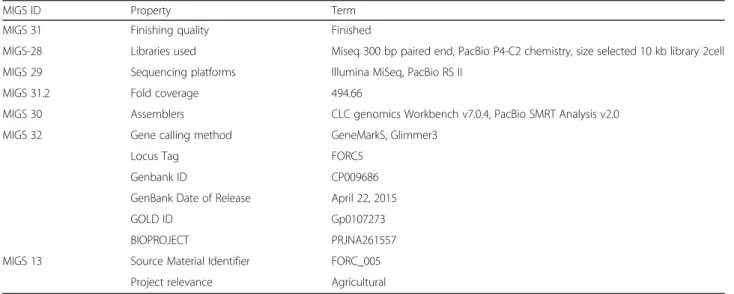
the project information and its association with MIGS version 2.0 compliance [6] was presented in Table 2.
Growth conditions and genomic DNA preparation
B. cereus FORC_005 was aerobically cultivated at 30 °C for 12 h with Brain Heart Infusion (BHI; Difco, Detroit, MI, USA) media, and the cells were harvested by centri-fugation at 16,000 x g for 1 min. Total genomic DNA was extracted and purified using DNeasy Blood & Tissue Kit (Qiagen, Hilden, Germany), according to the manu-facturer’s instructions for Gram-positive bacteria.
Bacter-ial cells (about 2 X 10⁹ CFU) were harvested by
centrifuging for 10 min at 5000 x g and pellet was
resus-pended with 180 μl of enzymatic lysis buffer (20 mM
Tris · Cl, pH 8.0, 2 mM sodium EDTA, 1.2 % Triton X-100, and 20 mg/ml lysozyme) and this mixture was incubated at least 30 min at 37 °C. In addition to the mixture, 25μl of proteinase K and 200 μl of Buffer AL, which are included in the kit, were mixed by vortexing before incubation at 56 °C for 30 min. And then 200μl of absolute ethanol was added and mixed thoroughly by vortexing. The mixture was transformed to DNeasy Mini spin column in a new 2 ml collection tube and centri-fuged at 6000 x g for 1 min to remove the flow-through. Then, 500μl of Buffer AW2 was added and centrifuged for 3 min at 20,000 x g to wash the genomic DNA in the
Fig. 1 TEM image of the B. cereus FORC_005. The strain cells were negatively stained with 2 % (w/v) uranyl acetate and observed using TEM JEM-2100 (JEOL, Tokyo, Japan) at 200 kV
column. The column was placed into a clean 1.5 ml tube and 200 μl of Buffer AE was directly added onto the
DNeasy membrane. After incubation at room
temperature for 1 min, the column was centrifuged for 1 min at 6000 x g to elute the purified genomic DNA. The concentration and purity of the purified DNA was determined using a NanoVue spectrophotometer (GE Healthcare, Little Chalfont, UK).
Genome sequencing and assembly
The genome sequence was determined using a hybrid-genome sequencing approach with PacBio RS II (Pacific Biosciences, Menlo Park, CA, USA) and Illumina MiSeq (Illumina, San Diego, CA, USA). Library construction for PacBio RS II was initialized by ligating universal hair-pin adaptors to both ends of DNA fragments using SMRTbell Template Prep kit 1.0 (Pacific Biosciences),
followed by purification using AMPure PB bead system (Pacific Biosciences) for the removal of small fragments sized <1.5 kb. Subsequent DNA polymerase binding with template DNAs was conducted using DNA/Polymerase Binding kit P6 v2 with C2 chemistry (Pacific Biosci-ences), followed by loading of SMRTbells using Mag-Beads kit (Pacific Biosciences) for greater number of reads at longer lengths per SMRT Cell. Sequencing was conducted using DNA sequencing Bundle 2.0 (Pacific Biosciences), on the PacBio RS II platform. 300 bp paired-end library for Illumina MiSeq (Illumina) was ini-tialized by simultaneously fragmenting template DNAs and tagging them with sequencing adapters using Nex-tera DNA Sample Preparation kit and Index kit (Illu-mina), followed by purification of prepared template DNA fragments using MinElute reaction clean up kit (Illumina) and AMPure XP bead (Beckman Coulter,
Table 1 Classification and general features of Bacillus cereus strain FORC_005 [6]
MIGS ID Property Term Evidence codea
Classification Domain Bacteria TAS [7]
Phylum Firmicutes TAS [8–10]
Class Firmibacteria TAS [8,9,11]
Order Bacillales TAS [8,9,12,13]
Family Bacillaceae TAS [8,9,13,14]
Genus Bacillus TAS [8,9,13,15]
Species Bacillus cereus TAS [8,9,13,16] Strain FORC_005
Gram stain Positive TAS [17,18]
Cell shape Rod TAS [17,18]
Motility Motile with peritrichous flagella TAS [17,18]
Sporulation Endospore-forming TAS [8]
Temperature range 10 °C–50 °C TAS [8,17]
Optimum temperature 28–35 °C TAS [8]
pH range; Optimum 4.9–9.3; 6.0–7.0 TAS [17]
Carbon source Glucose, Aesculin TAS [19]
MIGS-6 Habitat Ubiquitous; especially in soil TAS [17,18]
MIGS-6.3 Salinity 0–7.5 % NaCl (w/v) TAS [17]
MIGS-22 Oxygen requirement Facultative anaerobes TAS [17,18]
MIGS-15 Biotic relationship free-living NAS
MIGS-14 Pathogenicity Diarrhea, emesis in human NAS
MIGS-4 Geographic location Incheon, South Korea IDA
MIGS-23 Isolation Korean soy sauce braised fish-cake with quail-egg IDA
MIGS-5 Sample collection March 2014 IDA
MIGS-4.1 Latitude 37.27 N IDA
MIGS-4.2 Longitude 126.42 E IDA
MIGS-4.4 Altitude Not reported
a
Evidence codes - IDA inferred from direct assay, TAS traceable author statement (i.e., a direct report exists in the literature), NAS non-traceable author statement (i.e., not directly observed for the living, isolated sample, but based on a generally accepted property for the species, or anecdotal evidence). These evidence codes are from the Gene Ontology project [20]
Brea, CA, USA). Sequencing was conducted using MiSeq Reagent kit (600 cycle; Illumina). All kits were used according to the manufacturer’s instructions. Se-quencing reads from Illumina MiSeq system were as-sembled using the CLC Genomics Workbench v7.0.4 (CLC bio, Aarhus, Denmark), and the reads from PacBio system were assembled using the PacBio SMRT Analysis v2.0 (Pacific Biosciences). Finally, the initially assembled scaffolds were gathered and re-assembled to obtain one contig using CLC Genomics Workbench program.
Genome annotation
Initial prediction and annotation of all open reading frames, and tRNA/rRNA gene prediction was carried out using Glimmer3 by the Rapid Annotation using Sub-system Technology server [23], and was confirmed using
the GeneMarkS ORF prediction program [24]. Predicted ribosome binding sites by RBSfinder (J. Craig Venter In-stitute, Rockville, MD, USA) were used to confirm the predicted ORFs. The Global Annotation of Multiplexed On-site Blasted DNA-Sequences program and Inter-ProScan5 program with conserved protein domain data-bases were used for the annotation of confirmed ORFs [25, 26]. Artemis16 was used for handling of genome
se-quence and annotated data [27]. The functional
categorization and classification of all predicted ORFs were conducted using the RAST server-based SEED viewer and Clusters of Orthologous Groups -based WebMGA programs [28, 29]. Circular genome map, showed in Fig. 3, was generated using GenVision (DNASTAR, Madison, WI, USA) based on all predicted ORFs with COG information, tRNAs and rRNAs, GC-content, and gene cluster information. Detection and identification of virulence factors were carried out using BLAST search with protein sequences of VFs in the database [30]. Signal peptides, transmembrane helices, and Clustered Regularly Interspaced Short Palindromic Repeats were identified by using SignalP server v.4.1 [31], TMHMM server v.2.0 [32], and CRISPRfinder [33], respectively.
Genome properties
Table 3 contains the main FORC_005 statistics. It con-tains one chromosomal double-stranded DNA and no plasmid. The chromosome consists of 5,349,617 bp in DNA length with the GC content of 35.29 %, containing 5170 ORFs, 106 tRNA genes, and 42 rRNA genes con-sisting of 14 complete rRNA operons. Among the pre-dicted 5170 ORFs, 3892 ORFs (75.28 %) were annotated to encode functional proteins and 1278 ORFs were hypothetical proteins (748 conserved and 530
non-Table 2 Project information
MIGS ID Property Term
MIGS 31 Finishing quality Finished
MIGS-28 Libraries used Miseq 300 bp paired end, PacBio P4-C2 chemistry, size selected 10 kb library 2cell MIGS 29 Sequencing platforms Illumina MiSeq, PacBio RS II
MIGS 31.2 Fold coverage 494.66
MIGS 30 Assemblers CLC genomics Workbench v7.0.4, PacBio SMRT Analysis v2.0 MIGS 32 Gene calling method GeneMarkS, Glimmer3
Locus Tag FORC5
Genbank ID CP009686
GenBank Date of Release April 22, 2015
GOLD ID Gp0107273
BIOPROJECT PRJNA261557
MIGS 13 Source Material Identifier FORC_005 Project relevance Agricultural
Fig. 2 Phylogenetic tree highlighting the position of B. cereus strain FORC_005 relative to other species within the genus Bacillus. Alignment of 16S rRNA sequences was conducted using ClustalW [21], and the tree was generated using the Neighbor-joining algorithm with 1000 bootstraps, using MEGA 6 [22]. Type strains are labeled with superscript T, and the corresponding GenBank accession numbers are indicated in parentheses. Enterococcus faecium NRRL B-2354 was used as outgroup
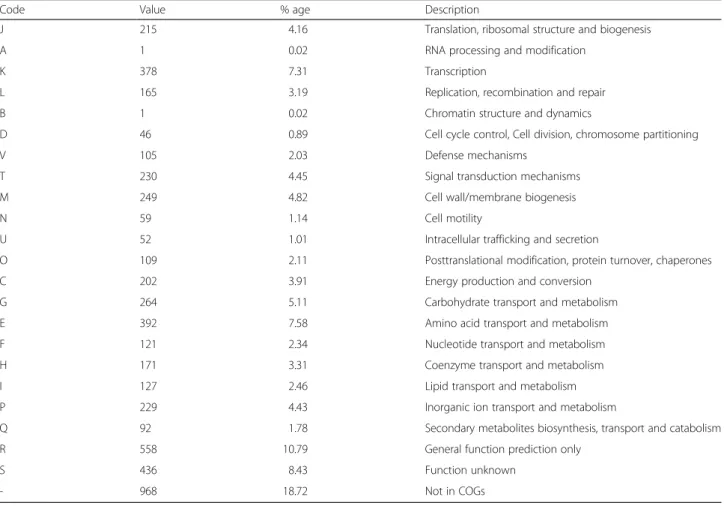
conserved). In addition, 4202 ORFs (81.28 %) were assigned to the related COG functional categories, and are listed in Table 4.
Insights from the genome sequence
Pathogenesis and virulence factors
Frequently,B. cereus causes diarrhea and emesis after in-gestion of the contaminated food. These food-borne ill-nesses are reported to be associated with specific toxin genes. The genome analysis of B. cereus FORC_005 re-vealed that there are three major toxins including cyto-toxin K, hemolysin BL, and non-hemolytic enterocyto-toxin [5]. These toxins are involved in severe diarrhea after in-fection ofB. cereus. Cytotoxin K is encoded by a single
gene, cytK (FORC5_0979). However, other two toxins
are encoded by two different gene clusters, a hemolysin
BL gene cluster (hblABDC; FORC5_2954 to
FORC5_2957) and a non-hemolytic enterotoxin gene cluster (nheABC; FORC5_1734 to FORC5_1736)). In addition, hemolysin III (hlyIII; FORC5_2063) was de-tected in the genome for additional hemolysis activity. Therefore, gene expression regulation of these toxin-associate genes may be key points for control and pre-vention of food poisoning after pathogenic B. cereus infection.
Anthrolysin O, one of the cholesterol-dependent cyto-lysins, was detected in the genome (FORC5_1940), which has been suggested to be a pore-forming protein Fig. 3 Genome map of B. cereus FORC_005. The outer circle indicates the location of all ORFs, and the inner circle with red peaks indicates the GC content. All ORFs were colored according to their COG functional groups. Sky-blue and orange arrows indicate rRNA, and tRNA genes, respectively. Gene clusters, virulence factors, and featural genes are labeled around the outer circle according to their approximate location. Labels were colored as follows; virulence-related genes in red, prophage-related genes in sky-blue, and other function-related genes in black
often found in many Gram-positive bacteria. This hemolytic and cytolytic protein was reported to be asso-ciated with cholesterol binding in the host cell plasma membrane, pore formation via its oligomerization, and transfer of virulence factors to the host cell cytoplasm [34, 35]. In addition, an internalin (FORC5_1206) was detected in the genome, suggesting that it may play an important role in host cell invasion. The predicted func-tions of these two host invasive proteins in the genome revealed that regulation and control of this initial step in the occurrence of food-borne pathogenesis and illness may be important for the host protection.
Bacillus has been known to have two kinds of bacterial protection systems from the host cell immune system, including polysaccharide capsule (PSC) and polyglutamic acid capsule [36, 37]. While PSC biosynthesis is common
in B. cereus, only PSC biosynthesis gene cluster
(FORC5_4952 to FORC5_4971) was detected in the gen-ome of B. cereus FORC_005, suggesting that the strain can protect itself from the host cell immune defense sys-tem for its further pathogenesis in the host cells. There-fore, this bacterial protection system is also considered as one of the virulence factors inB. cereus.
Table 3 Genome statistics
Attribute Value % of Totala
Genome size (bp) 5,349,617 100.00
DNA coding (bp) 4,476,678 83.68
DNA G + C (bp) 1,887,736 35.29
DNA scaffolds 1
-Total genes 5318 100.00
Protein coding genes 5170 97.22
RNA genes 148 2.78
Pseudo genes 134 2.52
Genes in internal clusters 0 0.00
Genes with function prediction 3892 73.19
Genes assigned to COGs 4202 81.28
Genes with Pfam domains 4718 88.72
Genes with signal peptides 383 7.20
Genes with transmembrane helices 1544 29.03
CRISPR repeats 4
-a
The total is based on either the size of the genome in base pairs or the total number of total gene in the annotated genome
Table 4 Number of genes associated with general COG functional categories
Code Value % age Description
J 215 4.16 Translation, ribosomal structure and biogenesis
A 1 0.02 RNA processing and modification
K 378 7.31 Transcription
L 165 3.19 Replication, recombination and repair
B 1 0.02 Chromatin structure and dynamics
D 46 0.89 Cell cycle control, Cell division, chromosome partitioning
V 105 2.03 Defense mechanisms
T 230 4.45 Signal transduction mechanisms
M 249 4.82 Cell wall/membrane biogenesis
N 59 1.14 Cell motility
U 52 1.01 Intracellular trafficking and secretion
O 109 2.11 Posttranslational modification, protein turnover, chaperones
C 202 3.91 Energy production and conversion
G 264 5.11 Carbohydrate transport and metabolism
E 392 7.58 Amino acid transport and metabolism
F 121 2.34 Nucleotide transport and metabolism
H 171 3.31 Coenzyme transport and metabolism
I 127 2.46 Lipid transport and metabolism
P 229 4.43 Inorganic ion transport and metabolism
Q 92 1.78 Secondary metabolites biosynthesis, transport and catabolism
R 558 10.79 General function prediction only
S 436 8.43 Function unknown
- 968 18.72 Not in COGs
Comparative genome analysis
To elucidate the evolutionary relationship of B. cereus
FORC_005 with other complete genomes of B. cereus,
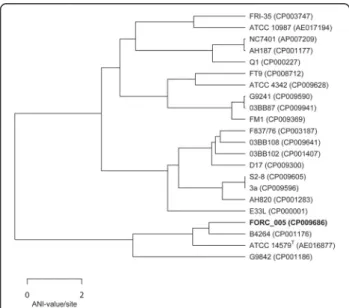
16S rRNA sequence-based phylogenetic tree analysis and whole genome-based average nucleotide identity (ANI) analysis were conducted. Comparative phylogen-etic tree analysis revealed thatB. cereus and B. anthracis strains formed a group including B. cereus FORC_005, suggesting that they may have been evolved from a com-mon ancestor (Fig. 2). Subsequent ANI analysis using the complete genome sequences of strain FORC_005 and other 21B. cereus strains revealed the closest evolu-tionary relationship between the strains FORC_005 and B4264 with the ANI value of 98.68 (Fig. 4). The strain B4264 was initially isolated from a male patient with a fatal pneumonia in 1969 [38], indicating that this strain is a clinical isolate. However, the strain FORC_005 was
isolated from a B. cereus-contaminated Korean food,
suggesting that it may have pathogenesis for potential food-borne outbreak. Therefore, the genome informa-tion of the strain FORC_005 may be important to extend our knowledge about the study of food-borne outbreak via ingestion of the contaminated foods in genomic level, even though it is a food isolateB. cereus strain.
Conclusions
While 21 complete genome sequences have been an-nounced to date, all strains were originated from other
countries. In this study, newly isolated B. cereus
FORC_005 from a contaminated food in South Korea was selected for genomic study to elucidate the genomic pathogenesis of aB. cereus strain from South Korea and taxonomical location with complete genome sequences of otherB. cereus strains.
The strain FORC_005 showed that anthrolysin O and internalin in the strain FORC_005 may occur or help the initial step of host cell invasion. In addition, the polysaccharide capsule biosynthesis gene cluster may protect the bacterial pathogen from the host cell immune defense system after host cell invasion.
Sub-sequently, the pathogenesis-associated enterotoxin
genes may cause severe diarrhea. The enterotoxin-associated genes in the genome encode three different enterotoxins including cytotoxin K, hemolysin BL, and non-hemolytic enterotoxin, suggesting that this strain may cause human diarrhea. Therefore, the gen-ome of this strain has a complete set of genes or gene clusters for host cell invasion, bacterial protec-tion from the host cell immune system, and entero-toxin production for diarrhea, suggesting that this strain is a food-borne pathogenic bacterium indeed. Comparative phylogenetic tree analysis and ANI
ana-lysis of the strain FORC_005 and other B. cereus
strains revealed that a food isolate strain FORC_005 is the closest to a clinical isolate strain B4264, sup-porting this.
In conclusion, the genomic study of B. cereus
FORC_005 provides important information about the genomic features and pathogenesis mechanism of a food isolateB. cereus, which is highly similar to a clinical iso-late B4264. Furthermore, this genome information would be useful for development of novel biocontrol ap-proach to regulate the pathogenesis of food isolateB. ce-reus strains.
Abbreviations
FORC:Food-borne pathogen omics research Center; TEM: Transmission electron microscopy; PSC: Polysaccharide capsule; ANI: Average nucleotide identity.
Competing interests
The authors declare that they have no competing interests.
Authors’ contributions
SHC, and JHL initiated and supervised the study. DHL and JHL drafted the manuscript. HRK, HYC, SK, SKK, HJK conducted wetlab work and performed electron microscopy. DHL and HRK worked on the genome sequencing and annotated the genome. DHL, HRK, HK, SR, SC, and JHL discussed, analyzed the data and revised the manuscript. All authors read and approved the final manuscript.
Acknowledgements
This research was supported by a grant (14162MFDS972) from the Ministry of Food and Drug Safety, Korea in 2015 (to JHL and SHC) and the R&D Convergence Center Support Program of the Ministry of Agriculture, Food and Rural Affairs, Republic of Korea (to SHC).
Fig. 4 Genome tree highlighting the position of B. cereus FORC_005 relative to other B. cereus strains, based on the average nucleotide identity (ANI) value. ANI is a pairwise whole-genome comparing method for genetic relatedness between prokaryotic strains, and its values were calculated using JSpecies [39, 40], with nucleotide fragment length of 1020, based on the BLAST algorithm [41]. The genome tree was constructed using the R software according to the ANI values using the unweighted pair group method
Author details
1
Department of Food Science and Biotechnology, Institute of Life Science and Resources, Kyung Hee University, Yongin, Republic of Korea.2National
Research Laboratory of Molecular Microbiology and Toxicology, Department of Agricultural Biotechnology, and Center for Food Safety and Toxicology, Seoul National University, Seoul, Republic of Korea.3Department of Food and Animal Biotechnology, Department of Agricultural Biotechnology, Research Institute of Agriculture and Life Sciences, and Center for Food and Bioconvergence, Seoul National University, Seoul, Republic of Korea.
4
Department of Agricultural Biotechnology, Research Institute for Agriculture and Life Sciences, Seoul National University, Seoul, Republic of Korea.
Received: 23 April 2015 Accepted: 31 October 2015
References
1. Granum PE, Lund T. Bacillus cereus and its food poisoning toxins. FEMS Microbiol Lett. 1997;157(2):223–8.
2. Portnoy BL, Goepfert JM, Harmon SM. An outbreak of Bacillus cereus food poisoning resulting from contaminated vegetable sprouts. Am J Epidemiol. 1976;103(6):589–94.
3. Andersson A, Rönner U, Granum PE. What problems does the food industry have with the spore-forming pathogens Bacillus cereus and Clostridium perfringens? Int J Food Microbiol. 1995;28(2):145–55.
4. Bottone EJ. Bacillus cereus, a volatile human pathogen. Clin Microbiol Rev. 2010;23(2):382–98.
5. Jeßberger N, Dietrich R, Bock S, Didier A, Märtlbauer E. Bacillus cereus enterotoxins act as major virulence factors and exhibit distinct cytotoxicity to different human cell lines. Toxicon. 2014;77:49–57.
6. Field D, Garrity G, Gray T, Morrison N, Selengut J, Sterk P, et al. The minimum information about a genome sequence (MIGS) specification. Nat Biotechnol. 2008;26(5):541–7.
7. Woese CR, Kandler O, Wheelis ML. Towards a natural system of organisms: proposal for the domains Archaea, Bacteria, and Eucarya. Proc Natl Acad Sci U S A. 1990;87(12):4576–9.
8. Ludwig W, Schleifer K, Whitman WB: Class I. Bacilli class. nov. In: Parte AC, Whitman WB, De Vos P, Garrity GM, Jones D, Krieg NR, et al., editors. Bergey’s Manual of Systematic Bacteriology. Volume 3 (The Firmicutes). 2nd ed. New York: Springer; 2009. p. 21–128.
9. Garrity GM, Lilburn TG, Cole JR, Harrison SH, Euzeby J, Tindall B. The Bacteria: Phylum Firmicutes, Class“Bacilli”. In: Garrity GM, editor. Taxonomy Outline of Bacteria and Archaea, release 7.7. East Lansing: Michigan State University Board of Trustees; 2007. p. 333–98.
10. Gibbons N, Murray R. Proposals concerning the higher taxa of bacteria. Int J Syst Bacteriol. 1978;28(1):1–6.
11. Euzeby J. List of new names and new combinations previously effectively, but not validly, published. Int J Syst Evol Microbiol. 2010;60(Pt 5):1009–10. 12. Prevot A: Dictionnaire des bactéries pathogens. Hauduroy P, Ehringer G,
Guillot G, Magrou J, Prevot AR, Rosset, Urbain A 1953, :1–692.
13. Skerman VBD, McGowan V, Sneath PHA. Approved lists of bacterial names. Int J Syst Bacteriol. 1980;30(1):225–30.
14. Fischer A. Untersuchungen über Bakterien. In Jahrbücher für Wissenschaftliche Botanik. 1895;27:1–163.
15. Cohn F. Untersuchungen über Bakterien. In Beitr Biol Pflanz. 1872;1:127–224. 16. Frankland GC, Frankland PF: Studies on some new micro-organisms
obtained from air. Philos. Trans. R. Soc. Lond. B 178;1887:257–87. 17. Rajkowski KT, Bennett RW. Bacillus cereus. In: Miliotis MD, Bier JW, editors.
International Handbook of Foodborne Pathogens. New York: Marcel Dekker, Inc; 2003. p. 40–52.
18. Kramer JM, Gilbert RJ. Bacillus cereus and Other Bacillus Species. In: Doyle MP, editor. Foodborne Bacterial Pathogens. New York: Marcel Dekker, Inc; 1989. p. 22–70.
19. Logan NA, Berkeley RC. Identification of Bacillus strains using the API system. J Gen Microbiol. 1984;130(7):1871–82.
20. Ashburner M, Ball CA, Blake JA, Botstein D, Butler H, Cherry JM, et al. Gene Ontology: tool for the unification of biology. Nat Genet. 2000;25(1):25–9. 21. Thompson JD, Higgins DG, Gibson TJ. CLUSTAL W: improving the sensitivity
of progressive multiple sequence alignment through sequence weighting, position-specific gap penalties and weight matrix choice. Nucleic Acids Res. 1994;22(22):4673–80.
22. Tamura K, Stecher G, Peterson D, Filipski A, Kumar S. MEGA6: Molecular Evolutionary Genetics Analysis version 6.0. Mol Biol Evol. 2013;30(12):2725–9. 23. Aziz RK, Bartels D, Best AA, DeJongh M, Disz T, Edwards RA, et al. The RAST
Server: rapid annotations using subsystems technology. BMC Genomics. 2008;9:75-2164-9-75.
24. Besemer J, Lomsadze A, Borodovsky M. GeneMarkS: a self-training method for prediction of gene starts in microbial genomes. Implications for finding sequence motifs in regulatory regions. Nucleic Acids Res.
2001;29(12):2607–18.
25. Altermann E, Klaenhammer TR. GAMOLA: a new local solution for sequence annotation and analyzing draft and finished prokaryotic genomes. Omics A Journal of Integrative Biology. 2003;7(2):161–9.
26. Zdobnov EM, Apweiler R. InterProScan–an integration platform for the signature-recognition methods in InterPro. Bioinformatics. 2001;17(9):847–8. 27. Rutherford K, Parkhill J, Crook J, Horsnell T, Rice P, Rajandream MA, et al.
Artemis: sequence visualization and annotation. Bioinformatics. 2000;16(10):944–5.
28. Disz T, Akhter S, Cuevas D, Olson R, Overbeek R, Vonstein V, et al. Accessing the SEED genome databases via Web services API: tools for programmers. BMC Bioinformatics. 2010;11:319-2105-11-319.
29. Wu S, Zhu Z, Fu L, Niu B, Li W. WebMGA: a customizable web server for fast metagenomic sequence analysis. BMC Genomics. 2011;12:444-2164-12-444. 30. Chen L, Xiong Z, Sun L, Yang J, Jin Q. VFDB 2012 update: toward the
genetic diversity and molecular evolution of bacterial virulence factors. Nucleic Acids Res. 2012;40(Database issue):D641–5.
31. Bendtsen JD, Nielsen H, von Heijne G, Brunak S. Improved prediction of signal peptides: SignalP 3.0. J Mol Biol. 2004;340(4):783–95.
32. Krogh A, Larsson B, Von Heijne G, Sonnhammer EL. Predicting
transmembrane protein topology with a hidden Markov model: application to complete genomes. J Mol Biol. 2001;305(3):567–80.
33. Grissa I, Vergnaud G, Pourcel C. CRISPRFinder: a web tool to identify clustered regularly interspaced short palindromic repeats. Nucleic Acids Res. 2007;35(Web Server issue):W52–7.
34. Palmer M. The family of thiol-activated, cholesterol-binding cytolysins. Toxicon. 2001;39(11):1681–9.
35. Madden JC, Ruiz N, Caparon M. Cytolysin-mediated translocation (CMT): a functional equivalent of type III secretion in gram-positive bacteria. Cell. 2001;104(1):143–52.
36. Sue D, Hoffmaster AR, Popovic T, Wilkins PP. Capsule production in Bacillus cereus strains associated with severe pneumonia. J Clin Microbiol. 2006;44(9):3426–8.
37. Han CS, Xie G, Challacombe JF, Altherr MR, Bhotika SS, Brown N, et al. Pathogenomic sequence analysis of Bacillus cereus and Bacillus thuringiensis isolates closely related to Bacillus anthracis. J Bacteriol. 2006;188(9):3382–90. 38. J. Craig Venter Institute. [http://gcid.jcvi.org/projects/msc/bacillus/
bacillus_cereus_b4264/index.shtml] Accessed 12 Apr 2015.
39. Goris J, Konstantinidis KT, Klappenbach JA, Coenye T, Vandamme P, Tiedje JM. DNA-DNA hybridization values and their relationship to whole-genome sequence similarities. Int J Syst Evol Microbiol. 2007;57(Pt 1):81–91. 40. Richter M, Rossello-Mora R. Shifting the genomic gold standard for the
prokaryotic species definition. Proc Natl Acad Sci U S A. 2009;106(45):19126–31.
41. Altschul SF, Madden TL, Schäffer AA, Zhang J, Zhang Z, Miller W, et al. Gapped BLAST and PSI-BLAST: A new generation of protein database search programs. Nucleic Acids Res. 1997;25(17):3389–402.
Submit your next manuscript to BioMed Central and take full advantage of:
• Convenient online submission
• Thorough peer review
• No space constraints or color figure charges
• Immediate publication on acceptance
• Inclusion in PubMed, CAS, Scopus and Google Scholar
• Research which is freely available for redistribution
Submit your manuscript at www.biomedcentral.com/submit

![Table 1 Classification and general features of Bacillus cereus strain FORC_005 [6]](https://thumb-ap.123doks.com/thumbv2/123dokinfo/4721787.9216/3.892.86.811.147.738/table-classification-general-features-bacillus-cereus-strain-forc.webp)