http://dx.doi.org/10.7839/ksfc.2016.13.4.052
Biped Walking of a Humanoid Robot for Argentina Tango
Doo-Sung Ahn
Received: 23 Sep. 2016, Revised: 04 Nov. 2016, Accepted: 22 Nov. 2016
Key Words:Humanoid Robot, Argentina Tango, Biped Walking, Particle Swarm Optimization, Trajectory Generation, Zero Moment Point
Abstract: The mechanical design for biped walking of a humanoid robot doing the Argentina Tango is presented in this paper. Biped walking has long been studied in the area of robotic locomotion. The aim of this paper is to implement an Argentina Tango dancer-like walking motion with a humanoid robot by using a trajectory generation scheme. To that end, this paper uses blending polynominals whose parameters are determined based on PSO (Particle Swarm Optimization) according to conditions that make the most of the Argentina Tango’s characteristics. For the stability of biped walking, the ZMP (Zero Moment Point) control method is used. The feasibility of the proposed scheme is evaluated by simulating biped walking with the 3D Simscape robot model.
The simulation results show the validity and effectiveness of the proposed method.
* Corresponding author: [email protected]
Department of Mechanical Design Engineering, PukyongNational University, Pusan 608-739, Korea
Copyright Ⓒ 2016, KSFC
This is an Open-Access article distributed under the terms of the Creative Commons Attribution Non-Commercial License(http://
creativecommons.org/licenses/by-nc/3.0) which permits unrestricted non-commercial use, distribution, and reproduction in any medium, provided the original work is properly cited.
Nomenclature
: sagittal angle φ : coronal angle ψ : transverse angle
, : coordinate of ZMP
: cycle time, sec
: support time, sec
: velocity and position of k-th agent
: each agent’s best position
: population’s global best position
: reference trajectory of swing foot
: initial and final time of the i-th segment
: slanted angle of upper body
Ω Ω : absolute angular velocity components
: mass of link i
: mass center coordinate of link
: inertial components of link I
1. Introduction
Over the last decades, robots have been increasingly applied in various industrial applications, where the robot executes mostly the pre-programmed tasks such as welding, assembling, and painting etc. In recent years, population aging brings about many problems, such as shortage of labor, a feeling of alienation et al., in the welfare and medical areas. Biped humanoid robots are expected to get over these problems in human-robot coexistent environment. Especially robot dance will play important roles in this fields. Robot dance is one of most challenging topics in the area of humanoid robot.
Robot dance research is related to a recreational, scientific and artificial intelligence activity. Robot dance involves technologies from many fields such as machinery, robotics, electronics, automatic control, sensor, artificial intelligence, precision structure and biomimetic materials1). Combining interdisciplinary technologies, a dancing robot can conduct an attractive appearance in the harmonious and refined movements.
Technical challenge and artistic inspiration are two key points in robot dance research. The common approach in design and implementation of robot dance is to mimic human movement. In order to make robot movement stable, smooth and stylish, the design needs to be optimized.
The goal of this study is to propose a biped humanoid robot to imitate Argentina Tango dance.
Argentine Tango is a partner dance that developed over the last century in Argentina's capital city, Buenos Aires2). It is an interpretive, improvisational social dance that allows the dancers to develop a deep connection between themselves, the music, and the environment in which they are dancing. The Argentina Tango, now familiar around the world, was inscribed in 2009 on the Representative List of the Intangible Cultural Heritage of Humanity.
It is well known that walking in an embrace is the very essence of Argentina Tango, and that considerable depth of experience can be achieved through just such simple walking. Walking together while facing each other in a closed embrace as shown in Fig. 1, in line with each other (meaning that the man steps straight forward essentially replacing the woman’s foot which moves straight back at the same time) is the simplest and the most difficult tango figure. Very few dancers can do it with ease. Learning how to do it well is a big key to many other figures. But the most important point is that all true tango choreography is accomplished through natural walking. That is, whenever stepping is involved, it must be proper natural stepping, no special manipulation of the legs and the feet. Walking is one of the most beautiful features of this dance and the biggest key to its elegance.
Fig. 1 Argentina tango
The present work aims to realize natural human-like walking with a humanoid robot derived from DARWIN-OP3). This paper is consisted of three sections; Section 2 presents mechanical design of humanoid robot for Argentina tango, including a whole-body model of the humanoid. Section 3 describes two-stage gait cycle and stability for dancer-like walking. Section 4 provides trajectory generation scheme for Argentina tango walking. Section 5 shows simulation results and Section 6 makes a conclusion of the present work and introduces future research topics.
2. Mechanical Design of Humanoid Robot for Argentina tango
The first step of this subject is to design the mechanical structure, control system, the number of degree of freedom (DOF) to enable the robot walking, turning and other movements required for Argentina tango, also to ensure the stability of the biped robot.
Humanoid robot's walking ability is mainly dependent on its kinematics of mechanical structure4). The number of DOF and its reasonable assignment play a definite role in the performance of the biped robot. The biped robot’s modeling mainly includes the modeling of the head, the main body, two legs and two arms.
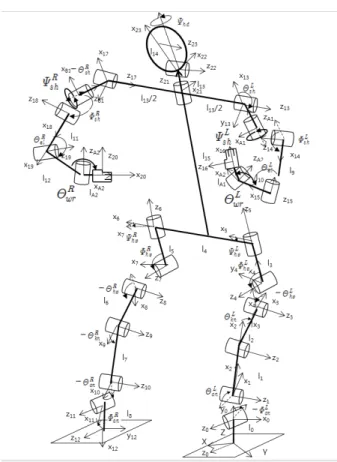
For the appropriate biped robot to dance Argentina Tango, we propose a design by Solidworks5). as shown in Fig. 2, which is based on DARWIN-OP robot developed by Robotis Ltd. Then it is transformed into Simscape6) model which will be used in simulation. The robot is 45 cm tall, weighs 2.8kg, and has 20 DOF. It has 11 DOF in the sagittal plane, 6 DOF in the coronal plane and 3 DOF in the transverse plane. For the dance of Argentina Tango, 20 DOF is not sufficient. As shown in Fig.3, 4 DOF in upper body, , , ,
(2 DOF for each shoulder and 2 DOF for each wrist) are additionally supplemented for the need of embracing a partner. The center of mass is positioned in the center of its pelvis. The position is optimal for adequate balancing and proper distribution of inertia moment during gait.
(a) CAD design by Solidworks (b) Simscape model Fig. 2 CAD design and Simscape model
Fig. 3 Whole body model of the humanoid robot
Fig. 3 illustrates the proposed humanoid model described in the three dimension when left leg is supported. There are three types of angles in the model;
(sagittal angle), (coronal angle) and (transverse angle). The sagittal angles ,
and are the joint angles that make a robot move forward and backward swing in the x direction, where the subscripts and
stand for ankle, knee, hip, shoulder, elbow and wrist and the superscripts and represent left and right, respectively. The robot’s one-step motion will be described in the base frame. The origin is at the center of the current support foot, the X-axis is forward
walking direction, the Z-axis is perpendicular to the ground, and then the Y-axis is properly determined
3. Dancer-like biped walking
3.1 Gait cycle
Argentina tango contains some phrases which consists of eight bits. Normally dancer walks one step at two bit.
Fig. 4 Gait cycle composed three postures
A human walks with a periodic gait cycle comprised of standing and swing period. Huang et al. define the step cycle as starting with the heel of the swing foot leaving the ground and ending with the heel touching down the ground7). Because the joint trajectories of the next step are obtained throughout the switch of left and right leg, a pair of successive step cycles consists of a gait cycle. A k-th step cycle consisted of two stages and three element postures with a cycle period, , and double support period, , are shown in Figure 4, where the right leg is in the standing period. In the first stage, from to k tok , the humanoid shifts its body forward into a double support phase (DSP) by advancing from posture P1 to P2. While the right leg goes through the initial contact and loading phases, the left leg takes the final stance and pre-swing phases successively. In the second stage, from to k
to (k+1), the robot steps forward by moving the left leg from P2 to P3 in the single support phase (SSP). The period of the right leg elapses from the loading response phase to the final standing phase, while the left leg advances from the pre-swing phase to the terminal swing phase. The three postures, P1, P2
and P3, are obtained using optimization or inverse kinematics.
3.2 Stability analysis of biped walking
Zero Moment Point (ZMP) is the basis and starting point of stability analysis, and it is the criterion of biped walking stability. ZMP is defined as a point in which all the forces and moments can be supplanted with a single force and a single moment respectively8). The dynamic balance of biped walking is the major premise of ZMP, and the dynamic balance of biped walking must meet the following two prerequisites
(1)
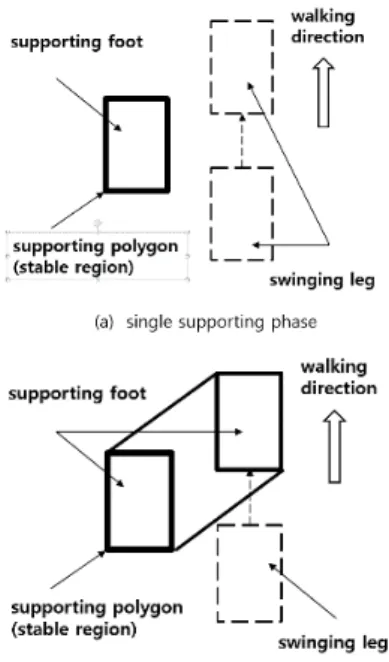
where is the mass of link and are components of inertia moment, Ω and Ω are the angular acceleration components around x-axis and y-axis at mass center of link i, g is the acceleration of gravity, ( ) is the coordinate of the ZMP, and ( ) is the mass center’s coordinate of link on an absolute Cartesian coordinate frame. ZMP must be within the support polygon of foot-ground shown in Fig. 5, or the biped robot would fall down.
And the ZMP should be too far to the edge of the foot, because that’s easy to fall down.
Fig. 5 Stable support polygon
4. Trajectory generation for Argentina tango walking
4.1 Blending polynominal
For a natural and dance walking, the leg joints need to revolve in a smooth and seamless way. For this cause, blending polynomial (BP) was basically adopted to represent joint angle trajectories, which uses cubic polynomial as each segment. A blending polynomial (BP) is consisted of more than two segments, which are depicted by cubic polynomials with conditions at via points. Since most of trajectories can be represented effectively with these conditions, BP’s are used for describing the joint trajectory9). Joint angle trajectories in the i-th segment of BP are represented with the following cubic polynomial function:
(2)
where the four coefficients are determined from the specified boundary condition such as the initial and final angular positions/velocities of the the i-th segment
4.2 Particle swarm optimization (PSO)
PSO is a global optimization tool inspired by the social activities of schools of fish and herds of birds, which occasionally share their information on messages and food10). The underlying principle of PSO supports that a herd of birds communicates with their best-so-far individual information as well as the up-to-date global best information, whose equations are written as below:
(3)
where and show the current velocity and position vector of the k-th agent, while and
are the next velocity and position vectors determined after iterations based on each agent’s best position vector and the population’s global best position vector The coefficients , and w denote two weight factors linked with the search history and inertial
Fig. 6 Successive 3D view of Argentina tango walking weight, respectively. and are between 0 and 1
random numbers uniformly distributed.
4.3 Optimization of Joint angle trajectory
Because the parameters to be optimized are so many, they must be reduced to obtain precise parameters efficiently using PSO. For the stable and natural walking in Argentine tango, the following conditions about walking posture should be satisfied:
Walking Condition 1 : Upper body must be maintained to be leaned forward by some degree in the sagittal plane and to be vertical in the coronal plane for the correct embracement.
(4)
Walking Condition 2 : The swing leg should be parallel to supporting leg in order to keep natural tango walking.
(5) Walking Condition 3 : The swing foot during walking should be above and parallel to ground in order to decrease possibility that the toe or heel of the swing foot bump into ground.
(6)
Walking Condition 4 : All the sagittal and coronal joints of upper body should keep the initial angles for the rigid embrace through dance of Argentine tango.
(7)
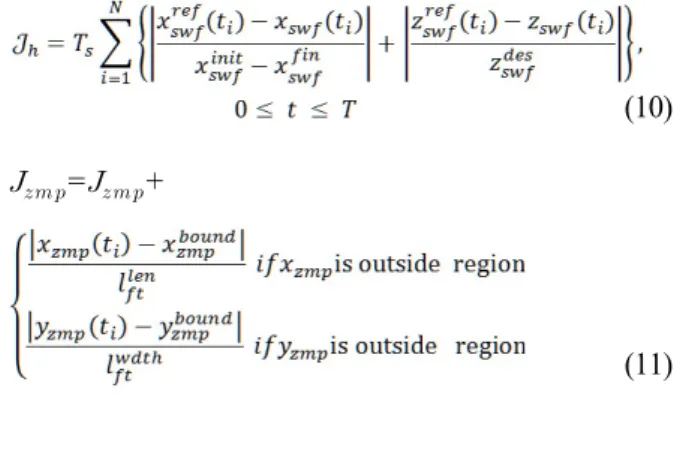
In order to make stable biped walking of Argentina tango cost function is designed as follows considering the cost conditions1).
(8) Cost Condition 1. Angles of both knees always should keep positive in order to avoid damage of joints and disgusting movement of arms and legs.
(9)
Cost Condition 2. Swing foot should keep the reference trajectory in the sagittal and coronal plane for the stable step.
Cost Condition 3. Reference trajectory of ZMP should be located in the sole region for the stability of biped humanoid robot.
(10)
= +
(11)
5. Simulation
In this paper, Argentina tango walking are simulated using the proposed humanoid robot made in Simscape.
The step length is 5 cm, and the center of pelvis is located ahead of legs’ center. The robot leans its upper body forward by 5 degrees in walking under the given
conditions in Chapter 4. The cycle period is 1 second.
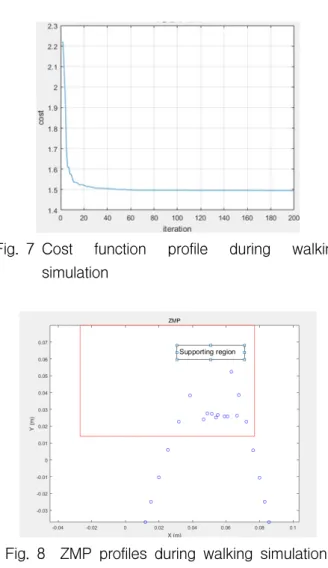
Fig. 6 shows the successive 3D view of humanoid robot in Argentina tango walking when the left foot is supported. Fig. 7 shows the search feature of PSO performed on the proposed humanoid robot when Walking Condition 1~4 and Cost Condition 1~3 are given. PSO succeeds in finding local minimum within about 40 iterations.
Fig. 7 Cost function profile during walking simulation
Fig. 8 ZMP profiles during walking simulation.
Fig. 9 Joint angle trajectories of legs in sagittal plane
Fig. 8 shows that ZMP profiles are located inside supporting area during single support phase. ZMP profiles outside supporting area in Fig. 8 represent profiles during double supporting area and are naturally located inside double supporting area as shown in Fig.5 (b). Joint angle trajectories and torque profiles of legs in sagittal plane are shown in. Fig. 9 and Fig. 10, respectively. The joint angle and torque of legs in sagittal plane remains in permissible motor angle and torque range, respectively.
Fig. 10 Torque profiles of leg joints in sagittal plane
6. Conclusion
The mechanical design and biped walking of the humanoid robot for Argentina tango is presented in this paper. To implement Argentina tango dancer-like walking with humanoid robot, trajectory generation schems represented by blending polynominals is presented. Their parameters are determined based on PSO(particle swarm optimization) according to some conditions which make the most of Argentina tango’s characterists. For the stability of biped walking, ZMP(zero moment point) control method is adopted.
The feasibility of the proposed scheme is validated by simulating biped walking with the 3D Simscape robot model.
Acknowledgement
This work was supported by a Research Grant of Pukyong National University(2015Year).
References
1) H. B. Wang, J. Y. Lu and Z. S. Yuan, "Analysis and Design of Humanoid Robot Dance," Int. Conf.
on Intelligent Computation Technology and Automation, pp. 88-94, 2014.
2) http://www.tangoprinciples.org 3) http://www.robotis.com
4) S. Philippe, R. Mostafa, and B. Guy, “An anthropomorphic biped robot : dynamic concepts and technological design,” IEEE Transactions on Systems, Man, and Cybernetics--Part A : Systems and Humans, “ Vol.28, No.6, pp.823-838, 1998.
5) http://www.solidworks.co.kr 6) http://mathworks.co.kr
7) Q. Huang, K. Yokoi, S. Kajita and K. Tanie,
“Planning Walking Patterns for a Biped Robot,”
IEEE Trans. Robotics and Automation, Vol.17, No.3, pp.280-289, 2001
8) M. Vukobrativic and B. Borovac, “Zero-moment point thirty five years of its life,” Int. J. of Humanoid Robotics, Vol.1, No.1, pp.157-173, 2004 9) J. W. Kim, “Online Joint Trajectory Generation of
Human-like Biped Walking,” Int. J. of Advanced Robotic Systems, Vol.11, No.19, pp1-12, 2014 10) J. Kennedy, and R. Eberhart,“Particle Swarm
Optimization,” IEEE Int. Conf. on Neural Network, Vol.4, pp.1942-1948, 1995
11) J. W. Kim, Humanoid Robot Robotis OP, Hong Reung Scientific Publishing Co., Seoul, pp366-382, 2015