Vol. 21, No. 5, pp. 41-47, October 2017
Optimal Trajectory Modeling of Humanoid Robot for Argentina Tango Walking
Doo-Sung Ahn*
(Received 17 July 2017, Revision received 30 September 2017, Accepted 10 October 2017)
Abstract: To implement Argentina tango dancer-like walking of the humanoid robot, a new trajectory generation scheme based on particle swarm optimization of the blending polynomial is presented. Firstly, the characteristics of Argentina tango walking are derived from observation of tango dance. Secondly, these are reflected in walking pose conditions and cost functions of particle swarm optimization to determine the coefficients of blending polynomial. For the stability of biped walking, zero moment point and reference trajectory of swing foot are also included in cost function. Thirdly, after tango walking cycle is divided into 3 stages with 2 postures, optimal trajectories of ankles, knees and hip of lower body, which include 6 sagittal and 4 coronal angles, are derived in consequence of optimization. Finally, the feasibility of the proposed scheme is validated by simulating biped walking of humanoid robot with derived trajectories under the 3D Simscape environment.
Key Words:Humanoid robot, Particle swarm optimization, Argentina tango, Biped walking, Blending polynomial
* Doo-Sung Ahn(corresponding author) : Department of Mechanical Design Engineering, Pukyong National University.
E-mail : [email protected], Tel : 051-629-6154
― Nomenclature ―
, , : sagittal, coronal and transverse angle[rad]
: velocity and position of k-th agent [m/sec]
: each agent’s best position
: population’s global best position
: cost function for optimization of ready posture and dance walking
,: x-coordinate of the center of robot’s pelvis and the foot center of front leg[m]
: x, z-coordinates of the foot center of free (back) leg [m]
, : distance of step and stride [m]
: reference trajectory of swing foot
: zmp trajectory of robot
: relative location of pelvis’ center [m]
: standing posture and ready posture
Superscripts
: left, right
Subscripts
: ankle, knee, hip, shoulder, elbow, wrist and neck
1. Introduction
Robot dance is one of most challenging topics in
the area of humanoid robot. The common approach in design and implementation of robot dance is to mimic human movement. To imitate dancer’s motion, the method using a motion capture system1,2) has been used largely until now. But this method requires highly expensive equipments and tedious time-consuming mapping operations between human and humanoid motion to resolve problems resulting from the differences of size and structure.
The goal of this study is to propose a new method which enables a humanoid robot to imitate Argentina Tango3) dance without highly expensive equipments. This scheme is based on particle swarm optimization of the blending polynomials which represent joint trajectories. The key idea is that the characteristics of Argentina tango walking are reflected in walking pose conditions and cost functions in the process of optimization.
This paper is consisted of six sections; Section 2 explains the characteristic of Argentina tango walking Section 3 presents the kinematic model of humanoid biped robot, including a whole-body model of the humanoid. Section 4 provides optimal trajectory modeling scheme presented in this paper for Argentina tango walking. Section 5 shows simulations of humanoid robot walking and Section 6 makes a conclusion of the present work and introduces future research topics.
2. Characteristics of Argentina tango walking
Argentine Tango is a partner dance that developed over the last century in Argentina's capital city, Buenos Aires as in Fig. 1. It is an interpretive, improvisational social dance that allows the dancers to develop a deep connection between themselves, the music, and the environment in which they are dancing. The Argentina Tango was inscribed in 2009 on the Representative List of the Intangible Cultural Heritage of Humanity.
Fig. 1 Argentina tango
Walking is basic to most Argentina tango step patterns. In tango, most of the time entire weight will be on one leg. Normally there’s no hopping in tango, meaning: dancers always step with their free foot, i.e. the one they are not standing on. Some important characteristics are as follows :
- Dancer’s posture of the upper body is as perfect as can be and nothing ever needs to change there, except for dissociation,
- Let’s never fall into a step. That means a tango dancer simply can't trip. This is the main difference with normal walking, and this is also why tango-walking is cat-like.
- Because dancer’s hip remain horizontal. he can't step with a stretched standing leg.
- Dancers have to “arm” themself for a step, by bending the knee of the standing leg. The amount of bending in standing knee will dictate the length of a step, and the free leg will want to remain stretched.
- When unbending the knee of the standing leg, walking is over. The step itself is carried out by typically reaching still a bit farther with the free foot and now landing and transferring weight in a controlled fashion. Hips, chest and head travel the exact same distance.
3. Kinematic model of humanoid biped robot
An biped robot is designed by Solidworks4),
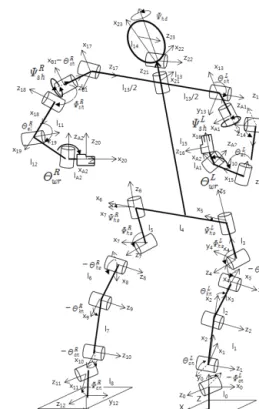
which is based on DARWIN-OP5) developed by Robotis Ltd. Then it is transformed into Simscape6) model which will be used in simulation, as shown in Fig. 2.7) This original robot is 45 cm tall, weighs 2.8kg, and has 20 DOF. It has 11 DOF in the sagittal plane, 6 DOF in the coronal plane and 3 DOF in the transverse plane. For the dance of Argentina Tango, 20 DOF is not sufficient. As shown in Fig. 3, additional 4 DOF in upperbody,
(2 DOF for each wrist and 2 DOF for should) are supplemented for the need of embracing a partner.
(a) DARWIN-OP (b) Simscape model Fig. 2 DARWIN-OP and Simscape model
The center of mass is positioned in the center of its pelvis for adequate balancing and proper distribution of inertia moment during gait. Fig. 3 illustrates the proposed humanoid model described in the three dimension when left leg is supported.
There are three types of angles in the model; (sagittal angle), (coronal angle) and (transverse angle).
The sagittal angles
and are the joint angles that make a robot move forward and backward swing in the x direction, where the subscripts stand for ankle, knee, hip, shoulder, elbow, wrist, neck and the superscripts represent left and right, respectively.
The origin is at the center of the current support foot, the X-axis is forward walking direction, the Z-axis is perpendicular to the ground.
Fig. 3 Kinematic model of the humanoid robot
4. Optimal trajectory modeling for Argentina tango walking
4.1 Particle swarm optimization(PSO) PSO8) is a global optimization method inspired by the social activities of herds of birds and schools of fish, which frequently share their information on food and messages, whose equations are written as below
⋯
where and show the current velocity and position vector of the k-th agent, while and
are the next velocity and position vectors determined after iterations based on each agent’s best position vector and the population’s
global best position vector The coefficients ,
and w denote two weight factors linked with the search history and inertial weight, respectively. and are between 0 and 1 random numbers uniformly distributed.
4.2 Gate cycle of biped tango walking
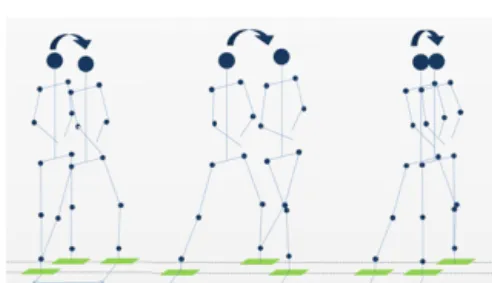
Fig. 4 Initial, periodic and final walking
A gate cycle suitable for Argentina tango walking is proposed with three stages shown in Fig. 4 in case of left-leg supporting. In the first stage, initial walking is headed starting from Standing Posture(SP) to Ready Posture(RP) by moving right foot with step distance . In the second stage, periodic walkng is alternatively processed between left-support RP and right-support RP by moving free leg with stride distance . In the third stage, final walking is performed returning from RP to SP.
4.3 Optimization of Joint angle trajectory 4.3.1 Optimization of RP
Because RP keeps step size between the center of front foot and that of the back foot in double support and requires the condition the foot of moving leg makes contact with ground, cost function for RP is determined as follows.
(2)
Where are x-coordinate of the center of robot’s pelvis, x- and z-coordinates of the foot center of free(back) leg, respectively. is x-coordinate of the foot center of front leg. is relative location of pelvis’ center to the middle of both legs.
4.3.2 Optimization of biped walking For a natural and dancer-like walking, blending polynomial is adopted to represent joint angle trajectories, which uses cubic polynomial as each segment.9)10) Because the parameters to be optimized are so many, they must be reduced to obtain precise parameters efficiently using PSO. For the stable and natural walking in Argentine tango as discussed in Section 2, the following conditions about walking pose should be satisfied.
Walking Pose Condition 1 : Upperbody must be maintained to be vertical in the sagittal and coronal plane for the correct embracement
≤ ≤
(3)
Walking Pose Condtion 2 : The swing leg should be parallel to supporting leg in order to keep natural tango walking.
≤ ≤ (4)
Walking Pose Condtion 3 : The swing foot during walking should be above and parallel to ground in order to decrease possibility that the toe or heel of the swing foot bump into ground.
≤ ≤
(5)
Walking Condtion 4 : All the sagittal and coronal
joints of upperbody should keep the initial angles during dancing of Argentine tango.
≤ ≤
(6)
In order to make stable biped walking of Argentina tango cost function is designed as follows considering the cost conditions.
(7) Cost Function 1. Angles of both knees always should keep positive in order to avoid damage of joints and disgusting movement of arms and legs.
i f ≻
or ≺
i f ≻
≺
(8)
Cost Function 2. Swing foot should keep the reference trajectory in the sagittal and coronal plane for the stable step.
(9)Cost Function 3. Reference trajectory of ZMP11) should be located in the sole region for the stability of biped humonoid robot
if
if
(10)
5. Simulation
In this reserach, Argentina tango walking are
simulated using the proposed humanoid robot made in Sinscape.12)13) The step length is 5 cm and upperbody keeps vertical in walking under the conditions given in Section 4. The cycle period is 1 second. Biped walking begins from SP and then returns to SP via RP. Fig. 5 shows SP and RP. In SP all angles of lowerbody is zeros. RP is obtained in case of =0.7 which means pelvis’center is located a little close to back foot.
(a) Standing Posture (b) Ready Posture Fig. 5 Standing and Ready Posture
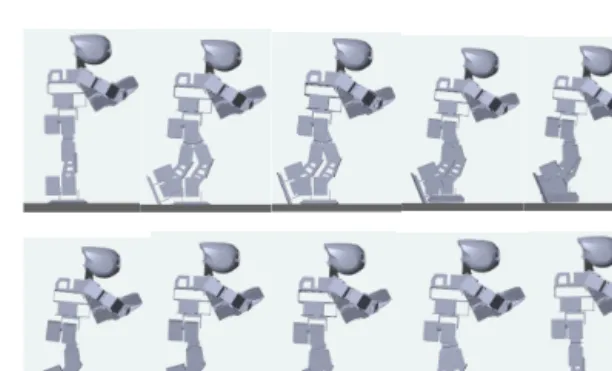
Fig. 6 shows the successive 3D view of humanoid robot in Argentina tango walking when the left foot is supported, reflecting charactericts discussed in Section 2, from SP to SP, via RP.
Fig. 6 Successive 3D view of humanoid robot
Fig. 7 shows cost function profiles during optimization of Ready Posture and trajectories of periodic tango walking. Joint angle trajectories of legs in sagittal and coronal plane are shown in. Fig.
8 and Fig. 9, respectively. Fig. 10 shows trajectories of swing foot in x-z plane.
(a) Ready Posture
(b) Biped walking
Fig. 7 Cost function of optimization
Fig. 8 Sagittal angle trajectories of legs
Fig. 9 Coronal angle trajectories of legs
Fig. 10 Trajectories of swing foot
6. Conclusions
To implement Argentina tango dancer-like walking with humanoid robot, a new trajectory generation scheme represented by blending polynomals is presented. Firstly, tango walking cycle is divided into 3 stages with 2 postures. Two postures (SP,RP) and parameters of blending polynomials at biped walking are determined based on PSO according to some conditions which make the most of Argentina tango’s characteristics. For the stability of biped walking, ZMP and reference trajectory of swing foot are included in cost function. The feasibility of the proposed scheme is validated by simulating biped walking with the 3D simscape robot model.
Acknowledgement
This work was supported by a Research Grant of Pukyong National University (2016 Year).
References
1. S. Nakaoka, A. Nakazawa, F. Kanehiro, K.
Kaneko, M. Morisawa and K. Ikeuchi, 2005,
"Task Model of Lower Body Motion for a Biped Humanoid Robot to Imitate Human
Dances", IEEE/RSJ Int. Conf. on Intelligent Robots and Systems Intelligent, pp. 3157-3162.
2. N. Shikanai, W. Choensawat, K. hachimura, 2014, "Movement Characteristics of entire bodies in dancers’ interaction", 14th Int. Conf.
on Control, Automation and Systems, pp.
1357-1361.
3. http://www.tangoprinciples.org.
4. http://www.solidworks.co.kr.
5. http://www.robotis.com/index/product.php?cate_
code=131210.
6. http://www.mathworks.co.kr.
7. D. S. Ahn, 2016, "Biped Walking of the Humanoid Robot for Argentina Tango", Journal of Drive and Control, Vol. 13, No. 4, pp. 52-58.
8. J. Kennedy, and R. Eberhart, 1995, "Particle Swarm Optimization", IEEE Int. Conf. on Neural Network, Vol. 4, pp. 1942-1948.
9. J. W. Kim, 2014, "Online Joint Trajectory Generation of Human-like Biped Walking", Int.
J. of Advanced Robotic Systems, Vol. 11, No.
19, pp. 1-12.
10. J. W. Kim, 2015, "Humanoid Robot Robotis OP", HongReung Scientific Publishing Co., Seoul, pp. 366-382.
11. M. Vukobratovic and B. Borovac, 2004,
"Zero-moment point thirty five years of its life", Int. J. of Humanoid Robotics, Vol. 1, No. 1, pp. 157-173.
12. D. S. Ahn, 2015, "Integrated Solidworks &
Simscape Platform for the Model-Based Control Algorithms of Hydraulic Manipulators", Journal of Drive and Control, Vol. 12, No. 4, pp. 41-47.
13. D. S. Ahn, 2014, "Integrated Solidworks &
Simscape Platform for the Model-Based Control Algorithms of Robot Manipulators", Journal of KSPSE, Vol. 18, No. 4, pp. 91-96.