일반농장과 동물복지농장 닭의 혈액 내 gas, 생화학인자, 호르몬 농도 및 근육 내 스트레스 반응인자 비교*
1)
김희은
**․박진룡
***․이정은
***․강다래
****․장애라
*****․최호성
******․심관섭
******Comparison of Blood Gas, Biochemical Factors, and Hormone Concentrations, and Muscle Stress Response Factors of Chickens in
General Farms and Animal Welfare Farms
Kim, Hee-Eun․Park, Jin-Ryong․Lee, Jeong-Eun․Kang, Da-Rae․
Jang, Ae-Ra․Choe, Ho-Sung․Shim, Kwan-Seob
It is generally recognized that high stocking density can increase the risk of immune dysfunction and reduction in productivity cause of elevated stress in broiler farm. The domestic livestock industry is implementing a certification system for animal welfare and livestock farms to reduce the problem of dense breeding. This study compared broiler from the general farm and animal welfare farm to confirm the effectiveness of animal welfare farms against stress. Gas concentrations in a farm of general and animal welfare farms were analyzed, blood (n=10) of the 28-day-old broiler was collected, the partial pressure of the gas in the blood was analyzed using whole blood, and biochemical factors and hormones were analyzed using the serum. Glycogen and L-lactate are analyzed using ELISA kit on finely pulverized muscles (n=10). CO
2and NH
3levels in the farm were significantly higher in general farm. Partial carbon dioxide tension (PCO
2) in blood was significantly higher and partial oxygen tension (PO
2) was significantly lower in the general farm. Creatinine (CREA), glucose (GLU), aspartateaminotransferase
******
본 연구는 농림축산식품부의 재원으로 농림식품기술기획평가원의 농생명산업기술개발사업의 지
원을 받아 연구되었음(318022-04-2-CG000).
******
전북대학교 농축산식품융합학과 석사과정
******
전북대학교 축산학과 박사 수료, 석사과정
******
전북대학교 동물생명공학과 박사
******
강원대학교 동물응용과학과 교수
******
Corresponding author, 전북대학교 동물생명공학과, 농축산식품융합학과 교수([email protected],
[email protected])
(AST), and creatinekinase (CK) in the blood were significantly higher in the general farm, and total protein (TP) and globulin (GLOB) were significantly higher in animal welfare farm. Blood corticosterone and norepinephrine were significantly higher in general farm and epinephrine was significantly higher in animal welfare farm. These results imply that animal welfare farm provides a stress-reduced breeding environment.
Key words : animal welfare, blood, broiler, muscle, stress
Ⅰ. 서 론
가금 산업은 경제적인 이익을 위해 고밀도의 사육방식을 추구해왔다(Tomhave and Seeger, 1945). 하지만 사육 밀도가 증가하면 농장 내부의 유해가스 발생이 증가되며, 가축의 스트 레스를 유발하고 면역력을 저하시켜 전염병에 취약하게 만드는 등, 건강에 부정적인 영향 을 미친다(Shin et al., 2004; An et al., 2012). 이처럼 밀집 사육의 문제점과 소비자들의 안전 한 식품에 대한 관심이 높아짐에 따라 동물복지에 대한 관심이 증가하였다(Kim et al., 2018).
스트레스는 척추동물의 시상하부-뇌하수체-부신 축(HPA axis; hypothalamic-pituitary-adrenal axis)을 활성화시켜 스트레스 호르몬인 corticosterone을 혈액으로 방출시킨다(Micale and Drago, 2018). 이렇게 증가한 corticosterone은 갑상선 손상, 면역체계의 문제를 일으키는 등 전반적인 생체 기능에 부정적인 영향을 미친다(Selye, 1950; Roussel et al., 2004; Lee et al., 2007). 또한 스트레스는 육계의 사료 섭취량을 감소시켜 영양소 공급에 문제가 생기며, 이 를 해결하기 위해 성장과 면역반응에 이용되는 영양소를 공급하면 체내의 단백질과 지방을 분해하여 생산성이 감소한다(Bains 1996; Mashaly et al., 2004). 이와 같은 가축의 생산성, 건 강 및 안정성 문제를 해결하기 위해서는 가축의 스트레스를 줄이는 것이 중요하다. 국내에 서는 동물복지 축산농장 인증제를 2012년부터 시행하며, 동물복지 사육을 통한 동물의 스 트레스 감소를 기대하고 있다(Yoon et al., 2018). 국내의 동물복지 연구는 동물복지의 개념, 국내외 문헌비교를 통해 정책에 적용하는 위주로 수행되었으며(Na, 2014), 복지농장의 가축 이 스트레스가 적다는 것을 과학적인 지표를 분석하여 확인한 이화학적인 연구는 거의 없 는 상황이다.
따라서 본 연구는 일반농장과 동물복지농장의 gas 농도, 육계의 혈액 내 gas 분압, 호르 몬, 생화학인자 및 근육 내 glycogen과 L-lactate 함량을 비교하여, 육계의 스트레스에 대한 동물복지농장의 효과를 확인하고자 한다.
Ⅱ. 재료 및 방법
1. 공시재료본 연구에 이용된 공시재료는 일반농장(0.04 m2/수, 전북 정읍)과 동물복지농장(0.06 m2/ 수 전북 부안)의 28일령 육계(cobb)의 혈액을 각 처리구당 10수씩 경정맥에서 채취하여 혈 액 내 gas 분압 분석을 위해 전혈은 EDTA tube에 수집하여 분석에 사용하였고, 호르몬과 생화학 인자 분석을 위해 micro centrifuge tube에 수집하여 원심분리(3,000 rpm, 4℃, 10 min) 하여 혈청을 분석에 사용하였다. 근육은 ㈜하림에서 일반 및 동물복지농장의 닭을 각 10수 씩 구입하였다. 정읍 도계장에서 도계 후 실험실로 이동하여 가슴육을 분리 및 액체질소로 분쇄 후 -80℃에 보관하였다.
2. 농장 내 Gas (CO2, NH3) 분석
CO2와 NH3는 농장을 9구획(전, 중, 후 × 좌, 중, 우)으로 나누어 측정하였다. CO2는 Telaire 7001 CO2 Sensor을 농장 바닥에 약 30초간 놓고 측정하였고, NH3는 기체 채취기 GV-100S (GASTEC Corporation, japan)에 Ammonia detector tube 3La (GASTEC Corporation, Japan)을 끼우고 닭의 머리 높이에서 측정하였다.
3. 혈액 내 PCO2, PO2 분석
혈액 내 이산화탄소 분압(PCO2; partial carbon dioxide tension)과 산소 분압(PO2; partial oxygen tension)은 채혈 직후의 전혈을 이용하여 분석하였다. 분석에는 Nova Profile pHOx Ultra (Nova Biomedical Corp, Waltham, MA, USA)을 사용하였다.
4. 혈액 내 호르몬 분석,
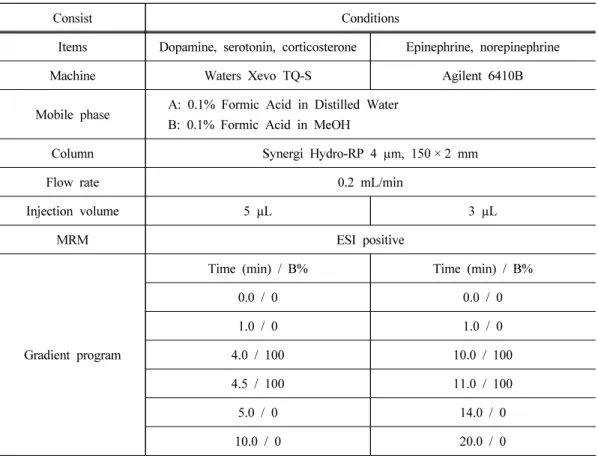
혈액 내 호르몬 분석은 혈청을 메탄올에 혼합하여 -20℃에서 1시간 보관 후 원심분리 (13,000 rpm, 4℃, 10 min)하여 수거한 상층액을 LC-MS/MS를 이용하여 수행하였다. 각각의 표준물질은 Sigma (St. Louis Missouri, USA)에서 구입하여 사용하였고, dopamine, serotonin 및 corticosterone은 Water xevo TQ-S, epinephrine 및 norepinephrine은 Agilent 6410B로 분석 하였으며, 분석조건은 Table 1과 같다.
Table 1. LC-MS/MS condition for dopamine, serotonin, corticosterone, epinephrine and norepinephrine
Consist Conditions
Items Dopamine, serotonin, corticosterone Epinephrine, norepinephrine
Machine Waters Xevo TQ-S Agilent 6410B
Mobile phase A: 0.1% Formic Acid in Distilled Water B: 0.1% Formic Acid in MeOH
Column Synergi Hydro-RP 4 µm, 150 × 2 mm
Flow rate 0.2 mL/min
Injection volume 5 µL 3 µL
MRM ESI positive
Gradient program
Time (min) / B% Time (min) / B%
0.0 / 0 0.0 / 0
1.0 / 0 1.0 / 0
4.0 / 100 10.0 / 100
4.5 / 100 11.0 / 100
5.0 / 0 14.0 / 0
10.0 / 0 20.0 / 0
5. 혈액 내 생화학인자 분석
혈청 내 alkaline phosphatase (ALP), total protein (TP), total bilirubin (T-BIL), creatinine (CREA), cholesterol (CHOL), triglyceride (TG), uric acid (UA), alanine aminotransferase (ALT), albumin (ALB), blood urea nitrogen (BUN), glucose (GLU), aspartate aminotransferase (AST), creatine kinase (CK) 및 globulin (GLOB)은 Hitachi 7180 automatic analyzer (Hitachi Ltd., Tokyo, Japan)을 이용하여 분석하였다.
6. 근육 내 glycogen 및 L-lactate 분석
근육 내 glycogen과 L-lactate 함량은 닭 가슴육을 액체질소를 이용하여 잘게 분쇄하여, Glycogen ELISA kit (Abcam, #ab65620)와 L-lactate ELISA kit (Abcam, #ab65330)을 이용하여 분석하였다.
7. 통계 분석
본 실험의 결과는 SAS 9.4 software program (SAS Institute Inc, USA)의 Student’s t-test로 처리 간에 유의성 검정을 실시하였다. 모든 통계 수치는 평균값과 표준오차로 나타내었으 며, 유의 수준은 P<0.05, P<0.01로 설정되었다.
Ⅲ. 결과 및 고찰
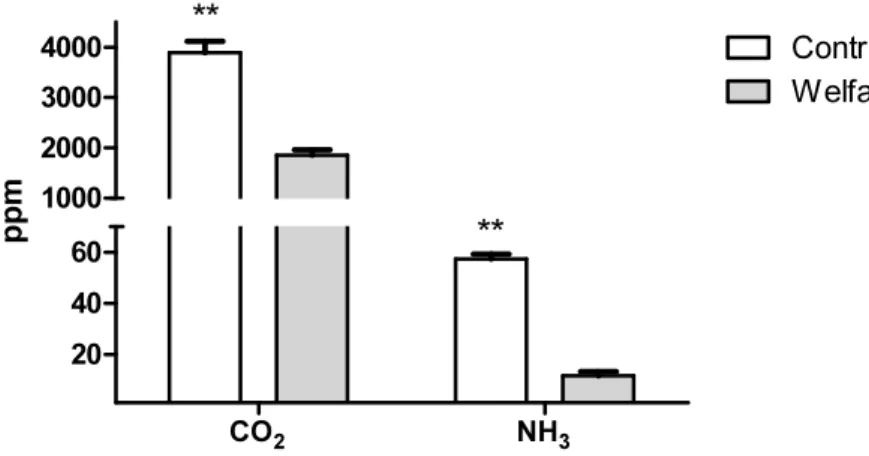
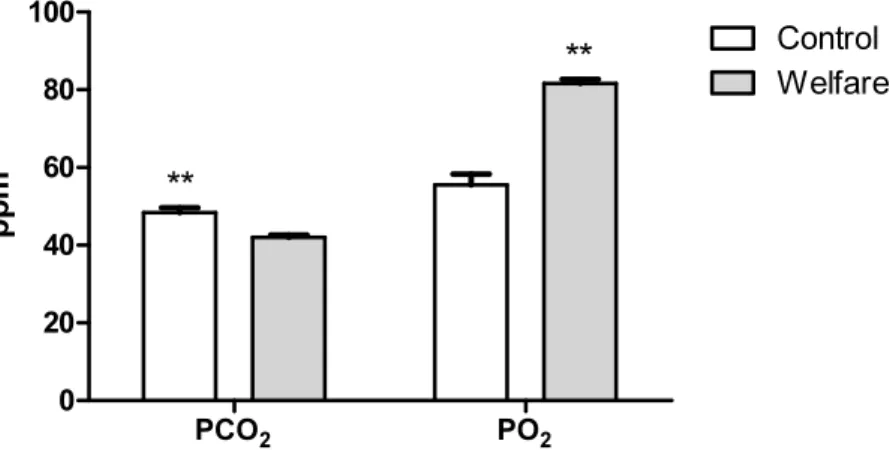
1. 농장 내 gas 농도 및 혈액 내 gas 분압일반 및 동물복지농장의 농장 내 gas 농도와 육계 혈액 내 gas 분압은 각각 Fig. 1과 Fig.
2에 나타내었다. 농장 내 CO2와 NH3 농도는 모두 일반농장에서 유의하게 높았다(Fig. 1, P<0.01). 혈액 내 PCO2는 일반농장에서 높았으며(Fig. 2, P<0.01), PO2는 동물복지농장에서 유의하게 높았다(Fig. 2, P<0.01).
농장의 밀집도는 농장 내 CO2, NH3 농도에 영향을 준다. 농장의 밀집도가 높아지면 NH3
의 발생이 증가하여 농장 내 NH3 농도가 높아진다(Cai et al., 2009). 높은 농도의 NH3는 체 내 활성산소를 증가시켜 면역력을 저하시키며, 가축과 농장 노동자의 건강에 부정적인 영 향을 미친다(Donham et al., 1989; An et al., 2012). 또한 높은 밀집도로 인해 농장 내부 온도 가 상승하면 체온을 낮추기 위해 혈관이 팽창하고, 체온 조절을 위해 혈액의 산소 소모량 이 증가한다(Tan and Knight, 2018). 높아진 산소 소모량은 호흡수를 증가시켜, 농장 내 CO2
CO
2NH
320 40 60 1000 2000 3000 4000
Welfare Control
**
**
ppm
Fig. 1. Gas concentration in farm. Asterisk represent statistically significant differences among the treatments (**P < 0.01).
PCO
2PO
20
20 40 60 80 100
Welfare Control
**
**
ppm
Fig. 2. Partial pressure of gas in blood. Partial carbon dioxide tension (PCO2), partial oxygen tension (PO2). Asterisk represent statistically significant differences among the treatments (**P < 0.01).
농도가 높아지게 된다(Lasiewski, 1969). 공기 중의 높은 CO2 농도는 체내로 흡입되는 CO2
를 증가시키며, 뇌의 일시적인 산성화를 일으켜 호흡 횟수, 흥분, 불안을 증가시킨다(Battaglia, 2017). 흥분, 불안과 같은 스트레스는 폐포와 모세혈관의 세포막에 손상을 주며, 국소 혈액 순환과 환기 사이의 조정력 저하 및 폐 확산 용량 감소가 발생하며, 혈액 내 PO2를 감소시 킨다(Meerson et al., 1989).
본 연구에서는 일반농장에서 CO2와 NH3의 농도가 높았는데, 이는 일반농장의 밀집도가 더 높았기 때문이라고 판단되며, 일반농장의 육계에서 PCO2가 높은 것은 농장 내 높은 농 도의 CO2로 인해 체내로 흡입되는 CO2가 증가한 것으로 판단된다. PO2가 일반농장에서 낮 은 것은 일반농장의 육계가 더 많은 스트레스를 받았기 때문이라고 판단된다.
2. 혈액 내 호르몬
Fig. 3은 혈액 내 호르몬 분석 결과를 나타내었다. Dopamine과 serotonin은 처리구간 유의 차가 없었으며, 스트레스 호르몬으로 알려진 corticosterone은 일반농장에서 유의하게 높았 다(P<0.01). Epinephrine은 일반농장에서 낮았으며(P<0.01), norepinephrine은 일반농장에서 유 의하게 높았다(P<0.05).
Dopamine과 serotonin은 모두 긍정적인 기분과 관련된 호르몬이다. 뇌의 dopamine 수치가 증가하면 긍정적인 기분과 관련이 있으며, 부정적인 기분은 낮은 dopamine 수치와 관련이 있다(Ashby and Isen, 1999). Serotonin은 만족, 행복 및 낙관주의를 매개하는 신경 전달물질 로 수치가 증가하는 경우 긍정적인 기분과 관련이 있으며(Mitchell and Phillips, 2007), 우울
Dopamin
Serotonin
Corticosterone Epinep
hrine Nore
pine phrine
0.000
0.005 0.010 0.015 0.020 0.025 1 2 3 4 100 200 300 400
Welfare Control
**
*
*
C o n cen tr at io n ( u g /100m l)
Fig. 3. Dopamine, serotionin, corticosterone, epinephrine and norepinephrine level in serum.
Asterisk represent statistically significant differences between the treatments (*P <
0.05, **P < 0.01).
증일 경우 수치가 감소한다(Dfarhud et al., 2014). 하지만 Roth 등(1982)은 반복되는 스트레 스가 dopamine과 serotonin 또는 그들의 대사 산물에 거의 영향을 끼치지 않았다고 보고하 였으며, 본 연구에서 이와 유사한 경향을 보였다.
Corticosterone은 glucocorticoid hormone으로 부신에서 방출되며, 스트레스에 노출된 후 순 환 수준이 높아진다(Kant et al., 1987; de Kloet, 1991; Dobrakovová et al., 1993; Vallée et al., 1996). 스트레스는 시상하부-뇌하수체-부신 축(HPA axis; hypothalamic-pituitary-adrenal axis) 을 활성화시켜 corticosterone을 부신 피질에서 혈액으로 방출하여 혈중 농도를 증가시킨다.
또한 교감 아드레날린계(sympathetic-adrenergic system)를 활성화시켜 부신 수질과 신경 말 단에서 혈류로 epinephrine과 norepinephrine을 방출시킨다(Kvetnansky et al., 1978; Siegel, 1980; Elnagar et al., 2010; Micale and Drago, 2018). 본 연구에서 corticosterone과 norepine- phrine은 일반농장에서 높았으므로 일반농장의 육계가 더 많은 스트레스를 받은 것으로 판 단되지만, epinephrine은 동물복지농장에서 높았으므로 추가적인 연구가 필요하다.
4. 혈액 내 생화학인자
Table 2는 혈액 내 생화학 인자를 분석한 결과이다. 혈중 CREA, GLU, AST, CK는 일반 농장에서 유의하게 높았으며(P<0.05), TP와 GLOB는 동물복지농장에서 높았다(P<0.05). ALP, T-BIL, CHOL, TG, UA, ALT, ALB 및 BUN은 처리구간 유의한 차이가 없었다.
Table 2. Blood biochemical parameters of experimental groups
Items
Treatment
Control Welfare
ALP (U/l) 3485.71 ± 14.29 3300.00 ± 144.75
TP (g/dl) 2.57 ± 0.06 3.00 ± 0.08
**T-BIL (mg/dl) 0.20 ± 0.04 0.13 ± 0.02
CREA (mg/dl) 0.27 ± 0.02
*0.21 ± 0.01
CHOL (mg/dl) 96.00 ± 7.10 99.14 ± 6.56
TG (mg/dl) 74.86 ± 11.74 60.86 ± 8.15
UA (mg/dl) 7.30 ± 0.76 5.73 ± 0.48
ALT (U/l) 9.29 ± 1.87 5.43 ± 0.87
ALB (g/dl) 0.77 ± 0.04 0.86 ± 0.07
BUN (mg/dl) 2.50 ± 0.18 2.14 ± 0.07
GLU (mg/dl) 293.43 ± 11.36
**226.00 ± 9.63
AST (U/l) 220.43 ± 26.75
*134.14 ± 23.21
CK (U/l) 2004.29 ± 178.95
**913.86 ± 193.25
GLOB (mg/dl) 1.80 ± 0.03 2.14 ± 0.04
**Note: 1. Values are presented as mean ± SE, Control (n=10), Welfare (n=10).
2. Asterisk represent statistically significant differences between the treatments (*P<0.05, **P<0.01). ALP:
alkaline phosphate, TP: total protein, T-BIL: total bilirubin, CREA: creatinine, CHOL: choleterol, TG:
triglyceride, UA: uric acid, ALT: alanine aminotransferase, ALB: albumin, BUN: blood urea nitrogen, GLU: glucose, AST: aspartate aminotransferase, CK: creatine kinase, GLOB: globulin
Corticosterone은 단백질 분해 호르몬으로 작용하며 포도당 신생합성(gluconeogenesis) 반 응을 일으킨다(Khan et al., 2002; Lin et al., 2004; Kataria et al., 2008). 따라서 혈중 corticosterone이 증가하면 혈액 중 TP는 감소하며, GLU는 증가한다. 혈액 내 GLOB는 주로 만성 스트레스에 반응하며, 스트레스로 corticosterone이 증가함에 따라 GLOB는 감소한다 (Attia et al., 2019). 혈중 GLOB는 세포에 작용하는 corticosterone의 양을 줄이는 역할을 하 여 혈액 내 corticosterone이 증가하면 GLOB는 감소한다(Breuner et al., 2006). 본 연구에서 일반농장 육계의 혈액 내 TP, GLOB는 낮았으며 GLU는 높았는데, 이는 일반농장의 육계에 서 corticosterone이 증가하였기 때문이라고 판단된다(Fig. 3, P<0.01).
혈중 CREA는 일반적으로 신장 기능을 확인하는 바이오 마커로 사용된다(Schneider et al., 2010). 혈액 내 CREA는 신장에 손상이 발생하는 경우 증가하게 된다. AST는 주로 간에서 발
견되는 효소로 혈중 AST 수치는 간 질환 진단에 사용된다(Goodla et al., 2017). 신체 조직이나 심장, 간과 같은 기관이 손상되면 AST가 혈류로 방출되어 혈중 AST 수치가 증가한다(Huang et al., 2006). 또한 혈중 AST는 스트레스 환경에서 증가하는 경향을 보인다(Sudhanshu, 2013). CK는 에너지 수요가 높은 조직의 세포질과 미토콘드리아에서 발견되며, 혈중 CK 수치는 근육 손상의 지표로 사용된다(Baird et al., 2012). CK는 스트레스에 노출되었을 때 근육에서 발생하는 ADP에서 ATP로의 가역적 전환의 증가로 인해 혈액 내 농도가 증가한 다(Hollands et al., 1980; Ostrowski-Meissner, 1981). 본 연구에서 혈중 CREA, AST 및 CK가 일반농장에서 높았던 것은 일반농장의 육계가 더 많은 스트레스를 받아서 발생한 현상이라 고 판단된다.
5. 근육 내 glycogen 및 L-lactate 함량
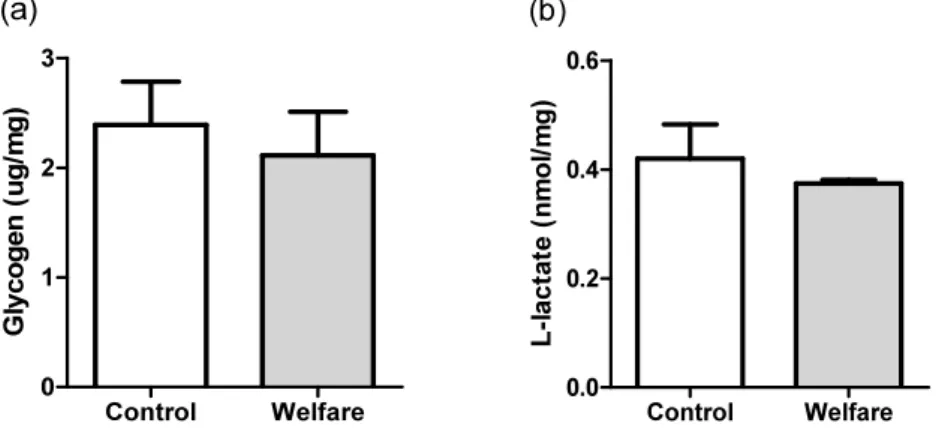
Fig. 4는 근육 내 glycogen과 L-lactate 함량 분석 결과이다. Glycogen과 L-lactate 모두 처리 구간 유의차가 없었다. 스트레스로 인해 부신 수질에서 epinephrine과 norepinephrine이 방출 되며, epinephrine은 간 및 근육 glycogen을 혈액으로 방출시켜 혈중 포도당, 젖산 농도를 상 승시킨다(Apple et al., 1995; Knowles and Warriss, 2007). 근육 내 L-lactate는 스트레스를 받 았을 때 증가하는 경향을 보인다(Hutchison and Turney, 1975). 당 분해는 사후에 매우 중요 한 대사경로로 근육의 혐기성 조건에서 lactate dehydrogenase (LDH)가 해당과정의 주요산물 인 pyruvate를 lactate로 전환시킨다(Zhang et al., 2012). LDH는 고온과 같은 스트레스 하에 서 활성이 높아지며, 근육 내 pyruvate를 lactate로 전환하는 비율을 증가시킨다(Zhang et al., 2012). 하지만 본 연구에서는 glycogen과 L-lactate 모두 유의한 차이가 없었다.
Control Welfare 0
1 2 3
(a)
Glycogen (ug/mg)
Control Welfare 0.0
0.2 0.4 0.6
(b)
L-lactate (nmol/mg)
Fig. 4. Glycogen (a) and L-lactate (b) content in muscle.
Ⅳ. 적 요
본 연구는 육계에서 동물복지농장의 스트레스 저감효과를 과학적인 지표를 통해 확인하 고자 시행되었다. 농장 내 gas 농도를 비교한 결과 일반농장에서 육계에 부정적인 영향을 미칠 수 있는 CO2와 NH3의 농도가 높았다. PCO2는 일반농장에서, PO2는 동물복지농장에서 유의하게 높았다. 일반농장의 육계에서 혈중 CREA, GLU, AST, CK가 유의적으로 높았으 며, TP, GLOB는 유의하게 낮았다. 또한 혈중 corticosterone과 norepinephrine이 일반농장에서 유의하게 높은 값을 나타내었다. 이러한 결과를 통해 동물복지농장에 비해 일반농장 육계 의 스트레스 수치가 더 높은 것으로 판단되며, 동물복지농장이 스트레스가 감소된 사양 환 경을 제공하고 있다는 것을 의미한다.
[Submitted, October. 14, 2020; Revised, January. 13, 2021; Accepted, August. 11, 2021]
References
1. An, Y. S., J. G. Park, I. S. Jang, S. H. Sohn, and Y. S. Moon. 2012. Effects of high stocking density on the expressions of stress and lipid metabolism associated genes in the liver of chicken. J. Life Sci. 22(12): 1672-1679.
2. Apple, J. K., M. E. Dikeman, J. E. Minton, R. M. McMurphy, M. R. Fedde, D. E. Leith, and J. A. Unruh. 1995. Effects of restraint and isolation stress and epidural blockade on endocrine and blood metabolite status, muscle glycogen metabolism, and incidence of dark-cutting longissimus muscle of sheep. J. Anim. Sci. 73(8): 2295-2307.
3. Ashby, F. G. and A. M. Isen. 1999. A neuropsychological theory of positive affect and its influence on cognition. Psychol. Rev. 106(3): 529-550.
4. Attia, Y. A., A. S. El-Naggar, B. M. Abou-Shehema, and A. A. Abdella. 2019. Effect of supplementation with trimethylglycine (betaine) and/or vitamins on semen quality, fertility, antioxidant status, DNA repair and welfare of roosters exposed to chronic heat stress.
Animals. 9(8): 547.
5. Bains, B. S. 1996. The role of vitamin C in stress management. World Poultry. 12(4): 38-41.
6. Baird, M. F., S. M. Graham, J. S. Baker, and G. F. Bickerstaff. 2012. Creatine-kinase-and exercise-related muscle damage implication for muscle performance and recovery. J. Nutr.
Metab. 2012.
7. Battaglia, M. 2017. Sensitivity to carbon dioxide and translational studies of anxiety disorders. Nueroscience. 346: 434-436.
8. Breuner, C. W., S. E. Lynn, G. E. Julian, J. M. Cornelius, B. J. Heidinger, O. P. Love, R.
S. Sprague, H. Wada, and B. A. Whiteman. 2006. Plasma-binding globulins and acute stress response. Horm. Metab. Res. 38(4): 260.
9. Cai, Y., Z. Song, X. Zhang, X. Wang, H. Jiao, and H. Lin. 2009. Increased de novo lipo- genesis in liceer contributes to the augmented fat deposition in dexamethasone exposed broiler chickens (Gallus gallus domesticus). Comp. Biochem. Physiol. C: Toxicol. Pharmacol.
150(2): 164-169.
10. de Kloet, E. R. 1991. Brain corticosteroid receptor balance and homeostatic control. Front.
Neuroendocrinol. 12(2): 95-164.
11. Dfarhud, D., M. Malmir, and M. Khanahmadi. 2014. Happiness & health: the biological factors-systematic review Article. Iran J. Public Health. 43(11): 1468.
12. Dobrakovová, M., R. Kvetňanský, Z. Opršalová, and D. Jeẑová. 1993. Specificity of the effect of repeated handling on sympathetic-adrenomedullary and pituitary-adrenocortical activity in rats. Psychoneroendocrinology. 18(3): 163-174.
13. Donham, K., P. Haglind, Y. Peterson, R. Rylander, and L. Belin. 1989. Environmental and health studies of farm workers in Swedish swine confinement buildings. Br. J. Ind. Med.
46(1): 31-37.
14. Elnagar, S., S. Scheideler, and M. Beck. 2010. Reproductive hormones, hepatic deiodinase messenger ribonucleic acid, and vasoactive intestinal polypeptide-immunoreactive cells in hypothalamus in the heat stress-induced or chemically induced hypothyroid laying hen. Poult.
Sci. 89(9): 2001-2009.
15. Goodla, L., M. Manubolu, K. Pathakoti, and P. R. Poondamalli. 2017. Preventive and curative effects of Cocculus hirsutus (Linn.) Diels leaves extract on CCl4 provoked hepatic injury in rats. Egyption J. Basic Appl. Sci. 4(4): 264-269.
16. Hollands, K. G., A. A. Grunder, C. J. Williams, and J. S. Gavora. 1980. Plasma greatine kinase as an indicator of degenerative myopathy in live turkeys. Br. Poult. Sci. 21(3):
161-169.
17. Huang, X. J., Y. K. Choi, H. S. Im, O. Yarimaga, E. Yoon, and H. S. Kim. 2006. Aspartate aminotransferase (AST/GOT) and alanine aminotransferase (ALT/GPT) detection techniques.
Sensors. 6(7): 756-782.
18. Hutchison, V. H. and L. D. Turney. 1975. Glucose and lactate concentrations during activity in the leopard frog, Rana pipiens. J. Comp. Physiol. 99(4): 287-295.
19. Kant, G. J., J. R. Leu, S. M. Anderson, and E. H. Mougey. 1987. Effects of chronic stress on plasma corticosterone, ACTH and prolactin. Physiol. Behav. 40(6): 775-779.
20. Kataria, N., A. K. Kataria, and A. K. Gahlot. 2008. Ambient temperature associated variations in serum hormones and interrelated analytes of broiler chickens in arid tract. Slov.
Vet. Res. 45(4): 127-134.
21. Khan, W., A. Khan, A. Anjuman, and Z. Rehman. 2002. Effects of induced heat stress on some biochemical values in broiler chicks. Int. J. Agric. Biol. 4: 74-75.
22. Kim, H. J., H. J. Kim, S. J. Oh, K. C. Nam, K. S. Shim, J. H. Jung, K. S. Kim, Y. I. Choi, S. H. Kim, and A. Jang. 2018. Comparison of quality and bioactive compounds in chicken thigh meat from conventional and animal welfare farm in Korea. Korean J. Poult. 45(4):
261-272.
23. Knowles, T. and P. Warriss. 2007. 19 Stress Physiology of Animals During Transport.
Livestock handling and transport. pp. 312-325.
24. Kvetnansky, R., C. Sun, C. Lake, N. Thoa, T. Torda, and I. Kopin. 1978. Effect of handling and forced immobilization on rat plasma levels of epinephrine, norepinephrine, and dopamine-β-hydroxylase. Endocrinology. 103(5): 1868-1874.
25. Lasiewski, R. C. 1969. Physiological responses to heat stress in the poorwill. American Journal of Physiology-Legacy Content. 217(5): 1504-1509.
26. Lee, S. H., J. H. Koo, Y. M. Lim, S. N. Kim, and Y. Heo. 2007. Preliminary investigation on effect of intense husbandry environment on serum Level of epinephrine, norepinephrine, and cortisol in pig or hen. Journal of Animal Experimental Alternative Law. 1(2): 55-59.
27. Lin, H., E. Decuypere, and J. Buyse. 2004. Oxidative stress induced by corticosterone administration in broiler chickens (Gallus gallus domesticus): 2. Short-term effect. Comp.
Biochem. Physiol. B. Biochem. Mol. Biol. 139(4): 745-751.
28. Mashaly, M. M., G. L. Hendricks, M. A, Kalama, A. E. Gehad, A. O. Abbas, and P. H.
Patterson. (2004). Effect of heat stress on production parameters and immune responses of commercial laying hens. Poult. Sci. 83(6): 889-894.
29. Meerson, F., T. Miniaĭlenko, V. Pozharov, and M. Seredenko. 1989. Disorders of external respiration and oxygen transport and utilization in stress. Patol. Fiziol. Eksp. Ter. (6): 20-26.
30. Micale, V. and F. Drago. 2018. Endocannabinoid system, stress and HPA axis. Eur. J.
Pharmacol. 834: 230-239.
31. Mitchell, R. L. and L. H. Phillips. 2007. The psychological, neurochemical and functional neuroanatomical mediators of the effects of positive and negative mood on executive functions. Neuropsychologia. 45(4): 617-629.
32. Na, I. J. 2014. Domestic animal welfare policy trend. World agriculture. 163: 91-103.
33. Ostrowski-Meissner, H. T. 1981. The physiological and biochemical responses of broilers exposed to short-term thermal stress. Comp. Biochem. Physiol. A. Physiol. 70(1): 1-8.
34. Roth, K. A., I. M. Mefford, and J. D. Barchas. 1982. Epinephrine, norepinephrine, dopamine and serotonin: differential effects of acute and chronic stress on regional brain amines. Brain Res. 239(2): 417-424.
35. Roussel, S., P. H. Hemsworth, A. Boissy, and C. D. Ponter. 2004. Effects of repeated stress during pregnancy in ewes on the behavioural and physiological responses to stressful events and birth weight of their offspring. Appl. Anim. Behav. Sci. 85(3-4): 259-276.
36. Schneider, J., R. Khemani, C. Grushkin, and R. Bart. 2010. Serum creatinine as stratified in the RIFLE score for acute kidney injury is associated with mortality and length of stay for children in the pediatric intensive care unit. Crit. Care Med. 38(3): 933-939.
37. Selye, H. 1950. Stress and the general adaptation syndrome. Br. Med. J. 1(4667): 1383- 1392.
38. Shin, C. L., K. S. Lee, K. R. Kim, T. S. Kang, and N. W. Paik. 2004. A study on exposure to organic dust and ammonia in poultry confinement buildings. Rural Medicine‧Community Health. 29(2): 303-314.
39. Siegel, H. S. 1980. Physiological stress in birds. Bioscience. 30(8): 529-534.
40. Sudhanshu, D. G. 2013. Assessment of liver damage in male albino rats after repetitive heat stress of moderate level. Nati. J. Physiol. Pharm. Phamacol. 3(2): 147-152.
41. Tan, C. L. and Z. A. Knight. 2018. Regulation of body temperature by the nervous system.
Neuron. 98(1): 31-48.
42. Tomhave, A. E. and K. C. Seegar. 1945. Floor space requirements of broilers.
43. Vallée, M., W. Mayo, S. Maccari, M. Le Moal, and H. Simon. 1996. Long-term effects of prenatal stress and handling on metabolic parameters: relationship to corticosterone secretion response. Brain Res. 712(2): 287-292.
44. Yoon, J., G. Kim, and S. Joung. 2018. An exploratory study on the animal welfare certified product. J. Conum. Stud. 29(3): 83-107.
45. Zhang, Z. Y., G. Q. Jia, J. J. Zuo, J. Lei, L. Ren, and D. Y. Feng. 2012. Effects of constant and cyclic heat stress on muscle metabolism and meat quality of broiler breast fillet and thigh meat. Poult. Sci. 91(11): 2931-2937.