Values of Winter Fallow Crops on Soil Properties and Watermelon Productivity in Plastic Greenhouse
Mi Jeong Uhm*, Hyong Gwon Chon, Jae Jong Noh, Young Ju Song, Sung Whan Kwon, and Sameena Sheikh
Jeollabuk-do Agricultural Research & Extension Services, Iksan 570-704, Republic of Korea
This study was performed to screen fallow crops during winter period for improvement of soil quality and utilizing as mulching material in watermelon cropping system during winter period. Five fallow crops, mainly, hairy vetch, barley, rye, oat and wheat, were sown in early November. They were mowed for covering the soil surface instead of polyethylene (PE) film before watermelon planting in early April the following year. The highest absorbed nutrients and dry matter yield were found in rye. Bulk density in plots with fallow crop was lower than control plot. There was observed no significant differences among the fallow crops. However, porosity was the lowest in control plot. Soil EC reduced to 12%, 13%, 14%, 16% and 22%, respectively, by cultivation of hairy vetch, oat, wheat, barley and rye. Microbial biomass carbon and dehydrogenase activities were higher in soil treated with gramineous crops, such as barley, rye and oat. The growth of watermelon was more affected by regeneration of fallow crop than the occurrence of weed, especially in plots treated with rye or oat. Also, the fruit damage by aphid was found severe in these treatment plots. The fruit yield in plots treated with hairy vetch and barley was increased 5.7% and 2.6%, respectively, compared to that of PE films. The present experiment findings implied that these fallow crops had significant beneficial effects on improvement of soil qualities and could be utilized for mulching materials in watermelon cropping system.
Key words: Bulk density, Weed occurrence, Fruit yield, Dehydrogenase
접수 : 2012. 2. 12 수리 : 2012. 3. 21
*연락저자 : Phone: +82632706072 E-mail: [email protected]
Introduction
Watermelon (Citrullus lanatus Thunb.) tend to have a relatively long growing period when cultivated in plastic greenhouse, and have been produced using high chemical fertilizer applications and heavy farm machinery. The problems related to the continuous cropping in the plastic greenhouse are physiochemical deterioration of soil by nutrient imbalance and disturbed soil. There are many factors to consider for solving these problems (Ryu et al., 1992). Researchers have proposed various solutions including an occasional movement of an indoor cropping facility, addition of soil amendments, subsoil tillage, and use of irrigation water to remove accumulated salts (Jung et al., 1994).
Fallow or cover crops have also been proposed to improve the soil properties (Choi and Curt, 2006;
Andrzej et al., 2006; Araki et al., 2009). Generally, fallow crops have been cultivated for green manure.
Green manure crops are good source of available
nitrogen to following crops and are effective in improvement of soil quality (Thorup-Kristensen and Bertelsen, 1996). Major benefits obtained from them are addition of organic matter to the soil and its other advantageous impacts such as increase of aggregate that makes well aerated soil (Sullivan, 2003). Green manure crop and plant residue management has positive effect on soil organic matter content and microbial community dynamics including C sequestration under no-tillage system even though it depends on soil type, management practice system, cropping sequence, and climate (Paustian et al., 1997; Wright et al., 2005). On the other hand, cover crops is one of the important tools for sustainable agro-production because of improving soil properties, and cover cropping can maintain or increase organic C and N concentration in the soil by providing additional crop residue (Araki et al., 2009).
Generally, green manure crops have been cultivated during fallowing time in paddy field and cover crops have been cultivated for weed control with main crop in orchards. Otherwise, it is rare to raise and use fallow crops in plastic greenhouses for the purpose of soil improvement and mulching. The cultivation of proper
Table 1. Soil chemical properties investigated before cultivating fallow crops
Division pH EC OM Avail. P2O5
Exch. Cation
K Ca Mg
1:5 dS m-1 g kg-1 mg kg-1 --- cmolc kg-1 ---
Measured value 5.9±0.2 3.4±0.2 19±1 410±19 1.3±0.1 7.8±1.2 3.5±0.3
Optimum range† 6.0~6.5 < 2 20~30 350~450 0.7~0.8 5.0~6.0 1.5~2.0
†Ranges of optimal conditions of soil properties for watermelon cultivation (RDA, 2006).
fallow crops in plastic greenhouses during winter period may be an appropriate solution to improve soil quality. In addition, weed control may be expected by covering the soil surface mowed fallow crop before planting watermelon.
The objective of present experiment was to investigate the effect of cultivating winter fallow crops and utilizing as mulching material on the soil properties and productivity in plastic green house where soils have been used continuously for watermelon production.
Materials and Methods
This study was conducted in the plastic greenhouse [each plot size: 112 m2 (7 m × 16 m)] of the Watermelon Experiment Station, Gochang in Korea from November 2009 to July 2010. Before conducting this experiment, the experimental plots had been utilized for watermelon monoculture cropping system for continuous ten years.
Soil texture was a sandy clay loam in the experimental plots. Selected soil chemical properties investigated before cultivating the fallow crops are presented in Table 1.
The electrical conductivity (EC), plant available phosphorus (Avail. P2O5), exchangeable potassium (Exch. K), calcium (Exch. Ca) and magnesium (Exch. Mg) were mostly 1.5 to 2.0 times higher than the optimal level for watermelon cultivation (RDA, 2006). The results indicated towards the use of accumulated salts in these plastic house plots for watermelon monoculture cropping during past several years continuously.
Fallow crop cultivation Hairy vetch (Vicia villosa), barley (Hordeum vulgare), rye (Secale cereale), oat (Avena sativa) and wheat (Triticum aestivum), were selected as winter fallow crops of watermelon in the plastic greenhouse. The available quantity of seeds (kg ha-1) were sown for hairy vetch (70), barley (150), wheat (150), rye (150) and oat (150) in early November
and following year, in early April were used to cover the soil surface instead polyethylene (PE) film after mowing. Above ground parts of each crops were collected from three sites (a site; 1 m × 1 m) of each plot at the mowing time and data was collected on dry matter yield and absorbed nutrient amount. Watermelon was planted in the plots covered with mowed crop residue.
Watermelon cultivation Seeds of watermelon (Citrullus lanatus Thunb.) ‘Samboggul’ (Monsanto Seed) and bottle gourd (Lagenaria leucanth Standl.) ‘Bullojangsaeng’
(Syngenta Seed) were simultaneously germinated in an incubator at 30℃ for 24 hours. Germinating seedlings were grown in plant nursery and subsequently, these 12 days old were grafted onto the rootstocks of bottle gourds. The grafted plants were kept for approximately 18 more days in the nursery. After 30 days in the nursery, the grafted watermelon plants were transplanted (planting density: 45 × 270 cm) into plastic greenhouse plots. Six different mulching methods with five mowed fallow crops and a PE film (control) were used. Water- melon was harvested at 90~95 days after transplanting, and weights and sugar contents were measured from thirty samples of watermelon fruits collected randomly in each plot. The weight was weighted using a table top balance, and the sugar content was measured using a potable refractometer (Atago, PAL-1, Japan).
Occurrence of weed and regenerated fallow crop Above ground parts of weeds and regenerated fallow crops were collected from three sites (a site; 1 m × 1 m) of each plot at harvesting time of watermelon. It was measured as fresh weight per ha.
Analysis of soil properties Soil samples for chemical analysis in plastic greenhouse plots were collected from 10 to 20 cm depth of soil surface before seedling fallow crops, after cutting fallow crops and after harvesting watermelon. Chemical properties of soil were determined
Table 2. Growth increment and absorbed nutrient amount of fallow crop by the cultivation during winter
Exp. plot Growth increment Absorbed nutrient amount C/N
Ratio Plant length Dry matter yield Nitrogen Phosphorus Potassium
cm Mg ha-1 --- kg ha-1 ---
Hairy vetch 165a† 5.8d 257d 26e 239e 9.8d
Barley 90c 11.2b 300b 33d 483b 18.7b
Rye 110b 17.8a 420a 47a 599a 21.2a
Oat 76c 9.0c 263cd 38c 399c 17.1bc
Wheat 78c 9.6c 284bc 43b 307d 16.9c
†Values within a column followed by different letters are significantly different using Duncan’s multiple range test at the 95% probability level.
Fig. 1. Comparison of soil physical properties, bulk density (A) and porosity (B), by cultivation of fallow crop (HV;
hairy vetch, BL; barley, RY; rye, OT; oat, WH; wheat, CT; control, Topsoil; soil at 0~20 cm depth, Subsoil; soil at 20~40 cm depth). Values within a series followed by different letters are significantly different using Duncan’s multiple range test at the 95% probability level.
using methods proposed by Rural Development Administration (RDA), Korea (2000). Soil samples were taken from each plot divided by topsoil (0~20 cm depth) and subsoil (20~40 cm depth) to examine physical analysis. Bulk density and porosity were determined by using a soil core method (Blake and Hartge, 1986). The amount of soil microbial biomass C was measured by chloroform fumigation-extraction method (Vance et al., 1987). Soil dehydrogenase activity was estimated using 2, 3, 5 - triphenyltetrazolium chloride (TTC) as a substrate (Sukul, 2006; Suh et al., 2009).
Results and Discussion
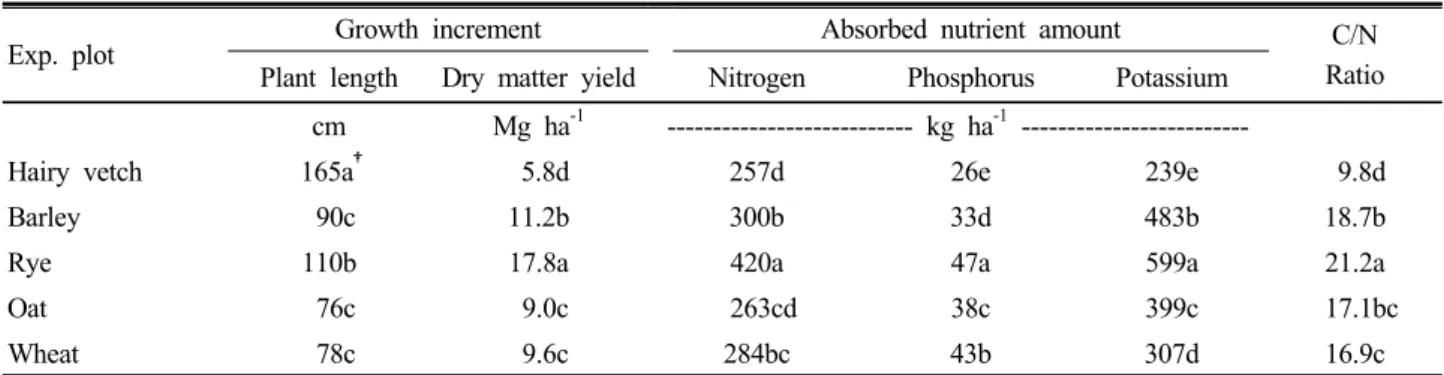
The growth increment and absorbed amount of nutrients of fallow crops grown during the winter are shown in Table 2. The highest plant height (cm) were observed in hairy vetch (165) followed by rye (110), barley (90), wheat (78) and oat (76), and dry matter yield (ton/ha) was maximum in rye (17.8) and barley (11.2). The reason for low dry matter yield in
hairy vetch, despite tallest height among fallow crops, was its light weight plant with creeping growth habit.
Absorbed amount of nutrients (kg ha-1) was maximum in rye (420 nitrogen; 47 phosphorus; 599 potassium) followed by barley (300 nitrogen; 33 phosphorus; 483 potassium) among the fallow crops. The large amount in absorbed nutrient of rye or barley suggested to be due to increased dry matter yield and relatively wide root distribution compared to others crops. The C/N ratio of hairy vetch, leguminous plant, is lower than others, gramineous plants, and was similar to previous research. But the C/N ratio of rye was slightly differ from other researches. The difference is probably caused by various harvesting time (Seo et al., 2000; Choi et al., 2010).
Selected soil physical properties, bulk density and porosity, by cultivation of fallow crop are presented in Fig. 1. Bulk density was observed significantly lower and porosity significantly higher among all five fallow.
Bulk density is closely related with soil porosity and penetration resistance, and it also affects field soil water
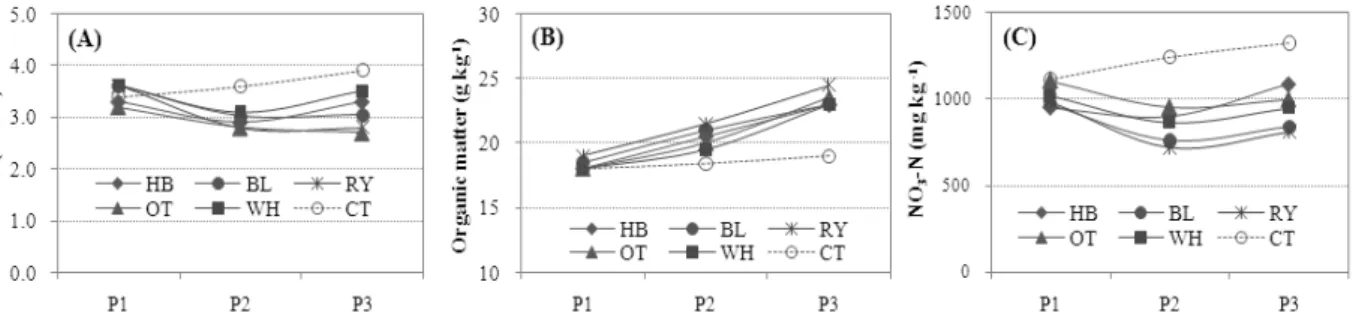
Fig. 2. Comparison of soil chemical properties, electrical conductivity (A), organic matter (B) and nitrate nitrogen (C), by cultivation and utilizing of fallow crops (P1; before cultivating fallow crop, P2; after cultivating fallow crop and before planting watermelon, P3; after harvesting the watermelon).
content. Higher bulk density with low porosity decreases soil aeration and water infiltration and percolation, and can restrict plant root growth (Lampurlanes and Cantero- Martinez, 2003). Meanwhile, the soil improvement by incorporation into soil of organic matter, such as green manure crop or crop residue, are result from decrease in bulk density and increase in porosity, aggregate stability and water permeability (Boparai et al., 1992;
Whitbread et al., 2000; Ray and Gupta, 2001). It has been observed in present study that fallow crops owing to their sufficient growth and wide root growth system in plastic green houses, despite of winter were effective in decreasing soil compaction and ultimately improves physical properties of not only topsoil but subsoil also as reflected from increased dry matter content, amount of absorbed nutrients, improving watermelon yield and quality traits described above. These results were similar to earlier findings by Ray and Gupta, 2001; Chand et al., 2009 but somehow different from RDA, 2009, where it was reported that fallow crops were not effective in improving soil physical properties in paddy grown during winter.
The chemical properties of soil investigated are presented in Fig. 2. Soil EC was observed to be decreased from maximum 3.2~3.6 dS m-1 before cultivating fallow crops to 2.8~3.1 dS m-1 after culti- vating for fallow crops. On percentage basis, it was found that soil EC reduced maximum by cultivation of rye (22%) followed by barley (16%), wheat (14%), oat (13%) and hairy vetch (12%) respectively. There was observed continuous increasing trend in EC in the control plot without fallow crops. It has been suggested that increased nutrient absorption and regenerated crops tended to reduce soil salt (see Table 2) and resulted in decreasing soil EC in fallow crops plots particularly in rye and oat. Soil organic matter (OM) ranged from 18
to 19 g kg-1 before cultivating fallow crops and from 23 to 24 g kg-1 after harvesting watermelon. That is to say, soil OM increased 21~29% by the cultivation and utili- zation of fallow crops compared to the control plot. It is presumed that mowed parts, root and other residue of fallow crop decomposed gradually during experimental period, which resulted in the increase of soil OM. The contents of nitrate nitrogen in soil reduced about 5% by hairy vetch and 27% by rye after cultivation of each, and that showed the similar trend as EC value. Overall, the chemical properties of these plots after harvesting watermelon reached at relatively favorable level compared to that of control. It showed that cultivation of fallow crops would be effective method to reduce salinity and increasing OM in soil. Several studies conducted also implies that incorporation of organic residue could improve soil quality by reduction of salt activity and increment of organic matter (Choi et al, 2010; Lee et al. 2009).
Soil microbial biomass carbon (SMBC) is an indicator of microbial activity, as carbon contents consist of microbial body, and dehydrogenase (DHA) activity is considered to reflect the total range of oxidative activity of soil microflora (Masto et al. 2006).
The fallow crops were found to have significant effect on the SMBC and DHA activities as presented in Fig. 3.
SMBC ranged 350 to 513 µg g-1 and DHA activity ranged 132 and 170 TPF µg g-1 at planting period of watermelon, while that of control was 325 µg g-1 to 117 TPF µg g-1, respectively. This result was caused by increasing microbial population and activity, which were to more growth of fallow crop and higher temperature from winter through spring. The cultivation of fallow crop was supposed to influence enzymatic activities in the soil because the added organic fractions contain intra- and extra-cellular enzymes, which might
Fig. 3. Comparison of microbial biomass C (A) and dehydrogenase (DHA) activity (B) by cultivation and utilizing of fallow crop (HV; hairy vetch, BL; barley, RY; rye, OT; oat, WH; wheat, CT; control. P1; before cultivating fallow crop, P2; after cultivating fallow crop and before planting watermelon, P3; after harvesting the watermelon)
Table 3. Occurrence of weed and fruit damage by aphid by mulching with mowed fallow crop
Exp. plot Occurrence of weed Fruit damage
by aphid‡ Usual weed (A) Regenerated crop†(B) Total(A+B)
--- Mg ha-1 --- %
Hairy vetch 0.55b§ 0.56c 1.11cd 3.4d
Barley 1.02a 0.71c 1.73cd 5.6c
Rye 0.16c 7.82b 7.98b 15.6a
Oat 0.11c 28.92a 29.03a 10.5b
Wheat 0.54b 3.40c 3.94c 6.0c
Control 0.10c - 0.10d 3.6d
†Regenerated amount after mowing fallow crop surveyed at harvesting time of watermelon. ‡Percentage of watermelon damaged by aphid at harvesting time. §Values within a column followed by different letters are significantly different using Duncan’s multiple range test at the 95% probability level.
have also stimulate soil microbial activity. SMBC and DHA activities were higher particularly in soil treated with gramineous crops, such as barley, rye and oat, compared to hairy vetch, a leguminous crop. It has been suggested that gramineous crop were having C/N ratio, relatively higher than hairy vetch and supplied more carbon to soil and microorganisms. These findings were similar to previous reports, where the SMBC had increased after addition of organic residues with high C/N ratio, such as rye and straw (Lee et al. 2009), and dehydrogenase activity had been the highest in the soil treated with rice straw compost (Suh et al. 2009). High SMBC often lead to high nutrient availability to crops (Wang et al., 2004), through enhancing both the microbial biomass turnover and degradation of non-microbial organic materials. On the basis of present results it was concluded that utilization of fallow crops improved the organic matter status of soil, which in turn enhanced
the enzyme activity in plastic greenhouse.
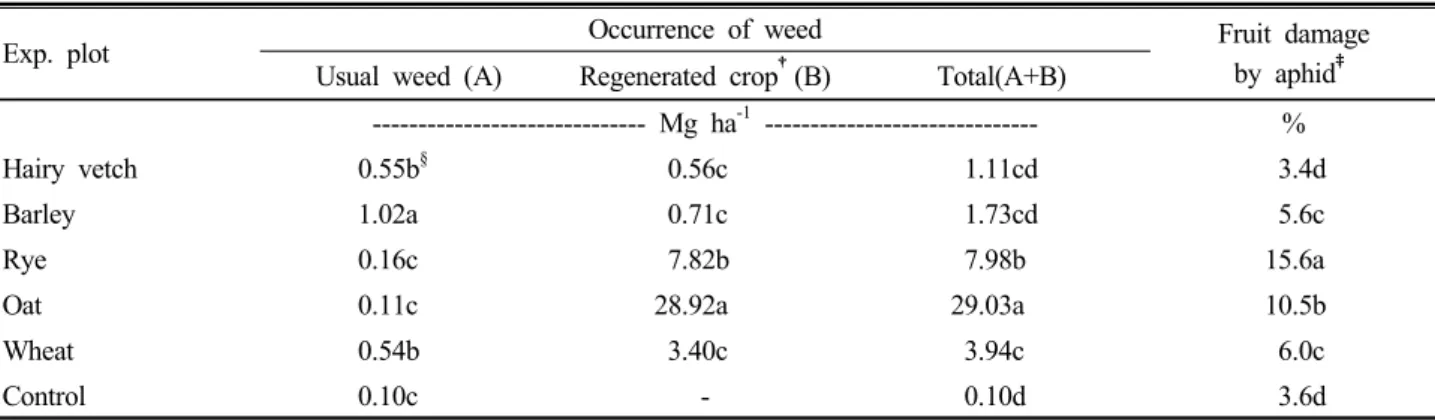
Occurrence of usual weed and regenerated fallow crop after mulching with mowed fallow crop during watermelon cultivation period are shown in Table 3.
The occurrence of regenerated crops was observed more in oat (28.92 ton ha-1) and rye (7.82 ton ha-1), and also it resulted in highest percentage of fruit damage due to aphid attack, particularly in these plots. But it was observed less in hairy vetch (0.56 ton ha-1) and barley (0.71 ton ha-1), and that meant hairy vetch and barley were greatly influence by summer depression owing to higher temperature from spring through summer. Usual weeds were observed minimum 0.11 ton ha-1 in oat plot and maximum 1.02 ton ha-1 in barley plots. Hairy vetch had comparatively more covering area because of creeping growth habit than other fallow crops, which were having an upright growth habit and might have resulted in relatively small weed amount growth in this
Table 4. Fruit quality and yield of watermelon by cultivation and utilizing of fallow crops
Exp. plot Sugar content† Fruit
weight
Fruit length
Fruit width
Ratio of commercial
yield
Yield
brix kg each --- cm --- % Mg ha-1
Hairy vetch 9.8ab‡ 10.5a 30.4a 25.8a 91.7 61.6a
Barley 10.3a 10.1a 29.7a 24.8ab 92.5 59.8a
Rye 9.4b 9.6ab 28.7b 24.4ab 77.4 47.7b
Oat 9.2b 8.7b 28.0b 23.6b 77.5 43.5c
Wheat 10.1a 9.0b 28.2b 23.7b 86.8 49.9b
Control 9.7ab 10.4a 30.4a 25.7a 87.2 58.3a
†Refractometric sugar content. ‡Values within a column followed by different letters are significantly different using Duncan’s multiple range test at the 95% probability level.
plot. The large amount of usual weed and regenerated fallow crops are considered unfavorable for overall growth of watermelon in aspect that these compete for water and nutrients.
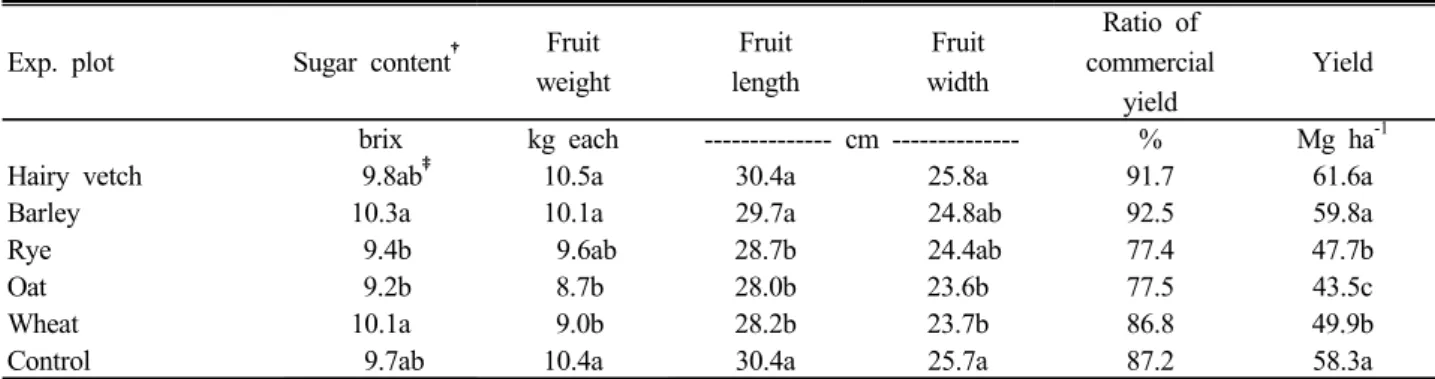
Influence of cultivation and mulching of fallow crop on the quality and yield of watermelon are shown in Table 4. The plots mulched with fallow crops were observed to have sugar content, fruit weight, and yield ranged between 9.2~10.3 brix, 8.7~10.5 kg per each, and 43.5~61.6 ton ha-1, respectively. The barley and wheat had significant positive affect on the sugar content of watermelon as found highest 10.3 and 9.8 brix respectively. Fruit weight in plots treated with rye and oat were significantly lower than those in control as occurrence of regenerated crops and fruit damage by aphids were more in these plots and this affected the yield performance of watermelon. Increased fruit length and fruit width affected positively fruit weight in both hairy vetch (10.5 kg) and barley (10.1 kg). It had also resulted in improving overall yield performance as 61.6 ton ha-1 and 59.8 ton ha-1 in hairy vetch and barley respectively compared to other fallow crops. The yield of watermelon in hairy vetch and barley increased by 5.7% and 2.6%, respectively, compared to that of control plots with PE film. It seemed that optimum fallow crop lead to increase in watermelon yield by improvement of soil properties and utilizing as mulching material. Present experimental findings on the basis of growth increment, absorbed amount of nutrients, occurrence of weeds and aphid infestation, revealed that hairy vetch and barley have beneficial effects.
Conclusions
The results of this study suggested that incorpor-
ation of fallow crop during winter in plastic green- house could improve soil quality by reduction of soil compaction, reduction of salt, increment of organic matter and enhancement of enzyme activity. In addition, mowed hairy vetch or barley before planting watermelon showed availability as mulching materials because the amount of weed and regeneration in plot treated with these were less. Therefore, hairy vetch or barley could be used as winter fallow crop and organic mulching materials for improvement of soil properties in sustainable watermelon production system under plastic greenhouse.
References
Andrzej B. 2006. Growth of onion (Allium cepa L.) under no-tillage cultivation with rye (Secale cereale L.) as cover crop. Kor. J. Hort. Sci, & Tech. 27th International Horticultural Congress & Exhibition. 369 (Abstr.)
Araki, H., H. Shiori, H. Yoichiro, and H. Toshiyuki. 2009.
Cover crop use in tomato production in plastic high tunnel.
Kor. J. Hort. Sci. & Tech. 50:324-328.
Blake, G.R. and K.H. Hartge. 1986. Bulk density. p. 363-375. In A. Klute (ed.) Methods of soil analysis. Part 1. 2nd ed. Agron.
Monogr. 9. ASA and SSSA, Madison WI.
Boparai, B.S., Yadvinder-Singh, and B.D. Sharma. 1992. Effect of green manure on physical properties of soil and growth rice-wheat and maize-wheat cropping systems. Int. Agrophys.
6:95-101.
Cassel, D.K. 1982. Tillage effects on soil bulk density and mechanical impedance. p. 45-67. In P. W. Unger and D. M.
Van Doren (ed.) Predicting tillage effects on soil physical properties and processes. ASA Spec. Publ. 44. ASA and SSSA, Madison, WI.
Chand R., T. Watari, K. Inoue, H. Kawakita, H.N. Luitel, D.
Parajuli, T. Torikai, and Mi Yada. 2009. Selective adsorption of precious metals from hydrochloric acid solutions using porous carbon prepared from barley straw and rice husk.
Minerals Engineering 22:1277-1282.
Choi B.S., J.A. Jung, M.K. Oh, S.H. Jeon, H.G. Goh, Y.S. Ok, and J.K. Sung. 2010. Effects of green manure crops on improvement of chemical and biological properties in soil.
Korean J. Soil Sci. Fert. 43:650-658.
Choi, H.S. and R. Curt. 2006. Seasonal variation of nutrient content of apple leaves grown under different organic ground cover management systems. Kor. J. Hort. Sci. & Tech. 27th International Horticultural Congress & Exhibition. 367 (Abstr.).
Jung, G.B., I.S. Ryu, and B.Y. Kim. 1994. Soil texture, electrical conductivity and chemical components of soils under the plastic film house cultivation in northern central areas of Korea. Korean J. Soil Sci. Fert. 27:33-40
Lampurlanes, J. and C. Cantero-Martinez. 2003. Soil bulk density and penetration resistance under different tillage and crop management systems and their relationship with barley root growth. Agron. J. 95:526-536.
Lee S.B., C.H. Lee, C.H. Hong, S.Y. Kim, Y.B. Lee, and P.J.
Kim. 2009. Effect of organic residue incorporation on salt activity in greenhouse soil. Kor. J. Environ. Agric.
28(4):397-402.
Masto, R.E., P.K. Chhonkar, D. Singh, and A.K. Patra. 2006.
Changes in soil biological and biochemical characteristics in a long-term field trial on a sub-tropical inceptisol. Soil Boil.
Biochem. 38:1577-1582.
Paustian, K., H.P. Collins, and E.A. Paul. 1997. Management controls in soil carbon. In: Paul, E.A., Paustian, K., Elliott, E.T., Cole, C.V. (Eds.), Soil Organic Matter in Temperate.
Ecosystems: Long Term Experiments in North America.
CRC Press, Boca Rotan, FL, pp. 15-49.
Ray, S.S. and R.P. Gupta. 2001. Effect of green manuring and tillage practices on physical properties of puddled loam soil under rice-wheat cropping system. J. Indian Soc. Soil Sci.
49:670-678.
RDA. 2006. Standard for fertilization on crops. National Institute of Agricultural Science and Technology, Rural Development Administration, Korea.
RDA. 2000. Methods of analysis of soil and plant. National Institute of Agricultural Science and Technology, Rural Development Administration, Korea.
RDA. 2009. Study of environment-friendly fertilizer reduction using green manure crops, Rural Development Administration, Korea.
Ryu, J., J.S. Na, and N.Y. Hwang. 1992. Study on the cause of injury by continuous cropping of peanut. Korean J. Soil Sci.
Fert. 25:270-274.
Seo, J.H., H.J. Lee, I.B. Hur, S.J. Kim, C,K, Kim, and H.S. Jo.
2000. Comparisons of chemical composition and forage yield among winter green manure crops. J. Kor. Grassi. Sci.
20:193-198.
Suh, J.S., H.J. Noh, and J.S. Kwon. 2009. Impact of amendments on microbial biomass, enzyme activity and bacterial diversity of soils in long-term rice field experiment. Korean J. Soil Sci. Fert. 42:257-265.
Sukul, P. 2006. Enzymatic activities and microbial biomass in soil as influenced by metalaxyl residues. Soil Biol. Biochem.
38: 320-326.
Sullivan, P. 2003. Overview of cover crops and green manures:
Fundamentals of sustainable agriculture. Appropriate Technology Transfer for Rural Areas, the National Center for Appropriate Technology (NCAT), Fayetteville, AR.
Thorup-Kristensen, K. and M. Bertelsen. 1996. Green manure crops in organic vegetable production. In: Kristensen, N.H., Hoeg-Jensen, H. New Research in Organic Agriculture.
Proceedings from the 11th International Scientific IFOAM Conference, Copenhagen, pp. 75-79.
Vance, E.D., P.C. Brooks, and D.S. Jeninson. 1987. An extraction method for measuring soil microbial biomass carbon. Soil Biol. Biochem. 19:703-707.
Wang, W.J., C.J. Smith, and D. Chen. 2004. Predicting soil nitrogen mineralization dynamics with a modified double exponential model. Soil Soc. Am. J. 68:1256-1265.
Whitbread, A.M., G.J. Blair, and R.D.B. Lefroy. 2000.
Managing legume leys, residues and fertilizers to enhance the sustainability of wheat cropping systems in Australia. Soil Tillage Res. 54:63-75.
Wright, A.L., F.M. Hons, and J.E. Matocha Jr. 2005. Tillage impacts on microbial biomass and nitrogen dynamics of corn and cotton rotations. Appl. Soil Ecol. 29:85-92.