Journal of the Korea Institute of Building Construction, Vol. 12, No. 4
http://dx.doi.org/10.5345/JKIBC.2012.12.4.451 www.jkibc.org
Physical Properties of 50㎫ and 80㎫
Ternary High Strength Concretes before and after Concrete Pumping
1)Lee, Bum-Sik1 Kim, Seong-Deok2* Jun, Myoung-Hoon1 Park, Sung-Sik1 Park, Su-Hee3 Jung, Sang-Jin2 Construction Technology Reserch Dept., Land & Housing Institute, Yuseong, Daejeon City, 305-731, Korea 1 Dept. of Architectural Engineering. Dankook University Graduate School, Jukjeon, Yongin City, 448-701, Korea 2 Machinery, Metals & Construction Team, Korea Institute of Patent Information, Mapo, Seoul City, 121-816, Korea 3
Abstract
At the Korea Land and Housing Corporation(LH), concretes with high design strength of 50 ㎫ and 80 ㎫that are composed only of ordinary Portland cement, blast furnace slag, and fly ash are developed. To determine whether the developed high strength concretes have the same properties when they are produced in batch plant(B/P) condition in the ready mixed concrete plant, and as existing high strength concretes, field tests are performed and material properties are evaluated. To investigate the material properties of the high strength concretes before and after pumping, compressive strength, flowability, air content, hydration temperature, pumping and compactability are evaluated. In field tests, before and after pumping, flowability satisfied the relevant criteria. In terms of air content, while it was slightly decreased after pumping, it satisfied the requirements. Hydration temperature criteria were satisfied, and compactability was excellent as well. The study found that the developed ternary high strength concretes have the same properties as existing high strength concretes. They can also be useful for the construction of high-rise buildings, as they are economical.
Keywords : high-strength concrete, compressive strength, flowability, hydration temperature, pumping, compactability
1. Introduction
High-strength concrete, which offers such advantages as rapid development of removal strength, reduction in member areas, weight reduction in structure and improvement of concrete durability, is evaluated as an excellent structural material that can contribute to improved earthquake resistance and longevity, and is widely used for high-rise buildings.
As the use of high-strength concrete has been
Received : September 8, 2011 Revision received : May 2, 2012 Accepted : May 21, 2012
* Corresponding author: Kim, Seong-Deok
[Tel: 82-31-8005-3744, E-mail: [email protected]]
ⓒ2012 The Korea Institute of Building Construction, All rights reserved.
on the rise in conjunction with the recent boom in the construction of high-rise buildings in Korea, there have been various studies done on advancing the practicability of high-strength concrete.
However, silica fume, which is more expensive than cement, is mixed at a certain level to improve strength.
LH Corporation is now expecting the demand for 40- and 80-story high-rise buildings to increase.
In terms of reducing construction cost, it has strived to develop a more economical high-strength concrete with the same properties as the existing high-strength concrete with silica fume. As part of its efforts, LH developed ternary high-strength concrete with a target strength of 50- and 80-MPa (“high-strength concrete” hereinafter) using only ordinary Portland cement, blast furnace slag and
Physical Properties of 50㎫ and 80㎫ Ternary High Strength Concretes before and after Concrete Pumping
fly ash[2,3,4,5].
In this research a test construction was done for a building now being built by LH Corporation, and the properties of material before and after pumping, hydration temperature, changes in length and pumpability of concrete were assessed in order to verify whether various material properties measured under laboratory conditions can be reproduced in the field, when the concrete with target strength 50MPa and 80MPa developed in the laboratory was produced and supplied in a batching plant or in a ready mix concrete factory and delivered to a site by truck and then pumped to a high-rise building structure [6,7,8].
If the evaluation results of the test construction and material properties of the high-strength concrete are equivalent to the physical properties and constructability of the existing high-strength concrete, the high-strength concrete can be widely used for high-rise buildings and commercialized.
2. Experiment plan and method
2.1 Outline of the field test conditions
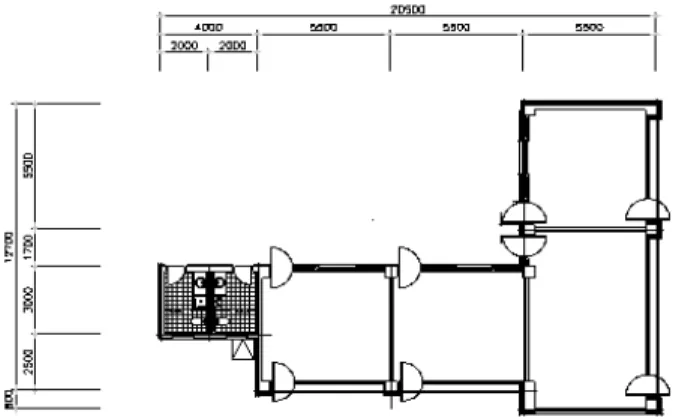
The field test commercial building satisfying the target performance was a 1-story RC Ramen structure neighborhood living facility within the 00 Project Group of LH Corporation with 4,000mm
Figure 1. Plan of field test commercial building
height, 200mm wall thickness, 150mm slab thickness, 400mmx500mm or 400mmx600mm beam dimension (width x depth) and 400mmx400mm column dimension. Figure 1 illustrates the plan for the field test commercial building.
2.2 Plan for test construction
The plan to supply ready-mixed high-strength concrete for the field test in a commercial building was made by assuming that concrete would be placed either by pumping or pouring into a horizontal or vertical structure separately, as is done in a high-rise building construction site.
To make the field test successful, a ready mix concrete plant that could smoothly manufacture and produce the high-strength concrete required for the field test was selected. After selecting the factory, a test of material properties was done to adjust the basic mixture of the high-strength concrete caused by differences in cement, aggregate, and admixture compared to the mixture obtained under laboratory condition, and finally to draw the mixture to be used in the field test.
Table 1 indicates the target physical properties of high-strength concrete used for the field test.
Table 1. Target physical properties of high strength concrete Compressive
strength (㎫)
Margin of error
contentAir (%)
Flow properties Slump
flow L-flow U-box V-lot 50, 80 ±20% 3.0±1.5 650±50㎜ 700㎜,
15sec. 50㎜
below 15±5 sec.
A total of 83㎥ of high-strength concrete was used: about 36㎥ of high-strength concrete with 80
㎫ for the vertical members (columns and walls) and about 47㎥ of high-strength concrete with 50
㎫ for the horizontal members (slabs and beams).
To place the mixture of high-strength concrete
was planned to use a high-pressure pump with over 380mph and 130bars and a pumping pipe with 7.1mm thick for high-strength concrete. To assess the pressure within the pipe, three points were selected: at the high-pressure pump, on the middle of the pumping pipe and near the pump car, as shown in Figure 5.
In addition, to deal with the side pressure in the cast caused by the high-strength concrete with good flowability, a new form was designed, and form tie (f12) and steel pipes (f48.6x2.5) were placed at 500mm intervals.
As 50MPa and 80MPa high-strength concretes were used in the field test, the difference in strength exceeded 1.4 times the strength defined in the concrete structure design criteria. For this reason, when placing 80MPa high-strength concrete to the vertical members, the vertical member was expanded to 600mm in length based on the related criteria, and 50MPa high-strength concrete was placed to the slabs in the fresh concrete condition.
To prevent the rapid evaporation of water after concrete placement, the surface was covered with vinyl. Since temperatures inside and outside of the
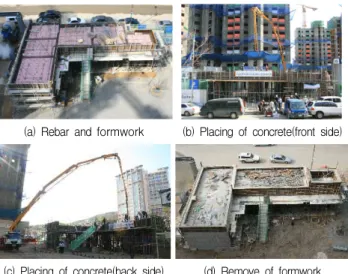
(a) Rebar and formwork (b) Placing of concrete(front side)
(c) Placing of concrete(back side) (d) Remove of formwork Figure 2. Process of field test of HSC
mid-April, no additional thermal treatment was done.
Figure 2 indicates the field test process in a neighborhood living facility, including the placement of pumping pipes for high-strength concrete, and the installation plan and shapes of the high-pressure pump and pipes.
2.3 Plan to evaluate material properties of high-strength concrete
2.3.1 Evaluation of basic material properties A test for the physical properties of fresh and hardened concrete was planned in this research.
For the fresh concrete, tests were done for air content, slump flow, L-flow, U-box and V-lot to evaluate flowability. Taking the field test into account, for the hardened concrete, compressive strength was measured in two ways: in water curing at site and in standard curing. For the 80MPa high-strength concrete, the compressive strength was also measured after pumping. In addition, the core strength was measured using the specimens for measuring hydration temperature. For the general concrete specimen, it was measured at 3, 7, 28, 56, and 91 days, while for the core specimen, it was measured at 28, 56, and 91 days.
Tables 2 and 3 indicate the mix proportions of 50MPa and 80MPa high-strength concrete used in the field test under the experimental conditions.
2.3.2 Evaluation of changes in length
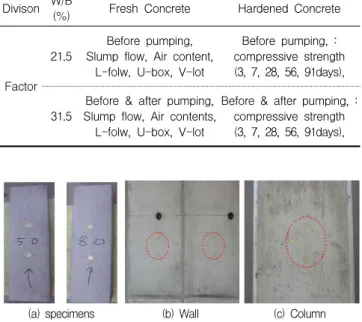
To evaluate the changes in length of 50MPa and 80MPa high-strength concrete, length was measured from specimen (100x100x400mm) and members in the structure (wall and column) by age using a contact gauge. The shapes of the specimens for measuring changes in length is indicated in Figure 3.
Physical Properties of 50㎫ and 80㎫ Ternary High Strength Concretes before and after Concrete Pumping
Table 2. Mix proportions of high strength concrete W/B(%) S/a
(%)
Unit weight (㎏/㎥) AE
(%) SP
W C BS FA S G (%)
21.5 44 150 384 175 140 667 852 0.005 1.40
31.5 46 160 330 102 76 768 905 0.005 1.25
Divison W/B
(%) Fresh Concrete Hardened Concrete
Factor
21.5 Before pumping, Slump flow, Air content,
L-folw, U-box, V-lot
Before pumping, : compressive strength (3, 7, 28, 56, 91days),
31.5 Before & after pumping, Slump flow, Air contents, L-folw, U-box, V-lot
Before & after pumping, : compressive strength (3, 7, 28, 56, 91days), Table 3. Experiment conditions
(a) specimens (b) Wall (c) Column
Figure 3. Shrinkage test of specimens
2.3.3 Evaluation of hydration temperature
To evaluate the characteristics of the hydration temperature of 50MPa and 80MPa high-strength concrete, a cubicle specimen measuring 1000mm per
(a) Shape of specimen molds (b) Placing of concrete
(c) Data logger (d) Shape of specimens Figure 4. Process of hydration temperature test
side was manufactured. Thermocouples were installed on the center and the upper surface, and changes in the hydration temperature of high-strength concrete were measured for 26 days using a data logger. Figure 4 indicates the shape of the specimen for measuring hydration temperature.
2.3.4 Evaluation of pumpability and compactability The concrete pumping equipment was selected after setting the unit volume of concrete to be placed per hour. The unit volume was set as 40㎥ of high-strength concrete to be placed per hour based on 40-story-building construction projects in Korea where the 60MPa high-strength concrete was placed.
To assess the changes in pump pressure of the high-strength concrete developed in this research from the high-pressure pump to placement by the pump car, sensors were installed at 3m(measuring point 1) and 64m(measuring point 2) from the high-pressure pump and 107m(measuring point 3) just before placing concrete by the pump car to measure pump pressure. The pumping placement plan of the pilot test is shown in Figure 5.
Figure 5. Pumping Placement Plan of Pilot Test
3. Results of evaluation of material properties of high-strength concrete
3.1 Properties of fresh concrete
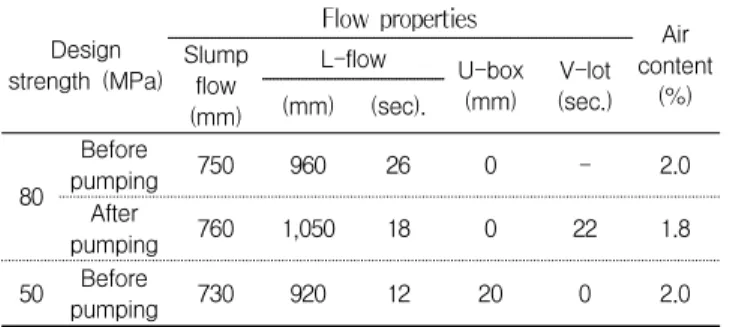
pumping was shown to be 2.0% both in 50Mpa and in 80MPa, while after pumping it was slightly decreased to 1.8% in 80MPa, which was within the management range that satisfied the target property. In terms of slump flow, it was shown as 730mm for 50MPa and as 750mm for 80MPa, both of which were higher than the target properties but met the tolerance range of slump flow(±100㎜) stipulated in KSF 4009, and no material segregation was found, based on which there were no problems in usability of the concrete tested. In terms of evaluating any effect of pumping, it was shown as 760mm for 80MPa after pumping, which was almost no change compared to before pumping.
L-flow, another index of flowability, should be measured as 700mm for 15 seconds, but the criteria for L-flow was not met after pumping. The test results of U-Box, which determines the compactability of high-strength concrete with good viscosity, showed no significant differences before and after pumping. At 50MPa, there was a difference of 20mm, but it was within the tolerance range. The test results of V-lot, which evaluates material segregation of high-strength concrete, also met the target properties. Therefore, it is believed that the physical properties of 80MPa fresh concrete used in this research satisfied the target properties overall, except for the time in the L-flow test.
Table 4. Result of flow and air content test Design
strength (MPa)
Flow properties Air
content (%) Slump
flow (mm)
L-flow U-box
(mm) V-lot (sec.) (mm) (sec).
80
Before
pumping 750 960 26 0 - 2.0
After
pumping 760 1,050 18 0 22 1.8
50 Before
pumping 730 920 12 20 0 2.0
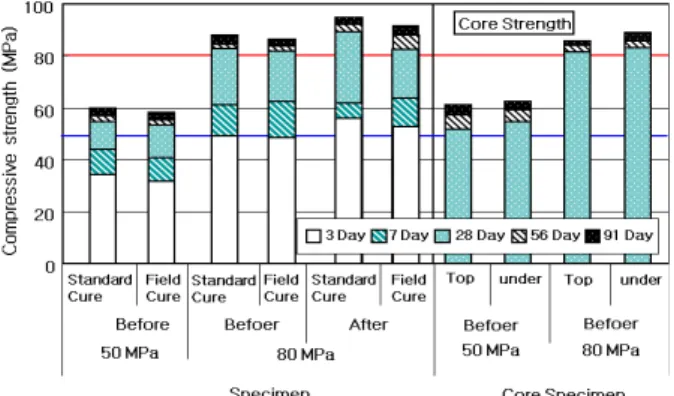
The compressive strength of the high-strength concrete used in this research was shown to be higher than the target strength at 28 days regardless of the curing method and pumping. For the target strength of 50MPa, the strength was measured to be slightly higher in the standard curing than in the water curing at site, and the target strength of 50MPa was reached at 28 days.
Results were similar at the target strength of 80MPa.
Differences in strength development by curing method are believed to be due to the fact the temperature of the water during curing at site was lower than that of the standard curing in April.
For the target strength of 80MPa tested for the effect of pumping, the compressive strength was measured as 56.2MPa at day 3 of an early curing after pumping, which was higher than 52.8MPa of managed specimens by curing method before pumping. The compressive strength was shown to be higher at 56 days as well. This might be due to a slight decrease in air content after pumping from the test results of fresh concrete properties.
The core strength measured from the specimens for hydration temperature was slightly lower than the strength of specimens targeted to be 50MPa at 28 days, but there were almost no differences at 56 and 91 days compared to the specimens cured at site before pumping. Moreover, by measuring the position of the core specimens, the compressive strength was found to be slightly higher at the lower part than at the upper part, both in target strengths of 50MPa and 80MPa, as is generally known.
Figure 6 indicates the results of compressive strength test by age, curing method and before and after pumping
Physical Properties of 50㎫ and 80㎫ Ternary High Strength Concretes before and after Concrete Pumping
Figure 6. Results of compressive strength test 3.3 Length change in high-strength concrete
(a) specimens
(b) Wall & Column(80㎫) Figure 7. Results of shrinkage test
In the test of length change in specimens for 91 days, shrinkage was found to be significant at an early stage, and more shrinkage was shown at the target strength of 50MPa than in 80MPa. In addition, by application part, the maximum change in length, vertical and horizontal, of the columns thicker than the walls was shown to be 97%, a
slightly lower shrinkage. Although applied at the same part, there was slightly more shrinkage in the width direction than in the length direction.
Results of shrinkage test are indicated in Figure 7.
3.4 Hydration temperature of high-strength concrete Hydration temperature test was conducted for the specimens with dimensions 1,000x1,000x1,000mm for about 620 hours. From the test results, for 50Mpa high-strength concrete, the highest temperature was measured 17 hours after concrete placing. The highest temperatures at the center and on the surface of the specimens were measured at 61.6℃ and 44.3℃, respectively, and the difference between temperature at the center and temperature on the surface stood at 17.3℃.
For 80MPa high-strength concrete, the highest temperatures at the center and on the surface were
(a) 56 days - 50 MPa, 80 MPa
(b) 2 days - 50 MPa, 80 MPa
Figure 8. Result of hydration temperature test
hours after concrete placing. The temperature difference between at the center and on the surface stood at 12.1℃. Unit binder weight is relatively higher in 80MPa concrete than in 50MPa concrete, which caused the highest temperature to be higher and the temperature difference to be smaller in 80MPa concrete. The time differences between at the center and on the surface were measured at 17.3℃ for 50MPa and at 12.1℃ for 80MPa, both of which satisfy the internal and external criteria related to temperature difference in the hydration temperature category[1]
3.5 Pumping pressure and compactability of high-strength concrete
To evaluate changes in pumping pressure from the high-pressure pump until placing the high-strength concrete developed in this research by a pump car, sensors were attached and the pumping pressure was
(a) Whole pumping change - 80 MPa
(b) Unit stroke distance pumping - 80 MPa Figure 9. Results of pumping test
1) and about 60m(measuring point 2) from the highpressure pump, and at 110m (measuring point 3) right before cement placing.
Through the pumping pressure test, it was found that a unit stroke of the piston to carry high-strength concrete took about 4.8 seconds, and the pump pressures were about 60bar, 26bar and 8bar at measuring points 1, 2 and 3, respectively.
The farther the measuring point from the pump, the more the pump pressure gradually decreased.
In addition, the unit volume of concrete placement per hour was 38㎥, approximately reaching the target volume of 40㎥.
Figure 9 (a) is the relation between the time taken to place concrete and pump pressure, and Figure 9 (b) is one cylinder cycle of the high-pressure pump. The changes both in the entire pumping and in a unit stroke were shown to be stable, from which it can be interpreted that the pumping was performed smoothly.
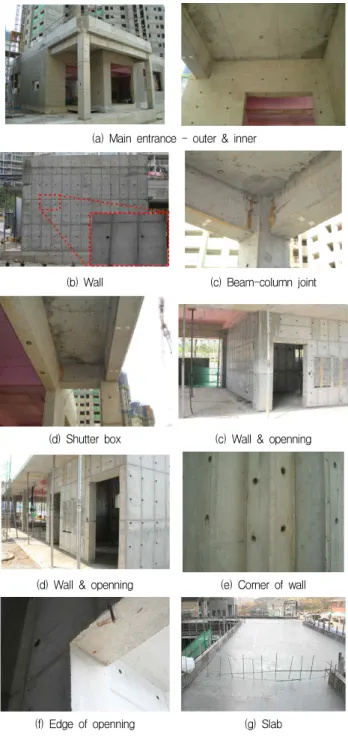
To evaluate compactability of high-strength concrete, the state of compactability and smoothness were investigated from the slab, the opening part and elevator box of the structure tested. Although the high-strength concrete used in this research was not rammed separately, it was compacted only with its empty weight and flowability. In particular, it was smoothly compacted even in the connected parts between beam and column, and the corners where more rebars were placed. Moreover, it was also compacted well even in the parts that are usually not flat, such as the main entrance, the connected part between beam and column, the opening part and slabs. The surface of the structure was also shown as being smooth, without any uneven parts. Figure 10 shows the state of compactability by part after the concrete placement.
Physical Properties of 50㎫ and 80㎫ Ternary High Strength Concretes before and after Concrete Pumping
(a) Main entrance - outer & inner
(b) Wall (c) Beam-column joint
(d) Shutter box (c) Wall & openning
(d) Wall & openning (e) Corner of wall
(f) Edge of openning (g) Slab
Figure 10. Results of compactability test
4. Conclusion
Experiments were done on physical properties, hydration temperature and compactability before and after the pumping of 50MPa and 80MPa ternary high-strength concrete developed in this study for a neighborhood living facility, and the
results are as follows:
1) Before pumping, the physical properties of the fresh concrete exceeded the target slump flow, which was within the tolerance stipulated by KS F 4009, and also satisfied L-flow, V-lot and U-box. After pumping, the physical properties showed no or little variation in air content, slump flow, V-lot and U-box, to an extent that was found not to affect usability, but the criteria for L-flow was found to not be satisfied.
2) For the specimens for strength management and the core specimens, all of the specimens before and after pumping satisfied the target strength at 28 days. In the standard curing, slight but rather high strength was measured, which is believed to have been caused by the curing temperature differential.
3) In terms of length change, there were slightly more changes in low-strength concrete, and for members, more shrinkage was found in the width direction.
4) In terms of hydration temperature, the temperature differential between temperature at the core and on the surface was found to be 17.3℃ for 50MPa concrete and 12.1℃ for 80MPa concrete, both of which were found to satisfy the European and JCI crack initiation-related criteria caused by temperature differential.
5) In terms of pumping pressure and compactability, there were no uneven parts found, and compactability was particularly good for the connected part between beam and column, and opening parts and corners.
6) The high-strength concrete with target strength of 80MPa developed in this study can be applied to high-rise building construction if L-flow after pumping is improved. If it is commercialized, it is believed to be more economical and secure better
concrete.
References
1. Ministry of Land, Transport and Maritime Affairs(MLTM).
Application of High Strength Concrete to High-rise Residential Building(Ⅲ). Seongnam (Korea): LH; 2008. 213 p. Korean.
2. Concrete Institute of Korea. Korea Structural Concrete Design Code, Seoul (Korea): Kimoondang; 2007. 523 p.
Korean.
3. Concrete Institute of Korea. concrete standard specification.
Seoul (Kora): Concrete Institute of Korea; 2009. 762 p.
Korean.
4. Architecture Institute of Japan. Japanese Architectural Standard Specification 5. Tokyo (Japan): Architecture Institute of Japan; 2009. 916 p. Japanese.
5. Kim WJ, Lee GC, Kim KK, Jung SJ, Lee JI. Kim HB. A study on 80㎫ high strength concrete pumping for the construction of high rise buildings. Kim Woo Jae. Proceeding Annual Conference of the Architectural institute of Korea Structure
& Construction; 2007; Chunbuk University. Seoul (Korea);
Architrcturl Institute of Korea: 2007. p. 491-4.
6. Choi SM, Lee BS, Bae KS, Kim SY. Park SH. Rheological Characteristics of Fiber-Reinforced High-Strength AFR Concrete. Proceedings of the Korea Concrete Institute; 2009;
Busan Bexco. Seoul (Korea); Korea Concrete Institute: 2009.
p. 543-44.
7. Ko JH, Moon HJ, Seok WK, Park SJ, Kim HJ. A study on the 1:1 full scale core wall mock-up test of high strength concrete performed by testing pumpability. Journal of the architectural institute of Korea Structure & Construction.
2008 Aug;24(8):203-10.
8. Kim HY, Seo CH. An Experimental Study on the Physical Properties by Compressive Strength Areas of Concrete at High Temperature. Journal of the architectural institute of korea Structure & Construction. 2004 Nov;20(11): 75-82.
9. Song H, Chu YS, Lee JK. Strength and Deformation of High Strength Concrete in High Temperatures. Proceeding Annual Conference of the Architectural institute of Korea Structure
& Construction; 2006; Daegu Exco (Korea). Seoul (Korea);
Architrcturl Institute of Korea: 2006. p. 505-8.
10. Kim JM. A Study on Basic Properties of Ultra High-Strength Concrete according to Kinds of Cement and
11. Son HJ, Noh SK, Kim SH, Han MC, Baek JH, Han CG.
Shrinkage and Strength of Concrete Incorporating Blast-furnace Slag. Proceeding Annual Conference of the Architectural institute of Korea Structure & Construction;
2008; Dankook University Seoul (Korea); The Korea Institue of Building Construction: 2008. p. 99-102.
12. Kwon YJ. An experimental study on the Carbonation and Drying Shrinkage of High Strength Concrete According to Kinds and Ratios of Mineral Admixtures. Journal of the korea institute of building construction. 2003 Sep;3(3):127-33.