This is an Open Access article distributed under the terms of the Creative Commons Attribution Non-Commercial License (http: //creativecommons.org/licenses/by- nc/4.0/) which permits unrestricted non-commercial use, distribution, and reproduction in any medium, provided the original work is properly cited.
Copyright: © 2020 Korean Journal of Agrcultural Science
ANIMAL
Quality grading of Hanwoo (Korean native cattle breed) sub-images using convolutional neural network
Kyung-Do Kwon
1, Ahyeong Lee
1, Jongkuk Lim
1, Soohyun Cho
2, Wanghee Lee
3, Byoung-Kwan Cho
3, Youngwook Seo
1,*1
National Institute of Agricultural Sciences, RDA, Wanju 55365, Korea
2
National Institute of Animal Sciences, RDA, Wanju 55365, Korea
3
Department of Biosystems Machinery Engineering, Chungnam National University, Daejeon 34134, Korea
*
Corresponding author: [email protected]
Abstract
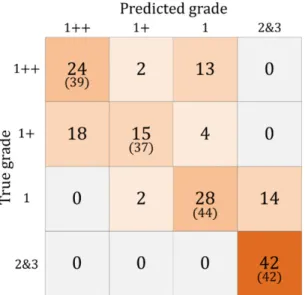
The aim of this study was to develop a marbling classification and prediction model using small parts of sirloin images based on a deep learning algorithm, namely, a convolutional neural network (CNN). Samples were purchased from a commercial slaughterhouse in Korea, images for each grade were acquired, and the total images (n = 500) were assigned according to their grade number: 1++, 1+, 1, and both 2 & 3. The image acquisition system consists of a DSLR camera with a polarization filter to remove diffusive reflectance and two light sources (55 W). To correct the distorted original images, a radial correction algorithm was implemented. Color images of sirloins of Hanwoo (mixed with feeder cattle, steer, and calf) were divided and sub-images with image sizes of 161 × 161 were made to train the marbling prediction model. In this study, the convolutional neural network (CNN) has four convolution layers and yields prediction results in accordance with marbling grades (1++, 1+, 1, and 2&3). Every single layer uses a rectified linear unit (ReLU) function as an activation
function and max-pooling is used for extracting the edge between fat and muscle and reducing the variance of the data. Prediction accuracy was measured using an accuracy and kappa coefficient from a confusion matrix. We summed the prediction of sub-images and determined the total average prediction accuracy. Training accuracy was 100% and the test accuracy was 86%, indicating comparably good performance using the CNN. This study provides classification potential for predicting the marbling grade using color images and a convolutional neural network algorithm.
Keywords: beef marbling, convolutional neural network, deep learning, quality prediction, sub-images
OPEN ACCESS
Accepted: November 30, 2020 Revised: November 27, 2020 Received: August 25, 2020
Citation: Kwon KD, Lee A, Lim J, Cho S, Lee W, Cho BK, Seo Y. 2020. Quality grading of Hanwoo (Korean native cattle breed) sub- images using convolutional neural network.
Korean Journal of Agricultural Science 47:1109-1122. https://doi.org/10.7744/
kjoas.20200093
Introduction
Hanwoo cattle have been a native and major cattle breed in the Korean Peninsula since 3,000 B.C. (Lee et al., 2014). Four major breeds currently are commercial in Korea, and brown (Hanwoo) is the main domestic cattle breed for providing edible beef. Korean customers are prone to seeking tender, low-marbled meat, and thus the marbling index is an important factor in making consumption decisions of meat and its prices (Lee et al., 2017; Kang et al., 2019). Marbling in beef is relevant to the taste, tenderness, flavor, and juiciness (Platter et al., 2005).
In Korea, beef quality measurements are carried out by seeing the sirloin cut from between the 13th thoracic vertebrae and 1st lumbar vertebrae from the left half-carcass that has been kept in cold storage (- 4℃) for a day. There are five indices for deciding the beef quality: marbling index, muscle color, fat color, tenderness, and maturity. However, a number of inspectors still evaluate the quality grades using the standard card for decision color and marbling of beef without any equipment for acquiring scientific data to support their decision.
Currently, beef marbling and quality levels are determined by trained experts using beef marbling standard image cards, and thus the decisions depend on subjective, experienced visual assessments and environmental conditions such as lighting conditions or viewing angle (Sun et al., 2018). Since 2004, the beef marbling index in Korea has comprised nine beef marbling standards (BMSs), and their combinations yield five quality grades (QGs), 1++, 1+, 1, 2, and 3 (Gotoh and Joo, 2016). Among the 9 marbling BMSs, QG 3 includes BMS 1, QG 2 includes BMS 2 and 3, QG 1 includes BSM 4 and 5, QG 1+ includes BMS 6, and QG 1++ includes BMS 7, 8, and 9. Higher BMS beef contains more small and homogeneous fat
spreading on the sirloin.
Various computer vision-based approaches for the visual detection and grading of meat quality have been demonstrated such as image processing using a color camera (Farrow et al., 2009; Barbon et al., 2017), ultrasound (Greiner et al., 2003), and hyperspectral imaging (Pu et al., 2015; Wu et al., 2016). A quality comparison of fresh and frozen-thawed pork using hyperspectral imaging (Barbin et al., 2013; Ma et al., 2015; Pu et al., 2015) and frozen pork quality evaluation without thawing using a hyperspectral imaging system (Xie et al., 2015) have been reported. An artificial intelligence method (support vector machine, SVM) was also used to predict pork color and marbling (Sun et al., 2018). Furthermore, Barbon et al. (2017) reported the development of a computer vision system for beef marbling classification using the k-nearest neighbors (k-NN) algorithm.
Recently, image detection and classification algorithms have rapidly improved along with advancements in machine
learning, especially deep learning (DL) methods. DL convolutional algorithms have been successfully applied to classifying
image datasets (LeCun et al., 2015). Thus, so far, machine learning methods such as a convolutional neural network (CNN)
using ultrasound to analyse the intramuscular fat of pork (Kvam and Kongsro, 2017), classification of plant species (Dyrmann
et al., 2016), detection of plant disease (Mohanty et al., 2016), and food image recognition (Yanai and Kawano, 2015). Using
DL technique, the features can be detected and classified automatically on account of learning complex patterns of target
objects. However, to the best of our knowledge, DL has not yet been used as a classification method for beef marbling
based on color images. Given this, the present work aimed to develop a beef marbling measurement technique using a DL
algorithm and small pieces of color images. Image processing (image correction) and the CNN model applied to divide
images in the same area and develop a classification model, respectively.
Materials and Methods
Samples preparation
In Korea, beef quality is graded according to livestock product grading standards. The grading part on the left half-carcass is the cut on the sirloin side between the last thoracic vertebrae and the first lumbar vertebrae, including the longissimus muscle area. Samples evaluated by an inspection expert were purchased several times at a commercial slaughterhouse (Geonhwa Inc., Anseong, Korea) in 2017, and a total number of 100 of samples were prepared. Samples were stored in a refrigerator at 4℃ then took pictures at room temperature.
Image acquisition
The image acquisition system for beef images was composed of a light source, polarization filter, worktable, and RGB camera as shown in Fig. 1. The RGB camera (EOS 5Ds, CANON, Tokyo, Japan) contains a complementary metal-oxide semiconductor approximately 36 mm × 24 mm in size. The maximum effective number of pixels is approximately 50.6 million (8,688 × 5,792 pixels). The light source used for photographing (RB-5055-HF Lighting Unit, Kaiser Fototechnik, Buchen, GERMANY) consists of four 55 W fluorescent lamps, and the color temperature of the light source is 5,400 K.
To effectively remove the diffuse reflection generated during sample measurement, the RGB camera was equipped with a polarization filter (PR120-82, Midwest Optical Systems Inc., Palatine, USA) with a wavelength range of 400 to 700 nm and a contrast ratio of 10,000 : 1. In addition, the light source was also equipped with a polarization filter (HT008, Midwest Optical Systems Inc., Palatine, USA) with a contrast ratio of 10,000 : 1 in the range of 400 to 700 nm wavelength.
Image calibration for distortion correction
Radial distortion, a type of image distortion, occurs when the position of an object in an image is different from that in
real space (Park et al., 2009). Because this study considered fine intramuscular fat, even small parts of the image must be
positioned accurately, and thus distortion calibration of the sample images was required. Image distortion can be calculated
Fig. 1. Schematic design of the image acquisition devices for beef marbling classification with two light
sources.
and calibrated relatively simply, and the calibration of image distortion is widely used in research on image processing (Weng et al., 1992). Fig. 2 shows a schematic diagram of radial distortion in an image. Radial distortion occurs in the radial direction due to the deflection of light passing through the lens and defects in the lens, and depending on the type of distortion that occurs; it is classified into negative (barrel) distortion and positive (pincushion) distortion.
The proposed algorithm (Zhang, 2000; Lin et al., 2005; Park et al., 2009) was used to calibrate the radial distortion in the original images, and the distortion ratios were calibrated using the equation 1 and 2.
(1) (2)
In Eq. 1, X
D, Y
Dare coordinates in the distorted image (b and c), and X
I, Y
Iare coordinates in the calibrated image (a) in Fig. 3. If one point in the distorted image is P(X
D, Y
D) and one point in the distortion-calibrated image is P
′( X
I, Y
I), by Eq.
1, the straight line distance (ΔR) between the difference in X-axis coordinates (ΔX) and difference in Y-axis coordinates ( ΔY) can be calculated. Since the ideal position is P', the distortion ratio is calculated by Eq. 2. A variety of open sources is commonly used for calibrating radial distortion. In this study, the single camera calibration toolbox (MATLAB R2016a, The MathWorks, Natick, USA) was used to calibrate radial distortion in the original images.
Image data preparation for analysis
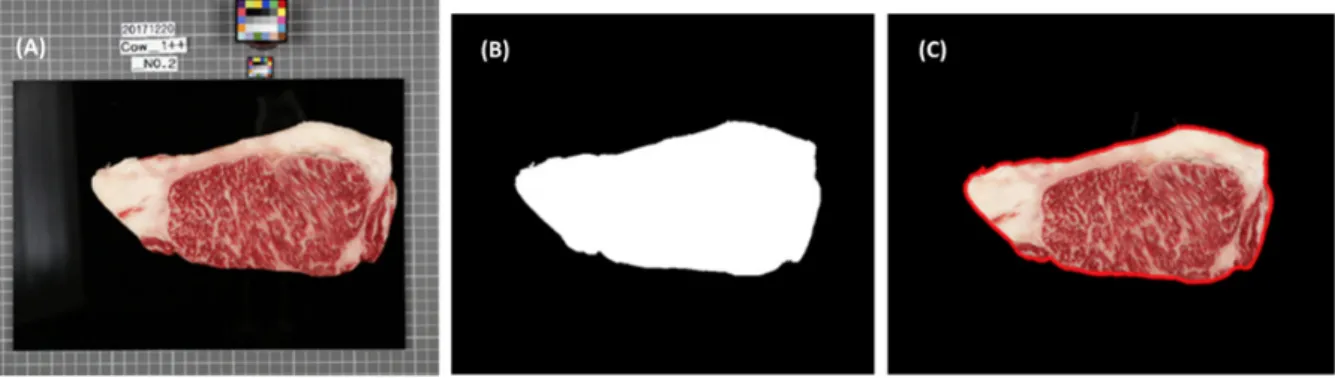
In this study, we extracted only the region corresponding to the actual beef as the region of interest (ROI) from the area
that was calibrated for radial distortion and used it as the dataset. The size of the extracted ROI images varied slightly from
sample to sample but was approximately between 2,000 × 1,000 and 3,500 × 1,500 pixels, which is greatly reduced
compared with the initial image size (8,688 × 5,792 pixels). However, for the ImageNet Large Scale Visual Recognition
Challenge (Russakovsky et al., 2015), the image size for the input dataset is 224 × 224 pixels (Krizhevsky et al., 2012), and
the image size of the input dataset used for handwritten digits was 28 × 28 pixels (Niu et al., 2012). That is, the extracted
ROI images were thought to be too large to be used as input data. In other words, it would take a long time to perform
Fig. 2. (a) Corrected image and (b) radial distortion examples such as barrel distortion and (c) pincushion
distortion.
learning using the as-extracted ROI images as input data, and thus a different strategy was required to perform deep learning with limited samples. In contrast, a reduced pixel image had taken as a sample for beef marbling grading is not considered as the best strategy for reliable detection and classification.
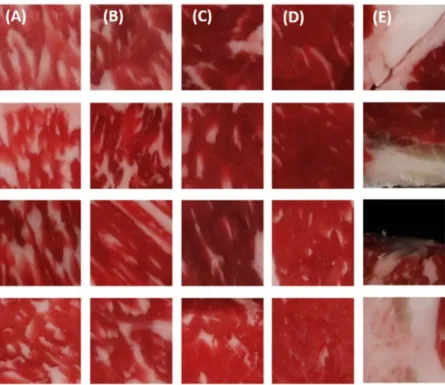
Therefore, we created a sub-image of 161 × 161 pixels and constructed a dataset that uses each sub-image as the input.
In our previous study, size of the sub-image for beef marbling grades, 161 × 161 pixels were the least and reasonable size among 28 and 161 pixels (Kwon et al., 2019).
According to the beef grade, there were 4 categories (1++, 1+, 1, and 2 & 3), the total training data comprised 1,200 images, the validation data comprised 210 images, and the test data comprised 88 images. Among the obtained beef samples, since the number of grade 2 and 3 images was much smaller than that of other grades, and these grades are not of much interest to consumers, this study set grade 2 and 3 images into one class of 2 & 3. In addition, for the training dataset, the number of images was increased to include left and right inversion and top and bottom inversion to address the overfitting problem and develop a high-performance CNN. In total, 3,600 images were used for training.
Finally, one image that was not used for training was prepared for each grade, and a sub-image of 161 × 161 pixels across the grading part was set as the prediction dataset. The results predicted from the complete grading area were checked. Based on this, the performance of the developed CNN was evaluated in comparison with the actual grading results.
Prediction model using CNN
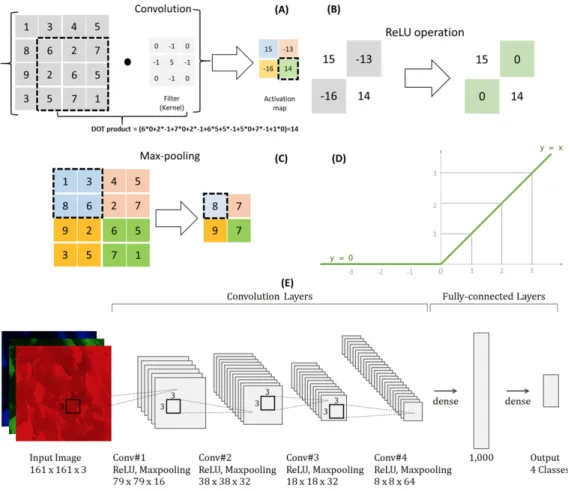
A CNN is an artificial neural network that creates the features of input images using various filters (kernels) to perform convolution operation, and learning is performed based on this. The features of input images are generated differently depending on filter size and stride, and different learning results are derived in accordance with each layer composition. In this study, we set the convolutional filter size to 3 × 3 which strides to 1 across the width and height of the input image and executes a dot product is computed to build up an activation map (Fig. 3A).
Primary algorithms used in the CNN configuration were ReLU (rectified linear unit), batch normalization, and dropout.
After the convolution operation, ReLU was used as the layer activation function (Fig. 3B and 3D). The use of ReLU function (f(x) = max(0,x)) enables learning with faster and higher performance than other activation functions such as logistic and hyperbolic tangent networks, and thus because it is widely used not only the image processing field but also in various study fields (Glorot et al., 2011).
To reduce computation time, the pooling process, known as downsampling, is applied to reduce the size of the image.
Currently, average and max-pooling are the most common methods, max-pooling layer consists of a sliding window function such as 2 × 2 that moves with stride 2 over the image matrix and gathers the highest number from the window. Max-pooling layer produces a new output matrix with the highest value from the original image matrix so that has the potential to stand out the edge of the image (Fig. 3C).
Batch size refers to the number of input data learned at a time. That is, even within a training process, the learning process
changes depending on the batch size. The batch normalization technique normalizes the results for each batch of input data
and uses the average in the test process. Batch normalization can be used to reduce covariate shifts and enables the design of
deeper layers (Ioffe and Szegedy, 2015).
Dropout, proposed by Srivastava et al. (2014), is involved in the activation of neurons in the corresponding layer and controls signal transmission to the next layer. This prevents overfitting and yields high-performance results through random dropping units include their connections during training.
The CNN architecture of this study, including the algorithms described above, is summarized in Fig. 3. There are four convolution layers and two fully-connected layers. A 3 × 3 kernel size of the max-pooling window and was used for subsampling in each convolution layer. ReLU was used as an activation function, and batch normalization was applied to all convolution layers.
Each fully-connected layer is connected to all neurons in the layer immediately preceding it. In the first fully-connected layer, 4,096 neurons of the preceding layer are connected to 1,000 neurons. The final fully-connected layer is connected to four categories, and the number of final outputs after the dropout is applied at a rate of 0.5. In this case, to solve a multi-class (4 grades of beef marbling) problem, softmax was used as the activation function.
In this study, Python (version 3.7.4) was used in the Ubuntu 16.04 version environment for CNN development and learning. The PC used for learning was equipped with a 2.6 GHz CPU (Intel core processor, Skylake, Intel Corporation, Santa Clara, USA) with 8 cores and 16 GB of RAM, and training for model took about 4 hours under this environment.
Fig. 3. The architecture of the convolutional neural network (CNN) structure for beef marbling classification
and prediction. (A) Convolution, (B) rectified linear unit (ReLU) operation layer, (C) max-pooling, (D) ReLU
function and (E) overall CNN architecture. The input image was trained through its 4 convolutional layers
and then outputs predicted probabilities between 0 and 1, represent 1 to 4 classes respectively, with the
threshold being 0.5 using softmax function.
Fig. 4. Radial distorted (A and C) image and corrected (B and D) image.
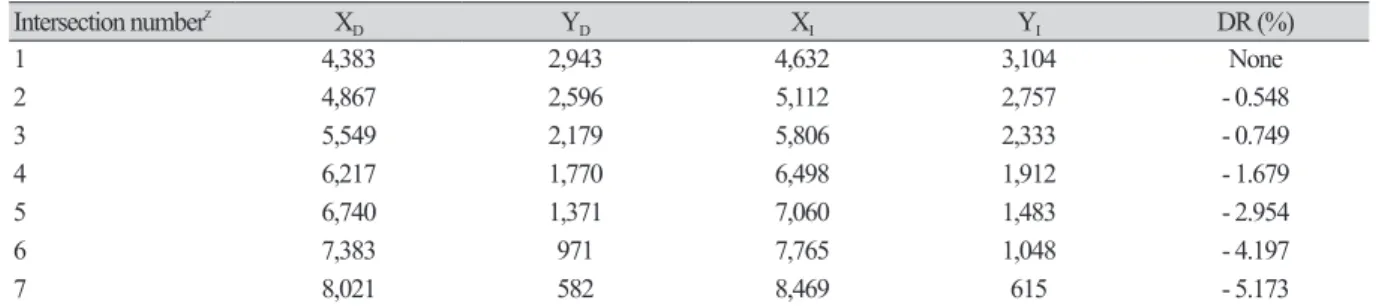
Table 1. Distortion ratio in accordance with intersection number from bottom left (1) to top right (7) of grid plate.
Intersection number
zX
DY
DX
IY
IDR (%)
1 4,383 2,943 4,632 3,104 None
2 4,867 2,596 5,112 2,757 - 0.548
3 5,549 2,179 5,806 2,333 - 0.749
4 6,217 1,770 6,498 1,912 - 1.679
5 6,740 1,371 7,060 1,483 - 2.954
6 7,383 971 7,765 1,048 - 4.197
7 8,021 582 8,469 615 - 5.173
X
D, X-axis coordinate of intersection point in a distorted image; Y
D, Y-axis coordinate of intersection point in a distorted image; X
I, X-axis coordinate of intersection point in a calibrated image; Y
I, Y-axis coordinate of intersection point in a calibrated image; DR, distortion ratio.
z