Print ISSN: 1738-3110 / Online ISSN 2093-7717 http://dx.doi.org/10.15722/jds.18.3.202003.53
Factors Influencing the Reuse of Mobile Payment Services in Retail* **
Soon-Hong KIM ***, Byong-Kook YOO****
Received: February 12, 2020 Revised: February 16, 2020 Accepted: March 05, 2020.
Abstract
Purpose: This study tests the suitability of a new technology acceptance model for a mobile payment system by checking how statistically significant the change is from the UTAUT (Unified Theory of Acceptance and Use of Technology) and UTAUT 2 models. Research, Data, and Methodology: We surveyed 250 students at Incheon University who are using the mobile payment system. The analysis was conducted on 243 valid questionnaires. The survey was conducted for one month in October 2018. The collected data were analyzed using SPSS and hierarchical regression analysis was applied. Results: Using hierarchical regression analysis, this study confirmed whether the newly added hedonic motivation, switching cost, and perceived risk variables in the UTAUT2 model are good explanatory variables. Mobile payment usage experience was found to have a moderating effect on mobile payment reuse intention. According to the analysis, the UTAUT2 model brought about more influential change than the variables of the UTAUT model. Conclusions: This study found that consumers‘ psychological factors added in the UTAUT2 model greatly influenced the reuse intention for mobile payment. As an implication of this study, mobile payment providers need to develop strategies that could meet hedonic motivation, switching cost and perceived risk for their customers.
Keywords: Mobile Payment Service, UTAUT2 Model, Hedonic Motivation, Switching Cost, Retail Fields.
JEL Classification Code: L81, M10, M15, M30, M31.
1.Introduction 1213
Due to the development of the 4th industry, mobile payment service is actively being applied in the retail fields.
In particular, as the technology of mobile phones has been remarkably developed, more consumers have made mobile shopping and payment. Massive big data accumulated through online and mobile transactions serves as an engine to develop the 4th industry in the retail business area.
Among information technology (IT) acceptance models, the
* This study was supported by the Incheon National University research grant in 2016.
** This study was revised by and supplemented paper published at summer conference of ICBE 2019
***First Author, Professor, Incheon National University, Division of International Trade, Korea, Tel: +82-32-835-8523, Email:
****Corresponding Author, Professor, Incheon National University, Division of International Trade, Korea, Tel: +82-32-835-8529, Email:
© Copyright: Korean Distribution Science Association (KODISA)
This is an Open Access article distributed under the terms of the Creative Commons Attribution Non- Commercial License (https://creativecommons.org/licenses/by-nc/4.0/) which permits unrestricted non- commercial use, distribution, and reproduction in any medium, provided the original work is properly cited.
model often used for consumer behavior is Technology Acceptance Model (TAM) which was developed to explain the determinants of consumers‘ acceptance behavior of new products. The main variables affecting consumer‘
acceptance behavior in the TAM model are ‗perceived usefulness‘ and ‗perceived ease of use‘ (Davis, Bagozzi, &
Warshaw, 1989). However, TAM has been extended and developed into various models because it has not fully considered the effects of various exogenous variables.
Comprehensively considering various theories related to the TAM model, Venkatesh, Morris, Davis, and Davis (2003) designed Unified Theory of Acceptance and Use of Technology (UTAUT) model by using three variables influencing behavioral intention and control variables influencing the moderating effect. The UTAUT model, simple and integrated, is used to analyze users‘ acceptance factors and negative factors in terms of new technology and thereby to find a way to improve consumers‘ technology acceptance model (Venkatesh et al., 2003). UTAUT2 model in which consumers‘ personal perception or psychology is added to the UTAUT is presented as a suitable model for psychological analysis of mobile service
users. Therefore, this study tries to analyze the factors influencing consumers‘ intention to reuse mobile payment based on the UTAUT model known as the improved model for IT service users and the UTAUT2 model which is an extended model of UTAUT. This study attempts to sets the basic factors of UTAUT-performance expectancy, effort expectancy, social influence, and facilitating conditions-as independent variables, and tries to analyze how the added factors in the UTAUT2 model influence the intention to reuse mobile payment service.
We will test whether additional variables, hedonic motivation, switching costs and perceived risks of UTAUT2 are suitable models for mobile payment services through hierarchical regression analysis. These additional variables are emotional factors that consumers experience when using mobile payment services. Hierarchical multiple regression analysis is not an evaluation of each independent variable, but an analysis method to see how explanatory power changes as new variables are added at each stage. In addition, hierarchical regression analysis is useful to reveal the relative effect of main variables in the condition that demographic variables as moderating variables, including gender and experience, are controlled.
2. Theoretical Background
2.1. Concept and Types of Mobile Payment Service
Mobile payment service refers to an electronic payment service that simply makes payments using a mobile app without going through complicated procedures such as certificates. Mobile payment service has emerged as the most important payment method in online and offline retail stores because it is easy to use and provides various services (He, Kim, & Lee, 2019). According to the Bank of Korea, the amount of domestic mobile payment service usage is growing rapidly from 11.11 trillion won in 2016 to 39.9 trillion won in 2017. The average daily use of mobile payment service increased 2.5 times from 859,000 in 2016 to 2,124,000 in 2017. In 2018, the average daily use of payment service was 117.4 billion won (3.68 million use cases), which was increased by 17.4% than previous quarter.
Mobile payment service is not only used as a payment method, but also widely used in online and offline fields such as remittance and O2O service, and payment methods are rapidly reorganizing from the existing credit card to the mobile payment market.
Mobile payment methods are divided into NFC (Near Field Communication), MST (Magnetic Secure Transmission) and APP-Card according to technology used.
NFC method operates based on Radio Frequency
Identification (RFID) technology, which does not require a separate connection process and has superior security (Lee, 2019). MST is a service where customers can automatically pay by putting smartphone near a magnetic credit card machine. App-Card is a payment method where one can pay with a barcode or QR code provided by a smartphone app. However, each of payment methods above has a need to be improved.
Mobile Payment Service is classified into various types according to its provider. There are types developed by manufacturers such as Samsung Pay and Apple Pay, types developed by platform companies such as Kakao Pay and Naver Pay, and SSG Pay and L Pay developed by distributors. Mobile payment service is convenient, but there are also problems such as personal hacking and privacy invasion. The challenges of mobile payment service providers are to improve efficiency, convenience and security, and to expand merchants online and offline (Park
& Lee, 2019).
2.2. Technology Acceptance Model (TAM) Technology Acceptance Model (TAM) was mostly used to explain consumers‘ behavior for information technology acceptance before the theory of integrated technology acceptance emerged. It was suggested on the basis of Theory of Reasoned Action (TRA) and Theory of Planned Behavior (TPB) (Davis et al., 1989). At the beginning time when technology acceptance model was suggested, it was developed to explain the determinants of computer acceptance behavior, and the main variables of the theory were ‗perceived usefulness‘ and ‗perceived ease of use‘
(Lee, Wu, & Fan, 2017). The perceived usefulness is defined as a degree of perception that work efficiency will be improved when a new information technology is used, and the perceived ease of use is defined as a degree of perception that less effort is made when a new technology is used (Lee, Wu, & Fan, 2017). Davis et al., (1989) analyzed that the perceived ease of use and usefulness of technology acceptance influenced actual use intention. In TAM model, attitude is used as a mediating variable. In the TAM model, studies have been argued that attitude variables do not play a role as a mediating variable.
Venkatesh et al. (2003) argued that attitude failed to serve as a mediating role for use intention in terms of usefulness and ease of use as main causal variables of TAM, and proved that usefulness and ease of use, except for attitude, directly influenced use intention. Teo (2009), Nistor and Heymann (2010) proved that the model using attitude as a mediating variable had no explanatory power.
In addition, Theory of Reasoned Action (TRA) is a theory that humans always make rational judgments and act according to systematic information activities, and present
'subjective norms' as the main independent variables that affect behavioral intention. It is the same concept as 'social impact', an important independent variable of the UTAUT theory (Fishbein & Ajzen, 1975). The study also try to perform multiple regression analysis assuming that the independent variables of the UTAUT model combined with the TAM model and the TRA model directly affect the intention to reuse mobile payment services.
2.3. UTAUT (Unified Theory of Acceptance and Use of Technology) Model
Unified Theory of Acceptance and Use of Technology (UTAUT) model was developed from TRA and TAM models. TAM has been applied to explain users‘ acceptance behavior for various kinds of information technology.
However, TAM has not fully considered the effects of various exogenous variables. Since the model was supplemented, diverse models have been expanded and developed (Le et al., 2020). Venkatesh et al. (2003) comprehensively took into account eight theories, including Theory of Reasoned Action (TRA), Technology Acceptance Model (TAM), Theory of Planned Behavior (TPB) and Innovation Diffusion Theory (IDT). The UTAUT model was designed using four variables that influence behavioral intentions and consumer behavior by arranging 32 concepts of similar models .Of independent variables in UTAUT model, performance expectancy, effort expectancy, social influence, and facilitating conditions were suggested to influence behavioral intention. And age, gender, experience and self-motivation of use were suggested the moderating variables. In particular, among independent variables influencing behavioral intention, performance expectancy and effort expectancy are the concepts developed from the perceived usefulness and perceived ease of use in TAM model. Social influence has the same concept as the subjective norm of TAM model.
According to many studies, facilitating conditions more directly influence behavior than behavioral intention, and their concept is similar to the ‗perceived behavioral control‘
of TPB model.
2.4. Modified UTAUT2 Model
Venkatesh, Thong, and Xu (2012) argued that UTAUT model had technical and functional approaches only because the model set ease of use and usefulness as main factors of the intention to use information technology products, and proposed Unified Theory of Acceptance and Use of Technology (UTAUT2) Model in which several variables considering personal perception or psychological factors were added to UTAUT model. Firstly, these researchers suggested hedonic motivation as the first factor.
Hedonic motivation was defined as a degree of interest and pleasure that a user has in accepting a technology and determining technology use. Hedonic motivation was found to play a very important role in a user‘s technology acceptance and use determination (Venkatesh et al., 2003:
Kim, Hong, & Yang, 2019). Raman and Don (2013) found that hedonic motivation variables play an important role in behavioral intention in the UTAUT2 model.
Secondly, Venkatesh et al. (2012) added price value as the second factor. They revealed that price value was able to influence consumers‘ use and reuse intention of new IT products like mobile app. The research by Escobar and Carvajal (2013) also showed that price value influenced consumers‘ intention to purchase online flight tickets. In mobile payment service, using a service app costs nothing so that price value is not meaningful. If consumers think that using a mobile payment service app is relatively more convenient and familiar than using other apps, they feel that it costs more to switch to a different payment app. Such a feeling is called switching barrier or switching cost. In other words, if users feel more convenient in using their current payment service app, they refuse to switch to a different app. Therefore, this study uses switching cost as a surrogate variable of price value which is one of concept variables of UTAUT2. According to Ping (1993), the concept of switching barrier is used together with switching cost and switching cost refers all cost factors that make it hard for customers to switch their products, services, or stores in use. Given that there is a factor which makes it possible for users to continue to use a mobile payment service as long as the mobile payment services gives them economic benefit or habitual convenience, this study uses switching barrier as a main causal variable of reuse intention.
Thirdly, UTAUT2 model set perceived risks arising in mobile phone use such as privacy violation, security issue, careless accidents, and addiction, as a significant variable.
Therefore, in mobile payment system, perceived risks are considered to be an important variable of use intention.
Unlike simple product purchase, mobile payment service makes users exposed to diverse risks when they use the payment service. In other words, in the course of using mobile payment service, it is possible to face various risks, such as personal information leakage, privacy violation, payment delay, and hacking-induced financial loss (Prashar, Vijay, & Parsad, 2015). In addition, mobile payment use can cause such perceived risks as smartphone use addiction and distraction. This study tries to consider hedonic motivation, switching cost, and perceived risks as the main causal variables of modified UTAUT2, which can influence the intention to reuse mobile payment service.
3. Research Design, Data and Methodology
3.1. Variables of UTAUT Model and the Establishment of Hypotheses
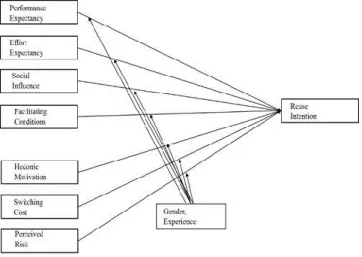
The purpose of this study is to test whether the model is a suitable model for the new technology acceptance model as like mobile payment system by checking how statistically significant the change is made from the UTAUT and UTAUT 2 models. As a method of analysis, hierarchical analysis is used, the first step is to set the performance expectancy and effort expectancy corresponding to the perceived usability and perceived ease of use of the TAM model as independent variables. In the second step, social influence and facilitating conditions are additionally set as independent variables of the UTAUT model. In the third step, hedonic motivation, switching cost, and perceived risk are additionally set as independent variables of the UTAUT2 model.
3.1.1. Performance Expectancy
Performance expectancy is the concept developed from the perceived usefulness of technology acceptance model, and refers as a degree of expectancy that when a technology is used to solve a problem or be applied to work in everyday life, it is possible to obtain usefulness. Venkatesh and Davis (2000) suggested that performance expectancy for new information technology products influenced consumers‘ technology acceptance intention. Chen and Chang (2013) revealed that performance expectancy for NFC mobile phone positively influenced consumers‘
product use attitude and their use intention.
3.1.2. Effort Expectancy
Effort expectancy refers to a degree of expectancy that consumers are able to learn how to use a new particular system skillfully (Venkatesh et al., 2003). Effort expectancy is similar to ‗perceived ease of use‘ of TAM (technology acceptance model). There are multiple studies on the influence of effort expectancy on the acceptance intention of new technology. Venkatesh et al. (2003), Moran, Hawkes, and Gayer (2010), Zhou, Lu, and Wang (2010) analyzed that effort expectancy positively influenced behavioral intention. Amin (2007)‘s research on mobile credit card service also suggested that the perceived ease of use, similar to effort expectancy, significantly influenced the intention of acceptance.
3.1.3. Social Influence
Social influence is similar to subjective norm, social factor, and image among variables in TPB, technology acceptance model, and TRA. It is defined as a degree of feeling that acquaintances influence a persons‘ use of a new
information technology (Venkatesh et al., 2003). Social influence of information technology use is also an important factor that can influence the intention to use a technology. Chen and Chang (2013) proved that social influence influenced behavioral intention.
3.1.4. Facilitating Conditions
Facilitating conditions means a degree of perception that there is organizational or technical support in order for individuals to smoothly use a particular information technology (Venkatesh et al., 2003). The concept is similar to ‗perceived control behavior‘ of TRA and TPB. In the previous study on mobile credit card service use, facilitating conditions are defined as a degree of perception that organizational or technical environments are established in order for service use (Yoo & Kim, 2019).
Based on the previous research, we set the following hypothesis:
H1: Performance expectancy will positively influence the intention to reuse mobile payment service.
H2: Effort expectancy will positively influence the intention to reuse mobile payment service
H3: Social influence will positively influence the intention to reuse mobile payment service.
H4: Facilitating conditions will positively influence the intention to reuse mobile payment service.
3.2. Modified UTAUT2 Model 3.2. 1. Hedonic Motivation
Brown and Venkatesh (2005) suggested that hedonic motivation significantly influenced use intention. Research that hedonic motivation influences technology acceptance intentions has been done in Martins (2013), Raman and Don (2013), and Dlodlo (2014) argues that the more people enjoy shopping, the stronger their intention to reuse.
Consumers using mobile payments are more interested in optional services, such as events and discounts on mobile payments, rather than mobile payments themselves.
Consumers pay more attention to a variety of information, such as recommendations, while paying for food delivery or travel bookings. A diversity of events in the payment course, such as online present purchase and discount coupon offering, give them pleasure and interest. In this sense, consumers use more mobile payment service when they feel interest in and satisfaction with optional services in the way of mobile payment.
3.2.2. Switching Cost
Switching costs means a barrier that prevents customers from switching to other stores or services due to psychological burden, which leads to customer loyalty
(Burnham, Frels, & Mahajan, 2003; Jones, Mothersbaugh,
& Beatty, 2000). Consumers using mobile payment services are more likely to continue using their payment services. Therefore, switching cost will influence the intention to reuse. Recent studies revealed that switching cost directly influenced customer loyalty or intention to reuse. Anderson and Sullivan (1993) found that switching costs had a moderating effect on customer reuse or customer loyalty. The studies conducted by Burnham et al.
(2003) and Sharman (2000) suggested that switching cost influenced customers‘ continuous use intention.
3.2.3. Perceived Risks
Lalinthorn and Vinai (2017) and Chiu, Wang, Fang, and Huang (2012) suggested that perceived risks were negatively influential on repurchase intention. Lu, et al.
(2011) also proved that perceived risks significantly influenced the behavioral intention of mobile payment.
Therefore, this study tries to set the hedonic motivation, switching cost, and perceived risks other than four core variables of UTAUT as the factors influencing behavioral intention of mobile payment service. Therefore, this study tries to analyze hedonic motivation, switching cost, and perceived risks other than four core variables of UTAUT as the factors influencing behavioral intention of mobile payment service.
3.3. Reuse Intention
In the research on the acceptance of a new information system or information technology, continuous use intention is perceived to be a very important concept. That is because consumers‘ continuous use of a new information technology or system is a critical factor for the success of the technology or system (Kwak et al., 2019; Ryu, 2019). In the study on smartphone technology acceptance, use intention is defined as users‘ intention to continue to use smartphone or recommend it to others (Choi & Yang, 2018;
Yang, et al., 2018). Based on the UTAUT2 study described above, this study sets the following hypotheses about the factors that influence mobile payment reuse intent.
Hierarchical regression analysis will be used to analyze this assumption.
H 5: Hedonic motivation will positively influence the intention to reuse mobile payment service.
H 6: Switching cost will positively influence the intention to reuse mobile payment service.
H 7: Perceived risks will positively influence the intention to reuse mobile payment service.
And Venkatesh et al. (2003) found that age, gender, experience, habits, and self-motivation play a moderating
role between independent variables and customer use intentions (Chang, 2012). Therefore, considering these previous studies, this study will test whether the independent variables as like age and experience have a moderating effect on the intention to reuse mobile payments.
Figure 1: Research Model
3.4. Operational Definition
3.4.1. Operational Definition for Performance Expectancy
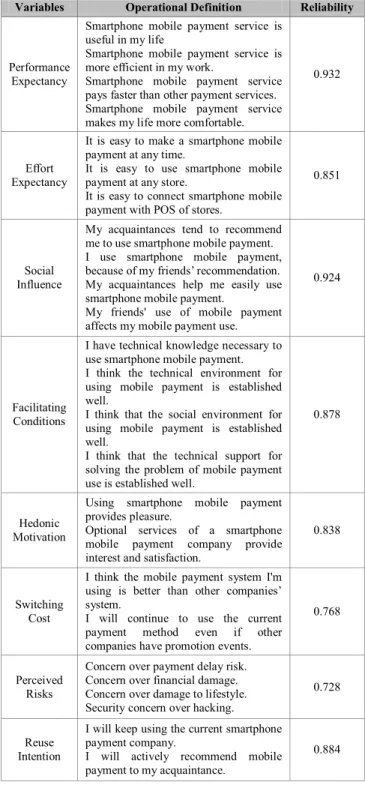
The previous studies based on UTAUT model revealed that performance expectancy positively influenced behavioral intention (Martín & Herrero, 2012; Moran et al., 2010; Wang & Wang, 2010). Referring to the aforementioned studies, this study set four items for performance expectancy as follows: Smartphone mobile payment service is useful in my life; smartphone mobile payment service is more efficient in my work; Smartphone mobile payment service is thought to be faster than other payments, smartphone mobile payment service makes my life more comfortable.
3.4.2. Operational Definition for Effort Expectancy Previous research has shown that the effort expectancy positively affect behavioral intentions (Moran et al., 2010;
Wang & Wang, 2010). Considering the above studies, three items of effort expectancy are established as follows: It is easy to use smartphone mobile payment skillfully; it is easy to understand the functions of smartphone mobile payment; it is easy to learn how to use smartphone mobile payment. Many studies already suggested that effort expectancy or ease of use worked as a main variable to explain the acceptance intention of mobile service (Kim et al., 2014; Schiertz et al., 2010).
Referring to the above studies, this study set four items for effort expectancy as follows: It is easy to make a smartphone mobile payment at any time and any place; it is
easy to use smartphone mobile payment at any store; it is easy to connect smartphone mobile payment with POS of stores.
3.4.3. Operational Definition for Social Influence Venkatesh et al. (2003) recognized that social influence was a main variable greatly influencing users‘ behavior, and defined social influence ―the degree to which an individual perceives that important others believe he or she should use the new system‖. Previous studies revealed that social influence positively influenced behavioral intention (Wang & Wang, 2010). Referring to the above studies, this study set three items for effort expectations as follows: ―My acquaintances tend to recommend me to use smartphone mobile payment; I use smartphone mobile payment, because of my friends‘ recommendation; my friends' use of mobile payment affected my mobile payment use.
3.4.4. Operational Definition for Facilitating Conditions
In reference to the studies conducted by Venkatesh et al.
(2003), Moran et al., (2010), and Raman and Don (2013), four items of facilitating conditions are set as follows: I have technical knowledge necessary to use smartphone mobile payment; the technical environment for using mobile payment is established well; the social environment for using mobile payment is established well; the technical support for solving the problem of mobile payment use is established well.
3.4.5. Operational Definition for Hedonic Motivation In reference to the studies conducted by Brown and Venkatesh (2005), Raman and Don (2013), and Martins (2013), two items are set as follows: Using smartphone mobile payment provides pleasure; optional services of a smartphone mobile payment company provide interest and satisfaction.
3.4.6. Operational Definition for Switching Cost In reference to the studies conducted by Burnham et al.
(2003) and Sharman and Patterson (2000), two items are set as follows: I think the mobile payment system I am using is better than other companies‘ system; I will continue to use the current payment method even if other companies have promotion events.
3.4.7. Operational Definition for Perceived Risks In reference to the studies conducted by Chiu et al.
(2012), and Lu, Yang, and Patrick (2011), four items are set as follows: concern over payment delay risk; concern over financial damage; concern over damage to lifestyle;
security concern over hacking.
3.4.8. Operational Definition for Reuse Intention In reference to previous studies, three items are set, such as I will keep using the current smartphone payment company;
I will actively recommend mobile payment to my acquaintance. The operational definitions are summarized in the following Table 1.
Table 1: Operational Definition
Variables Operational Definition Reliability
Performance Expectancy
Smartphone mobile payment service is useful in my life
Smartphone mobile payment service is more efficient in my work.
Smartphone mobile payment service pays faster than other payment services.
Smartphone mobile payment service makes my life more comfortable.
0.932
Effort Expectancy
It is easy to make a smartphone mobile payment at any time.
It is easy to use smartphone mobile payment at any store.
It is easy to connect smartphone mobile payment with POS of stores.
0.851
Social Influence
My acquaintances tend to recommend me to use smartphone mobile payment.
I use smartphone mobile payment, because of my friends‘ recommendation.
My acquaintances help me easily use smartphone mobile payment.
My friends' use of mobile payment affects my mobile payment use.
0.924
Facilitating Conditions
I have technical knowledge necessary to use smartphone mobile payment.
I think the technical environment for using mobile payment is established well.
I think that the social environment for using mobile payment is established well.
I think that the technical support for solving the problem of mobile payment use is established well.
0.878
Hedonic Motivation
Using smartphone mobile payment provides pleasure.
Optional services of a smartphone mobile payment company provide interest and satisfaction.
0.838
Switching Cost
I think the mobile payment system I'm using is better than other companies‘
system.
I will continue to use the current payment method even if other companies have promotion events.
0.768
Perceived Risks
Concern over payment delay risk.
Concern over financial damage.
Concern over damage to lifestyle.
Security concern over hacking.
0.728
Reuse Intention
I will keep using the current smartphone payment company.
I will actively recommend mobile payment to my acquaintance.
0.884
3.5. Data Collection and Samples
In this study, we surveyed 250 students in their 20s and 30s at the Incheon National University of who use the mobile payment service. The analysis was conducted on 243 valid questionnaires. Although the survey subject is limited to college students, since mobile services are still used by many younger people, we think there will be no problem in conducting research. According to a survey by DMC Report (2019.3), more than 80% of mobile payment service users are in their 20s and 30s. The survey had been conducted for one month, in October 2018. The collected data had been analyzed with SPSS. As an analysis method, hierarchical regression analysis was applied. Unlike multiple regression analysis, hierarchical regression is a way to show of setting up a regression equation by dividing independent variables in stages for model comparison. In hierarchical multiple regression analysis, each independent variable is not evaluated separately, but how explanatory power is changed when new variables are added together in
each step is analyzed.
4. Study Results
4.1. Descriptive Statistics
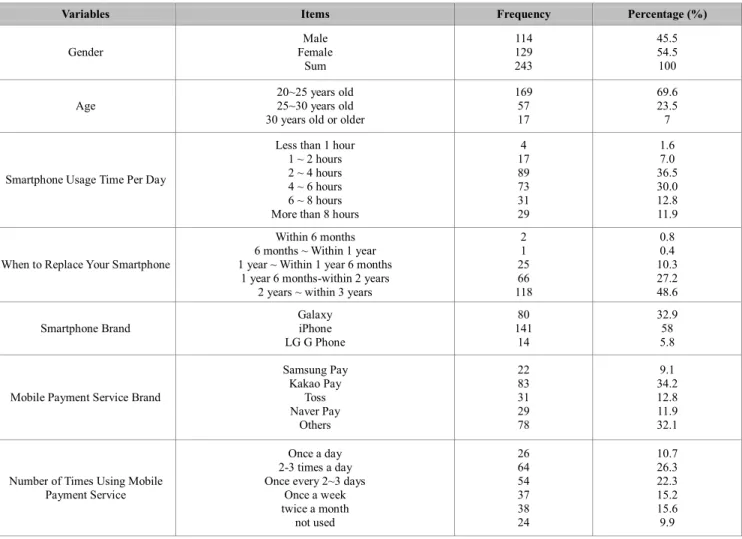
The descriptive statistics analysis results summarized in Table 2 are as follows. Male students accounted for 45.5%, and female ones for 54.5%. The age range is 69.6% from 20 to 25 years old, 23.5% from 25 to 30 years old, and 7%
from 30 years old or older. The allowance of students accounted for 39% of students with 300,000 to 500,000 won, and 22.5% of students with 500,000 to 700,000 won.
The students whose used smartphone for 2-4 hours accounted for 36.5% and those who used smartphone for 4- 6 hours accounted for 31.5%. The students who used iPhone as a main brand accounted for 59% and those with Galaxy Phone accounted for 31.5%.
Table 2: Demographic Characteristics
Variables Items Frequency Percentage (%)
Gender
Male Female
Sum
114 129 243
45.5 54.5 100
Age 20~25 years old
25~30 years old 30 years old or older
169 57 17
69.6 23.5 7
Smartphone Usage Time Per Day
Less than 1 hour 1 ~ 2 hours 2 ~ 4 hours 4 ~ 6 hours 6 ~ 8 hours More than 8 hours
4 17 89 73 31 29
1.6 7.0 36.5 30.0 12.8 11.9
When to Replace Your Smartphone
Within 6 months 6 months ~ Within 1 year 1 year ~ Within 1 year 6 months
1 year 6 months-within 2 years 2 years ~ within 3 years
2 1 25 66 118
0.8 0.4 10.3 27.2 48.6
Smartphone Brand
Galaxy iPhone LG G Phone
80 141
14
32.9 58 5.8
Mobile Payment Service Brand
Samsung Pay Kakao Pay
Toss Naver Pay
Others
22 83 31 29 78
9.1 34.2 12.8 11.9 32.1
Number of Times Using Mobile Payment Service
Once a day 2-3 times a day Once every 2~3 days
Once a week twice a month
not used
26 64 54 37 38 24
10.7 26.3 22.3 15.2 15.6 9.9
The students who changed smartphone every 2 to 3 years accounted for 51.5% and those who changed every 1.6 to 2 years accounted for 26%. With regard to the apps that students mainly used in their smartphone, YouTube videos accounted for 35.5%, chatting 29.5%, and internet search 19%. With regard to mobile payment service companies that the students mainly used, Kakao Pay accounted for 34.5%, Toss 13.5%, Samsung Pay 9%, and others 18%.
Regarding the count of mobile payment use, the students who made mobile payment 2-4 times daily accounted for 29%, those who did so once every week accounted for 15.5%, and those who did so twice a month accounted for 13.5%. With regard to importance factors for purchase, brand accounted for 24%, function 23%, and price & design 19%.
4.2. Correlation Analysis and Factor Analysis According to the coefficient of correlation rating, if independent variables have strong correlation (r>0.7~0.90 and more), they are judged to have high correlation and multicollinearity. Since the coefficient of determination (R2) is the square of the coefficient of correlation, it is possible to use this rating concept. In case of coefficient of
determination, if R2 is 0.65 or more, the regression formula is judged to explain data well. When the value is at least 04~0.6(moderate) or more, the regression formula is considered significant. There is another indicator representing multicollinearity. In the indicator, if Variance Inflation Factor (VIF) is 10 or more, it is judged that there is multicollinearity. In this study, the VIF is less than 2.
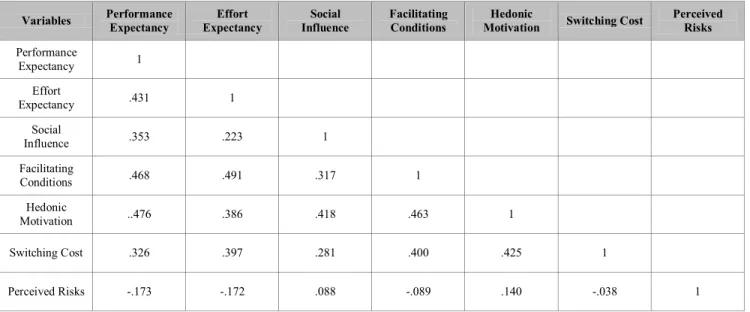
Therefore, it is found that there is no multicollinearity. A correlation analysis was also performed to analyze multicollinearity relationships between independent variables (Table 3). The correlation between the variables of UTAUT model (performance expectancy, effort expectancy, social influence, and facilitating conditions) and those of TAUT2 model (hedonic motivation factor, switching cost, and perceived risks) was analyzed. As a result, the coefficient of correlation between the variables was statistically significant. On the basis of, 0.7, the correlation value between the variables was not higher than 0.7 so that multicollinearity between the independent variables had no problem. As a result of factor analysis, each factor showed statistically significant results and the value of Cronbach‘s α for reliability was 0.7 or more so that the variables had reliability.
Table 3: Correlation Analysis Variables Performance
Expectancy
Effort Expectancy
Social Influence
Facilitating Conditions
Hedonic
Motivation Switching Cost Perceived Risks Performance
Expectancy 1
Effort
Expectancy .431 1
Social
Influence .353 .223 1
Facilitating
Conditions .468 .491 .317 1
Hedonic
Motivation ..476 .386 .418 .463 1
Switching Cost .326 .397 .281 .400 .425 1
Perceived Risks -.173 -.172 .088 -.089 .140 -.038 1
4.3. Results from Hierarchical Regression Analysis
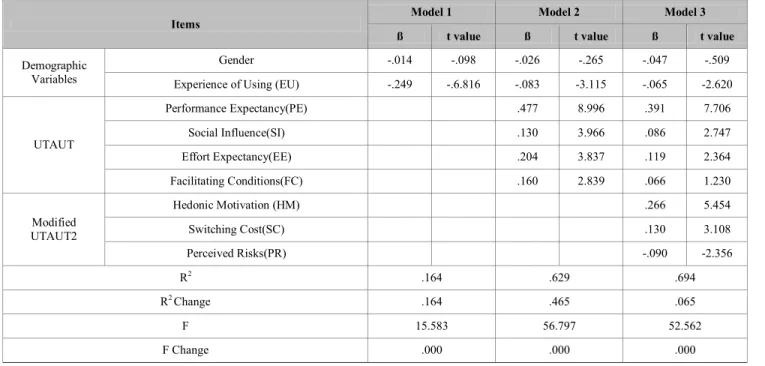
The hierarchical regression analysis results of the effects of the UTAUT, UTAUT2 model on the reuse of mobile payment services are as follows. Table 4 shows the results of the hierarchical regression analysis. In the model 1, a regression analysis was performed using gender and
experience variables as control variables to find moderating variables that influence behavioral intention. The frequency of use of mobile payment service was used as the experience variable. Since the samples were college students, age and income were excluded from the control variables. According to the analysis, the influence of gender on the reuse intention for mobile payment service was not statistically significant, but the use experience was
statistically significant (t=-3.115). It means that use intention is different depending on the experience of using of mobile payment. In other words, the lower the frequency of use is, the lower the reuse intention is as much as the value of 0.249.
In the model 2, in the condition that demographic variables are controlled, the influence of such variables as performance expectancy, social influence, facilitating conditions, and effort expectancy on the reuse intention of mobile payment use was analyzed in regression model.
According to the analysis, the goodness-of-fit of the model was statistically significant (R2=0.629, R2 change=0.465, F=56.797, Significance value of F change value=0, the goodness-of-fit of the model is significant at p<.001).
According to the regression analysis on each independent variable, all of the four variables significantly influenced the reuse intention for mobile payment (performance expectancy β=0.477, t=8.996, effort expectancy β=0.204, t=3.837, facilitating conditions β=0.160, t=2.839, social influence β=0.130, t=3.966). Among the independent variables, the most influential factors for mobile payment reuse were performance expectations and followed by social influence and facilitating conditions.
In the Model 3, which is UTAUT2 model, all independent variables except facilitating conditions were significant. According to the analysis, R2 =0.833, R2 change was 0.0.065 (6.5% higher than in UTAUT model), and F value=52.562, Significance value of F change value=0. As a result, the added values of UTAUT2 model brought about more influential change than the variables of
UTAUT model. Performance expectancy (β =0.391, t=7.706) was still the most important factor. Hedonic motivation factor (β=0.266, t=5.454), effort expectancy (β=0.119, t=2.364), switching cost (β=0.130, t=3.108), perceived risk (β=-0.090, t=-2.358), and social influence (β=0.086, t=.2.747) also significantly influenced the reuse intention for mobile payment service. However, facilitating conditions (β=0.066, t=1.230) was not statistically significant. For mobile payments services, facilitating conditions terms refer to a technical infrastructure that can use mobile payments. Since the current level of mobile payment has already been sufficiently developed, consumers may not feel uncomfortable in terms of technical infrastructure. So, the technology infrastructure may not affect the reuse intention. The results of the hierarchical regression analysis show that the added variables in the UTAUT2 model, that is the cognitive and psychological factors felt by consumers have significant influences. Thus, the UTAUT and UTAUT2 models are suitable models for explaining the intention to reuse mobile payment services.
Venkatesh et al. (2003) found that age, gender, experience, and self-motivation play a moderating role between independent variables and customer intention in the UTAUT model. In the hierarchical regression analysis, we found that only the use experience among the demographic factors affects mobile payment reuse, so we will analyze the moderating effect by applying only the user experience variables as variables affecting mobile payment reuse. Therefore, the following hypotheses are set for the analysis of moderating effects.
Table 4: Result of Hierarchical Regression Analysis
Items Model 1 Model 2 Model 3
ß t value ß t value ß t value
Demographic Variables
Gender -.014 -.098 -.026 -.265 -.047 -.509
Experience of Using (EU) -.249 -.6.816 -.083 -3.115 -.065 -2.620
UTAUT
Performance Expectancy(PE) .477 8.996 .391 7.706
Social Influence(SI) .130 3.966 .086 2.747
Effort Expectancy(EE) .204 3.837 .119 2.364
Facilitating Conditions(FC) .160 2.839 .066 1.230
Modified UTAUT2
Hedonic Motivation (HM) .266 5.454
Switching Cost(SC) .130 3.108
Perceived Risks(PR) -.090 -2.356
R2 .164 .629 .694
R2 Change .164 .465 .065
F 15.583 56.797 52.562
F Change .000 .000 .000
H 8: The experience of using mobile payment service will have a moderating effect on the intention to reuse mobile payment in the UTAUT model.
H 8-1: The experience of using mobile payment service will have a moderating effect on the performance expectancy on mobile payment service reuse.
H 8-2: The experience of using mobile payment service will have a moderating effect on the effort expectancy on mobile payment service reuse.
H 8-3: The experience of using mobile payment service will have a moderating effect on the social influence on mobile payment service reuse.
H 8-4: The experience of using mobile payment service will have a moderating effect on the effect of facilitating condition on mobile payment service reuse.
H 8-5: The experience of using mobile payment service will have a moderating effect on the hedonic motivation on mobile payment service reuse.
H 8-6: The experience of using mobile payment service will have a moderating effect on the switching cost on mobile payment service reuse.
H 8-7: The experience of using mobile payment service will have a moderating effect on the perceived risk on mobile payment service reuse.
Table 5: Result of Moderating Effect for the UTAUT Model
Items Model R2 Statistics Change
R2 Change F Change Sig(F Chang) Result
Performance Expectancy(PE)
1(PE) .507 .507 247.824 .000
Accepted
2(PE, EU) .529 .022 11.392 .001
3(PE*EU) .542 .013 6.550 .011
Effort Expectancy(EE)
1(EE) .264 .264 86.416 .000
Not Accepted
2(EE,EU) .362 .098. 36.812 .000
3(EE*EU) .369 008 2.846 .093
Social Influence(SI)
1(SI) .206 .206 62.434 .000
Accepted
2(SI,EU) .301 .095 32.739 .000
3(SI*EU) .319 .018 6.157 .014
Facilitating Conditions(FC)
1(FC) .281 .281 94.386 .000
Not Accepted
2(FC,EU) .377 .098 36.894 .000
3(FC*EU) .377 .000 .001 .979
Hedonic Motivation (HM)
1(HC) .390 .390 154.042 .000
Accepted
2(HM, EU) .464 .074 33.301 .000
3(HM*EU) .489 .025 11.518 .001
Switching Cost(SC)
1(SC) .248 .248 79.607 .000
Accepted
2(SC,EU) .331 .083 29.685 .000
3(SC*EU) .352 .021 7.597 .000
Perceived Risks(PR)
1(PR) .025 .025 6.054 .015
Accepted
2(PR,EU) .175 .150 43.730 .000
3(PR*EU) .200 .025 7.410 .007
Notes: * Dependent variable: mobile payment service reuse.
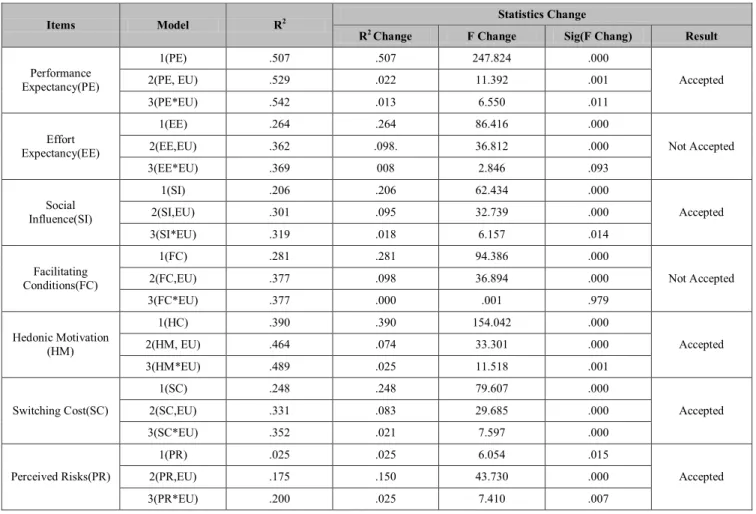
The results of the analysis on the moderating effect are as follows (Table 5): Regarding moderating effect of experience of using on the relationship between performance expectancy and reuse intention, R2 is increasing gradually from Model 1 to Model 3, from 50.7%
to 54.2%. The significance probability is also 0.011, which can be interpreted as having a moderating effect. Regarding moderating effect of experience of using on the relationship
between social influence and reuse intention, R2 is increasing gradually from Model 1 to Model 3, from 20.1%
to 31.9%. The significance probability is also 0.014, which can be interpreted as having a moderating effect. Regarding moderating effect of experience of using on the relationship between hedonic motivation and reuse intention, R2 is increasing gradually from Model 1 to Model 3, from 39%
to 48.9%. The significance probability is also 0.001, which can be interpreted as having a moderating effect. Regarding
moderating effect of usage experience on the relationship between switching cost and reuse intention, R2 is increasing gradually from Model 1 to Model 3, from 24.8% to 35.2%.
The significance probability is also 0.006, which can be interpreted as having a moderating effect. Regarding moderating effect of experience of using on the relationship between perceived risks and reuse intention, R2 is increasing gradually from Model 1 to Model 3, from 2.5%
to 20%. The significance probability is also 0.007, which can be interpreted as having a moderating effect. However, this analysis showed that the experience of using do not have moderating effect on relationship between effort expectancy and reuse intention or relationship between facilitating conditions and reuse intention.
5. Conclusion
5.1. Academic Implications
The purpose of this study was to theoretically test the UTAUT2 model, we found that the variables of UTAUT2 affect the intention to reuse mobile payments. In this study, we also confirmed whether the newly added hedonic motivation, switching cost, and perceived risk variables in the UTAUT2 model are well-explained variables through the hierarchical regression analysis. And we analyzed whether control variable such as mobile payment usage experience has a moderating effect on mobile payment reuse intention. According to the analysis, UTAUT2 model brought about more influential change than the variables of UTAUT model.
To sum up this study, in the first step of hierarchical regression analysis, the experience of using influenced the intention to reuse mobile payment service. In the second model, in the condition that demographic variables are controlled, the influence of such variables as performance expectancy, social influence, facilitating conditions, and effort expectancy on the reuse intention of mobile payment use was statistically significant. In the third model, which is UTAUT2 model, all independent variables except facilitating conditions were significant. Performance expectations, social influence, effort expectations, hedonic motivation, switching costs and perceived risk have significant effects except facilitating conditions. According to the hierarchical regression analysis, it indicated that consumers‘ psychological factors added in the UTAUT2 model greatly influenced the reuse intention for mobile payment. This analysis showed that performance expectation had the greatest influence on the intention to reuse mobile payment system, and the next order was the
most influential in order of hedonic conditions and social Influence.
5.2. Practical Implications
The practical implications of this study are as follows.
First, the analysis results that the performance expectancy has a great influence on the mobile payment intention because the payment process is simple and fast during the mobile payment. Mobile payment service providers should focus on developing more efficient payment services.
Brands currently being used are Samsung Pay, Kakao Pay, Naver Pay and Toss, and these mobile payment services need to be supplemented in terms of usability. Some brands are inconvenient to use online, while others are inconvenient to use offline. Mobile payment service providers need to develop services that consumers can use easily and conveniently both online and offline payments.
For example, the payment stage should be further shortened by expanding the development of the recently developed 'One Touch Pay' function. In addition, by providing a payment alarm push function, customers can check and approve payment anywhere, regardless of distance, so that payments can be made quickly and easily.
Secondly, mobile payment service affiliated stores need strategies such as providing abundant information on products, strengthening the recommendation service for consumers, providing coupons, and managing customers.
Thirdly, social Influence means that customers who use mobile payments are affected by those around them such as friends and colleagues. Therefore, retail companies need a customer management strategy that incentivizes customers who refer to friends and colleagues in using mobile payment services. In addition, perceived risks and switching costs also influenced the intention to use mobile payments, mobile payment service companies should make efforts that payment systems are secure and maintain existing customers so that customers do not transfer to other brands. In addition, the results of the analysis showed that there is a moderating effect on the re-use of mobile payments, except for the expectation and promotion conditions according to the mobile payment experience, this suggests that more customers with more experience using the mobile payment will increase customer loyalty.
Therefore, merchants need CRM (customer relationship management) strategies such as more discounts and VIP customer benefits.
For example, the mobile payment provider should enable the use of the app push function for events and promotions of the mobile payment service. App Push is more efficient for product promotion than existing text message or email. Product information providers can send notification messages to specific target consumers at low