INTRODUCTION 1. The necessity of research
Korean society experienced dramatic change in various fields in recent decades. GNP per capita was just US$ 82 in 1960 but surged to US$ 10,000 in 1997 just before the Asian financial crisis. It was temporarily dropped for the next two to three years and it is about US$ 16,000 in 2006.
Thanks to raised standard of living and the improvement and distribution of medical supplies and appliances, people’s interest about their health was heightened and resulted in the improvement of health status. Average life expectancy was enormously improved from 59 years of age in 1960 to 77 years of age in 2006.6
In 1999, Korea became an aging society, which is defined as the percentage of elderly people who are 65 years and older is 7% or more. The population of the elderly increased steadily since then to reach 9.3% in 2006 and is expected to be over 14% in 2016 and will be over 20% in 2024 with entering a super-aging society.6
Along with longer life expectancy of the aging people, changes of Korean society in general are increasing people’s interest about their dental health. Furthermore, their efforts to maintain good oral health are steadily reinforced. Higher income and aging of the population raises demand and expectation of dental prosthetic treatment. Main purpose of the prosthetic treatment is changed from restoring chewing function to achieving esthetic function, as patient’s expe- ctation about the prosthetic treatment is getting higher.
Therefore, appropriate clinical environment and social
condition are needed to provide safe and continuous dental care along with well-functioning and esthetic dental treatment to the public considering diversely changing social environment. Deciding to get dental prosthetic treatment is expected to have close relationships with demographic characteristics such as gender, age, education, economic condition, interest and expectation about health, and surrounding environment.
In this context, investigating the status of dental prosthetic treatment and factors affecting decision making of dental prosthetic treatment are meaningful not only to the patients but to restoring dentist and dental technician.
2. Purposes
The status of dental prosthetic treatment and factors affecting decision making to receive dental treatment in Daegu and Gyoungbook areas was examined. Followings are the purposes of this study.
Firstly, it is to describe the status of dental care and dental prosthetic treatment.
Secondly, it is to investigate empirically the factors affecting the decision-making.
Thirdly, it is to investigate factors affecting the selection of dental prosthesis and contribute to improvement of public oral health.
LITERATURE REVIEW
Raised standard of living and aging of the population increase the demand for the functional and esthetic dental
FACTORS AFFECTING PATIENTS ’ ’DECISION-MAKING FOR DENTAL PROSTHETIC TREATMENT
Hyo Kyung Jung1, PhD, Han Gon Kim2*, PhD
1Professor, Department of Dental Technology, Daegu Health College,
2Professor, Department of Sociology, Yeungnam University
Corresponding Author: Han Gon Kim
Deaprtment of Sociology, College of Liberal Arts, Yeungnam University
214 Daedong, Gyongsan, 712-749, Korea +82 53 810 2255: e-mail, [email protected] Received Octorber 28, 2008 Last Revison December 3, 2008 Accepted December 4, 2008.
prosthetic treatment. As more people are engaged in social activities, their interest about the esthetics as well as restoring the function is increased. To satisfy patients’
desire to esthetically restore damaged teeth, introduction of innovative dental treatment method and development of biocompatible material is urgently needed.
To fabricate dental prosthesis that meets patients’
demand, appropriate treatment planning and decision- making are required to make esthetic restorations with long longevity and good function. Therefore, it requires that dentist and dental technician’s technical skillfulness and cl- inical judgment and studies to precisely evaluate about factors affecting patient’s satisfaction are needed.
Followings are factors affecting decision-making of prosthetic treatment.
1. Factors affecting decision-making of dental prosthetic treatment
1) Dental disease
Dental diseases such as dental caries, periodontal disease urge patients to receive dental prosthetic treatment.
(1) Dental caries
Dental caries can be very extensive and it is often a cause of prosthetic treatment in many cases and many surveys of epidemiology has been carried out.7
Caries of an infant and child can be caused by breast- feeding and bad oral hygiene. Because treatment of caries in primary dentition has an influence on the health of permanent dentition, proper screening and restoration of caries are very important.
(2) Periodontal disease
Periodontal disease is a very important factor of treatment decision-making before and after the restorative treatment.
Periodontal disease can be induced by patient’s current occlusal status and occlusal interference after placing the restoration.3
(3) Oral disease
Economic development and changes of the dietary habits increased intake of instant food. Due to processed food with high-calorie and high-sugar level, various oral diseases such as attrition, abrasion and oral cancer become the cause of prosthetic treatment.4Demand for dental prosthesis is increasing owing to disease or damage to oral tissues such
as tooth or bone due to unexpected accident of an elderly.
Therefore, treatment of the host is the most important factor of prosthetic decision-making and is closely related to the retention of the prosthesis.
2) Sociodemographic characteristics
Patient factors of sociodemographic characteristics for the decision for dental prosthetic treatment include health status, age, sex, education, and annual incomes. And healthier, older, women, and people with higher education gets more dental prosthetic treatment.
Kim JS (2003) reported that marital status and dental prosthetic treatment are related. 80.0% of divorcee or people who lost their spouses received the treatment but only 52.9% of unmarried people had the treatment.8
Regarding the correlation between age and dental prosthetic treatment, older people received more dental prosthetic treatment. These results are consistent with the results of ‘2000 national survey of oral health status’
performed by ministry of health and welfare that the proportion of full denture wearers is the highest in 66 - 74 years-old. Regarding the correlation between education and dental prosthetic treatment, people with lower educational background has poor oral health knowledge and they tend to neglect oral health maintenance.5
3) Factors affecting on the selection of dental clinic KY Chang, KB Song, CH Lee, and KH Cho (1997) reported health care facility, tradition, religion, place of residence, characteristics of medical care provider, and doctors’treatment behavior play important roles in the usage of health care.
Positive perception shapes positive feeling about hospital experience and reinforces the patient to visit there again in the future. Therefore, patients choose hospital based on the past experience, recommendation, and image of the hospital.1
DATA AND METHODS 1. Data
700 dental outpatients who visited dental clinic in Daegu and Gyoungbook areas were surveyed. The age of respondents ranged from 20s to 70s. Amongst 700
questionnaires, 41 unidentified and 30 unanswered questionnaires were discarded and the remaining 629 questionnaires were analyzed.
2. Sampling and Data Collection
Survey was performed for two months from July 1 to August 31 in 2006 after preliminary survey on June 2006.
Researchers and research assistant visited dental clinics and distributed questionnaires to subjects and let them fill out.
Questionnaires were collected and finally 629 subjects were used for the analysis.
The data were statistically analyzed using SPSS program and frequency analysis, cross tabulation analysis, and logistic regression analysis were introduced.
3. Research model
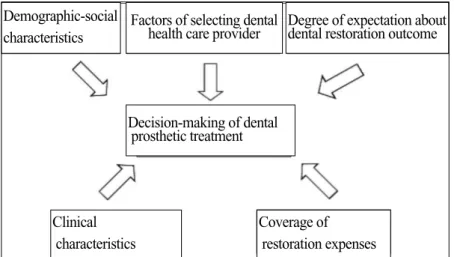
Hypothetic research model was introduced in this investigation.
1) Hypothetical research model about factors affecting decision-making of dental prosthetic treatment is as follows:
Various independent variables affecting dependent variable of prosthetic treatment decision can be classified as demographic characteristics, factors of selecting dental health care provider, degree of expectation about dental restoration outcome, clinical characteristics, and coverage of restoration expenses.
2) Hypotheses of this study
Based on several previous studies, hypotheses were postulated about the relationship between dental prosthetic treatment and demographic characteristics, factors for selecting dental health care provider, degree of expectation about the treatment outcome, clinical characteristics, and coverage of treatment expenses. Followings are hypotheses to empirically investigate factors affecting decision-making of dental prosthetic treatment in this study,
Hypothesis 1: Women receive more prosthetic treatment than men.
Hypothesis 2: Age has a positive relationship with prosthetic treatment.
Hypothesis 3: Educational attainment has a negative relationship with prosthetic treatment.
Hypothesis 4: Married people get more prosthetic treatment compared to the unmarried.
Hypothesis 5: Income has a positive relationship with prosthetic treatment.
Hypothesis 6: Health status has a negative relationship with prosthetic treatment.
Hypothesis 7: Expectation about the prosthetic treatment has a positive relationship with prosthetic treatment.
Hypothesis 8: Financial expenses are a negative relationship with prosthetic treatment.
Hypothesis 9: Membership status of employed insured program of national health insurance has a positive relationship with prosthetic
Fig. 1. Hypothetic research model about factors affecting decision-making of den- tal prosthetic treatment.
Demographic-social characteristics
Factors of selecting dental health care provider
Decision-making of dental prosthetic treatment
Clinical characteristics
Coverage of restoration expenses
Degree of expectation about dental restoration outcome
treatment.
Hypothesis 10: Knowledge of prosthetic treatment has a positive relationship with prosthetic treatment.
3) Dependent variable and independent variables
Dependent variable: Presence or absence of dental prosthetic treatment
Independent variables
① Demographic factors: sex, age, marital status, educational attainment, income
② Information of dental care provider
Facility: modern building, parking, medical device, cleanness, interior, convenient facilities
Human resource: doctor’s competency, reputation and helpfulness, number of doctors, diversity of doctor’s specialty, number of hygienists, and explanation about the procedure
③ Clinical factors: Health status, degree of expectation about the treatment, expected oral health status
④ Coverage of the treatment expense: Financial burden, and membership status of employed insured program of national health insurance
4. Statistical analysis
Collected data were statistically analyzed with SPSS (Statistical Package for Social Sciences) 12.0 program and analyzed with frequency analysis, cross tabulation analysis, logistic regression analysis.
1) Descriptive statistics was used to analyze subject’s demographic characteristics, factors of selecting dental health care provider, degree of expectation about dental restoration outcome, clinical characteristics, and coverage of restoration expenses.
2) Cross tabulation analysis was used to evaluate the
Table I. General characteristics of respondents N = 629
Characteristics Category Number (N) Percentage (%)
Gender Male 254 40.6
Female 372 59.4
Age - 29 240 39.1
30 - 39 108 17.6
40 - 49 145 23.6
50 - 59 82 13.3
60 - 69 28 4.6
70 - 11 1.8
Marital status Unmarried 250 41.1
Married 344 56.6
Divorce, lost spouse 14 2.3
Education < Middle school education 87 14.1
High school graduate 211 34.3
Community college graduate 156 25.3
College or more 162 26.3
Occupation Professionals 149 24.4
Office workers 62 10.2
Service, sales person 107 17.5
Students 102 16.7
Housewives 129 21.1
Peasant, technician 28 4.6
Laborer 16 2.6
Other 17 2.8
Monthly incomes < \ 990,000 85 14
(KRW) \ 1,000,000 - 1,990,000 217 35.6
\ 2,000,000 - 2,990,000 174 28.6
\ 3,000,000 - 3,990,000 69 11.3
\ 4,000,000 - 4,990,000 35 5.7
> \ 5,000,000 29 4.8
relationship between independent variables and decision of dental prosthetic treatment.
3) To investigate the influence of independent variables such as general characteristics, expectation about dental prosthetic treatment, factors of selecting dental health care provider, clinical characteristics, and coverage of restoration expenses on the decision of dental prosthetic treatment, logistic regression analysis was used.
RESULTS
1. General characteristics of the respondents
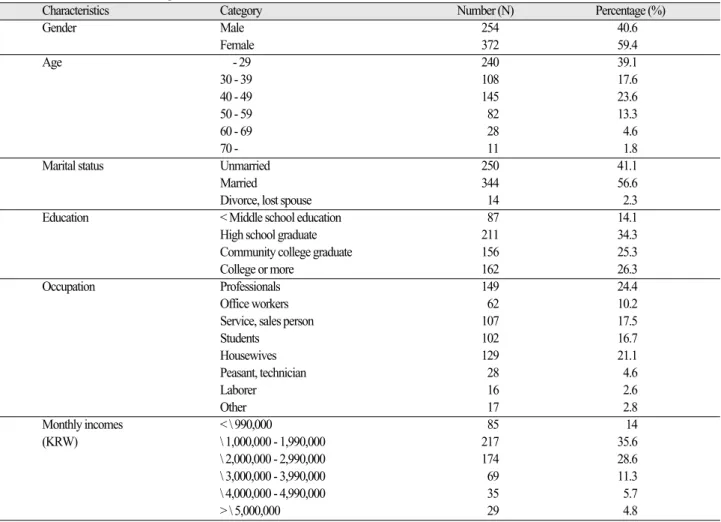
General characteristics of the respondents in this study are described in table I. Among the respondents, 59.4% were women and the remaining 40.6% were men. 17.6% were in their thirties, 23.6% in their forties, and 6.4% were over 60s.
56.2% were married, 41.1% were unmarried, and only remaining 2.3% were divorced or lost their spouses.
14.1% of respondents graduated middle school, 34.3%
graduated high school, 25.3% graduated community college, and 26.3% had a college degree.
24.4% of respondents were professionals, 21.1% were housewives, 17.5% were service sales personnel, 16.7%
were students, 10.2% were office workers, 4.6% were peasants, 2.6 were laborers, 2.8% were military personnel, politicians, and congressmen.
14.0% of respondents had average monthly incomes below \ 990,000 (KRW) and 35.6% of people ranged from \ 1,000,000 to \ 1,990,000, 28.6% were from \ 2,000,000 to \ 2,990,000, 11.3% were from \ 3,000,000 to \ 3,990,000, and 5.7% were from \ 4,000,000 to \ 4,990,000. People with monthly incomes above \ 5,000,000 were 4.9%. Majority of respondents (64%) had monthly incomes ranged from \ 1,000,000 to \ 2,990,000.
2. Clinical characteristics of respondents
Followings were clinical characteristics of respondents about dental prosthetic treatment. 52.1% of respondents replied to be healthy and 13.4% said to be unhealthy.
Motivations of visit to the dental clinic and hospital were for the treatment of dental caries (58.4%), scaling (26.2%),
prosthetic treatment (25.7%), periodontal treatment (26.9%), screening (12.4%), preventive procedure (11.6%), orthodontic treatment (7%), implant (4.9%), denture (2.7%), and other treatment (2.2%). The percentage of patients for the prosthetic treatment (25.7%) was less than that of patients for the caries treatment. It means that patients are not recognizing that they are receiving prosthetic treatment in broad meaning, which make teeth whiter and more esthetic such as periodontal treatment (scaling), caries, and orthodontic treatment.
The reasons respondents postponed to get the prosthetic treatment included high expenses (60.8%), a busy schedule (36.8%), fear about dental treatment (24.2%), dislike the drilling noise of the treatment (12.0%), unawareness of the treatment (8.9%), hatred of dental office smell (7.2%), and others (1.4%). Prosthetic treatment is not covered by national insurance and large portion of respondents (60.8%) couldn’t get the treatment due to the financial reason.
Therefore, dental insurance that covers prosthetic treatment is urgently needed.
32.5% of respondents placed dental restoration for the first time in their under 20s. 37.85% were below in their 20s, 18.0% were in their 30s, 8.8% were in their 40s, 2.9%
were in their 50s.
Individuals in their twenties generally care much about their appearance and they are also very active to get the dental treatment. Among dental care providers, this age group used dental clinic most often (54.5%), followed by dental hospital (3.5%), public health care center (1.1%), and other facility (0.3%). Only 0.5% received the treatment by non-licensed personnel. 90% of respondents used dental clinics rather than dental hospitals. The reason for unpopularity of dental hospital seems to be related to high expenses and relatively more complicated medical services compared to local dental clinics.
The time prosthetic was placed varied such as within 1 - 5 years (43.4%), within 5 - 10 years (24.4%), within 1 year (21.3%), within 10 - 15 years (6.7%), within 15 - 20 years (2.9%), or over 20 years (1.3%). Therefore, it turned out that more than 50% of dental patients visited dental office within 5 years.
33.8% of respondents had more than 26 teeth, 30.4% had 21 - 25 teeth, 12.6% had 16 - 20 teeth, 8.1% had 1 - 5 teeth, 7.4% had 11 - 15 teeth, and 2.4% were edentulous. The fact
that more than 60% had more than 20 teeth shows that people tries to save as many teeth as possible due to the increased awareness about dental health.
Regarding the cause of prosthetic treatment, toothache was the most frequent reason (50.6%) followed by restoration of decayed tooth (35.8%), difficulty of chewing (29.7%), extraction due to the bad condition of teeth-ridge (8.3%), spacing between teeth (7.2%), discoloration (6.9%), irregular arrangement of dentition (6.4%), better esthetics (6.4%), damage to the teeth after an accident (5.6%), and other reasons (1.6%).
3. Cross tabulation analyses between independent variables and decision-making of respondents
Cross tabulation analysis between sociodemographic characteristics and decision-making of prosthetic treatment was performed to investigate factors related to the decision- making of dental prosthetic treatment.
Results of cross tabulation analysis between sex and decision-making of prosthetic treatment are in the table II.
71.0% of men made decisions to receive prosthetic treatment and 78.2% of women decided to get the treatment. Therefore, women received more prosthetic treatment than men according to the cross tabulation analysis results.
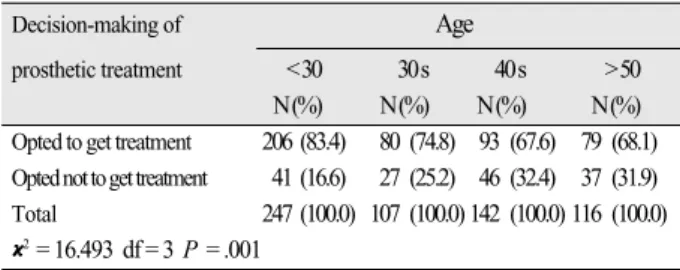
Results of cross tabulation analysis between age and decision-making of prosthetic treatment are presented in the table III. Experience of prosthetic treatment in 20s and 30s were 83.4% and 74.8%, respectively, and that in 40s and 50s were 67.6% and 68.1%, respectively. Therefore, as
people get older, they received more prosthetic treatment and the correlation was statistically significant.
Results of cross tabulation analysis between marital status and decision-making of prosthetic treatment are presented in the table IV. 81.5% of unmarried people opted to receive prosthetic treatment and 71% of married people opted to get the treatment. From these results, unmarried people opted to receive more prosthetic treatment than married people with statistically significance.
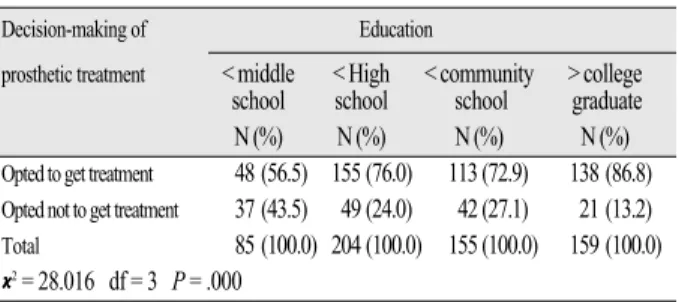
Results of cross tabulation analysis between education and decision-making of prosthetic treatment are presented in the table V. The relationship between education and decision-making of the treatment were statistically significant. 56.5% of elementary and middle school graduates opted to receive prosthetic treatment but the percentage was higher in high school (76.0%), community school (72.9%), and college graduates (86.8%). Therefore, people with higher education were well aware of the necessity for their prosthetic treatment.
Income and decision-making of prosthetic treatment were statistically significant. Results of cross tabulation analysis are presented in the table VI. 86.3% of respondents with Table III. Cross tabulation analysis between age and prosthetic treatment
Decision-making of Age
prosthetic treatment < 30 30 s 40 s > 50
N (%) N (%) N (%) N (%)
Opted to get treatment 206 (83.4) 80 (74.8) 93 (67.6) 79 (68.1) Opted not to get treatment 41 (16.6) 27 (25.2) 46 (32.4) 37 (31.9)
Total 247 (100.0) 107 (100.0) 142 (100.0) 116 (100.0)
χ2 = 16.493 df = 3 P = .001
Table IV. Cross tabulation analysis between marital status and deci- sion-making of prosthetic treatment
Decision-making of Marital status
prosthetic treatment Unmarried Married
N (%) N (%)
Opted to get treatment 212 (81.5) 237 (71.0) Opted not to get treatment 48 (18.5) 97 (29.0)
Total 260 (100.0) 334 (100.0)
χ2= 8.869 df= 1 P = .003 Table II. Cross tabulation analysis between sex and decision-making
of prosthetic treatment
Decision-making of Sex
prosthetic treatment Male Female
N (%) N (%)
Opted to get treatment 176 (71.0) 284 (78.2) Opted not to get treatment 72 (29.0) 79 (21.8)
Total 242 (100.0) 363 (100.0)
χ2 = 4.184 df = 1 P = .041
monthly income above 4,000,000 (KRW) received the prosthetic treatment but 70.5% of people with monthly income below \ 1,990,000 got the prosthetic treatment.
Therefore, people with higher income received relatively more prosthetic treatment. It can be concluded that individuals with solid financial status tended to receive more expensive prosthetic treatment.
Relationships between decision-making of the prosthetic treatment and respondents’health status or health care facilities they were using were not statistically significant.
Results of cross tabulation analysis between expectation about the prosthetic treatment and decision-making of prosthetic treatment are presented in the table VII. Only 42.5% of individuals with low expectation received the prosthetic treatment but 76.6% of people with high expectation received the treatment. Therefore, the relationship between expectation and decision-making of prosthetic treatment were statistically significant.
Results of cross tabulation analysis between financial status and decision-making of prosthetic treatment are
presented in the table VIII. 67.6% of people who didn’t feel financial burden from the treatment received the treatment and 73.4% of people who felt the financial pressure received the treatment.
It turned out that the relationship between the types of dental insurance and decision-making of prosthetic treatment were not statistically significant from the cross tabulation analysis.
4. Hypothesis tests by logistic regression analysis
Results of logistic regression analysis to empirically verify hypotheses of this study are the followings.
Logistic regression analysis to verify the hypotheses showed that the relationship between sex and decision- making of prosthetic treatment were not statistically significant on the contrary to the results of cross tabulation analysis. Therefore, hypothesis 1 was not statistically significant.
Logistic regression analysis that empirically investigated Table V. Cross tabulation analysis between education and decision mak-
ing of prosthetic treatment
Decision-making of Education
prosthetic treatment < middle < High < community > college school school school graduate
N (%) N (%) N (%) N (%)
Opted to get treatment 48 (56.5) 155 (76.0) 113 (72.9) 138 (86.8) Opted not to get treatment 37 (43.5) 49 (24.0) 42 (27.1) 21 (13.2)
Total 85 (100.0) 204 (100.0) 155 (100.0) 159 (100.0)
χ2= 28.016 df = 3 P = .000
Table VI. Cross tabulation analysis between monthly income and deci-
sion-making of prosthetic treatment
Decision-making of Monthly incomes (KRW) prosthetic treatment < 1,990,000 2,000,0000 - 3,990,000 > 4,000,000
N (%) N (%) N (%)
Opted to get treatment 208 (70.5) 124 (73.4) 88 (86.3) Opted not to get treatment 87 (29.5) 45 (26.6) 14 (13.7)
Total 295 (100.0) 169 (100.0) 102 (100.0)
χ2 = 9.930 df = 2 P = .007
Table VII. Cross tabulation analysis between expectation and decision- making of prosthetic treatment
Decision-making of Degree of expectation
prosthetic treatment Low Middle High
N (%) N (%) N (%)
Opted to get treatment 17 (42.5) 160 (67.8) 265 (76.6) Opted not to get treatment 23 (57.5) 76 (32.2) 81 (23.4)
Total 40 (100.0) 236 (100.0) 346 (100.0)
χ2 = 22.233 df = 2 P = .000
Table VIII. Cross tabulation analysis of financial status and decision-
making of prosthetic treatment
Financial burden
Decision-making of None A little bit Much
prosthetic treatment N (%) N (%) N (%)
Opted to get treatment 25 (67.6) 64 (61.5) 354 (73.4) Opted not to get treatment 12 (32.4) 40 (38.5) 128 (26.6)
Total 37 (100.0) 104 (100.0) 482 (100.0)
χ2= 6.142 df = 2 P = .046
the influence of age on the decision-making of the prosthetic treatment showed that aging increased the logarithmic multiplication. In other words, 1 year older people had 1.051 times more decision-making of prosthetic treatment. Therefore it supports the hypothesis 2: Age is in positive correlation with prosthetic treatment.
This study proved that education and decision-making of prosthetic treatment had statistically significant negative correlation. Logistic regression analysis showed that people with more years of education had less prosthetic treatment and it supported the hypothesis 3. On the other hand, marriage increased the logarithmic multiplication of decision-making of prosthetic treatment when unmarried people are set to be reference group. 2.228-fold increase was found in married group. Therefore, it supported the hypothesis 4: Married people get more prosthetic treatment.
It also turned out that income also 1.282-fold increased the logarithmic multiplication of decision-making of prosthetic treatment. Thus, hypothesis 5 that income has a positive impact on the prosthetic treatment’was confirmed.
However, hypothesis 6 that ‘health status has a negative impact on the prosthetic treatment’did not have statistical significance by this study. Meanwhile, expectation about the prosthetic treatment was found to increase the logarithmic multiplication of decision-making of prosthetic treatment.
As expectation increases, 1.312-fold increase in prosthetic treatment was found.
But financial burden, membership status of employer insured program, and knowledge about prosthetic treatment did not have statistically significant relationships with the
prosthetic treatment. Logistic regression analysis supported hypotheses 2, 3, 4, 5, and 6, but it did not support hypotheses 1, 6, 8, 9, 10 with statistical significance.
CONCLUSION
This study was performed to describe the status of dental prosthetic treatment and explore factors affecting the decision to receive the treatment. 629 subjects visiting dental clinics and hospitals in Daegu and Gyoungbook areas were selected in this survey. The brief summary of the results are as follows:
Factors affecting decision-making of dental prosthetic treatment were verified using logistic regression analysis.
Aging increased the logarithmic multiplication and education also had a positive relationship with the decision.
In addition, monthly incomes also increased the logarithmic multiplication of the decision. Marriage increased the logarithmic multiplication of decision-making of prosthetic treatment with the unmarried as a reference group.
Expectation about the prosthetic treatment increased the logarithmic multiplication of decision-making of prosthetic treatment. As people expect more about prosthetic treatment, they have a tendency to receive more treatment.
Therefore, among 10 hypotheses of this study, hypotheses 2, 3, 4, 5, and 6 were empirically supported but hypotheses 1, 6, 8, 9, 10 were not. That is to say, sex, health status, financial burden, type of dental insurance, and selection factor of health care provider didn’t have statistically significant impacts on the decision-making of dental Table IX. Logistic regression analysis of factors affecting decision-making of dental prosthetic treatment
Characteristics b S.E. Wald Sig Exp (B)
Income 0.249 0.08 9.735 0.002** 1.282
Age 0.05 0.011 19.13 0.000*** 1.051
Sex (male = 1, female = 0) 0.061 0.2 0.094 0.759 1.063
Education -0.09 0.043 4.451 0.035* 0.914
Marital status 0.801 0.279 8.227 0.004** 2.228
(Married = 1, Unmarried = 0)
Health status -0.07 0.119 0.339 0.56 0.933
Expectation 0.272 0.129 4.443 0.035* 1.312
Dental insurance coverage 0.353 0.2 3.128 0.077 1.424
(employer covered = 1, other = 0)
Financial status 0.155 0.119 1.687 0.194 1.168
Selection factor 0.003 0.01 0.072 0.789 1.003
Constant -3.939 1.277 9.517 0.002** 0.019
* P < .05 ** P < .01 ***P < .001
prosthetic treatment.
Here are a few suggestions to improve oral health status.
First, it is necessary for those who are older and less educated to provide oral health education and importance of dental prosthetic treatment because they demand more prosthetic treatment. Second, it is very important to inform the importance of prosthetic treatment and oral health for people. Third, for those who need prosthetic treatment but cannot afford the treatment, government intervention, such as enacting an oral health initiative for alienated group’s prosthetic treatments is necessary. Fourth, dental professionals and people related to dental field have responsibilities to inform the public of improvement of chewing by prosthetic treatment.
As population of elder people increases with longer life expectancy, demands and needs for prosthetic treatment will increase even more in the future. Therefore, dentists and dental technicians should make efforts to contribute to the maintenance of oral health with the enthusiasm and make more people to lead a healthy life by receiving prosthetic treatment on timely manner.
REFFRENCES
1. Kim MA. A study on the Patient Satisfaction of Dental Outpatients of University Hospital. MA thesis, Graduate School of Environmental Studies, Youngnam University, 2002.
2. Kim JS. Status of Dental Prosthetic Treatment in a Few Areas of Korea and Analysis of Related Factors. PhD the- sis, Geimyoung University, 2004.
3. Kim BO. Periodontology. Daehan Nara publishing, 2004.
4. Sin SH. The Degree of Dental Caries and Related Factors in Children of an Elementary School. PhD thesis, Kyoungpook Univerisity, 1989.
5. Lee HS. Object of Oral Health Education in School and Development of the Curriculum model. PhD thesis, Kyoung Nam University, 2000.
6. Chang KY, Song GB, Lee CH, Cho GH. An Analysis on Dental Patients’Attitude and Satisfaction of the Treatment in Department of Prosthodontics, Kyoungpook University.
Kor Acad Dent Health, 1997;21:605-20, National Statistical Office 2006.
7. Choi WJ. Contemporary Public Oral Health, Myoungmoon Publishing, 2003.
8. Ivancevich JM. Stress and Work AM; Foresman and Company, 1980.
FACTORS AFFECTING PATIENTS’DECISION-MAKING FOR DENTAL PROSTHETIC TREATMENT
Hyo-Kyung Jung1, PhD, Han-Gon Kim2*, PhD
1Professor, Department of Dental Technology, Daegu Health College,
2Professor, Department of Sociology, Yeungnam University
STATEMENT OF PROBLEM: Factors affecting patients’decision-making for dental prosthetic treatment should be examined in terms of understanding improving patients’oral health. PURPOSE: The main purpose of this dissertation was to investigate patients’dental prosthetic treatment and factors affecting patients’decision-making for dental prosthesis treatment in Deagu and Gyungbook areas.
MATERIAL AND METHODS: This study was based on the preliminary survey of dental patients conducted from July 1 to August 31 in 2006. A total of 700 questionnaires had been distributed and 640 were collected. 629 questionnaires were used for the statistical analysis.
Descriptive and inferential statistics, such as frequencies, cross tabulation analysis, correlation analysis, logistic regression analysis, and multiple regression analysis were introduced. In the multiple regression analysis and logistic regression analysis, twenty-two independent variables were employed to explore the factors which have impacts on decision-making and satisfaction. RESULTS: The results of this dissertation are as follows: Logistic regression analysis turned out that monthly income, age, degree of expectation, marital status, and em- ployer-insured policy of national insurance statistically increased the odds of decision-making of dental prosthesis treatment. But education- al attainment decreased the odds ratio of the decision-making of dental prosthesis treatment. However, the rest independent variables do not have statistically significant impacts on the decision-making of dental prosthesis treatment CONCLUSION: Among independent variables, marital status had the most significant influence on the decision making of dental prosthesis treatment. Finally, suggestions for the future study and policy implications to improve satisfaction of the patients’dental prosthetic treatment were discussed.
KEY WORDS: Dental prosthetic treatment, Decision-making, Logistic regression analysis
Corresponding Author: Han Gon Kim
Deaprtment of Sociology, College of Liberal Arts, Yeungnam University
214 Daedong, Gyongsan, 712-749, Korea +82 53 810 2255: e-mail, [email protected] Article history
Received Octorber 28, 2008 Last Revison December 3, 2008 Accepted December 4, 2008.