Vol. 25, No. 1 (2015)
43
Gas Absorption and Release Properties of Zn(BH 4 ) 2 and MgH 2 -Zn(BH 4 ) 2 -Ni-Ti-Fe Alloy
Young Jun Kwak, Sung Nam Kwon
1and Myoung Youp Song
2†Department of Materials Engineering, Graduate School, Chonbuk National University, 567 Baekje-daero Deokjin-gu Jeonju 561-756, Korea
1
Professional Graduate School of Flexible and Printable Electronics, Chonbuk National University, 567 Baekje-daero Deokjin-gu Jeonju 561-756, Korea
2
Division of Advanced Materials Engineering, Research Center of Advanced Materials Development, Engineering Research Institute, Chonbuk National University, 567 Baekje-daero Deokjin-gu Jeonju 561-756, Korea
(Received September 3, 2014 : Received in revised form December 5, 2014 : Accepted December 17, 2014) Abstract Zn(BH
4)
2was prepared by milling ZnCl
2and NaBH
4in a planetary ball mill in an Ar atmosphere, and XRD analysis, SEM observation, FT-IR analysis, DTA, and TGA were performed for synthesized Zn(BH
4)
2samples. 90 wt% MgH
2+ 1.67 wt% Zn(BH
4)
2(+NaCl)+5 wt% Ni+1.67 wt% Ti+1.67 wt% Fe (named 90MgH
2+1.67Zn(BH
4)
2(+NaCl)+5Ni+1.67Ti+1.67Fe) samples were also prepared by milling in a planetary ball mill in an H
2atmosphere. The gas absorption and release properties of the Zn(BH
4)
2(+NaCl) and 90MgH
2+1.67Zn(BH
4)
2(+NaCl)+5Ni+1.67Ti+1.67Fe samples were investigated. An FT-IR analysis showed that Zn(BH
4)
2formed in the Zn(BH
4)
2(+NaCl) samples prepared by milling ZnCl
2and NaBH
4. At the first cycle at 320
oC, 90MgH
2+1.67Zn(BH
4)
2(+NaCl)+5Ni+1.67Ti+1.67Fe absorbed 2.95 wt% H for 2.5 min and 4.93 wt% H for 60 min under 12 bar H
2, and released 1.46 wt% H for 10 min and 4.57 wt% H for 60 min under 1.0 bar H
2.
Key words hydrogen absorbing materials, microstructure, X-ray diffraction, Zn(BH4)
2-MgH
2-Ni-Ti-Fe, hydrogen release.
1. Introduction
Hydrogen energy is the energy which can be obtained as exothermic heat when hydrogen reacts with oxygen to form water vapor. There are several methods of hydrogen storage: for example, metal hydride storage, pressure storage, cryogenic storage, and carbon nanotube storage.
Hydrogen storage by metal hydride has several advan- tages over pressure storage, cryogenic storage, and carbon nanotube storage. Metal hydride has high specific volu- metric capacity, and hydrogen storage by metal hydride is safe, since some metals absorb hydrogen under low hydrogen pressure at moderate temperature. Waste heat can be used to evolve hydrogen from metal hydride. In addition, metal hydride selectively absorbs and desorbs hydrogen, so that high-purity hydrogen can be produced.
1)Among the many metal hydrides, magnesium hydride has been intensively studied since it has many advantages
as a hydrogen storage material. Magnesium has a high hydrogen storage capacity(7.6 wt%), is relatively inex- pensive, and is abundant in the earth’s crust. However, its reaction rate with H
2is very low. A lot of work to improve the hydriding and dehydriding rates of magne- sium has been performed by alloying certain metals
2-7)with magnesium, such as Cu, Ni, and Ni and Y, by syn- thesizing compounds, such as CeMg
12,
8)and by making composites, such as Mg-20 wt% Fe
23Y
8.
9)Many researchers are interested in metal borohydrides [M(BH
4)
n], such as LiBH
4and Mg(BH
4)
2,
10-19)since these have high gravimetric hydrogen densities and are there- fore promising candidates as materials for advanced hydrogen storage.
Zn(BH
4)
2, a complex metal hydride, has also drawn attention because it has a high hydrogen storage capacity (8.5 wt%),
20)and it reportedly has a low decomposition temperature(50-120
oC). In addition, Zn(BH
4)
2can be easily
†Corresponding author
E-Mail : [email protected] (M. Y. Song, Chonbuk Nat'l Univ.)
©Materials Research Society of Korea, All rights reserved.
This is an Open-Access article distributed under the terms of the Creative Commons Attribution Non-Commercial License (http://creative- commons.org/licenses/by-nc/3.0) which permits unrestricted non-commercial use, distribution, and reproduction in any medium, provided the original work is properly cited.
ZnCl
2+ 2NaBH
4→ Zn(BH
4)
2+ NaCl. (1) Nakagawa et al.
20)also reported that the reaction between MgH
2and Zn(BH
4)
2proceeds according to the following reaction:
MgH
2+ Zn(BH
4)
2→ Zn + MgB
2+ 5H
2. (2) Ni, Fe and Ti were selected to improve the hydriding and dehydriding rates of magnesium. Ni is known to form Mg
2NiH
4, which has higher hydriding and dehydriding rates than magnesium. Fe is cheaper than Ni, and it may act as an active site for the dissociative chemisorption of H
2.
24)Ti is believed to increase hydriding and dehydriding rates of magnesium. When added, it forms Ti hydride, which is brittle. Titanium hydride can be pulverized during reactive mechanical grinding, and this pulverized titanium hydride can help in the pulverization of Mg into finer particles. In addition, titanium hydride can prevent the agglomeration of magnesium by remaining as a hydride mixed among the Mg particles.
In this work, Zn(BH
4)
2was prepared by milling ZnCl
2and NaBH
4in a planetary ball mill under an Ar atmos- phere, and 90 wt% MgH
2+1.67 wt% Zn(BH
4)
2(+NaCl)+
5 wt% Ni+1.67 wt% Ti+1.67 wt% Fe(named 90MgH
2+ 1.67Zn(BH
4)
2(+NaCl)+5Ni+1.67Ti+1.67Fe) samples were prepared by milling in a planetary ball mill under an H
2atmosphere. Then, the gas absorption and release pro- perties of the Zn(BH
4)
2(+NaCl) and 90MgH
2+1.67Zn (BH
4)
2(+NaCl)+5Ni+1.67Ti+1.67Fe samples were inves- tigated.
2. Experimental Details
ZnCl
2(Zinc chloride, Aldrich, purity 99.999 %), NaBH
4(Sodium borohydride, Aldrich, granular, purity 99.99 %), MgH
2(Magnesium hydride, Aldrich, hydrogen-storage grade), Ni [Nickel powder, Alfa Aesar, average particle size 2.2-3.0 μm, purity 99.9 %(metals basis), C typically
< 0.1 %], Ti [Titanium powder, Aldrich, −325 mesh, purity 99 %(metals basis)], and Fe [Iron powder, Alfa Aesar, spherical, < 10 μm, purity 99.9+%(metals basis), 99.5 %]
were used as starting materials.
Milling was performed in a planetary ball mill(Planetary Mono Mill; Pulverisette 6, Fritsch). A mixture of ZnCl
2and NaBH
4with a molar ratio of 1 : 2(total weight = 2.2 g) was mixed in a hermetically sealed stainless steel container(with 30 hardened steel balls, total weight =
was 400 rpm. The milling was performed for 4 h or 6 h.
A 90 wt% MgH
2+1.67 wt% Zn(BH
4)
2(+NaCl)+5 wt%
Ni+1.67 wt% Ti+1.67 wt% Fe mixture was then milled in a planetary ball mill under a hydrogen atmosphere at 400 rpm for 2 h, as described in Ref.
25)X-ray diffraction(XRD) patterns of the prepared samples were obtained using a Rigaku D/MAX 2500 powder diffractometer with Cu K α radiation(diffraction angle range 10-80
o, scan speed 4
o/min). The microstructures of the synthesized samples were observed using a JSM- 6400 scanning electron microscope(SEM) operating at 20 kV. For the synthesized samples, thermogravimetric analysis(TGA) and differential thermal analysis(DTA) with Al
2O
3used as a reference were performed using a ther- mogravimetric analyzer(Rigaku TG8121). The synthesized samples were also characterized by Fourier Transform Infrared(FT-IR) spectroscopy(Frontier, PerkinElmer).
3. Results and Discussion
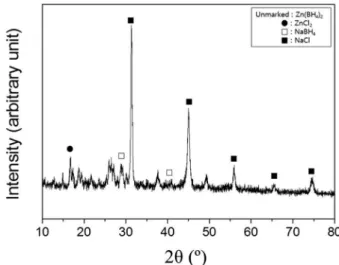
Fig. 1 shows the XRD pattern of the sample synthesized from ZnCl
2and NaBH
4by milling under an Ar atmos- phere at 400 rpm for 6 h. The sample contains Zn(BH
4)
2and NaCl together with small amounts of ZnCl
2and NaBH
4that remain unreacted. We designate this sample as Zn(BH
4)
2(+NaCl) since it contained a large amount of NaCl. The XRD pattern of the sample is very similar to those of the samples prepared by Jeon and Cho under similar conditions.
22,23)An analysis of the phases in the prepared sample indicates that milling ZnCl
2and NaBH
4Fig. 1. XRD pattern of a sample synthesized from ZnCl2 and NaBH4 by milling under Ar atmosphere at 400 rpm for 6 h.
formed Zn(BH
4)
2and NaCl, with small amounts of ZnCl
2and NaBH
4remaining unreacted. The by-product NaCl is inert.
The SEM micrographs of Zn(BH
4)
2(+NaCl) synthesized from ZnCl
2and NaBH
4by milling under an Ar atmos- phere at 400 rpm for 6 h are shown in Fig. 2. The sample
consists of small particles, large particles with flat surfaces, and a small number of agglomerates of particles. The particle sizes range from 1 to 50 μm.
The FT-IR spectrum of Zn(BH
4)
2(+NaCl) synthesized from ZnCl
2and NaBH
4by milling under an Ar atmos- phere at 400 rpm for 6 h, is shown in Fig. 3. The bands are indicated in comparison with those of the Zn (BH
4)
2(+NaCl) sample reported in Ref.
22)Strong bands due to B-H
t(terminal B-H) stretching between 2,227 and 2,369 cm
−1are observed. In addition, one band from B- H
b(bridge B-H) stretching at 1,631 cm
−1is observed. These are typical bands that can be detected in metal boro- hydrides.
22)Quite a strong band due to Zn-Cl is observed at 1,631 cm
−1. Zn-H band is observed between 1,353 and 1,403 cm
−1, and BH
2band is observed at 1,127 cm
−1. This result shows that Zn(BH
4)
2formed in the sample.
The DTA result for Zn(BH
4)
2(+NaCl) synthesized from ZnCl
2and NaBH
4by milling under an Ar atmosphere at 400 rpm for 6 h is shown in Fig. 4. An endothermic peak is observed at 87.9
oC in the DTA curve of this sample.
Comparing the DTA result with that reported in Refs.,
20,22,23)the phase that decomposes at 87.9
oC is that of Zn(BH
4)
2. The other peaks are considered to have re- sulted from the materials formed through oxidation or adsorption of water vapor during the treatment of Zn(BH
4)
2.
The TGA result for Zn(BH
4)
2(+NaCl) is shown in Fig.
5. This sample was prepared by milling under an Ar atmosphere at 400 rpm for 4 h. As the temperature increases from room temperature to about 60
oC, the weight of Zn(BH
4)
2(+NaCl) decreases slowly, and from about 60
oC to about 300
oC, the weight of Zn(BH
4)
2(+NaCl) decreases rapidly. From about 300
oC to 400
oC, the weight of Zn(BH
4)
2(+NaCl) decreases very slowly.
The weight loss up to 400
oC of Zn(BH
4)
2(+NaCl) is 11.2 wt%. NaCl, which is contained in the Zn(BH
4)
2 Fig. 2. SEM micrographs of Zn(BH4)2(+NaCl) prepared by millingunder Ar atmosphere at 400 rpm for 6 h.
Fig. 3. FT-IR spectrum of Zn(BH4)2(+NaCl) prepared by milling under Ar atmosphere at 400 rpm for 6 h.
Fig. 4. DTA result for Zn(BH4)2(+NaCl) prepared by milling under Ar atmosphere at 400 rpm for 6 h.
(+NaCl) sample, is inert. Nakagawa et al.
20)reported that Zn(BH
4)
2releases hydrogen with toxic diborane(B
2H
6), after melting with increasing temperature, and this reaction can be described as follows:
Zn(BH
4)
2→ Zn + B
2H
6+ H
2. (3) According to the reaction equation (3), the weight ratio of B
2H
6and H
2is 93.21 : 6.79. So, the weight % of B
2H
6with respect to the sample weight is 10.44 wt% and that of hydrogen is 0.76 wt%.
The percentage of absorbed hydrogen, H
a, is expressed with respect to sample weight. Fig. 6 shows the H
aversus t curve for 90MgH
2+1.67Zn(BH
4)
2(+NaCl)+5Ni+ 1.67Ti +1.67Fe at 320
oC under 12 bar H
2at the first cycle.
Zn(BH
4)
2(+NaCl) used for the preparation of this sample was prepared by milling under an Ar atmosphere at 400 rpm for 4 h. The initial hydrding rate is quite high, and it then is very low after about 10 min. The quantity of
hydrogen absorbed for 60 min is 4.93 wt% H. The sample absorbs 2.95 wt% H for 2.5 min, 3.82 wt% H for 5 min, 4.71 wt% H for 10 min, and 4.85 wt% H for 15 min.
The percentage of released hydrogen, H
d, is also ex- pressed with respect to sample weight. The H
dversus t curve for 90MgH
2+1.67Zn(BH
4)
2(+NaCl)+5Ni+1.67Ti+
1.67Fe at 320
oC under 1.0 bar H
2at the first cycle is presented in Fig. 7. The initial dehydrding rate is relatively high, and becomes low after about 30 min. The quantity of hydrogen released for 60 min is 4.57 wt% H. The sample releases 0.84 wt% H for 5 min, 1.46 wt% H for 10 min, and 3.53 wt% H for 30 min.
A sample with a composition of Zn(BH
4)
2(+NaCl)+
MgH
2was prepared by mixing Zn(BH
4)
2(+NaCl) with MgH
2in an 1 : 1 mole ratio in a mortar and a pestle. Zn (BH
4)
2(+NaCl) used for the preparation of this sample
Fig. 8. XRD pattern of Zn(BH4)2(+NaCl)+MgH2 after heated up to 370oC.Fig. 7. Hd versus t curve for 90MgH2+1.67Zn(BH4)2(+NaCl)+5Ni +1.67Ti+1.67Fe at 320oC under 1.0 bar H2 at the first cycle.
Fig. 6. Ha versus t curve for 90MgH2+1.67Zn(BH4)2(+NaCl)+5Ni+
1.67Ti+1.67Fe at 320oC under 12 bar H2 at the first cycle.
Fig. 5. TGA result for Zn(BH4)2(+NaCl) prepared by milling under Ar atmosphere at 400 rpm for 4 h.