Effects of Collaborative Learning in a Virtual Environment on Students’ Academic Achievement and Satisfaction
Mi Hwa Kim
Assistant Professor, Department of HRD, Korea University of Technology & Education (KOREATECH)
가상 학습 공간에서의 협력 학습이 학업 성취도 및 만족도에 미치는 영향
김미화
한국기술교육대학교 HRD학과 조교수
Abstract This experimental study was to examine the impact of collaborative learning in a virtual environment on students' learning outcomes and satisfaction. The collaborative virtual learning environment was created for a Korean history class for high school students. A total of 119 participants were recruited and were randomly assigned to either "collaborative group" or an "individual group."
Students’ academic achievements and satisfaction were collected as measurement tools to examine the effect of collaborative learning in the virtual learning environment and collected data were tested by independent sample t. The results showed that participation in collaborative groups had a significant positive effect on academic achievement and satisfaction than individual groups.
Key Words : Virtual learning environment, collaborative learning, academic achievement, satisfaction, virtual reality
요 약 본 연구는 가상 환경에서의 협력 학습에의 참여가 학생들의 학업 성취도와 만족도에 미치는 영향을 조사하고자 하였다. 세컨드라이프라는 가상현실 플랫폼에 고등학생이 국사 과목을 학습할 수 있는 공간을 만들고 이를 활용하였다.
총 119명의 참가자를 ‘협력학습 유형'이나 '개인학습 유형'에 무선 할당하였으며, 학생들의 학업 성취도와 만족도를 측 정 도구로 수집하였다. 가상공간에서의 협력학습의 효과를 검토하려 독립표본 t검증 및 대응표본 t검증을 실행하였고, 연구의 결과는 개인학습 유형에 참여한 경우보다 협력학습 유형에 참여한 경우가 학업성취도와 만족도에 유의미하게 긍정적 영향을 미치는 것으로 나타났다. 마지막으로 향후 가상현실을 기반으로 한 협력학습의 활용에 대한 제언이 논의 되었다.
주제어 : 가상현실 학습환경, 협력학습, 학업성취도, 만족도, 가상현실
*This paper was supported by the new professor research program of KOREATECH in 2019.
*Corresponding Author : Mi Hwa Kim([email protected]) Received January 25, 2021
Accepted April 20, 2021
Revised March 24, 2021
Published April 28, 2021
1. Introduction
With a large number of students of all ages currently experiencing edu-tech based educational environment settings, the use of virtual environments in education (VLEs) can be expected to allow many concurrent students to interact with one another in real time.
In VLEs, each user is represented by an avatar that can walk, fly, or teleport between simulated environments and engages in various activities[1].
It allows both synchronous and asynchronous communication. Several studies have discussed the benefits of using virtual environments in the learning process [2-4], which include anytime/anywhere access and multiple ways of communication. Proponents note advantages such as increased sense of immersion comparing to other online learning platforms and the ability to construct experiences which are hard to capture in traditional classrooms [5]. The sense of immersion in a VLE may be more beneficial, as its features and capabilities allow learners to engage in deeper interactions and have experiences closer to those in a face-to-face learning environment than other online learning platforms [6, 7].
Many researchers have studied the use of virtual learning environments (VLEs) to mediate collaboration among learners and enhance their learning [6-8]. In VLEs, students themselves can collaboratively mediate their own interactions and their learning. An important aspect of the learning supported by the VLE is the ability to learn by doing [9]. The VLE experiences help students to feel and engage with the virtual historical places as if they were real [10], while interacting with other students' avatars. As history is an engaging subject that is consisted of a process of exploration and interaction, using VLEs in history classes can be a good opportunity to develop engaging and realistic educational scenarios [9]. Thus, VLEs can be a
promising feature in history courses, helping students to access realistic places and artifacts that encourage exploration.
Having these in notion, this experimental study aims to investigate the effects of collaborative learning in the VLE with Korean history contents on students’ academic achievements and satisfaction with Korean history.
2. Literature Review
2.1 Virtual Learning Environments(VLEs)
Virtual environments can be defined by their characteristics of physicality, interactivity, and persistence [11, 12]. Virtual realities are physical in that they include graphic representations of the space and its users, complete with gravity.
Users are represented by digital representations of themselves called avatars, which can move the virtual environment freely. Interactivity refers to actions that can be taken by users and affect the actions or states of other users, such as the building and sharing of objects [13]. It also covers the ability of users to communicate with each other in real time, either one to one, or with multiple participants simultaneously. VLEs like that of Second Life are places where users can move around freely, use tools to create or manipulate virtual artifacts, and socialize with other users [14].
2.2 Collaborative Learning
In collaborative learning, students participate in groups of two or more, searching for meanings, solutions, or producing an outcome mutually[15]. Collaborative learning activities vary widely, but most focus on student exploration or application of the course materials [8].
In other words, collaborative learning
represents a significant change from the
teacher-centered education in classrooms; in collaborative classrooms, learning processes are based in student discussion and active participation with the course materials[4].
In collaborative learning activities, students are not just taking in new information; they are creating something new with this information and ideas. These acts of intellectual processing or construction of meaning are crucial to learning[4, 7].
2.3 Collaborative Virtual Learning Environments
Collaborative virtual environments(CVEs) can enhance the sharing and integration of knowledge [5]. It is believed that three-dimensional CVEs has the potential to improve current knowledge management practices even more substantially, beyond applications in which CVEs have previously been effective such as visualizing data or reviewing spatial models in areas like architecture and design[11]. The systematic description and classification of group interaction in CVEs aims to help facilitate and enhance team collaboration and knowledge management by providing patterns that leverage the possibilities that three-dimensional virtual environments offer[7, 8]. Virtual environments provide ways to experience and view information that are dynamic and interactive [14, 17]. A more accurate approximation of physical reality (immersion) can be provided, which can and improve overall usability. Physicality in general is thought to increase or enhance enjoyment and involvement [17]. By a strong sense of orientation and position in space, the feeling of immersion is enhanced. In addition, enjoyment can be heightened from engagement with a CVE.
Participants may enjoy learning more in a virtual world that is engaging, interesting, enjoyable, and makes the learners feel as if they are in the CVE [4]. As shown above, CVEs help users make sense of complex data, help develop a common
understanding and collaborative mindset, and engage people by providing them with appealing and memorable experiences, which can lead to increased involvement while focusing the attention of the participants, thus providing a solid basis for creative ideas [5][16].
3. Research Methods 3.1 Material and Participants
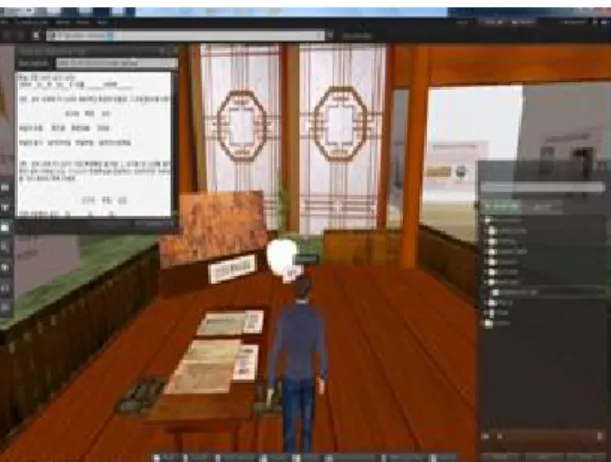
Fig. 1. Screenshot of Three Kingdom Period in SL
Fig. 2. Screenshot of Chosun Dynasty in SL
The learning environment was created for a
Korean history class in Second Life1(SL), a 3D
virtual reality platform. It was designed for a
Korean history class for 11th grade (grade 2 of
high school) students and its contents included historical events and concepts that were in their curriculum. It consisted of two places, one of which concerned the Three Kingdom Period, while the other was about the former and the latter Chosun dynasty. Both places included their representative historical places, events, and artifacts.
Participants were recruited from a school in South Korea. The sample size was 119. The research took place in the participants' classrooms with computers at the two high schools over one month period. The participants were randomly assigned to 'collaborative group' or 'individual group‘ which was the control group. The collaborative group consisted of 60 participants and the individual group(control group) consisted of 59 participants. They participated the three sessions overall and each session took about 50 minutes.
3.2 Research Design and Procedure
This study used an experimental design with pretest-posttest comparison and survey questionnaire administration. The design includes randomly assigning the students to two groups, collaborative group and individual group.
A pretest and a posttest were designed to assess participants' knowledge about
Korean history, and pre and post-survey questionnaires were designed to investigate participants' satisfaction. In this study, the treatment was given to a collaborative group during participating three day sessions. Solving the learning activity problems together as a group was the treatment for this study.
Participants in the collaborative group could communicate with their group members while exploring the environment, and worked together to gather information for solving the learning activity problems as a group. Subsequently, they had to submit a group answer sheet together at the end of the third session. However,
participants in the individual group were not allowed to chat with other participants, or to solve the problems together. At the end of the third day session, participants in the individual group were asked to submit their own answer sheets respectively within the Second Life. There was no intervention whatsoever from teachers or instructors during any of the three sessions.
3.3 Measurement Tools
Students’ academic achievements and satisfaction were collected as measurement tools to examine the effect of collaborative learning in the VLE and collected quantitative data were tested by independent sample t. A pretest and a posttest were designed to assess participants' academic achievement about Korean history by the two Korean history teachers in highschool. A total of 30 questions developed for each test.
These problem items were verified by the educational evaluation expert. Then, a pre-survey and a post-survey questionnaire were developed to evaluate students' evaluations of their perceptions of engagement, enjoyment, immersion, and collaboration in learning in the 3D VLE. These questionnaires were consisted of 20 questions on a five-point Likert-scale ranging from to 5.
3.4 Results
The collected quantitative data were analyzed using the statistical program SPSS 20.0 and tested by independent sample t-test and paired t-test.
3.4.1 Academic Achievements
A independent t-test is conducted and the results are as follows.
Means and standard deviations for Pre-test
and Post-test scores per group (collaborative
group and individual group) are presented in
Table 1. The results show that there is no
significant differences on Pre-test scores
between the collaborative group and the individual group. However, the results show that the collaborative group (M = 13.53, SD=3.48) performs better in the Post-test score than the individual group (M = 11.60, SD=4.40) does and it shows that participating in collaborative learning in SL has a significant positive effect on the academic achievement.
CG (N=60)
IG
(N=59) t
M SD M SD
Pre-test 7.74 3.48 7.34 3.64 .16
Post-test 13.53 3.29 11.60 4.40 2.72
****
p<.01, CG=Collaborative Group, IG=Individual Group
Table 1. Means and Standard Deviations for Pre-test, Post-test per Study-type
Paired t-test is conducted to identify changes in academic achievement per group and the result are shown in Table 2. According to the results of pre-test and post-test of academic achievement in the collaborative group, post-test score (M=13.53) is higher than pre-test score (M=7.74), and this increase in academic achievement shows statistically significant difference (t=-12.09 p<.001). In the individual group, post-test score (M=11.60) is higher than pre-test score (M=7.34), and this increase in academic achievement also shows statistically significant difference (t=-12.09 p<.001).
Pre-test Post-test DF
M SD M SD M SD t
CG
(N=60) 7.74 2.77 13.53 3.29 -6.09 3.90 -12.09
***IG
(N=59) 7.34 3.64 11.60 4.40 -4.26 4.11 -7.98
******
p<.001,
Table 2. Result of Pre-test and Post-test
3.4.2 Students’ Satisfaction
The results of analyzing the effect of learning types on students' perception of satisfaction are
as shown in Table 3. A independent t-test is conducted and the results are as follows.
First, Cronbach’s alpha was used to measure reliability for items of pre-survey and post-survey as shown in Table 3.
Cronbach’s alpha Pre-survey Post-survey
Engagement .91 .90
Enjoyment .90 .87
Immersion .77 .92
Collaboration .84 .90
Table 3. Cronbach’s alpha for Pre-survey and Post-survey
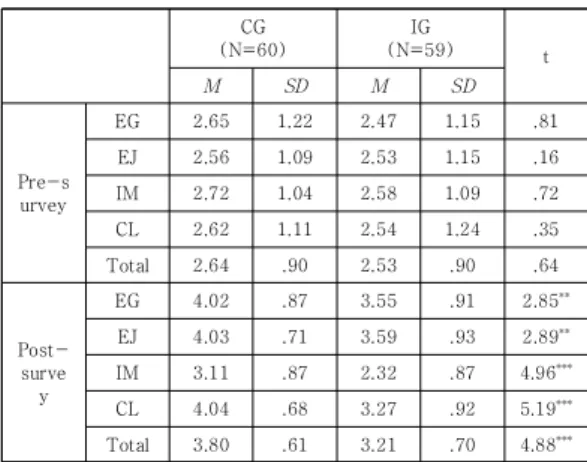
As shown in Table 4, the result of pre-survey shows no difference between the two groups.
However, there are statistically significant differences between the two groups’ result of post-survey. The mean average of collaborative group of post-survey (M=3.80) is found to be higher than the individual group’s (M=3.21), and there are significant differences between the two groups (t=4.88 p<.001).
CG (N=60)
IG
(N=59) t
M SD M SD
Pre-s urvey
EG 2.65 1.22 2.47 1.15 .81
EJ 2.56 1.09 2.53 1.15 .16
IM 2.72 1.04 2.58 1.09 .72
CL 2.62 1.11 2.54 1.24 .35
Total 2.64 .90 2.53 .90 .64
Post- surve y
EG 4.02 .87 3.55 .91 2.85
**EJ 4.03 .71 3.59 .93 2.89
**IM 3.11 .87 2.32 .87 4.96
***CL 4.04 .68 3.27 .92 5.19
***Total 3.80 .61 3.21 .70 4.88
*****p<.01, ***p<.001, EG=Engagement, EJ=Enjoyment, IM=Immersion, CL=Collaboration
Table 4. Students’ Satisfaction per Study-type
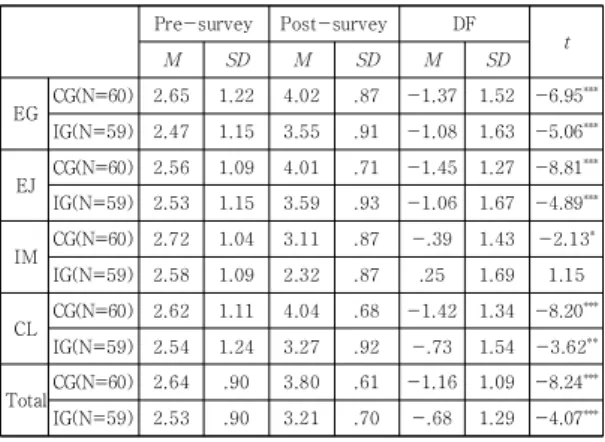
The results of paired t-test are as shown in
Table 5. As shown in Table 5, the comparison of
pre-survey and post-survey for collaborative
group resulted in higher post-survey than pre-survey, and this increase is statistically significant. In the case of individual group, all the sub-factors except immersion and sum of the sub-factors of post-survey are higher than the pre-survey. This increase is statistically significant.
Pre-survey Post-survey DF
M SD M SD M SD t
EG CG(N=60) 2.65 1.22 4.02 .87 -1.37 1.52 -6.95
***IG(N=59) 2.47 1.15 3.55 .91 -1.08 1.63 -5.06
***EJ CG(N=60) 2.56 1.09 4.01 .71 -1.45 1.27 -8.81
***IG(N=59) 2.53 1.15 3.59 .93 -1.06 1.67 -4.89
***IM CG(N=60) 2.72 1.04 3.11 .87 -.39 1.43 -2.13
*IG(N=59) 2.58 1.09 2.32 .87 .25 1.69 1.15
CL CG(N=60) 2.62 1.11 4.04 .68 -1.42 1.34 -8.20
***IG(N=59) 2.54 1.24 3.27 .92 -.73 1.54 -3.62
**Total CG(N=60) 2.64 .90 3.80 .61 -1.16 1.09 -8.24
***IG(N=59) 2.53 .90 3.21 .70 -.68 1.29 -4.07
****
p<.05,
**p<.01,
***p<.001
Table 5. Result of Pre-survey and Post-survey
4. Discussion
Virtual environments can be defined by their characteristics of physicality, interactivity, and persistence [2][3]. Virtual realities are physical Second Life (SL) as a collaborative virtual learning environment (VLE) has the potential to motivate collaborative learning [8][15]. As SL provides an environment supportive of learning activities such as experimentation, exploration, task selection, and dynamic feedback, this suggests that virtual learning environments are likely to accommodate collaborative learning [14].
The VLE (SL) was designed to help students learn about Korean history through an interactive learning environment. Students investigate, retain, and generalize information better when actively engaged in learning through virtual learning representations in VLEs [18].
The results show that regardless of condition (i.e., collaborative group vs. individual group),
participants' learning improved after the three-day sessions in the VLE (SL). This is consistent with previous work that VLEs have a direct impact on student learning, as VLEs allow students to engage with the subject and explore their surrounding environment [9]. Overall, the results of this study show that participation in a collaborative group is significant in achieving higher scores than participating in individual groups.
This study also examines the impact of VLE interaction on participants' satisfaction toward collaboration, engagement, enjoyment, and immersion in the VLE; it was expected that the interaction would have a positive effect on these factors. The results show that participating in the three sessions are sufficient to bring about a positive change in students’ satisfaction toward VLEs. These findings seem to confirm what has already been established about the benefits of a VLE. The use of SL has been argued to have a positive impact on collaborative learning [10], engagement [10], enjoyment [14], and immersion [15, 18, 19, 20].
A number of next steps emerge from the findings of this study. Perhaps the richest area of further inquiry is exploring the interactions of collaborative groups on the learning in VLE.
Much research has investigated impacts of collaborative learning on students' outcomes[21].
However, unfortunately, the field lacks findings about the influence of the level of collaborative interaction on participants' leaning outcome in VLE. Further, in depth research on levels of collaborative VLE interactions' impact on student learning might be a worthy challenge for future work. Especially, it needs to develop more realistic and educational historical scenarios [9]
in the VLE platforms and figure out various collaborative activities, so students could fully take advantages of learning history with the VLE’s features.
Now that participating in a collaborative
group setting in the VLE has been shown to give more positive impact on participants' satisfaction toward the VLE, an important next step is to understand how participating in a collaborative group brought about change at the qualitative level. Conducting interviews with students might offer some insight on what aspects of the collaborative interactions in VLE had worked to influence participants' perceptions.
Lastly, this research attempts to investigate learners' satisfaction toward VLEs, but does not explore the effectiveness of virtual environments compared to traditional face-to-face ones. There are not many empirical studies or clear evidence that shows that student learning using VLEs yields an improved student outcome over standard teaching modalities or 2D environments.
REFERENCES
[1] M. Mannisto, K. Mikkonen, H, Kuivila, M. Virtanen, H.
Kyngas, & M. Kaariainen. (2020). Digital collaborative learning in nursing education: A systematic review. Scandinavian journal of caring sciences, 34(2), 280-292.
DOI : 10.1111/scs.12743
[2] E. Vuopala, P. Hyvönen, & S. Järvelä. (2016).
Interaction forms in successful collaborative learning in virtual learning environments. Active Learning in Higher Education, 17(1) , 25-38.
DOI : 10.1177/1469787415616730
[3] Y. H. Cho, & K. Y. Lim, (2017). Effectiveness of collaborative learning with 3 D virtual worlds. British Journal of Educational Technology, 48(1), 202-211.
DOI : 10.1111/bjet.12356
[4] M. Bower, M. J. Lee, & B. Dalgarno. (2017).
Collaborative learning across physical and virtual worlds: Factors supporting and constraining learners in a blended reality environment. British Journal of Educational Technology, 48(2) , 407-430.
DOI : 10.1111/bjet.12435
[5] Y. H. Cho, Y. K. Kim, & M. H. Hwang. (2014). A case study on 3d virtual role play for improving problem solving skills of elementary school pre-service teachers. Journal of Educational Technology, 30(1), 45-75.
DOI: 10.17232/KSET.30.1.45
[6] J. W. Lin, & H. C. K. Lin. (2019). User acceptance in a computer-supported collaborative learning (CSCL)
environment with social network awareness (SNA) support. Australasian Journal of Educational Technology, 35(1) .
DOI : 10.14742/ajet.3395
[7] D. Baser, M. Y. Ozden, & H. Karaarslan. (2017).
Collaborative project-based learning: An integrative science and technological education project. Research in Science & Technological Education, 35(2) , 131-148.
DOI : 10.1080/02635143.2016.1274723
[8] K. Kim & H. Kim. (2017). A Study on customized software education method using flipped learning in the digital age. Journal of Digital Convergence, 15(7) , 55-64.
DOI : 10.14400/JDC.2017.15.7.55
[9] K. Getchell, A. Miller, C. Allison, R. Sweetman. (2009).
Exploring the Second life of a Byzantine Basilica. In:
Petrovic O., Brand A. (eds) Serious Games on the Move, Vienna: Springer.
DOI : 10.1007/978-3-211-09418-1_11
[10] T. L. Taylor (2002) Living Digitally: Embodiment in Virtual Worlds. In: Schroeder R. (eds) The Social Life of Avatars. Computer Supported Cooperative Work.
London: Springer.
DOI : 10.1007/978-1-4471-0277-9_3
[11] Y. H. Cho, Y. K. Kim, & M. H. Hwang. (2014). A case study on 3d virtual role play for improving problem solving skills of elementary school pre-service teachers.
Journal of Educational Technology, 30(1), 45-75.
DOI : 10.17232/KSET.30.1.45
[12] B. Dalgarno, & J. W. Lee, M. (2010). What are the learning affordances of 3-d virtual environments?
British Journal of Educational Technology, 41(1), 10-32,
DOI : 10.1111/j.1467-8535.2009.01038.x
[13] I. Duncan, A. Miller, & S. Jiang. (2012). A taxonomy of virtual worlds usage in education, British Journal of Educational Technology. 43(6), 949-964.
DOI : 10.1111/j.1467-8535.2011.01263.x
[14] A. Alrayes, & A. Sutcliffe. (2011). Students’ attitudes in a virtual environment (SecondLife). Journal of Virtual Worlds Research, 4(1) , 71-79.
DOI : 10.4101/jvwr.v4i1.2107
[15] V. Chang, C. Gutl, S. Kopeinik, & R. Williams. (2009).
Evaluation of Collaborative Learning Settings in 3D Virtual Worlds. International Journal of Emerging Technologies in Learning (iJET), 4(1), 12-19.
DOI : 10.3991/ijet.v4s3.1112
[16] H. Huang, U. Rauch, & S. Liaw, S. (2010). Investigating learners’ attitudes toward virtual reality learning environments: Based on a constructivist approach.
Computers & Education, 55(3), 1171-1182.
DOI : 10.1016/j.compedu.2010.05.014
[17] I. Krange, A. Fjuk, A. Larsen, & S. Ludvigsen. (2002).
Describing construction of knowledge through
identification of collaboration patterns, 3D learning
environments. (pp 7-11) Boulder, Colorado, USA:
CSCL.
DOI : 10.3115/1658616.1658628
[18] M. Lom bard, & T. Ditton. (1997). At the heart of it all: The concept of presence. Journal of computer-mediated communication, 3(2) , 0-0.
DOI : 10.1111/j.1083-6101.1997.tb00072.x
[19] C. Kim. (2017). Study of Theme Park Attractions using Virtual Reality and Augmented Reality Technologies.
Journal of Digital Convergence, 15(9), 443-452.
DOI : 10.14400/JDC.2017.15.9.443
[20] M. Choi, J. Choi, S. Choun, Y. Ha, & S. Yang. (2020).
Study of Theme Park Attractions using Virtual Reality and Augmented Reality Technologies, Journal of Digital Convergence, 15(9) , 443-452.
DOI : 10.14400/JDC.2020.18.5.347
[21] M. H. Kim, (2017). The Effect of Performing Leader's Role on Academic Achievement and Satisfaction in Small Group Collaborative Learning in Virtual Reality.
Journal of Digital Convergence, 15(11) , 67-76.
DOI : 10.14400/JDC.2017.15.11.67
김 미 화(Kim Mi Hwa) [정회원]