연구논문
아미노산 에스테르의 벤조피논 이민 유도체의 액체 크로마토그래피의 광학분리
윤원남, 서문준, 황 호, 이원재*
Liquid Chromatographic Resolution of α-Amino Acid Esters as Benzophenone Imine Derivatives
Won Nam Yun, Wen Jun Xu, Hu Huang, and Wonjae Lee*
접수: 2012년 5월 23일 / 게재승인: 2012년 6월 8일
© 2012 The Korean Society for Biotechnology and Bioengineering
Abstract:
1)A convenient liquid chromatographic enantiomer separation of several α-amino acid esters as benzophenone Schiff base derivatives on covalently immobilized chiral stationary phases (CSPs) derived from polysaccharide derivatives was developed. The benzophenone imine derivatives of α-amino acid esters were readily prepared by stirring benzophenone imine and the α-amino acid ester hydrochloride salts in 2-propanol. The chromatographic conditions used on all CSPs were 0.5% or 5% 2-propanol/hexane (V/V) as the mobile phases at 1 mL/min of flow rate and UV 254 nm detection. The performance of Chiralpak IC among all CSPs was superior to that of the other CSPs for resolution of benzophenone imine derivatives of α-amino acid esters. It is expected that the developed analytical method will be useful for enantiomer resolution of other α-amino acid esters as benzophenone Schiff base derivatives.Keywords: Chiral stationary phase, α-Amino acid ester,
Benzophenone imine derivative, Enantiomer separation1. 서론
키랄 의약품을 개발하는 과정부터 키랄 의약품을 품질관리
조선대학교 약학대학 약학과
College of Pharmacy, Chosun University, Gwangju 501-759, Korea Tel: +82-62-230-6376, Fax: +82-62-222-5414
e-mail: [email protected]
하는 제약분야에서 키랄 중간체 및 의약품의 합성, 분리 등 과정에서 키랄 물질들의 광학분리는 매우 중요한 연구 영역 에 해당된다. 그러므로 키랄 의약품개발에서 키랄 중간체나 의약품들의 광학이성질체 순도와 절대구조를 측정하는 광 학분리에 대한 많은 연구가 계속하여 진행되어 왔다 [1,2].
키랄 물질들의 광학분리를 위한 여러 분석방법중에서, 키랄 고정상을 이용한 키랄분석법은 가장 편리하고 정확한 방법 으로 알려져 있다 [1]. 최근 본 연구실에서 키랄 의약품을 개 발하는데 중요한 물질로 알려진 α-amino acid ester와 amino alcohol의 광학분리한 결과를 보고하였다 [3,4]. 이들의 광 학분리를 위해 α-amino acid ester와 amino alcohol를 9- anthraldimine Schiff base로 유도체화 한 후에, 다당 유도체의 여러 키랄고정상에서 광학분리를 수행하였다. 이들 α-amino acid ester와 amino alcohol의 9-anthraldimine 유도체는 Chiralcel OD (OD-H)에서 상당히 좋은 광학분리를 보여주었 다. 앞선 연구에서 α-amino acid ester의 9-anthraldimine 유도 체를 만들기 위해서 amino acid ester HCl에 9-anthraldehyde, 1,8-diazabicyclo[5.4.0]undec-7-ene (DBU) 염기를 MgSO4
와 함께 2-propanol 용매에서 상온 반응시켜 손쉽게 합성 할 수 있었지만 좀 더 간편하고 더욱 편리한 유도체화 방법 을 찾고자 시도하였다 [3]. 그래서 α-amino acid ester와 aromatic Schiff base로 치환된 imine 유도체를 만들기 위해 benzophenone imine을 사용하였다. Benzophenone imine과 α-amino acid ester와 반응하여 생성되는 benzophenone imine Schiff base 유도체의 두 개의 phenyl group이 키랄 고정상 의 chiral selector에 의해 광학이성질체를 분리하기 위한 aromatic auxiliary group으로써 기능을 할 것이라 기대하였 다 [5]. Benzophenone imine Schiff base 유도체는 이전에
phase-transfer alkylation에서 α-amino acid ester의 비대칭 합성을 위한 물질로 사용되어 보고된 바가 있다 [6]. 유도체 화 반응물질로 사용하는 benzophenone imine은 쉽게 구할 수 있는 화합물일 뿐만 아니라 이를 사용할 경우, 앞선 연구 의 9-anthraldimine 유도체를 만들 때 사용했던 DBU와 같 은 염기를 사용하지 않아도 되기 때문에 광학분리를 위한 aromatic Schiff base 유도체로 합성방법이 더욱 간편해진 장점이 있다. Benzophenone imine은 Benzophenone과 NH3의 축합반응물이기 때문에 α-amino acid ester HCl을 2-propanol 에 녹여 benzophenone imine을 가할 경우 transamination 반 응이 일어난다. 그래서 α-amino acid ester의 benzophenone imine Schiff base 유도체를 합성하여 만들 때, α-amino acid ester HCl에 benzophenone imine만을 넣어 2-propanol 용매 에서 상온 반응시킴으로 합성할 수 있지만 무수 MgSO4를 함께 첨가하여 수분을 제거함으로 더 효율적으로 유도체 를 합성할 수 있었다 [4,6,7]. 이러한 benzophenone imine 유도체화 반응과정은 선행 연구의 α-amino acid ester의 9- anthraldimine 유도체를 만드는 방법보다 훨씬 간편하다 [3].
또한 다당 유도체로부터 유도된 키랄 컬럼가운데 키랄선택 자가 흡착된 키랄 컬럼은 n-hexane, 2-propanol 등과 같은 이동상 외에 다른 이동상 용매를 사용하는데 제한을 받기 때문에 본 연구에서는 다당 유도체의 공유결합된 키랄 컬럼 만 사용하였다 [8-10]. 그러므로 본 연구에서 여러 종류의 α- amino acid ester를 benzophenone imine Schiff base로 유도 체한 후에 다당 유도체의 키랄선택자가 공유결합된 키랄 컬 럼들을 (Chiralpak IA, Chiralpak IB, Chiralpak IC) 사용하 여 광학분리한 연구결과를 보고하고자 한다.
2. 재료 및 실험방법
고성능 액체 크로마토그래피 실험은 다음과 같이 구성된 HPLC 기기를 사용하여 수행하였다. Waters model 1525 binary pump, Waters auto-sampler, Waters 2487 detector (미국 Waters 회사)를 사용하였다. HPLC 용매로 사용하는 n-hexane, 2-propanol은 J. T. Baker (Phillipsburg, NJ)에서, anhydrous magnesium sulfate (일본 순정화학), benzophenone imine과 α-amino acid methyl ester 분석물질은 모두 Aldrich (Milwaukee, WI) 회사로부터 구입하였다. α-Amino acid ethyl ester 분석물질은 α-amino acid에 ethanol을 가한 후 ice-bath 에서 2-3당량의 thionyl chloride을 서서히 가하여 상온에서 밤새 교반한 다음, rotary evaporator를 이용하여 용매를 날 려 건조시킨 후 분석물질로 사용하였다 [7]. 키랄 컬럼으로는 Chiralpak IA, Chiralpak IB, 그리고 Chiralpak IC (250 mm L
× 4.6 mm i.d., 5 µm, 일본 Daicel Chemical 회사)를 사용하 였다. 이동상 용매로 0.5% 2-propanol/hexane (V/V)을 사용 하였고 유속은 1 mL/min, 검출파장으로 UV 254 nm에서 실험하였다. 다만, Chiralpak IC 컬럼을 이용한 광학분석에서 몇 개의 α-amino acid methyl ester의 분석을 수행할 때에만 5% 2-propanol/hexane (V/V)을 사용하였다. 분석물질의 α- amino acid ester의 benzophenone 유도체를 합성하는 방법
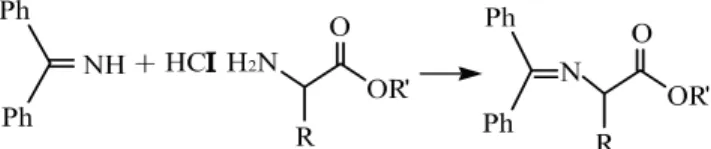
은 다음과 같다 (Fig. 1) [4,6]. 10 mL의 2-propanol 용매에 α-amino acid ester HCl 0.6 mmol, benzophenone imine 0.5 mmol, MgSO4 2.5 mmol을 가하여 12시간동안 상온에서 교반시킨다. 반응 후 불용물을 여과하고 여과액을 고성능 액 체 크로마토그래피에 직접 주입하여 광학분리를 수행하였다.
Fig 1. Preparation of the benzophenone derivatives of α‐amino acid
esters.3. 결과
앞선 연구에서 9-anthryl group이 키랄 고정상의 chiral selector와 광학이성질체를 분리하기 위한 aromatic auxiliary group으로써 기능을 하였던 것처럼, 본 연구의 benzophenone imine Schiff base 유도체의 두 개의 phenyl group이 그러한 역할을 할 것이라 기대하였다 [3-5]. 그래서 benzophenone imine을 이용하여 다양한 종류의 α-amino acid ester의 benzophenone imine Schiff base 유도체를 합성하여 다당 유도체의 키랄선택자가 공유결합된 키랄 컬럼을 이용하여 광학분리를 수행하였다. Table 1-3은 다당 유도체의 키랄 선 택자가 고정상에 공유결합된 3개의 키랄 컬럼 (Chiralpak IA, Chiralpak IB, Chiralpak IC)에서 16개의 α-amino acid methyl ester와 ethyl ester의 benzophenone imine 유도체를 광학 분리한 결과이다. Table 3에 나타난 것처럼 Chiralpak IC 키랄 컬럼에서 α-amino acid ester의 benzophenone imine 유도체의 가장 좋은 광학분리 결과를 보여주고 있다. Table 1, 2 의 Chiralpak IA와 Chiralpak IB 키랄 컬럼에서는 몇 개의 분석물질을 제외하고는 대체적으로 광학분리가 되지 않았 지만 Table 3의 Chiralpak IC 키랄 컬럼에서는 실험했던 모든 시료의 광학분리가 기준분리로 되고 있음을 보여주 고 있다 (α = 1.12~2.12, Rs = 2.08~12.94). Table 1-3에서 α-amino acid ester의 benzophenone imine 유도체의 광학 분리를 수행할 경우, 전체적으로 동일한 이동상인 0.5% 2- propanol/hexane (V/V)을 사용하였는데 Table 3의 Chiralpak IC 컬럼에서 asparagine methyl ester 유도체와 aspartic acid dimethyl ester 유도체 경우에는 2시간 분석시간이 지나도 전혀 용리되지 않았다. 그래서 이들 두 유도체들의 경우, 5%
2-propanol/hexane 이동상을 사용하여 asparagine methyl ester 유도체와 (α = 1.48, k'1 = 7.23) aspartic acid dimethyl ester 유도체 (α = 1.47, k'1 = 7.57)의 좋은 광학분리 결과를 얻을 수 있었다. 또한 Table 3에서 분명하게 보여주고 있는 것처럼, 전체적으로 α-amino acid methyl ester의 benzophenone imine 유도체의 separation factor나 resolution factor의 광학 분리 결과는 해당하는 ethyl ester 유도체 것보다 조금씩 더 좋게 나타나 이러한 결과는 9-anthraldimine derivatives 에서의 광학분리와 같은 경향임을 보여주고 있다 [3]. 또한
α-amino acid ester의 benzophenone imine 유도체의 광학분 리에 있어 그 용리순서에 대한 실험을 진행하였다. 모든 시료 가 광학분리되고 있지는 않았지만, Table 1의 Chiralpak IA 에서는 용리순서가 일정하지 않았고, Table 2의 Chiralpak IB에서는 L-이성질체가 일정하게 두 번째로 용리되었다. 한 편, Table 3의 Chiralpak IC에서는 phenylglycine ester들의 유도체의 경우를 제외하고는 모든 시료에서 L-이성질체가 두 번째로 용리되었다. 아마 phenylglycine ester 유도체의 경우, chiral center에 있는 phenyl 그룹이 Chiralpak IC의 키랄선택자와 특별한 chiral recognition interaction을 가짐 으로 다른 분석물질과 정반대의 용리순서 결과가 나온 것으 로 추정된다.
Fig 2. Chromatograms of the enantiomer resolution of the
benzophenone imine derivative of racemic leucine methyl ester (the left) and L‐leucine methyl ester (Aldrich reagent) (the right) (D:L = <0.1:>99.9) on Chiralpak IC. Mobile phase:0.5% 2- propanol/hexane (V/V); flow rate = 1 mL/min; detection wavelength : UV 254 nm; injection amount 4-5μg.Table 1. Separation of the enantiomers of α‐amino acid methyl and
ethyl esters as benzophenone imine derivatives on Chiralpak IA.Analyte α k'1 Rs Conf*
Alanine methyl ester Asparagine methyl ester Aspartic acid dimethyl ester Leucine methyl ester Methionine methyl ester Norleucine methyl ester Norvaline methyl ester Phenylalanine methyl ester Phenylglycine methyl ester Valine methyl ester
1.00 1.16 1.12 1.00 1.00 1.00 1.00 1.00 1.23 1.06
1.36 5.95 4.99 1.16 3.83 4.04 1.31 2.05 3.32 0.99
‐ 3.01 2.20
‐
‐
‐
‐
‐ 2.16 0.63
- D D - - - - - D L Alanine ethyl ester
Aspartic acid diethyl ester Isoleucine ethyl ester Leucine ethyl ester Phenylglycine ethyl ester Valine ethyl ester
1.00 1.08 1.00 1.00 1.12 1.04
1.24 4.12 0.99 1.00 2.52 1.06
‐ 1.55
‐
‐ 1.68 0.57
- D
- - D L α: Separation factor, k'1: Capacity: factorof the first eluted enantiomer, Rs: Resolution factor, Mobile phase: 0.5% 2‐propanol/hexane (V/V);
Flow rate: 1 mL/min; Detection UV 254 nm; *indicates the absolute configuration of the second eluted enantiomer.
Table 2. Separation of the enantiomers of α‐amino acid methyl and
ethyl esters as benzophenone imine derivatives on Chiralpak IBAnalyte α k'1 Rs Conf*
Alanine methyl ester Asparagine methyl ester Aspartic acid dimethyl ester Leucine methyl ester Methionine methyl ester Norleucine methyl ester Norvaline methyl ester Phenylalanine methyl ester Phenylglycine methyl ester Valine methyl ester
1.00 1.55 1.49 1.00 1.05 1.00 1.00 2.62 1.17 1.00
1.91 4.40 4.23 0.93 2.38 1.17 1.20 1.58 1.92 1.32
‐ 6.19 5.70
‐ 0.30
‐
‐ 8.39 0.69
‐ - L L - L - - L L - Alanine ethyl ester
Aspartic acid diethyl ester Isoleucine ethyl ester Leucine ethyl ester Phenylglycine ethyl ester Valine ethyl ester
1.00 1.35 1.00 1.00 1.16 1.00
1.61 3.90 0.59 0.84 1.69 1.28
‐ 3.38
‐
‐ 0.55
‐ - L - - L - α: Separation factor, k'1: Capacity: factorof the first eluted enantiomer, Rs: Resolution factor, Mobile phase: 0.5% 2-propanol/
hexane (V/V); Flow rate: 1 mL/min; Detection UV 254 nm; *indicates the absolute configuration of the second eluted enantiomer.
Table 3. Separation of the enantiomers of α‐amino acid methyl and
ethyl esters as benzophenone imine derivatives on Chiralpak ICAnalyte α k'1 Rs Conf*
Alanine methyl ester Asparagine methyl ester Aspartic acid dimethyl ester Leucine methyl ester Methionine methyl ester Norleucine methyl ester Norvaline methyl ester Phenylalanine methyl ester Phenylglycine methyl ester Valine methyl ester
1.48 1.48 1.47 1.72 2.09 1.80 1.73 1.12 1.98 2.12
7.32 7.23**
7.57**
3.91 15.61 4.36 4.95 8.48 9.78 3.33
6.67 8.47 7.48 6.68 11.84 7.06 6.78 2.08 9.59 12.94
L L L L L L L L D L Alanine ethyl ester
Aspartic acid diethyl ester Isoleucine ethyl ester Leucine ethyl ester Phenylglycine ethyl ester Valine ethyl ester
1.43 1.42 1.86 1.61 1.60 1.85
6.74 6.97**
3.12 3.68 9.66 3.11
5.90 7.01 4.07 5.59 8.08 10.11
L L L L D L α: Separation factor, k'1: Capacity: factorof the first eluted enantiomer, Rs: Resolution factor, Mobile phase: 0.5% 2-propanol/hexane (V/V); Flow rate: 1 mL/min; Detection UV 254 nm; *indicates the absolute configuration of the second eluted enantiomer; **5%
2-propanol/hexane (V/V).
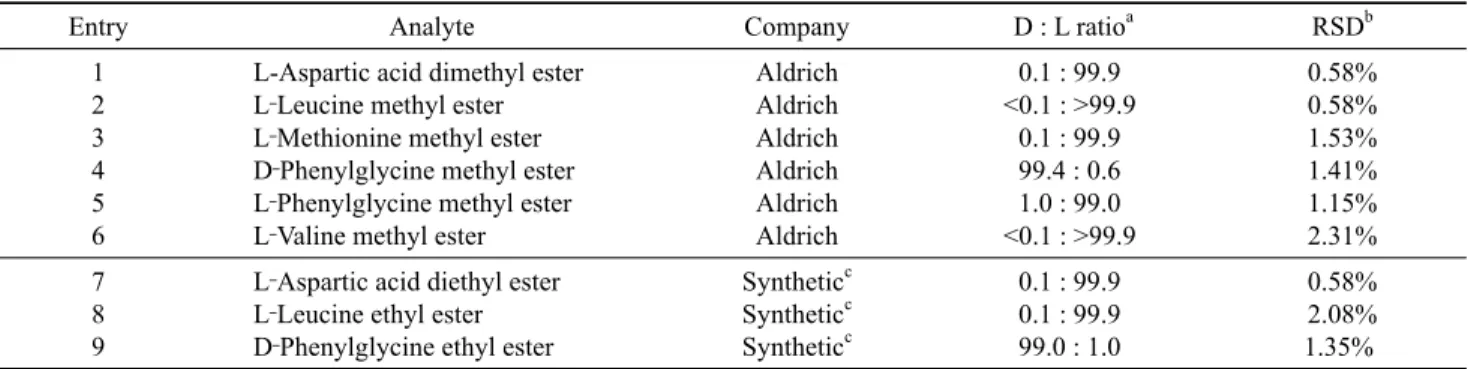
또한 본 연구에서 개발한 분석법을 이용하여 현재 시판 되고 있거나 또는 본 연구실에서 합성한 여러 α-amino acid ester의 광학순도를 측정하고자 하였다. 광학분리 실험에서 가장 좋은 결과를 보인 Chiralpak IC 컬럼을 사용하여 9개 의 시료의 광학순도 측정실험을 수행하였다. Table 4에서 보여주고 있는 것처럼 benzophenone imine 유도체로 합성한 후 측정한 시판되고 있는 α-amino acid methyl ester의 광학
Entry Analyte Company D : L ratioa RSDb 1
2 3 4 5 6
L-Aspartic acid dimethyl ester L‐Leucine methyl ester L‐Methionine methyl ester D‐Phenylglycine methyl ester L‐Phenylglycine methyl ester L‐Valine methyl ester
Aldrich Aldrich Aldrich Aldrich Aldrich Aldrich
0.1 : 99.9
<0.1 : >99.9 0.1 : 99.9 99.4 : 0.6 1.0 : 99.0
<0.1 : >99.9
0.58%
0.58%
1.53%
1.41%
1.15%
2.31%
7 8 9
L‐Aspartic acid diethyl ester L‐Leucine ethyl ester D‐Phenylglycine ethyl ester
Syntheticc Syntheticc Syntheticc
0.1 : 99.9 0.1 : 99.9 99.0 : 1.0
0.58%
2.08%
1.35%
See experimental for chromatographic conditions. aAverage value of more than three times determined.
bRelative standard deviation. cSynthesized sample prepared according to the conventional methods [7].
Table 4. Determination of the optical purity of commercially available or synthetic α‐amino acid esters as benzophenone imine derivatives
on Chiralpak IC순도는 99.0-99.9% 이상으로 나타났다 (이들의 광학이성 질체 불순물은 <0.1-1.0% 이다). 그리고 본 연구실에서 합성 한 α-amino acid ethyl ester의 광학순도는 99.0-99.9%으로 나타났다 (이들 광학이성질체 불순물은 <0.1-1.0% 이다).
본 실험실에서 phenylglycine으로부터 합성한 phenylglycine ethyl ester의 광학순도는 99.0% 이어서 (entry 9), 시판되고 있는 phenylglycine methyl ester (Aldrich 시약)보다도 광학 순도가 낮게 나타나는데 합성하는 과정에서 일부가 라세미 화 현상이 일어난 것으로 추정된다. Fig. 2는 시판되고 있는 L-leucine methyl ester의 광학순도를 benzophenone imine 유도체를 통하여 측정한 대표적인 크로마토그램이다. 또한 2-propanol에서 α-amino acid ester의 benzophenone imine 유도체화 이후 보관시간에 따른 시료의 안정도시험을 수행하 였다. Table 5는 Aldrich 회사에서 시판되고 있는 L-leucine methyl ester를 benzophenone imine 유도체로 합성한 후 한 달여 동안 4℃에 보관하면서 광학순도를 측정함으로 시료의 안정성을 보여준 실험 결과이다. Table 5에서 보는 바와 같 이 4℃에서 한 달여 동안 시료를 보관하더라도 L-leucine methyl ester의 benzophenone imine 유도체를 실험하여 얻 은 광학순도가 매우 일정함을 보였는데 이는 본 연구에서 개발 한 α-amino acid ester의 benzophenone imine 유도체 시료가 매우 안정함을 보여주는 것이라 말할 수 있다.
Table 5. Stability test of optical purity results for L‐leucine methyl
ester as benzophenone imine derivatives stored at 4℃ after derivatization with benzophenone imine in 2‐propanolStorage period D : L ratioa RSDb
0 Day 2 Day 4 Day 7 Day 10 Day 15 Day 21 Day 27 Day 35 Day
<0.1:>99.9
<0.1:>99.9
<0.1:>99.9
<0.1:>99.9
<0.1:>99.9
<0.1:>99.9
<0.1:>99.9
<0.1:>99.9
<0.1:>99.9
0.58%
0.47%
0.70%
1.01%
0.58%
0.75%
0.61%
0.80%
1.12%
aAverage value of three determinations.
bRelative standard deviation.
4. 결론
고성능 액체 크로마토그래피에서 다당 유도체가 공유결합 한 3개의 키랄 컬럼을 사용하여 여러 종류의 α-amino acid methyl/ethyl ester의 benzophenone imine 유도체의 광학 분리를 수행하였다. 이를 위하여 본 연구에서 크로마토 그래피의 이동상으로 사용하는 2-propanol 용매에 α-amino acid ester와 benzophenone imine, MgSO4를 반응시켜 benzophenone imine 유도체를 합성하는 매우 편리한 유도 체화 방법을 개발하였다. 또한 Chiralpak IC는 본 연구에 서 사용한 다른 컬럼들에 비해서 여러 α-amino acid ester 유도체 시료를 모두 기준분리하며 상당히 좋은 광학분리 결과를 보여주었다. 그리고 본 연구에서 개발한 분석법을 이용하여 현재 시판하고 있거나 합성한 여러 α-amino acid ester의 광학순도를 측정하였다. 또한 본 연구에서 개발한 유도체화 방법으로 합성된 시료의 안정도 시험을 수행하였 는데 1달여 정도 4℃에 보관하더라도 이들의 광학순도에 변화가 없음을 확인하였다. 그러므로 α-amino acid ester의 광학분리를 위해 본 연구에서 개발한 benzophenone imine 유도체를 이용한 광학분리 분석법이 매우 유용하게 사용될 수 있으리라 기대한다.
References
1. Subramanian, G. (Ed.) (2001) Chiral Separation Techniques:
A practical approach second revised ed., VCH, Weinheim.
2. Francotte, E. and W. Lindner (Ed.) (2006) Chirality in Drug
Research, Wiley-VCH, Weinheim.
3. Huang, H., J. Y. Jin, and W. Lee (2011) Chromatographic enantiomer separation and determination of optical purity for α-amino acid esters as 9-anthraldimine derivatives using polysaccharide based chiral columns. Kor. Soc. Biotech. Bioeng. J. 26: 139-142.
4. Xu, W. J., J. Y. Jin, and W. Lee (2011) Enantiomer separation of chiral amino alcohols as 9-anthraldimine derivatives on coated and covalently bonded chiral stationary phases based on polysaccharide derivatives by high performance liquid chromatography. Kor. Soc. Biotech. Bioeng. J. 26: 323-327.
5. Duchateau, A. L. L., J. J. Guns, R. G. R. Kubben, and A. F. P.
van Tilburg (1994) High-performance liquid chromatography of diamine enantiomers as Schiff bases on a chiral stationary phase. J. Chromatogr. A. 664: 169-176.
6. O’Donnell, M. J., and Polt, R. L. (1982) A mild and efficient route to schiff base derivatives of amino acids. J. Org. Chem.
47: 2663-2666.
7. Greene, T. W. and P. G. M. Wuts (1999) Protective Groups in
Organic Synthesis, 3rd ed., John Wiley & Sons, New York.
8. Jin, J. Y., W. Lee, J. H. Park, and J. J. Ryoo (2006) Covalently bonded and coated chiral stationary phases derived from polysaccharide derivatives for enantiomer separation of
N-fluorenylmethoxycarbonyl α-amino acids with fluorescence detection. J. Liq. Chrom. & Rel. Tech. 29: 1793-1801.
9. Jin, J. Y. and W. Lee (2008) Enantiomer separation of N-protected α-amino acids on covalently immobilized cellulose tris (3,5- chlorophenylcarbamate) chiral stationary phase in HPLC. Bull.
Kor. Chem. Soc. 29: 491-493.
10. Jin, J. Y., S. K, Bae, and W. Lee (2009) Comparative studies between covalently immobilized and coated chiral stationary phases based on polysaccharide derivatives for enantiomer separation of N-protected α-amino acids and their ester derivatives. Chirality 21: 871-877.