115
DOI: 10.4046/trd.2010.69.2.115
ISSN: 1738-3536(Print)/2005-6184(Online) Tuberc Respir Dis 2010;69:115-118
CopyrightⒸ2010. The Korean Academy of Tuberculosis and Respiratory Diseases. All rights reserved.
A Case of Ischemic Colitis Associated with Paclitaxel Loaded Polymeric Micelle (Genexol-PM
Ⓡ) Chemotherapy
Choel-Kyu Park, M.D.1, Hyun-Wook Kang, M.D.1, Tae-Ok Kim, M.D.1, Ho-Seok Ki, M.D.1, Eun-Young Kim, M.D.1, Hee-Jung Ban, M.D.1, Byeong-Kab Yoon, M.D.1, In-Jae Oh, M.D.1, Yoo-Deok Choi, M.D.2, Yong-Soo Kwon, M.D.1, Yoo-Il Kim, M.D.1, Sung-Chul Lim, M.D.1, Young-Chul Kim, M.D.1, Kyu-Sik Kim, M.D.1
Departments of 1Internal Medicine, 2Pathology, Chonnam National University Medical School, Gwangju, Korea
Paclitaxel has been widely used for treating many solid tumors. Although colonic toxicity is an unusual complication of paclitaxel-based chemotherapy, the reported toxicities include pseudomembranous colitis, neutropenic entero- colitis and on rare occasions ischemic colitis. Genexol-PMⓇ, which is a recently developed cremophor-free, polymeric micelle-formulated paclitaxel, has shown a more potent antitumor effect because it can increase the usual dose of paclitaxel due to that Genexol-PMⓇ does not include the toxic cremophor compound. We report here on a case of a 57-year-old man with advanced non-small cell lung cancer and who developed ischemic colitis after chemotherapy with Genexol-PMⓇ and cisplatin. He complained of hematochezia with abdominal pain on the left lower quadrant. Colonoscopy revealed diffuse mucosal hemorrhage and edema from the sigmoid colon to the splenic flexure. After bowel rest, he recovered from his symptoms and the follow-up colonoscopic findings showed that the mucosa was healing. Since then, he was treated with pemetrexed monotherapy instead of a paclitaxel compound and platinum.
Key Words: Paclitaxel; Genexol-PM; Colitis, Ischemic
Address for correspondence: Kyu-Sik Kim, M.D.
Lung and Esophageal Cancer Clinic, Chonnam National University Hwasun Hospital, 160, Ilsim-ri, Hwasun-eup, Hwasun 519-809, Korea
Phone: 82-61-379-7615, Fax: 82-61-379-7628 E-mail: [email protected]
Received: Jan. 7, 2010 Accepted: Jan. 12, 2010
Introduction
Paclitaxel have been widely used for treatment of many solid tumors as a combination chemotherapeutic regimen. In advanced non-small cell lung cancer (NSCLC), especially, paclitaxel is one of the most commonly used agents in platinum-based combination chemotherapy1. Although colonic toxicity is an unusual complication of paclitaxel-based chemotherapy, the reported toxicities include pseudomembranous colitis, neutropenic enter- ocolitis, and rarely ischemic colitis2. Recently developed Genexol-PMⓇ (Samyang Co., Seoul, Korea) - a cremo- phor-free, polymeric micelle-formulated paclitaxel -
shows more potent antitumor effect because it can in- crease the usual dose of paclitaxel due to not including toxic cremophor compound3. Reported adverse effects on the gastrointestinal tract in chemotherapy including polymeric micelle-formulated paclitaxel, such as nausea, anorexia, diarrhea, and abdominal pain, are mild and transient4. We report a case of 57-year-old man with advanced NSCLC who developed ischemic colitis after chemotherapy with polymeric micelle-formulated pacli- taxel and cisplatin.
Case Report
A 57-year-old man was admitted to our hospital with intermittent loose stool for 3 days and subsequent bloody diarrhea with abdominal pain on left lower quadrant. He had been diagnosed as advanced NSCLC in April 2009, which revealed adenocarcinoma in histol- ogy, confirmed by endobronchial ultrasonography- guided transbronchial needle aspiration (EBUS-TBNA),
Case Report
CK Park et al: Ischemic colitis associated with Genexol-PMⓇ
116
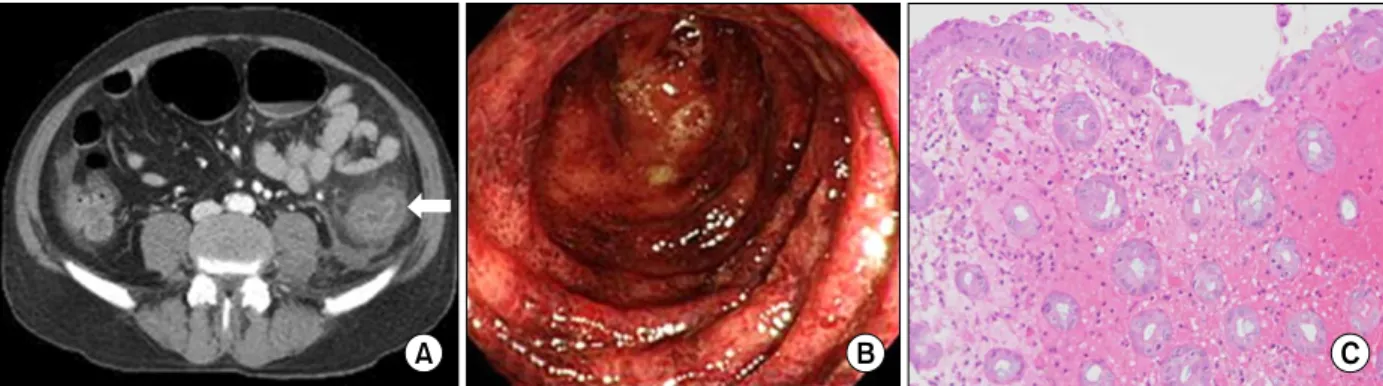
Figure 1. (A) Computed tomography finding shows long segmental and concentric wall thickening, called “double halo sign” (arrow), from sigmoid to distal transverse colon, without significant stenosis or obstruction in mesenteric vessels.
(B) Colonoscopy finding reveals continuous circular diffuse mucosal hemorrhage and edema from sigmoid colon to splen- ic flexure. (C) Pathologic examination of specimens revealed a mild edema, focal atrophic change of mucosal glands, and infiltration of erythrocytes into lamina propria, suggestive of early phase of ischemic colitis (H&E stain, ×400).
and multiple metastases to brain in imaging studies.
After whole brain radiotherapy, he was treated with 230 mg/m2 of polymeric micelle-formulated paclitaxel (Genexol- PMⓇ) and 60 mg/m2 of cisplatin. He was on medication due to diabetes mellutis and hypertension for 1 year, and he did not have any antiplatelet agents or anticoa- gulants. He had never been treated for peptic ulcer, liv- er cirrhosis, or other hereditary disease that could have a tendency of hemorrhage.
On day 5 after the second cycle of chemotherapy, he complained of bloody diarrhea (up to 4 times, each amount of 100 mL) with abdominal pain. Vital sign was stable, and there was not any hemorrhagic appearance except hematochezia. Physical examination showed abdominal tenderness on left lower quadrant with mild distension, but did not reveal rebound tenderness or muscle guarding. Laboratory findings revealed; white blood cell count 9,900/mm3, absolute neutrophil count 7,870/mm3, hemoglobin 13.3 g/dL, platelet count 194,000/mm3, C-reactive protein (CRP) 0.50 mg/dL (0∼
0.3), serum protein 7.0 g/dL, serum albumin 4.2 g/dL, serum lactate dehydrogenase 573 U/L (218∼472), se- rum aspartate transaminase 17 U/L, serum alanine trans- aminase 34 U/L, prothrombin time INR 1.29, and acti- vated partial thromboplastin time 29.4 second. After- wards, the white blood cell was not significantly changed, but CRP level was increased (21.88 mg/dL).
Plain radiography of abdomen did not show the ob- structive pattern of small intestine or colon, and there was no evidence of free-air in abdominal cavity.
Computed tomography (CT) of abdomen revealed long segmental and concentric wall thickening, called“dou- ble halo sign,”from sigmoid to distal transverse colon, without significant stenosis or obstruction in mesenteric vessels (Figure 1A). Gastroduodenoscopy showed shal- low ulcer on antrum, but there was no evidence of hemorrhage. Colonoscopy revealed continuous, circu- lar, and diffuse mucosal hemorrhage and edema from sigmoid colon to splenic flexure (Figure 1B). There were not the cobble stone-like appearance suggestive of“pseudomembrane”on examination. Biopsies were obtained separately each from involved mucosa in sig- moid to transverse colon. Pathologic examination of specimens revealed a mild edema, focal atrophic change of mucosal glands, and infiltration of erythrocytes into lamina propria, suggestive of early phase of ischemic colitis (Figure 1C). Stool culture and Clostridium difficile toxin assay were negative.
Then, from these colonoscopic and CT findings, a di- agnosis of ischemic colitis was made. We maintained the fasting state with total parenteral nutrition for 12 days. During the bowel rest, his symptom of abdominal pain was gradually recovered and bloody diarrhea was completely resolved. CRP level was improved nearly to
Tuberculosis and Respiratory Diseases Vol. 69. No. 2, Aug. 2010
117 normal range (1.1 mg/dL). After 1 month from the on-
set, follow-up colonoscopic finding showed healing state of mucosa. Since then, he was treated with peme- trexed monotherapy instead of paclitaxel compound and platinum.
Discussion
This case showed a ischemic colitis as the colonic toxicity after chemotherapy with polymeric micelle-for- mulated paclitaxel and cisplatin in a patient with ad- vanced NSCLC, and reported case of this adverse events in chemotherapy with newly developed agent, Genexol- PMⓇ, is absent in Korea, so far.
Paclitaxel (TaxolⓇ; Bristol-Myers Squibb, Wallingford, CT, USA) is a chemotherapeutic agent effective for many solid tumors1. Dose-limiting toxicities by paclitax- el, such as neuropathy and neutropenia, may be related with the taxane compound itself or with the vehicle necessary to formulate the drug. Owing to water in- solubility of the drug, paclitaxel is formulated with the micelle-forming vehicle, Cremophor-EL (CrEL), to en- hance drug solubility5. But, as mentioned above, the ad- dition of CrEL has been reported to have relevance to hypersensitivity reaction, neuropathy, cytotoxic effect, inconvenience in preparation or alteration in pharmaco- kinetics of the drug3,5. To overcome the unfavorable ef- fects due to CrEL, the development of new CrEL-free formulations of paclitaxel have been attempted to use some of other drug delivery systems, such as emulsion, micelles, water-soluble prodrugs and conjugates4. Genexol- PMⓇ, as a outcome of these efforts, is a novel for- mulation of paclitaxel, a sterile lyophilized polymeric micellar formulation without CrEL. Genexol-PMⓇ was found to have higher maximum tolerated doses and higher levels of biodistribution in a variety of tissues in- cluding liver, spleen, kidney, and lung and more im- portantly tumors. Also, the in vivo antitumor efficacy has been shown to be greater than that of TaxolⓇ6. In a phase II clinical trial, several adverse events associated with Genexol-PMⓇ and cisplatin combination regimen were reported, which included neutropenia, peripheral
sensory neuropathy, hypersensitivity reaction, and so on. But, in spite of higher paclitaxel doses, the side ef- fects were comparable with conventional chemotherapy of paclitaxel and cisplatin. Moreover, the response rate and survival duration were more favorable than in most phase II or phase III clinical trials using TaxolⓇ com- bined with cisplatin. Therefore, a cremophor-free, poly- meric micelle-formulated paclitaxel (Genexol-PMⓇ) com- bined with cisplatin has been reported to show sig- nificant antitumor effect with low incidence and severity of toxicity in spite of administration of higher doses of paclitaxel compared with CrEL-containing formulation in advanced NSCLC4.
Colon toxicities associated with chemotherapy have the low incidence, but among them, pseudomembra- nous colitis and neutropenic enterocolitis are relatively common after paclitaxel combined chemotherapy2. A few cases of ischemic colitis after taxane compound- containing chemotherapy, such as paclitaxel or doce- taxel. Ischemic colitis caused by certain medications or drugs is unusual, and necessary to differentiate with other disease with bloody diarrhea in colon, such as gastrointestinal infections including Escherichia coli O157:H7, Clostridium difficile, and cytomegalovirus, di- verticular diseases, Crohn’s disease, or malignancy with stricture7. In this case, colonoscopic findings did not show the typical appearances of pseudomembrane, cir- cular ulceration or crypt abscess suggestive of in- flammatory bowel diseases, and stool culture and toxin assay revealed negative. Biopsy did not reveal the ma- lignant lesion or viral infection, and CT findings did not show the evidence of diverticuli. Besides, white blood cell was within normal range at the time of admission.
Therefore, we could rule out several diseases and make the diagnosis of ischemic colitis.
The exact mechanism by which paclitaxel-associated gastrointestinal toxicity occurs is poorly understood, but there are several postulations as to the onset of the complication. Paclitaxel may induce the necrosis of the gastrointestinal mucosa by taxane-based effect, arresting the mitosis of rapidly dividing colonic mucosal cells and also synergistic interaction with compromised bowel
CK Park et al: Ischemic colitis associated with Genexol-PMⓇ
118
due to previous chemotherapy may play a part8. Fur- thermore, in a study, paclitaxel had antiangiogenic pro- perties in mice, interfering with vascular smooth muscle cell proliferation, migration, and neointimal accumu- lation9,10. In fact, the patient had a history of diabetes mellutis and hypertension, and he was treated with the chemotherapeutic agent previously. So, the vascular in- sufficiency with underlying disease and the fragility of intestine due to previous chemotherapy would be the risk factors for the colonic toxicity.
Reported adverse effects on the gastrointestinal tract in chemotherapy with Genexol-PMⓇ are mild and tran- sient4. Because both TaxolⓇ and Genexol-PMⓇ have common component of paclitaxel, the nature of colonic toxicity may not reveal the dissimilarity. So, in escalat- ing the usual dosage of the polymeric micelle-for- mulated paclitaxel, the monitoring for toxicities of gas- trointestinal tract as well as hematologic abnormalities should be considered. Furthermore, as in this case, at the time of disease onset, suspicious drugs including polymeric micelle-formulated paclitaxel should be stop- ped, and the shift to other line of chemotherapeutic agent is considerable after the complete recovery of ad- verse events.
References
1. Johnson DH, Paul DM, Hande KR, Shyr Y, Blanke C, Murphy B, et al. Paclitaxel plus carboplatin in ad- vanced non-small-cell lung cancer: a phase II trial. J Clin Oncol 1996;14:2054-60.
2. Tashiro M, Yoshikawa I, Kume K, Otsuki M. Ischemic colitis associated with paclitaxel and carboplatin chemotherapy. Am J Gastroenterol 2003;98:231-2.
3. Kim TY, Kim DW, Chung JY, Shin SG, Kim SC, Heo DS, et al. Phase I and pharmacokinetic study of Genexol-PM, a cremophor-free, polymeric micelle-for- mulated paclitaxel, in patients with advanced malig- nancies. Clin Cancer Res 2004;10:3708-16.
4. Kim DW, Kim SY, Kim HK, Kim SW, Shin SW, Kim JS, et al. Multicenter phase II trial of Genexol-PM, a novel Cremophor-free, polymeric micelle formulation of paclitaxel, with cisplatin in patients with advanced non-small-cell lung cancer. Ann Oncol 2007;18:2009- 14.
5. Gelderblom H, Verweij J, Nooter K, Sparreboom A.
Cremophor EL: the drawbacks and advantages of ve- hicle selection for drug formulation. Eur J Cancer 2001;
37:1590-8.
6. Kim SC, Kim DW, Shim YH, Bang JS, Oh HS, Wan Kim S, et al. In vivo evaluation of polymeric micellar pacli- taxel formulation: toxicity and efficacy. J Control Re- lease 2001;72:191-202.
7. Sreenarasimhaiah J. Diagnosis and management of is- chemic colitis. Curr Gastroenterol Rep 2005;7:421-6.
8. Seewaldt VL, Cain JM, Goff BA, Tamimi H, Greer B, Figge D. A retrospective review of paclitaxel-associated gastrointestinal necrosis in patients with epithelial ovar- ian cancer. Gynecol Oncol 1997;67:137-40.
9. Sollott SJ, Cheng L, Pauly RR, Jenkins GM, Monticone RE, Kuzuya M, et al. Taxol inhibits neointimal smooth muscle cell accumulation after angioplasty in the rat.
J Clin Invest 1995;95:1869-76.
10. Klauber N, Parangi S, Flynn E, Hamel E, D'Amato RJ.
Inhibition of angiogenesis and breast cancer in mice by the microtubule inhibitors 2-methoxyestradiol and taxol.
Cancer Res 1997;57:81-6.