Special Review:
Korean Society of Gastrointestinal Endoscopy “Accreditation of Qualified Endoscopy Unit” Guideline: Update 2019
Clin Endosc 2019;52:451-457 https://doi.org/10.5946/ce.2019.172
Print ISSN 2234-2400 • On-line ISSN 2234-2443
Updates on the Sedation for Gastrointestinal Endoscopy
Jun Kyu Lee1, Yoo Jin Lee2, Jun Hyung Cho3, Jong Pil Im4, Chang-Hwan Park5, Jae-Young Jang6, Byung Ik Jang7 and the Quality Management Committee and the Disinfection Management/Conscious Sedation Committee of Korean Society of Gastrointestinal Endoscopy (KSGE)
1Department of Internal Medicine, Dongguk University Ilsan Hospital, College of Medicine, Dongguk University, Goyang, 2Department of Internal Medicine, Keimyung University College of Medicine, Seoul, 3Department of Internal Medicine, Soonchunhyang University College of Medicine, Seoul, 4Department of Internal Medicine and Liver Research Institute, Seoul National University College of Medicine, Seoul,
5Department of Internal Medicine, Chonnam National University Medical School, Gwangju, 6Department of Internal Medicine, Kyung Hee University College of Medicine, Seoul, 7Department of Internal Medicine, Yeongnam University College of Medicine, Daegu, Korea
Sedation, defined as the depressed level of consciousness, induced by drug administration, is widely used for gastrointestinal endoscopy to relieve a patient’s anxiety and discomfort. In addition, successful procedure is anticipated with control of unintended movements.
Endoscopic sedation, however, cannot be free from the risk of serious adverse events, e.g., cardiopulmonary compromise. Therefore, principles on personnel, facility and equipment, as well as performance itself, should be followed to prevent unfavorable incidents. In this article, sedation guidelines for the Accreditation of Qualified Endoscopy Units, issued by the Korean Society of Gastrointestinal Endoscopy, are presented. clin endosc 2019;52:451-457
Key words: Endoscopic sedation; Monitoring; Oxygenation; Pulse oximetry; Adverse event Open access
IntrodUctIon
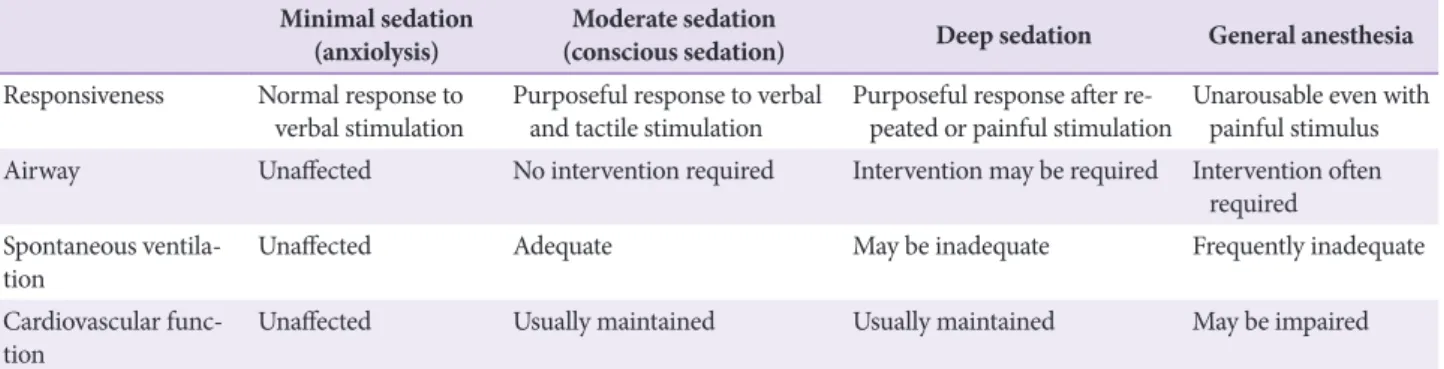
Sedation is defined as the depressed level of consciousness induced by administration of drugs. When gastrointestinal endoscopy is performed, sedation is frequently used for the sake of both the patient and the endoscopist. For a patient, anxiety and discomfort can be relieved. Moreover, amnesia, regarding memory of the event, may be anticipated. For an endoscopist, the quality of the examination is improved through the control of unintended movements. The level of sedation is a continuum ranging from minimal sedation (anx- iolysis) to general anesthesia, which is defined by a patient’s
degree of spontaneous ventilation, maintenance of cardio- vascular function, and response to verbal and tactile stimuli (Table 1).1 The targeted level of sedation may differ depending on a patient’s condition and the duration or complexity of the procedure. Usually, moderate sedation is the preferred level.
Deep sedation, however, may be achieved with or without intention, in which case the risk of serious adverse events (AEs), e.g., cardiopulmonary compromise, increases. In this article, sedation guidelines for the Accreditation of Qualified Endoscopy Units (AQEUs), issued by the Korean Society of Gastrointestinal Endoscopy (KSGE), are presented (Table 2).
received: September 2, 2019 revised: September 10, 2019 Accepted: September 11, 2019
correspondence: Jun Kyu Lee
Department of Internal Medicine, Dongguk University Ilsan Hospital, Dongguk University College of Medicine, 27 Dongguk-ro, Ilsandong-gu, Goyang 10326, Korea
tel: +82-31-961-7750, Fax: +82-31-961-9390, E-mail: [email protected] orcId: https://orcid.org/0000-0002-2694-3598
cc This is an Open Access article distributed under the terms of the Creative Commons Attribution Non-Commercial License (http://creativecommons.org/
licenses/by-nc/3.0) which permits unrestricted non-commercial use, distribution, and reproduction in any medium, provided the original work is properly cited.
Minimal sedation
(anxiolysis) Moderate sedation
(conscious sedation) deep sedation General anesthesia Responsiveness Normal response to
verbal stimulation Purposeful response to verbal
and tactile stimulation Purposeful response after re-
peated or painful stimulation Unarousable even with painful stimulus Airway Unaffected No intervention required Intervention may be required Intervention often
required Spontaneous ventila-
tion Unaffected Adequate May be inadequate Frequently inadequate
Cardiovascular func-
tion Unaffected Usually maintained Usually maintained May be impaired
Modified from American Society of Anesthesiologists Task Force on Sedation and Analgesia by Non-Anesthesiologists.1
Table 2. Accreditation of Qualified Endoscopy Unit Assessment Items for Endoscopic Sedation
category AQEU assessment items Grade
Mandatory items (12 items) Pre-procedure assess-
ment(4 items)
1. Prior to endoscopic sedation, the medical history of the patient must be verified and the physical status of the patient must be assessed, according to the physical status classification system approved by the American Society of Anesthesiologists.
2. Prior to endoscopic sedation, the patient’s blood pressure, heart rate, respiratory rate, and oxygen saturation must be recorded.
3. A recommended format of the consent form must be used, or all information needed for sedation consent must be included. In addition, the patient must be notified about the pos- sibility of being accompanied by a guardian during endoscopic sedation, and the presence of this individual should be confirmed.
4. Endoscopists and nurses must have completed their endoscopic sedation-related education.
Mandatory
Intra-procedure as- sessment (3 items)
1. During endoscopic sedation, monitoring and recording the patient’s blood pressure, heart rate, respiratory rate, and oxygen saturation in regular intervals is recommended.
2. The type and dosage of drug(s) used for endoscopic sedation must be recorded and main- tained.
3. Guidelines on drug administration for endoscopic sedation must be available.
Mandatory
Post-procedure assess- ment(3 items)
1. There must be nurses assigned to the recovery room.
2. After endoscopic sedation, the patient’s oxygen saturation and heart rate must be moni- tored and blood pressure must be measured regularly, from the time of admission to the recovery room until the time of discharge.
3. After endoscopic sedation, the patient must be discharged in accordance with the desig- nated criteria.
Mandatory
Narcotics control
(2 items) 1. Narcotics used for endoscopic sedation must not be easily accessible by patients and must be stored in the narcotics storage facility with a lock.
2. Narcotics must be dispensed immediately before administration and prepared in an inde- pendent area, such as a drug preparation room.
Mandatory
Recommended items (5 items) Pre-procedure assess-
ment(3 items)
1. Regarding the ratio of beds in an examination room to those in the recovery room, a ratio of ≥2 is recommended.
2. Before initiating the endoscopic sedation, it is recommended to predict the risk of hypox- ia and difficulty of endotracheal intubation based on the patient’s Mallampati score.
3. Before initiating the endoscopic sedation, the patient’s level of consciousness should be assessed.
Recommended
Intra-procedure as-
sessment (1 item) 1. ECG monitoring during endoscopic sedation is recommended in patients with serious
cardiovascular disease or arrhythmia. Recommended
Post-procedure assess-
ment (1 item) 1. ECG monitoring after endoscopic sedation is recommended in patients with serious car-
diovascular disease or those who showed unstable vital signs during the procedure. Recommended AQEU, accreditation of qualified endoscopy unit; ECG, electrocardiogram.
Lee JK et al. Quality Control of Endoscopic Sedation
rAtIonAlE bEhInd AQEU ASSESSMEnt ItEMS For EndoScopIc SEdAtIon
Mandatory items 12 items
pre-procedure assessment: 4 items
1. confirmation of medical history and American Society of Anesthesiologists physical status classifi- cation
Prior to endoscopic sedation, the medical history of the patient must be verified and the physical status of the pa- tient must be assessed according to the American Society of Anesthesiologists (ASA) physical status classification system.
Rationale: Prior to endoscopic sedation, previous medical history of the patient, including cardiopulmonary disease, neurological disease, sleep apnea, AEs from using sedatives, current medication, alcohol abuse, and compliance with fast- ing time, must be checked to determine if any of these factors may affect the outcome of sedation.1,2 The findings must be recorded in the pre-screening chart or pre-procedure assess- ment report (Supplementary file 1).
2. Vital signs
Prior to endoscopic sedation, the patient’s blood pressure, heart rate, respiratory rate, and oxygen saturation must be recorded.
Rationale: Sedatives and analgesics administered during endoscopic sedation may cause cardiovascular and/or re- spiratory AEs, such as a temporary drop in blood pressure, respiratory depression, or arrhythmia. In particular, greater caution should be taken in cases comorbid with chronic dis- eases. Accordingly, pre-procedure assessment on these factors is necessary, and appropriate measures should be taken when required.
3. Informed consent and guardian
A recommended format of the consent form must be used, or all information needed for sedation consent must be included. The patient must be notified regarding the pos- sible need of being accompanied by a guardian during en- doscopic sedation and the actual presence of this individual must be confirmed.
Rationale: The endoscopic sedation consent form must include an explanation on the sedative endoscopic procedure;
purpose and necessity of sedation; processes and methods of endoscopic sedation; problems, AEs, and sequelae associat- ed with endoscopic sedation; alternative treatment options besides endoscopic sedation; and prognosis, if left untreated (Supplementary file 2). Even after an endoscopic sedation has been completed, the patient may still face the risk of AEs as- sociated with the sedative(s) used. Although the patient is dis- charged after the state of recovery is adequately assessed, each individual may experience a different duration of sustained sedative effect. Therefore, it is necessary for the patient to be accompanied by a guardian when being discharged.
4. Sedation-related education
Endoscopists and nurses must have completed their endo- scopic sedation-related education.
Rationale: Life-threatening AEs, such as cardiopulmonary dysfunction, may occur during endoscopic sedation; thus, endoscopists and other assistants must have completed se- dation-related education on symptoms to check prior to the procedure, monitor during the procedure, and after the proce- dure, and on emergency measures to ensure patient safety.
Intra-procedure assessment: 3 items 1. Vital signs monitoring
During endoscopic sedation, monitoring and recording the patient’s blood pressure, heart rate, respiratory rate, and oxygen saturation at regular intervals is recommended.
Rationale: During the procedure, the patient’s blood pres- sure, heart rate, respiratory rate, and oxygen saturation must be monitored regularly, to discern possible endoscopic seda- tion-related AEs.3 The findings must be recorded in the seda- tion report (Supplementary file 3).
2. drug administration records
The type and dosage of drug(s) used for endoscopic seda- tion must be recorded and stored.
Rationale: An endoscopy findings report serves as evidence of the most important outcomes in endoscopy. Therefore, records of sedatives, analgesics, spasmolytics, and antagonists used during the endoscopic procedure must be available. The
be confirmed from the narcotics control records, and the use of non-narcotics could be found in relevant records. Records contained in computer storage media or hand written reports are acceptable.
3. drug administration guidelines
Guidelines on drug administration for endoscopic seda- tion must be available.
Rationale: The patient’s age, health status, current medi- cation, tension, and sensitivity to pain, are factors that may affect the efficacy of sedation, and thus, must be considered prior to endoscopic sedation. Because the required dose of sedatives used for endoscopic sedation may change de- pending on the patient’s general condition, age, and current medication, it is necessary to have sedative administration guidelines in place. In this context, the guidebook for endo- scopic sedation issued by the KSGE recommends the follow- ing administration method:
When administering midazolam alone to healthy adults aged <65 years, 2.5–3 mg of midazolam (or 0.05 mg/kg of body weight) should be slowly administered intravenously, followed by repeated administration of 1–2 mg (or 0.02–0.03 mg/kg) in 2- to 3-minute intervals until adequate sedation is achieved. For general diagnostic examinations, a dose within 5 mg should be sufficient and a higher dose is not recom- mended since it increases the risk of AEs. For patients with a high risk of endoscopic sedation-related AEs, such as the elderly aged ≥65 years, patients with ASA class III or higher, and patients with airway obstruction, a dose reduction of
≥20% should be applied. Co-administering midazolam with narcotic analgesics has a synergistic effect, and thus, the in- jection should be accompanied by a single administration of midazolam reduced by 20% from the dose described above.
When using meperidine, adequate sedation could be achieved with an initial intravenous injection of 12.5–25 mg, followed by repeated administration of 12.5–25 mg in 3- to 5-minute intervals when necessary. If the length of the procedure is short, a single injection is sufficient and the maximum dose of 50 mg should not be exceeded. When using fentanyl, an initial intravenous injection of 25–50 μg should be used, followed by repeated administration of 12.5–25 μg in 3- to 5-minute inter- vals when necessary. However, a single injection is sufficient in most cases and the maximum dose of 100 μg should not be exceeded. For patients with high risk of endoscopic seda- tion-related AEs, elderly patients aged ≥65 years, or patients with ASA class III or higher, the analgesic dose should be re- duced by ≥50% (meperidine 12.5 mg/fentanyl 25 μg).
<65 years, 30–40 mg (or 0.5 mg/kg) should be administered, and an additional 10–20 mg should be administered with at least a 20-second intermission, as necessary. For patients with a high risk of endoscopic sedation-related AEs, elderly aged
≥65 years, or patients with ASA class III or higher, the admin- istered dose should be reduced by ≥50%. When opting for a balanced propofol sedation, midazolam (0.025–0.05 mg/kg), meperidine 25 mg (or fentanyl 50 μg), and propofol (10–20 mg or 0.25 mg/kg) should be administered in sequence to healthy adults aged <65 years; sedation should be maintained by repeated administration of 10–20 mg of propofol with at least 20-second intermission. For patients with high risk of endoscopic sedation-related AEs, elderly aged ≥65 years, or patients with ASA class III or higher, the administered dose should be reduced by ≥50% or midazolam should be used alone.
post-procedure assessment: 3 items 1. dedicated nurses
There must be nurses assigned to the recovery room.
Rationale: Nurses assigned to the recovery room are needed for proper patient monitoring following endoscopic sedation, assessment of discharge criteria, and for providing adequate explanation to the patient and guardian at the time of dis- charge.
2. patient monitoring
After endoscopic sedation, the patient’s oxygen saturation and heart rate must be monitored and blood pressure must be measured regularly from the time of admission to the recovery room until the time of discharge.
Rationale: There are individual differences with respect to recovery from endoscopic sedation, and in rare cases, AEs, such as respiratory distress, apnea, hypotension, bradycardia, and shock, may occur. Therefore, the patient’s oxygen satura- tion, heart rate, and blood pressure must be monitored and even electrocardiogram (ECG) should be performed when necessary, until discharge in accordance with the guidelines.
Therefore, patient monitoring and oxygen-supply equipment must be available and countermeasures need to be established.
Lee JK et al. Quality Control of Endoscopic Sedation
3. discharge criteria
After endoscopic sedation, the patient must be discharged in accordance with the designated criteria.
Rationale: After endoscopic sedation, the risk of AEs associ- ated with the sedative used still remains. Therefore, standards and manuals for patient care in the recovery room and dis- charge from the recovery room are absolutely necessary. The most commonly used recovery assessment scales include the Aldrete score (Table 3) and the Postanesthetic Discharge Scor- ing System (PADSS).4
narcotics control: 2 items 1. drug management
Narcotics used for endoscopic sedation must not be easily accessible by patients and must be stored in a narcotics stor- age facility with a lock.
Rationale: Narcotics act on the human central nervous sys- tem and are recognized to cause serious harm to the human body when misused or abused. Therefore, they must be kept in a reserved area that is not easily accessible by patients and in an area protected by a double lock to avoid misuse and abuse.
2. Medication preparation
Narcotics must be dispensed immediately before admin- istration and prepared in an independent area, such as a medication preparation room.
Rationale: Close attention must be paid to the storage of narcotics since they have a high risk of theft and loss, which may lead to misuse and abuse. Drugs containing a lipid emul- sion must be dispensed and prepared immediately before the administration owing to a potential risk of infection due to bacterial contamination.
recommended items 5 items
pre-procedure assessment: 3 items
1. the ratio of examination room beds to recovery room beds
The recommended ratio of examination room beds to re- covery room beds is ≥2.
Rationale: Emergencies may occur during endoscopic seda- tion. Accordingly, areas, equipment, and personnel for moni- toring and responding to such situations are needed.5
Table 3. Adult Post Procedure/Post Sedation Recovery (Aldrete) Score
parameters Score
Activity level • Able to move all extremities voluntarily or on command 2
• Able to move 2 extremities voluntarily or on command 1
• Cannot move extremities voluntarily or on command 0
Respiration • Able to take deep breath and cough 2
• Dyspnea/shallow breathing 1
• Apnea 0
Circulation • BP within 20% of pre-anesthesia/sedation level 2
• BP within 20%–50% of pre-anesthesia/sedation level 1
• BP >50% of pre-anesthesia/sedation level 0
Consciousness • Fully awake 2
• Arousable on calling 1
• Not responding 0
Oxygen saturation • Maintains >92% on room air 2
• Maintains >90% with supplemental oxygen 1
• Oxygen saturation <90% even with supplemental oxygen 0
Modified from Aldrete et al.4 BP, blood pressure.
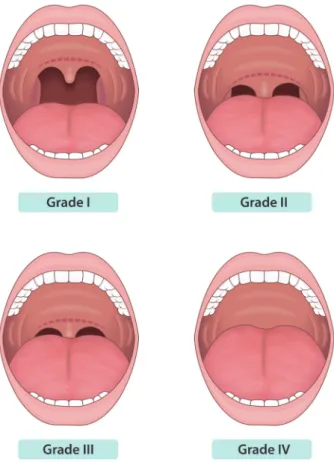
Before beginning the endoscopic sedation, it is recom- mended to predict the risk of hypoxia and difficulty of endotracheal intubation based on the patient’s Mallampati score.
Rationale: To determine cases with respiratory depression severe enough to require endotracheal intubation, the Malla- mpati score should be assessed prior to endoscopic sedation to determine the risk of hypoxia and the expected degree of difficulty when intubating the patient. The Mallampati classi- fication is as shown below (Fig. 1).6 For cases characterized as Class IV, assistance from an anesthesiologist may be required.3
3. Assessment of level of consciousness
Before starting an endoscopic sedation, the patient’s level of consciousness should be assessed.
Rationale: Endoscopic sedation involves administration of
for the procedure. Therefore, it is necessary to assess the pa- tient’s level of consciousness accurately, prior to the procedure and determine whether sedation could be performed. An ex- ample of assessment of the level of consciousness is as follows (Table 4)7:
Intra-procedure assessment: 1 item 1. EcG monitoring
ECG monitoring during endoscopic sedation is recom- mended in patients with serious cardiovascular disease or arrhythmia.
Rationale: When performing moderate or deep sedation on patients with serious cardiovascular disease or arrhythmia, continuous ECG monitoring is recommended. It may also be helpful in cases involving elderly patients or patients with respiratory disease, and when the procedure is expected to prolong.
post-procedure assessment: 1 item 1. EcG monitoring
ECG monitoring after endoscopic sedation is recom- mended in patients with serious cardiovascular disease or for those who showed unstable vital signs during the proce- dure.
Rationale: ECG monitoring should be performed on pa- tients with serious cardiovascular disease or arrhythmia or in cases for which it is recommended. It may also be helpful in cases involving elderly patients or patients with respiratory disease, when bradycardia or arrhythmia occurs during the
Fig. 1. The Mallampati classification. Grade I: soft palate, fauces, uvula, pil- lars are visible. Grade II: soft palate, fauces, portion of uvula are visible. Grade III: soft palate, base of uvula are visible. Grade IV: only hard palate is visible (Modified from Mallampati et al.6).
Table 4. Modified Observer’s Assessment of Alertness and Sedation (MOAA/
S) Scale
description Score
Responds readily to name spoken in normal tone 5 Lethargic or slow response to name spoken in normal
tone 4
Responds only after name is called loudly and/or
repeatedly 3
Responds only after mild prodding or shaking 2 Responds only after painful trapezius squeeze 1 No response after painful trapezium squeeze 0 Modified from Chernik et al.7
Lee JK et al. Quality Control of Endoscopic Sedation
procedure, and when the patient shows unstable vital signs during the procedure.
conclUSIonS
When performing endoscopic sedation, practitioners should do their best to maximize the benefits while minimiz- ing the risks. Principles regarding the personnel, facility and equipment, as well as performance itself, should be followed to prevent unfavorable incidents.
Conflicts of Interest
The authors have no financial conflicts of interest.
ORCID
Yoo Jin Lee: https://orcid.org/0000-0003-1799-0146 Jun Hyung Cho: https://orcid.org/0000-0003-2075-2333 Jong Pil Im: https://orcid.org/0000-0003-1584-0160 Chang-Hwan Park: https://orcid.org/0000-0002-2995-8779 Jae-Young Jang: https://orcid.org/0000-0002-7930-1468 Byung Ik Jang: https://orcid.org/0000-0002-3037-9272
rEFErEncES
1. American Society of Anesthesiologists Task Force on Sedation and An- algesia by Non-Anesthesiologists. Practice guidelines for sedation and analgesia by non-anesthesiologists. Anesthesiology 2002;96:1004-1017.
2. Cohen LB, Delegge MH, Aisenberg J, et al. AGA Institute review of en- doscopic sedation. Gastroenterology 2007;133:675-701.
3. ASGE Standards of Practice Committee, Early DS, Lightdale JR, et al.
Guidelines for sedation and anesthesia in GI endoscopy. Gastrointest Endosc 2018;87:327-337.
4. Aldrete JA, Kroulik D. A postanesthetic recovery score. Anesth Analg 1970;49:924-934.
5. Mulder CJ, Jacobs MA, Leicester RJ, et al. Guidelines for designing a digestive disease endoscopy unit: report of the World Endoscopy Orga- nization. Dig Endosc 2013;25:365-375.
6. Mallampati SR, Gatt SP, Gugino LD, et al. A clinical sign to predict difficult tracheal intubation: a prospective study. Can Anaesth Soc J 1985;32:429-434.
7. Chernik DA, Gillings D, Laine H, et al. Validity and reliability of the observer’s assessment of alertness/sedation scale: study with intravenous midazolam. J Clin Psychopharmacol 1990;10:244-251.