Korean J Intern Med 2021;36:491-514 https://doi.org/10.3904/kjim.2020.213
1Division of Medical Oncology, Department of Internal Medicine, Seoul St. Mary’s Hospital, College of Medicine, The Catholic University of Korea, Seoul; 2Division of Oncology, Department of Internal Medicine, Yonsei University College of Medicine, Seoul; 3Department of Oncology/
Hematology, Kyungpook National University Hospital, Daegu; 4Division of Hematology/Oncology, Department of Internal Medicine, Kangbuk Samsung Hospital, Sungkyunkwan University School of Medicine, Seoul; 5Division of Hematology & Medical Oncology, Department of Internal Medicine, Dongguk University Ilsan Hospital, Goyang; 6Division of Hematology-Oncology, Department of Internal Medicine, Seoul National University Hospital, Seoul; 7Division of Hemato-Oncology, Keimyung University Dongsan Hospital, Daegu; 8Division of Hematology & Oncology, Department of Internal Medicine, Soonchunhyang University Bucheon Hospital, Bucheon; 9Division of Hematology/Oncology, Department of Internal Medicine, Chung-Ang University College of Medicine, Seoul; 10Division of Medical Oncology-Hematology, Department of Internal Medicine, Kyung Hee University Hospital, Seoul; 11Medical Oncology and Hematology, Department of Internal Medicine, Pusan National University Yangsan Hospital, Yangsan; 12Division of Medical Oncology, Department of Internal Medicine, Gachon University Gil Medical Center, Incheon; 13Department of Hemato-Oncology, Chonnam National University Hwasun Hospital, Hwasun; 14Department of Internal Medicine, Inje University Sanggye Paik Hospital, Seoul; 15Division of Hematology & Oncology, Department of Internal Medicine, Soonchunhyang University Seoul Hospital, Seoul; 16Department of Oncology and Internal Medicine, Asan Medical Center, University of Ulsan College of Medicine, Seoul;
17Division of Medical Oncology, Department of Internal Medicine, Daegu Fatima Hospital, Daegu; 18Department of Oncology, Yonsei University Wonju College of Medicine, Wonju; 19Department of Hematology/Oncology, Inha University School of Medicine, Incheon; 20Division of Medical Oncology, International St. Mary’s Hospital, Catholic Kwandong University College of Medicine, Incheon; 21Division of Hemato-Oncology, Hallym University Dongtan Sacred Heart Hospital, Hwaseong; 22Division of Hematology-Oncology, Department of Medicine, Korea University Anam Hospital, Seoul; 23Department of Radiation Oncology, Asan Medical Center, University of Ulsan College of Medicine, Seoul; 24Department of Radiation Oncology, Yonsei Cancer Center, Yonsei University College of Medicine, Seoul; 25Center for Urologic Cancer, National Cancer Center, Goyang; 26Division of Hematology-Oncology, Department of Medicine, Samsung Medical Center, Sungkyunkwan University School of Medicine, Seoul; 27Department of Internal Medicine, Chungnam National University College of Medicine, Daejeon, Korea
In 2017, Korean Society of Medical Oncology (KSMO) published the Korean man- agement guideline of metastatic prostate cancer. This paper is the 2nd edition of the Korean management guideline of metastatic prostate cancer. We updated recent many changes of management in metastatic prostate cancer in this 2nd edition guideline. The present guideline consists of the three categories: man- agement of metastatic hormone sensitive prostate cancer; management of meta- static castration resistant prostate cancer; and clinical consideration for treating patients with metastatic prostate cancer. In category 1 and 2, levels of evidence (LEs) have been mentioned according to the general principles of evidence-based medicine. And grades of recommendation (GR) was taken into account the qual- ity of evidence, the balance between desirable and undesirable effects, the values and preferences, and the use of resources and GR were divided into strong rec- ommendations (SR) and weak recommendations (WR). A total of 16 key questions are selected. And we proposed recommendations and described key evidence for each recommendation. The treatment landscape of metastatic prostate cancer is changing very rapid and many trials are ongoing. To verify the results of the fu-
2020 Korean guidelines for the management of metastatic prostate cancer
In-Ho Kim1,*, Sang Joon Shin2,*, Byung Woog Kang3, Jihoon Kang4, Dalyong Kim5, Miso Kim6, Jin Young Kim7, Chan Kyu Kim8, Hee-Jun Kim9, Chi Hoon Maeng10, Kwonoh Park11, Inkeun Park12, Woo Kyun Bae13, Byeong Seok Sohn14, Min-Young Lee15, Jae Lyun Lee16, Junglim Lee17, Seung Taek Lim18, Joo Han Lim19, Hyun Chang20, Joo Young Jung21, Yoon Ji Choi22, Young Seok Kim23, Jaeho Cho24,
Jae Young Joung25, Se Hoon Park26, and Hyo Jin Lee27
Received : October 2, 2020 Accepted : November 2, 2020 Correspondence to
Hyo Jin Lee, M.D.
Department of Internal Medi- cine, Chungnam National Uni- versity College of Medicine, 282 Munhwa-ro, Jung-gu, Daejeon 35015, Korea
Tel: +82-42-280-8369 Fax: +82-42-257-5753 E-mail: [email protected] https://orcid.org/0000-0001- 8378-3001
*These authors contributed equally to this work.
INTRODUCTION
In 2017, the Korean Society of Medical Oncology (KSMO) published the Korean management guidelines for met- astatic prostate cancer. Here, we present the second edition of the Korean management guidelines for met- astatic prostate cancer, in which we have incorporated recent changes in metastatic prostate cancer manage- ment. The questions addressed in this second edition of management guidelines can be classified into three categories: (1) management of metastatic hormone-sen- sitive prostate cancer (mHSPC); (2) management of met- astatic castration-resistant prostate cancer (CRPC); and (3) clinical considerations for the treatment of patients with metastatic prostate cancer. We addressed key ques- tions in each category and proposed evidence-based rec-
ommendations. For categories 1 and 2, levels of evidence (LEs) have been described according to the general prin- ciples of evidence-based medicine (Table 1) [1]. Grades of recommendation (GR) were taken into account to deter- mine (1) quality of evidence; (2) balance between desir- able and undesirable effects; (3) values and preferences;
and (4) use of resources. GR were defined as strong rec- ommendations or weak recommendations [2].
MANAGEMENT OF METASTATIC HOR- MONE-SENSITIVE PROSTATE CANCER
Key question 1-1: What is the significance of andro- gen deprivation therapy?
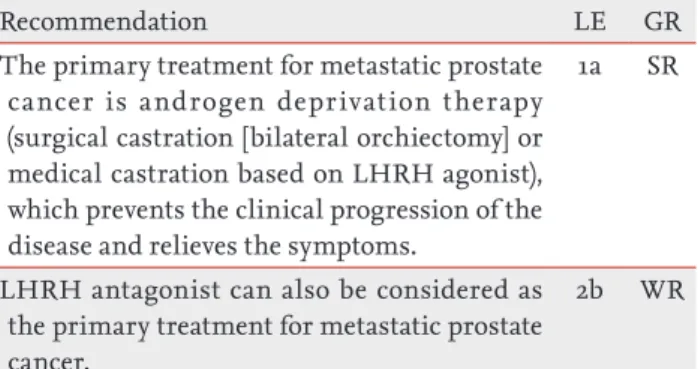
Recommendation LE GR
The primary treatment for metastatic prostate cancer is androgen deprivation therapy (surgical castration [bilateral orchiectomy] or medical castration based on LHRH agonist), which prevents the clinical progression of the disease and relieves the symptoms.
1a SR
LHRH antagonist can also be considered as the primary treatment for metastatic prostate cancer.
2b WR
The growth of mHSPC relies on the androgen recep- tor (AR) and the androgen signaling pathway; hence, androgen deprivation therapy (ADT) is used to treat patients with mHSPC [3-6]. In patients with metastatic prostate cancer, ADT typically involves surgical castra- tion (bilateral orchiectomy) or medical castration with luteinizing hormone-releasing hormone (LHRH) ago- nists and antagonists. There is no high-level evidence supporting the use of LHRH agonists or orchiectomy [7], and LHRH agonists and antagonists provide similar efficacy [8]. Medical castration is often preferred due to cosmetic and psychological reasons, and due to the fact ture trials is necessary and should be applied to the treatment for metastatic prostate cancer patients in the clini- cal practice. Especially, many prostate cancer patients are old age, have multiple underlying medical comorbidities, clinicians should be aware of the significance of medical management as well as clinical efficacy of systemic treat- ment.
Keywords: Practice guideline; Prostate neoplasms
Table 1. Definition of levels of evidence Level of
evidence Definition
1a Systematic reviews (with homogeneity) of randomized controlled trials
1b Individual randomized controlled trials (with narrow confidence interval)
1c All or none randomized controlled trials 2a Systematic reviews (with homogeneity) of cohort
studies
2b Individual cohort studies or low-quality randomized controlled trials
2c Outcomes research or ecological studies 3a Systematic review (with homogeneity) of case-
control studies
3b Individual case-control studies
4 Case-series (and poor-quality cohort and case- control studies)
5 Expert opinion without explicit critical appraisal or based on physiology, fundamental research, or first principles
that surgical castration is irreversible. LHRH agonists can cause testosterone flare in some patients, worsening early clinical symptoms. In patients receiving LHRH ag- onists, serum testosterone reach castration levels in ap- proximately 1 to 4 weeks after treatment initiation; thus, treatment with antiandrogens for at least 7 days before administrating LHRH agonists may be required to pre- vent the exacerbation of clinical symptoms. In contrast to LHRH agonists, LHRH antagonists do not cause a testosterone flare and reach castration levels within 3 days of injection [9].
Key question 1-2: What is the clinical significance of docetaxel in mHSPC?
Recommendation LE GR
Docetaxel should be considered in patients with high volume disease who are fit for chemotherapy.
1a SR
Docetaxel can be considered in patients with low volume disease who are fit for chemotherapy.
1a WR
The GETUG-AFU15 [10], CHAARTED [11], and STAM- PEDE [12] studies evaluated the clinical significance of docetaxel in mHSPC patients. GETUG-AFU15 was a 1:1 randomized phase 3 study that compared the ADT plus docetaxel with ADT alone, and the primary end- point was overall survival (OS). Docetaxel (75 mg/m2, ev- ery 3 weeks) was administered for up to nine cycles [10].
The results revealed that ADT plus docetaxel provided longer progression-free survival (PFS) than ADT alone (median, 23.5 months vs. 15.4 months; hazard ratio [HR], 0.75; 95% confidence interval [CI], 0.59 to 0.94; p = 0.015), but did not improve OS (median, 58.9 months vs. 54.2 months; HR, 1.01; 95% CI, 0.75 to 1.36; p = 0.955).
The CHAARTED, a 1:1 randomized phase 3 study of 790 patients with mHSPC, compared the ADT plus docetaxel with ADT alone, and the primary endpoint was OS [11]. Unlike GETUG-AFU15, the results of CHAART- ED revealed that ADT plus docetaxel provided a longer OS than ADT alone (median, 57.6 months vs. 44.0 months;
HR, 0.61; p < 0.001). Additionally, ADT plus docetaxel im- proved most secondary endpoints, including the time to clinical progression and the time to CRPC. Subgroup analysis revealed that the clinical benefit of combination
therapy was more apparent in patients with high-volume disease (HVD; defined as the presence of visceral metas- tases or ≥ 4 bone lesions with ≥ 1 beyond the vertebral bodies and pelvis) than in the overall study population;
in this subgroup, ADT plus docetaxel provided a sig- nificantly longer OS than ADT alone (median OS, 49.2 months vs. 32.2 months; HR, 0.60; 95% CI, 0.45 to 0.81; p
< 0.001). Severe docetaxel-related adverse events (grade 3 or higher) were observed in 16.7% of patients. Allergic re- action, fatigue, diarrhea, stomatitis, and peripheral neu- ropathy were the most common side effects, and only one treatment-related death was reported. A recent long-term follow-up study of the CHAARTED cohort confirmed the clinical benefits of docetaxel in patients with mHSPC [13].
STAMPEDE was a randomized, multi-arm, controlled trial investigating the clinical efficacy of different first- line treatments in men undergoing long-term hor- mone therapy as the standard of care (SOC) for newly diagnosed locally advanced, metastatic, or recurring prostate cancer. The survival outcomes in patients re- ceiving first-line docetaxel, zoledronic acid, or both in combination with hormone therapy were reported in 2016 [12]. The median OS was 71 months for SOC-only, 81 months for SOC + docetaxel (HR, 0.78; 95% CI, 0.66 to 0.93; p = 0.006), and 76 months for SOC + zoledronic acid + docetaxel (HR, 0.82; 95% CI, 0.69 to 0.97; p = 0.022).
Long-term follow-up of the STAMPEDE cohort demon- strated that ADT plus docetaxel significantly prolonged OS, PFS, and failure-free survival (FFS), regardless of the disease volume (high or low volume disease) [14].
However, the volume of metastasis and other baseline characteristics differed significantly among the patients of these studies. Furthermore, the rate of docetaxel-re- lated deaths was lower in the CHAARTED study than in the GETUG-AFU 15 study (1% vs. 7%). The frequency of exposure to other treatments (abiraterone, enzalut- amide, and cabazitaxel) also differed across these stud- ies. Additionally, most (about 80%) of ADT alone group in GETUG-AFU15 study received docetaxel after disease progression, which indicating that GETUG-AFU15 trial was more a trial of early versus delayed docetaxel [15].
Two meta-analysis studies confirmed that the combi- nation of docetaxel with ADT improved OS in patients with mHSPC [16,17]. Therefore, docetaxel administra- tion should be considered in patients who are suitable for chemotherapy, especially in patients with HVD.
Key question 1-3: What is the clinical significance of the androgen receptor-targeted agents?
Recommendation LE GR
Abiraterone/prednisone, apalutamide or enzalutamide (alphabetical) should be considered as standard primary therapy in mHSPC.
1b SR
The combination of docetaxel with ADT is widely ac- cepted as the SOC for mHSPC [11,12]. However, because many prostate cancer patients are elderly and have multiple underlying comorbidities, and are not fit for docetaxel, other treatment option is needed in these patients. To address the need for further treatment op- tions in mHSPC, studies have investigated the clinical usefulness of androgen receptor-targeted agents (ARTA) in mHSPC patients. Abiraterone acetate is a selective inhibitor of androgen biosynthesis that potently blocks cytochrome P450 c17 (CYP17), a critical enzyme in testos- terone synthesis, thereby blocking androgen synthesis by the adrenal glands and testes and within the pros- tate tumor [18]. Enzalutamide [19] and apalutamide [20]
are selective antagonists of the androgen receptor (AR) which inhibits AR translocation to the cell nucleus, re- cruitment of AR cofactors and AR binding to DNA.
LATITUDE was a multinational, 1:1 randomized, dou- ble-blind, placebo-controlled, phase III trial evaluating the efficacy of abiraterone/prednisone combined with ADT in men with newly diagnosed high-risk mHSPC.
The primary endpoints were OS and radiographic pro- gression-free survival (rPFS). High-risk disease was de- fined as tumors with at least two of the following charac- teristics: (1) Gleason score of 8 or higher; (2) at least three bone lesions; and (3) presence of measurable visceral me- tastasis [21]. Patients in the abiraterone group exhibited better OS (median OS, not reached [NR] vs. 34.7 months) and rPFS (median rPFS, 33.0 months vs. 14.8 months) than those in the placebo group (OS [HR, 0.62; 95% CI, 0.51 to 0.76; p < 0.001], rPFS [HR, 0.47; 95% CI, 0.39 to 0.55;
p < 0.001]). The superiority of abiraterone over placebo was also obvious for all secondary endpoints (time to pain progression, time to prostate-specific antigen [PSA]
progression, time to next symptomatic skeletal event, time to chemotherapy, time to subsequent prostate cancer therapy). The long-term clinical benefits of abi-
raterone combined with ADT in patients with mHSPC have recently been reported [22].
A similar survival benefit of abiraterone/prednisone in mHSPC was demonstrated in STAMPEDE [23]. This study was a 1:1 random assignment study of 1917 HSPC patients comparing the combination of ADT and abi- raterone/prednisone and ADT alone, about 50% of which were metastatic disease. Abiraterone significantly improved OS (HR, 0.63; 95% CI, 0.52 to 0.76; p < 0.001) and FFS (HR, 0.29; 95% CI, 0.25 to 0.34; p < 0.001). The benefit of abiraterone for OS was demonstrated in pre- planned subgroup analysis of 1002 patients with meta- static disease at entry (HR, 0.61; 95% CI, 0.49 to 0.75). A recent post hoc analysis of the STAMPEDE study was per- formed to evaluate the heterogeneity of effect between LATITUDE high- and low-risk “metastatic” prostate cancer patients receiving ADT with abiraterone/pred- nisone in the STAMPEDE study [24]. The combination of ADT with abiraterone/prednisone provided a signifi- cantly better OS than ADT alone. Heterogeneity of effect was not seen between low- and high-risk groups for OS or FFS.
The multinational, 1:1 randomized, open-label, phase III trial ENZAMET compared the efficacy of early en- zalutamide and standard nonsteroidal antiandrogens (SOC group: bicalutamide, nilutamide, or flutamide) in 1,125 patients with mHSPC [25]; the primary study end- point was OS. At the first interim analysis, there were 102 deaths in the enzalutamide group and 143 deaths in the SOC group (HR, 0.67; 95% CI, 0.52 to 0.86; p = 0.002). Enzalutamide group exhibited superior OS than SOC group (3-year OS rates, 80% vs. 72%). Additional- ly, enzalutamide significantly improved key secondary endpoints, including PSA-PFS (HR, 0.39; p < 0.001) and clinical PFS (HR, 0.40; p < 0.001).
The multinational, 1:1 randomized, double-blind, pla- cebo-controlled, phase III trial ARCHES compared the efficacy of enzalutamide combined with ADT to that of ADT plus placebo in 1,150 patients with mHSPC; the primary study endpoint was rPFS [26]. Compared with placebo plus ADT, enzalutamide plus ADT significant- ly reduced the risk of radiographic progression by 61%
(HR, 0.39; 95% CI, 0.30 to 0.50; p < 0.001). Median rPFS was NR in the enzalutamide group (95% CI, NR to NR) versus 19.0 months (95% CI, 16.6 to 22.2) with placebo.
The superiority of enzalutamide combination treatment
was also apparent for key secondary endpoints, includ- ing the time to PSA progression, the time to initiation of new antineoplastic therapy, PSA undetectable rate, and objective response rate.
TITAN, a multinational, 1:1 randomized, double-blind, placebo-controlled, phase III trial, evaluated the effects of combination therapy with apalutamide and ADT on rPFS and OS in 1,052 patients with mHSPC [27]. The 2-year rPFS rates were 68.2% in the apalutamide group and 47.5% in the placebo group (HR, 0.48; 95% CI, 0.39 to 0.60; p < 0.001). The 2-year OS rates were 82.4% in the apalutamide group and 73.5% in the placebo (OS: HR, 0.67; 95% CI, 0.51 to 0.89; p = 0.005).
The ENZAMET, ARCHES, and TITAN studies per- mitted early docetaxel or included patients who had been treated with early docetaxel. In the ENZAMET study, the early administration of docetaxel (75 mg/m2, every 3 weeks, up to six cycles) was permitted as a strat- ification factor before randomization. Subgroup analy- sis revealed a smaller OS benefit of enzalutamide in the early docetaxel group (HR, 0.90; 95% CI, 0.62 to 1.31). In contrast, the OS benefit of enzalutamide was apparent in patients without planned early docetaxel use (HR, 0.53;
95% CI, 0.37 to 0.75). In the TITAN and ARCHES studies, before randomization, patients were stratified based on previous early docetaxel use. rPFS improvement after treatment with enzalutamide or apalutamide was ob- served in patients with or without previous docetaxel use. However, subgroup analysis of the TITAN cohort failed to confirm the benefit of apalutamide on OS (HR, 1.27; 95% CI, 0.52 to 3.09) in patients who previously re- ceived early docetaxel. The effects of enzalutamide on OS based on previous docetaxel exposure were not re- ported in the ARCHES study. Currently, the clinical ef- ficacy of ARTA in patients with mHSPC previously or concomitantly treated with docetaxel is unclear.
Key question 1-4: What should be considered in determining the treatment of mHSPC?
Recommendation LE GR
Immediate ADT should be performed to prevent disease progression, symptoms and complications.
1b SR
Deferred ADT may be considered in patients with well-informed asymptomatic patients if the risk of treatment related side effects is greater than treatment benefits.
2b WR
Abiraterone/prednisone, apalutamide, docetaxel, or enzalutamide (alphabetical) should be considered as standard primary therapy and clinician's judgement is important in treatment choice.
1b SR
Determination to start systemic treatment for mHSPC ADT should be implemented immediately for symp- tomatic patients. However, the benefit of asymptom- atic patients from ADT remains controversial due to thelack of evidence from well-designed studies which were conducted in the era of clinical use of PSA and in- cluded heterogeneous patients group [28-30]. However, considering the poor prognosis of metastatic disease, immediate ADT should be considered in metastatic patients, even if they are asymptomatic. Deferred ADT may be considered for asymptomatic patients if the risk of treatment-related side effects is greater than the treat- ment benefits.
Clinical consideration for determining treatment strategy Careful consideration is required when deciding a treat- ment strategy. To date, no large-cohort studies have compared the clinical efficacy of cytotoxic chemother- apy (docetaxel) and ARTA in patients with mHSPC. Ta- ble 2 summarizes the main characteristics of different agents and results of key phase III clinical trials in pa- tients with mHSPC.
MANAGEMENT OF METASTATIC CASTRA- TION-RESISTANT PROSTATE CANCER
Key question 2-1: What should be considered with diagnosis of castration resistance?
Recommendation LE GR
Castration resistant prostate cancer is defined as following.
5 SR
Serum testosterone < 50 ng/dL or 1.7 nmol/L plus either:
1. Three consecutive rises in PSA at least 1 week apart over the nadir, and a PSA > 2 ng/mL
2. Appearance of 2 or more new lesions in bone scan or progressive disease using RECIST version 1.1
CRPC is defined as disease progression despite effective suppression of serum testosterone. The castration level of serum testosterone is defined as less than 50 ng/dL or 1.7 nmol/L. CRPC is defined as castration level of serum testosterone plus one of the followings: (1) three consec- utive rises (over the nadir) in PSA levels at least 1 week apart, and a PSA > 2 ng/mL (biochemical progression);
(2) development of two or more new lesions in bones or progressive disease according to Response Evaluation Criteria in Solid Tumors (RECIST) version 1.1 [4,5,31-33]
criteria (radiographic progression). In addition, EAU guideline mentions PSA rise resulting two 50% increas- es over the nadir for biochemical progression. If bone lesions are the only indicator of disease progression, at least two new lesions should appear in the bone scan for a CRPC diagnosis; ambiguous results should be con- Table 2. Results of four major phase III clinical studies on metastatic hormone-sensitive prostate cancer
LATITUDE (n = 1,199) [21]
TITAN (n = 1,052) [27]
CHAARTED (n = 790) [11]
ENZAMET (n = 1,125) [25]
Agent Abiraterone Apalutamide Docetaxel Enzalutamide
Control Placebo Placebo Placebo Nonsteroidal
antiandrogen Primary endpoint, HR
(95% CI)
OS: 0.62 (0.51–0.76) rPFS: 0.47 (0.39–0.55)
OS: 0.67 (0.51–0.89) rPFS: 0.48 (0.39–0.60)
OS: 0.72 (0.59–0.89) OS: 0.67 (0.52–0.86)
Duration, mo Median OS: NR vs. 34.7 Median rPFS: 33.0 vs.
14.8
Median OS: NR vs. NR Median rPFS: NR vs.
22.1
Median OS: 57.6 vs. 47.2 Median OS: NR vs. NR
Prior ADT, mo Up to 3 Up to 6 Up to 4 Up to 3
Prior/concurrent docetaxel
Exclusion Prior docetaxel (10%) Exclusion Concurrent docetaxel
(45%)
De novo M1, % 100 80 73 60
Visceral metastases, % 5 12 15 12
AE of interesta Elevated liver enzymes, electrolyte imbalance, hypertension
Rash, seizures, hypothyroidism
Neutropenia,
peripheral neuropathy
Seizures, falls
Corticosteroid Yes No No No
Population 100% high riskb All 65% High volumesc All
HR, hazard ratio; CI, confidence interval; OS, overall survival; rPFS, radiographic progression-free survival; NR, not reached;
ADT, androgen deprivation therapy; AE, adverse event.
a AE of interest: These are AEs of special interest, not most common AEs.
b High risk: At least 2 of 3 high risk criteria (Gleason score of ≥ 8, presence of ≥ 3 lesions on bone scan, presence of measurable visceral lesion).
c High volumes: Visceral metastases (extra-nodal) and/or bone metastases (at least 4 or more bone lesions, one of which must be outside of the vertebral column or pelvis).
firmed by other imaging modalities. For patients who develop CRPC, ADT with an LHRH agonist or antago- nist should be continued to maintain castration level of serum testosterone. For patients treated with combined androgen blockade, antiandrogens could be discontin- ued to exclude an antiandrogen withdrawal response.
Antiandrogen withdrawal response is characterized by PSA reduction, occasionally accompanied by a radio- graphic response, and typically occurs 4 to 6 weeks after the discontinuation of first-generation antiandrogen therapy [34]. However, if the disease progression is ob- vious or suspected of rapid progression, this approach is not appropriate and should be changed to subsequent treatment.
Key question 2-2: What is the clinical significance of androgen receptor-targeted agents?
Recommendation LE GR
Abiraterone/prednisone and enzalutamide (alphabetical) are important treatment options not only for patients who have progressed after docetaxel, but also for patients who have not previously received docetaxel.
1b SR
Two phase III trials were conducted to evaluate the clinical efficacy of abiraterone and enzalutamide in patients with metastatic CRPC (mCRPC) who had not been previously treated with chemotherapy. The mul- tinational, 1:1 randomized, double-blind, placebo-con- trolled, phase III trial COU-AA-302 compared the effects of abiraterone plus prednisone to those of placebo plus prednisone in 1,088 chemotherapy-naïve patients with progressive mCRPC (but no visceral metastasis) who had asymptomatic or mildly symptomatic disease; the pri- mary endpoints were rPFS and OS [35]. No symptoms or mild symptoms were defined as follows: (1) Eastern Cooperative Oncology Group (ECOG) performance status grade of 0–1; or (2) Brief Pain Inventory–Short Form (BPI-SF) scores from 0–3. The median rPFS was 16.5 months in the abiraterone group and 8.3 months in the placebo group (HR, 0.53; 95% CI, 0.45 to 0.62; p <
0.001). Median OS was NR in the abiraterone group and was 27.2 months in the placebo group (HR, 0.75; 95% CI, 0.61 to 0.93; p = 0.01). Notably, abiraterone consistently improved rPFS and OS in all prespecified subgroups. A
preplanned interim analysis of COU-AA-302 evaluating patient-reported pain and functional status revealed that abiraterone treatment delayed the progression of patient-reported pain and deterioration of the quality of life [36].
The multinational, 1:1 randomized, double-blind, pla- cebo-controlled, phase III trial PREVAIL compared the clinical efficacy of enzalutamide to that of placebo in 1717 chemotherapy-naïve patients with progressive mCRPC and who had asymptomatic or mildly symptomatic disease; the primary endpoints of the study were rPFS and OS [37]. In contrast to COU-AA-302, PREVAIL in- cluded patients with visceral metastasis. No symptoms or mild symptoms were defined with the same criteria as the COU-AA-302 study (ECOG 0–1, BPI-SF score 0–3).
The median rPFS (NR vs. 3.9 months) and median OS (32.4 months vs. 30.2 months) were longer in enzalut- amide-treated patients than in patients treated with pla- cebo (rPFS [HR, 0.19; 95% CI, 0.15 to 0.23; p < 0.001], OS [HR, 0.71; 95% CI, 0.60 to 0.84; p < 0.001]). The treatment effect of enzalutamide on rPFS and OS was consistent across all prespecified subgroups.
Two phase III trials were conducted to evaluate the clin- ical efficacy of abiraterone and enzalutamide in mCRPC patients who had previously undergone chemothera- py. The multinational, 2:1 randomized, double-blind, placebo-controlled, phase III trial COU-AA-301 evalu- ated the effects of abiraterone plus prednisone in 1,195 patients with progressive mCRPC who had previously been treated with chemotherapy [38]. The primary end- point was OS. The median OS was 14.8 months in the abiraterone plus prednisone group and 10.9 months in the prednisone alone group (HR, 0.74; 95% CI 0.64 to 0.86; p < 0.001). Importantly, abiraterone consistently improved OS in all subgroups. Additionally, abiraterone improved all secondary endpoints analyzed, including the confirmed PSA response rate, the objective response rate in patients with measurable disease at baseline, the time to PSA progression, and rPFS. The long-term clin- ical benefits of abiraterone were recently confirmed in a longer follow-up study [39].
AFFIRM was a multinational, 2:1 randomized, dou- ble-blind, placebo-controlled, phase III trial evaluating the effect of enzalutamide in 1,199 patients with pro- gressive mCRPC who had previously undergone chemo- therapy [40]. The primary endpoint was OS. The median
OS was 18.4 months in the enzalutamide group and 13.6 months in the placebo group (HR, 0.63; 95% CI, 0.53 to 0.75; p < 0.001). The OS benefit of enzalutamide was con- sistent across all subgroups. The superiority of enzalut- amide over placebo was consistent across all secondary endpoints, including PSA response rate, soft tissue re- sponse rate, health-related quality of life, time to PSA progression, rPFS, and time to the first skeletal-related event.
The adverse events of abiraterone and enzalutamide have also been investigated. In COU-AA-301 trial, ad- verse events associated with CYP17 inhibition and ele- vated mineralocorticoid levels (fluid retention, edema, hypokalemia, and hypertension), cardiac disorders, and liver function abnormalities were more common in the abiraterone acetate group than in the placebo group (55% vs. 43%, p < 0.001). Meanwhile, a higher incidence of any grade fatigue, diarrhea, hot flashes, musculoskel- etal pain, and headache was observed in the enzalut- amide group than in the placebo group. Notably, the AFFIRM study revealed that five of 800 patients (0.6%) receiving enzalutamide experienced seizures; some of these patients had predisposing conditions or received concomitant treatments. Thus, caution should be used with patients with a history of seizures, patients receiv- ing concomitant medication that may lower the seizure threshold, and those who have other predisposing fac- tors, including brain injury, stroke, brain metastases, or alcoholism. Additionally, an increased risk of falls was observed in older patients treated with enzalutamide [41].
Treatment with abiraterone plus prednisone, and enzalutamide should be considered for chemothera- py-naïve patients and those with progressive disease after treatment with docetaxel. To date, no studies have di- rectly compared the safety and efficacy of enzalutamide and abiraterone plus prednisone. The differences in their mechanisms of action may result in differences in their toxicity profiles, and clinicians should carefully consider the patient’s underlying diseases and clinical conditions.
Key question 2-3: What is the clinical significance of cytotoxic chemotherapy?
Recommendation LE GR
Docetaxel with prednisone is a standard therapy for first line cytotoxic chemotherapy in patients with mCRPC
1b SR
Cabazitaxel with prednisone is one of the standard therapies in patients with mCRPC who have previously received docetaxel.
1b SR
The multinational, 1:1:1 randomized, non-blinded, phase III trial TAX327 compared the effects of docetaxel (given either every 3 weeks or weekly) plus prednisone with that of mitoxantrone plus prednisone in 1,006 patients with mCRPC. Patients received 5 mg of prednisone twice dai- ly and were randomly assigned to receive 75 mg/m2 of docetaxel every 3 weeks, 30 mg/m2 of docetaxel weekly for 5 of every 6 weeks, or 12 mg/m2 of mitoxantrone every 3 weeks. OS was the primary endpoint of the study [42].
Patients in the 3-week docetaxel group (median OS, 18.9 months) but not those in the 1-week docetaxel group (median OS, 17.4 months) had a longer OS than patients in the mitoxantrone group (median OS, 16.5 months).
There were 166 (50%) deaths (HR, 0.76; 95% CI, 0.62 to 0.94; p = 0.009) in the 3-week docetaxel group, 190 (57%) deaths (HR, 0.91; 95% CI, 0.75 to 1.11; p = 00.36) in the weekly docetaxel group, and 201 (60%) deaths in the mi- toxantrone group. Hair loss (62%), fatigue (53%), diarrhea (32%), and grade 3 or 4 neutropenia (32%) were observed in patients treated with docetaxel every 3 weeks. A lon- ger follow-up study of the TAX327 cohort confirmed the superiority of docetaxel plus prednisone (every 3 weeks) over mitoxantrone plus prednisone in terms of mCRPC patient survival [43].
Although the TAX327 study demonstrated the clin- ical efficacy of 75 mg/m2 docetaxel every 3 weeks, con- cerns remain regarding the relatively high toxicity rates. PROSTY was a multinational, 1:1 randomized, non-blinded, phase III trial comparing the effects of 75 mg/m2 of 3-weekly docetaxel plus prednisone with those of 50 mg/m2 2-weekly docetaxel plus prednisone in 361 patients with mCRPC; the primary endpoint of the study was time to treatment failure (TTTF) [44]. The me- dian TTTF and OS were longer in the 2-weekly group than in the 3-weekly group (median TTTF, 5.6 months vs. 4.9 months; HR, 1.3; 95% CI, 1.1 to 1.6; p = 0.014) (OS,
19.5 months vs. 17.0 months; HR, 1.5; 95% CI, 1.1 to 1.8; p
= 0.021). Severe adverse events were more frequent in the 3-weekly docetaxel group than in the 2-weekly docetaxel group (neutropenia [HR, 2.3, 95% CI, 1.2 to 4.2; p = 0.007], leucopenia [HR, 2.8; 95% CI, 1.0 to 7.6; p = 0.046], infec- tions with neutropenia [HR, 4.1; 95% CI, 1.1 to 15.4; p = 0.034]). The findings of this study suggest that 2-weekly docetaxel could be a safe option for patients who are not suitable for a 3-weekly regimen. The COU-AA-302 [35]
and PREVAIL [37] studies confirmed the clinical bene- fit of abiraterone plus prednisone and enzalutamide in docetaxel-naïve patients. However, these studies were conducted in asymptomatic or minimally symptomat- ic patients. Therefore, docetaxel remains a important treatment option for patients requiring symptom man- agement and those with visceral metastasis.
Cabazitaxel is an important treatment option for mCRPC patients previously treated with docetaxel.
TROPIC was a multinational, 1:1 randomized, open-la- bel, phase III trial evaluating the effects of cabazitaxel plus prednisone and mitoxantrone plus prednisone in 755 patients with mCRPC who had progressed during or after treatment with a docetaxel-containing reg- imen. The primary endpoint of the study was OS [45].
The median OS was 15.1 months in patients receiving cabazitaxel plus prednisone and 12.7 months in patients receiving mitoxantrone plus prednisone (HR, 0.70; 95%
CI, 0.59 to 0.83; p < 0.001). Subgroup analyses of OS con- sistently favored cabazitaxel group. Additionally, caba- zitaxel plus prednisone improved most secondary end- points, including PFS (median PFS, 2.8 months vs. 1.4 months; HR, 0.74; p < 0.0001), tumor response rate, PSA response, and PSA-PFS. However, severe adverse events (grade 3 or higher) were more frequent in the cabazitaxel group (57.4%) than in the mitoxantrone group (39.4%).
The most common side effects of cabazitaxel were he- matological grade 3 or 4 adverse events, including neu- tropenia, leukopenia, and anemia. The most common non-hematological grade 3 or 4 adverse event was diar- rhea. Peripheral neuropathy (any grade) was observed in 14% of patients in the cabazitaxel group and in 3% of pa- tients in the mitoxantrone group. Treatment discontin- uation due to severe toxicity was required in 18% of pa- tients in the cabazitaxel group and in 4% of patients in the mitoxantrone group. Dose modifications (delay or reduction) and prophylactic treatment with granulocyte
colony-stimulating factor (G-CSF) in high-risk patients are potential strategies to mitigate the risk of toxicity.
The PROSELICA study assessed whether 20 mg/m2 cabazitaxel (C20) was noninferior, in terms of OS, to 25 mg/m2 cabazitaxel (C25) [46]. The median OS was 13.4 months in the C20 group and 14.5 months in the C25 group (HR, 1.024), suggesting that the clinical efficacy of C20 and C25 are similar in terms of OS. PSA response rates and time to PSA progression were superior in the C25 group than in the C20 group. The incidence of most severe (grade 3 or higher) adverse effects (e.g., fatigue, hematuria, neutropenia, and febrile neutropenia) was lower in patients receiving C20 (39.7%) than those re- ceiving C25 (54.5%). The results of this study suggest that cabazitaxel provides a similar clinical benefit at 20 and 25 mg/m2, while the incidence of manageable grade 3 or higher adverse events is relatively low, particularly in pa- tients receiving 20 mg/m2 cabazitaxel. Thus, 20 mg/m2 of cabazitaxel could be a feasible treatment option when a standard dose of cabazitaxel is unlikely to be tolerated.
FIRSTANA, a multinational, 1:1:1 randomized, open-la- bel, phase 3 trial designed to demonstrate whether caba- zitaxel 25 mg/m2 (C25) or 20 mg/m2 (C20) was superior to docetaxel 75 mg/m2 (D75) [47]. The median OS was 24.5 months in the C20 group, 25.2 months in the C25 group, and 24.3 months in the D75 group. No statistically significant differences were observed between the three treatment groups in terms of OS, PFS, PSA response, and pain response; therefore, the study failed to demon- strate the superiority of cabazitaxel over docetaxel as a first-line treatment. The usefulness of cabazitaxel ad- ministration before docetaxel treatment remains to be demonstrated.
With the treatment options rapidly expanding, many studies have investigated the most effective treatment sequences. The multicenter, 1:1 randomized, open-label, phase III trial CARD compared cabazitaxel with either abiraterone or enzalutamide (ARTA) in 255 patients with mCRPC who had previously received docetaxel and who had disease progression within 12 months while they had been receiving alternative ARTA. The primary end- point of the study was imaging-based progression-free survival (iPFS) [48]. The median iPFS was 8.0 months in the cabazitaxel group and 3.7 months in the ARTA group (HR, 0.54; 95% CI. 0.40 to 0.73; p < 0.001). The clinical benefit of cabazitaxel to prolong iPFS was consistent
in all prespecified subgroups. The median OS was 13.6 months in the cabazitaxel group and 11.0 months in the ARTA group (HR, 0.64; 95% CI, 0.46 to 089; p = 0.008).
The incidence of adverse events (any grade) was similar in the cabazitaxel group (38.9%) and in the ARTA group (38.7%). In this study, prophylactic treatment with G-CSF was mandatory during each cycle of cabazitaxel, and se- vere febrile neutropenia (grade 3 or higher) was observed in 3.2% of patients. Therefore, cabazitaxel should be considered in patients previously treated with docetaxel and ARTA, especially in patients whose tumors rapid- ly progressed during ARTA treatment. Primary G-CSF prophylaxis should also be considered in these patients.
Key question 2-4: What is the clinical significance of radium-223 treatment in patients with bone metas- tasis?
Recommendation LE GR
Radium-223 can be considered in CRPC patients with symptomatic bone metastases and no known visceral metastasis.
1b WR
Radium-223 dichloride (radium-223), an alpha emitter, selectively targets bone metastases with alpha particles.
The multicenter, 2:1 randomized, double-blind, place- bo-controlled, phase III trial ALSYMPCA evaluated the efficacy and safety of radium-223 in 921 CRPC patients with bone metastasis who had received, were not eligi- ble to receive, or declined docetaxel. Patients received six intravenous injections of radium-223 (50 kBq/kg) or matching placebo; one injection was administered ev- ery 4 weeks. The primary endpoint of the study was OS [49]. The median OS was 14.0 months in the radium-223 group and 11.2 months in the placebo group. Compared with placebo, radium-223 treatment was associated with a 30% reduction in the risk of death (HR, 0.70; 95% CI, 0.58 to 0.83; p < 0.001). The effect of radium-223 on OS was consistent across all subgroups. All main secondary efficacy end points including first symptomatic skele- tal event provided support for the benefit of radium-223 over placebo. The frequency of adverse events did not differ between the radium-223 and placebo groups.
The multicenter, 1:1 randomized, double-blind, pla- cebo-controlled, phase III trial ERA223 assessed the efficacy and safety of radium-223 and abiraterone plus prednisone in chemotherapy-naïve patients with as-
ymptomatic or mildly symptomatic mCRPC (bone metastases). Patients received up to six injections of radium-223 (55 kBq/kg) or placebo every 4 weeks. The primary endpoint of the study was symptomatic skele- tal event-free survival [50]. Median symptomatic skeletal event-free survival was 22.3 months in the radium-223 group and 26.0 months in the placebo group (HR, 1.122;
95% CI, 0.917 to 1.374; p = 0.263). The incidence of frac- ture was higher in the radium-223 group (29%) than in the placebo group (11%). Osteoporotic fractures were the most common fractures in the radium-223 group (49% in radium-223 vs. 17% in placebo). These findings suggest that radium-223 may increase the risk of osteo- porotic fractures. The effects of radium-223 combined with enzalutamide and bone-protecting agents, such as denosumab and zoledronic acid, are currently under clinical investigation. Based on currently available data, we do not recommend the combination of radium-223 with abiraterone plus prednisone, docetaxel, or enzalut- amide.
Key question 2-5: What is the status of precision medicine in prostate cancer?
Recommendation LE GR
In order for precision medicine to be applied to clinical practice, the evidence of accurate diagnosis and effective treatment for specific genetic alteration are required. Recently, many trials targeting BRCA and others are ongoing.
2b WR
Precision cancer treatment based on genomic tumor profiling at the point-of-care is transforming the treat- ment of several cancers, including advanced prostate cancer [51]. Recently, several studies on DNA damage re- pair (DDR) genes have been conducted in prostate can- cer. Specifically, alterations in DNA repair genes were identified in nearly 20% of all primary prostate cancer samples. Among these, BRCA1 and BRCA2 alterations were found in 1% and 3% of samples, respectively [52].
BRCA1/2 alterations have been associated with aggres- sive tumor phenotypes and poor prognosis [53]. A recent study identified genomic defects in DNA repair genes in 20% to 30% of advanced CRPC samples; BRCA2 was identified as a promising target in mCRPC, being mu- tated in 10% of mCRPC patients [54].
The multicenter, open-label, single-group, two-stage, phase II study TOPARP-A evaluated the efficacy of olaparib as salvage therapy in 50 patients with mCRPC.
The response rate was the primary endpoint of the study [55]. Of the 50 patients, 16 patients (33%) had mutations in DDR genes, including BRCA2; 14 of these 16 bio- marker-positive patients (88%) responded to olaparib, but only 6% of biomarker-negative patients exhibited a response. OS and rPFS were significantly longer in the biomarker-positive group than in the biomarker-nega- tive group (median OS: 13.8 months vs. 7.5 months, p = 0.05; median rPFS: 9.8 months vs. 2.7 months, p < 0.001).
The multicenter, open label, investigator-initiated, randomized, phase II trial TOPARP B validated the an- titumor activity of olaparib in 711 patients with mCRPC harboring DDR gene alterations. Patients with DDR gene alterations were randomly assigned (1:1) into two groups, balancing for circulating tumor cell (CTC) count at screening. Patients were administered with 400 or 300 mg olaparib twice daily, given continuously in 4-week cycles until disease progression or unacceptable toxici- ty. Composite response was the primary endpoint of the study, and was defined as any of the following: radiolog- ical objective response by RECIST 1.1; a decrease of 50%
or more in PSA levels from baseline; or conversion of CTC count from ≥ 5 cells per 7.5 mL blood at baseline to
< 5 cells [56]. In total, 161 (22.6%) patients had DDR gene alterations, 98 of whom were randomly assigned and treated. Confirmed composite response was observed in 54.3% of patients in the 400 mg group and in 39.1%
of patients in the 300 mg group. Composite response rates according to DDR gene alterations were reported as 83.3% in BRCA1/2, 36.8% in ATM, 25.0% in CDK12, and 57.1% in PALB2.
PROfound was a 2:1 randomized open-label phase III trial evaluating the efficacy and safety of olaparib (com- pared with enzalutamide or abiraterone) in patients with mCRPC with genetic alterations in any of 15 pre- defined homologous recombination repair genes; in all patients, the disease had progressed on prior enzalut- amide or abiraterone treatment [57]. Cohort A included patients with alterations in BRCA1, BRCA2, or ATM, and cohort B included patients with alterations in any of the following genes: BRIP1, BARD1, CDK12, CHEK1, CHEK2, FANCL, PALB2, PPP2R2A, RAD51B, RAD51C, RAD51D, or RAD54L. Primary endpoint was rPFS in co-
hort A. The median rPFS was 7.4 months in the olaparib group and 3.6 months in the control group (HR, 0.34;
95% CI, 0.25 to 0.47; p < 0.001). The objective response rates were 33.3% in the olaparib group and 2.3% in the control group. Therefore, PARP inhibition is a promis- ing option for the treatment of CRPC patients harbor- ing DDR gene alterations.
Recently, immune checkpoint inhibitors have shown promising antitumor effects in various cancers. Several ongoing studies are evaluating the efficacy of immu- notherapy in prostate cancer. The randomized dou- ble-blind phase III trial CA184-095 investigated the effi- cacy and safety of ipilimumab as the first-line treatment of patients with asymptomatic or minimally symptom- atic mCRPC without visceral metastases. OS was the primary endpoint of the study [58]. Median OS was 28.7 months in the ipilimumab group and 29.7 months in the placebo group. Although ipilimumab did not im- prove OS, the median PFS was longer in the ipilimum- ab group than in the placebo group (5.6 months vs. 3.8 months; HR, 0.67; 95% CI, 0.55 to 0.81).
KEYNOTE-028 was a multicenter, open-label, phase Ib trial evaluating the efficacy and safety of pembroli- zumab in patients with PD-L1-positive advanced solid tumors, including 23 patients with prostate adenocar- cinoma [59]. It revealed that the objective response rate in PD-L1-positive patients was 17.4%. KEYNOTE-199, a multicohort open-label phase II study, investigated the effects of pembrolizumab in 258 patients with mCRPC treated with docetaxel and one or more ARTA [60]. The objective response rate was 5% in the PD-L1-positive group and 3% in the PD-L1-negative group. Numerous ongoing studies are investigating the efficacy and safety of immune checkpoint inhibitors in prostate cancer.
Key question 2-6: What are the trends in the treat- ment of non-metastatic CRPC?
Recommendation LE GR
The ADT should also be maintained in patients with non-metastatic CRPC, and ARTA (apalutamide, darolutamide and enzalutamide, [alphabetically]) can be considered in patients with PSADT ≤ 10 months, and careful observation can be taken in patients with PSADT > 10 months.
1b WR
Non-metastatic castration-resistant prostate cancer (M0CRPC) is characterized by PSA progression despite primary ADT and the absence of apparent metastatic lesions in conventional imaging [61]. The findings of several studies suggest that patients with shorter PSA doubling time (PSADT) are at greater risk for developing metastasis [62,63]. In patients with PSADT of 10 months or less, treatment with apalutamide, darolutamide, and enzalutamide combined with ADT can be considered.
The international, 2:1 randomized, placebo-con- trolled, phase III trial SPARTAN evaluated the effect of apalutamide on metastasis-free survival (MFS) in 1,207 men with M0CRPC and PSADT of ≤ 10 months. The primary endpoint was MFS, defined as the time from randomization to the first detection of distant metas- tasis or death from any cause (whichever occurred first) [64]. The median MFS was 40.5 months in the apalut- amide group and 16.2 months in the placebo group (HR, 0.28; 95% CI, 0.23 to 0.35; p < 0.001). The effect of apalut- amide to prolong MFS was consistent across all prespec- ified subgroups. The following adverse events occurred more frequently in the apalutamide group than in the placebo group: fatigue (30.4% vs. 21.1%), rash (23.8% vs.
5.5%), falls (15.6% vs. 9.0%), fracture (11.7% vs. 6.5%), and hypothyroidism (8.1% vs. 2.0%).
PROSPER, an international, 2:1 randomized, pla- cebo-controlled, phase III trial, evaluated the effect of enzalutamide on MFS in 1,401 men with M0CRPC and PSADT ≤ 10 months. The primary endpoint of the study was MFS [65]. The median MFS was 36.6 months in the enzalutamide group and 14.7 months in the placebo group (HR, 0.29; 95% CI, 0.24 to 0.35; p < 0.001). The clini- cal benefit of enzalutamide was consistent across all pre- specified subgroups. The most common adverse event in patients receiving enzalutamide was fatigue. Adverse events of special interest that occurred more frequent- ly (by ≥ 2 percentage points) in the enzalutamide group than the placebo group, were hypertension (12% vs. 5%), major adverse cardiovascular events (5% vs. 3%), and mental impairment disorders (5% vs. 2%).
The international, 2:1 randomized, placebo-controlled, phase III trial ARAMIS investigated the effect of darolut- amide on MFS in 1,509 patients with M0CRPC and PSADT of ≤ 10 months. The primary endpoint of the study was MFS [66]. The median MFS was 40.4 months in the darolutamide group and 18.4 months in the pla-
cebo group (HR, 0.41; 95% CI, 0.34 to 0.50; p < 0.001). All prespecified subgroups benefited from darolutamide treatment. The incidence of adverse events was generally similar in the darolutamide and placebo groups. Key ad- verse events that are known to be associated with ARTAs including fracture, falls, seizures, and weight loss were not different between darolutamide and placebo.
Meanwhile , for patients with PSADT of > 10 months, patients can be closely monitored for disease progres- sion and development of clinical symptoms [63].
Key question 2-7: What should be considered in determining treatment in mCRPC?
Recommendation LE GR
The decision of treatment should be determined comprehensively considering their previous treatment history, performance status, presence of visceral metastasis, and presence of symptoms.
1a SR
In patients without previous docetaxel use
The primary treatments for mCRPC patients without previous docetaxel use are docetaxel and abiraterone plus prednisone or enzalutamide. To date, no large-co- hort studies have compared the efficacies of docetaxel, abiraterone, or enzalutamide in patients who did not previously receive docetaxel; therefore, clinical deci- sions should be based on a comprehensive evaluation of the patient’s symptoms, presence of visceral metastasis, and performance status.
Docetaxel is an important primary treatment for pa- tients with symptomatic mCRPC with or without vis- ceral metastasis. Docetaxel can be used in patients with suspected rapid progression, even in the absence of symptoms or visceral metastasis. However, no guide- lines have been developed regarding docetaxel treat- ment duration in patients with docetaxel-sensitive tu- mors. In the TAX327 study [42], patients received up to 10 cycles of docetaxel. A recent study suggested that the continuation of docetaxel chemotherapy for over six cycles may provide a survival benefit [67]. However, cli- nicians should also consider the potential toxicity and quality of life impairment associated with prolonged docetaxel use.
Enzalutamide and abiraterone plus prednisone are also important primary treatments, significantly im-