• 검색 결과가 없습니다.

The Economic Feasibility of Building-Integrated Photovoltaics System Installed on the Roof of Residential Building - Focused on Comparison with Construction Cost of BAPV System Depend on Roof Finishing Materials

N/A
N/A
Protected

Academic year: 2021

Share "The Economic Feasibility of Building-Integrated Photovoltaics System Installed on the Roof of Residential Building - Focused on Comparison with Construction Cost of BAPV System Depend on Roof Finishing Materials"

Copied!
7
0
0

로드 중.... (전체 텍스트 보기)

전체 글

(1)

1. Introduction 1)

1.1. Background and Purpose of Study

According to the report of the Korea Energy Economics Institute, Korea's dependence on energy imports is as high as 95.7% in 2013

1)

, and Korea is trying to develop energy resources such as oil, natural gas, coal and uranium, no visible effect is seen.

In addition, Korea's GHG reduction target announced at the Paris Climate Conference in December 2016 is 37% of the BAU emission estimate in 2030.

2)

The government confirmed the reduction target for manufacturing industries, considering the burden of the industry, was less than 12%, which means that even if the carbon credits are purchased overseas, the commercial, building and transport sectors are burdened with a relatively smaller burden. In this way, the use of natural energy is indispensable for the reduction of greenhouse gas emissions for solving the problems of our reality and global warming, which are absolutely lacking in natural energy, and the use of solar energy, which is a natural energy that is infinitely supplied from the sun, is essential.

Solar photovoltaic power generation system, which is one of the

pISSN 2288-968X, eISSN 2288-9698 http://dx.doi.org/10.12813/kieae.2017.17.1.015

methods of using solar energy, can be classified into Stand-Alone Photovoltaics system, Building-Applied Photovoltaics (BAPV) system, and Building-Integrated Photovoltaics (BIPV) system depend on installation type of solar module. The advantage of the building-integrated photovoltaics (BIPV) system is to have both building materials and power generation functions as combined existing building materials with solar cells by applying to building envelope by making solar module as building material, and to increase the efficiency of the solar photovoltaic system by raising the economical efficiency as well as various added value.

3)

In addition, it has been known that replacing existing building envelope finishing materials with PV modules can have side effects that reduce facility cost.

4)

A study on the economical efficiency of the BIPV system, Barbose, G. et al.

5)

has reported by year construction cost of the BIPV system and stand-alone photovoltaics system to produce electricity 1W, but the roof material cost reduced due to the installation of BIPV was not included in the calculation. In addition, Kim et al.

6)

analyzed LCC including finishing materials replacement costs, power generation, lighting energy, and cooling and heating load reduction to secure the economical efficiency of the amorphous BIPV system installed in windows, but it examined the economic benefits of light-emitting amorphous BIPV rather

KIEAE Journal

Korea Institute of Ecological Architecture and Environment

83

The Economic Feasibility of Building-Integrated Photovoltaics System Installed on the Roof of Residential Building

- Focused on Comparison with Construction Cost of BAPV System Depend on Roof Finishing Materials Oh, Byung-Chil

*

* School of Design, Space Design Major, Shinhan University, South Korea ([email protected])

A B S T R A C T K E Y W O R D

Purpose: This study was on the economic feasibility of BIPV system, focused on comparison with construction cost of BAPV system depend on roof finishing materials, and to suggest basic data on the construction cost. Method: Construction cost of BAPV system was calculated, by selecting asphalt single, flat type roof tile, color steel plate, titanium zinc plate as roof finishing material of residential building and by sum up each cost for roof finishing construction and cost for 3kWp-volumed PV module installation. Also, the economic feasibility was analysed quantitatively by comparing the cost for BIPV system construction, installing same volumed PV module instead of roof finishing materials. Result: 1. By installing BIPV system instead of the roof finishing material, the cost of construction falls ; about 19% in case of the titanium zinc plate, which is the most expensive, and about 11% in case of the color steel plate. 2. Reducing amount of the construction cost gets larger because of installing BIPV module instead of the roof finishing material, as the construction cost for roof finishing material gets higher ; therefore, it is more economical than BAPV system in terms of whole cost of construction.

ⓒ 2017 KIEAE Journal

건물일체형 태양광발전 시스템 공사비

지붕공사 지붕마감재

BIPV System Construction Cost Roofing

Roof Finishing Materials

A C C E P TA N C E I N F O Received December 31, 2016 Final revision received Jan 23, 2017 Accepted Jan 28, 2017
(2)

than reduction of the construction cost.

The new and renewable energy installation standard unit cost of Korea Energy Agency's New and Renewable Energy Center

7)

also announced by year construction cost of BIPV system and Stand-Alone Photovoltaics system to produce electricity 1W, but as the roof material cost reduced due to installation of BIPV is not included in the calculation, actual Photovoltaic construction cost including roof construction cost was not compared.

It has been known that the BIPV system reduces the construction cost by replacing the building envelope material with the photovoltaic module, but the actual amount of the construction cost is not presented as to how the actual construction cost changes. In other words, the results of the study on how economical is the BIPV system compared to the BAPV system (BAPV) system and how different the economical efficiency is according to the finishing materials of the roof have not been announced. In this study, we intend to compare and study the economical efficiency of BIPV system for roof finishing materials quantitatively with the BAPV system and present its basic data.

1.2. Method and Scope of Study

The solar module can be installed on the roof or wall of the building, or in the opening part by using lighting type (transparent or translucent) solar cell. In addition to these areas, it is possible to install rooftop, sunscreen, and balconies integrated with the building, but it is desirable to install it in a place where the sunshine conditions are good and the shadows of other parts are not affected in order to obtain a large amount of electricity. In this study, we intend to change the type of finishing materials and compare with the BAPV system, focusing on the installation cost of the system on the economic effect of the BIPV system, which reduces the installation cost by replacing the roof finishing materials with the solar module installed on the roof.

There are many different types of roof finishing materials, but here are selected 4 types of roof materials such as the asphalt shingle, flat type roof tile, color steel plate, Titanium zinc plate, which are commonly used as roof finishing materials for residential buildings. We calculated the construction cost of BAPV system by adding 3kWp photovoltaic module installation cost in the form of BAPV system on top of each roof construction cost and finishing materials, and substituting the same finishing materials and the BIPV system construction cost of installing the solar module of the photovoltaic module is calculated and compared to analyze economical efficiency quantitatively.

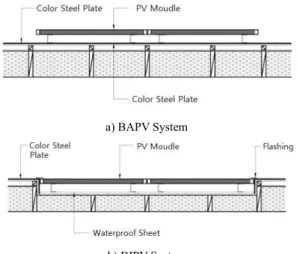
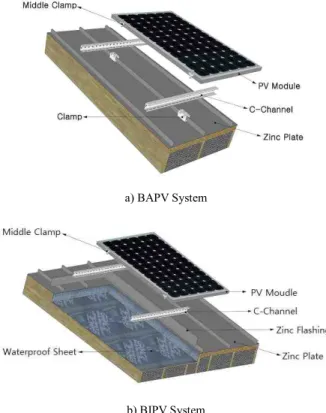
Fig. 1 is an example of the case where the roof finishing materials are color steel plates, and replacing the BAPV system (a) and finishing materials, a section view of BIPV system (b)

installing solar module.

As shown in the figure, in case of the BAPV system, the supporting structure is placed on the roof finishing materials and the solar module is installed on that. On the other hand, in the case of the BIPV system, the roofing finishing materials are not installed and waterproofing works such as installing a waterproof sheet to prevent rainwater from penetrating the site, and a supporting structure is placed thereon, and a solar module is buried and installed. At this time, in case the roof finishing material is steel plate material such as color steel plate and Titanium zinc plate, finishing material such as roof is used on the incision side to install the solar module and install flashing which is rainwater-proof construction (see Fig .3) If the BIPV system is installed on the roof finishing material instead of installing the BAPV system, the roof finishing area is reduced and the construction cost is reduced.

However, the waterproofing work and the flashing installation are required, which may increase the construction cost.

a) BAPV System

b) BIPV System

Fig. 1. Roof section(roof finishing material is color steel plate)

Fig. 2 shows in case the roof finishing materials are asphalt shingle, and Fig. 3 is drawn in the form of exploded view of (a) BAPV system and (b) BIPV system in case the roof finishing materials are Titanium zinc plate.

a) BAPV System

(3)

b) BIPV System

Fig. 2. Exploded View(roof finishing material is asphalt shingle)

a) BAPV System

b) BIPV System

Fig. 3. Exploded View(roof finishing material is titanium zinc plate)

In case the roof finishing materials are asphalt shingle or flat type roof tiles, there is no need to install flashing like Fig. 2, but in case the roof finishing materials are steel plate materials such as color steel plate and Titanium zinc plate, flashing should be installed on the incised side using the same finishing materials as the roofing material to install the photovoltaic module like Fig. 3.

2. Calculation of Construction Cost

2.1. Unit Cost by Roof Finishing Materials

In order to prepare the unit cost for the installation work of four types of roof finishing materials for residential buildings, which are asphalt shingle, flat type roof tile, color steel plate, Titanium zinc plate, the materials and products are based on the

government-standardized calculation and the items not specified in the standard calculation are based on the calculation commonly used in the construction work. The construction costs per unit area (㎡) by roof finishing materials as shown in (a) to (d) of Table 1 are applied to unit price of the price data sheet in 2016 and the labor unit price of government in the first half of 2016.

Division specification unit qty price sum

mate- rial cost

asphalt shingle double type

336*1000*3  ㎡ 7.3 2,105 15,367 waterproof sheet  2t, 1.0*10  ㎡ 1.18 3,258 3,844

odd materials double shingle

337*982 ㎡ 1.00 1,077 1,077

sub total       20,288

labor cost

asphalt shingle

installation ㎡ 1.00 12,420 12,420

waterproof sheet

installation   ㎡ 1.00 2,872 2,872

finishing   ㎡ 1.00 675 675

sub total       15,967

expen -se

transportation cost site arrival  ㎡ 1.00 1,350 1,350 get off &

minor transport   ㎡ 1.00 675 675

waste disposal   ㎡ 1.00 675 675

sub total     2,700

Total - - - 38,955

Table 1. Unit cost depend on roof finishing materials a) roof finishing material is Asphalt shingle (㎡)

Division specification unit qty price sum

mate- rial cost

clay roof tile 11(460*290) EA 11.5 4,347 49,991 square timber

for roof tile 30*30@380 m 2.65 621 1,646 rafter timber 30*30@400 m 2.50 621 1,553 odd materials screw, nail, etc. ㎡ 1.00 3,105 3,105

sub total       56,294

labor cost

clay roof tile

installation ㎡ 1.00 25,616 25,616

square timber

installation   ㎡ 1.00 4,658 4,658

rafter timber

installation ㎡ 1.00 4,658 4,658

finishing silicon working ㎡ 1.00 1,553 1,553

sub total         36,485

expen -se

transportation cost site arrival  ㎡ 1.00 1,350 1,350 get off & minor

transport   ㎡ 1.00 675 675

waste disposal   ㎡ 1.00 675 675

sub total       2,700

Total - - - 95,479

b) roof finishing material is Flat type roof tile (㎡)

Division specification unit qty price sum

mate- rial cost

PRINTEEL THK 0.5/W450_H25 ㎡ 1.25 13,973 17,466 vapour

permeability waterproof sheet

TEKTON H/W

(1.52Mx50M) ㎡ 1.18 1,785 2,106 waterproofing

plywood 12T/4*8(1,220x2,440) ㎡ 1.03 11,178 11,513

structural ㅁ-40x40x1.6T ㎡ 3.24 2,174 7,044

c) roof finishing material is Color steel plate (㎡)

(4)

Division specification unit qty  price sum

mate- rial cost

ZM TITANZINC THK 0.7 / W430_H25 ㎡ 1.25 51,233 64,041 vapour

permeability waterproof sheet

TEKTON H/W

(1.52Mx50M) ㎡ 1.18 1,785 2,106 waterproofing

plywood 12T/4*8 (1,220x2,440) ㎡ 1.03 11,178 11,513 structural

under-pipe ㅁ-40x40x1.6T m 3.24 2,174 7,044 structural angle

(fastener) L-50x50x4T, W=80 EA 2.20 574 1,263 set anchor M10x120 EA 2.20 994 2,187 fixed clip 0.4T STS. EA 6.00 171 1,026 sliding clip 0.4T STS. EA 2.00 342 684 S.D.S screw D3.8x38mm EA 16.00 68 1,088 odd materials screw, nail, etc. set 1.00 675 675

plastic vinyl set 1.00 1,553 1,553

sub total       93,180

labor cost

fishing installation form making &

installation ㎡ 1.00 28,721 28,721 installation of

vapour permeability waterproof sheet

㎡ 1.00 2,562 2,562

installation of waterproofing

plywood

㎡ 1.00 8,539 8,539 installation of

structural under pipe

㎡ 1.00 20,493 20,493 finishing welding, calking, etc. ㎡ 1.00 2,562 2,562

sub total       62,877

expen -se

transportation cost site arrival ㎡ 1.00 350 1,350 get off & minor

transport ㎡ 1.00 675 675

waste disposal ㎡ 1.00 675 675

sub total 2,700

Total - - - 158,757

d) roof finishing material is Titanium zinc plate (㎡)

Following Table 2 summarizes Table 1, which is the unit cost by roof finishing materials.

Division  Asphalt shingle

Flat type roof tile

Color steel plate

Titanium zinc plate Material

cost 20,288 56,294 46,605 93,180

Labor cost 15,967 36,485 62,877 62,877

Expense 2,700 2,700 2,700 2,700

Total 38,955 95,479 112,182 158,757

Ratio 1 2.45 2.88 4.08

Table 2. Summary of Table 1

Comparing the roof construction cost per unit area (㎡), it shows that the titanium zinc plate is the most expensive at 158,757 won, because the material cost is high and labor cost is high, and asphalt shingle is the cheapest at 38,955 won. Comparing this by ratio, the construction cost of the most expensive titanium zinc plate showed more that four times as much as that of the cheapest asphalt shingle.

In this way, since there is a great difference in the construction cost of roof construction depending on the finishing materials, economic efficiency is different depending on whether the BIPV system installs solar module in place of which finishing materials.

Therefore, in this study, we intend to examine the economical efficiency by comparing the construction cost with each other how different the construction cost according to the roof finishing materials replaced with the photovoltaic module of the form of BIPV is.

2.2. Installation Construction Cost of Photovoltaics System

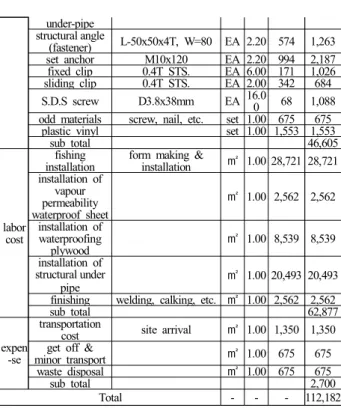
Table 3 shows the cost of installing 3 kWp crystalloid photovoltaic module installed in the form of BAPV system on top of the roof finishing material, which is a construction cost only for pure photovoltaic module installation, except for the roof construction cost, ie, roof finishing materials, material cost or labor cost for installation.

Division specification unit qty  price sum

mate -rial cost

photovoltaic module

250Wp

(BJP-250PC) EA 12.00 180,000 2,160,000 inverter 220V, 3kVA EA 1.00 1,000,000 1,000,000 connection board 3kVA 2CH EA 1.00 55,000 55,000

support fixture 3kW, C-Channel,

Clamp, etc. set 1.00 600,000 600,000 0.6/1kV

Cross-linked polyethylene

F-CV*1C,4㎟  m 25.00 777 19,425

0.6/1kV F-CV*2C,6㎟ m 55.00 1,949 107,195 Table 3. Construction cost for BAPV system of 3kWp, excluding roofing under-pipe

structural angle

(fastener) L-50x50x4T, W=80 EA 2.20 574 1,263

set anchor M10x120 EA 2.20 994 2,187

fixed clip 0.4T STS. EA 6.00 171 1,026 sliding clip 0.4T STS. EA 2.00 342 684 S.D.S screw D3.8x38mm EA 16.0

0 68 1,088

odd materials screw, nail, etc. set 1.00 675 675

plastic vinyl set 1.00 1,553 1,553

sub total       46,605

labor cost

fishing installation

form making &

installation ㎡ 1.00 28,721 28,721 installation of

vapour permeability waterproof sheet

㎡ 1.00 2,562 2,562 installation of

waterproofing plywood

㎡ 1.00 8,539 8,539 installation of

structural under pipe

㎡ 1.00 20,493 20,493 finishing welding, calking, etc. ㎡ 1.00 2,562 2,562

sub total       62,877

expen -se

transportation

cost site arrival ㎡ 1.00 1,350 1,350 get off &

minor transport ㎡ 1.00 675 675

waste disposal ㎡ 1.00 675 675

sub total     2,700

Total - - - 112,182

(5)

As shown in the above table, the construction cost of photovoltaic module with 3kWp capacity of BAPV system is calculated to be about 6 million won plus material cost and labor cost.

3. Economical Efficiency Comparison

The economic efficiency is analyzed by calculating and comparing the construction cost of photovoltaic module with capacity of 3 kWp installed in the form of BAPV system on top of each roof finishing material and the construction cost of photovoltaic modules of the same capacity installed in the form of BIPV system by replacing finishing materials.

3.1. Construction Cost of BAPV system

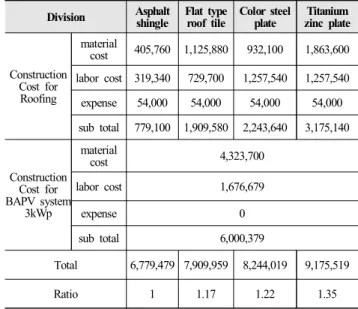
Table 4 shows photovoltaic construction cost calculated including roof finishing when installing BAPV system with capacity of 3kWp on the roof, which is the addition of roof construction cost of 20㎡ multiplied by the cost per unit area of each finishing materials in Table 1, and construction cost for BAPV system of 3kWp. At this time, the roof area of 20㎡ is the roof area required to install 3kWp of photovoltaic capacity assuming that the efficiency of the crystalloid type photovoltaic module is 15%.

Therefore, the roof construction cost in Table 4 is obtained values by multiplying the unit cost of Table 1 by photovoltaic installation area of 20㎡.

Division Asphalt shingle

Flat type roof tile

Color steel plate

Titanium zinc plate

Construction Cost for Roofing

material

cost 405,760 1,125,880 932,100 1,863,600 labor cost 319,340 729,700 1,257,540 1,257,540 expense 54,000 54,000 54,000 54,000 sub total 779,100 1,909,580 2,243,640 3,175,140

Construction Cost for BAPV system

3kWp

material

cost 4,323,700

labor cost 1,676,679

expense 0

sub total 6,000,379

Total 6,779,479 7,909,959 8,244,019 9,175,519

Ratio 1 1.17 1.22 1.35

Table 4. Construction cost for BAPV system of 3kWp, including Roofing

As shown compared in Table 2, the roof construction cost for Titanium zinc plate, the most expensive in material cost and labor cost, was more than four times than that of the cheapest asphalt shingle, which showed about 1.35 times more expensive, or about 35% in case of including photovoltaic construction cost.

3.2. Construction Cost of BIPV system

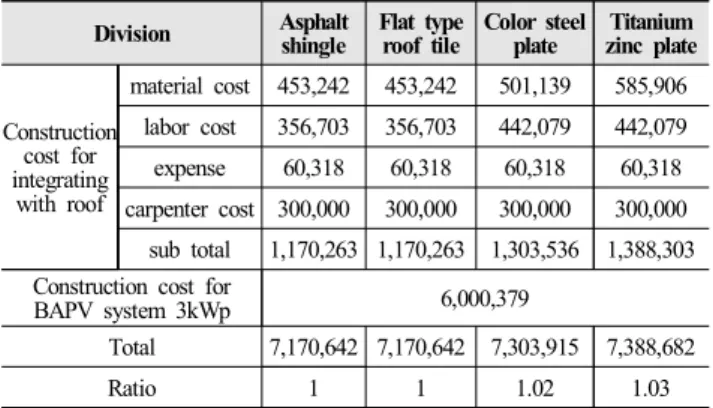
Table 5 shows the construction cost calculated 20㎡ of BIPV system with capacity of 3kWp, which is the addition of construction cost for integrating with roof and construction cost for BAPV system of 3kWp

Since the part where the roof finishing material of the BAPV system is installed is replaced with the photovoltaic module, the construction cost for roofing is excluded from the BAPV system cost of Table 4.

The construction cost for integrating with the roof includes floor waterproofing, preparation for installation of photovoltaic modules, etc., which are not necessary for installing BAPV system.

Especially, in case roof finishing Materials are steel plate materials such as color steel plate or Titanium zinc plate, since it should install flashing which is rainwater-proof construction using the same finishing material as the roof material on the incision side to install the photovoltaic module (see Fig .3), the material cost and the labor cost are increased, and the construction cost is increased as compared with the asphalt single type or flat type roof tile.

In the Table 5, ‘the construction cost for BAPV of 3kWp’ is pure photovoltaic module installation cost which come from Table 3 as it was except for the roof finishing construction. Photovoltaic module installation cost of BAPV system and BIPV system is basically the same (see Fig.1).

Cross-linked polyethylene

drain wire F-GV 4㎟ m 60.00 723 43,380

Al. duct 50 x 35 m 50.00 2,600 130,000 flexible conduit GW-28 m 50.00 2,690 134,500 conduit connecter GWCZ-28 EA 15.00 2,520 37,800

circuit breaker MCCB 30A, 2P,

2.5ka EA 2.00 7,200 14,400

Conduit box 200*300*150

(waterproof type) EA 1.00 22,000 22,000

sub total         4,323,700

labor cost

installation of photovoltaic module, inverter

plant electrician  man 2.00 177,610 355,220 indoor wiring

electrician man 2.00 144,238 288,476

support fixture installation

steel-frame work man 2.00 127,758 255,516 scaffolding work man 1.00 150,672 150,672 plasterer work man 1.00 123,123 123,123

electric work

low voltage

electrician man 2.00 179,717 359,434 indoor wiring

electrician man 1.00 144,238 144,238

sub total         1,676,679

Total - - - 6,000,379

(6)

Division Asphalt shingle

Flat type roof tile

Color steel plate

Titanium zinc plate

Construction cost for integrating

with roof

material cost 453,242 453,242 501,139 585,906 labor cost 356,703 356,703 442,079 442,079 expense 60,318 60,318 60,318 60,318 carpenter cost 300,000 300,000 300,000 300,000 sub total 1,170,263 1,170,263 1,303,536 1,388,303 Construction cost for

BAPV system 3kWp 6,000,379

Total 7,170,642 7,170,642 7,303,915 7,388,682

Ratio 1 1 1.02 1.03

Table 5. Construction cost for BIPV System of 3kWp

Comparing the cost of BIPV system according to roof finishing materials, Titanium zinc plate, the most expensive roof finishing material, is about 3% more expensive compared to the asphalt shingle, the cheapest construction cost due to the difference of material cost such as rainwater-proof construction and labor cost, but this is very small compared to the 35% difference in BAPV system cost of Table 4. Though there is a big difference in the construction cost of BAPV system due to the large difference in construction cost of roof finishing materials, there is no big difference because BIPV system construction cost do not include roof finishing materials.

3.3. Comparison of Construction Cost

Following table 6 summarizes the Table 4, the construction cost of the BAPV system, and Table 5, the construction cost of the BIPV system.

For the ratio of construction cost of BIPV system to construction cost of BAPV system(b/a), in case of asphalt shingle with relatively low roof construction cost, if BIPV type photovoltaic module instead of roof material and BAPV was installed, the roof finishing construction cost increased by 6%, but in case of the other three types of roof materials, if BIPV type photovoltaic module instead of BAPV was installed, the cost of construction reduced and it was economical.

Division Asphalt shingle

Flat type roof tile

Color steel plate

Titanium zinc plate Construction Cost for

BAPV system 3kWp, including Roofing (Table 4) (a)

6,779,479 7,909,959 8,244,019 9,175,519 Construction Cost for

BIPV system 3kWp (Table 5) (b)

7,170,642 7,170,642 7,303,915 7,388,682

Ratio (b/a) 1.06 0.91 0.89 0.81

Table 6. Summary & comparison of construction cost

Particularly, in the case of Titanium zinc plate, the most expensive in roof construction cost, if BIPV type photovoltaic

module was installed instead of the roof finishing material, the roof construction cost reduced by 19%. In case of the next expensive color steel plate, it reduced by about 11%.

In other words, as the cost of finishing materials is higher, the cost of BIPV type photovoltaic module is reduced, which is more economical than BAPV in terms of overall construction cost.

Fig. 4 shows graphs for easier comparison in Table 6 above.

BIPV is more economical in all three cases except for asphalt shingle as roof finishing materials, and especially, in case of Titanium zinc plate with expensive roof construction cost, it can be seen that the difference of the construction cost is larger.

Fig. 4. Comparison of construction cost

4. Conclusion

In this study, by calculating each construction cost for the subject of 4 types of roof finishing materials such as asphalt shingle, flat type roof tile, color steel plate, Titanium zinc plate, which are commonly used as roof finishing materials for residential buildings, BAPV system construction cost combined photovoltaic construction cost when 3 kWp photovoltaic module is installed in the form of BAPV system on top of these finishing materials, and BIPV system construction cost installed with the same capacity of photovoltaic modules in the form of BIPV system in place of finishing materials, the following results were obtained by quantitatively comparing the economical efficiency focused on the roof finishing construction cost.

1. When installing BIPV system instead of roof finishing material, it was analyzed that the construction cost Titanium zinc plate, which is the most expensive roof finishing construction cost, reduced by about 19%, and that of color steel plate also reduced by about 11%,

2. In case of asphalt shingle, which has the cheapest roof

finishing construction cost, it is calculated that the construction

cost increased by about 6% in case of replacing with BIPV system.

(7)

In this study, it is found that the higher the construction cost of roof finishing material is, the more reduced the construction cost is due to the BIPV installed replacing roof finishing material, so it is more economical than BAPV in terms of overall construction cost.

In order to expand the BIPV system in the future, it is considered to need additional study of LCC analysis, etc. including power generation amount and recently revised electricity billing system considering the efficiency difference between the two systems.

Acknowledgements

This work was supported by Shinhan University Research Fund, 2016

Reference

[1] Korea Energy Economics Institute, Yearbook of Energy Statistics, Statics in Chart, p.21, 2014

[2] KOREA ENERGY AGENCY, A News Release, 2016.11.29

[3] Jongho Yoon, 2008.8, BiPV, New Wave of Building Integrated Photovoltaics System, Korea Institute of Registered Architects, Korean Architects, p.67

[4] Yoon, Jongho Kim, J.I Lee, K.S. Yu, G.J., Development of Building Integrated PV(BIPV) module for the replacement of commercial building envelope materials“, The International Journal of The Korea Institute of Ecological Architecture and Environment, Vol.4(3), 2004 [5] Barbose, G. et al., 2011, Tracking The Sun Ⅳ : An Historical

Summary of the Installed cost of Photovoltaics in the United States from 1998 to 2010, Berkeley, CA : Lawrence Berkeley National Laboratory

[6] Lee Han-Myoung, Oh Min-Seok, Kim Hway-Suh, “A Study on the Life Cycle Cost Analysis of the See-thorough a-si Building Integrated Photovoltaic System”, Journal of the Korean Solar Energy Society, Vol. 29(1), 2009

[7] KOREA ENERGY AGENCY, New and Renewable Energy Center,

Unit Cost for Construction of New and Renewable Energy, 2012

수치

Fig.  1  is  an  example  of  the  case  where  the  roof  finishing  materials are color steel plates, and replacing the BAPV system (a)  and  finishing  materials,  a  section  view  of  BIPV  system  (b)
Table  1.  Unit  cost  depend  on  roof  finishing  materials a) roof finishing material is Asphalt shingle (㎡)
Table  2.  Summary  of  Table  1
Table  4.  Construction  cost  for  BAPV  system  of  3kWp,  including  Roofing
+2

참조

관련 문서

Based on the parametric study on the characteristic of solid NaBH 4 hydrolysis using the NaHCO 3 agent, a prototype of the hydrogen generation system was developed

S., An Experimental Study on the Cooling and Heating Performance of a Residential Ground Source Heat Pump System, Korean Journal of Air-Conditioning

This study focuses on the energy-related legal system of Australia and examines (1) the general regulatory framework of energy industries, (2) the management and oversight

41 Developing Web Intelligence System of Construction Tacit Knowledge Based on Text

government’s assessment of the project’s technical feasibility, time for completion, and cost.. 401.649 Cost Planning for Construction Projects 10.  Scope of work at

The purpose of the achievement standard in the Chinese letters area was more focused on understanding and appreciation of the actual work than on the form

This study collects and analyzes data on the historical construction cost of steel box girder bridges, identifies key cost impact factors, provides two approximate

The construction of Electric motor propulsion system are presumed arrangement of boat and compared The engine fuel of cost with battery charge of cost .The Model