K.-S. Shin ( ) ・ J.-H. Lee ・ M.-H. Lim ・ H.-J. Woo ・ Y. Qin ・ S.-C. Suh ・ S.-J. Kweon ・ H.-S. Cho
국립농업과학원 생물안전성과
(National Academy of Agricultural Science, Rural Development Administration, Suwon 441-707, Korea)
e-mail: [email protected]
해충저항성 유전자변형 벼 Agb0101에 대한 PCR 검정
신공식 ・ 이진형 ・ 임명호 ・ 우희종 ・ 친양 ・ 서석철 ・ 권순종 ・ 조현석
Qualitative and quantitative PCR detection of insect-resistant genetically modified rice Agb0101 developed in korea
Kong-Sik Shin ・ Jin-Hyoung Lee ・ Myung-Ho Lim ・ Hee-Jong Woo ・ Yang Qin ・ Seok-Cheol Suh ・ Soon-Jong Kweon ・ Hyun-Suk Cho
Received: 11 December 2012 / Accepted: 13 December 2012
ⓒKorean Society for Plant Biotechnology
Abstract Genetically modified (GM) rice Agb0101, which expresses the insecticidal toxin modified cry1Ac (mcry1Ac1) gene, was developed by the Rural Development Administra- tion in Korea. To monitor the probable release of Agb0101 in the future, it is necessary to develop a reliable detection method. Here, we developed the PCR detection method for monitoring and tracing of GM rice. The primer pair (RBEgh- 1/-2) from a starch branching enzyme (RBE4) gene was designed as an endogenous reference, giving rise to an expected PCR amplicon of 101 bp. For the qualitative PCR detection, construct- and event-specific primers were de- signed on the basis of integration sequence of T-DNA. Event- specific PCRs amplified specifically 5’- or 3’-junction region spanning the native genome DNA and the integrated gene construct, while none of amplified product was shown on crops, rice varieties, and other insect-resistant transgenic rice lines. The event-specific real-time PCR method was performed using TaqMan probe and plasmid pRBECrR containing both rice endogenous gene RBE4 sequence and 5’-junction sequence as the reference molecule. The abso- lute limit of quantification (LOQ) of real-time PCR was established with around 10 copies for one plasmid molecule pRBECrR. Thereafter, the different amounts of transgenic rice (1, 3, 5, and 10%, respectively) were quantified by using the established real-time PCR method, with a range below
19.55% of the accuracy expressed as bias, 0.06-0.40 of standard deviation (SD) and 3.80-7.01% of relative standard deviations (RSD), respectively. These results indicate that the qualitative and quantitative PCR methods could be used effectively to detect the event Agb0101 in monitoring and traceability.
서 론
국제생명공학응용정보서비스(ISAAA)에 따르면 전 세계 적으로 유전자변형(genetically modified, GM) 작물은 2011 년 29개 국가에서 1억6,000만 헥타르가 재배되어, 1996년 에 상업적인 재배를 시작한 이후보다 무려 94배 증가한 것으로 재배면적이 급속히 확대되고 있음을 보여주고 있 다(James 2011). 최근에는 기존의 제초제저항성, 해충저항 성 등 농업적 재배 이득이 강한 작물의 개발에서, 영양성 분 개선, 에너지 생산, 의약품 생산, 환경오염 개선 등 인 류의 직면한 문제해결을 위한 방향으로 생명공학작물의 개발이 이루어지고 있다. 국내에서 GM농산물은 재배 목 적이 아닌 식품, 사료 및 이의 가공목적으로 2011년 기준 총 7,853천 톤(식용 1,875천 톤 및 사료용 5,978천 톤)이 수입 승인되었다(KBCH Database, htt://www.biosafety.or.kr).
또한 GM작물의 개발 현황은 실용화 및 재배가 허가된 품목은 아직 없고, 대학 및 관련 연구기관에서 벼, 토마 토, 감자, 콩, 고추, 배추, 들깨 등 경제적으로 중요한 작 물들을 대상으로 생명공학작물의 개발 연구가 수행되고 있다(Kim et al. 2006; Woo et al. 2006).
GM작물은 국제적으로 인체 및 환경에 대한 위해성 논 란이 끊임없이 제기되고 있는 실정으로, 안전한 사후관 DOI:http://dx.doi.org/10.5010/JPB.2013.40.1.018
Research Article
리를 위해서 각 해당 품목에 대하여 과학적인 검출방법 들이 개발되고 있고, 국내에서도 개발 GM작물의 실용화 또는 허가 시 안전성 확보를 위해서 외래 도입유전자의 판별에 적용할 수 있는 검출법을 요구하고 있다(Lim et al. 2007; Shin et al. 2009). GM작물의 검출에 현재 일반적 으로 이용되고 있는 방법으로 유전자의 염기를 증폭하는 PCR(polymerase chain reaction) 분석법이 활용되고 있으며, 스크리닝(screening), 유전자 특이적(gene-specific), 구조 특 이적(construct-specific) 및 이벤트(또는 계통) 특이적(event- specific) PCR법 등이 있다. 구체적으로, 스크리닝 PCR은 GM작물에 보편적으로 적용되어 있는 유전자, 35S 프로 모터 또는 Nos터미네이터를 검출하여 유전자변형생물체 (genetically modified organism, GMO)의 유무를 확인하는 수단이고, 유전자 특이적 및 구조 특이적 PCR법은 도입 된 T-DNA 내의 특정한 부위를 증폭시켜 검지하는 방법 이다. 이벤트 특이적 PCR법은 도입유전자가 삽입된 식물 게놈의 주변 염기서열과 T-DNA 염기서열 사이를 검지하 는 방법으로, 분석에 앞서 식물체내 도입유전자 삽입부 위의 염기서열 확인이 필요하다(Huang and Pan 2005; Pan et al. 2006; Shrestha et al. 2008; Zhang and Guo 2011). 스크 리닝, 유전자 특이적 및 구조 특이적 방법은 변형된 유전 자 또는 구조를 이용하여 유전자변형체를 얻었을 때, 일 정치 않은 카피수를 가질 때 잘못된 양성반응을 나타낼 수 있고, 동일 형질전환 벡터로부터 유도된 유전자변형 체의 계통 간 구별이 어렵다는 단점이 있다. 반면, 이벤 트 특이적 방법은 외래유전자가 삽입된 부위의 게놈과 도입유전자 사이의 새롭게 형성된 특정 염기서열을 검출 하기 때문에 각 형질전환 계통의 구별이 가능하고, 특히 교배에 의해 파생된 개체의 모본을 파악할 수 있기 때문 에 계통의 이력추적이 가능하여 최근 GM작물의 PCR 검 출방법으로 권장되고 있다(Taverniers et al. 2005; Yang et al. 2005; Su et al. 2011; Shin et al. 2012). 한편, 각 국가에서 는 GMO의 안전한 유통관리를 위해서 비의도적 혼입치 를 설정하여 표시제를 실시하고 있어 정량적인 분석법이 개발되고 있다. Real-time PCR분석법은 목적유전자의 PCR 증폭산물(amplicon)을 plasmid로 제작하여 표준물질로 하 고, 형광 probe를 이용함으로써 보다 정확한 GMO의 혼입 율을 확인할 수 있어 정밀분석을 가능케 하였다(Kuribara et al. 2002; Shindo et al. 2002; Rho et al. 2004; Toyota et al.
2006).
국내에서는 살충성 유전자, mcryIAc1를 벼에 형질전환 하여 해충저항성 GM벼로 개발하였고(Kim et al. 2009), 최 근 GM작물의 실용화를 위해서 이벤트 Agb0101에 대한 식품 및 환경위해성평가 연구를 수행하였다. 따라서, 본 연구는 GM작물의 실용화에 따른 모니터링 및 사후 안전 관리를 위한 검출방법을 개발하고자 Agb0101에 대한 특 이 primer를 작성하여 정성 PCR 분석법을 도출하였고, 삽
입 인접염기서열을 포함하는 plasmid를 표준물질로 한 real-time PCR을 실시하여 정량분석의 정확성 및 정밀성 을 확인하였다.
재료 및 방법
식물재료 및 DNA 추출
해충저항성 유전자변형(genetically modified, GM) 벼 Agb0101 은 농촌진흥청에서 토양미생물인 Bacillus thringiensis로부 터 유래한 곤충 독소유전자cry1Ac를 작물에 적합하도록 살충성을 갖는 주요 염기부위를 변형시켜 mcryIAc1 유전 자(GeneBank Accession No. AY126450)로 합성하였고, 이 를 낙동벼 품종에 형질전환하여 해충저항성 GM벼로 개 발한 것이다(Kim et al. 2009). 형질전환 계통 중 분자생물 학적으로 안정하고 수량 및 임실율이 높은 고정계통 C7- 1-9-1-1을 우량계통으로 육성하고, GM작물 실용화를 위 한 이벤트 Agb0101로 설정하여 인체 및 환경위해성 연구 를 수행하였다. 본 실험에서는 C7-1-9-1-1-1(T5 세대)를 해 충저항성 GM벼의 PCR 검출을 위한 실험재료로 이용하 였다. 대조구로는 Agb0101과 동일한 형질전환 운반체 (Fig. 1)로 낙동벼 및 화영벼에 형질전환하여 선발된 계통 들을 PCR 검출 특이성 확인에 사용하였다. 또한, 벼를 포 함한 콩, 배추, 감자, 고추, 상추, 참외, 들깨, 토마토, 완 두, 피망, 고구마 등 non-GM작물을 이용하였으며, 특히, 국내의 벼 품종으로 간척벼, 계화벼, 그루벼, 금남벼, 금 오벼, 금호1호, 금호2호, 낙동벼, 남감벼, 남원벼, 남천벼, 남평벼, 내풍벼, 농안벼, 다산벼, 대립1호, 대산벼, 대안 벼, 대야벼, 대진벼, 대청벼, 동안벼, 동진벼, 동해벼, 둔내 벼, 만금벼, 봉광벼, 삼백벼, 상산벼, 상주벼, 상주찰벼, 삼 천벼, 서안벼, 서진벼, 소백벼, 신선찰벼, 신운봉벼, 장안 벼, 조령벼, 주안벼, 중화벼, 진부벼, 진부올벼, 진부찰벼, 진미벼, 청명벼, 추청벼, 아랑향찰, 안산벼, 안중벼, 양조 벼, 영남벼, 영해벼, 오대벼, 오봉벼, 운봉벼, 운장벼, 일미 벼, 화남벼, 화동벼, 화서벼, 화선찰벼, 화성벼, 화신벼, 화 영벼, 화중벼, 향남벼, 향미1호, 향미2호, 탐진벼, 팔공벼 등 총 71개 품종을 PCR 검출 특이성 분석의 대조구로 사 용하였다.
식물체의 genomic DNA는 각 시료 1 g씩을 취하여 막자 사발에서 액체질소를 넣고 분말화 한 후, DNeasy Plant kit (Qiagen, Valencia, CA, USA)를 이용하여 DNA를 추출하였 다. 추출된 DNA는 NanoDrop Spectrophotometer ND-1000 (NanoDrop Technologies, Inc. USA)를 이용하여 260/280 nm 값이 1.8 ~ 2.0 사이인 DNA액을 각 실험의 주형DNA로 사 용하였다.
Fig. 1 Schematic diagram of the designed PCR primers for detection of insect resistant GM rice (A), and nucleotide sequences between the rice genome and the integrated T-DNA (B). Bold bars in A indicate the specific regions for the detection of GM rice.
In B, capital letters represent the flanking genomic sequences and lower case letters show the T-DNA sequences of right border region. RB: right border; MAR: matrix attachment region; P rbcs: ribulose bisphophate carboxylase small subunit; TP: transit peptide sequence; mcry1Ac1: synthetic cry1Ac1 gene; T pinII: potato proteinase inhibitor II gene; P 35S: CaMV 35S promoter; BAR:
phosphinothricin acetyltransferase gene; T nos: A. tumefaciens nopaline synthase poly A; LB: left border
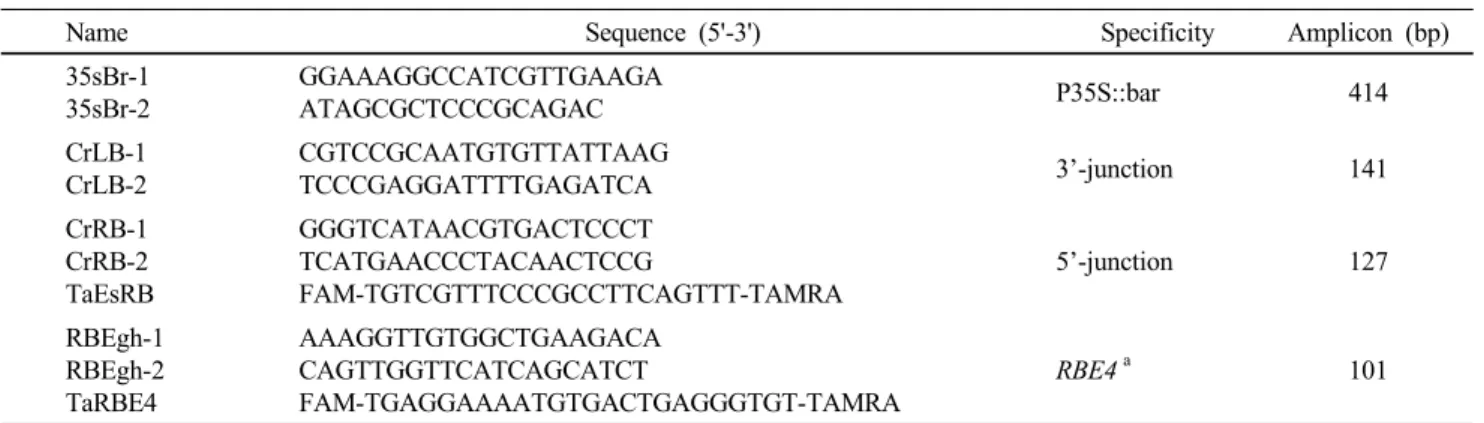
Table 1 Sequences of primers and probes used in this study
Name Sequence (5'-3') Specificity Amplicon (bp)
35sBr-1 35sBr-2
GGAAAGGCCATCGTTGAAGA
ATAGCGCTCCCGCAGAC P35S::bar 414
CrLB-1 CrLB-2
CGTCCGCAATGTGTTATTAAG
TCCCGAGGATTTTGAGATCA 3’-junction 141
CrRB-1 CrRB-2 TaEsRB
GGGTCATAACGTGACTCCCT TCATGAACCCTACAACTCCG
FAM-TGTCGTTTCCCGCCTTCAGTTT-TAMRA
5’-junction 127
RBEgh-1 RBEgh-2 TaRBE4
AAAGGTTGTGGCTGAAGACA CAGTTGGTTCATCAGCATCT
FAM-TGAGGAAAATGTGACTGAGGGTGT-TAMRA
RBE4a 101
aRBE4, starch branching enzyme gene, was used as the endogenous reference gene of rice
Primer 및 probe 제작
해충저항성 GM벼 Agb0101의 검출을 위해서 삽입된 T-DNA의 유전정보를 바탕으로 구조 특이적(construct- specific) primer쌍을 제작하였고, Agb0101만의 특이적인 검출과 이력추적이 가능하도록 도입 T-DNA와 벼 염색체 DNA사이의 5’ 및 3’ 삽입 인접염기서열을 바탕으로 이벤 트 특이적(event-specific) primer를 제작하였다. PCR검정의 대조 마커로써 벼 내재유전자의 검출 primer는 RBE4(starch branching enzyme) 유전자의 염기로부터 작성하였다. 본 연 구에 이용된 RBE4 유전자는 벼 염색체 내에 단일 copy 유전자로 존재하고 PCR 검정을 위한 내재유전자로 이용
되고 있다(Jeong et al. 2007). 정량 real-time PCR 검정분석 을 위해서 RBE4 내재유전자 및 Agb0101의 5’ 삽입 인접염 기서열 부위에 대한 TaqMan probe를 제작하여 사용하였 다. 본 실험에 이용된 정성 PCR 및 정량 real-time PCR을 위한 primer 및 probe의 염기서열은 Table 1에 나타내었다.
정성 PCR 검정
기본적인 정성 PCR 반응액은 한 시료 당 총 25 μL로 하여, 2.5 μL의 10×PCR buffer(Ampliqon, Herlev, Denmark), 2 μL 의 dNTP(2.5 mM each, Ampliqon), 1.5 μL의 1.5 mM MgCl2
(Ampliqon), 각각 10 μM의 forward와 reverse primer, Taq
DNA polymerase는 TEMPase Hot Start DNA polymerase (Ampliqon)를 1.25 unit 첨가하고, 20 ng/μL의 template DNA를 사용하여 반응을 수행하였다. PCR반응조건은 Dyad Peltier Thermal cycler(Bio-Rad, USA)를 이용하여, 95℃에서 15분 간 실시하고, 95℃에서 20초, 60℃에서 40초, 72℃에서 1분 간 35cycle로 하였으며, 마지막 단계로 72℃에서 5분간 수 행하였다. 증폭된 PCR산물은 전기영동 장치를 이용하여 2% agarose gel 상에서 전개한 후 UV로 확인하였다.
표준 plasmid 제조 및 정량 real-time PCR 검정
Agb0101 벼의 정량 real-time PCR 분석을 위해서 사용된 표준 plasmid는 Table 1에 나타낸 도입유전자에 대한 이벤 트 특이적 primer(CrRB-1/CrRB-2) 및 벼 내재유전자 primer (RBEgh-1/RBEgh-2)를 이용하여 증폭된 각 PCR 산물(amplicon) 을 SmaI/SrfI 제한효소 인식부위를 갖도록 연결하고, pGEM-T easy vector(Promega, USA)에 삽입하여 plasmid, pRBECrR 을 제조하였다(Fig. 5). 이후, Escherichia coli strain DH5α (RBC Bioscience, Taiwan)에 cloning하여 얻어진 plasmid를 정량 PCR의 표준물질(reference molecule)로 이용하였다.
이러한 plasmid의 이용은 GMO표준시료를 대체하여 정밀 하고 편리하게 real-time PCR의 표준물질로 이용할 수 있 는 방법이다(Kuribara et al. 2002).
pRBECrR은 SmaI으로 절단하여 선형화 시킨 후, ColE1/
TE DNA(Nippon Gene Co. Japan)를 이용하여 2.0×10⁶, 2.0×10⁵, 2.0×10⁴, 2.0×10³, 2.0×10², 2.0×101 및 1.0×101 copies농도로 단계별 희석한 후 검량선 작성용 표준용액으로 사용하였 다. Real time-PCR 분석은 시료 당 3 반복 분석하였고, 반 응은 각 반응당 총 20 μL로 하여 내재유전자 및 도입유전 자에 대한 반응액을 준비하였다. 반응용액은 primer 1.25 μM와 TaqMan probe 0.5 μM을 혼합액으로 하고, Brilliant II QPCR Master Mix(Agilent Technologies, USA)와 1:1.25의 비율로 조제하였다. Real-time PCR 반응은 Brilliant II QPCR Master Mix 10 μL, primer/probe mix 8 μL 및 Template DNA (50 ng/μL) 2 μL를 혼합하고, Stratagene Mx3005P system (Agilent Technologies, USA)을 이용하여 95℃에서 10분간 실시 후, 95℃에서 15초, 60℃에서 1분간 총40 cycle을 수 행하였다. 대조구(NTC, no template control)는 시료 DNA를 넣지 않은 음성대조구로 ColE1/TE DNA용액(5 ng/μL)을 넣 어 분석하였다. Real-time PCR 분석은 10 ~ 2,000,000 copies 범위에서 단계별 희석하여 얻어진 표준 plasmid의 내재유 전자 및 도입유전자에 대한 각 표준검량선(Standard curves) 으로부터 산출하였다. 또한 pRBECrR를 표준물질로 한 real-time PCR 분석의 검정 보정계수(Cf, Conversion factor) 및 GMO 정량의 정확성 확인을 위해서 Agb0101의 종자로 부터 100, 10, 5, 3 및 1% DNA 시료를 조제하여 PCR 분석 을 수행하였다. 보정계수는 내재유전자의 copy수에 대한
도입유전자의 copy 수의 비로 계산되었고, GMO의 혼입율 (%)은 다음 식을 이용하여 산출하였다(Toyota et al. 2006).
혼입율(%) = 시료의 도입유전자 copy수/시료의 내재유전 자의 copy수 × 1/보정계수 ×100
PCR 산물의 염기서열 분석
염기서열의 분석은 특이 primer로부터 증폭된 PCR산물을 agarose gel에 전기영동 하고 Gel Extraction kit(Qiagen, USA) 로 정제하여 pGEM-T easy vector에 삽입한 후, Escherichia coli strain DH5α로 형질전환 하여 염기서열을 확인하였다.
결과 및 고찰
해충저항성 GM벼의 정성 PCR 분석
해충저항성 벼 Agb0101은 살충 독소유전자 cry1Ac를 작 물에 적합하도록 주요 염기의 일부를 변형시켜 합성한 mcryIAc1 유전자로 벼에 형질전환하여 나비목(Lepidoptera) 해충에 저항성을 갖도록 개발한 GM벼(Kim et al. 2009)이 며, mcryIAc1및 bar 유전자를 포함하는 T-DNA가 벼 식물 체 게놈의 제1염색체 내에 단일 copy로 삽입되어 있는 것 으로 밝혀졌다(Lee et al. 2009; Shin et al. 2009; Park et al.
2010).
PCR반응에 이용되는 primer 및 probe의 적절한 설계는 민감도 있고 정확한 GM작물의 검정분석을 위해서 매우 중요하다. 따라서 Agb0101 벼를 특이적으로 PCR 검출하 기 위해서 T-DNA내의 염기서열을 바탕으로 구조 특이적 (construct-specific) primer와 T-DNA와 벼 게놈 내 삽입부위 사이의 인접염기서열을 바탕으로 이벤트 특이적(event- specific) primer를 선발하여 Table 1에 나타내었다. 구조 특이적 primer는 P35S::bar 부위를 증폭하고, 이벤트 특이 적 primer는 삽입된 T-DNA의 right 및 left border(RB 및 LB)의 인접염기서열을 증폭하도록 하였다. 벼의 내재유 전자로 식물 게놈 내에 단일 copy로 존재하는 전분분지 효소 유전자, RBE4를 작물 검출을 위한 대조 유전자로 사용하여 예상된 크기인 101bp의 PCR 증폭산물을 확인 할 수 있었다.
Agb0101의 검출을 위해 제작한 각 primer의 특이성 확 인을 위해서 각종 작물에 대한 PCR 반응을 수행하였다.
PCR 반응의 결과로, 이벤트 Agb0101의 경우에 구조 특이 적 primer쌍 35sBr-1/-2와 RB 및 LB의 인접염기서열을 바 탕으로 설계된 두 종의 이벤트 특이적 primer쌍인 CrRB -1/-2 및 CrLB-1/-2가 각각의 예상된 크기인 414 bp, 141 bp
Fig. 2 Specificity analysis of the construct- and event-specific primer pairs for insect-resistant GM rice and various non-GM crops. PCR products were electrophoresed on 2% agarose gel.
A: RBEgh-1/-2; B: 35sBr-1/-2; C: CrRB-1/-2; D: CrLB-1/-2 primer pairs. Lane M: 100 bp DNA ladder, lane N: no template control; lane 1: insect-resistant GM rice Agb0101; lanes 2-14:
non-GM crops (nagdong rice, hwayoung rice, Chinese cabbage, papper, potato, lettuce, soybean, perila, tomato, musk melon, pea, pimento, and sweet potato, respectively)
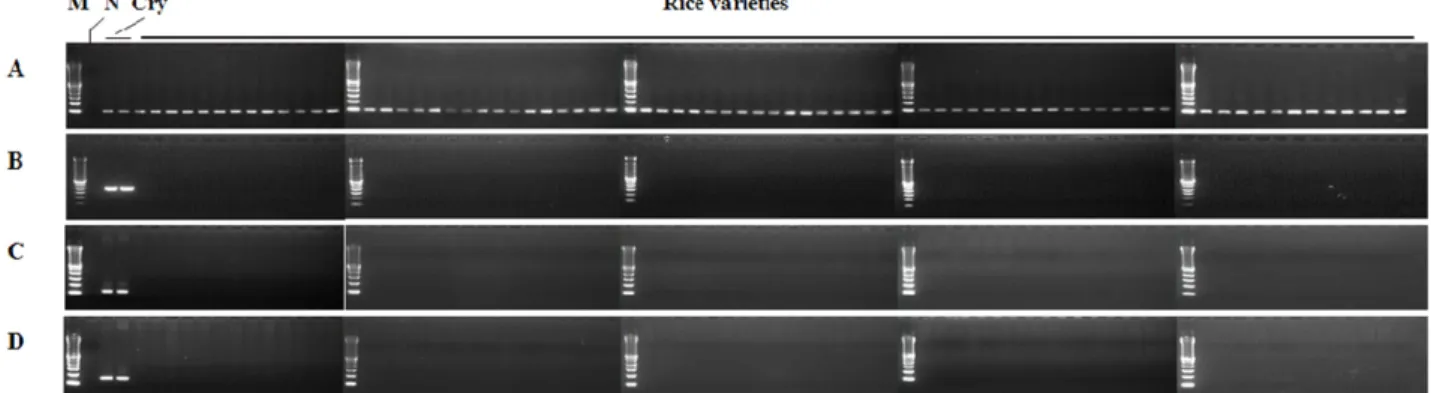
Fig. 3 Specificity analysis of the construct- and event-specific primer pairs for insect-resistant GM rice and various non-GM rice varieties. The 71 varieties of cultivated rice were shown in materials and methods. PCR products were electrophoresed on 2% agarose gel. A: RBEgh-1/-2; B: 35sBr-1/-2; C: CrRB-1/-2; D: CrLB-1/-2 primer pairs. Lane M: 100 bp DNA ladder, lane N: no template control; lane Cry: insect-resistant GM rice Agb0101
및 127 bp를 명확하게 형성한 반면, non-GM작물의 대조 구로 사용한 벼, 배추, 고추, 감자, 상추, 콩, 들깨, 토마토, 참외, 완두, 피망 및 고구마 등에 있어서는 어떠한 PCR 반응산물도 형성하지 않았다. 또한, 벼 내재유전자의 검 출을 위한 primer쌍 RBEgh-1/-2는 Agb0101과 non-GM벼인 낙동벼 및 화영벼에서 만 PCR 증폭산물을 확인할 수 있 었다(Fig. 2).
GM작물의 PCR 반응 시 검출 primer가 동일 작물의 품 종에 따라 genome 상에 유사 염기서열의 존재로 비특이 적인 반응산물을 형성하여 검정의 정확성을 감소시킬 수 있기 때문에 국내 벼 품종에 대한 primer의 특이성을 확인하였다. 그 결과 Figure 3에 나타난 바와 같이, primer 쌍 35sBr-1/-2, CrRB-1/-2 및 CrLB-1/-2는 단지 Agb0101에
서만 명확한 증폭산물을 나타냈고, 벼 내재유전자의 검 출 primer쌍 RBEgh-1/-2는 71개 벼 품종 모든에서 PCR 반 응 증폭산물을 형성하였다. 이의 결과는 Agb0101의 검출 을 위한 특이 primer가 국내 벼 품종들과 비특이적으로 반응할 수 있는 여타 염기서열을 포함하고 있지 않다는 것을 보여주고 있으며, 추후 다양한 벼 품종에 Agb0101 이 혼재되어 있을 경우라도 이들 특이 primer의 이용으로 쉽게 구분할 수 있을 것으로 본다.
작물의 형질전환 수행 시 일반적으로 동일의 식물 형 질전환 발현벡터를 이용하여 많은 개체를 얻게 되는데, 이 개체들은 genome상에 각기 상이한 위치로 목적유전자 가 삽입되어 각각의 계통을 이루게 된다. 하지만, 각 계 통들은 외래로부터 삽입된 동일한 유전정보를 갖고 있기 때문에 계통간 구분이 어려워 같은 계통으로 잘못 판별 될 수 있다. 최근, 식물 genome상의 도입유전자의 삽입부 위 인접염기서열을 확인함으로써 각 계통에 대한 구분이 가능하게 되었다(Taverniers et al. 2005; Yang et al. 2005;
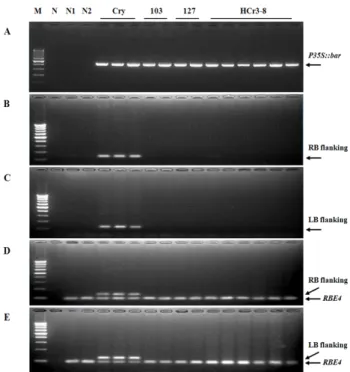
Pan et al. 2006). 따라서, 본 연구에서도 Agb0101의 지속적 인 사후관리 및 이력추적을 위해서 genome 내 도입유전 자의 삽입인접부위 염기서열을 바탕으로 특이적 primer 를 설계하였고, 이들 이벤트 특이적 primer의 PCR 특이성 을 확인하고자 Agb0101과 동일한 형질전환 운반체를 이 용하여 유도된 다양한 해충저항성 벼 계통들에 대하여 분석하였다. Figure 4에 나타난 바와 같이 T-DNA 내의 검출 부위를 갖는 35sBr-1/-2에 있어서는 Agb0101을 비롯 한 모든 계통에서 동일한 PCR 증폭산물을 생산하였다.
반면, 계통에 특이적인 primer쌍 CrRB-1/-2 및 CrLB-1/-2 의 경우에는 Agb0101에서만 명확한 증폭산물을 나타냈 으며, 그 외 계통에서는 PCR 산물을 형성하지 않았다. 또 한, 벼 내재유전자의 primer와 이벤트 특이적 primer를 이 용한 duplex-PCR 반응에서도 명확하게 Agb0101를 판별할 수 있었다.
Fig. 4 PCR amplification using the construct- and event-specific primer pairs for insect-resistant GM rice Agb0101 and various insect-resistant rice lines. D and E were carried out by the duplex PCR with mixed primers of endogenous gene and 5’- or 3’-juction region. PCR products were electrophoresed on 2%
agarose gel. A: 35sBr-1/-2; B: CrRB-1/-2; C: CrLB-1/-2; D:
RBEgh-1/-2 and CrRB-1/-2; E: RBEgh-1/-2 and CrLB-1/-2 primer pairs. Lane M: 100 bp DNA ladder, lane N: no template control; lane N1: non-GM nagdong rice; lane N2: non-GM hwayoung rice; lane Cry: insect-resistant GM rice event Agb0101;
lanes 103-127: insect-resistant GM rice lines of nagdong rice;
lanes HCr3-8: insect-resistant GM rice lines of hwayoung rice.
Insect-resistant GM rice lines were transferred with the same construct as that of event Agb0101
Fig. 5 Standard plasmid pRBECrR as reference molecule. A, Schematic diagram of pRBECrR: RBE4 indicates the rice en- dogenous gene, and CryRB represents the event-specific region between the native rice genome DNA and the transferred DNA (T-DNA). SmaI/Srf I indicates the restriction enzyme site. B, Nucleotide sequence of the integrated PCR amplicons in pRBECrR. Arrows indicate the location of primers with direction, and squared boxes indicate TaqMan probes
이벤트 특이적 PCR 방법은 외래유전자가 도입되어 각 계통에 특이적으로 형성된 염기부위를 검출하는 것으로, 우선적으로 새롭게 형성된 인접염기서열을 확인해야 하 는 어려움이 있지만 동일 식물발현 운반체 또는 유전자 의 사용으로 유도된 GM작물들의 판별 시에 유사 양성반 응의 위험성으로부터 최소화 할 수 있다. 따라서 GM작 물의 모니터링을 보다 효율적으로 수행할 수 있으며, GM 품목간의 교배에 의해 개발된 후대교배계통(stacked traits) 의 모본 확인이 가능하여 사후 이력추적에 효과적으로 적용할 수 있는 방법이다(Taverniers et al. 2005; Yang et al.
2005; Pan et al. 2006; Shin et al. 2012). 이상의 각종 특이 primer를 이용한 PCR의 결과로부터 확인한 바와 같이 본 연구에서 개발된 정성 PCR 검정방법은 이벤트 Agb0101 가 실용화 되어 재배 또는 유통 시 GMO의 모니터링 및 이력추적을 위해서 정확하고 효율적인 판별법으로 이용 될 수 있을 것이다.
Real-time PCR 검정을 위한 표준 plasmid 제조
해충저항성 GM벼 Agb0101의 real-time PCR 정량분석을 위해서 표준 plasmid을 이용하고자 하였다. 표준 plasmid제 작은 벼 내재유전자 primer쌍(RBEgh-1/-2) 및 이벤트 특 이적 primer쌍(CrRB-1/-2)으로 증폭된 PCR 산물을 서로 연결하고 T-Vector에 도입하여 제조하였다(Fig. 5). 표준 plasmid, pRBECrR은 검출단편으로 5’ 삽입 인접염기서열 이 포함되도록 제작하였기 때문에 이를 이용하여 Agb0101 의 이벤트 특이적 정량검정이 가능하다. 최근 정확한 GMO 의 정량분석을 위해서 real-time PCR이 이용되고 있으며, 정량 표준물질로 주로 내재유전자 및 도입유전자의 단편 을 포함한 plasmid을 사용하고 있다. 표준 plasmid의 이용은 목표 단편들에 대하여 정확한 농도로 표준용액을 조제할 수 있기 때문에 이로부터 GMO 시료의 농도를 용이하게 산출할 수 있는 장점이 있다(Kuribara et al. 2002; Toyota et al. 2006; Zhang and Guo 2011). 따라서 Agb0101 벼의 정량 분석용 pRBECrR을 제작하였고, 이의 목적하는 내재유전 자 및 도입유전자의 단편들이 벡터 내에 삽입되어 있는 지 염기서열 분석을 수행한 결과, 예상한 염기서열과 정 확하게 일치하는 237 bp의 단편을 확인 하였다(Fig. 5B).
해충저항성 GM벼 Agb0101에 대한 정량 real-time PCR검정 pRBECrR을 E. coli DH5α로부터 회수하여 제한효소 SmaI 으로 절단하고, 0 ~ 2,000,000 copies 범위에서 농도를 단계
Fig. 6 Amplification plots and standard curves of quantitative real-time PCR assay for insect-resistant rice Agb0101. A, Am- plification plots for the rice endogenous RBE4 gene were 10, 20, 200, 2,000, 20,000, 200,000, and 2,000,000 copies of standard plasmid. B, Event-specific real-time PCR amplification plots for the 5’-junction region of Agb0101 were established using 10, 20, 200, 2,000, 20,000, 200,000, and 2,000,000 copies of standard plasmid. Parameters of the regression line through data points are indicated within the plot
Table 2 Absolute limit and repeatability of the real-time PCR using pRBECrR as calibrant.
Target copies Ct value
Mean Ct Mean copy no. SDa RSD (%)b Mean 1 Mean 2 Mean 3
RBE4 2,000,000 17.81 18.03 17.77 17.87 2,182,000.00 0.14 0.78
200,000 21.66 21.45 21.66 21.59 191,300.00 0.12 0.56
20,000 24.78 24.65 24.74 24.72 20,596.67 0.07 0.27
2,000 28.11 27.89 27.92 27.97 2,111.67 0.12 0.43
200 32.00 31.70 31.60 31.77 190.40 0.21 0.66
20 34.73 34.78 34.72 34.74 21.65 0.03 0.09
10 35.62 35.96 35.96 35.85 10.45 0.20 0.55
5’-junction 2,000,000 17.83 18.00 17.88 17.90 1,957,444.33 0.09 0.49
200,000 21.34 21.30 21.44 21.36 189,300.00 0.07 0.34
20,000 24.42 24.43 24.51 24.45 21,975.00 0.05 0.20
2,000 27.90 27.83 27.98 27.90 2,046.50 0.08 0.27
200 31.39 30.90 31.30 31.20 199.40 0.26 0.84
20 34.74 34.76 34.75 34.75 19.43 0.01 0.03
10 35.66 35.99 35.96 35.87 9.41 0.18 0.51
aSD = standard deviation
bRSD = relative standard deviation. Experiments were performed three times
별로 희석한 후 real-time PCR 분석의 표준물질로 사용하 였다. Real-time PCR 반응의 수행으로 얻어진 각 표준물 질에 대한 검량선에서 내재유전자 RBE4에 대하여 기울 기(slope)와 선형성(R2)은 각각 -3.371와 0.999을 나타냈고, Agb0101의 이벤트 특이적 단편은 기울기와 선형성이 각 각 -3.371와 1.000을 보여 두 검량선 모두 98.0% 이상의 높 은 검량 효율성을 나타내었다(Fig. 6).
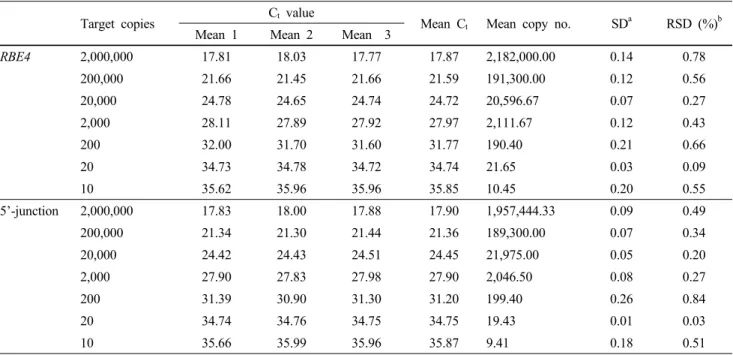
pRBECrR을 이용한 real-time PCR 분석에 대하여 각 표 준물질의 분석 감도 및 재현성을 확인한 결과, RBE4는 단계별 농도의 Ct값(fluorescence values)이 17.87 ~ 35.85 내 에서 반응하였으며, 표준편차(SD) 및 상대표준편차(RSD) 는 각각 0.03 ~ 0.21 및 0.09% ~ 0.78% 범위로 나타났다. 이 벤트 특이적 단편에 대해서는 Ct값이 17.90 ~ 35.87 범위 내 에서 반응했으며, 표준편차 및 상대표준편차는 각각 0.01
~ 0.26 및 0.03% ~ 0.84%의 낮은 편차를 보였다(Table 2).
pRBECrR은 표준물질로써 단계별 희석액의 최저 농도인 10 copies에서도 실질적인 농도와 높은 정확성(accuracy) 을 나타냄으로써, 이의 농도 범위를 real-time PCR분석에 대한 정량한계(LOQ, limit of quantitation)일 것으로 본다.
또한 pRBECrR에 의한 표준검량선으로부터 해충저항성 GM벼 Agb0101의 내재유전자, RBE4와 도입유전자의 copy 수를 산출하여 real-time PCR 정량분석에 대한 보정계수 (Cv, coefficient value)를 확인한 결과 1.06을 나타내었다 (Table 3).
Real-time PCR 분석에 의한 표준검량선의 정확성과 보 정계수의 확인으로 Agb0101에 대한 정밀분석이 가능할
Table 3 Coefficient value (Cv) of the quantitative PCR assay
Target Copy no Mean copy no. Mean Cv SDa RSD (%)b
5’-junction 15,580 14,880 16,150 15,537 1.06 0.12 11.3
RBE4 14,112 12,610 17,150 14,624
aSD = standard deviation
bRSD = relative standard deviation. Experiments were performed three times
Table 4 Accuracy and precision statistics for quantitative method True value
(%) Cv value Measured value Mean value
(%)
Accuracy Bias (%)a
Precision
Mean 1 Mean 2 Mean 3 SDb RSD (%)c
10 1.06 10.2 10.6 10.9 10.5 5.94 0.40 3.80
5 6.31 5.62 5.99 5.97 19.55 0.34 5.76
3 2.59 3.00 2.72 2.77 7.93 0.20 7.01
1 1.04 0.93 0.94 0.97 3.19 0.06 6.18
aBias = (mean value-true value)/true value×100
bSD = standard deviation
cRSD = relative standard deviation. Experiments were performed three times
것으로 판단되었다. 따라서 Agb0101 벼를 1, 3, 5 및 10%
농도로 각각 조제하고 real-time PCR 반응을 동일하게 수 행하여 정량성을 확인하였다. Table 4에 나타낸 바와 같 이 0.97, 2.77, 5.97 및 10.5의 측정치가 얻어졌으며 실제값 (true value)에 가까운 수치를 보였다. 또한 측정값과 실제 값의 오차(Bias)가 최대 20% 이하로 나타나 정량분석의 정확성을 보였으며, 각 실험구에 대한 상대표준편차는 3.80 ~ 7.01%의 범위로 매우 낮은 편차를 나타내어 분석 의 정밀성(precision)이 확인되었다. Agb0101벼에 대한 분 석의 편차값은 옥수수, 콩, 감자 및 벼 등의 기존 보고들 (Kuribara et al. 2002; Shindo et al. 2002; Pardigol et al. 2003;
Rho et al. 2004; Su et al. 2011)의 상대표준편차 30% 내의 범주에 포함되고, 비교적 낮은 편차를 보여주는 것으로 정량분석의 정확성을 나타내고 있다. 한편, PCR에 있어 서 분석의 변이는 일반적으로 낮은 주형 DNA 농도의 사 용 시 반응 중 온도 등으로 DNA분해, 손실 및 다양한 요 소에 의해 그의 폭이 크게 나타날 수 있다. 따라서 정량 분석을 위해서는 높은 목표 DNA 농도의 사용이 측정치와 실제값의 차를 줄여 분석의 정확성을 높게 한다(Huang and Pan 2005; Song et al. 2007; Shin et al. 2012). Agb0101벼 는 pRBECrR을 이용한 real-time PCR분석에서 비교적 낮 은 주형DNA 농도 범위(50 ng/μL)로 충분히 정확성과 정 밀성이 있는 분석이 가능한 것으로 확인되었다.
이와 같이 본 연구에서는 해충저항성 GM벼에 대하여 각종 특이 프라이머를 이용한 검출 특이성을 확인함으로 써 정성 PCR 검정법으로 개발하였고, 이벤트 특이적 염 기서열을 포함하는 표준 plasmid로 정량 real-time PCR을 수행하여 실제 측정값의 정확성과 정밀성을 갖는 분석법 을 도출하였다. 따라서 이의 분석법이 Agb0101에 대한
모니터링 및 사후 이력추적에 효과적으로 적용될 수 있 을 것으로 사료된다.
적 요
살충성 유전자 mcry1Ac1을 포함하고 있는 해충저항성 유 전자변형(GM) 벼 Agb0101이 국내에서 개발되었다. 향후 Agb0101 벼의 환경방출에 따른 모니터링과 이력추적을 위해서는 신뢰성 있는 검출방법의 개발이 필요하다. 따 라서, 본 연구에서 해충저항성 GM벼의 사후 안전관리를 위한 정성적 및 정량적 PCR 검정 방법을 개발하였다. 벼 녹말분지효소 유전자 RBE4를 PCR 분석의 내재유전자로 사용하였고, 이의 primer쌍 RBEgh-1/-2는 101bp의 PCR 증 폭산물을 형성하였다. 정성 PCR 분석을 위해서 삽입된 T-DNA를 바탕으로 특이 primer를 제작하였고, 이벤트 특 이적 검출 primer의 경우 Agb0101의 도입유전자 및 벼 염 색체 DNA 사이의 5’ 또는 3’ 인접염기부위를 정확하게 특 이적으로 PCR 증폭하였다. 반면, 대조구인 각종 작물, 국 내 벼 품종 및 Agb0101과 동일 형질전환 벡터를 갖는 해 충저항성 벼에서는 어떠한 PCR 증폭산물도 형성하지 않 았다. 표준물질로써 내재유전자 및 이벤트 특이적 단편으 로 제조된 pRBECrR을 이용한 real-time PCR 분석에 의해 서 정량한계(LOQ)가 10 copies 농도의 범위인 것으로 확 인되었고, 이의 유효성을 검증하기 위하여 상이한 농도 의 Agb0101시료(10, 5, 3 및 1%)를 real-time PCR 분석하여 정량검정에 대한 표준편차 및 상대표준편차가 각각 0.06
~ 0.40 및 3.80 ~ 7.01%의 낮은 범위에 포함되는 것을 확 인할 수 있었다. 이들 결과로 본 연구에서 개발된 정성 및
정량 PCR 검정 방법이 해충저항성 GM벼 Agb0101의 모 니터링 및 이력추적에 효과적으로 이용될 수 있을 것으 로 본다.
사 사
본 연구는 농촌진흥청 국립농업과학원(과제번호: PJ0086 34042012)에 의해 지원되었습니다.
인용문헌
Huang HY, Pan TM (2005) Event-specific real-time detection and quantification of genetically modified Roundup Ready soybean. J Agric Food Chem 53:3833-3839
James C (2011) Global Status of Commercialized Biotech/GM Crops: 2011. ISAAA Brief No. 43. ISAAA: Ithaca, NY, USA Jeong SC, Pack IS, Cho EY, Youk ES, Park S, Yoon WK, Kim CG,
Choi YD, Kim JK, Kim HM (2007) Molecular analysis and quantitative detection of a transgenic rice line expressing a bifunctional fusion TPSP. Food Control 18:1434-1442 Kim JH, Ahn jH, Song HS, Kim KH, Kim DH, Kim HY (2006)
Qualitative PCR detection of vitamin E-enriched GM perilla.
J Korean Soc Appl Biol Chem 49:192-195
Kim EH, Suh SC, Park BS, Shin KS, Kweon SJ, Han EJ, Park SH, Kim YS, Kim JK (2009) Chloroplast-targeted expression of synthetic cry1Ac in transgenic rice as an alternative strategy for increased pest protection. Planta 230:397-405
Kuribara H, shindo Y, Matsuoka T, Takubo K, Futo S, Aoki N, Hirao T, Akiyama H, Goda Y, Toyoda M, Hino A (2002) Novel reference molecules for quantitation of genetically modified maize and soybean. J AOAC Int 85:1077-1089 Lee KR, Shin KS, Suh SC, Kim KY, Jeon YH, Park BS, Kim JK,
Kweon SJ, Lee YH (2009) Molecular characterization of lepidopteran pest-resistant transgenic rice events expressing synthetic Cry1Ac. Plant Biotechnol Rep 3:317-324
Lim SH, Kim NY, Lee SM, Woo HJ, Shin KS, Jin YM, Cho HS (2007) Molecular characterization and event-specific marker development of insect resistant Chinese cabbage for envir- onmental risk assessment. J Plant Biotechnol 34:347-354 Pan A, Yang L, Xu S, Yin C, Zhang K, Wang Z, Zhang D (2006)
Event-specific qualitative and quantitative PCR detection of MON863 maize based upon the 3'-transgene integration sequence. J Cereal Sci 43:250-257
Pardigol A, Guillet S, Popping B (2003) A simple procedure for quantification of genetically modified organisms using hybrid amplicon standards. Eur Food Res Technol 216:412-420 Park HM, Jeon EJ, Waminal NE, Shin KS, Kweon SJ, Park BS, Suh
SC, Kim HH (2010) Detection of transgenes in three genetically modified rice lines by fluorescence in situ hybridization. Genes & Genomics 32:527-531
Rho JK, Lee T, Jung SI, Kim TS, Park YH, Kim YM (2004) Qualitative and quantitative PCR methods for detection of three lines of genetically modified potatoes. J Agric Food Chem 52:3269-3274
Shindo H, Goda Y, Toyoda M, and Hino A (2002) Validation of real-time PCR analysis for line-specific quantitation of genetically modified maize and soybean using new reference molecules. J AOAC Int 85:1119-1126
Shin KS, Lee SM, Lim SH, Woo HJ, Cho HS, Lee KR, Lee MC, Kweon SJ, Suh SC (2009) Molecular biological characteristics and analysis using the specific markers of leaf folder-resistant GM rice. J Plant Biotechnol 36:115-123
Shin KS, Lim SH, Woo HJ, Lee KR, Lim SH, Ahn HI, Lee JH, Cho HS, Kweon SJ, Suh SC (2012) Event-specific qualitative and quantitative polymerase chain reaction methods for detection of insect-resistant genetically modified Chinese cabbage based on the 3’-junction of the insertion site. J Korean Soc Appl Biol Chem 55:367-375
Shrestha HK, Hwu KK, Wang SJ, Liu LF, Chang MC (2008) Simultaneous detection of eight genetically modified maize lines using a combination of event- and construct-specific multiplex-PCR technique. J Agric Food Chem 56:8962-8968 Song HS, Kim JH, Kim DH, Kim HY (2007) Qualitative and
quantitative analysis of genetically modified pepper. J Microbiol Biotechnol 17:335-341
Su C, Xie J, Wang X (2011) Integrated structure and event-specific real-time detection of transgenic cry1Ac/SCK rice kefeng 6.
Eur Food Res Technol 232:351-359
Taverniers I, Windels P, Vaitilingom M, Milcamps A, Van Brckstaele E, Van Den Eede G, Ee Loose M (2005) Event- specific plasmid standard and real-time PCR methods for transgenic Bt11, Bt176, and GA21 maize and transgenic GT73 canola. J Agric Food Chem 53:3041-3052
Toyota A, Akiyama H, Sugimura M, Watanabe T, Kikuchi H, Kanamori H, Hino A, Esaka M, Maitani T (2006) Quantification of genetically modified soybeans using a combination of a capillary-type real-time PCR system and a plasmid reference standard. Biosci Biotecnol Biochem 70:821-827
Woo HJ, Lim SH, Lee KJ, Won SY, Kim TS, Cho HS, Jin YM (2006) Current development status on the genetically modified crops in Korea. Korean J Intl Agri 18:221-229
Yang L, Pan A, Zhang K, Yin C, Qian B, Chen J, Huang C, Zhang D (2005) Qualitative and quantitative PCR methods for event- specific detection of genetically modified cotton Mon1445 and Mon531. Transgenic Research 14:17-831
Zhang D, Guo J (2011) The development and standardization of testing methods for genetically modified organisms and their derived products. J Integrative Plant Biology 53:539-551