• 검색 결과가 없습니다.

Investigation of Effect of Input Ground Motion on the Failure Surface of Mountain Slopes

N/A
N/A
Protected

Academic year: 2021

Share "Investigation of Effect of Input Ground Motion on the Failure Surface of Mountain Slopes"

Copied!
8
0
0

로드 중.... (전체 텍스트 보기)

전체 글

(1)

1) Ph.D. Candidate, Department of Civil and Environment Engineering, Hanyang University

Investigation of Effect of Input Ground Motion on the Failure Surface of Mountain Slopes

Muhammad Irslan Khalid 1) ・ Usman Pervaiz 2) ・ Duhee Park Received: May 26

th

, 2021; Revised: May 31

st

, 2021; Accepted: June 8

th

, 2021

ABSTRACT : The reliable seismic stability evaluation of the natural slopes and geotechnical structures has become a critical factor of the design. Pseudo-static or permanent displacement methods are typically employed to evaluate the seismic slope performance.

In both methods, the effect of input ground motion on the sliding surface is ignored, and failure surface from the limit equilibrium method is used. For the assessment of the seismic sensitivity of failure surface, two-dimensional non-linear finite element analyses are performed. The performance of the finite element model was validated against centrifuge measurements. A parametric study with a range of input ground motion was performed, and numerical results were used to assess the influence of ground motion characteristics on the sliding surface. Based on the results, it is demonstrated that the characteristics of input ground motion have a significant influence on the location of the seismically induce failure surface. In addition to dynamic analysis, pseudo-static analyses were performed to evaluate the discrepancy. It is observed that sliding surfaces developed from pseudo-static and dynamic analyses are different. The location of the failure surface change with the amplitude and T

m

of motion. Therefore, it is recommended to determine failure surfaces from dynamic analysis

Keywords : Seismic slope stability, Finite element, Dynamic analysis, Non-linear soil model, Centrifuge test, Failure surface Journal of the Korean Geo-Environmental Society

22(7): 5~12. (July 2021) http://www.kges.or.kr

ISSN 1598-0820 (Print) ISSN 2714-1233 (Online) DOI https://doi.org/10.14481/jkges.2021.22.7.5

1. Introduction

Among various hazards caused by earthquakes, landslides are the major concern because of the loss of human lives and injuries (Keefer, 1984). In addition, significant damages to the infrastructure and buildings may lead to the potential paralyzing of the social functioning and severe economic losses.

(Park et al., 2018; Kwag et al., 2020). Hence, a reliable seismic stability evaluation of the natural slopes and geotechnical structures has become a critical factor for the cost-effective and safe design. Generally, the Republic of Korea is not considered among the earthquake-prone countries. But the occurrence of recent past two earthquakes (Gyeongju and Pohang) has raised concerns for the safety of nuclear power plants and other major facilities in the vicinity of slopes (Park et al., 2018; Kwag et al., 2020; Naik et al., 2020).

Jibson (2011) classified the available approaches to assess the seismic stability of slope into three categories as (a) pseudo-static method, (b) Newmark sliding block method, and (c) stress deformation methods. The pseudo-static method is simple and widely used in many codes and design guidelines

to calculate the factor of safety based on seismic coefficient k (Baker et al., 2006; Loáiciga, 2015). Seed (1979) recommended k for the two earthquake magnitude values based on sliding block analyses and field observations. It was demonstrated that using the values of k and a factor of safety greater than 1.15 assured that large deformations do not develop. Similarly, Hynes & Franklin (1984) performed sliding block analyses and presented that considering the value of k as one-half of the input motion PGA does not develop large deformations in the earth dams. Kramer (1996) reported that k values of 0.1-0.25 and 0.15-0.25 were typically adopted design values in the USA and Japan, respectively. However, in the pseudo-static method, earthquake load is represented as static equivalent load, and motion characteristics are not considered. The sliding surface is determined from limit equilibrium analysis. Moreover, it does not provide any information about slope displacement (Kramer, 1996). However, in today’s practice, the performance- based design concept requires the expected displacements instead of only a pseudo-static safety factor.

Newmark (1965) sliding-block or permanent displacement

method is a well-established method for predicting slope

(2)

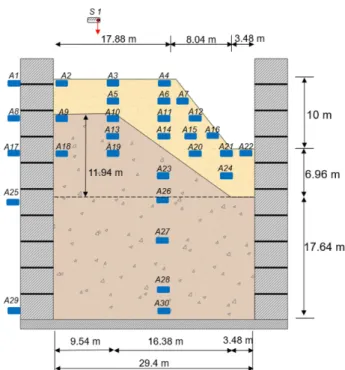
Fig. 1. Centrifuge model test setup for soil slope overlying bedrock slope

displacement. The accuracy and reliability of the method have been demonstrated by observations of natural slopes and laboratory tests. In this method, Newmark considered the slope behavior when the safety factor is less than one and calculated the slope displacement assuming that sliding begins when yield acceleration (k

y

) is exceeded. Many researchers have attempted to estimate the permanent downslope displacements using Newmark basic concept. They have proposed user- friendly charts and equations given different seismic ground motion parameters (Ambraseys & Menu, 1988; Jibson, 1993;

2007; Saygili & Rathje, 2008; Lee et al., 2015). The literature review highlights that the sliding block method is the most extensively used design method for permanent slope displace- ments. However, the traditional Newmark method does not quantify the expected strain effects due to earthquake shaking.

Also, the assumption of soil above the failure surface as a rigid block is not satisfied in flexible slopes. At acceleration below the yield acceleration, the slope does not experience any displacement, which might or might not represent the actual condition in various situations (Jibson, 1993; 2007;

2011). To conduct the Newmark sliding block analysis, one must first determine the sliding surface. However, in previous studies, the effect of input ground motion on the sliding surface is ignored, and failure surface from the limit equilibrium method is used. In contrast, in the stress deformation analysis, the assumption of slope failure surface in the sliding block method is calculated using the increments of plastic shear strains.

The growing need to better predict earthquake-induced slope failures and prediction of seismic displacement makes the mountain slopes increasingly critical. In this study, 2D finite element analyses were performed to investigate the effect of earthquake ground motion characteristics on the sliding surface of mountain slopes. The non-linear behavior of soil was modeled using the elastic-perfectly plastic model following the hysteretic soil behavior. This study utilized the centrifuge test measurements of a slope composed of granular soil overlying the inclined bedrock to validate the numerical model.

2. Centrifuge Model Test

Centrifuge model tests are performed at 60 g acceleration at the centrifuge facility of the Korea Advanced Institute of

Science and Technology (KAIST) centrifuge and earthquake simulator. The centrifuge has a maximum capacity of 240 g-tons and an effective radius of 5 m. The model was prepared in the equivalent shear beam (ESB) model container for dynamic centrifuge tests. ESB model container has been reported to provide a more representative free field boundary condition than the rigid model container (Lee et al., 2013).

Technical specifications of the centrifuge, base plate, and container at the KAIST experimental facility can be found in Lee et al. (2013).

The soil slope configuration at an angle of 51.34° is tested

in the centrifuge test. The centrifugal acceleration employed

for the soil slope test is 60 g, which led to having a prototype

slope model with a slope height, width, and depth of 10.0,

29.4, and 34.64 m, respectively. The bedrock slope angle

is 36°, and the height of the bedrock slope is 11.94 m. A

series of dynamic centrifuge tests are performed to measure

the dynamic performance of the slope. The centrifuge model

was heavily instrumented with accelerometers and laser sensors

to provide a rich data set for comparison with the numerical

analysis. Fig. 1 shows the ESB model container, the soil model,

the location of accelerometers and laser sensors, dimensions

are in prototype scale. The detail of soil properties used in

the centrifuge test is reported in Lee et al. (2020).

(3)

Fig. 2. Numerical model of the slope

Table 1. Soil and bedrock properties

Unit weight (kN/m

3

) Cohesion (kPa) Friction angle (°) Poisson ratio

Soil 17.5 12 39 0.30

Bedrock 21.5 1.2e4 55 0.25

3. Finite Element Model

In this study, LS DYNA software (2D) is used to perform the non-linear dynamic finite element analyses of slope (LSTC, 2007). The 2D finite element model of the slope is depicted in Fig. 2. The dimensions of the numerical model are identical to those of the centrifuge model test on a prototype scale.

Plane strain elements are used to simulate the 2D numerical model. The element size in the numerical analysis is selected such that the minimum propagating wave frequency was 30 Hz.

The base nodes of the model are allowed to move in the lateral direction and be fixed vertically. Due to the difference in the height of boundaries, the equal degree of freedom (EDOF) constraint is not applied to simulate the free field boundary conditions for the lateral boundaries. To avoid the influence of reflected waves at the boundaries on the seismic response of slope and achieve the free field boundaries, soil model width is selected based on the sensitivity study.

In this study, soil materials are modeled using a non-linear hysteretic soil model (MAT-079) in the LS-Dyna material library, which Arup developed. The hysteretic model is a nested yield surface model. Hysteretic behavior is modeled by superposing multiple layers with elastic perfectly plastic materials that act in parallel to result in a backbone curve (LSTC, 2007). The hysteretic soil model has been widely used for seismic site response analyses (Bolisetti, 2015; Bolisetti et al., 2018; Hashash et al., 2018).

Properties of non-linear hysteretic soil model and pressure- dependent non-linear shear modulus reduction curves are developed for each layer using Darendeli (2001) formulation.

The shear strength correction is applied by a generalized quadratic/hyperbolic (GQ/H) constitutive model (Groholski et al., 2016). The coefficient of at-rest lateral earth pressure (ko) was set to 0.37, plasticity index (PI) was assumed as zero, over consolidation ratio (OCR) was set to 1.0, loading frequency and number of loading cycles was set as 1.0 and 10.0, respectively. The bedrock properties are assigned using the dynamic curves of Kim & Choo (2001). Table 1 list the material properties used for soil and bedrock layer.

Frequency independent formulation is used to model the small strain damping. Darendeli (2001) curves are used to select the soil layers small strain damping ratios consistent with the previously completed 1D site response analyses.

The highest and lowest frequency in the range of interest for soil layers are chosen as 30.0 and 0.1 Hz, respectively (Hashash et al., 2018).

4. Validation of Finite Element Model

The following section presents the results of finite element analysis and compared them with the centrifuge results. The comparison discussed in the following section includes the acceleration response spectra at selected accelerometers and the settlement of slope at the laser sensor.

The ground motion selected for the comparison is an

artificial motion. The acceleration time history and 5% damped

acceleration response spectra of artificial motion are shown

in Fig. 3. The artificial motion amplitude is scaled to peak

ground acceleration (PGA) of 0.11 g.

(4)

Fig. 3. Acceleration time history and response spectra for artificial motion

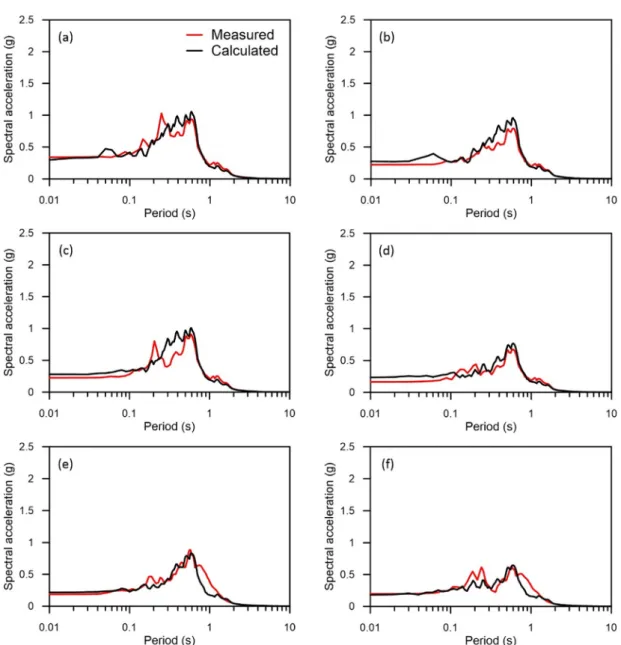
Fig. 4. Comparison of the measured and calculated acceleration response spectra of soil slope overlying inclined bedrock at selected locations: (a) A3, (b) A5, (c) A7, (d) A10, (e) A12, (f) A20

The calculated acceleration response spectra from non-linear finite elements are compared with the centrifuge results at the selected accelerometers A3, A5, A7, A10, A12, and A20 for soil slope overlying the inclined bedrock. Comparisons

demonstrate that the calculated response spectra from non-

linear analysis match favorably with the measurements as

depicted in Fig. 4. Results showed that peak acceleration

response spectra manifested at approximately the same periods

(5)

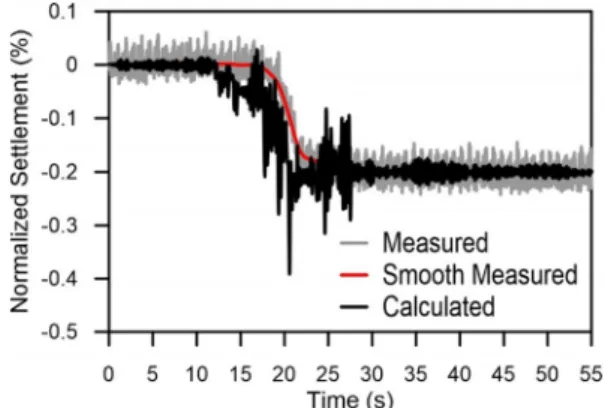
Fig. 5. Comparison of the measured and calculated vertical settlement at S1

Table 2. Input ground motions characteristics

Earthquake PGA (g) Mean period (s)

Whittier narrows 0.188 0.159

Northridge 0.221 0.250

Ofunato 0.186 0.317

in both calculated and measured.

The laser sensor measures the slope settlement due to dynamic loading in the centrifuge test. The measured settlement of slope at the laser sensor S1 in the centrifuge is compared with the calculated as shown in Fig. 5. Results showed that the numerical analysis showed good agreement with centrifuge measurements in terms of the slope settlement. With the application of dynamic loading, the vertical displacement of the slope increases gradually. This indicates that the non-linear soil model can reasonably compute the slope settlement under dynamic loading.

5. Parametric Study

Considering that numerical simulations of the slope model are found to be in good agreement with the measured data.

To further explore the failure surface changes under different earthquakes, input ground motion intensity is varied. The selected slope inclination for soil slope and bedrock slope is 45° and 35°. The soil friction angle was 40° and a cohesion value of 12 kPa for granular soil. Whittier Narrows, Northridge, and Ofunato are three additional ground motions used in the dynamic analysis, and characteristics of motions are listed in Table 2. The motion amplitudes are scaled to four peak ground accelerations (PGA), which are 0.25, 0.50,

0.75, and 1.0 g. The acceleration time history and response spectra for these additional motions are shown in Fig. 6.

6. Results and Discussion

6.1 Pseudo-static Sliding Surface

For the comparison purpose, the commercial software (SLOPE/W) was used to calculate the pseudo-static failure surface using the Morgenstern-Price method. Further analyses were performed to evaluate the effect of static equivalent load on the sliding surface. The sliding surfaces calculated from pseudo-static analysis resulting from for PGA of 0.25, 0.50, 0.75, and 1.0 g and static analysis are shown in Fig. 7.

The equivalent load marginally influences the sliding surface up to an amplitude of 0.50 g and widens at higher PGA, s. The results of the pseudo-static analysis show that the static equivalent load influences the failure surface. In the following section, the sliding surface from the pseudo-static analysis is compared with those determined from dynamic analysis.

6.2 Dynamic Sliding Surface

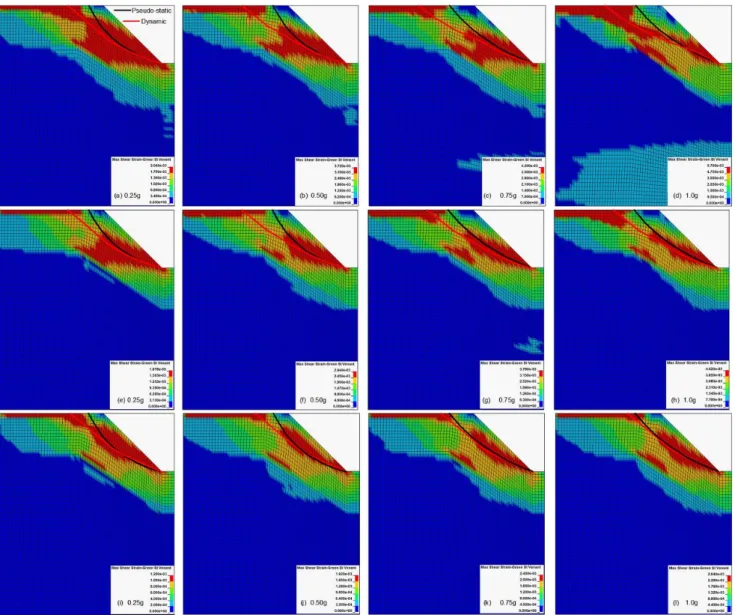
In LS-DYNA, the dynamic slope failure surface is inferred from the shear strains at the end of the seismic analysis. The dynamic critical failure surface will be within the localization of shear strains and points having maximum shear strains in the vertical direction (Zheng et al., 2009). However, for developing the failure surface, a level of smoothing was required.

The effect of amplitude and frequency of input motion is

evaluated in this section. Whittier Narrows, Northridge, and

Ofunato motions are used for the dynamic analysis. Motions

are scaled to four amplitudes, and developed sliding surfaces

are shown in Fig. 8. It can be observed that the sliding

surfaces developed from pseudo-static and dynamic analyses

are different. The result also indicates that the location of the

sliding surface is dependent on the amplitude and frequency

content of input ground motion. The failure surface derived

for Whittier Narrows motion indicates marginal change with

the increase in the amplitude of motion. On the other hand,

sliding surfaces determined from pseudo-static analysis change

(6)

Fig. 6. Acceleration time history and response spectra: (a-b) Whittier narrows (c-d) Northridge (e-f) Ofunato

Fig. 7. Effect of equivalent horizontal load on the sliding surface

with the increase in amplitude. The sliding surface shows a distinct discrepancy between two methods for Northridge and Ofunato motion as the mean period (T

m

) of motion is increasing. This can be attributed to the reason that the longer T

m

generates a longer wavelength and therefore produces a deeper sliding surface.

From the dynamic analysis, it is apparent that characteristics

of earthquake ground motion play a significant part in deter-

mining the sliding surface of slopes, whether as the pseudo-

static method cannot produce a change in sliding surfaces due

to input ground motions. It is seen from the dynamic analysis

that sliding surfaces are affected by both amplitude and T

m

.

However, a limited number of ground motions and slope

characterization is used in this study, and it is not possible

(7)

Fig. 8. Effect of input motion on the slope failure surface: (a-d) Ofunato (e-h) Northridge (i-l) Whittier narrows

to quantify the effect. Although, based on the observations, it is demonstrated that the sliding surface needs to be determined from dynamic analysis instead of pseudo-static analysis.

7. Conclusions

The objective of this paper was to investigate the effect of earthquake ground motion characteristics on the sliding surface. A comprehensive suite of 2D non-linear dynamic finite element analyses were performed. The non-linear behavior of soil was modeled using the elastic-perfectly plastic model following the hysteretic soil behavior. The performance of finite element model was validated against centrifuge measurements.

In this study, input ground motions of different intensities and T

m

are used to carry out the dynamic finite element

analyses. The dynamic slope failure surface is inferred from the shear strains at the end of the seismic analysis. In addition to dynamic analysis, pseudo-static analyses were performed to evaluate the discrepancy. It is observed that sliding surfaces developed from pseudo-static and dynamic analyses are different.

The location of the failure surface change with the amplitude and T

m

of motion. Therefore, it is recommended to determine failure surfaces from dynamic analysis.

Acknowledgment

This research was supported by the Korea Agency for

Infrastructure Technology Advancement (KAIA) grant funded

by the Ministry of Land, Infrastructure and Transport (Grant

21CTAP-C164148-01).

(8)

References

1. Ambraseys, N. and Menu, J. (1988), Earthquake‐induced ground displacements, Earthquake engineering & structural dynamics, Vol. 16, No. 7, pp. 985~1006.

2. Baker, R., Shukha, R., Operstein, V. and Frydman, S. (2006), Stability charts for pseudo-static slope stability analysis, Soil Dynamics and Earthquake Engineering, Vol. 26, No. 9, pp.

813~823.

3. Bolisetti, C. (2015), Site response, soil-structure interaction and structure-soil-structure interaction for performance assessment of buildings and nuclear structures,Research Report 1321569084, State University of New York at Buffalo.

4. Bolisetti, C., Whittaker, A. S. and Coleman, J. L. (2018), Linear and nonlinear soil-structure interaction analysis of buildings and safety-related nuclear structures, Soil Dynamics and Earthquake Engineering, Vol. 107, pp. 218~233.

5. Darendeli, M. B. (2001), Development of a new family of normalized modulus reduction and material damping curves, Ph.D. Thesis, University of Texas at Austin, Texas, USA.

6. Groholski, D. R., Hashash, Y. M. A., Kim, B., Musgrove, M., Harmon, J. and Stewart, J. P. (2016), Simplified Model for Small-Strain Nonlinearity and Strength in 1D Seismic Site Response Analysis, Journal of Geotechnical and Geoenvironmental Engineering, Vol. 142, No. 9, pp. 04016042.

7. Hashash, Y. M. A., Dashti, S., Musgrove, M., Gillis, K., Walker, M., Ellison, K. and Basarah, Y. I. (2018), Influence of Tall Buildings on Seismic Response of Shallow Underground Structures, Journal of Geotechnical and Geoenvironmental Engineering, Vol. 144, No. 12, pp. 04018097.

8. Hynes, M. E. and Franklin, A. G. (1984), Rationalizing the seismic coefficient method.

9. Jibson, R. W. (1993), Predicting earthquake-induced landslide displacements using Newmark’s sliding block analysis, Trans- portation research record, Vol. 1411, pp. 9~17.

10. Jibson, R. W. (2007), Regression models for estimating coseismic landslide displacement, Engineering geology, Vol. 91, No. 2~4, pp. 209~218.

11. Jibson, R. W. (2011), Methods for assessing the stability of slopes during earthquakes—A retrospective, Engineering geology, Vol. 122, No. 1~2, pp. 43~50.

12. Keefer, D. K. (1984), Landslides caused by earthquakes, Geological Society of America Bulletin, Vol. 95, No. 4, pp. 406~421.

13. Kim, D.-S. and Choo, Y.-W. (2001), Deformation Characteristics

of Hydraulic-Filled Choesionless Soils in Korea.

14. Kramer, S. L. (1996), Geotechnical earthquake engineering, Prentice-Hall, Upper Saddle River, NJ, United.

15. Kwag, S., Hahm, D., Kim, M. and Eem, S. (2020), Develop- ment of a probabilistic seismic performance assessment model of slope using machine learning methods, Sustainability, Vol.

12, No. 8, pp. 3269.

16. Lee, J. H., Ahn, J. K. and Park, D. (2015), Prediction of seismic displacement of dry mountain slopes composed of a soft thin uniform layer, Soil Dynamics and Earthquake Engineering, Vol. 79, pp. 5~16.

17. Lee, S.-H., Choo, Y.-W. and Kim, D.-S. (2013), Performance of an equivalent shear beam (ESB) model container for dynamic geotechnical centrifuge tests, Soil Dynamics and Earthquake Engineering, Vol. 44, pp. 102~114.

18. Lee, Y., Kim, H.-S., Khalid, M. I., Lee, Y. and Park, D.

(2020), Effect of Nonlinear Soil Model on Seismic Response of Slopes Composed of Granular Soil, Advances in Civil Engineering.

19. Loáiciga, H. A. (2015), Groundwater and earthquakes: Screening analysis for slope stability, Engineering geology, Vol. 193, pp.

276~287.

20. LSTC (2007), LS-DYNA Theory Manual.

21. Naik, S. P., Gwon, O., Park, K. and Kim, Y.-S. (2020), Land damage mapping and liquefaction potential analysis of soils from the epicentral region of 2017 Pohang Mw 5.4 earthquake, South Korea, Sustainability, Vol. 12, No. 3, pp. 1234.

22. Newmark, N. M. (1965), Effects of earthquakes on dams and embankments, Geotechnique, Vol. 15, No. 2, pp. 139~160.

23. Park, S., Kim, W., Lee, J. and Baek, Y. (2018), Case study on slope stability changes caused by earthquakes—Focusing on Gyeongju 5.8 ML EQ, Sustainability, Vol. 10, No. 10, pp.

3441.

24. Saygili, G. and Rathje, E. M. (2008), Empirical predictive models for earthquake-induced sliding displacements of slopes, Journal of Geotechnical and Geoenvironmental Engineering, Vol. 134, No. 6, pp. 790~803.

25. Seed, H. B. (1979), Considerations in the earthquake-resistant design of earth and rockfill dams, Geotechnique, Vol. 29, No.

3, pp. 215~263.

26. SLOPE/W GEO-SLOPE International, Calgary, Alberta, Canada.

27. Zheng, H., Sun, G. and Liu, D. (2009), A practical procedure for searching critical slip surfaces of slopes based on the strength reduction technique, Computers and Geotechnics, Vol. 36, No.

1~2, pp. 1~5.

수치

Fig. 1. Centrifuge model test setup for soil slope overlying bedrock  slope
Fig.  2.  Numerical  model  of  the  slope
Fig.  4.  Comparison  of  the  measured  and  calculated  acceleration  response  spectra  of  soil  slope  overlying  inclined  bedrock  at  selected  locations:  (a)  A3,  (b)  A5,  (c)  A7,  (d)  A10,  (e)  A12,  (f)  A20
Fig. 5. Comparison of the measured and calculated vertical settlement  at  S1
+3

참조

관련 문서

- Spring is any natural occurrence where water flows on to the surface of the earth from below the surface (aquifer surface meets the ground surface)5. - Ground

 depends on the size and shape of the drainage area, type of surface, slope of the drainage area,. rainfall intensity, and whether the flow is entirely over land

It considers the energy use of the different components that are involved in the distribution and viewing of video content: data centres and content delivery networks

After first field tests, we expect electric passenger drones or eVTOL aircraft (short for electric vertical take-off and landing) to start providing commercial mobility

1 John Owen, Justification by Faith Alone, in The Works of John Owen, ed. John Bolt, trans. Scott Clark, "Do This and Live: Christ's Active Obedience as the

"Policy Analytical Capacity as a Source of Policy Failure." Paper Prepared for the Workshop on Policy Failure, Annual Meeting of the Canadian

Microstructure of coated layers of (a) hydroxyapatite, (b) 7H3TCP and (c) 7H3W on zirconia substrate and their element composition on coated surface... XRD analysis

12 As such, using finite element modeling, the effect of stress distribution around the internal non-submerged type implants on marginal bone resorption