* 1 접수 2008년 3월 14일, 채택 2008년 5월 2일
* 2 강원대학교 산림환경과학대학. College of Forest and Environmental Sciences, Kangwon National University, Chuncheon 200-701, Korea
† 주저자(corresponding author) : 김남훈(e-mail: [email protected])
국내산 주요 침엽수 3종의 수간 내 마이크로피브릴 경사각의 변이
*1은 동 진*2⋅김 남 훈*2†
Variation of Microfibril Angle Within Stems of Three Commercial Softwoods Grown in Korea
Dong-Jin Eun*2⋅Nam-Hun Kim*2†
요 약
국내에서 생장한 주요 침엽수 3종(소나무, 잣나무, 리기다소나무)의 수간 내 마이크로피브릴 경사각 (microfibril angle, MFA)의 축방향 및 방사방향 변이를 요오드 침적법에 의해 조사하였다. 각 수종의 MFA의 평균값은 소나무 16.4°, 잣나무 14.4°, 리기다소나무 26.2°로 리기다소나무가 가장 크게 나타났다. 공시 수종의 MFA는 약 15∼20 연륜까지 감소하다가 그 후 거의 안정된 경향을 보여 주었고 만재부의 MFA는 조재부의 MFA 보다 다소 작은 경향이 있었다. 공시재료의 수고에 따른 MFA의 차이는 기부 부분에서 다소 크게 나타났으며 수고가 증가함에 따라 MFA는 감소하는 경향이 있었으나 리기다소나무 조재부는 예외였다. 따라서 MFA는 국내 산 주요 침엽수재의 미성숙재와 성숙재를 구분하는 지표의 하나로 이용이 가능할 것으로 생각되었다.
ABSTRACT
Radial and axial variations of microfibril angle (MFA) within stems of three commercial softwoods (Pinus densiflora, Pinus koraiensis and Pinus rigida) grown in Korea were examined by iodine crystal deposition method. The average MFA were 16.4° in Pinus densiflora, 14.4, in Pinus koraiensis, and 26.2° in Pinus rigida, respectively. The MFA in earlywood and latewood decreased with age to about 15∼20 years, and then remained almost constant. The MFA of latewood was slightly smaller than that of earlywood. The MFA in the three species was a little smaller at the base of stem and decreased slightly with increasing tree height, but no significant
difference by height was identified only in earlywood of Pinus rigida. Consequently, it was considered that the MFA could be an useful index for identifying juvenile wood and adult wood of Pinus densiflora, Pinus. koraiensis and Pinus rigida.
Keywords : microfibril angle (MFA), iodine crystal deposition, Pinus densiflora, Pinus koraiensis, Pinus rigida
1. 서 론
목재는 수종 간, 개체 간, 부위 간에 따라 재질의 차이가 나타난다. 따라서 목재의 효율적 이용을 위 해서는 재질 변이성을 평가하는 기준 항목의 마련이 중요하다. 이를 위해 연륜폭(Zhu et al., 1998;
Fujiwara and Yang, 2000), 마이크로피브릴 경사각 (Lichtenegger et al., 1999; Wahsusen et al., 2005;
이와 김 2005), 상대결정화도(이와 김, 1992; 김과 이, 1998; Jahan and Mun, 2005), 만재율과 비중 (Bao et al., 2001; Alteyrac et al., 2006), 가도관 길이(이와 김 2005) 등을 측정하여 재질 판단의 기 준으로 사용하고 있다. 특히, 목재 세포벽 중의 마이 크로피브릴 경사각은 목재의 재질적 특성에 크게 영 향을 끼치기 때문에 그 변이 양식의 구명이 요구되 고 있다.
목재 세포벽 중의 마이크로피브릴은 셀룰로오스 사 슬(cellulose chain)이 규칙적인 배열 구조를 갖는 결정영역과 불규칙적인 배열 구조를 갖는 비결정영 역, 양자의 중간 구조인 준결정영역으로 형성되어 있 다. 이러한 마이크로피브릴의 배열과 형태는 세포벽 층에 따라 다르다. 1차벽은 마이크로피브릴이 무질서 하게 배향되어 있는 망상구조로 이루어져 있으나 S1, S2 및 S3층으로 구성된 2차벽은 비교적 마이크로피브 릴의 배향이 규칙성을 보이고 있다(Wardrop, 1965).
그 중 S2층이 가장 두껍고 S2층의 마이크로피브릴의 배향이 목재의 재질적 특성을 나타내는데 매우 중요 한 역할을 하므로 MFA를 측정하여 재질 지표로 이 용하고 있다. Bendtsen과 Senft(1986)는 loblolly pine의 수심과 성숙재 부위를 비교하여 연륜 증가에 따라 마이크로피브릴 경사각(MFA)은 감소하고 비 중, MOR및 MOE는 증가한다고 보고하였다. 또한
MFA가 증가하면 축방향 수축률은 증가하며(Cave and Hutt, 1969), MFA가 감소하면 인장강도, 강도, 치수안정성은 증가한다고 하였다(Evans and Ilic, 2001). Douglas-fir (Erickson and Arima, 1974), Japanese cedar (Wang and Chiu, 1988)와 lo- blolly pine (Leaft and Bremer, 1998; Ying et al., 1994)에 대한 연구에서 MFA는 수심부에 가까울수 록 크고, 수심부로부터 10에서 15연륜까지 감소하다 가 그 이후부터 일정한 경향을 나타낸다고 보고하였 다.
MFA의 측정에는 편광현미경법 및 X선회절법을 이용한 간접적인 측정 방법과 S2층의 마이크로 피브 릴의 이미지를 이용한 요오드 결정 침적법과 같은 직접적인 측정 방법이 있다. 이 중 요오드 결정 침적 법은 S2층의 마이크로피브릴 사이에 요오드 결정을 침적시켜 광학현미경으로 관찰하는 방법으로 정확 하고 비교적 일관된 값을 나타내어 정확한 MFA의 측정이 요구될 때 사용된다(Huang, 1995).
본 연구에서는 최근 국내에서 생산과 이용량이 급 증하고 있는 중요 목재 자원인 소나무, 잣나무 및 리 기다소나무의 과학적이고 효율적인 이용을 위한 주 요 기초 특성의 하나가 될 수 있는 축방향 및 방사방 향의 MFA의 변이성을 조사, 검토하였다.
2. 재료 및 방법
2.1. 공시재료
강원대학교 구내림에서 비교적 생장이 양호한 소 나무, 잣나무, 리기다소나무 각 1본을 채취하여 공 시재료로 사용하였다(Table 1).
Table 1. Sample trees
Species Tree age Height (m) DBH* (cm) Locality
Pinus densiflora S. et Z. 47 13.5 47
Chuncheon, Korea
Pinus koraiensis S. et Z. 35 13.5 35
Pinus rigida Mill. 34 11.5 24
* Diameter at breast height
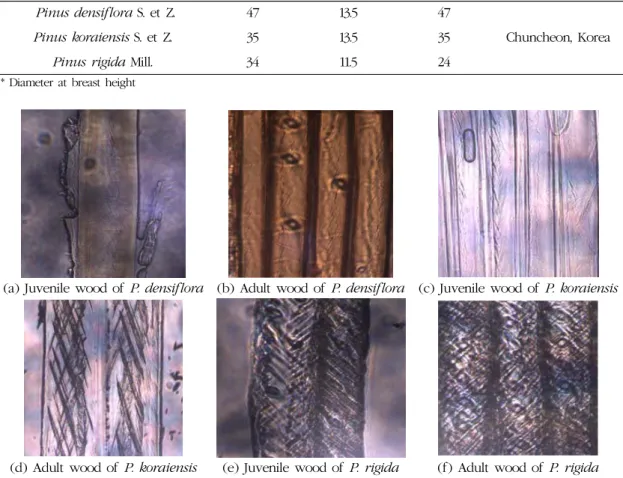
(a) Juvenile wood of P. densiflora (b) Adult wood of P. densiflora (c) Juvenile wood of P. koraiensis
(d) Adult wood of P. koraiensis (e) Juvenile wood of P. rigida (f) Adult wood of P. rigida
Fig. 1. Optical micrographs of iodine-crystal deposited tracheids in the sample trees.
2.2. 실험방법
2.2.1. 시료 제작
각 수종 별로 0.2, 1.2, 3.2, 5.2, 7.2, 9.2 및 11.2 m 높이에서 원판을 채취하였다. 각 원판의 수심에 서 수피방향으로 각 연륜 마다 조재부와 만재부를 구분하여 두께(R방향) 약 0.5 mm, 길이(L방향) 10 mm, 폭(T방향) 0.5 mm의 크기로 각각 2∼3개씩 제 작하였으며 제작된 시료는 실리카젤이 들어있는 데 시케이터 내에 보관하였다.
2.2.2. 마이크로피브릴 경사각(MFA) 측정
제작된 시료를 Schϋltze 용액으로 해리한 후, 알코 올로 탈수 처리(50%, 70%, 90%, 99%, 각 20분)하 고 요오드(I2)․요오드칼륨(KI) 용액에 약 5초간 침 지하였다. 슬라이드글라스에 해리된 시료를 올려놓 고 60% 질산 용액을 약 1∼2방울 떨어뜨려 일시슬라 이드를 제작하여 요오드 결정이 침적된 부분에서 마 이크로피브릴의 배향과 세포 축과의 경사각을 각 시 료 당 10회씩 측정하였다(Senft and Bendtsen, 1985; Huang et al., 1997).
각 수종의 평균치 통계 분석은 각 수종의 조재, 만
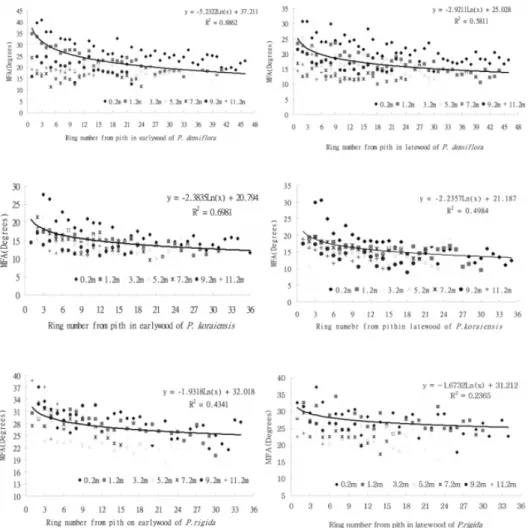
Fig. 2. Variation patterns of microfibril angle with age in the sample trees.
재, 미성숙재, 성숙재 부위 및 각 수종별 전체 결과 를 이용하였다.
3. 결과 및 고찰
3.1. 방사방향 변이
Fig. 1은 공시 수종의 미성숙재와 성숙재 부위의 가 도관 세포벽의 사진이다. 가도관 세포벽에 요오드 결 정이 침적되어 있어 축방향과 어느 정도 경사져서 배 열되어 있는 마이크로피브릴을 쉽게 관찰할 수 있다.
Fig. 2는 각 수종의 수에서 수피방향으로의 연륜 증가에 따른 조재와 만재 부위의 MFA를 측정한 결 과이다. 공시수종의 MFA는 수에서 크고 약 15∼20 연륜까지 감소하다가 그 후 거의 일정해지는 경향을 나타냈다. Zhang et al. (2007)은 중국 적송 수간 내 의 MFA에 관한 연구에서 수심부에서 높고 수피방향 으로 10연륜까지 급격히 감소하다 거의 일정해진다고 하였다. 또한 Shengzuo et al. (2006)은 포플러 7개 체의 MFA에 대한 연구에서 수에서 수피방향으로 감 소한다고 보고하고 있다. Matsumura와 Butterfield (2001)는 radiata pine과 nigra pine의 기부에서 MFA를 측정한 결과 두 수종 모두 수에서 수피방향으
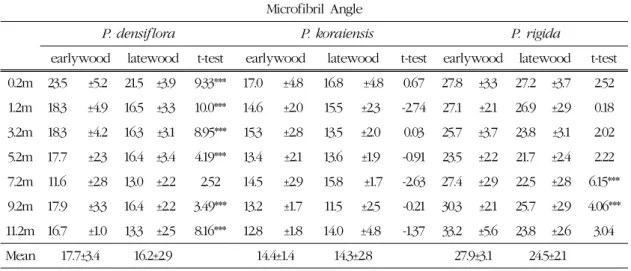
Table 2. Mean microfibril angle at each height of sample trees
Microfibril Angle
P. densiflora P. koraiensis P. rigida
earlywood latewood t-test earlywood latewood t-test earlywood latewood t-test 0.2m 23.5 ±5.2 21.5 ±3.9 9.33*** 17.0 ±4.8 16.8 ±4.8 0.67 27.8 ±3.3 27.2 ±3.7 2.52 1.2m 18.3 ±4.9 16.5 ±3.3 10.0*** 14.6 ±2.0 15.5 ±2.3 -2.74 27.1 ±2.1 26.9 ±2.9 0.18 3.2m 18.3 ±4.2 16.3 ±3.1 8.95*** 15.3 ±2.8 13.5 ±2.0 0.03 25.7 ±3.7 23.8 ±3.1 2.02 5.2m 17.7 ±2.3 16.4 ±3.4 4.19*** 13.4 ±2.1 13.6 ±1.9 -0.91 23.5 ±2.2 21.7 ±2.4 2.22 7.2m 11.6 ±2.8 13.0 ±2.2 2.52 14.5 ±2.9 15.8 ±1.7 -2.63 27.4 ±2.9 22.5 ±2.8 6.15***
9.2m 17.9 ±3.3 16.4 ±2.2 3.49*** 13.2 ±1.7 11.5 ±2.5 -0.21 30.3 ±2.1 25.7 ±2.9 4.06***
11.2m 16.7 ±1.0 13.3 ±2.5 8.16*** 12.8 ±1.8 14.0 ±4.8 -1.37 33.2 ±5.6 23.8 ±2.6 3.04
Mean 17.7±3.4 16.2±2.9 14.4±1.4 14.3±2.8 27.9±3.1 24.5±2.1
* P< 0.0005, ** P< 0.005, *** P<0.05
로 10∼15연륜까지 점차 감소하다가 그 후 안정된 경 향을 보인다고 보고하였다. 이와 유사한 연구 결과 는 비교적 많은 편이다(Ying et al., 1994; Megraw et al., 1997). 이러한 MFA의 수간 내 변이성은 성 숙재와 미성숙재를 구분할 수 있는 중요한 지표로 생각된다.
3.2. 축방향 변이
Table 2는 수고 별 조재와 만재 부위의 MFA 측정 결과이다. 소나무, 잣나무, 리기다소나무의 기부에 서는 다른 수고 위치에 비하여 다소 큰 MFA가 나타 났다. 또한 수고가 증가함에 따라 MFA는 점차 감소 하는 경향을 보였다. 그러나 리기다소나무 조재는 수고에 따른 차이는 거의 보이지 않았다. Sahlberg et al. (1997)은 X선 회절을 이용한 독일가문비나무 의 수고에 따른 축방향 MFA의 변이는 모든 수고 위 치의 미성숙재 부근에서 연륜 증가에 따라 MFA는 감소하며, 성숙재 부근의 MFA는 모든 수고 위치에 서 일정한 값을 나타낸다고 보고하였다. Shengzuo et al. (2006)은 MFA는 기부에서 높고 수고가 증가 함에 따라 감소하는 경향이 나타난다고 하였는데 이
는 본 연구의 결과와 일치한다. 그러나 Zhang et al.
(2007)은 X선을 이용한 중국 적송의 MFA 변이성에 관한 연구에서 수고에 따른 MFA의 차이는 없다고 보고 하여 본 연구와 다른 결과를 나타내었다. 이처 럼 수고에 따른 MFA의 변이성은 일정하지 않아 목 재의 재질을 평가하기 위한 지표로 이용하기는 어려 울 것으로 생각되었다.
각 수종별 수고에 따른 조재와 만재 부위의 MFA 유의성을 검정한 결과, 소나무 0.2, 1.2, 3.2, 5.2, 9,2 및 11.2m 그리고 잣나무 7.2 및 9.2m 부위에서 부분적으로 유의성이 인정되었다. 따라서 각 수종별 수고에 따른 조재와 만재 부위의 MFA 상관관계는 다소 다른 경향을 나타냈다.
3.3. 각 수종별, 부위별 MFA 차이
각 수종의 성숙재와 미성숙재, 조재와 만재 부위 의 MFA를 Table 3에 나타냈다. 3수종의 MFA 평균 값은 소나무 16.4°, 잣나무 14.4°, 리기다소나무 26.2°로써 잣나무가 가장 낮게 나타났다. 성숙재와 미성숙재를 구분하여 MFA를 측정한 결과 소나무 미성숙재 20.1°, 성숙재 16.1°, 잣나무 미성숙재 15.7°, 성숙재 13.6°, 리기다소나무 미성숙재 26.9°,
Table 3. Mean microfibril angle by position in the sample trees
MFA (Degree)
P. densiflora t-test P. koraiensis t-test P. rigida t-test JW vs AW 20.1 ± 1.9 18.4 ± 1.2 4.864*** 15.7 ± 1.6 13.6 ± 1.0 4.764*** 26.9 ± 1.9 24.7 ± 0.2 3.908***
EW vs LW 17.7 ± 3.4 16.1 ± 2.9 24.13*** 14.4 ± 1.4 14.3 ± 2.8 -0.913 27.9 ± 3.1 24.5 ± 2.1 3.670***
Mean 16.4 ± 1.1 14.4 ± 0.05 26.2 ± 2.6
JW: Juvenile wood, AW: Adult wood, EW: Earlywood, LW: Latewood
* P< 0.0005, ** P< 0.005, *** P<0.05
성숙재 24.7°로 미성숙재가 성숙재보다 높게 나타났 다. Sahlberg et al. (1997)은 노르웨이가문비나무와 독일가문비나무의 MFA에 대한 연구에서 10연륜 이 전 미성숙재 부분의 MFA는 10연륜 이후의 성숙재 부분의 MFA보다 높다고 보고하였다. 또한 각 수종 별 조재와 만재 부위의 MFA는 소나무 조재 17.7°, 만재 16.1°, 잣나무 조재 14.4°, 만재 14.3°, 리기다소 나무 조재 27.9°, 만재 24.5°로써 만재부가 조재부보 다 다소 낮게 나타났는데 이는 이전의 연구 결과와 비슷하였다(Megraw et al., 1997; 이와 김, 2005).
각 수종의 성숙재와 미성숙재, 조재와 만재 부위 사이의 MFA 유의성을 검토한 결과 잣나무 조재부 와 만재부를 제외한 모든 부위에서 유의성이 인정되 었다.
4. 결 론
최근 국내에서 생산과 이용량이 급증하고 있는 중 요 목재 자원인 소나무, 잣나무 및 리기다소나무의 재질 특성을 이해하기 위한 기준을 마련하기 위하여 수간 내에서 방사방향 및 축방향의 MFA의 변이성 을 조사, 검토 결과는 다음과 같다.
1) MFA는 수심부에서 크고 수피 쪽을 향해 약 15
∼20연륜까지 감소하다가 그 후 거의 안정되는 경향 을 나타냈다.
2) 만재부의 MFA는 조재부의 MFA보다 다소 작 은 값을 나타냈다.
3) MFA는 리기다소나무가 가장 컸으며 소나무, 잣나무 순이었다.
4) MFA는 기부에서 다소 큰 값이 나타났으며, 수 고가 증가함에 따라 그 값은 다소 감소하는 경향을 보였다.
사 사
본 연구는 강원대학교 산림과학연구소의 지원에 의하여 수행되었음.
참 고 문 헌
1. Alteyrac, J., A. Cloutier, and S. Y. Zhang. 2006.
Characterization of juvenile wood to transition age in black spruce (Picea mariana (Mill.) B. S.
P.) at different stand densities and sampling heights. Wood Science and Technology. 40: 124∼ 138.
2. Bao, F. C., Z. H. Jiang, X. M. Jiang, X. X. Lu, X. Q.
Luo, and S. Y. Zhang. 2001. Differences in wood properties between juvenile wood and mature wood in 10 species grown in China. Wood Science and Technology, 35: 363∼375.
3. Bendtsen, B. A. and J. F. Senft. 1986. Mechanical and anatomical properties in individual growth rings of plantation-grown eastern cottonwood and loblolly pine. Wood and Fiber Science. 18(1):
23∼38
4. Cave, I. D. and L. Hutt. 1969. The longitudinal young’s modulus of Pinus radiata. Wood Science and Technology. 3: 40∼48.
5. Erickson, H. D. and T. Arima. 1974. Douglas-fir wood quality studies. Part II: Effects of age and
stimulated growth on fibril angle and chemical constituents. Wood Science and Technology.
8(4): 255∼265.
6. Evans, R. and J. Ilic. 2001. Rapid prediction of wood stiffness from microfibril angle and density. Forest Product Journal. 51(3): 53∼57.
7. Fujiwara, S. and K. C. Yang. 2000. The relation- ship between cell length and ring width and cir- cumferential growth rate in five canadian species. IAWA Journal. 21(3): 335∼345.
8. Huang, C. L. 1995. Revealing fibril angle in wood sections by ultrasonic treatment. Wood and Fiber Science. 27(1): 49∼54.
9. Huang, C. L., N. P. Kutscha, G. J. Leaf, and R. A.
Megraw. 1997. Comparison of microfibril meas- urement techniques. Microfibril angle in wood, Proceeding of the IAWA/IUFRO International Workshop on the significance of microfibril an- gle to wood quality, New Zealand, November pp. 177∼205.
10. Jahan, M. S. and S. P. Mun. 2005. Effect of tree age on the cellulose structure of nalita wood (Trema orientalis). Wood Science and Technology. 39: 637∼373.
11. Leaft, G. and D. Bremer. 1998. Longitudinal shrinkage and microfibril angle in loblolly pine.
In: Microfibril angle in wood. B. G. Butterfield, ed. University of Canterbury Press, Christchurch, New Zealand, pp. 27∼61,
12. Lichtenegger, H., A. Reiterer, S. E. Stanzel-Tschegg, and P. Fratzl. 1999. Variation of cellulose micro- fibril angles in softwood and hardwoods: A pos- sible strategy of mechanical optimization.
Journal of Structural Biology. 128: 257∼269.
13. Matsumura, J. and B. G. Butterfield. 2001.
Microfibril angles in the root wood of Pinus ra- diata and Pinus nigra. IAWA Journal. 22(1): 57∼ 62.
14. Megraw, R. A., G. Leaf, D. Bremer, and C.
Weyerhaeuser. 1997. Longitudinal shrinkage and microfibril angle in loblolly pine. Microfibril an- gle in wood, Proceeding of the IAWA/IUFRO International Workshop on the significance of microfibril angle to wood quality, New Zealand, November pp. 27∼61.97.
15. Sahlberg, U., L. Salmén, and A. Oscarsson. 1997.
The fibrillar orientation in the S2-layer of wood fibres as determined by X-ray diffraction analysis. Wood Science and Technology. 31: 77∼ 86.
16. Senft, J. F. and B. A. Bendtsen. 1985. Measuring microfibrillar angle using light microscopy.
Wood and Fiber Science. 17(4): 564∼567.
17. Shengzuo F., Y. Wenzhong, and T. YE. 2006.
Clonal and within-tree variation in microfibril angle in poplar clones. New Forests. 31: 373∼383.
18. Wang, S. Y. and C. M. Chiu. 1988. The wood properties of Japanese cedar originated by seed vegetative reproduction in Taiwan. III. The var- iation of microfibril angles of tracheids. Mokuzai Gakkaishi 34(11): 881∼888.
19. Wardrop, A. B. 1965. Cellular differentiation in xylem. In: Cellular ultrastructure of woody plants. W. A. Cote, ed. Syracuse University Press, Syracuse, NY., pp. 61∼97.
20. Washusen, R., R. Evans, and S. Southerton. 2005.
A study of Eucalyptus grandis and Eucalyptus globulus branch wood microstructure. IAWA Journal. 26(2): 203∼210.
21. Ying, L., D. E. Kretschmann, and B. A. Bendtsen.
1994. Longitudinal shrinkage in fast-grown lo- blolly pine plantation wood. Forest Products Journal. 44(1): 58∼62.
22. Zhang, B., B. H. Fei, Y. Yan, and R. J. Zhao. 2007.
Microfibril angle variability in masson pine (Pinus massoniana Lamb.). Forestry Studies in China. 9(1): 33∼38.
23. Zhu, J., T. Nakano, and Y. Hirakawa. 1998. Effect of growth on wood properties for Japanese larch (Larix kaempferi): Difference of annual ring structure between corewood and outer- wood. Journal of Wood Science. 44: 392∼396.
24.김남훈, 이기영. 1998. 편백(Chamaecyparis obtusa E.) 수간내에서의 결정상태의 변이성. 목재공학 26(4):
20∼28.
25. 이소미, 김병로. 2005. 일본잎갈나무 수간내 재질변동 에 관한 연구(Ⅱ): 가도관 길이와 폭, 마이크로피브릴 경각, 강도의 납북방향 변동. 목재공학 33(1): 21∼28.
26.이원용, 김남훈. 1992. X선회절법에 의한 주요 침․활 엽수재의 미세구조 해석. 목재공학 20(1): 28∼37.