• 검색 결과가 없습니다.

Expression Analysis of Oryza sativa Ascorbate Peroxidase 1 (OsAPx1) in Response to Different Phytohormones and Pathogens

N/A
N/A
Protected

Academic year: 2021

Share "Expression Analysis of Oryza sativa Ascorbate Peroxidase 1 (OsAPx1) in Response to Different Phytohormones and Pathogens"

Copied!
7
0
0

로드 중.... (전체 텍스트 보기)

전체 글

(1)

Expression Analysis of Oryza sativa Ascorbate Peroxidase 1 (OsAPx1) in Response to Different Phytohormones and Pathogens

Yiming Wang

1

, Jingni Wu

1

, Young Whan Choi

2

, Tae Hwan Jun

3

, Soon Wook Kwon

3

, In Soo Choi

3

, Yong Chul Kim

3

, Ravi Gupta

3

and Sun Tae Kim

3

*

1

Department of Plant Microbe Interactions, Max Planck Institute for Plant Breeding Research, Cologne 50829, Germany

2

Department of Horicultural Bioscience, Pusan National University, Miryang 627-706, Korea

3

Department of Plant Bioscience, Pusan National University, Miryang 627-706, Korea Received June 29, 2015 /Revised July 30, 2015 /Accepted August 6, 2015

We have isolated and characterized an ascorbate peroxidase (APx) gene, OsAPx1 from rice. Northern and Western blot analyses indicated that at young seedling stage, OsAPx1 mRNA was expressed high- ly in root, shoot apical meristem (SAM) and leaf sheath than leaf. In mature plant, OsAPx1 gene ex- pressed highly in root, stem and flower but weakly in leaf. OsAPx1 gene and protein expression level was induced in leaves inoculated with Magnaporthe oryzae (M. oryzae) and Xanthomonas oryzae pv. or- yzae (Xoo). Phytohormones treatment showed that OsAPx1 was up-regulated by jasmonic acid (JA), but was down regulated by ABA and SA co-treatments with JA, resulting that they have antagonistic ef- fect on pathogen responsive OsAPx1 expression. Phylogenetic analysis illustrated that Arabidopsis AtAPx1 has a close relationship with OsAPx1. In AtAPx1 knock out lines, the accumulation of O

2-

and H

2

O

2

are all highly detected than wild type, revealing that the high concentration of exogenous H

2

O

2

cause the intercellular superoxide anion and hydrogen peroxide accumulation in AtAPx1 knockout plant. These results suggested that OsAPx1 gene may be associated with the pathogen defense cas- cades as the mediator for balancing redox state by acting ROS scavenger and is associated with re- sponse to the pathogen defense via Jasmonic acid signaling pathway.

Key words : Ascorbate peroxidase, phytohormone, ROS, shoot apical meristem

*Corresponding author

*Tel : +82-55-350-5505, Fax : +82-55-350-5509

*E-mail : [email protected]

This is an Open-Access article distributed under the terms of the Creative Commons Attribution Non-Commercial License (http://creativecommons.org/licenses/by-nc/3.0) which permits unrestricted non-commercial use, distribution, and reproduction in any medium, provided the original work is properly cited.

Journal of Life Science 2015 Vol. 25. No. 10. 1091~1097 DOI : http://dx.doi.org/10.5352/JLS.2015.25.10.1091

Introduction

Reactive oxygen species (ROS), which are formed from excitation or incomplete reduction of molecular oxygen, are unwelcome harmful by-products of normal cellular metabo- lism in aerobic organisms [13]. These partially reduced or activated derivatives of oxygen, such as singlet oxygen, su- peroxide anions, hydrogen peroxide and hydroxyl radical, are highly reactive and toxic not only to mammals, but also to the other life forms including plants, and can lead to the oxidative destruction of cells [2]. H

2

O

2

is a major ROS which is generated in cells by the direct transfer of two electrons to the superoxide anion [8]. During the perception process of abiotic and biotic stresses, the rate of cellular H

2

O

2

pro- duction is enhanced dramatically as a consequence of super-

oxide dismutase activation, which catalyze the conversion of O

2-

to H

2

O

2

, and also activates the NADPH-dependent oxidase system [5, 15].

In plant cells, ROS overproduction is induced by biotic and abiotic stresses, such as salt, drought, high light, patho- gen, etc. To avoid the toxicity of ROS, aerobic cells are pro- vided with a flexible set of enzymes and metabolites in- volved in ROS catabolism, which often acts at the site of ROS production [12]. These enzymes and metabolites main- tain the homeostasis of ROS in plant cells. Major ROS-scav- enging enzymes in plants include superoxide dismutase (SOD), ascorbate peroxidase (APx), catalase (CAT), gluta- thione peroxidase (GPx) and peroxiredoxin (PrxR). Together with the antixoidants ascorbic acid and glutathione, these enzymes provide cells with highly efficient machinery for detoxifying O

2-

and H

2

O

2

. The ROS network of these various scavenging enzymes can be found in almost every sub- cellular compartment. A particular ROS signal can be scav- enged by more than one enzymatic scavenger in each of the different compartments [16].

Ascorbate peroxidase (APx) exists as isoenzymes and

plays an important role in the metabolism of H

2

O

2

in higher

(2)

plants. APx utilizes ascorbate (ASC) as its specific electron donor to reduce H

2

O

2

to water with the concomitant gen- eration of monodyehydroascorbate (MDHAR), a univalent oxidant of ASC. In ascorbate-glutathione cycle, APx func- tions to prevent the accumulation of toxic levels of H

2

O

2

in photosynthetic organisms [3]. Recent studies showed that APx isoenzymes subjected to several environmental stresses such as ozone, high light, and extremes of temperature, salt, and paraquat. In Arabidopsis and Tobacco, APx was reported plays a key role in elevating H

2

O

2

and results in enhanced cell death in response to pathogen attack. The regulation of APx may play an essential part of regulation of terminal and beneficial roles of H

2

O

2

in plant cell. Nitric oxygen is also a dose-dependent inhibitor of APx during the process of programmed cell death (PCD) which also can influence the H

2

O

2

cellular levels [6].

In rice genome, eight different ascorbate peroxidase iso- forms were already characterized by southern blotting anal- yses (OsAPx1 – OsAPx8) [23]. Two of them are cytosolic, two are putative peroxisomal, while four are putative chloroplastic. OsAPx1 and OsAPx2 are involved in pathogen response and growth, and plant hormones which trigger the defense/stress phenomenon [1]. Previously, based on the 2-DE-MS results, we identified 21 different oxygen detoxify- ing proteins in the roots of rice [18]. We demonstrated that OsAPx1 is involved in H

2

O

2

scavenging system. In this study, the infection of Magnaporthe oryzae (M. oryzae) fungal elicitor, M. oryzae, and Xanthomonas oryzae pv. oryzae (Xoo) and phytohormone illuminated that OsAPx1 is associated with response to the pathogen defense via Jasmonic acid sig- naling pathway.

Materials and Methods

Plants material and growth conditions

Mature rice seeds (Oryza sativa L.) were obtained from the National Gyeongnam Agricultural Experimentation Station. The dehulled seeds were sterilized in 70% ethanol for 10 min and then in 3% sodium hypochlorite for 20 min.

To induce the callus formation, sterilized seeds were placed in R2 medium and allowed to culture in the dark at 25°C.

For raising the rice seedlings, the dehulled seeds were put onto the Kimwipe paper with water in a plant culture dish, and kept in the light chambers for 3 days for germination.

Germinated rice seedlings were then shifted to the green- house for further growth. Fourth- and fifth-leaf stage rice

seedlings grown under natural light conditions in a green- house (20-30°C) were inoculated with the rice blast fungus, M. oryzae.

Arabidopsis thaliana plants were grown in growth cham- bers under controlled conditions: 21-22℃, with 18 hr or con- stant light cycle, 100 μmol m

-2

sec

-1

, and a relative humidity of 70%. Knockout Arabidopsis plants containing a T-DNA in- sert in Apx1 was obtained from the Arabidopsis knockout fa- cility at the Arabidopsis Biological Resource Center (ABRC) and confirmed according to the knockout facility recom- mended protocols (http://www. arabidopsis.org/) using the following DNA Primers: LP 5’-ATTATAAGCCAGAGCC- ATCCG-3’ and RP 5’-AACTCTTGAGCGGAGAGAAGG-3’.

The plants were selected to obtain a pure homozygote line.

Chemical treatment

The calli were treated with 50 μg/ml fungal elicitor, 250 μM Jasmonic acid (JA), 5 mM Salicylic acid (SA), or 200 μM abscisic acid (ABA), and harvested at 24 and 48 hr after treat- ment [20]. RNA was extracted from whole plant after 3 and 6 days of treatments.

Infection with rice blast fungus and rice blight bacteria

Two races of rice blast fungus, M. oryzae races KJ401,

were used for infecting the rice plants. KJ401 is incompatible

with the Jinheung cultivar. Conidia were spread on rice pol-

ish agar medium (25 g of rice polish, 20 g of agar/1 l H

2

O)

and grown in the dark at 28°C for 3 days. For conidia pro-

duction, the plates were incubated at 28°C for 3−4 more

days under fluorescent light, after removing aerial mycelia

with a sterile loop. The conidia were collected by agitating

the cultures with distilled H

2

O containing 0.02% Tween 20,

filtered through two layers of Kimwipe to remove aerial my-

celia and cell debris and washed twice [20]. The rice calli

(ca. 500 mg fresh weight) were suspended in 5 ml of R2

medium in 6-well plates, and inoculated with suspensions

of conidia of each race to a final concentration of 1×10

5

con-

idia/ml. To prepare the fungal elicitor, mycelia of rice blast

fungus (race KJ401), which is avirulent to the rice cultivar

Jinheung, were used. The mycelia were chopped, homogen-

ized in 50 mM sodium acetate buffer (pH 4.5), sonicated,

and centrifuged. The pellet was homogenized again in 0.1

M borate buffer, pH 8.8, and autoclaved, and the super-

natant was extensively dialyzed against distilled water at

4°C and freeze-dried. Reducing sugar was determined by

(3)

the dinitrosalicylic acid method using glucose as standard [9, 10].

Northern blot analysis

Total RNA was isolated from rice leaves or suspension cells. RNA was separated on formaldehyde -denaturing agarose gel, and blotted onto nylon membranes. Each 20 μg RNA sample blotted onto a nylon membrane was hybridized with [α-

32

P]dCTP labeled OsAPx1gene probe using the Prime-a-Gene labeling system (Promega, Madison, USA).

Hybridization and washing conditions were as described for Southern blot analysis [21]. Equal loading of RNA were veri- fied by intensity of rRNA staining by Ethidium bromide stain.

Semi-quantitative RT-PCR

RNA isolation and first-strand cDNA synthesis was car- ried out as mentioned above. A mixture comprising 500 ng mRNA, 500 ng Oligo dT18, and 500 μM dNTP was prepared at 65°C and chilled on ice. To the mixture, the following reagents were added to the respective final concentrations:

1× First-strand buffer, 5 mM Dithiothreitol, 2 units RNaseOUT, and 10 units SuperScript II RT enzyme. The mixture was incubated at 50°C for 60 min and inactivated at 70°C for 15 min. PCR was performed on a PTC-0220 PCR machine (MJ Research, Waltham, MA, USA), using synthe- sized cDNA as template. Gene-specific primers were de- signed from the coding sequence of the desired gene (Forward primer, 5’-CTTGAGTGATCAGGACATTG-3’, and Reverse primer, 5’-AGCAGTAGTAGACTAGAAACCTCT- 3’). An equal amount of cDNA was used for each PCR re- action by normalization to the actin gene (Forward primer, 5’-AGGAATGGAAGCTGCGGGTAT-3’ and Reverse primer, 5’-GCAGGAGGACGGCGATAACA-3’).

Protein extraction and Western blot

Control and treated samples were harvested and pulv- erized in liquid nitrogen. Samples were then homogenized with protein extraction buffer (0.5 M Tris-Cl (pH 8.3), 2%

(v/v) NP-40, 20 mM MgCl

2

, 1 mM phenyl methyl sulfonyl fluoride, 2% (v/v) β-mercaptoethanol) and proteins were ex- tracted using phenol-methanolic ammonium acetate precip- itation as described previously [20].

For Western blotting, proteins (20 μg) were resolved on SDS-PAGE, and transferred to a Polyvinylidene fluoride (PVDF) membrane using a semidry electrophoretic appara-

tus (Hoefer, Holliston, MA). Protein detection was carried out using anti-Apx1, anti-CuZnSOD (1:1,000) and anti- Rubisco large subunit (1:5,000) as primary antibodies [20]

and anti-rabbit (1:10,000) conjugated with horseradish perox- idase as secondary antibodies.

Detection of H

2

O

2

and O

2-

with DAB and NBT stain Leaves from both wild type and APx1 knockout mutant Arabidopsis were put into 10 mM H

2

O

2

for 4 hr. Leaves were put into pH 3.8 ddH

2

O with 0.05% tween-20, and infiltrated for 5 min under vacuum. For 3,3'-Diaminobenzidine (DAB) staining, leaves were infiltrated with 1mg/ml DAB solution at 28°C for 4 hr, and cleared by 10% lactic acid for 4 hr.

To remove the chlorophylls, the stained samples were trans- ferred to 70% ethanol, and incubated at 70°C for 10 min.

For nitro blue tetrazolium (NBT) staining, leaves were in- filtrated with 0.1% NBT solution at room temperature for 2 hr, and washed with 70% ethanol for 4hr.

Results and Discussion

Expression pattern in rice tissues

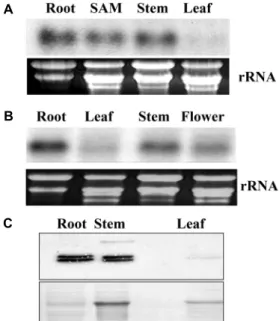
For analyzing the tissue specific expression of OsAPx1 in rice, total RNA was extracted from different tissues of either rice seedlings or mature plants, including root (R), leaf (L), stem (S), flower (F), short apical meristem (SAM) and leaf sheath (SH). At young seedling stage, OsAPx1 mRNA was highly expressed in root, SAM and leaf sheath, but expressed low in leaf (Fig. 1A). In mature plants, a higher level ex- pression of OsAPx1 was observed in root, stem and flower but weakly in rice leaf (Fig. 1B). Western blot analysis re- vealed that accumulation pattern of OsAPx1 was consistent with that of RNA level (Fig. 1C). Apx is an important ROS scavenger which maintains a particular level of ROS. ROS are continuously produced during different stages of plant growth and development. Here, we also observed the tran- scriptional and translational accumulation of OsAPx1 pro- tein in different developmental organs of rice which may help in maintaining the ROS levels in the cells.

Interestingly, a previous report categorized many ROS-re-

lated proteins as belonging to the defense/stress group. It

was also reported that ROS level was highly accumulated

in the rice root and the growth was dramatically inhibited

by ROS quenching chemicals which inhibited ROS gen-

eration in the rice root [18]. Thus, functions of APxs are to

detoxify cytotoxic substrates and protect cells against oxida-

(4)

A

B

C

Fig. 1. Northern blot analysis of OsAPx1 expression in different rice tissues. Total RNA were extracted form root, shoot apical meristem and leaf sheath at two leaf stage. (B) Total RNA were extracted form root, leaf, stem and flow- er at mature stage. (Each RNA sample (20 μ g) was blot- ted onto nylon membranes, hybridized with

32

P-labeled probes, and washed at high stringency. Equal loading was verified by staining rRNA with ethidium bromide.

Blots were exposed to X-ray film at -70℃ for 1 day. (C) Western blot analysis of OsAPx1 in the leaf, stem and root tissues of rice.

tive damage in the rice root system.

Semi quantitative RT-PCR and Western blot based validation of OsAPx1 expression

Here we characterized several proteins involved in redox regulation including OsAPx1 and cupper/zinc- superoxide dismutase (Cu/Zn-SOD) were characterized in response to Xoo and M. oryzae infection. Transcription of OsApx1 and Cu/Zn-SOD were detected at 12 hpi, and increased further at 48 and 72 hpi (Fig. 2A and 2C), indicated that OsApx1 and Cu/Zn-SOD was induced in response to Xoo and M. or- yzae infections. These results were further validated by Western blot analysis. The secretion of APx1 and Cu/Zn- SOD proteins were detected at 24 hpi, and were further in- creased at 48 hpi and 72 hpi (Fig. 2B and 2D). The intra- cellular protein RuBisCO was used for loading control.

In plant cells, ROS formation is induced by various factors including different biotic and abiotic stress [4, 17]. It was also reported that the ROS related-proteins including 7 glu- tathione S-transferases, 6 ascorbate peroxidases, 4 catalase

isozymes, 3 superoxide dismutase, glutathione (GSH)-de- pendent dehydroascorbate reductase 1, and glutathione re- ductase comprised the most abundant group in root pro- teome [18]. These data suggest that ROS-scavenging activ- ities may differentially regulate protein expression levels and patterns because GSH, ascorbate and diphenyleneiodo- nium (DPI), which were ROS quenching chemicals, have other cellular functions in addition to ROS scavenging. Thus, during plant-microbe interaction, OsAPx plays a critical role for homeostasis of ROS levels in leaves inoculated with pathogens.

Induction of OsAPx1 gene by JA

In plant cells, biotic stress and different stress signals such as JA can induce ROS overproduction. JA is a phytohormone which is produced in response to pathogen attack. Here, we observed that the OsAPx1 mRNA was strongly upregulated in response to JA treatment. When JA treatment was given along with either SA or ABA, a reduction in its m-RNA ex- pression was observed. Moreover, when SA and ABA were applied together, OsAPx1 transcription was completely in- hibited (Fig. 3).

SA and JA, produced during pathogen attack, act as sig- naling molecules which lead to the transcriptional induction of several PR genes [14, 24]. Detailed analysis of the SA and JA induced signaling has shown a crosstalk between these two signaling pathways each other and fungal elicitors in previous studies [7, 11]. Our results showed plant hormones also have great effect on OsAPX1 expression. Its mRNA was strongly upregulated by the presence of JA, but significantly reduced by SA and ABA. Both SA and ABA reduced the transcription level of OsAPx1, and also restricted the JA in- duced OsAPx1 gene expression. It has been reported that increased concentrations of H

2

O

2

have beneficial effects on plant defense. Several reports have suggested that pathogen attack leads to the accumulation of H

2

O

2

which results in cell death (hypersensitive response, HR). Therefore, SA and ABA based inhibition of OsAPx1 may be beneficial during pathogen attack as it would lead to the increased concen- tration of H

2

O

2

by reducing the expression of redox detoxify- ing enzymes including APx1. However, which pathways and cross-talk regulate the OsAPx1 expression is still un- known.

Phylogenetic relationship analysis and character-

ization of AtAPx1 knockout plant

(5)

A

B

C

D

Fig. 2. Valiation of expression patterns of OsAPX1 in leaves inoculated with Xoo and with M. oryzae. (A) Semiquantitative analysis of Apx1 and Cu/Zn-SOD transcriptional regulation in response to X. oryzae infection. (B) Western blot analysis of secreted Apx1 and Cu/Zn-SOD level in response to X. oryzae infection. (C) Semiquantitative analysis of Apx1 and Cu/Zn-SOD tran- scriptional regulation in response to M. oryzae infection. (D) Western blot analysis of secreted Apx1 and Cu/Zn-SOD level in response to M. oryzae infection.

Fig. 3. Northern blot analyses of OsAPx1 gene in treatment of plant hormones. Total RNA was extracted from rice cal- lus after different plant hormone treatment which de- scribed in pictures. RNA was extracted. Each RNA sam- ple (20 μ g) was blotted onto nylon membranes, hybri- dized with

32

P-labeled probes, and washed at high stringency. Equal loading was verified by staining rRNA with ethidium bromide. Blots were exposed to X-ray film at –70℃ for 1 day. Abbreviations: ABA, abscisic acid; JA, jasmonic acid; SA, salicylic acid.

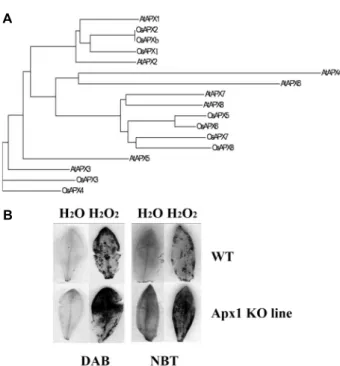
To understand the phylogenetic relationship among as- corbate peroxidases of Rice and Arabidopsis, APx protein se- quences of 9 isoforms of rice and 8 isoforms of Arabidopsis were aligned by Bio-Edit software. The phylogenetic tree showed that OsAPx1 protein has the close relationship with AtAPx1 (Fig. 4A), and shares 79.3% homology with each other. To further understand the function of APx gene, we studied the function of ascorbate peroxidase gene in Arabidopsis along with the rice. Therefore, we identified an

AtAPx1 knockout line (apx1) from the SALK collection, con- taining T-DNA insertions in the AtAPx1 gene. We named it apx1. The insertion is located in the 3’-UTR in apx1. We use PCR method which described in 2.1 to selected homol- ogy apx1 plant. Western blot analysis showed that the ex- pression of OsAPx1 gene in these apx1 plants was eliminated (data not shown).

H

2

O

2

treatment and Superoxide anion, hydrogen peroxide detection

Wild type and apx1 seeds were planted on the Phytagel solid MS medium contains 2.5 mM H

2

O

2

. H

2

O

2

showed an inhibitory effect on the growth of both wild type and apx1 lines were. However, the degree of inhibition was higher in the apx1 lines as compared with the wild type (Fig. 4B).

The effect of H

2

O

2

was further tested on the mature plants.

The wild type and apx1 root were dip into MS medium which contains 10 mM H

2

O

2

. The apx1 lines showed early senescence just after 3 days treatment with H

2

O

2

(Fig. 4B).

H

2

O

2

not only acts as a signal for biosynthesis and develop- ment, but it also acts as a signal for PCD when its concen- tration is increased over a threshold value. Therefore, we tried to examine whether the growth inhibit and early sen- escence is caused by the oxidative damage to cell. To detect the accumulation of O

2-

and H

2

O

2

levels in Arabidopsis

leaves, we stained it with NBT and DAB. The Arabidopsis

(6)

A

B

Fig. 4. Phylogenetic relationship of APx protein from Rice and Arabidopsis and Detection of O

2-

and H

2

O

2

in Arabidopsis leaves (A) The dendrogram was constructed using BioEdit program. Bootstrap values are shown at the branch. Protein sequences were identified by the ac- cession numbers in the NCBI database. (B) Wild type and apx1 line were infiltrated with 10mM H

2

O

2

. After 4 hr, plant leaves were stained with nitro blue tetrazo- lium (NBT) and 3,3’-diaminobenzidine (DAB) solution, respectively, for 2 hr. Leaves was washed with 98% etha- nol at 70℃ for 10 min, and then washed with 10% Lactic Acid or 70% ethanol.

leaves were infiltrated with 10 mM H

2

O

2

for 4 hr, then stained and washed as described in Materials and methods section. In apx1 lines, the accumulation of both O

2-

and H

2

O

2

were higher than the wild type (Fig. 4B). These results in- dicated that the high concentration of exogenous H

2

O

2

cause the intercellular superoxide anion and hydrogen peroxide accumulation in AtAPx1 knockout plant, and also lead to growth suppression and early senescence than wild type.

Therefore, ascorbate peroxidase may have the function of scavenging H

2

O

2

to reduce the oxidative damage of cell.

Conclusion

The fact that OsAPx1 expression is activated both by pathogens (M. oryzae and Xoo) and JA raised the possibility that signal transduction leading to OsAPx1 transcription oc- curs through a shared pathway. However, we first report that SA and ABA had antagonistic effects on pathogen re-

sponsive OsAPx1 expression. In a similar way, PR genes in- cluding OsGlu1, OsGlu2, OsTLP, OsRLK, and OsPR-10 tran- scription is induced by JA but inhibited by SA and ABA [19]. Taken together, these results suggest that the induction of OsAPx is differentially regulated by the signaling mole- cules, that is, positively by JA and negatively by SA and ABA.

Acknowledgment

This work was supported for 2 years by Pusan National University.

References

1. Agrawal, G. K., Jwa, N. S., Iwahashi, H. and Rakwal, R.

2003. Importance of ascorbate peroxidase OsAPx1 and OsAPx2 in the rice pathogen response pathways and growth and reproduction revealed by their transcriptional profiling. Gene 332, 93-103.

2. Asada, K. and Takahashi, M. 1987. Production and scaveng- ing of active oxygen in photosynthesis. In photoinhibition (Topics in Photosynthesis) (Vol.9) (Kyle, D.J.et al., eds), pp.

227-287, Elsevier.

3. Asada, K. 1992. Ascorbate peroxidase: a hydrogen peroxide- scavenging enzyme in plants. Physiol. Planta. 85, 235-241.

4. Asada, K. 1999. The water-water cycle in chloroplasts: scav- enging of active oxygens and dissipation of excess photons.

Annu. Rev. Plant Physiol. Plant Mol. Biol. 50, 601-639.

5. Baker, M. A. and Orlandi, E. W. 1995. Active oxygen in plant pathogenesis. Annu. Rev. Phytopathol. 33, 299-321.

6. de Pinto, M. C., Paradiso, A., Leonetti, P. and De Gara, L.

2006. Hydrogen peroxide, nitric oxide and cytosolic ascor- bate peroxidase at the crossroad between defence and cell death. Plant J. 48, 784-795.

7. de Torres-Zabala, M., Truman, W., Bennett, M. H., Lafforgue, G., Mansfield, J. W., Rodriguez Egea, P., Bogre, L. and Grant, M. 2007. Arabidopsis abscisic acid signalling pathway to cause disease. EMBO J. 26, 1434-1443.

8. Doke, N. 1985. NADPH-dependent O2

-

generation in mem- brane fractions isolated from wounded potato tubers in- oculated with Phytophthora infestans. Physiol. Plant Pathol. 27, 311-322.

9. Doke, N. and Furuichi, N. 1982. Response of protoplasts to hyphal wall components in relationship to resistance of po- tato to. Phytophthora infestans. Plant Physiol. 2, 23030.

10. Dygert, S. L., Li, L. H., Florida, D. and Thomas, J. A. 1965.

Determination of reducing sugar with improved precision.

Anal. Biochem. 13, 367-374.

11. Flors, V., Ton, J., van Doorn, R., Jakab, G., García-Agustín,

P. and Mauch-Mani, B. 2008. Interplay between JA, SA and

ABA signalling during basal and induced resistance against

Pseudomonas syringae and Alternaria brassicicola. Plant J. 54,

(7)

초록:벼 ascobate peroxidase 단백질의 병원균 및 식물호르몬에 대한 발현 분석

왕이밍

1

․우징니

1

․최영환

2

․전태환

3

․권순욱

3

․최인수

3

․김용철

3

․라비굽타

3

․김선태

3

*

(

1

맥스플랑크연구소,

2

부산대학교 원예생명과학과,

3

부산대학교 식물생명과학과)

본 논문에서 벼 ascorbate peroxidase (OsAPx1) 유전자의 발현 분석을 Northern과 Western 분석을 통하여 유묘 에서는 뿌리, 정단분열조직(shoot apical meristem, SAM), 잎 보다는 잎집에서 더 많이 발현되는 것을 확인하였다.

성숙된 조직에서는 OsAPx1 유전자가 잎을 제외하고는 뿌리, 줄기, 꽃에서 강하게 발현되었다. 또한 이 OsAPx1 유전자는 벼 곰팡이 병원균인 벼 도열병 및 세균성 병원균인 흰빛잎마름병에도 반응하였고 특히 흥미있게도 OsAPx1 유전자는 식물호르몬에 대해서 서로 다르게 발현 양상을 보였다. 이 유전자는 자스몬산(JA)에 대해서는 강한 발현 을 보였지만 반대로 살리실산(SA) 및 ABA와 같이 처리된 세포에서는 강한 발현 억제를 보였다. 이는 이 유전자가 JA에는 반응하지만 SA와 ABA하고는 서로 길항작용을 하는 것으로 보인다. 근연관계분석을 통하여 OsAPx1유전 자가 애기장대의 AtAPx1 와 거의 유사하여 AtAPx1 결손 라인을 가지고 표현형 조사를 실시하였다. 그 결과, 외부 에서 H

2

O

2

를 처리하였을 때에 O

2-

와 H

2

O

2

의 축적이 wild type과 비교하여 AtAPx1 결손 라인에서는 현저히 높았다. 따라서 본 연구를, 통하여 OsAPx1 유전자는 벼에서 산화 환원 균형 유지를 통하여 다양한 세포 분화발달 및 병원균 방어에도 관여하며 이 유전자의 발현은 JA의 신호전달에 의해서 매개되는 것으로 예상이 된다.

81-92.

12. Foyer, C. H. 2004. The role in ascorbic acid in defense net- works and signaling in plants. In Vitamin C: Its function and biochemistry in Animals and Plants (Asard, H., May, J. and Smirnoff, N., eds). Oxford: BIOS Scientific, pp. 65-82.

13. Halliwell, B. 2006. Reactive species and antioxidants. Redox biology is a fundamental theme of aerobic life. Plant Physiol.

141, 312-322.

14. Kunkel, B. N. and Brooks, D. M. 2002. Cross-talk between signaling pathways in pathogen defense. Curr. Opin. Plant Biol. 5, 325-331.

15. Mittler, R., Herr, E. H., Orvar, B. L., van Camp, W., Willekens, H., Inze´, D. and Ellis, B. E. 1999. Transgenic to- bacco plants with reduced capability to detoxify reactive oxygen intermediates are hyperresponsive to pathogen infection. Proc. Natl. Acad. Sci. USA 96, 14165-14170.

16. Mittler, R., Vanderauwera, S., Gollery, M. and Breusegem, F. V. 2004. Reactive oxygen gene network of plants. Trends Plant Sci. 9, 490-498.

17. Noctor, G. and Foyer, C. H. 1998. Ascorbate and gluta- thione: keeping active oxygen under control. Annu. Rev.

Plant Physiol. Plant Mol. Biol. 49, 249-279.

18. Kim, S. G., Kim, S. T., Kang, S. Y., Wang, Y., Kim, W. and Kang, K. Y. 2008. Proteomic analysis of reactive oxygen spe- cies (ROS)-related proteins in rice roots. Plant Cell Rep. 27, 363-375.

19. Kim, S. G., Wu, J., Wang, Y., White, E. E., Choi, Y. W., Kim, K. K., Choi, I. S., Kim, Y. C., Kim, S. H., Kang, K. Y. and

Kim, S. T. 2010. Effect of phytohormones and chemical in- hibitors on pathogenesis-related genes identified by differ- ential hybridization in rice suspension culture cells. Plant Pathol. J. 26, 386-393.

20. Kim, S. T., Cho, K. S., Yu, S., Kim, S. G., Hong, J. C., Han, C. D., Bae, D. W., Nam, M. H. and Kang, K. Y. 2003.

Proteomic analysis of differentially expressed proteins in- duced by rice blast fungus and elicitor in suspension-cul- tured rice cells. Proteomics 3, 2368-2378.

21. Kim, S. T., Kim, S. G., Hwang, D. H., Kang, S. Y., Kim, H. J., Lee, B. H., Lee, J. J. and Kang, K. Y. 2004. Proteomic analysis of pathogen-responsive proteins from rice leaves induced by rice blast fungus, Magnaporthe grisea. Proteomics 4, 3569-3578.

22. Kim, Y. J., Lee, H. M., Wang, Y., Wu, J., Kim, S. G., Kang, K. Y., Park, K. H., Kim, Y. C., Choi, I. S., Agrawal, G. K., Rakwal, R. and Kim, S. T. 2013. Depletion of abundant plant RuBisCO protein using the protamine sulfate precipitation method. Proteomics 13, 2176-2179.

23. Teixeira, F. K., Menezes-Benavente, L., Galvão, V. C., Margis, R. and Margis-Pinheiro, M. 2006. Rice ascorbate per- oxidase gene family encodes functionally diverse isoforms localized in different subcellular compartments. Planta 224, 300-314.

24. Thomma, B. P., Penninckx, I. A., Broekaert, W. F. and

Cammue, B. P. 2001. The complexity of disease signaling

in Arabidopsis. Curr. Opin. Immunol. 13, 63-68.

수치

Fig.  1.  Northern  blot  analysis  of  OsAPx1  expression  in  different  rice  tissues
Fig.  2.  Valiation  of  expression  patterns  of  OsAPX1  in  leaves  inoculated  with  Xoo  and  with  M
Fig.  4.  Phylogenetic  relationship  of  APx  protein  from  Rice  and  Arabidopsis  and  Detection  of  O 2-   and  H 2 O 2   in  Arabidopsis  leaves  (A)  The  dendrogram  was  constructed  using  BioEdit  program

참조

관련 문서

And based on these results, in order to utilize the witty stories appeared in the novels of Korean Pansori as actual educational texts, the brief analysis

In conclusion, it is suggested that: (a) there be educational programs for developing personality on the part of juveniles in order to prevent and

In order to defeat these problems and enhance patient’s convenience, we designed fluidal lipid matrix (FLM) for long-acting injection that can maintain the long efficacy

Conclusions : The mesiodens and the 3rd molar teeth are very similar to the inorganic component. These results provide reasonable rationale that mesiodens can be used

The proposed BMS in this thesis aimed to secure stability and increase the speed of balancing by minimizing the heat problem occurring in the cell

The analysis was done on the school section that needs to be improved first and is the most basic out of the different issued related to the high school equalization such

Secondly, in the results of the analysis as to the influence of the Taekowndo leader's leadership on the stress of a Taekowndo player, it appeared that in

From these results, we suggested that it is necessary to invigorate nature-experience in education program for alternative school so that self-esteem and