Isolation of Potato StACRE Gene and Its Function in Resistance against Bacterial Wilt Disease
Sang Ryeol Park1*, Eun-Mi Cha1, Tae Hun Kim1, Seyoun Han1, Duk-Ju Hwang1, Il-Pyung Ahn1, Kwang-Soo Cho2 and Shin-Chul Bae1
1Bio-Crop Development Division, National Academy of Agricultural Science, Rural Development Administration, Suwon 441-707, Korea
2Highland Agricultural Research Center (HARC), National Institute of Crop Science, Rural Development Administration, Pyeongchang 232-955, Korea
Received November 21, 2011 /Revised December 20, 2011 /Accepted December 26, 2011
Bacterial wilt (brown rot) caused byRalstonia solanacearum (Rs) is one of the most devastating bacterial plant diseases in potatoes. To isolate bacterial wilt disease resistance-related genes from the potato, theStACRE (HM749652) gene was isolated and a sequenced search was performed using functional orthologs of Solanaceae from potatoes. StACRE is homologous to the tobacco NtACRE 132 protein and belongs to the ATL family involved in ubiquitination. To analyze the expression pattern of this gene, RT-PCR was performed with potato treated with salicylic acid (SA) andRs (KACC 10722). StACRE was strongly induced 3 hours after treatment with SA and 12 hours after infection withRs. To inves- tigate its biological functions in the potato, we constructed a vector for overexpression in the potato by the Gateway system, and then generated transgenic potato plants. The gene expression of trans- genic potato was analyzed by northern blot analysis. In the results of disease resistance assay in rela- tion to bacterial wilt, StACRE overexpressed transgenic potato plants were shown to have more resist- ance than wild-type potato.
Key words : Potato, StACRE, ubiquitination, disease resistance, bacterial wilt
*Corresponding author
*Tel:+82-31-299-1743, Fax:+82-31-299-1722
*E-mail : [email protected]
서 론
감자는 세계 4대 식량작물 중의 하나로 전세계 130여 개 국에서 재배되고 있지만 끊임없이 많은 병원균과 해충의 공격 에 의해서 많은 손실을 가져오고 있다.Ralstonia solanacearum (Rs)에 의해 야기되는 감자 풋마름병(bacterial wilt, brown rot)은 감자 재배 시 발생하는 주요 병이며 세계 감자 재배 지역에서 수확량 감소의 주요한 요인 중의 하나이다[13]. 특히 기후변화로 열대 및 아열대 지역이 점차 확대되고 있어 그 피해가 더 심각해질 것으로 예상된다[4]. 국내에서도 1998년 제주도에서 처음 보고된 후 감자 재배지역에서 심각한 문제가 되고 있다[6]. 감자 풋마름병 방제를 위해서는 경종적인 방법 으로 돌려짓기와 화학적인 방제로 클로로피크린과 PCNB 등 의 토양소독제를 사용하고 있지만 그 효과는 미흡하다. 따라 서 저항성 품종개발이 가장 효과적인 방제대책으로 생각되지 만 현재까지 저항성 품종에 대해 국내 보고는 없는 실정이다 [12]. 저항성 품종 육성을 위하여 야생종으로부터 저항성 유전 자를 도입하는 연구가 주로 이루어져 오고 있으나[8], 야생종 으로부터 저항성 유전자의 직접 도입 또한 어려운 실정이다 [10]. 지난 10여 년간 QTL (quantitative trait loci)과 저항성
유전자를 분리하고 병방어 관련 유전자를 감자에 옮기기 위한 많은 노력이 있었다. 하지만 R gene인AP1 gene [9], chitinase 나 defensin 같은 외래 유전자를 가지는 형질전환 감자, sna- kin-1과 snakin-2 같은 감자 유래 유전자 등 극히 적은 양의 유전자가 Rs에 대해 저항성이 증가한다고 보고되고 있다[2].
몇몇의 유전자가 클로닝되고 특성이 밝혀졌지만 감자와Rs의 저항성 관련 기작은 많이 알려져 있지 않다. 전세계적으로 많 은 연구자들에 의해 병 저항성을 유도하는 유용 유전자를 확 보하고자 하는 연구와 식물과 병원균의 상호작용을 이용하여 식물에서의 병 저항성 조절 기작에 대한 기초적인 연구도 동 시에 활발하게 이루어지고 있다. 식물은 일반적으로 동물과 달리 면역세포나 기관이 따로 존재하지 않아 침입하는 병원균 에 대항하여 신호를 전달하고 일련의 방어 기작을 작동하여 자신을 방어한다. 많은 연구를 통해 애기장대의 경우 salicylic acid (SA) 의존 경로, jasmonic acid (JA) 의존 경로와 ethylene 의존 경로 등과 같이 다른 여러 가지 신호전달 경로를 통해 많은 종류의 병방어 관련 유전자를 조절하여 자신을 방어하게 된다고 잘 알려져 있다[15]. 하지만 최근 들어 ‘단백질의 분해’
가 병방어를 포함한 세포수준에서의 조절에 있어서 중요한 역할을 수행하고 있는 하나의 새로운 분야가 되고 있다. 이 중의 하나로 생물적․비생물적 스트레스에 있어서 중요한 역 할을 하는 것으로 알려진 ubiquitin ligase 기능을 가지는 RING finger 단백질이 알려져 있다. RING-H2 finger 단백질
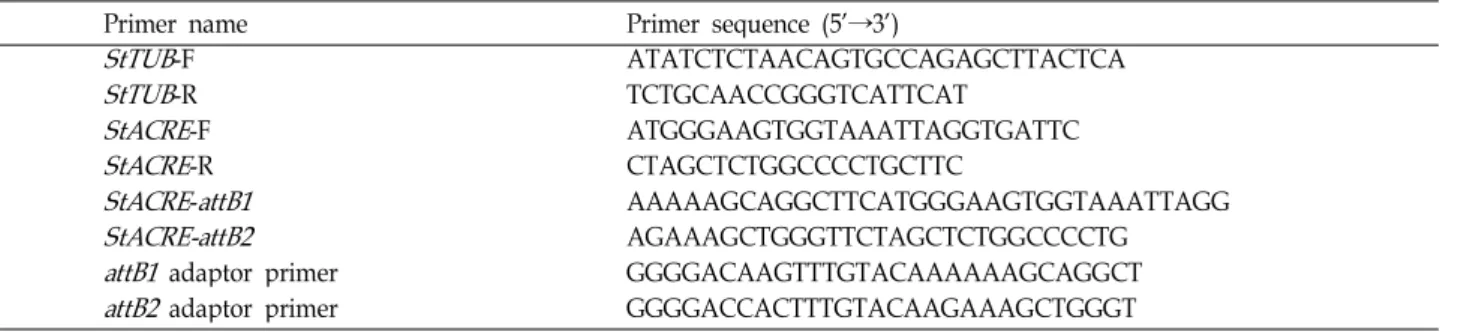
Table 1. List of primers used in this study
Primer name Primer sequence (5’→3’)
StTUB-F ATATCTCTAACAGTGCCAGAGCTTACTCA
StTUB-R TCTGCAACCGGGTCATTCAT
StACRE-F ATGGGAAGTGGTAAATTAGGTGATTC
StACRE-R CTAGCTCTGGCCCCTGCTTC
StACRE-attB1 AAAAAGCAGGCTTCATGGGAAGTGGTAAATTAGG StACRE-attB2 AGAAAGCTGGGTTCTAGCTCTGGCCCCTG
attB1 adaptor primer GGGGACAAGTTTGTACAAAAAAGCAGGCT attB2 adaptor primer GGGGACCACTTTGTACAAGAAAGCTGGGT 은 ATL 유전자 family를 이루며 애기장대에서 제일 먼저 알려
졌다[18]. 애기장대와 벼 유전체에는 각각 80개와 121개의 member를 포함하고 있는 것으로 알려져 있다[24]. 이 ATL family 형태의 유전자들은 식물병 방어 반응에서 E3 ubiquitin ligase로서 기능을 하는 것으로 알려져 있다[11,28]. 애기장대 의 경우ATL2, ATL6와 ATL9가 병방어 반응과 관련이 있다고 보고되었고[18,19, 22], 벼에서는EL5와 OsBIRF1 [13,25,26], 담 배에서는 NtACRE132가 잘 알려져 있다[3,11].
본 연구에서는 감자에서 RING finger protein을 암호화하 는StACRE유전자를 분리하고 풋마름병 저항성관련 기능 검 정한 결과를 보고 하고자 한다. 감자 StACRE는 전신획득저항 성을 유도하는 물질로 알려진 SA 처리에 의해 발현이 유도되 었을 뿐만 아니라 풋마름병균인Rs에 의해서도 발현이 증가하 였다. 따라서StACRE 유전자의 생물학적 기능을 검정하기 위 해 이 유전자를 과발현 시킨 형질전환 감자를 제작하였으며 형질전환체의 풋마름병 저항성 효과 여부를 조사하였다. 그 결과 이 유전자가 과발현된 감자 형질전환체가 야생형에 비해 풋마름병에 대해 저항성을 보였다.
재료 및 방법 식물 재료 및 생육 조건
형질전환 및 대조구로 실험에 사용된 감자 품종은 수미 (Solanum tubersoum L. cv. Superior)와 풋마름병 저항성으로 알려진 CT206-10으로 16시간 광/8시간 암 주기로, 23℃의 조 건에서 배양기에서 4주간 배양하였다. 대조구 감자와 형질전 환체는 MS 배지에[16] 계대 배양하여 배양기에서 2주간 배양 후 양액 또는 배양토로 옮겨 심어 약 2~3주간 더 키운 후 생물 학적 검정 또는 분자생물학적 분석에 이용하였다. 감자 형질 전환용 균주는Agrobacterium tumefaciens (LBA4404)를 사용하 였으며, 유전자 조작을 위한 균주는Escherichia coli (DH5α 계 통, RBC Science, Taiwan)를 사용하였다.
유전자 분리 및 발현분석
MS배지에서 2주간 계대 배양한 감자를 양액에서 2주간 더 배양하여 실험에 이용하였다. 2 mM salicylic acid (SA, Sigma,
Saint Louis)를 spray하여 1, 3, 6, 12, 24, 48시간 후 시료를 채취하여 -80℃에 보관하면서 RNA를 RNeasy Plant Mini Kit (Qiagen, Hiden)를 이용해 분리하였다. 병원균인Ralstonia sol- anacearum (Rs, KACC10722)은 CPG 한천 배지에 2∼3일간 배 양한 후 10 mM MgCl2에 OD600에서 0.5가 되게 희석 한 후에 뿌리를 5 cm씩 절단 한 후 침지하여 1, 3, 6, 12, 24, 48 시간 후 시료를 채취하여 -80℃에 보관하면서 RNA를 분리하였다.
사용한 primer 서열은 Table 1에 나타내었다. RT-PCR 조건은 5 μg의 total RNA, 100 pmol의 oligodT (Bioneer, Daejeon), ddH2O로 전체 반응액이 20 μl되게 혼합하여 65℃에서 5분간 가열 후 얼음 위에서 식히고 4 μl의 5x first strand buffer (Invitrogen, CA), 1 μl의 0.1 M DTT (Invitrogen, CA), 4 μl의 dNTP (2.5 mM/μl, Invitrogen, CA), 1 μl의 RNaseOUT re- combinant RNase Inhibitor (40 units/μl, Invitrogen, CA)와 1 μl의 SuperScriptIII (200 units/ μl, Invitrogen, CA)를 섞고 50℃에서 1시간 반응시킨 후 70℃에서 10분간 효소를 불활성 화 시키고 여기에 RNaseH (2 units/μl, Invitrogen, CA)를 1 μl 첨가하고 37℃에서 20분간 반응 후 다시 70℃에서 10분간 불활성화 시킴으로써 First strand 합성을 하였다. 목표 유전자 의 발현은 1 μl의 First strand 반응액, Table 1에 나타낸 20 pmol의 StTUB-forward primer와 StTUB-reverse primer, 20 pmol의StACRE-forward primer와 StACRE-reverse primer를 각각의 tube에 넣고 여기에 0.5 μl의 rTaq polymerse (5 units/
μl, Takara, Shiga), 2 μl 의10x PCR buffer (Takara, Shiga), ddH2O로 최종 20 μl 되게 혼합하여 95℃에서 2분 예열, 94℃에 서 30초, 50℃에서 30초, 72℃에서 1분 동안 25 cycle을, 70℃에 서 10분간 최종 연장반응 수행 후 1% agarose gel에 전기영동 하여 확인하였다[25].
Southern blot 및 northern 분석
배양된 감자의 전체 조직을 액체질소와 막자 사발을 이용하 여 잘 마쇄한 후 Plant Genomic DNA prep kit (Solgent, Daejeon)를 이용하여 분리한 genomic DNA 10 μg을BamH1, EcoR1, HindIII (Enzynomics, Daejeon) 등의 제한효소로 37℃
에서 12시간 반응 시킨 후 정제하여 1% agarose gel에 전기영 동 하여 분석하였다[21]. 유전자 발현분석을 위해 야생형과 형
질전환된 감자에서 Northern blot을 수행하였으며 RNeasy Plant Mini kit (Qiagen, Hiden)를 이용하여 total RNA를 분리 하였다. 분리된 10 μg의 total RNA는 1.0% (w/v) form- aldehyde-agarose gel에서 전기영동을 수행한 후, gel 위에 HyBond N+ membrane (Amersham Biosciences, Bucks)을 놓 고 membrane에 RNA를 전이시켰다. UV cross-linker를 이용 하여 RNA를 고정 시킨 후,StACRE 유전자에 α-[32P]dCTP의 방사선 동위원소로 표지 한 probe를 0.5 mM Na2HPO4 (pH 7.2), 1 mM EDTA, 1% BSA, 7% SDS를 포함하는 hybrid- ization buffer에서 65℃ 에서 18시간 동안 혼성화시킨 후, 0.1% SDS가 함유된 2x SSC washing buffer로 65℃ 에서 15분 간 1번 세척하고, 0.1% SDS가 함유된 1x SSC washing buffer 로 65℃에서 10분간 1번 더 세척하였다. 세척한 membrane은 BAS cassette (Fuji, Kanagawa)에서 스크린에 전이시킨 후 스 캔하여 확인하였다.
식물형질전환용 Vector 제작 및 감자 형질전환
감자 형질전환용 과발현 vector를 제작하기 위하여 Gateway system (Invitrogen, CA)을 이용하였으며, Table 1의StACRE- attB1과 StACRE-attB2 primer를 이용하여 1차 PCR을 수행한 후 Table 1의attB1 and attB2 adaptor primer를 이용하여 2차 PCR을 수행하였다. 증폭된 PCR 산물을 BP Clonase II (Invitrogen, CA)를 이용하여 pDONR201 vector에 클로닝하 고 LR Clonase II (Invitrigen, CA)를 이용하여 35S 프로모터와 bar표지를 포함하고 있는 pB7WG2D 벡터에 삽입하여 pB7WG2D/StACRE 벡터를 제작하였다. 제작된 pB7WG2D/
StACRE 벡터를Agrobacterium tumefaciens LBA4404 에 도입한 다음 감자(품종: 수미)에 형질전환 하였다[1,5]. MS 배지에서 4주간 배양한 수미감자의 분열조직을 제외한 줄기를 5 cm씩 절단하여 PreM 배지에서 1일간 전 배양한 후 50 ppm의 Spectinomycin (Duchefa, Haarlem)이 함유된 YEP broth에서 pB7WG2D/StACRE를 함유한 Agrobacterium tumefaciens LBA4404를 OD 600=2.0되게 배양하여 30분간 감염 시킨 후 물기를 제거하고 PreM 배지에서 4일간 배양 후 cefotaxim (Duchefa, Haarlem)이 함유된 증류수로 줄기에 자란 균을 제 거하고 callus 유도배지에서 3주간 배양하여 callus를 유도하 고 유도된 callus를 잘라내어 새로운 phosphinothricin (Duchefa, Haarlem)이 함유된 callus 유도 배지에 옮겨 2주간 배양한 후 phosphinothricin이 함유된 줄기 유도배지로 옮겨 10주간 배양하여 줄기를 유도하였다. 유도된 줄기를 phosphi- nothricin이 함유된 뿌리유도 배지에 옮겨 4주간 배양하여 뿌 리를 유도하면서 형질전환체를 선별하였다[15].
RT-PCR 검정
StACRE를 과발현시킨 형질 전환 식물체의 과발현 여부를 검정하기위해 형질전환 식물체로부터 앞서 기술한 방법으로
total RNA를 분리하여 cDNA 합성에 이용 하였다. 우선, total RNA에 DNase I (deoxyribonuclease I, Sigma, Saint Louis)을 상온에서 15분간 처리한 후, 70℃에서 10분간 불활성화 시켰 다. 1 μl의 역전사효소 SuperScript III (200 units/μl, Invitrogen, CA), 3 μg의 total RNA와 oligo (dT)20 primer를 함께 넣어 최종 20 μl의 반응 혼합물에서 First-strand cDNA를 합성한 후 RT-PCR을 수행하였다. 합성한 1 μl의 First-strand cDNA와 rTaq polymerse (5 units/μl, Takara)를 사용하였으 며, 95℃에서 2분 동안 예열 후, 95℃에서 30초, 55℃에서 30초, 72℃에서 1분 동안 25 cycles을 수행하였고, 마지막 72℃에서 10분간 증폭을 수행하였다. PCR산물은 1% agarose gel에서 전기영동 후 관찰 하였다. Internal control로는 감자의 tubulin 유전자를 사용하였다[18].
병원균 처리 및 병저항성 측정
StACRE를 과발현시킨 형질전환 감자의 풋마름병 저항성 을 관찰하고자Ralstonia solanacearum (Rs) KACC10722 균주를 사용하였다. 이 균주는 CPG agar에서 28℃, 48시간 동안 배양 한 후 10 mM MgCl2를 사용하여 OD 600=0.5되게 희석하였다.
희석된 균 현탁액에 뿌리를 절단한 감자의 줄기를 1시간 동안 침지한 후 Jiffy pot에 옮겨 양액을 보충해주면서 2주간 병 진 전 양상을 관찰하였다[17].
결과 및 고찰 분리된StACRE 유전자의 특성
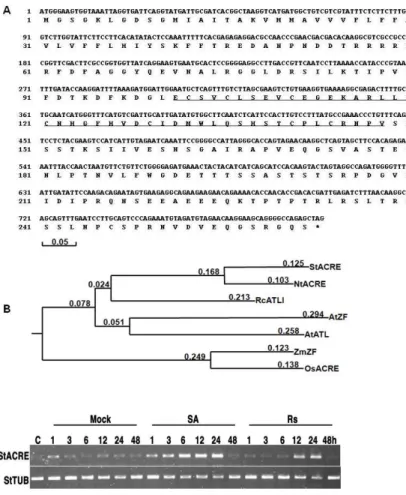
분리된StACRE (HM749652) 유전자는 261개의 아미노산을 암호화하는 786 bp DNA로 이루어져 있으며 DNAMAN을 이 용하여 분석한 결과 단백질의 분자량은 28.8 kDa으로 추정되 었으며, 추정된 아미노산을 이용하여 NCBI의 protein BLAST 를 이용하여 구조를 분석한 결과 RING finger domain을 가지 는 단백질의 일종으로 확인되었으며 motif 구조를 분석한 결 과 RING-H2 finger domain (C-x2-C-x15-C-x-H-x2-H-x2-C- x10-C-x2-C)[22]을 포함하고 있었다(Fig. 1A). 이것은 ATL gene family가 갖고 있는 전형적인 특징 중의 하나이다[20,23].
또한, 유추된 아미노산 서열을 이용하여 DNAMAN CLUSTAL-W programs으로 다른 식물의 유사 유전자와 유전 적 유연관계를 조사한 결과 StACRE는 담배(Nicotiana taba- cum)의 Avr9/Cf-9 rapidly elicited protein 132 (AF211532), 피마자(Ricinus communis)의 putative RING-H2 finger protein ATL1M (XP_002533814)와 유전적인 유연관계가 가까움을 알 수 있었다(Fig. 1B). 분리한 StACRE의 발현을 분석하기 위해 병 저항성 유도 신호전달 물질로 알려진 SA를 처리한 감자와 풋마름병균인Rs를 접종한 감자에서 추출한 RNA를 이용하여 RT-PCR을 수행하였다. 그 결과 SA 처리의 경우 3시간 이후부 터 발현량이 현저히 증가하였으며, Rs접종 12시간 이후부터
Fig. 1. Nucleotide sequence and phylogenetic rela- tionship of amino acid sequence of StACRE.
(A) Nucleotide sequence and deduced ami- no acid sequence of StACRE gene. The RING-H2 finger (C-x2-C-x15-C-x-H-x2-H- x2-C-x10-C-x2-C) domain was underlined.
(B) The phylogenetic tree of StACRE and other related proteins. One thousand boot- trap replicates were performed. The potato StACRE sequence was aligned with Avr9/Cf-9 rapidly elicited protein 132 of Nicotiana tabacum (NtACRE, AF211532), RING-H2 finger protein ATL1M of Ricinus communis, putative (RcATL1, XP_002533814), RING-H2 finger protein ATL3 ofArabidopsis thaliana(AtATL, NP_177375), RING-H2 fin- ger protein ATL60 of Arabidopsis thaliana (AtZF, NP_175785), ring-H2 zinc finger pro- tein of Zea mays (ZmZF, ACA21860)and Avr9/Cf-9 rapidly elicited protein ofOryzae sativa (OsACRE, BAD35269) by using DNAMAN CLUSTAL-W programs.
Fig. 2. Expression analysis of StACRE in mock (10 mM MgCl2), 2 mM SA andR. solanacearum(KACC10722) treated pota- to cv. Superior. Six-week-old potato were treated with SA andRs (KACC10722), and then whole plants were harvested at 0, 1, 3, 6, 12, 24 48 hr. Total RNA was iso- lated and RT-PCR was performed usingStACREspecific primer pairs. StACRE was markedly increased from 3 h after treated with SA and 12 hr after infected withRs, respectively. StTUB was used internal control.
24시간 후까지 발현량이 현저히 증가하였다(Fig. 2). 따라서 분리한StACRE 유전자는 감자에서 병 저항성 신호전달에 관 여하여 풋마름병 저항성을 증가시킬 것이라 추정되었다.
Southern blot
StACRE 완전장 cDNA를 probe로 하여 감자의 gDNA를 제한효소 BamH I, Eco R I, Hind III로 절단하여 수행한 DNA gel blot 분석에서StACRE 유전자는 감자 genome 상 에서 1개 내지 2개 정도의 copy수를 가지는 것으로 나타났다 (Fig. 3).
StACRE 과발현 형질전환체 제작
StACRE의 생물학적 기능 분석을 위해 CaMV35S promoter 조절하의 과발현 형질전환체를 제작한 결과 21개의 독립된
Fig. 3. DNA gel blot analysis ofStACREgene. Genomic DNA of potato Superior leaves (10 μg) was digested with the restriction enzymesBamH I,EcoR I andHind IIII as in- dicated B, E and H, respectively, and then fractionated on 1% agarose gel. The membrane was hybridized with a probe of α-[32P]-dCTP-radio- labeled potato StACRE gene.
개체를 얻었다. 이들을 northern blot으로 분석한 결과 3개체 는 발현이 증가하지 않았으며, 4개는 상대적으로 약한 발현을, 13개체는 중간 정도의 발현과 나머지 1개체에서 강한 발현을 보였다. 이들 중 중간 정도의 발현을 보인 #5와 발현이 가장 강하게 증대된 #16을 풋마름병 저항성 검정에 이용하였다 (Fig. 4).
Fig. 4. RT-PCR analysis of wild type potato cultivar ‘Superior’
and StACRE-overexpressing potato plants (T2).
StACRE-overexpressing potato plants #5 and #16 were shown the high level expression of StACRE compared with wild type.
Fig. 5. Evaluation of disease resistance toRs (KACC10722) of the StACRE-overexpressing potato, CT206-10 and the wild type potato. Representative plants showing symp- toms produced on wild type potato cv. ‘Superior’, CT206-10 and theStACRE-overexpressing potato plants 14 days post-inoculation withRs(KACC10722) by the stem-cut dipping method.StACRE-overexpressing trans- genic potato plants (#5 and #16) were shown more re- sistant than wild type.
StACRE 과발현 형질전환 감자의 병 저항성 검정
StACRE 과발현 형질전환체 발현 분석 결과 중간 정도의 발현을 보인 형질전환체 #15와 가장 강한 발현을 보인 형질전 환체 #16을 증식하여 배양하였다. 배양된 형질전환체의 뿌리 부분을 절단한 줄기에 풋마름병균인 Rs 균주를 1시간 동안 감염시킨 후 Jippy pot에 옮겨 배양실에 두고 14일 동안 병의 진전 여부를 관찰 하였다. 그 결과 대조구로 사용된 야생형 수미는 전체적으로 병징을 보여 식물체가 고사한 반면 선발한 2계통의 StACRE 과발현 형질전환체는 병 저항성 감자인 CT206-10과 같이 별다른 풋마름병의 증상을 보이지 않고 건전 한 상태를 유지하고 있음을 관찰할 수 있었다(Fig. 5). 이 결과 는 앞에서의 StACRE 발현분석 결과에서 얻은 병저항성 유도 물질인 SA와 풋마름병균인Rs 처리에 의해 StACRE의 발현이 현저하게 유도된 것과 잘 일치한다.
RING finger 단백질 중의 하나인 ATL family는 애기장대 에서 제일 먼저 알려 졌고[20], 후에 다른 식물에도 광범위하게 존재하는 것으로 알려져 있으며 애기장대에 80여 개가 존재하
고 벼에는 121개가 존재하고 있는 것으로 알려져 있다[25]. 애 기장대의 ATL2가 병방어 관련 유전자와 SA-반응 유전자를 활성화 시켜 병원균의 침입 시 병 방어 반응에 관여한다는 결과[20,23], 담배의 Avr9/Cf-9 rapidly elicited 132 (NtACRE132) 유전자가 신호전달을 조절하여 병 저항성에 관 여 한다는 보고[3], 벼의 EL5와 OsBIRF1 유전자가 생물학적 스트레스에 대해 병 방어 반응에 중요한 역할을 한다는 보고 [14], 그리고 애기장대의ATL6와 ortholog인 토마토의 LeATL6 유전자를 과발현 시켰을 때 JA-의존 신호전달 경로를 통해 병 방어에 기인하는 ubiquitin/proteasome 체계와 관련된다는 보고[7] 등에서 알 수 있듯이 StACRE 의 과발현이 풋마름병균 의 증식을 억제하였거나 SA- 또는 JA-의존 병 저항성 신호전 달 경로에 양성 조절자로 작용할 뿐만 아니라 ubiqitination과 관련되어 풋마름병에 대한 저항성이 증가하였을 것으로 추정 된다. 따라서 풋마름병 저항성과 관련하여 감자에서 SA- 또는 JA-의존 병저항성 신호전달에 대한 기작을 이해하는 좋은 자 료가 될 것이라 생각한다. 앞으로,StACRE 유전자가 어떤 병 방어 유전자를 활성화시키며 나아가 감자의 풋마름병 저항성 조절은 어떻게 이루어지는 지를 ubiquitination 관련 연구와 병행하여 수행하여 StACRE 유전자의 정확한 기능과 병저항 성 기작을 밝혀보고자 한다.
감사의 글
이 연구는 농촌진흥청 국립농업과학원 농업과학기술 연구 개발사업(과제번호: PJ006681012011)과 차세대 바이오그린21 사업(식물분자육종사업단 과제번호 : PJ0080212012)의 지원에 의해 이루어진 것임.
References
1. Beaujean, A., R. S. Sangwan, A. Lecardonnel, and B. S.
Sangwan-Norreel. 1998. Agrobacterium-mediated trans- formation of three economically important potato cultivars using sliced internodal explants: an efficient protocol of transformation. J. Exp. Bot. 49, 1589-1595.
2. Berrocal-Lobo, M., A. Segura, M. Moreno, G. López, F.
García-Olmedo, and A. Molina. 2002. Snakin-2, an anti- microbial peptide from potato whose gene is locally induced by wounding and responds to pathogen infection. Plant Physiol. 128, 951-961.
3. Durrant, W. E., O. Rowland, P. Piedras, K. E.
Hammond-Kosack, and J. D. G. Jones. 2000. cDNA-AFLP reveals a striking overlap in race specific resistance and wound response gene expression profiles. Plant Cell 12, 963-977.
4. Elphinstone, J. G., C. Allen, P. Proor, and A. C. Hayward.
2005. The current bacterial wilt situation: A global overview.
pages 9-28 in Bacterial wilt: The disease and theRalstonia
solanacearumSpecies complex., eds. American Phytopathology Society, St Paul, MN.
5. Geigenberger, P., B. Regierer, A. Nunes-Nesi, A. Leisse, E.
Urbanczyk-Wochniak, F. Springer, J. T. van Dongen, J.
Kossmann, and A. R. Fernie. 2005. Inhibition ofde novopyr- imidine synthesis in growing potato tubers leads to a com- pensatory stimulation of the pyrimidine salvage pathway and a subsequent increase in biosynthetic performance.
Plant Cell 17, 2077-2088.
6. Ham, Y. I. and M. Kwon. 1998. Distribution of disease and insects in cultivating field of alpine area.Korea Alpine Agric.
Exp. Sta. Ann. Rep. 236-252.
7. Hondo, D., S. Hase, Y. Kanayama, N. Yoshikawa, S.
Takenaka, and H. Takahashi. 2007. TheLeATL6-associated ubiquitin/proteasome system may contribute to fungal elic- itor-activated defense response via the jasmonic acid-de- pendent signaling pathway in tomato. Mol. Plant Microbe Interact. 20, 72-81.
8. Isabelle, F., C. Cecile, L. Jacques, P. Agus, S. Vongthip, V.Femand, S. Aline, A. Annick, K. Hippolyte, D. Georges, and D. Sihachakr. 2001. Use ofSolanum stenotomumfor in- troduction of resistance to bacterial wilt in somatic hybrids of potato. Plant Physiol. Biochem. 39, 899-908.
9. Feng, J., Y. Fenghua, G. Yin, L. Chenggang, X. Jin, Z.
Changling, and H. Liyuan. 2003. A novel antimicrobial pro- tein isolated from potato (Solanum tuberosum) shares homol- ogy with an acid phosphatase. Biochem. J. 376, 481-487.
10. Johnston, S. A., T. P. M. den Nijs, S. J. Peloquin, and R.
E. Hanneman Jr. 1980. The significance of genetic balance to endosperm development in interspecific crosses. Theor.
Appl. Genet. 57, 5-9.
11. Kawasaki, T., J. Nam, D. C. Boyes, B. F. Holt, D. A. Hubert, and A. Wiig. 2005. A duplicated pair of Arabidopsis RING-finger E3 ligases contribute to the RPM1- and RPS2- mediated hypersensitive response. Plant J. 44, 258-270.
12. Kim, H., J. S. Moon, Y. J. Hong, M. S. Kim, and H. M. Cho.
2005. Bacterial wilt resistance in the progenies of the fusion hybrids between haploid of potato andSolanum commersonii. Amer. J. Potato Res. 82, 129-137.
13. Li, G. C., L. P. Jin, X. W. Wang, K. Y. Xie, Y. Yang, E.
A. G. van der Vossen, S. W. Huang, and D. Y. Qu. 2010.
Gene transcription analysis during interaction between po- tato andRalstonia solanacearum. Russian J. Plant Physiol.57, 685-695.
14. Liu, H., H. Zhang, Y. Yang, G. Li, Y. Yang, X. Wang, B.
M. Basnayake, D. Li, and F. Song. 2008. Functional analysis reveals pleiotropic effects of rice RING-H2 finger protein gene OsBIRF1 on regulation of growth and defense re- sponses against abiotic and biotic stresses.Plant Mol. Biol.
68, 17-30.
15. Lodge, J. K., W. K. Kaniewski, and N. E. Tumer. 1993.
Broad-spectrum virus resistance in transgenic plants ex- pressing pokeweed antiviral protein. Proc. Natl. Acad. Sci.
USA 90, 7089-7093.
16. Murashige, T. and F. Skoog. 1962. A revised medium for
rapid growth and bioassays with tobacco tissue cultures.
Physiol. Plantarum15, 473-497.
17. Murata, Y., N. Tamura, K. Nakaho, and T. Mukaihara. 2006.
Mutations in thelrpEgene ofRalstonia solanacearumaffects Hrp pili production and virulence. Mol. Plant Microbe Interact. 19, 884-895.
18. Nicot, N., J. F. Hausman, L. Hoffmann, and D. Evers. 2005.
Housekeeping gene selection for real-time RT-PCR normal- ization in potato during biotic and abiotic stress.J. Exp. Bot. 56, 2907-2914.
19. Ramonell, K., M. Berrocal-Lobo, S. Koh, J. Wan, H. Edwards, and G. Stacey. 2005. Loss-of- function mutations in chitin responsive genes show increased susceptibility to the pow- dery mildew pathogenErysiphe cichoracearum.Plant Physiol.
138, 1027-1036.
20. Salinas-Mondragon, R. E., C. Garciduenas-Pina, and P.
Guzman. 1999. Early elicitor induction of a novel multi gene family coding for highly related RING-H2 proteins in Arabidopsis thaliana. Plant Mol. Biol. 40, 579-590.
21. Sambrook, J., E. F. Fritsch, and T. Maniatis. 1989. Molecular Cloning: A Laboratory Manual, 2nd eds. Cold Spring Harbor, New York, NY: Cold Spring Harbor Laboratory.
22. Saurin, A. J., K. L. B. Borden, M. N. Boddy, and P. S.
Freemont. 1996. Does this have a familiar RING? Trends Biochem. Sci. 21, 208-214.
23. Serrano, M. and P. Guzman. 2004. Isolation and gene ex- pression analysis ofArabidopsis thalianamutants with con- stitutive expression of ATL2, an early elicitor-response RING-H2 zinc-finger gene. Genetics 167, 919-929.
24. Serrano, M., S. Parra, L. D. Alcaraz, and P. Guzman. 2006.
The ATL genefamily fromArabidopsis thalianaandOryza sat- ivacomprises a large number of putative ubiquitin ligases of the RING-H2 type. J. Mol. Evol. 62, 434-445.
25. Shin, D. J., S. J. Moon, S. Y. Han., B. G. Kim, S. R. Park, S. K. Lee, H. J. Yoon, H. E. Lee, H. B. Kwon, D. Baek, B.
Y. Yi, and M. O. Byun. 2011. Expression of StMYB1R-1, a novel potato single MYB-Like domain transcription factor, increases drought tolerance. Plant Physiol. 155, 421-432.
26. Takai, R., K. Hasegawa, H. Kaku, N. Shibuya, and E.
Minami. 2001. Isolation and analysis of expression mecha- nisms of a rice gene, EL5, which shows structural similarity to ATL family from Arabidopsis, in response to N-acetylchi- tooligo- saccharide elicitor. Plant Sci. 160, 577-583.
27. Takai, R., N. Matsuda, A. Nakano, K. Hasegawa, C.
Akimoto, and N. Shibuya. 2002. EL5 a rice N-acetylchitooli- gosaccharide elicitor-responsive RING-H2 finger protein, is an ubiquitin ligase which functions in vitro in co-operation with an elicitor-responsive ubiquitin-conjugating enzyme, OsUBC5b. Plant J. 30, 447-455.
28. Zeng, L. R., M. E. Vega-Sa´nchez, T. Zhu, and G. L. Wang.
2006. Ubiquitination-mediated protein degradation and modification: an emerging theme in plant–microbe interactions. Cell Res. 16, 413-426.
초록:감자유전자 StACRE의 분리 및 풋마름병 저항성 기능 검정 박상렬1*․차은미1․김태훈1․한세연1․황덕주1․안일평1․조광수2․배신철1
(1농촌진흥청 국립농업과학원 농업생명자원부 신작물개발과,2농촌진흥청 국립식량과학원 고령지농업연구 센터)
Ralstonia solanacearum (Rs)에 의해 유발되는 풋마름병은 감자 재배 시 발병하는 주요 병 중의 하나이다. 감자에 서 풋마름병 저항성관련 유전자를 찾기 위해 기존에 기능이 알려진 다른 가지과 작물의 기능 유사 유전체를 이용 하여 StACRE (HM749652) 유전자를 분리하고 염기서열을 분석하였다. 분리한 StACRE의 발현양상을 분석하기 위해 병 저항성 유도 신호전달 물질인 SA와 풋마름병원균Rs (KACC10722)를 처리한 감자에서 RNA를 추출하여 RT-PCR을 실시한 결과 이 유전자는 SA 처리에 의해 3시간 후부터,Rs에 의해서는 12시간 후부터 발현이 현저하 게 증가하였다. 따라서, 감자에서 이 유전자의 생물학적인 기능을 분석하기 위해 Gateway System을 이용하여 과발현용 vector를 만든 후 과발현 형질전환 감자를 제작하고 풋마름병균인Rs를 접종하여 병 저항성 기능을 검 정 한 결과 대조구인 수미 감자에 비해 병 저항성이 증대하였다.