Study on the Assessment of Closed Trails at National Parks in the Baekdudaegan Mountains, South Korea
1In-Kyu Kim
2, Joon-Woo Lee
3, Woo Cho
4*ABSTRACT
This study examined the habitat status of wild birds at closed-trails and the control group of opened-trails in the national park of the Baekdudaegan mountains. After evaluating each area based on this, it’s aimed at being utilized as basic data for future national park management and opening of trails. Upon field investigations and analyzing existing literary materials, it was found that there were a total of 76 bird species living around the trails. Among them, it was confirmed that 60 species can breeding and 10 species are protected by law. Upon assessing the scores of each area according to the evaluation standards of this study, Area I had 7 scores, area II had 13 scores, area III had 5 scores, and area IV had 16 scores, showing that the control group open-trail area IV between Jeongryeongchi and Seongsamjae had the highest score, and that area III of Wolyeongdae~
Chotdaebong~Daeyasan~Miljae~Wolyeongdae had the lowest score. Evaluation of closed-trail according to wild bird species (Avifauna) was attempted in this study, but there were more bird species living in open-trails, while also having higher evaluation scores. Therefore, if opening trail is needed in the future due to excessive desires of visitors or inevitable social demands, it is judged that various environmental factors including mammals highly affected by people should be evaluated to open up the sector with the lowest score. Also, it is judged that through methods such as reservation systems, the number of visitors should be controlled or night-time hikes should be prohibited so that nocturnal wildlife can freely use the trails.
KEY WORDS: GRADING, SEORAK MOUNTAIN, SONGNI MOUNTAIN, JIRI MOUNTAIN, SCORE
1 Received 16 October 2014; Revised (1st: 12 November 2014, 2nd: 01 December 2014); Accepted 02 December 2014 2 Korea Institute of Environmental Ecology, Daejeon(305-509), Korea([email protected])
3 Dept. of Environment & Forest Resources, Chungnam National Univ., Daejeon(305-764), Korea([email protected]) 4 Dept. of Tourism Development, Sangji Univ., Wonju(220-702), Korea([email protected])
* Corresponding author: Tel: +82-33-730-0309, Fax: +82-33-730-0320, E-mail: [email protected]
INTRODUCTION
As growing attention is paid to leisure activities and health these days, recreational activities in well-preserved areas are increasing. Among them, the Baekdudaegan Mountains and national parks are preferred. In particular, since entrance fees were abolished in 2007, a number of tourists visiting nationals parks have been increasing and although there aren't precise statistics regarding the protected areas of the Baekdudaegan Mountains, they have
also been attracting more visitors that mainly walk along the ridges or hike the Mountains by section (Cho, 2012).
Such growing interest in recreation and health is driving up a social demand to open not only the protected areas but also closed trails and trails that are closed according to a rest-year program.
The Baekdudaegan Mountains, a mountain range which is known as the backbone of the Korean Peninsula and runs to the north along the eastern coastline, curves to the west near Mr. Taebaek and stretches to Mt. Jiri. With
approximately 2,634 ㎢, is designated and managed as a preserved area. In addition, seven national parks in the Baekdudaegan Mountains are designated repetitively and about 48 % of protected areas in them are national park areas (Cho, 2012). As of 2012, among those seven national parks, closed ridge trails account for 79.9 ㎞ of Mt.
Seorak, Mt. Odae, Mt. Worak and Mt. Sokri National Parks (Cho, 2012).
Up to now, the Ministry of Environment (2007a; 2007b;
2008; 2010) divided the Baekdudaegan Mountains by section and conducted researches on its ecosystem including birds, and the Korea Forest Service (2006; 2007;
2008; 2009; 2010; 2011; 2012) carried out its first investigation on the resources of the Baekdudaegan including birds between 2006 and 2010 and has been working on its second investigation since 2011. Studies on birds were performed partially by section or by region (Paek et al., 2003; Cho et al., 2011). Meanwhile, in regard to the grading of research areas through surveys on birds, there are Lee et al.(2004)'s and Shin et al.(2011)'s studies on value assessment through the grading of mud flats based on water birds living in there, and as for study on the grading of forested areas, Kim et al.(2013) carried out a study on the grading of the five regions in the Baekdudaegan. In particular, concerning the grading through investigations on birds in forested areas, still not many studies have been done as quantitative studies on areas with similar investigation period, distance, altitude and surrounding environment are required.
Accordingly, the purpose of this study is to investigate on wild bird inhabitation in the closed trails of national parks and an open trail, a control section, in the Baekdudaegan Mountains and based on this, to confirm the possibility of assessment through the grading attempt of each section and to provide fundamental data for the assessment and selection due to future management and pressure to open the closed trails of the national parks in the Baekdudaegan Mountains.
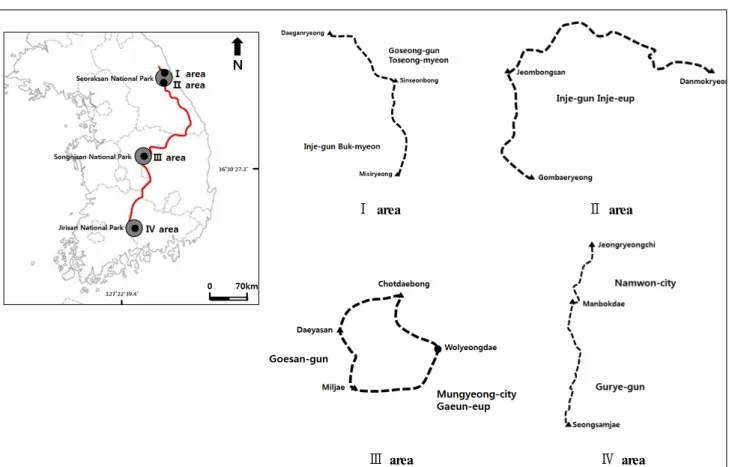
Mountains, closed ridge trails are in Mt. Seorak, Mt. Odae, Mt. Worak and Mt. Sokri National Parks. Although it is necessary to control variables such as homogeneity, length and sea level altitude of survey areas, in this study, Misiryeong ~ Daeganryeong (approx. 5.1 ㎞) section (I Section) and Danmokryeong ~ Mt. Jeombong ~ Gombaeryeong (approx. 7.0 ㎞) section (II Section) among closed trails in Mt. Seorak National Park, Wolyeongdae
~ Chotdaebong ~ Mt. Daeya ~ Miljae ~ Wolyeongdae (approx. 4.6 ㎞) section (III Section) among closed trails in Mt. Sokri National Park, and an open-trail Jeongryeongchi
~ Seongsamjae (approx. 7.0 ㎞) section (IV Section) in Mt. Jiri National Park, a control section, were selected as the investigation areas (Figure 1). Among them, a visiting appointment system needs to be adopted to the Jeongryeongchi ~ Seongsamjae section, where it was severely damaged due to an excessive number of visitors.
2. Method of Investigation and Assessment
Regarding a bird survey, it is general to observe a habitat throughout four seasons, but due to some limitations including the control of access, this study was conducted in a breeding season, when it is relatively easy to investigate birds. We have walked along each trail, which was selected as the investigation area in June 2012, and observed birds with the naked eye, binoculars and their sounds. The Ornithological Society of Korea (2009) was referred for types and scientific names of surveyed birds, and consulted Lee et al. (2014). The Cultural Heritage Adminstration (CHA) (2005) and the Ministry of Environment (MOE) (2012) were referred for the classification of legally protected species such as natural monuments designated by the CHA and endangered wild plants/animals designated by the MOE. The existing document data, Study on the Baekdudaegan's resources (KFS, 2006; 2008) and Study on the ecosystem of the Baekdudaegan protected area (MOE, 2007a; 2007b; 2008;
2010), were consulted as well for this study, for it was
Ⅰ area Ⅱ area
Ⅲ area Ⅳ area
Figure 1. Map of the study area
difficult to observe various types of birds with one-time survey in the summer breeding season. The areas included in the relevant sections were analyzed and in case of the areas that didn't coincide with those sections, the survey results of neighboring areas were referred. Total results indicate only whether or not birds live in the surveyed sections because some populations were not calculated in some document data (Table 1, 2 : +).
A measure for the grading is in accordance with Lee et al.(2004). In case of the field survey, it was possible to calculate birds populations, but as for the research on the document data, it was difficult to calculate populations because only birds' existence in the protected areas was referred. Accordingly, owing to the difficulty of the grading based on indices such as a species diversity index and an affinity index, criteria were simplified to suit with this study.
A total of four criteria, the total number of observed species;
the number of breedable common species; the number of breedable legally protected species; and the total observed number of legally protected species, that would add up to 20 points were selected as the assessment criteria (Table 3).
RESULTS AND DISCUSSION
1. Overall Survey Results of Bird Species
As the results of analysis on the existing documents and the one-time field survey conducted in June 2012 in regard to the closed trails and open trail of the national parks in the Baekdudaegan, a total of 76 bird species were found inhabit those trails. 38 species, 48 species and 35 species were identified in the Sections I, II and III, the closed sections, respectively, and 51 species were observed in the Section IV, the open section, where the largest number of different species were present (Table 1). Although the number of species found in the open section was not significantly greater than those found in the closed sections when the field survey was conducted, many more species were identified in the reference documents, driving the number of species go up in the open section. According to Cho et al. (2011), 71 species, a smaller number than this study, were found in Seodeuk Peak ~ Mt. Taebaek, and 92 species, a larger number than this study, were
5 Pernis ptilorhynchus 벌매 +
6 Accipiter soloensis 붉은배새매 + ○
7 Accipiter nisus 새매 +
8 Accipiter gentilis 참매 + ○
9 Butastur indicus 왕새매 +
10 Buteo buteo 말똥가리 +
11 Buteo hemilasius 큰말똥가리 +
12 Streptopelia orientalis 멧비둘기 + + + + ○
13 Hierococcyx hyperythrus 매사촌 + + + + ○
14 Cuculus micropterus 검은등뻐꾸기 + + + + ○
15 Cuculus canorus 뻐꾸기 + + ○
16 Cuculus saturatus 벙어리뻐꾸기 + + + + ○
17 Cuculus poliocephalus 두견이 + ○
18 Otus sunia 소쩍새 + ○
19 Strix aluco 올빼미 + ○
20 Caprimulgus indicus 쏙독새 + ○
21 Eurystomus orientalis 파랑새 + + ○
22 Halcyon coromanda 호반새 + ○
23 Dendrocopos kizuki 쇠딱다구리 + + + + ○
24 Dendrocopos leucotos 큰오색딱다구리 + + + + ○
25 Dendrocopos major 오색딱다구리 + ○
26 Picus canus 청딱다구리 + + ○
27 Oriolus chinensis 꾀꼬리 + + ○
28 Garrulus glandarius 어치 + + + + ○
29 Pica pica 까치 + + + ○
30 Nucifraga caryocatactes 잣까마귀 + ○
31 Corvus corone 까마귀 + + ○
32 Corvus macrorhynchos 큰부리까마귀 + + + + ○
33 Parus major 박새 + + + + ○
34 Parus ater 진박새 + + + + ○
35 Parus varius 곤줄박이 + + + + ○
36 Parus palustris 쇠박새 + + + + ○
37 Parus montanus 북방쇠박새 +
38 Hirundo rustica 제비 + ○
39 Aegithalos caudatus 오목눈이 + + + + ○
40 Microscelis amaurotis 직박구리 + + + + ○
41 Urosphena squameiceps 숲새 + + + + ○
42 Cettia diphone 휘파람새 + ○
43 Phylloscopus fuscatus 솔새사촌 +
No. Scientific Name Korean Name Ⅰ Ⅱ Ⅲ Ⅳ *
44 Phylloscopus inornatus 노랑눈썹솔새 + +
45 Phylloscopus borealis 솔새 + + + + ○
46 Phylloscopus tenellipes 되솔새 + + +
47 Phylloscopus coronatus 산솔새 + + + + ○
48 Paradoxornis webbianus 붉은머리오목눈이 + + ○
49 Zosterops japonicus 동박새 + ○
50 Troglodytes troglodytes 굴뚝새 + + + ○
51 Sitta europaea 동고비 + + + + ○
52 Certhia familiaris 나무발발이 + ○
53 Zoothera aurea 호랑지빠귀 + + + ○
54 Turdus hortulorum 되지빠귀 + + + + ○
55 Turdus obscurus 흰눈썹붉은배지빠귀 + ○
56 Turdus pallidus 흰배지빠귀 + + + + ○
57 Luscinia cyane 쇠유리새 + + + + ○
58 Luscinia sibilans 울새 + + + ○
59 Tarsiger cyanurus 유리딱새 +
60 Phoenicurus auroreus 딱새 + + + ○
61 Muscicapa griseisticta 제비딱새 +
62 Muscicapa sibirica 솔딱새 +
63 Ficedula zanthopygia 흰눈썹황금새 + ○
64 Ficedula mugimaki 노랑딱새 +
65 Cyanoptila cyanomelana 큰유리새 + + + + ○
66 Cinclus pallasii 물까마귀 + + + ○
67 Passer montanus 참새 + + + ○
68 Dendronanthus indicus 물레새 + ○
69 Motacilla cinerea 노랑할미새 + + + ○
70 Motacilla alba leucopsis 알락할미새 + ○
71 Anthus hodgsoni 힝둥새 +
72 Carduelis sinica 방울새 + ○
73 Carduelis spinus 검은머리방울새 +
74 Emberiza cioides 멧새 + ○
75 Emberiza chrysophrys 노랑눈썹멧새 +
76 Emberiza elegans 노랑턱멧새 + + + + ○
No. of Species 38 48 35 51 60
Ⅰ: Daeganryeong~Misiryeong, Ⅱ: Danmokryeong~Jeombongsan~Gombaeryeong,
Ⅲ: Wolyeongdae~Chotdaebong~Daeyasan~Miljae~Wolyeongdae, Ⅳ: Jeongryeongchi~Seongsamjae, * : Breeding species Table 1. Continued
found in the major ridges and valleys of the Baekdudaegan according to Kim et al. (2013). Moreover, the survey section of Mt. Bangtae, adjacent to the Baekdudaegan, in Kim et al.(2011) was shorter than this study but more species, a total of 90, were observed when including the ones found in the reference documents. It is judged that the gaps in the number of species are due to differences
in the survey scope: the results of this study are of specific closed sections whereas other surveys were conducted on the entire Baekdudaegan in each of the four seasons. In particular, a wide variety of birds were expected to live in the survey sections of this study, the closed sections that are not open to the public, but there were less of them compared to the number of those in the open section.
Valuation item Criterion
(No. of species) Score Survey areas
Ⅰ Ⅱ Ⅲ Ⅳ
Total number of species
50 < 5 5
40 < 3 3
30 < 1 1 1
Number of breeding species
Common species
50 < 5
40 < 3 3
30 < 1 1 1 1
Protected species
3 5 5 5
2 3 3
1 1 1
Number of protected species
5 5
4 4 4
3 3 3
2 2 2 2
1 1
Total score 20 7 13 5 16
Ⅰ: Daeganryeong~Misiryeong, Ⅱ: Danmokryeong~Jeombongsan~Gombaeryeong,
Ⅲ: Wolyeongdae~Chotdaebong~Daeyasan~Miljae~Wolyeongdae, Ⅳ: Jeongryeongchi~Seongsamjae Table 3. Score and criterion of grade at each survey areas
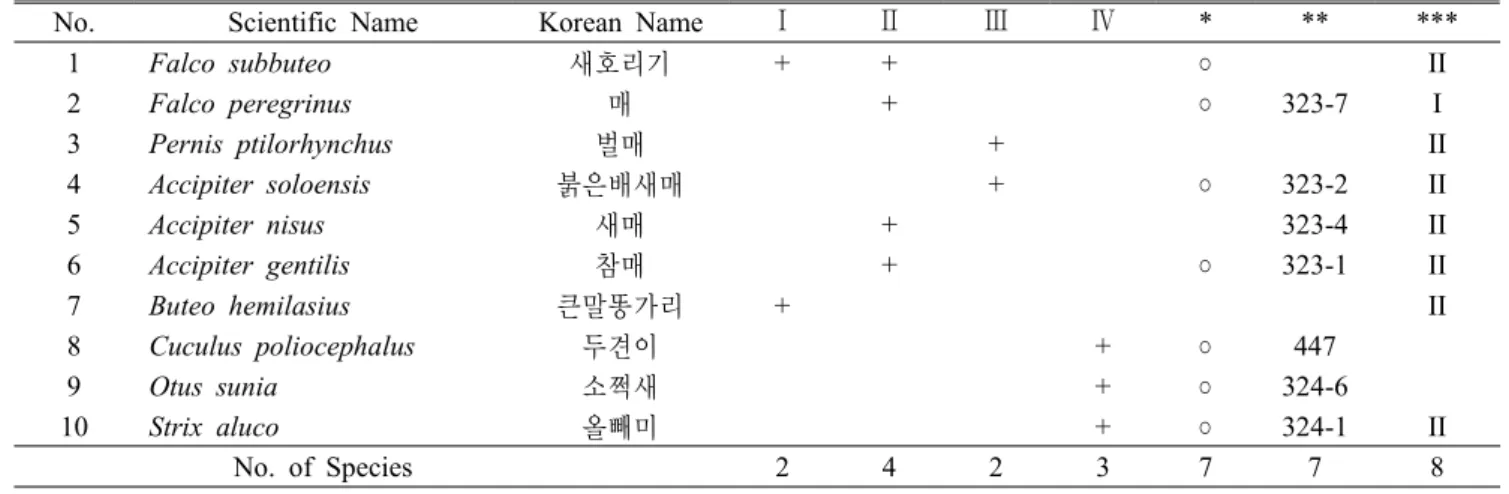
No. Scientific Name Korean Name Ⅰ Ⅱ Ⅲ Ⅳ * ** ***
1 Falco subbuteo 새호리기 + + ○ II
2 Falco peregrinus 매 + ○ 323-7 I
3 Pernis ptilorhynchus 벌매 + II
4 Accipiter soloensis 붉은배새매 + ○ 323-2 II
5 Accipiter nisus 새매 + 323-4 II
6 Accipiter gentilis 참매 + ○ 323-1 II
7 Buteo hemilasius 큰말똥가리 + II
8 Cuculus poliocephalus 두견이 + ○ 447
9 Otus sunia 소쩍새 + ○ 324-6
10 Strix aluco 올빼미 + ○ 324-1 II
No. of Species 2 4 2 3 7 7 8
Ⅰ: Daeganryeong~Misiryeong, Ⅱ: Danmokryeong~Jeombongsan~Gombaeryeong,
Ⅲ: Wolyeongdae~Chotdaebong~Daeyasan~Miljae~Wolyeongdae, Ⅳ: Jeongryeongchi~Seongsamjae, * : Breeding species, ** : Number of natural monument, *** : Grade of endangered species
Table 2. The list of protected birds observed at each survey areas use artificial structures or nests for breeding (Kim et al.,
2010). Further, birds that inhabit nationals parks or temples often obtain artificial food from people and eat food thrown away by visitors. The foregoing factors are
are designated and protected by the CHA and the MOE were observed, and seven natural monuments, one Class I and seven Class II bird species were observed (Table 2). Although there were some differences in the types of
species, the results were similar to 11 legally protected species found across the Baekdudaegan by Kim et al.(2013) and greater than eight species observed by Cho et al. (2011). On the other hand, more species, a total of 12, were observed in Mt. Bangtae, which adjoins the Baekdudaegan, because compared to the one-time survey conducted in summer for this study, a survey was conducted every season. In terms of the number of legally protected species observed in each section, two were found in the Section I; four in the Section II; two in the Section III; and three in the Section IV. Relatively more species were observed in the Section II and the open-trail Section IV, the control section (Table 3).
3. Grading and Assessment
A total of 76 different species were observed in the four survey sections as results of analysis on the field survey and document data, and 60 of them were breedable species.
10 legally protected species, natural monuments and endangered wild species, were observed. The maximum assessment points were 20: 5 points were granted when the total number of species observed was above 50; 5 points to above 50 common species; 5 points when more than three legally protected species bred; and 5 points when more than five difference legally protected species were observed.
After calculating the points of each section based on the assessment criteria, 7 points, 13 points, 5 points and 16 points were granted to Sections I, II, III and IV respectively the open-trail control section, the Section IV (Jeongryeongchi ~ Seognsamjae), scored the highest and the Section III (Wolyeongdae ~ Chotdaebong ~ Mt. Daeya ~ Miljae ~ Wolyeongdae) scored the lowest (Table 3). This is because the length of the Section III (Wolyeongdae ~ Chotdaebong ~ Mt. Daeya ~ Miljae ~ Wolyeongdae) was shorter than other sections and the trail was rugged and full of rock beds, making it less habitable for birds. Also, not so many investigations were peformed in this section in the reference documents. In addition, despite that the trail was closed, a majority of climbers went through its neighboring trail to the top. Meanwhile, in case of the open-trail Section IV (Jeongryeongchi ~ Seongsamjae), the reasons for its high points are judged to be its long length and a number of surveys carried out in the reference documents, resulting in many number of observed species.
This study is the survey results of the three closed sections and one open section at the national parks in the Baekdudaegan Mountains. It was judged that diverse bird species would inhabit the sections not open to the public but less species were observed compared to the open trail according to the results. A wide range of birds live in areas influenced by people due to the supply of food and the use of artificial structures for breeding (Kim et al., 2010).
In general, it is judged that among wild animals, mammals that use trails at night are most likely to be affected by the use of mountain trails. Not much impact is expected on birds, owing to their mobility, and on amphibians and reptiles as they have low sensitivity. This study tried to assess bird species in the closed trails but more species were observed in the open trail, also scoring higher points.
This is judged to be due to various factors including the differences in the environment, length and document data of each trail. Therefore, when it becomes necessary to open closed trails due to the excessive desire of visitors and an inevitable social demand, thorough consideration of the following few factors are judged to be required:
1) the mammals of which are greatly affected by people should be included in a survey; 2) regarding the selection of survey areas, conditions of survey areas such as vegetation environment and lengths of survey areas and equivalent sea level altitude should be considered; and 3) a sufficient number of bird species should be included through surveys conducted at each season. Through the assessment including the foregoing considerations, it is judged that opening the lowest grade section is desirable.
In addition, even with open trails, it is judged to be necessary to give consideration to nocturnal animals by adjusting the number of visitors through a booking system or prohibiting night mountaineering so that those animals can use the trails freely.
REFERENCES
Cho, H.J., S.H. Yoo, T.H. Kang, Y.U. Shin, and I.K. Kim(2011) Study of Avifauna from Seodeukbong to Taebaeksan Mountain in Baekdudaegan. Journal of Korean Nature 4(4): 309-317.
Cho, W.(2012) Deterioration Status of Closed-Trail of National Parks on the Baekdudaegan Mountains, South Korea. Korean Journal of Environment and Ecology 26(5): 827-834. (in
Korea Forest Service(KFS)(2006) Survey on the Resources Status of the Baekdudaegan. Korea Forest Service. pp. 134-151. (in Korean)
Korea Forest Service(KFS)(2007) Survey on the Resources Status of the Baekdudaegan. Korea Forest Service. pp. 157-170. (in Korean)
Korea Forest Service(KFS)(2008) Survey on the Resources Status of the Baekdudaegan. Korea Forest Service. pp. 358-403. (in Korean)
Korea Forest Service(KFS)(2009) Survey on the Resources Status of the Baekdudaegan. Korea Forest Service. pp. 289-336. (in Korean)
Korea Forest Service(KFS)(2010) Survey on the Resources Status of the Baekdudaegan. Korea Forest Service. pp. 189-207. (in Korean)
Kim, I.K., T.H. Kang, H.S. Lee, W.K. Paek and J.W. Lee(2010) The Using Rate of Breeding Birds by Artificial Nest Boxes Type at Orchard Area. Journal of Korean Nature 3(2): 117-121.
Korea Forest Service(KFS)(2011) Survey on the Resources Status of the Baekdudaegan. Korea Forest Service. pp. 64-98. (in Korean)
Kim, I.K., J.H. Kim, W.H. Hur, S.H. Kim and J.W. Lee(2011).
Avifauna of the Bangtaesan Mountain in Gangwon-do, Korea.
Journal of Korean Nature 4(4): 219-228.
Korea Forest Service(KFS)(2012) Survey on the Resources Status of the Baekdudaegan(Appendix). Korea Forest Service. pp.
25-61. (in Korean)
ing of the mudflat by birds. Journal of Korean Wetlands Society 6(1):105-115. (in Korean with English abstract)
Ministry of Environment(MOE)(2007a) Survey on the Ecosystem of the Baekdudaegan. Ministry of Environment (Hyeongjebong- Deogyusan). 558pp. (in Korean)
Ministry of Environment(MOE)(2007b) Survey on the Ecosystem of the Baekdudaegan. Ministry of Environment (Yuksimnyeong- Jirisan). 1095pp. (in Korean)
Ministry of Environment(MOE)(2008) Survey on the Ecosystem of the Baekdudaegan. Ministry of Environment (Daetjae- Hyeongjebong). 503pp. (in Korean)
Ministry of Environment(MOE)(2010) Survey on the Ecosystem of the Baekdudaegan. Ministry of Environment (Hyangrobong- Seoraksan). 450pp. (in Korean)
Ministry of Environment(MOE)(2012) Announcement of Ministry of Environment, 457. (in Korean)
Paek, W.K., H.S. Lee, I.K. Kim, S.W. Han, S.W. Lee, M.J. Song, J.W. Lee(2003) Study of Avifauna and Habitat Preference and Management from Manbokdae to Siribong in Baekdudaegan.
Korean Journal of Environment and Ecology 16(4): 409-420.
(in Korean with English abstract)
Shin Y.U., H.J Cho, T.H Kang, I.K. Kim, H.S Oh, S.W. Lee(2011) Distribution of Birds and Grading Assessment of the Tidal Flat at Gangjin bay in Jeollanamdo, Korea. The Korean Journal of Ornithology 18(3): 213-225. (in Korean with English abstract) The Ornithological Society of Korea(2009) Checklist of the birds of
Korea. Hanlimwon. 133pp.