공주시 노인의 주관적 건강 지식과 환경 노출 저감 행동의 관련성
서명순 · 김경희*
,** · 최재욱*
,**
†고려대학교 의과대학 보건학협동과정, *고려대학교 의과대학 예방의학교실,
**고려대학교 환경의학연구소
The Relationship between Subjective Health Knowledge and Environmental Exposure Reduction Behavior among the Elderly in Gongju City
Myung-Soon Seo, Kyung-Hee Kim*
,**, and Jae-Wook Choi*
,**
†Department of Public Health, College of Medicine, Korea University
*Department of Preventive Medicine, College of Medicine, Korea University
**Institute for Occupational and Environmental Health, Korea University
ABSTRACT
Objectives: In this study, the extent of environmental exposure reduction behavior among the elderly living in Gongju City was identified according to demographic and sociological characteristics of individual health behavior and environmental factors. In addition, the relationship between subjective health knowledge and environmental exposure reduction behavior among the elderly was investigated.
Methods: Demographic and sociological factors, subjective health status, environmental factors, and environmental exposure reduction behavior were investigated among 120 elderly people in Gongju City.
Through multiple regression analysis, variables with significant relationships with environmental exposure reduction behavior were identified (SPSS ver. 22, IBM, Armonk, NY, USA). The survey (IRB-2018-0096) was conducted over about two weeks (from Dec. 3 to 14, 2018).
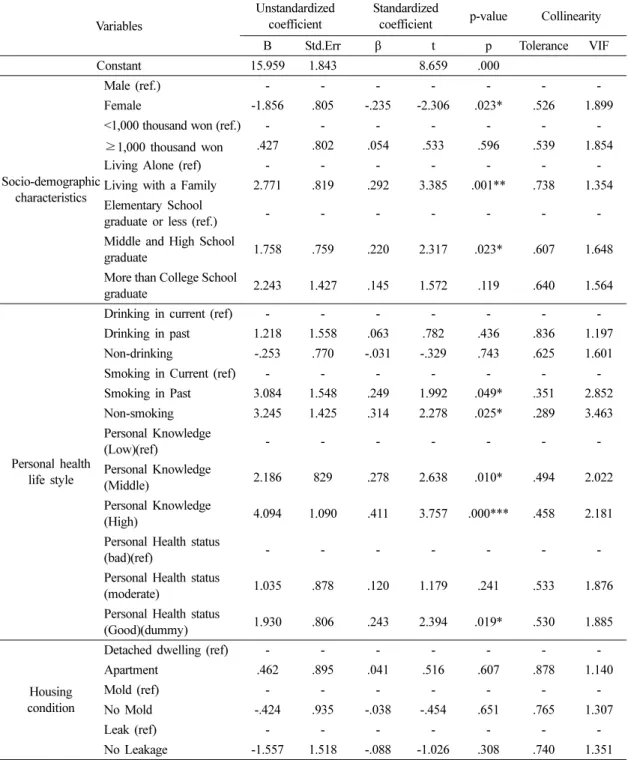
Results: The extent of practicing environmental exposure reduction behavior by the elderly in Gongju City was high in terms of cleaning, ventilation when cooking food, periodic outdoor activities, and ventilation when smoking. Significant variables were gender, past smoking and current non-smoking, subjective health knowledge, and subjective health status. The most influential variable was subjective health knowledge (β= .411).
Conclusion: There was a significant relationship between the level of subjective health knowledge and the level of objective education for health behavior related to the reduction of environmental exposure among the elderly.
Key words: Community health, elderly, environmental exposure reduction behavior, subjective health knowledge
I. 서 론
2019 년 행정안전부(Ministry of the Interior and Safety, MOIS)에서는 우리나라의 65세 이상 노인 인 구는 802만 6,915명이며 이 추세가 지속되면 2025
년 우리나라의 노인 인구가 1,000만명을 넘어서고 노인 비율이 20%를 넘는 초고령화 시대가 도래할 것으로 예측하였다.
1)평균수명의 증가 등으로 인해 노인 인구가 증가하면서 노년층의 건강 정책에 대 한 수요가 높아지고 있다. 과거 노년기 삶의 질은
†
Corresponding author: Department of Preventive Medicine, College of Medicine, Korea University, 73, Koryeodae-ro, Seongbuk-gu, Seoul 02841, Korea, Tel: +82-2-2286-1407, Fax: +82-02-920-6442, E-mail: [email protected] Received: 18 September 2020, Revised: 16 November 2020, Accepted: 17 November 2020
원 저 Original articles